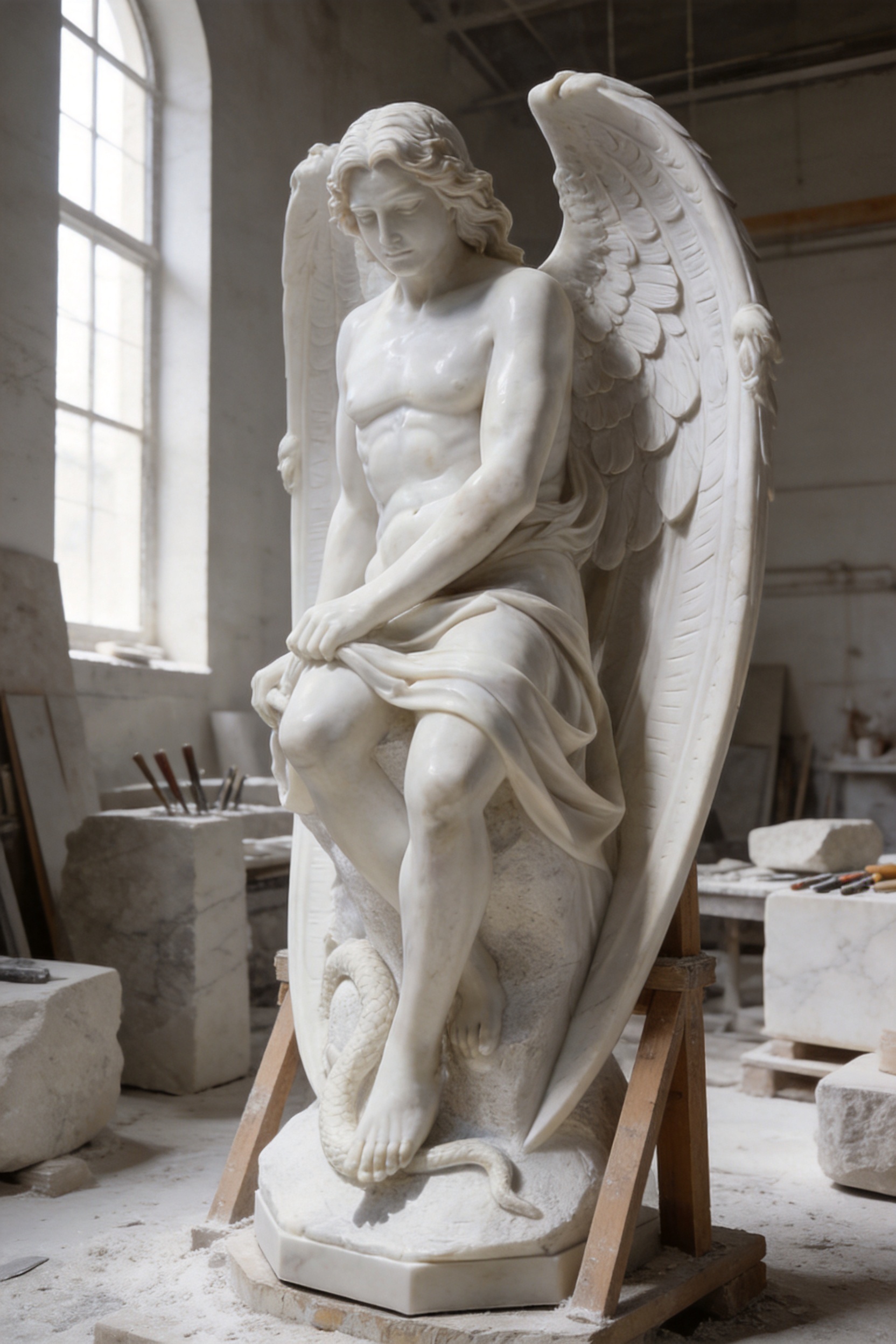
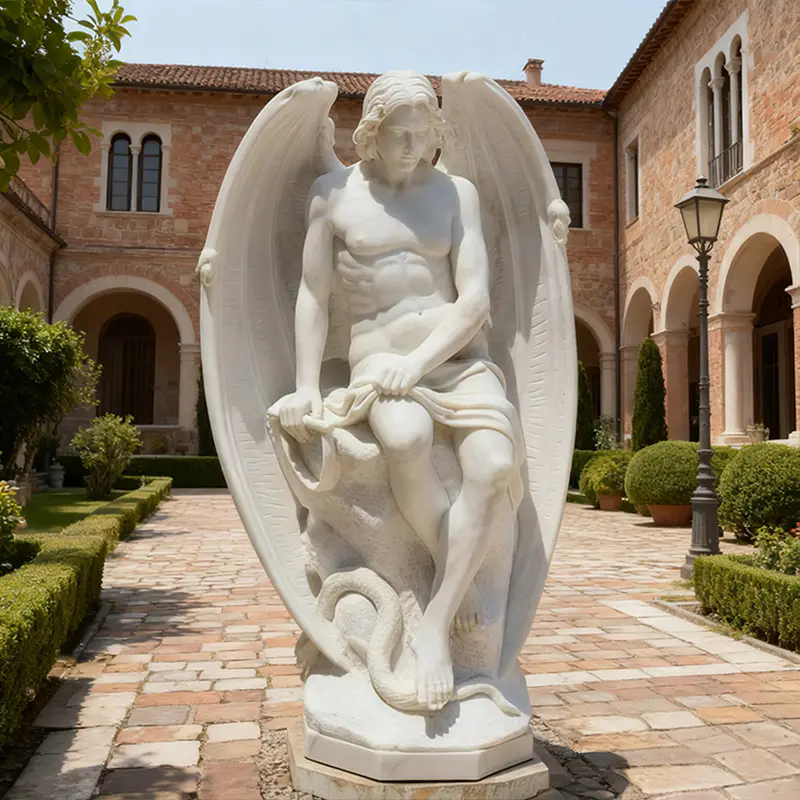
Among the many forms of architectural art available to collectors, property developers, hospitality designers, and private estate owners, marble human sculpture continues to possess an unusual sense of permanence. It combines the physical strength of natural stone with the emotional and symbolic language of the human figure. The Christian Religious Marble Human Sculpture: Autumn Lucifer Angel Statue presents this tradition through a dramatic composition featuring an angelic figure, broad outstretched wings, a muscular body, and a coiled serpent at the feet. Rather than functioning as a simple decorative object, the sculpture creates an atmosphere of reflection, tension, nobility, and timeless beauty.
Carved in white marble, the statue is designed to become a visual focal point in a manor, courtyard, private garden, gallery, hotel, or other architectural setting where classical character is important. The clean tone of the stone reflects natural and artificial light, allowing the wings, anatomy, drapery, and serpent form to remain visually legible throughout the day. Its vertical presence also gives it a strong architectural role: it can establish a central axis in a garden, reinforce the symmetry of a corridor, or provide a commanding sculptural accent in a reception space.
The sculpture is available in customized heights from approximately 100 to 180 centimeters, with a base width of about 50 to 80 centimeters. The listed price range is US$3,124.36 to US$7,541.36, depending on size, marble selection, craftsmanship, surface treatment, and customization requirements. These options allow buyers to commission a proportion suitable for a residential interior, a formal garden, a commercial property, or a larger architectural installation.
Content
The figure is built around contrast. The angel’s open wings suggest elevation, protection, movement, and spiritual aspiration, while the serpent introduces a darker and more mysterious note. This relationship between upward motion and grounded tension gives the sculpture visual depth. The composition can be interpreted through several artistic traditions, including Christian symbolism, European mythological imagery, Romantic-era drama, and the broader history of allegorical sculpture.
The use of the name “Lucifer” creates an intentionally complex emotional response. In religious and cultural history, Lucifer may be associated with light, pride, rebellion, transformation, fall, or the tension between divine aspiration and earthly limitation. The sculpture does not need to communicate only one interpretation. Its value lies partly in its capacity to encourage viewers to consider opposing ideas at the same time. The figure can appear powerful and vulnerable, beautiful and unsettling, elevated and bound to the earth.
The word “Autumn” further enriches the concept. Autumn is often associated with maturity, change, decline, harvest, memory, and the passage of time. When paired with an angelic figure, it can evoke a moment after triumph, a pause before transformation, or the quiet gravity that comes with experience. This gives the work an emotional character that differs from a purely celebratory winged figure. It is more contemplative, more theatrical, and more suitable for environments that seek atmosphere as well as ornament.
The serpent at the feet provides a powerful compositional anchor. It directs the eye downward after the viewer has followed the wings and torso upward. This movement creates a complete visual circuit from ground to figure and back to ground. It also prevents the sculpture from appearing weightless or overly decorative. The serpent introduces a sense of narrative, allowing the statue to function as an allegorical work rather than merely a study of anatomy.
White marble has been associated with monumental sculpture for centuries because of its visual clarity, strength, and ability to receive refined detail. Its restrained color does not compete with the surrounding environment. Instead, it reflects the tones of nearby stone, greenery, water, wood, metal, and architectural surfaces. In a formal interior, white marble reinforces a sense of order and luxury. In a garden, it contrasts naturally with foliage, soil, gravel, and seasonal flowers.
For a winged human sculpture, marble is especially effective because it supports both broad structural forms and delicate transitions. The wings can be developed as large planes with layered feather details. Muscular areas can be modeled through subtle changes in surface curvature. Facial features, hands, hair, and the serpent can be finished with controlled transitions between light and shadow. The result is a sculpture that can look powerful from a distance while rewarding closer inspection.
Natural marble also possesses a visual depth that manufactured materials often struggle to reproduce. Even when the stone appears predominantly white, its crystalline structure and soft tonal variations can produce a warm, refined appearance. Light moves across the surface differently in the morning, afternoon, evening, and under artificial illumination. This changing relationship with light helps the statue remain visually active instead of appearing flat or static.
Compared with painted fiberglass, marble generally offers a more authentic mineral presence and a greater sense of permanence. Compared with ordinary cast concrete, carefully selected marble can provide cleaner detail, a more elegant surface, and a higher-end appearance. Compared with thin metal sheet construction, solid stone gives the figure visual mass and a stronger connection to classical sculpture. These material advantages are particularly important for buyers seeking an heirloom-quality centerpiece rather than a short-term decorative product.
Christian Religious Marble Human Sculpture: Autumn Lucifer Angel Statue
The outstretched wings are among the statue’s most important design features. They increase the apparent width and visual authority of the figure while creating a sense of movement. A winged sculpture can easily become visually unbalanced if the wings are treated as simple symmetrical extensions. In this composition, the wings work together with the torso and legs to establish a stable vertical rhythm.
For installation planning, the wing span should be considered in addition to the stated base width. The height range of 100 to 180 centimeters provides flexibility, but the final spatial requirement will depend on the exact wing projection and the preferred viewing distance. In a narrow corridor, a more compact version may be appropriate. In a garden court or grand entrance, a larger interpretation can provide the scale needed to hold attention.
The muscular body gives the statue a sense of physical strength. This is important because the wings and religious associations could otherwise make the figure seem purely ethereal. The anatomical emphasis connects the work to the tradition of heroic European sculpture, in which the human body represents courage, ambition, resistance, and the burden of moral choice.
Strong anatomical modeling also improves the sculpture’s performance under changing light. Curved muscle groups create gradual shadow transitions, while sharper ridges around the shoulders, chest, arms, and legs produce visual definition. In an outdoor setting, sunlight can emphasize the relief of the body. In an interior, directional spotlights can be positioned to increase the theatrical effect without requiring excessive color or ornament.
The coiled serpent creates a counterpoint to the figure’s upward energy. Its compact, grounded shape helps stabilize the composition at the base. Symbolically, the serpent may suggest temptation, knowledge, danger, transformation, mortality, or the cyclical nature of existence. Because the meaning is open to interpretation, the sculpture can suit both religiously informed environments and secular spaces that appreciate dramatic classical imagery.
From a design perspective, the serpent also adds a smaller-scale detail that encourages viewers to approach the sculpture. At a distance, the overall silhouette dominates. At close range, the viewer can examine the relationship between the feet, serpent, pedestal, and lower folds of the composition. This combination of large-scale impact and close-range detail is one of the statue’s important artistic strengths.
The white marble surface gives the statue a calm and dignified appearance even though the subject contains dramatic tension. This balance makes it easier to integrate into established architectural styles. The piece can complement neoclassical buildings, European-style villas, traditional estates, luxury hotel interiors, museum-like halls, formal gardens, and contemporary spaces that use classical objects as contrast.
Unlike brightly colored decorative products, the sculpture does not depend on a particular interior color palette. It can work against cream walls, dark wood, gray stone, muted green landscapes, black architectural backgrounds, or warm gold lighting. This adaptability gives purchasers greater freedom when changing furniture, landscaping, or interior finishes in the future.
Buyers comparing sculpture suppliers often evaluate not only the design but also the material’s performance, visual credibility, maintenance needs, and long-term value. The Autumn Lucifer Angel Statue has several advantages when compared with commonly available alternatives, although each material has a place in the broader sculpture market.
| Comparison Factor | White Marble | Fiberglass or Resin | Common Cast Concrete | Metal Construction |
|---|---|---|---|---|
| Visual character | Natural mineral depth and classical elegance | Can imitate stone but may appear manufactured | Solid appearance with a more industrial surface | Strong modern or industrial character |
| Detail potential | Excellent for controlled carving and refined transitions | Good for molded repetition and painted finishes | Moderate, depending on mix and mold quality | Strong for fabricated forms but different from carved anatomy |
| Material presence | Substantial, prestigious, and traditionally monumental | Lightweight and easier to move | Heavy and durable but less refined | Varies according to thickness and construction |
| Color stability | Natural white tone without dependence on paint | Usually requires a coating or pigment system | May weather or discolor over time | May require protective finishing against oxidation |
| Stylistic suitability | Classical, religious, formal, and luxury settings | Temporary displays, events, and budget installations | Public landscapes and architectural applications | Contemporary, industrial, and modern environments |
| Long-term impression | Suitable for heirloom and landmark applications | Often selected for convenience and lower initial cost | Practical and robust, with less refined prestige | Highly dependent on fabrication and finish quality |
One major advantage of marble is its ability to communicate authenticity. A buyer commissioning a religious or allegorical human sculpture may want the work to feel connected to the history of European stone carving. Marble immediately establishes that connection. Its weight, texture, and surface response provide a physical experience that lightweight substitutes cannot fully duplicate.
Marble is also advantageous for projects where visual aging is part of the desired character. While outdoor stone requires appropriate site planning and maintenance, a naturally weathered marble surface can develop a dignified patina. By contrast, a damaged painted coating on fiberglass or metal may look more visibly degraded because the surface layer has failed. The choice should always consider climate, pollution, water exposure, freeze-thaw conditions, and installation details, but marble remains a compelling option for carefully managed environments.
Jiangsu Xinyesheng Sculpture Co., Ltd. is presented as the manufacturer and supplier of this custom sculpture. Its product range includes bronze sculptures, stainless steel sculptures, marble sculptures, fiberglass sculptures, and weathering steel sculptures. This broad material capability is significant because it suggests experience with different production methods, surface expectations, installation requirements, and design languages.
A manufacturer working across multiple sculpture materials can compare the behavior of stone, metal, composite, and steel during the design stage. This is valuable for customers who are unsure whether their concept should be carved, cast, fabricated, or molded. Although the present statue is specified as a marble human sculpture, the company’s wider material range can support related commissions, matching artworks, architectural accents, and coordinated site installations.
Custom sculpture manufacturing begins before material processing. The maker must understand the intended subject, proportions, emotional tone, location, viewing distance, and budget. For the Autumn Lucifer Angel Statue, the central design questions include the exact pose, wing spread, body proportions, serpent placement, pedestal relationship, and level of surface detail.
These decisions can be adapted for different projects. A private collector may request a more intimate height and a restrained base. A hotel or estate may require a larger version with greater visual authority. A garden designer may prefer a composition that reads clearly from a long approach path. A religious or cultural institution may ask for modifications to the expression, symbolism, or surrounding inscription. Custom development allows the sculpture to respond to the architecture rather than being treated as an isolated catalog object.
Modern sculpture production can combine digital planning with traditional craftsmanship. A digital model may help confirm dimensions, proportions, wing clearance, base stability, and the relationship between the figure and the installation site. It can also make it easier to discuss revisions with an international customer before the stone is processed.
Digital planning does not replace the importance of skilled finishing. Marble remains a material that must be understood through its grain, density, inclusions, fracture behavior, and response to tools. Experienced artisans use a sequence of rough removal, form development, detail refinement, smoothing, and polishing or honing. The transition from a digital or drawn concept to a convincing stone surface requires judgment at every stage.
For a white marble sculpture, material selection is directly connected to the final appearance. The manufacturer and buyer should discuss the preferred degree of whiteness, natural veining, crystalline texture, and acceptable variation. Some clients prefer a nearly uniform white surface, while others appreciate subtle gray or warm veining that makes the stone feel more natural.
Inspection should consider structural areas such as the wings, arms, ankles, lower body, serpent, and points where narrow forms connect to the main mass. These areas require careful planning because dramatic sculpture often includes projecting elements. Proper carving strategy, internal support where appropriate, packaging protection, and transport planning help reduce risk during production and delivery.
Surface refinement is essential to the statue’s visual quality. A high polish can create strong highlights across the body and wings, while a honed finish can provide a softer, more understated appearance. Selected areas may be finished differently to strengthen the contrast between skin, hair, wings, serpent scales, and architectural base elements.
The best surface treatment depends on location. In an interior, a refined polish may emphasize elegance and reflect ambient lighting. In a garden, a softer finish may reduce glare and make the sculpture feel more naturally integrated with stone paths, planting, and water features. A professional supplier should be able to explain how the selected finish will behave under the project’s lighting and environmental conditions.
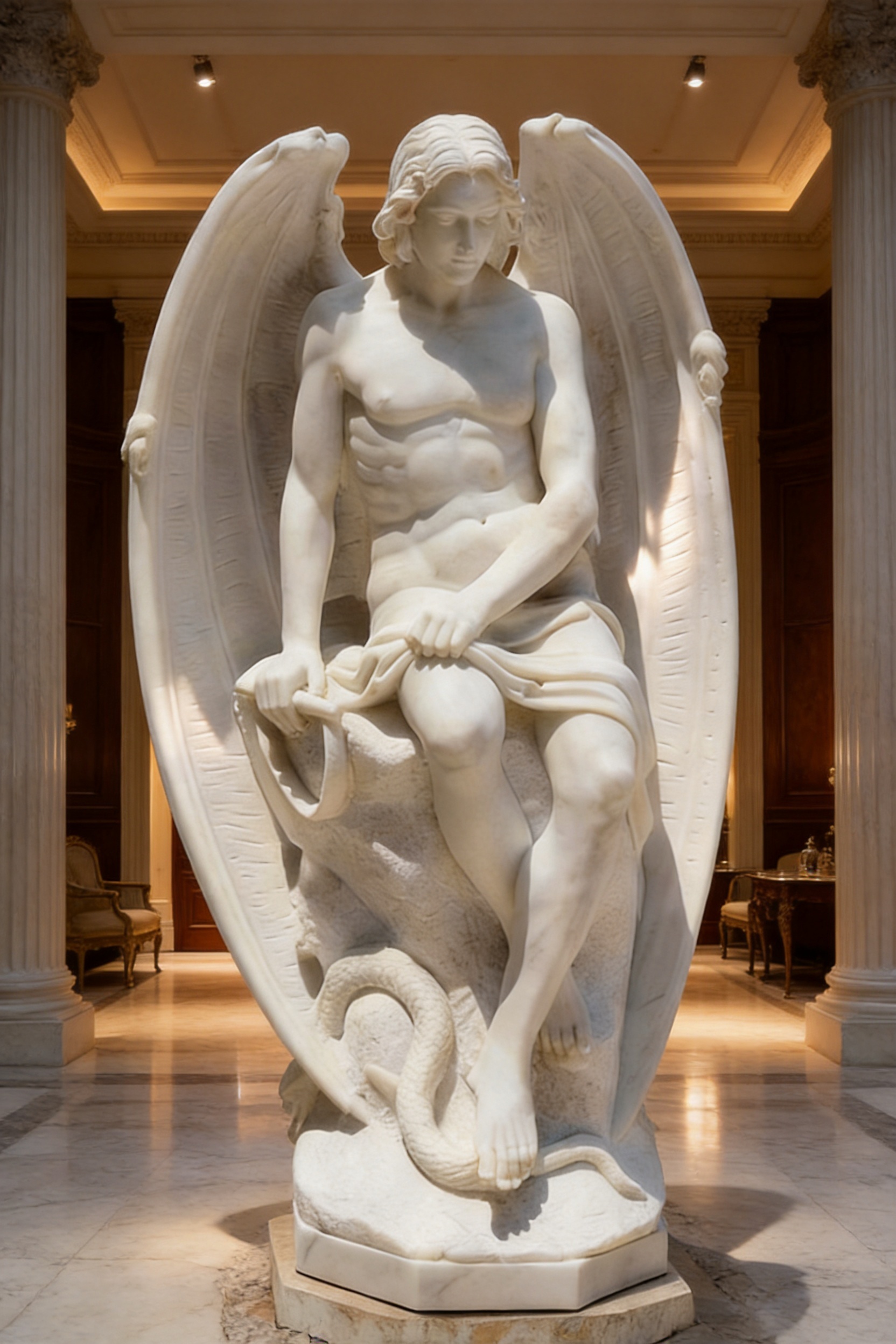
Inside a manor, the sculpture can occupy a central hall, staircase landing, library, gallery corridor, formal sitting room, or entrance vestibule. Its vertical presence works particularly well where there is sufficient ceiling height and a clear sightline. A wall with subdued color or textured plaster can provide a calm background, allowing the white figure to remain the primary visual focus.
Lighting should be planned with care. A combination of overhead and side lighting can reveal the wings and anatomy without creating harsh shadows on the face. Warm white lighting often complements marble’s natural warmth, while cooler lighting may create a more austere and dramatic atmosphere. The statue should not be crowded by too many competing objects. Its impact is strongest when the surrounding furniture and artwork support rather than obscure the central composition.
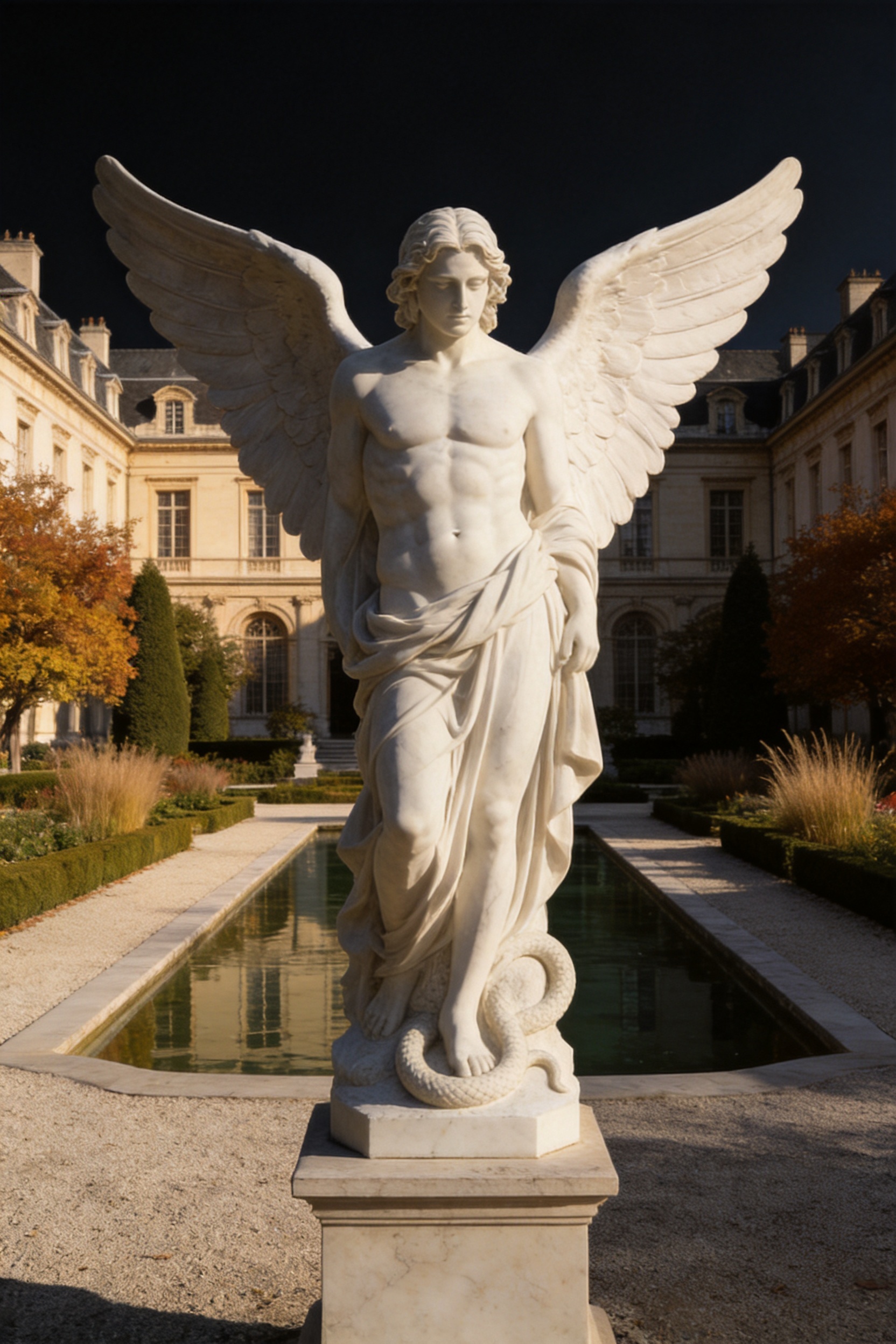
In a courtyard or formal garden, the sculpture can act as an anchor at the end of a path, within a circular planting arrangement, beside a reflecting pool, or along a symmetrical axis. The white marble contrasts with green hedges, dark soil, clipped shrubs, and gray paving. Seasonal changes can further strengthen the “Autumn” theme, especially when the surrounding landscape includes amber grasses, red foliage, or muted flowering plants.
Outdoor placement requires practical planning. The foundation must support the weight of the sculpture and resist settlement. Drainage should prevent standing water around the base. The installation team should confirm access routes, lifting equipment, anchoring requirements, and protection from accidental impact. In regions with severe weather, the project designer should also consider wind exposure, freezing conditions, salt, pollution, and biological growth.
Hotels, resorts, private clubs, and high-end restaurants often use sculpture to establish identity and create memorable arrival experiences. A winged marble figure can serve as a signature object in a lobby, courtyard, reception area, or VIP lounge. It can communicate luxury without relying on excessive decoration and can provide guests with a strong visual reference point.
For hospitality projects, durability and cleaning procedures are especially important. High-traffic locations should provide adequate clearance so guests do not repeatedly touch or bump projecting elements. The base should be stable and proportionate. Maintenance personnel should receive instructions regarding suitable cleaning materials, water exposure, stain prevention, and the avoidance of abrasive chemicals that could alter the finish.
The sculpture’s religious and allegorical character may make it appropriate for museums, cultural centers, theological settings, private chapels, heritage properties, and educational exhibitions focused on European art. Because Lucifer is a complex figure in Christian and literary traditions, curators may choose to present the work alongside interpretive text discussing symbolism, artistic history, and the evolution of angelic imagery.
In such settings, context is important. The work can encourage discussion about the relationship between beauty and morality, the meaning of rebellion, the symbolism of serpents, and the use of the human body in religious art. Its value is not limited to visual decoration; it can also support cultural interpretation and public engagement.
The listed height range of 100 to 180 centimeters provides a practical starting point for customization. A 100-centimeter version can suit a private interior, a boutique display, or a smaller garden. A version closer to 180 centimeters can establish a stronger landmark presence in a large hall, formal courtyard, or commercial entrance. The correct size should be judged by the room volume, viewing distance, ceiling height, and surrounding architecture.
The base width of approximately 50 to 80 centimeters can also be adjusted according to stability and proportion. A wider base may be suitable for a freestanding outdoor installation or a version with a more elaborate pedestal. A narrower base may be preferred in a corridor or compact interior. Buyers should confirm whether the quoted dimensions refer only to the sculptural body or include the complete pedestal and any additional support structure.
Possible customization areas include facial expression, hair treatment, wing spread, serpent detail, body proportions, pedestal design, surface finish, marble tone, inscription, and overall scale. Customers may also request a companion sculpture, a matching relief panel, or a coordinated set of classical figures. Any modification should be reviewed for its effect on structural balance, transport, installation, and final cost.
For a large architectural commission, it is advisable to prepare a site drawing showing the sculpture’s footprint, total height, wing projection, pedestrian clearance, lighting positions, and maintenance access. This prevents the common problem of selecting an attractive sculpture that is not properly scaled for its destination.
Quality control for a marble human sculpture should cover appearance, dimensions, structural integrity, surface treatment, and packaging. Before shipment, the buyer may request photographs or videos showing the front, rear, side profiles, wings, base, face, serpent, and any areas with natural stone variation. Such documentation helps confirm that the finished work corresponds with the approved concept.
Packaging is especially important because marble is heavy and can be vulnerable at projecting or narrow points. A responsible export process should use protective materials that prevent movement, abrasion, impact, and moisture-related packaging problems. The crate should be designed for the actual weight and geometry of the statue. Labels and handling instructions should clearly communicate the center of gravity and lifting requirements when appropriate.
International customers should confirm shipping terms, insurance coverage, customs responsibilities, unloading arrangements, and local installation requirements before placing an order. A sculpture of this type may require a professional rigging team, lifting equipment, a prepared foundation, or specialist positioning. These services may be arranged separately from manufacturing, so they should be included in the project schedule from the beginning.
Although the available product information provides a price range, the final quotation may change according to size, marble grade, design revisions, finish, packaging, shipping distance, insurance, and installation. A detailed quotation should identify what is included and should distinguish between the sculpture, pedestal, transport, customs, and site work.
White marble is durable, but no natural stone is entirely maintenance-free. Indoor sculptures can usually be maintained with a soft cloth, clean water, and a mild stone-safe cleaning method. Dust should be removed regularly so that particles do not accumulate in feather details, folds, or the serpent’s coils. Abrasive powders, acidic cleaners, harsh solvents, and unapproved sealers should be avoided.
Outdoor maintenance depends on the local climate. Rain, airborne pollution, dust, algae, mineral deposits, and bird activity may affect the surface. Regular visual inspection can identify changes before they become serious. Water should not be allowed to collect around the base. Plant growth should be kept away from joints and drainage areas. Where freezing conditions occur, the installation should be designed to limit water penetration and prevent pressure from ice expansion.
Professional stone conservation may be appropriate for valuable or historically important installations. Conservators can evaluate discoloration, biological growth, stains, minor damage, and surface changes without applying treatments that compromise the material. The manufacturer’s care guidance should be retained with the project documentation.
Jiangsu Xinyesheng Sculpture Co., Ltd. offers a product portfolio that includes marble, bronze, stainless steel, fiberglass, and weathering steel sculpture. This range can benefit buyers who are developing an entire property rather than purchasing a single object. A client may select marble for a classical figure, bronze for a garden companion, stainless steel for a contemporary entrance, fiberglass for a temporary display, or weathering steel for a landscape feature.
A multi-material supplier can help maintain consistent design standards across different production methods. Proportion, pedestal height, finish quality, packaging expectations, and installation coordination can be discussed through one manufacturing relationship. This may simplify communication for architects, landscape designers, art consultants, developers, and procurement teams.
The company’s listed contact information includes telephone numbers and an email address for project inquiries. Buyers should use direct communication to confirm current availability, exact specifications, production schedules, customization feasibility, payment terms, and export arrangements. Since sculpture projects can vary substantially from one order to another, written confirmation is important at every stage.
Before requesting a quotation, buyers should prepare as much project information as possible. Useful details include the intended location, indoor or outdoor use, desired height, maximum available footprint, preferred marble appearance, target delivery date, required finish, and whether a pedestal is needed. A simple photograph or drawing of the proposed site can help the manufacturer understand scale and context.
It is also useful to establish the artistic objective. Some buyers may want the statue to look serene and contemplative, while others may prefer a more dramatic and powerful interpretation. The desired emotional tone can influence facial expression, muscle definition, wing position, surface finish, and lighting recommendations.
Buyers should ask whether a pre-production drawing, three-dimensional rendering, sample finish, or approval image is available. For a customized sculpture, the approval stage helps prevent misunderstandings about proportions and iconographic details. It is better to resolve such questions before carving begins rather than after the stone has been substantially processed.
When comparing suppliers, price should be considered together with material grade, craftsmanship, structural planning, finishing standards, packaging quality, communication, and after-sales support. A lower initial price may not represent better value if the sculpture requires extensive correction, arrives damaged, or lacks suitable documentation. The Autumn Lucifer Angel Statue is positioned as a premium classical artwork, so buyers should evaluate it as a long-term architectural investment rather than as a simple decorative commodity.
The statue is made from white marble. The material gives the sculpture a classical appearance, natural mineral depth, and a substantial presence suitable for refined interiors, courtyards, formal gardens, and architectural settings.
The design depicts a winged human figure identified as an autumn Lucifer angel. It includes outstretched wings, a muscular body, and a coiled serpent at the feet. The composition combines Christian, allegorical, and classical visual references.
The stated size range is approximately 100 to 180 centimeters in height, with a base width of about 50 to 80 centimeters. Exact dimensions can be discussed according to the intended installation site and the customer’s requirements.
The listed price range is US$3,124.36 to US$7,541.36. The final price may depend on size, marble selection, customization, surface treatment, pedestal requirements, packaging, shipping, and other project conditions.
Yes, it can be considered for a courtyard, garden, or other outdoor environment, provided that the foundation, drainage, access, weather exposure, and maintenance requirements are properly addressed. Buyers should confirm the recommended finish and installation method for their climate.
Yes. It can be placed in a manor corridor, entrance hall, library, gallery, staircase landing, reception area, hotel lobby, or other interior with adequate space and ceiling height. Indoor lighting can be used to emphasize the wings, anatomy, and facial expression.
The product is suitable for custom development in areas such as height, proportions, wing spread, pedestal design, surface finish, marble tone, and selected details. Customers should confirm the exact scope of customization with the manufacturer before production.
Routine cleaning should use a soft cloth, clean water, and a mild stone-safe method. Abrasive products, acidic cleaners, harsh solvents, and unapproved chemicals should be avoided. Outdoor pieces may require additional inspection for biological growth, pollution, and mineral deposits.
Buyers should compare the authenticity and grade of the marble, anatomical quality, wing and serpent detailing, surface refinement, structural planning, size accuracy, packaging, delivery arrangements, customization support, and after-sales communication. Price alone does not fully indicate the value of a handcrafted stone sculpture.
Marble has a long association with religious, mythological, and classical sculpture. Its white color can suggest purity, monumentality, and timelessness, while its natural weight and texture give the figure a sense of permanence and seriousness.
Customers should provide the desired height, location, indoor or outdoor use, approximate footprint, preferred finish, delivery destination, required date, pedestal preference, and any requested design changes. Site photographs or drawings are also helpful.
The Autumn Lucifer Angel Statue is a visually commanding marble sculpture that brings together classical anatomy, religious symbolism, allegorical tension, and architectural presence. Its outstretched wings create an expansive silhouette, the muscular body provides strength and human drama, and the serpent introduces a grounded narrative counterpoint. The white marble surface allows the work to remain elegant across a wide range of interior and landscape environments.
Its advantages over many competing materials include the authenticity of natural stone, the prestige of classical marble, the ability to retain refined detail, and the long-term visual presence associated with monumental sculpture. The available height range makes it adaptable to both intimate and expansive settings, while customization can help align the sculpture with a specific architectural vision.
Supported by a manufacturer with experience in marble, bronze, stainless steel, fiberglass, and weathering steel sculpture, the product can form part of a broader art and design program. For collectors, architects, landscape designers, hospitality developers, and property owners, it offers more than a decorative object. It can become a symbolic center, a conversation piece, and a lasting expression of classical taste within a contemporary project.
Alberti, Leon Battista. On the Art of Building in Ten Books.
Boardman, John. Greek Sculpture: The Classical Period.
Honour, Hugh, and John Fleming. A World History of Art.
Janson, H. W., and Anthony F. Janson. History of Art.
National Association of Decorative and Fine Arts Professionals. General Principles of Sculpture Display and Conservation.
Rogers, Elizabeth Barlow. Landscape Design: A Cultural and Architectural History.
General technical principles of natural marble selection, stone carving, surface finishing, packaging, and architectural installation.



Daniel H.

Amanda R.

Robert B.

Jennifer S.

James W.

Barry G.

Michael T.

Emily K.

David L.

Sarah M.


Mikey XV

Jagxue

 English
 Español
 عربى
 Français
 italiano
 Deutsch