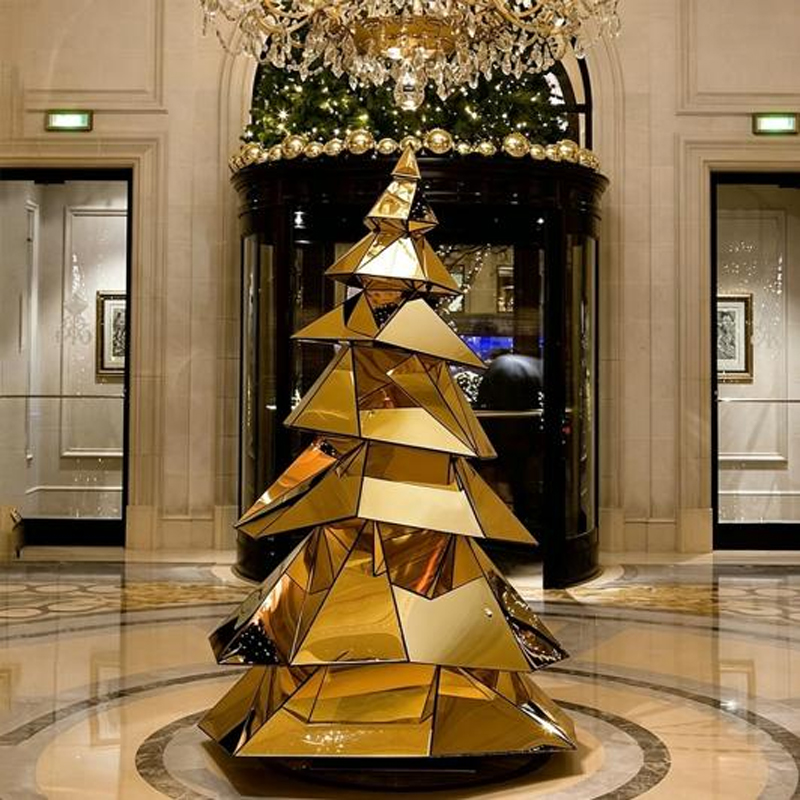
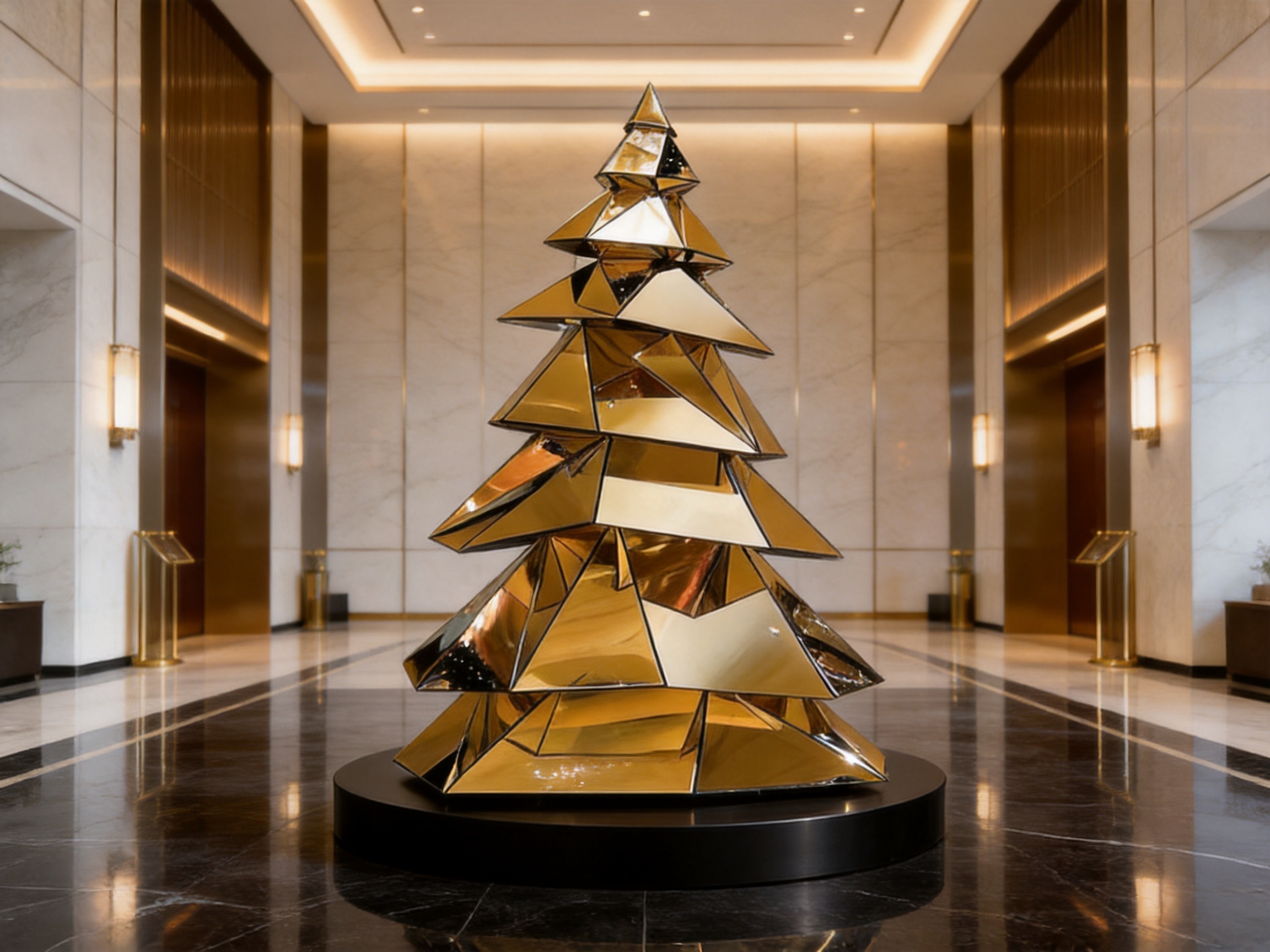
The Faceted Titanium-Gold Christmas Tree Sculpture combines architectural geometry, reflective metalwork, and seasonal symbolism in a single reusable artwork. Instead of relying on disposable decorations, fabric ornaments, painted panels, or conventional artificial foliage, this sculpture creates a clear Christmas tree silhouette from graduated polygonal mirror panels. Each angular panel is produced from stainless steel, finished with a titanium-gold vacuum-plated surface, and assembled over a round black base. The result is a contemporary festive installation with the visual authority of a permanent sculpture and the celebratory character of a holiday centerpiece.
Available in heights from approximately 1.2 meters to 4 meters, the sculpture can serve many commercial environments. A smaller version can anchor a reception desk, luxury retail display, private club entrance, or boutique hotel lounge. A larger version can become the focal point of a five-star hotel lobby, shopping mall atrium, corporate reception area, casino, restaurant, or event venue. Several sizes may also be grouped to create a coordinated forest of glittering trees, allowing designers to build a more expansive seasonal composition without depending on one oversized structure.
The sculpture is manufactured by Jiangsu Xinyesheng Sculpture Co., Ltd., a China-based metal sculpture manufacturer located in Jiangyin, Jiangsu Province. The supplied product information identifies the company as a producer of custom metal statues and European-style sculpture, with experience relevant to stainless steel fabrication, decorative finishing, and made-to-order art production. Its product category includes bronze, stainless steel, marble, fiberglass, and weathering steel sculptures, indicating a broad material base and the ability to address different aesthetic and architectural requirements.
What distinguishes this product is not simply its golden color. Its competitive strength comes from the relationship among material selection, geometric construction, surface treatment, scale flexibility, and long-term commercial usability. The faceted construction gives the sculpture a lively appearance under changing light, while the stainless-steel body offers a stronger foundation than temporary seasonal materials. The titanium-gold coating provides visual richness without the maintenance burden associated with traditional gold leaf. Together, these characteristics make the piece suitable for buyers who want holiday décor that functions as a carefully engineered architectural object.
Content
The sculpture interprets a Christmas tree through reduction and abstraction. It does not imitate branches, needles, or natural foliage. Instead, it uses a series of flat, angular sections that become progressively smaller toward the top. These sections are stacked and arranged into a cone-shaped silhouette, allowing the viewer to recognize the familiar tree form while experiencing it as modern metal artwork.
This approach gives the piece a distinctly contemporary identity. Traditional artificial trees often depend on dense green PVC needles, wire branches, fabric ornaments, and illuminated accessories. A sculptural tree follows a different design language. Its silhouette is created through proportion, spacing, repetition, and reflection. The absence of naturalistic branches makes the piece compatible with minimalist, luxury, modern European, industrial, and high-end commercial interiors.
The polygonal panels are central to the design. Their varying sizes create a graduated rhythm from the broad lower section to the narrow upper section. Because each section is flat and angular, it receives light differently from adjacent sections. One panel may appear bright and mirror-like, while another turns darker or more subdued as the viewing angle changes. This constant variation prevents the golden surface from appearing visually flat.
The round black base provides a contrasting visual foundation. Black emphasizes the warm metallic gold above it and helps the sculpture stand firmly within a polished interior. It also creates a clean transition between the artwork and the floor, reducing the impression that the lower panels simply rest on the surrounding surface. In a lobby, the dark base can echo black stone, dark wood, bronze accents, or charcoal architectural finishes.
Although the form is strongly associated with Christmas, it can be treated as a broader decorative sculpture outside the holiday season. The metallic cone can function as an abstract celebratory object, a symbol of prosperity, or a geometric focal point. In hospitality and retail settings, this year-round potential can improve the value of the purchase because the sculpture does not necessarily need to disappear into storage after the holiday period.
Faceted Titanium-Gold Christmas Tree Sculpture
The sculpture is fabricated from 304 or 316 stainless steel, depending on the selected specification and project requirements. Both grades are widely recognized stainless-steel materials used in architectural, industrial, and decorative applications. Their corrosion resistance, structural stability, and clean appearance make them more suitable for long-term sculpture than many temporary decoration materials.
Grade 304 stainless steel is commonly selected for indoor decorative applications. It offers a practical combination of strength, workability, corrosion resistance, and cost efficiency. In an indoor hotel lobby, boutique, mall, or club, 304 stainless steel can provide a durable foundation for polished or coated decorative surfaces while keeping the final product commercially accessible.
Grade 316 stainless steel contains molybdenum and is generally chosen when enhanced resistance to chloride exposure and more demanding environmental conditions is desirable. It may be appropriate for projects located near coastal areas, in humid settings, or in partially exposed architectural spaces. The final material decision should be made according to the installation environment, cleaning program, local climate, and the buyer’s performance expectations.
The use of stainless steel offers several advantages over mild steel, untreated sheet metal, plastic, foam, or wood-based seasonal decorations. It provides a more stable substrate, resists ordinary corrosion more effectively, and is less dependent on thick decorative paint to maintain its basic appearance. It also supports precise fabrication of flat faceted panels, allowing the geometric design to remain crisp and controlled.
Stainless steel is especially valuable for commercial buyers because public spaces experience repeated handling, cleaning, movement, and seasonal installation. A sculpture that will be assembled and stored many times must tolerate more than a one-time event prop. The material should retain its structural integrity during repeated use, and its surface should be manageable within a practical maintenance schedule. Stainless steel supports this long-term approach.
Material selection also contributes to sustainability. A durable metal sculpture can be reused over many holiday seasons rather than discarded after one event. While the environmental performance of any product depends on manufacturing, transportation, energy use, and end-of-life handling, long service life is an important advantage over short-lived seasonal décor. Buyers investing in a reusable centerpiece can reduce the need to purchase and dispose of temporary decorations each year.
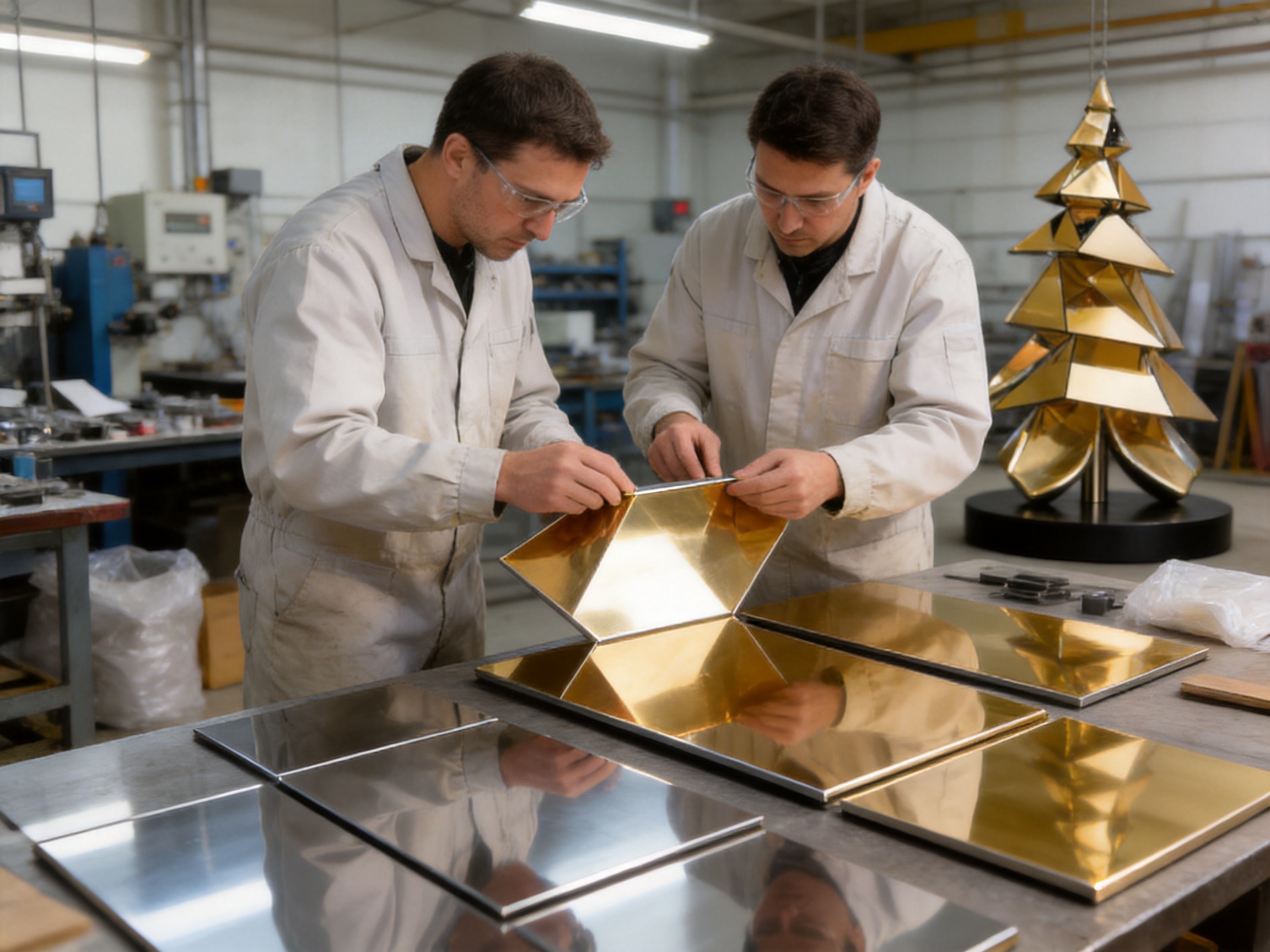
The golden appearance is created through vacuum plating, also known in many manufacturing contexts as physical vapor deposition or a related vacuum coating process. The supplied product information emphasizes that the titanium-gold layer is applied to each individual faceted panel before assembly. This sequence is important because it allows the coating to reach the visible surfaces of separate components before they are joined into the final tree structure.
Vacuum plating deposits an exceptionally thin metallic coating in a controlled low-pressure environment. Compared with traditional gold leaf, the process is less dependent on manually laid sheets of precious metal. Compared with ordinary surface paint, it creates a metallic finish with a more authentic reflective character and a more uniform appearance across the panel surface. The coating is not intended to imply that the sculpture is made from solid gold; rather, it provides a consistent titanium-gold decorative layer over the stainless-steel substrate.
The result is a rich golden tone that remains visually coherent across the complete sculpture. This consistency is especially important in a geometric artwork. If adjacent panels varied significantly in color or gloss, the design could look fragmented or unfinished. A controlled coating process helps maintain a unified appearance while preserving the distinction between individual facets.
Vacuum plating also has practical benefits for commercial displays. Gold leaf can be vulnerable to handling, abrasion, humidity, and inconsistent application. Conventional paint may show brush marks, uneven coverage, fading, or a less convincing metallic effect. A properly specified and professionally applied vacuum-plated coating can provide a more repeatable surface and better resistance to ordinary indoor use, subject to correct care and environmental conditions.
The reflective finish is one of the sculpture’s strongest visual advantages over competing seasonal products. The panels do not merely present one uniform gold color. They catch and scatter light from multiple angles, creating flashes, highlights, shadows, and changing tonal transitions. Under chandeliers, spotlights, daylight, or architectural lighting, the sculpture can appear to sparkle like a large piece of faceted jewelry.
For a commercial buyer, this reflective behavior can reduce the need for extensive additional decoration. The sculpture can create visual impact without dense ornaments, ribbons, artificial snow, or a large number of lights. Additional lighting may still be used, but the metal itself already provides a substantial portion of the display effect.
The sculpture’s appearance depends on accurate control of the panel sizes and their relationship to one another. The panels are not random pieces placed into a general cone. They are graduated from the base toward the tip so that the assembled structure reads clearly as a stylized tree. This is a deceptively demanding design requirement: the object must remain abstract enough to look modern while retaining enough visual hierarchy to be immediately recognizable.
Digital design and pattern development can support this process by defining panel dimensions, angles, spacing, and assembly relationships before fabrication begins. A professional metal sculpture manufacturer can use these design controls to prepare cutting patterns, establish bend or joining requirements where necessary, and coordinate the pieces with the base. For custom orders, the same approach can help adapt height, diameter, panel rhythm, or finish to a particular architectural setting.
Precision cutting is essential because irregular panel edges would weaken the clean faceted aesthetic. Depending on the production specification, stainless-steel panels may be shaped through appropriate industrial cutting methods, followed by edge treatment, surface preparation, and inspection. The goal is to create components that fit together with controlled alignment and that remain visually coherent when viewed from multiple directions.
Surface preparation is another important stage. Before vacuum plating, the stainless-steel panels need a suitable surface condition. Cleaning, degreasing, smoothing, and preparation remove contaminants that might affect coating adhesion or appearance. The visual quality of a metallic finish is strongly influenced by the quality of the underlying substrate. Scratches, dents, oil, residue, or inconsistent preparation can become more visible after the reflective coating is applied.
Manufacturing each panel separately before final assembly is a major strength of the product. It allows the finish to be applied consistently to individual pieces and makes it easier to inspect the visible faces. It also supports more efficient repair or replacement if a panel is ever damaged during transportation or installation. A fully assembled object can be more difficult to coat evenly, especially in internal angles and narrow spaces.
Assembly must balance stability and visual lightness. The finished object needs sufficient strength to remain secure on its base, but the design should not look weighed down by excessive supports. The black round base helps distribute the visual and physical load, while the graduated panel arrangement creates the impression of a carefully balanced metal composition.
For larger models approaching 4 meters in height, project planning becomes particularly important. Buyers should confirm shipping dimensions, access routes, door clearances, elevator capacity, installation procedures, and any local safety requirements. Depending on the final engineering specification, a large sculpture may be delivered in sections for assembly at the destination. The manufacturer and buyer should agree in advance on packaging, lifting points, anchoring requirements, and indoor or outdoor placement conditions.
The product offers a different value proposition from ordinary artificial Christmas trees. Conventional trees are often selected for their familiar appearance and relatively low initial cost. However, they may require ornaments, lights, replacement branches, seasonal repairs, and substantial storage space. Their visual effect can also vary depending on how carefully they are decorated.
This faceted metal sculpture arrives with its principal visual identity already integrated into the structure. The golden panels, angular silhouette, and dark base do not depend on a large collection of additional accessories. This can simplify installation and create a more controlled appearance across multiple locations belonging to the same hotel group, retailer, property developer, or event company.
Compared with painted metal sculptures, the vacuum-plated titanium-gold finish provides a more specialized and luxurious appearance. Paint can be effective, but it often reads as a flat color unless it includes carefully developed metallic pigments and protective layers. The reflective character of the plated panels creates greater depth and movement, which is particularly valuable in large interiors with changing light.
Compared with gold-leaf sculptures, the plated finish offers a more standardized production approach and avoids the visual variation that can result from manually applied leaf. Gold leaf may be appropriate for traditional or highly artisanal projects, but a commercial buyer seeking consistent appearance across multiple units may prefer the controlled effect of vacuum plating.
Compared with fiberglass or plastic decorative trees, stainless steel provides a stronger and more architectural impression. Fiberglass can be formed into complex shapes and may be lighter in some applications, but the material does not naturally communicate the same sense of permanence and precision as reflective metal. The stainless-steel construction makes the sculpture feel more like an investment in the property rather than a temporary prop.
Compared with bronze, the titanium-gold stainless-steel sculpture is lighter in visual expression and more closely associated with contemporary luxury. Bronze develops a characteristic patina and often suits classical, figurative, or historical themes. The faceted gold tree, by contrast, is more compatible with modern interiors, festive retail environments, and spaces where sparkle and reflection are central to the design concept.
Compared with natural stone, the sculpture is easier to position as a seasonal centerpiece because its metal panels create a lighter visual profile and its dimensions can be adapted more readily. Marble and other stones can provide exceptional permanence, but their weight, handling requirements, and traditional appearance may not suit a large temporary installation or a modern holiday theme.
| Feature | Faceted Titanium-Gold Tree | Conventional Artificial Tree | Painted Metal Decoration | Fiberglass or Plastic Tree |
|---|---|---|---|---|
| Primary visual language | Abstract geometric sculpture | Naturalistic tree imitation | Color-based decorative form | Molded or themed decorative form |
| Surface effect | Reflective, multifaceted titanium-gold finish | Typically matte or textured foliage | Dependent on paint quality and gloss | Usually painted, molded, or printed |
| Structural material | 304 or 316 stainless steel | Plastic, wire, PVC, and fabric components | Metal substrate with coating | Fiberglass, resin, or plastic |
| Decoration dependency | Strong visual impact without many accessories | Often requires ornaments and lighting | May require supplementary decoration | May require themed additions |
| Commercial positioning | Luxury architectural centerpiece | Traditional seasonal décor | General decorative display | Lightweight themed installation |
| Reuse potential | Designed for repeated annual use | Reusable but may require replacement parts | Reusable subject to coating condition | Reusable subject to surface and structural care |
Five-star hotels are among the most natural settings for this sculpture. Hotel lobbies typically require decorations that create immediate visual impact without obstructing circulation or damaging the property’s refined atmosphere. A gold geometric tree can stand near the reception desk, in a central atrium, beside a staircase, or within a lounge while reinforcing the hotel’s premium positioning.
The sculpture pairs particularly well with crystal chandeliers, marble floors, polished stone walls, brass fixtures, dark wood, mirrored surfaces, and warm architectural lighting. Its reflective facets can echo the sparkle of crystal while its angular silhouette introduces a contemporary contrast to more traditional luxury materials.
Hotels may select one large unit as a signature seasonal installation or arrange several units of varying heights across a lobby. A group of three, five, or more trees can create rhythm and depth, especially when the units are placed at different distances from the main entrance. The varying heights prevent the installation from appearing repetitive and can guide visitors through the space.
Because the sculpture is not dependent on natural foliage, it may also suit hotels with a minimalist or international design identity. The gold surface communicates celebration without requiring a traditional green-and-red color scheme. This gives interior designers greater freedom to coordinate the holiday installation with existing brand colors, lighting temperatures, flooring, and furniture.
Retail environments compete for attention, and a strong visual centerpiece can help establish a memorable seasonal atmosphere. In a luxury boutique, the sculpture can frame the entrance, stand near a product presentation, or occupy a window display. Its gold finish can support themes of exclusivity, gift-giving, celebration, and prosperity without overwhelming the merchandise when appropriately scaled.
Shopping mall atriums often have substantial ceiling height and long sightlines. A 3- to 4-meter sculpture can provide a vertical focal point visible from multiple levels. Its reflective surface can respond to daylight from skylights or to programmed evening lighting, ensuring that the display remains visually active throughout the day.
For mall operators, a group of different heights may be more flexible than one extremely tall tree. Several sculptures can be distributed around seating areas, escalators, event stages, or central gathering points. This approach spreads the decorative effect across a wider area and can be adjusted to accommodate pedestrian flow, retail sightlines, and fire-safety planning.
The sculpture can also be used as part of a photograph-friendly installation. Its faceted golden appearance provides a distinctive background for visitor photographs, promotional campaigns, and social media content. Property managers should, however, ensure that public interaction is managed appropriately and that barriers or placement strategies prevent people from leaning on, climbing, or touching the panels unnecessarily.
Upscale clubs and restaurants can use the sculpture to introduce seasonal character while preserving a sophisticated atmosphere. In contrast to brightly colored decorations, a titanium-gold tree can coordinate with dark interiors, velvet seating, metallic lighting, and dramatic music-driven environments. It can be positioned near a bar, stage, entrance, private dining area, or VIP lounge.
Event venues may benefit from the sculpture’s ability to function as a reusable backdrop. Corporate holiday parties, gala dinners, product launches, award ceremonies, and winter weddings can all incorporate the tree into a wider styling concept. The geometric form is sufficiently neutral to adapt to different event themes, while the gold finish adds a sense of occasion.
Corporate reception areas can use the sculpture to communicate a more permanent design investment than disposable seasonal decorations. A company may display it during the year-end period and store it for future use, reducing the need to redesign the reception area each season. Outside the holidays, it can remain as an abstract metal artwork if the interior design supports a gold sculptural accent.
The stated height range of 1.2 to 4 meters allows the product to address different spatial conditions. Height alone should not determine the correct selection. Buyers should also consider the available floor area, ceiling height, viewing distance, pedestrian circulation, base diameter, lighting position, and relationship to nearby architectural elements.
| Approximate height | Suitable setting | Typical visual role | Planning consideration |
|---|---|---|---|
| 1.2–1.6 meters | Reception desk, boutique, lounge, private dining room | Compact accent or tabletop-adjacent floor sculpture | Keep visible above furniture and away from congested paths |
| 1.8–2.5 meters | Hotel lobby, restaurant entrance, club, corporate reception | Independent centerpiece | Coordinate with doorways, furniture, and visitor circulation |
| 2.6–3.2 meters | Large lobby, gallery-like retail space, event venue | Strong vertical focal point | Review ceiling proportions and lighting angles |
| 3.3–4 meters | Mall atrium, hotel atrium, spacious public interior | Major architectural centerpiece | Confirm transport, assembly, access, stability, and safety requirements |
A large space does not always require the largest possible sculpture. In some interiors, several medium-sized trees can create a more elegant and flexible composition than a single four-meter object. Grouping different heights produces a skyline-like rhythm and can make the installation more engaging from several viewing directions.
Designers should also consider the distance from the main viewer. A compact sculpture may disappear in a large atrium, while an oversized unit may dominate a small lounge. The best selection maintains a clear hierarchy: the tree should be noticeable, but it should not block architectural features, signage, emergency equipment, artwork, or important retail displays.
Jiangsu Xinyesheng Sculpture Co., Ltd. is identified in the supplied materials as a China sculpture manufacturer and custom metal statue supplier. Its product range includes bronze sculptures, stainless steel sculptures, marble sculptures, fiberglass sculptures, and weathering steel sculptures. This breadth suggests familiarity with different fabrication methods, surface treatments, structural requirements, and installation expectations.
For the faceted titanium-gold tree, the most relevant strengths are metal fabrication, stainless-steel processing, decorative finishing, component assembly, and custom sizing. The company’s role is not limited to selling a standardized seasonal ornament. The supplied product details indicate that the sculpture can be offered in multiple heights and may be adapted for commercial display environments.
A manufacturer working across several sculpture materials can also help buyers compare alternatives. Some projects may require bronze for a classical appearance, weathering steel for an outdoor landscape, fiberglass for a lightweight themed form, or marble for a monumental architectural statement. In this context, stainless steel with titanium-gold plating represents one specialized solution within a broader sculpture-manufacturing capability.
The company’s location in Jiangyin, Jiangsu Province, places it within a major Chinese manufacturing region with access to metalworking, fabrication, finishing, packaging, and logistics resources. For international buyers, the purchasing process should include clear drawings, material specifications, coating expectations, packing requirements, delivery terms, and installation documentation. These details help convert a visually attractive concept into a reliable commercial order.
Custom sculpture manufacturing is strongest when communication begins before production. Buyers should provide photographs or drawings of the intended location, approximate viewing distances, floor conditions, ceiling height, preferred color temperature, access limitations, and any local standards. The manufacturer can then confirm whether the requested height, panel arrangement, base dimensions, finish, and packaging method are appropriate.
Quality control should address both appearance and structure. Visible panel surfaces should be examined for scratches, dents, coating inconsistencies, sharp edges, and unacceptable color variation. Assembly points should be checked for alignment and stability. The base should be inspected for level contact with the floor and for compatibility with the expected installation method. A professional pre-shipment inspection can reduce the risk of discovering avoidable problems after international delivery.
Since no independent company or website introduction was available in the supplied information, buyers should request project-specific documentation directly from the manufacturer. This may include material certificates, finish samples, drawings, inspection photographs, packaging plans, installation instructions, and warranty terms. Such documentation is a normal part of responsible procurement for a large decorative sculpture.
Buyers should request a detailed specification rather than relying only on product photographs. The specification should identify the stainless-steel grade, approximate panel thickness, overall dimensions, base construction, coating method, coating color, surface gloss, assembly method, packaging method, and intended placement conditions.
Finish samples are particularly useful because the appearance of titanium gold can vary according to the coating formula, substrate preparation, gloss level, lighting, and photography conditions. A small sample panel or approved color reference can help the buyer compare the finished product with marble, brass, lighting fixtures, flooring, and surrounding furnishings.
The buyer should also confirm whether the quoted price covers the complete sculpture, base, internal supports, fasteners, packaging, export preparation, and installation guidance. The supplied price range is approximately $1,650 to $5,100, depending on size and configuration. Final pricing may vary according to material grade, dimensions, custom design, quantity, coating requirements, packing, shipping, and other project conditions.
For multiple units, it is advisable to confirm that all sculptures will be produced using the same approved finish parameters. A coordinated group should have consistent gold tone and reflectivity, even if the heights differ. The manufacturer may also be asked to label components clearly so that installation teams can identify the correct assembly sequence.
Packaging deserves special attention because reflective panels can be vulnerable to abrasion during transportation. Protective films, padded separators, reinforced crates, moisture control, and clear handling instructions may be necessary. The packaging plan should be appropriate for the size and weight of the sculpture and should account for loading, unloading, storage, and possible re-use in later seasons.
The titanium-gold vacuum-plated finish is designed to resist tarnishing under normal indoor display conditions, but no decorative surface is completely maintenance-free. Routine care should use a soft, clean, non-abrasive cloth to remove dust and fingerprints. If additional cleaning is required, the buyer should follow the manufacturer’s recommended solution and dilution rather than applying an untested chemical product.
Avoid abrasive pads, scouring powders, steel wool, rough paper towels, strong solvents, and aggressive polishing compounds. These materials can scratch or dull the reflective surface. Cleaning should begin with the least aggressive method, using gentle pressure and a small test area where appropriate.
Because the panels are reflective, fingerprints and dust may be more visible under spotlights than under general ambient lighting. A display team may therefore schedule light cleaning before major events, hotel peak periods, holiday photography, or VIP functions. Regular gentle maintenance is preferable to occasional aggressive cleaning.
When the sculpture is removed for seasonal storage, each panel should be protected against contact with other metal components. Soft separators, padded wrapping, and a dry, clean storage environment can help prevent scratching and moisture-related problems. Components should not be stacked directly on top of one another unless the manufacturer has supplied a suitable packing system.
Storage records can improve reuse. The owner should retain assembly photographs, component labels, hardware information, cleaning instructions, and the original packaging whenever possible. A short annual inspection can identify loose fittings, damaged protective materials, base problems, or coating marks before the sculpture returns to a public area.
If the sculpture is to be installed outdoors or in a partially exposed space, the buyer should obtain specific written confirmation regarding environmental suitability. Indoor use is the primary application described for this product. Coastal air, road salt, standing water, ultraviolet exposure, rain, snow, temperature cycling, and airborne pollutants may require different material, coating, drainage, anchoring, and maintenance specifications.
Although the sculpture is decorative, it should be treated as a freestanding architectural object rather than as a lightweight ornament. The installation area should have a level, stable floor capable of supporting the unit. The sculpture should not obstruct entrances, emergency exits, fire equipment, accessible routes, escalators, stairs, or required circulation widths.
Large installations should be reviewed by the property’s facilities team or an appropriately qualified professional. The review may include stability, tipping resistance, anchoring, wind exposure if placed near an opening, public contact risk, and the ability to move the sculpture safely during installation and removal.
The height and geometry of the sculpture may attract children or visitors who want to touch the panels. In high-traffic areas, placement should discourage climbing, leaning, pulling, or unauthorized movement. A discreet barrier, strategic furniture arrangement, or controlled distance from the main circulation route may be appropriate.
Lighting should be positioned to enhance the facets without producing uncomfortable glare. Narrow spotlights can emphasize the angular planes, while broad warm illumination can create a softer gold atmosphere. Designers should test the sculpture from the main viewing angles because the appearance may change substantially as people move around it.
The sculpture can stand alone, but a complete installation may include complementary materials and lighting. Designers can pair it with low floral arrangements, dark plinths, mirrored flooring, crystal elements, neutral winter branches, or restrained gold accents. The key is to preserve the sculpture’s geometric clarity rather than covering it with excessive decoration.
In a hotel lobby, a large tree can be positioned beneath a chandelier and framed by low arrangements on either side. In a boutique, a smaller tree may be placed beside a product display with warm lighting directed toward the gold panels. In a mall, multiple units can be arranged in a staggered composition with generous spacing so that the public can see the differences in height and reflection.
Color temperature influences the perceived character of the finish. Warm light can deepen the gold tone and create a welcoming holiday atmosphere. Neutral or cooler light may emphasize the mirror-like qualities and make the sculpture appear more contemporary. The selected lighting should coordinate with the property’s existing illumination rather than creating an isolated color effect.
Red, green, white, black, champagne, and deep blue can all be used with titanium gold, but the visual result differs in each case. Black creates high contrast and emphasizes luxury. White produces a bright winter effect. Deep green reinforces the seasonal theme while keeping the metal as the focal point. Champagne and beige create a softer, more restrained palette suitable for elegant hospitality interiors.
The purchase price of a seasonal centerpiece should be evaluated over its expected service life rather than only against the cost of one year’s temporary decorations. A durable sculpture that can be reused over many seasons may provide value through repeated deployment, consistent visual identity, reduced annual sourcing, and lower dependence on disposable materials.
For hotel groups, retailers, and property operators, repeatability is especially useful. The same design can become part of an annual visual tradition. Guests may come to associate the faceted gold tree with the property’s holiday season, while management benefits from a display system that does not need to be reinvented each year.
Multiple units may also be purchased in stages. A buyer could begin with one medium-sized sculpture for a flagship lobby and later add smaller units for entrances, restaurants, lounges, or affiliated locations. Because the design is modular in concept and available in several heights, an expanding collection can remain visually coordinated.
The sculpture’s year-round potential further supports its commercial value. During the holiday season, it functions clearly as a Christmas tree sculpture. During other months, it can be presented as an abstract gold geometric artwork or stored for the next seasonal cycle. The appropriate choice depends on the interior design and the property’s programming.
The supplied information presents a height range of 1.2 to 4 meters, but commercial buyers should discuss the full scope of customization with the manufacturer. Potential subjects for discussion include exact height, overall width, panel proportions, number of facets, base diameter, stainless-steel grade, surface gloss, gold tone, logo integration, internal structure, modular assembly, and packaging.
Customization should preserve the fundamental qualities that make the product successful. The tree must continue to read as a tree from the intended viewing distance. The panel sizes must remain graduated, the finish must remain visually consistent, and the base must provide an appropriate foundation. Excessive additions may weaken the simplicity of the design.
For hospitality groups, a custom finish may be considered to coordinate with existing brass, champagne metal, or warm gold details. For luxury retailers, the base or surrounding display may be adapted to support the store’s merchandising strategy. For malls and event venues, modular construction may simplify installation and annual storage.
Any custom change should be documented through approved drawings before production. A drawing package can clarify dimensions, tolerances, assembly order, panel numbering, base design, finish references, and connection details. This is particularly important when the sculpture will be manufactured internationally and installed by a separate local team.
The sculpture is made from faceted panels of 304 or 316 stainless steel, finished with a titanium-gold vacuum-plated coating and assembled on a round black base. The final material grade should be confirmed in the project specification because the selection may depend on the intended environment and buyer requirements.
No. The gold appearance is produced by a thin titanium-gold vacuum-plated coating over stainless steel. This process provides a consistent metallic decorative surface without claiming that the sculpture is made from solid gold.
The stated height range is approximately 1.2 to 4 meters. Exact dimensions, base size, panel proportions, and other specifications should be confirmed for each order.
Yes. Several units of varying heights can be arranged as a small forest of faceted golden trees. Grouping different sizes creates a layered composition suitable for hotel lobbies, mall atriums, event venues, and large retail spaces.
The supplied description focuses on normal indoor display conditions, including hotels, boutiques, clubs, and mall atriums. Outdoor or partially exposed use should be approved separately because humidity, rain, salt, ultraviolet exposure, temperature changes, and anchoring conditions may affect material and coating performance.
Use a soft, clean, non-abrasive cloth and follow the manufacturer’s recommended cleaning method. Avoid abrasive pads, harsh chemicals, scouring powders, rough materials, and untested polishing products. A small test area can be used before broader cleaning if the recommended procedure is not already documented.
No. Its faceted panels and reflective titanium-gold surface provide the primary decorative effect. Additional lighting or restrained accessories may be used, but the sculpture is designed to create a strong visual statement without depending on extensive ornamentation.
It presents the tree as a permanent geometric sculpture rather than as a naturalistic foliage imitation. It uses stainless steel, a vacuum-plated metallic finish, graduated polygonal panels, and a black base. It is designed for long-term reuse and luxury commercial interiors.
Buyers should request drawings, exact dimensions, material grade, finish information, price details, packaging specifications, installation instructions, maintenance guidance, delivery terms, inspection information, and warranty conditions. For large or customized units, they should also confirm access, assembly, stability, and local safety requirements.
The supplied price range is approximately $1,650 to $5,100. The final price may depend on height, quantity, material grade, customization, coating requirements, packaging, shipping, and other project conditions.
Before approving the purchase, the buyer should identify the intended location, maximum available height, floor area, viewing distance, installation date, access route, and storage location. These practical details can be as important as the appearance of the sculpture.
The buyer should approve a finish reference and confirm whether the desired appearance is bright mirror gold, softer satin gold, or another titanium-gold variation available from the manufacturer. Photographs alone may not provide sufficient information because lighting and camera settings affect the appearance of metallic surfaces.
The buyer should determine whether the sculpture will be delivered fully assembled or in sections. If assembly is required, the order should include clear instructions, labeled components, appropriate hardware, and information about tools or lifting equipment.
The buyer should also plan for receiving inspection. The sculpture should be checked for transport damage, missing parts, coating marks, panel alignment, base condition, and general stability before it is placed in a public area. Any issue should be documented promptly with photographs and order details.
Finally, the buyer should establish a maintenance and storage routine before the first holiday season ends. A durable product achieves its greatest value when it is cleaned correctly, packed carefully, and stored in a controlled location for future reuse.
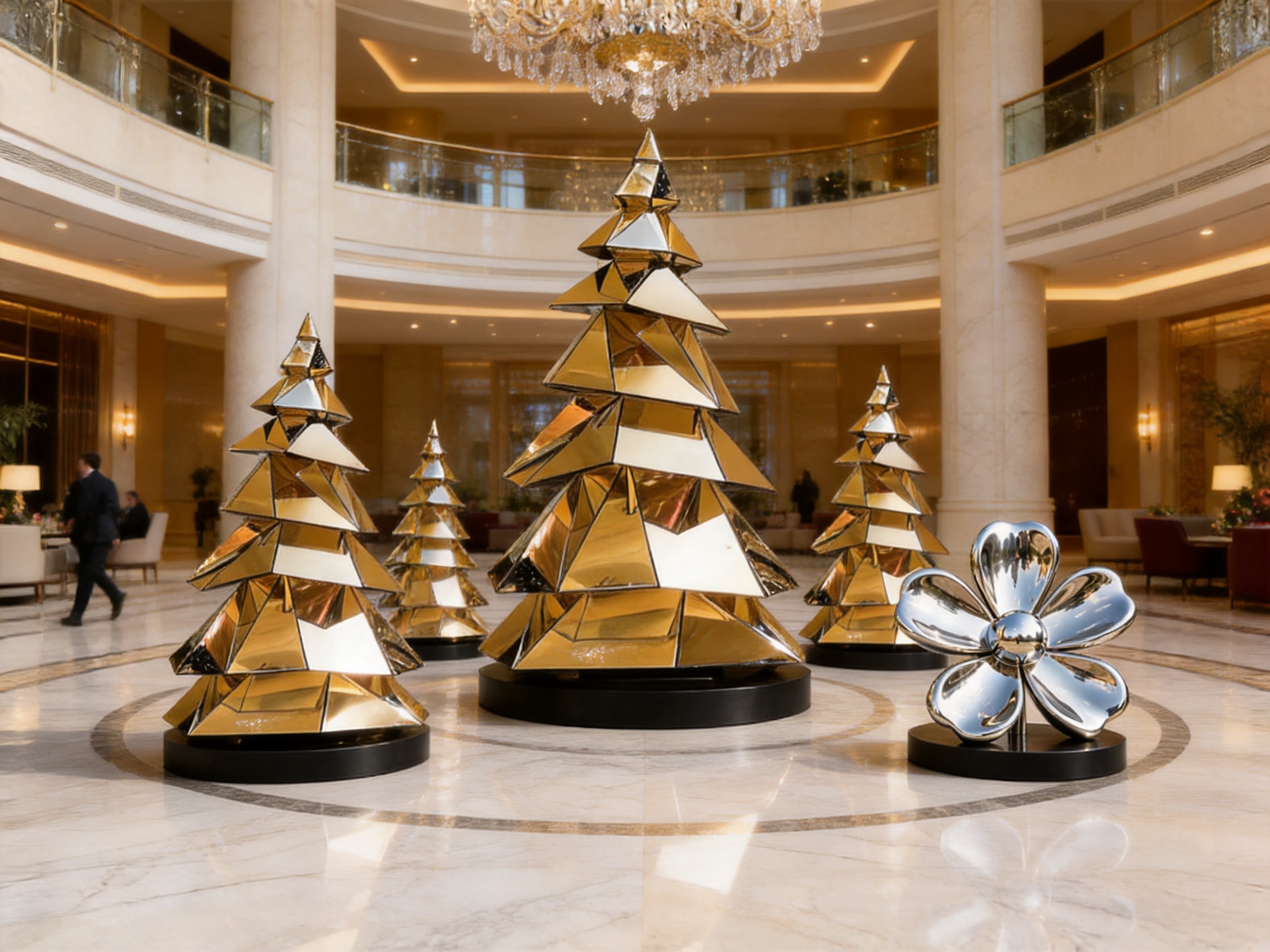
The Faceted Titanium-Gold Christmas Tree Sculpture is a strong alternative to temporary holiday décor for buyers seeking a more permanent, architectural, and luxurious centerpiece. Its graduated polygonal panels create a recognizable tree silhouette without imitating natural branches. Its 304 or 316 stainless-steel construction provides a durable foundation, while the vacuum-plated titanium-gold finish delivers a consistent reflective surface with a jewel-like visual quality.
The sculpture’s advantages over conventional artificial trees, painted decorations, gold-leaf pieces, fiberglass forms, and other seasonal products lie in its combination of longevity, geometric precision, visual impact, and commercial adaptability. It can be used in five-star hotels, luxury boutiques, upscale clubs, mall atriums, corporate interiors, restaurants, event venues, and other high-visibility spaces. Its height range from approximately 1.2 to 4 meters allows buyers to select a compact accent, a medium centerpiece, or a major atrium installation.
Jiangsu Xinyesheng Sculpture Co., Ltd. contributes manufacturing experience across stainless steel and other sculpture materials, with capabilities relevant to custom fabrication, decorative finishing, and commercial-scale production. Buyers can strengthen the result by requesting detailed drawings, approved finish references, material confirmation, packaging plans, inspection documentation, and installation guidance.
When properly specified, installed, cleaned, and stored, the sculpture can serve as a reusable seasonal asset for many years. It offers the festive symbolism of a Christmas tree while presenting the sophistication of contemporary metal art. For properties that want a display capable of attracting attention, reinforcing a luxury environment, and returning to service year after year, the faceted titanium-gold sculpture provides a distinctive and durable solution.
1. Product specification and descriptive materials supplied for the Faceted Titanium-Gold Christmas Tree Sculpture.
2. General technical information concerning 304 and 316 stainless steel used in architectural and decorative fabrication.
3. General manufacturing references concerning vacuum plating, physical vapor deposition, and decorative metallic coatings.
4. General principles of commercial interior display planning, sculpture installation, surface maintenance, and seasonal storage.
5. Company and product information supplied for Jiangsu Xinyesheng Sculpture Co., Ltd., including its listed sculpture materials and manufacturing categories.



Daniel H.

Amanda R.

Robert B.

Jennifer S.

James W.

Barry G.

Michael T.

Emily K.

David L.

Sarah M.


Mikey XV

Jagxue

 English
 Español
 عربى
 Français
 italiano
 Deutsch