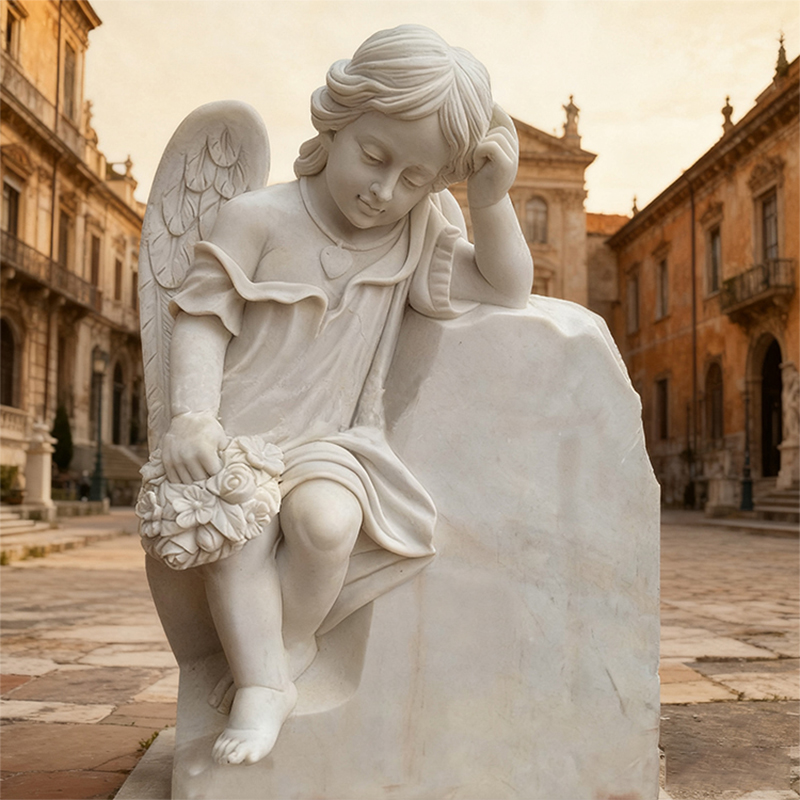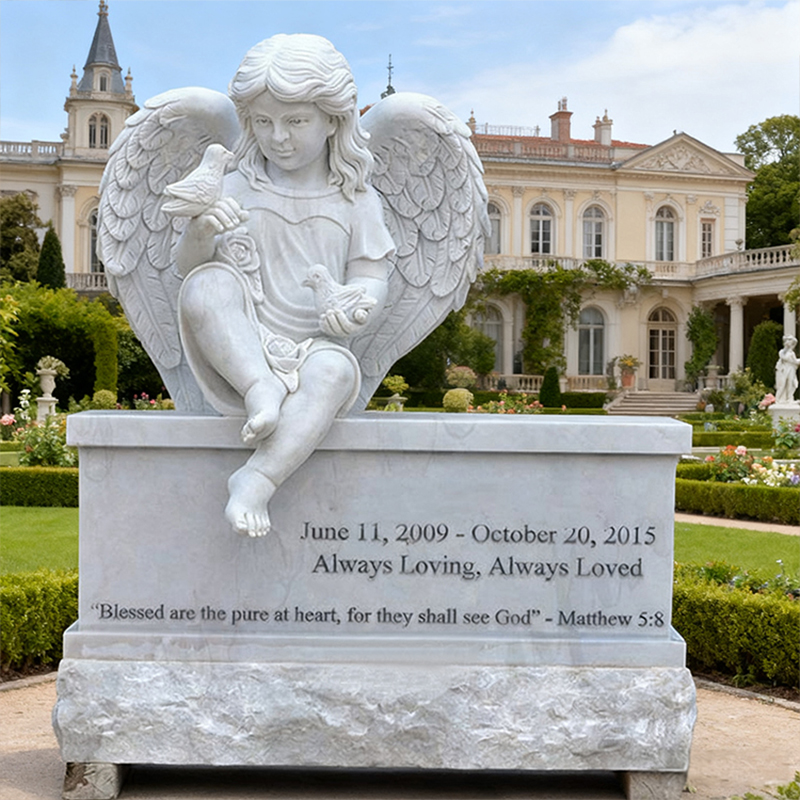
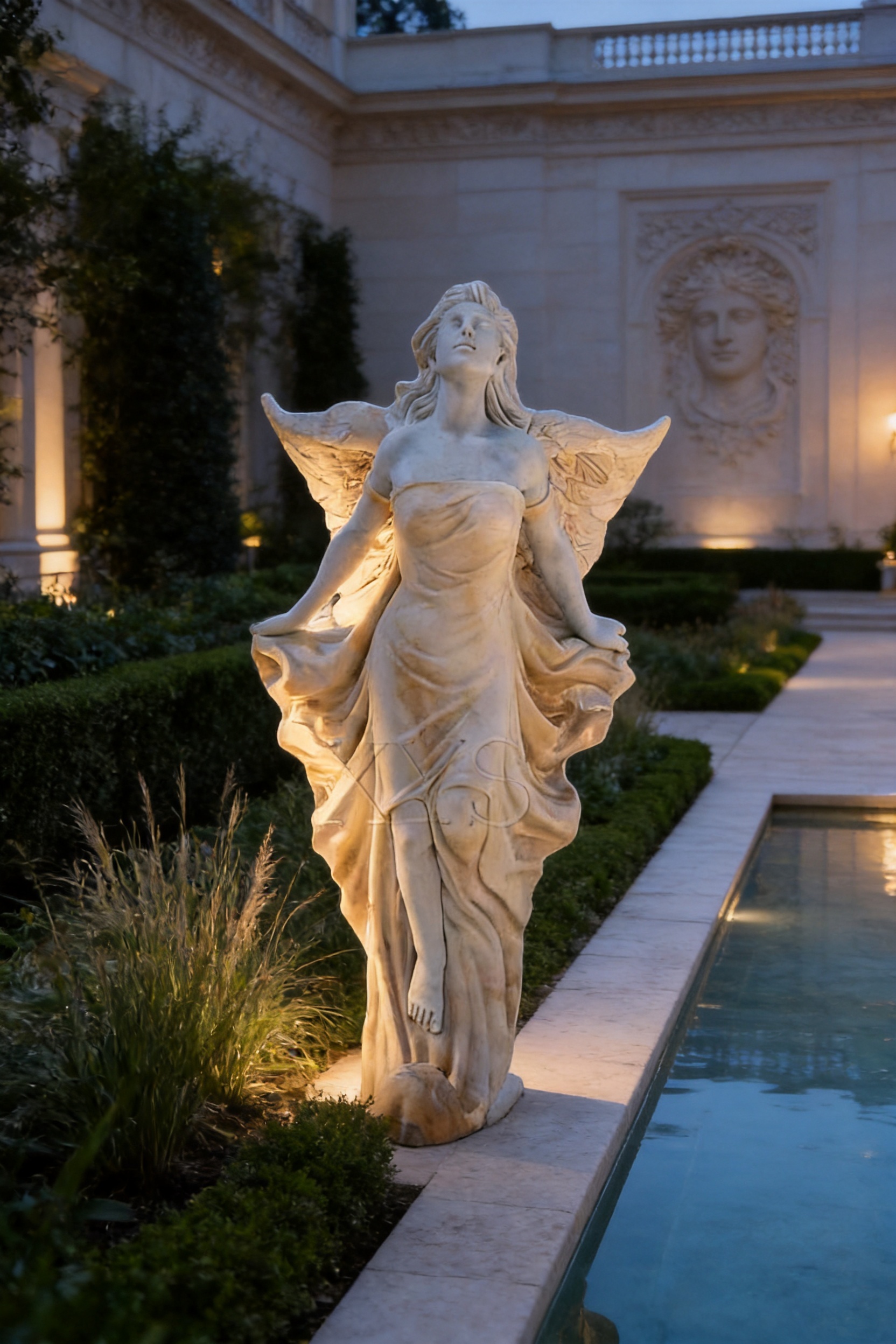
European-style stone angel carving combines classical beauty, symbolic meaning, and the enduring character of natural marble. Designed for villas, gardens, courtyards, hotels, clubs, and other refined architectural settings, this full-size angel sculpture presents a graceful figure with flowing drapery, carefully rendered wings, and an aged finish that recalls the atmosphere of historic European gardens.
At approximately two meters in total height, the sculpture has a strong visual presence without overwhelming its surroundings. It can serve as a focal point beside an entrance, a quiet guardian in a landscaped garden, a centerpiece in a courtyard, or an elegant decorative feature in a hospitality environment. Because the work is hand-carved from natural stone and can be customized in full size, it offers a level of individuality that mass-produced decorative ornaments cannot easily provide.
This article examines the product’s artistic qualities, material advantages, manufacturing process, customization potential, installation considerations, and suitability for professional landscape and architectural projects. It also explains why working with an experienced sculpture manufacturer can provide advantages in consistency, communication, and project coordination.
Content
The European Style Stone Angel Carving belongs to the category of marble human sculptures. It is a figurative work based on the traditional European angel motif, a subject that has been used for centuries in religious art, memorial design, aristocratic gardens, public landscapes, and decorative architecture.
The sculpture is hand-carved from natural stone. Its composition emphasizes a graceful and ethereal figure rather than a highly dramatic pose. The drapery creates a sense of movement, while the wings add vertical rhythm and symbolic identity. The aged surface treatment gives the piece a vintage appearance, making it suitable for projects that seek the atmosphere of an established European estate, classical garden, or historic sculpture park.
The listed total height is approximately two meters, and the stated price is $36,300. The final price of a specific commission may depend on the chosen stone, dimensions, carving complexity, surface treatment, packaging, transportation, installation requirements, and any changes to the original design.
| Product Element | Available Information | Design Significance |
|---|---|---|
| Product type | European-style stone angel carving | Combines classical figurative sculpture with architectural landscape decoration |
| Category | Marble human sculpture | Provides a durable and refined medium for detailed human and drapery forms |
| Material | Natural stone | Every piece can possess individual color, veining, and mineral character |
| Production method | Hand-carved | Supports nuanced facial, fabric, wing, and surface details |
| Approximate height | 2 meters | Creates a visible landmark or focal point in medium and large spaces |
| Finish | Aged finish | Adds vintage charm and helps the sculpture integrate with established landscapes |
| Customization | Full-size customization available | Allows adjustment for site scale, proportion, composition, and project requirements |
| Recommended settings | Villas, gardens, hotel clubs, and courtyards | Well suited to luxury residential, hospitality, and landscape environments |
The angel figure is one of the most recognizable subjects in European decorative art. Angels are commonly associated with protection, hope, guidance, peace, remembrance, and spiritual elevation. These associations give the sculpture an emotional depth beyond its physical appearance. A buyer may select the work not only because it is attractive, but also because it conveys a message of welcome, guardianship, serenity, or remembrance.
The figure’s graceful posture is particularly important. A successful human sculpture depends on balance, proportion, weight distribution, and the relationship between the body and the surrounding negative space. In an angel carving, the wings extend the visual composition beyond the body, creating a wider silhouette and a stronger vertical presence. The drapery then connects the upper and lower portions of the figure, guiding the eye through the sculpture.
Flowing fabric is one of the most technically demanding features in stone carving. Thin folds must appear soft and natural while retaining enough material thickness to remain structurally sound. The folds should also respond to the implied movement of the figure. When executed effectively, drapery creates alternating areas of light and shadow, helping the sculpture remain visually expressive throughout the day.
Wing details provide another important artistic feature. Feathers can be suggested through layered carving, directional lines, changes in relief depth, and carefully controlled transitions between broad masses and smaller details. The wings should appear integrated with the body rather than attached as separate decorative elements. Their rhythm contributes to the overall harmony of the work.
The aged finish strengthens the classical impression. Rather than looking like a newly manufactured ornament, the sculpture is intended to evoke the character of an object that belongs naturally within a historic or traditionally styled environment. The finish can visually soften the contrast between the new sculpture and mature landscaping, stone paving, stucco walls, planting beds, or weathered architectural surfaces.
Natural stone remains one of the most respected materials for monumental and architectural sculpture. Unlike synthetic materials that are manufactured to achieve uniformity, natural stone contains its own mineral structure, color variation, density, and visual depth. These qualities make every finished sculpture individual.
Marble and other suitable natural stones can provide a refined surface that responds beautifully to changing light. In bright daylight, the surface may appear luminous and crisp. Under softer evening illumination, the carved folds and wing details may produce deeper shadows and a more atmospheric appearance. This changing visual character helps the sculpture remain engaging over time.
Natural stone also offers substantial physical weight. This can be an advantage in outdoor placement because a properly designed and installed sculpture has a stable presence and is less vulnerable to being moved by accidental contact or moderate environmental forces. The weight must be considered carefully during shipping and installation, but it also contributes to the authority and permanence of the finished work.
Another advantage is the relationship between stone and landscape. Stone naturally complements greenery, water, gravel, brick, timber, metal, and architectural masonry. A marble angel can be placed among clipped hedges in a formal garden, surrounded by flowers in a villa courtyard, positioned near a reflective pool, or installed against a neutral architectural wall. Its material language is versatile enough to support both traditional and transitional design concepts.
Natural stone is also appropriate for projects that seek a sense of authenticity. A client commissioning a classical sculpture often wants the work to feel connected to established artistic traditions. Hand-carved stone communicates that connection more convincingly than a lightweight molded ornament with a printed or painted imitation of stone.
It is important to recognize that natural stone is not completely uniform. Differences in veining, tone, grain, and small mineral inclusions are normal characteristics rather than defects. These variations make each work unique. For projects requiring close visual consistency among several sculptures, the stone selection stage should be carefully coordinated with the manufacturer.
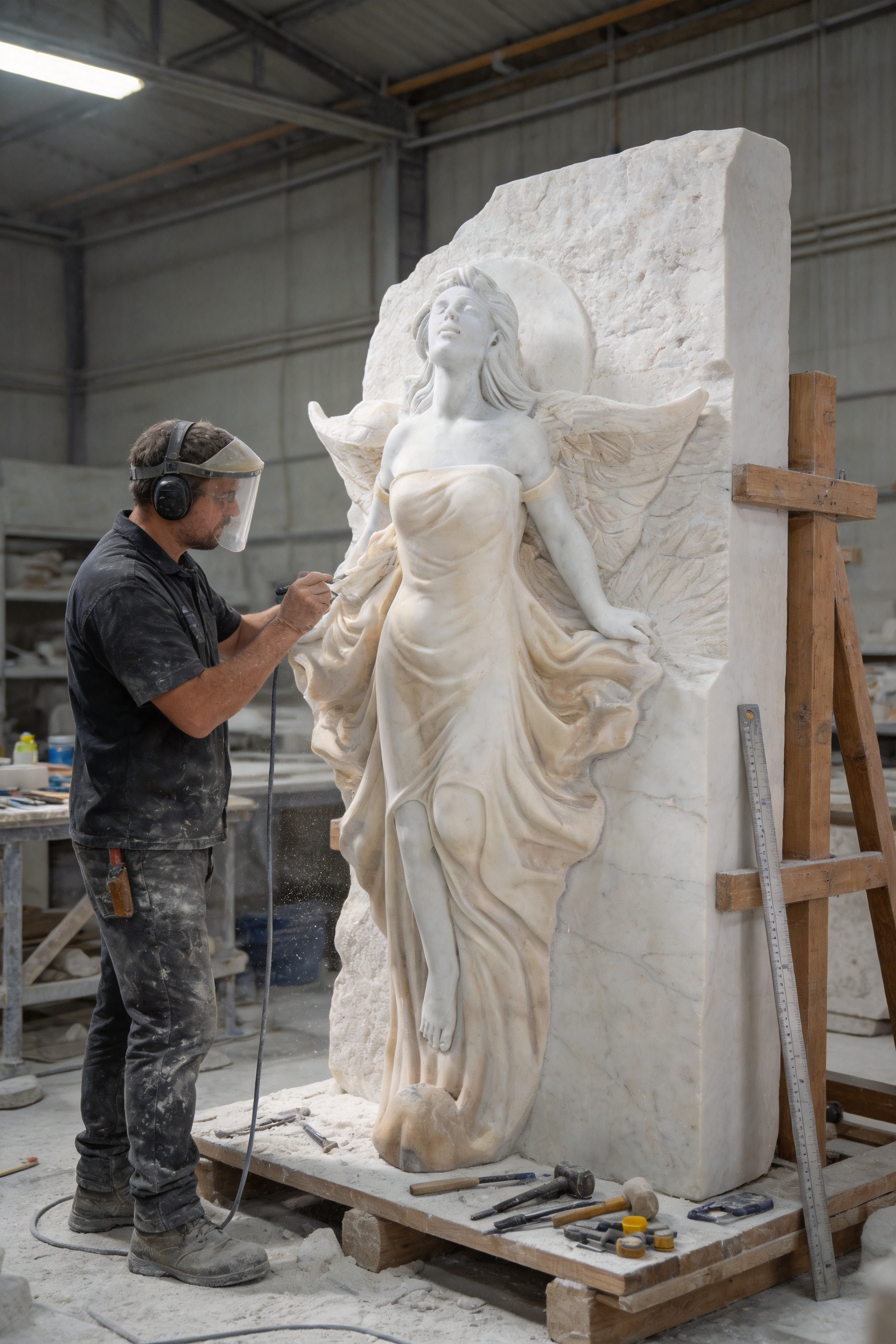
Hand carving is the defining production method of this angel sculpture. It allows an artisan to respond to the stone as an individual material rather than treating every block as an identical industrial component. The carver can refine transitions, adjust the rhythm of folds, strengthen facial expression, and preserve the natural character of the stone throughout the process.
Hand carving does not mean that the production process lacks planning or technical control. High-quality stone sculpture requires coordination among design interpretation, material inspection, proportion control, rough shaping, detail carving, finishing, quality review, packing, and delivery preparation. The strength of a professional sculpture manufacturer lies in managing these stages as one connected process.
A suitable manufacturing workflow begins with design confirmation. The client and manufacturer should agree on the general pose, dimensions, viewing angles, finish, mounting requirements, and intended location. If the sculpture is being customized, reference drawings, sketches, digital models, or photographs may be used to clarify the desired result. For a full-size commission, scale and proportion should be checked before carving begins.
The next stage is stone selection and inspection. The block must be large enough to contain the required composition while allowing for safe removal of excess material. The manufacturer should consider the direction of natural veining, possible inclusions, structural weaknesses, and the placement of delicate features such as wings, fingers, drapery edges, and projecting ornaments.
Rough shaping establishes the primary silhouette. At this stage, the artisan removes unnecessary material and defines the major masses of the body, wings, clothing, and base. The objective is not to create final detail immediately, but to preserve the proportions and structural integrity of the design.
Intermediate carving then develops the anatomy and composition. The shape of the shoulders, arms, torso, legs, wings, and garments is refined. The relationship between the figure and the base is carefully balanced. A sculpture that looks correct from the front must also maintain convincing form from the sides and rear, particularly when it will be installed in an open garden or viewed from several approaches.
Detail carving focuses on facial features, hair, feather patterns, fabric folds, and transitions between surfaces. This is where hand craftsmanship provides a major advantage. The artisan can vary the depth and sharpness of details according to the scale of the sculpture and the distance from which it will normally be viewed.
Finishing completes the visual character of the work. Depending on the agreed specification, the surface may be refined, softened, textured, or treated to produce an aged appearance. The finish should support the design rather than obscure important details. On a sculpture with an antique character, subtle variations in surface tone can make the piece appear more integrated with its environment.
Final quality control should include dimensional review, inspection of the main silhouette, examination of delicate carved areas, assessment of the surface finish, and confirmation that the completed work corresponds to the approved design. For a large sculpture, photographs from multiple angles can help the client review the piece before shipment.
This combination of hand craftsmanship and organized manufacturing coordination is an important competitive advantage. It offers the expressive quality of an individually carved artwork while maintaining the project discipline expected by professional buyers, designers, contractors, and property developers.
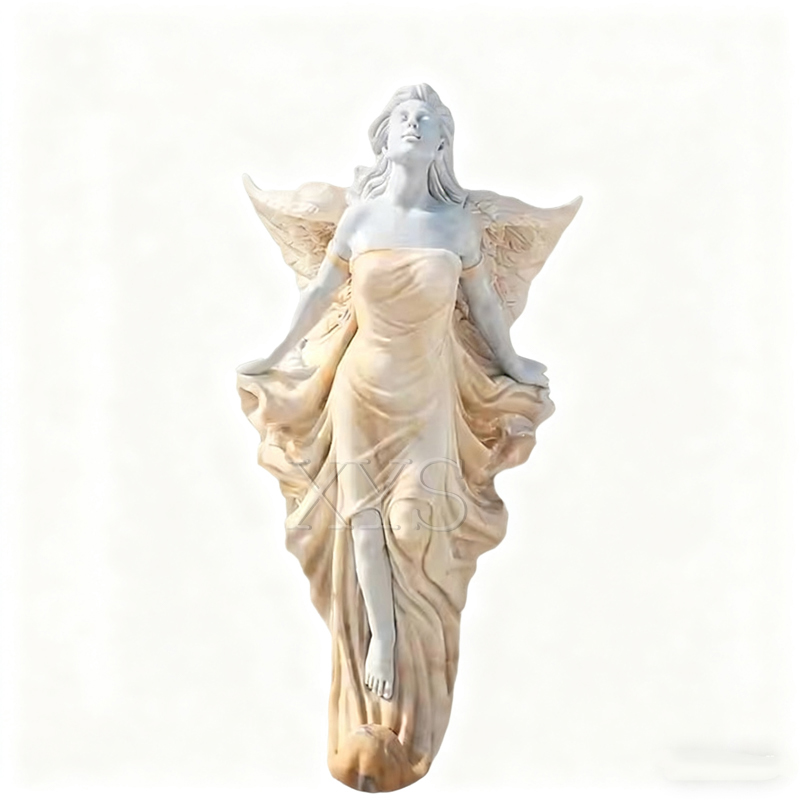
European Style Stone Angel Carving
The most obvious advantage of this angel carving over mass-produced decorative statues is individuality. Factory-made ornaments are often produced from the same mold and repeated in large quantities. Their surfaces may look uniform, but they can lack the visual depth and personal character expected from a premium architectural sculpture.
A hand-carved natural stone piece has a distinct relationship between material and craftsmanship. The final appearance reflects both the inherent qualities of the stone and the decisions made by the artisan. Small differences in carving, surface movement, and mineral pattern contribute to an authentic artistic presence.
Scale is another advantage. Standard decorative statues are often available only in predetermined dimensions. This can create problems when the work is placed beside a tall entrance, a large lawn, a multi-story villa, or a substantial hotel courtyard. The availability of full-size customization makes it possible to adapt the sculpture to the visual scale of the site.
Customization also allows a client to consider the viewing experience. A sculpture placed near a walkway may need a more frontal composition, while a centerpiece in a circular garden should be effective from multiple directions. A work positioned beside a pool may benefit from a wider wing silhouette, whereas a narrow courtyard may require a more compact profile. These considerations can be incorporated into a custom design discussion.
Material authenticity is a further distinction. Lightweight resin, plastic, or cement-based copies may imitate the appearance of stone, but they do not necessarily provide the same density, tactile quality, or long-term visual credibility. Natural stone communicates permanence and is often more appropriate for luxury properties and carefully designed landscapes.
The aged finish also differentiates the product from bright, newly painted ornaments. An antique-style surface can help the sculpture blend into an established environment from the beginning. It may work especially well with mature trees, weathered masonry, traditional paving, and classical architectural details.
Finally, the symbolic content of the angel figure gives the product an advantage over purely abstract or generic decoration when a project requires emotional meaning. The sculpture can represent protection at an entrance, peace in a garden, remembrance in a memorial setting, or spiritual elegance in a hospitality environment.
In a private villa or estate, a two-meter angel sculpture can become an important element of the arrival sequence. Positioned near a gate, driveway, entrance court, or front façade, it can establish a refined first impression before visitors enter the main building.
The sculpture does not need to be placed directly in the center of a symmetrical composition. It can also be positioned at the end of a visual axis, where a pathway, hedge, or garden wall naturally directs attention toward it. In this arrangement, the angel becomes a destination within the landscape and encourages visitors to move through the space.
For a formal garden, the sculpture may be paired with clipped planting, geometric beds, stone urns, balustrades, or a central fountain. For a more natural garden, it may be surrounded by flowering plants, low ground cover, gravel, and mature trees. The contrast between the precise human form and organic vegetation can make the sculpture particularly memorable.
Private clients may also choose an angel sculpture for a quieter setting, such as a secluded terrace, meditation garden, family memorial area, or poolside retreat. In these locations, the symbolic qualities of the figure may be more important than its role as a formal landmark.
When selecting the exact size, the client should consider the distance between the sculpture and the main viewing points. A two-meter figure can appear elegant in a medium courtyard but may need a larger custom scale for a very broad lawn or monumental entrance. Conversely, a narrow space may benefit from adjustments to the wing span or base proportions rather than simply increasing height.
Hotels and private clubs often use sculpture to create a distinctive identity for their entrance, garden, lobby approach, courtyard, or event area. An angel carving can support an atmosphere of elegance and exclusivity while remaining understandable to visitors from different cultural backgrounds.
At a hotel entrance, the sculpture can function as a welcoming landmark. It may be placed beside a driveway, near a porte-cochère, or within an entrance garden. The aged finish can complement classical architecture, while the pale or naturally varied stone can provide contrast against dark paving, green planting, or warm façade materials.
In a resort garden, the sculpture can help divide a large landscape into recognizable zones. A pair of custom angel sculptures may frame a passage or water feature, while a single figure can mark a quiet seating area. In a club environment, it can reinforce a traditional, cultural, or art-focused design concept.
Hospitality projects require careful consideration of durability, safety, maintenance, pedestrian circulation, and installation. The manufacturer should receive information about the location, expected viewing distance, access for lifting equipment, and any restrictions imposed by the property or construction team. Early coordination reduces the risk of making a beautiful object that is difficult to transport or install.
For commercial properties, consistency in finish and documentation is also important. A professional supplier should be able to confirm the agreed dimensions, material, finish, packaging method, and customization details before production. This helps architects, landscape designers, purchasing departments, and contractors coordinate their responsibilities.
Full-size customization is one of the most useful features of this product. Customization may involve more than increasing or reducing the height. It can include adjustments to the overall proportions, wing spread, pose, base design, drapery movement, surface treatment, and relationship between the figure and its surroundings.
Height should be selected according to the scale of the site. A two-meter sculpture is a practical reference size, but a large estate entrance may call for a taller version, while a smaller garden may require a reduced format. The width of the base and the overall visual mass should be considered alongside height so that the sculpture does not appear too narrow or too heavy for its setting.
The base can also be adapted. A simple plinth may suit a modern courtyard, while a stepped architectural pedestal may be more appropriate for a classical garden. The base should be strong enough to support the sculpture and designed for a stable connection to the foundation or installation surface.
Clients may request adjustments to the finish. A more pronounced aged appearance can create a stronger historical effect, while a cleaner surface may suit a contemporary luxury project that uses classical forms in a restrained way. Because natural stone varies, the desired finish should be discussed with reference samples or approved photographs whenever possible.
Design customization should always protect structural safety. Extremely thin wings, fingers, fabric edges, or projecting ornaments may be vulnerable during carving, transport, and installation. An experienced manufacturer can help balance artistic ambition with the practical requirements of stone construction.
Customization is most successful when the buyer provides clear project information. Useful materials may include site photographs, approximate dimensions, architectural elevations, landscape plans, reference images, preferred viewing angles, and details of the intended foundation. The more clearly the site conditions are understood, the more effectively the sculpture can be adapted.
A premium sculpture should be evaluated as both artwork and engineered object. Artistic quality includes proportion, expression, surface rhythm, anatomy, drapery, wing design, and overall harmony. Technical quality includes stone integrity, structural balance, finish consistency, base stability, packing, and suitability for installation.
The face is one of the most sensitive areas. Even a small change in the eyes, mouth, or direction of the head can alter the emotional character of the figure. A serene angel should not appear tense or distorted. The expression should remain legible at the intended viewing distance.
Drapery should show a convincing relationship between fabric weight, body movement, and gravity. Excessively regular folds may look mechanical, while random grooves may fail to communicate fabric. Good carving creates a controlled variety of deep and shallow folds, broad planes, and delicate transitions.
Wing details should be sufficiently clear to read from a distance without making the surface unnecessarily busy. The primary wing shape must remain strong even when individual feather details are not visible. This is especially important for outdoor sculpture, where changing light, weather, and planting may partially obscure fine lines.
The base and lower body require particular attention because they carry the visual and physical weight of the sculpture. A well-designed base creates a stable transition from the figure to the ground and reduces the impression that the statue has been placed without architectural planning.
The aged finish should be judged by how well it supports the design. It should not hide the expression, weaken the visibility of the folds, or create artificial-looking color changes. The objective is a surface with character, not a distracting coating.
Before final approval, clients may request photographs from the front, rear, sides, and elevated or close viewpoints. For a custom project, dimensional information should also be confirmed. If the sculpture will be installed in a public or commercial location, the project team should review local requirements for anchoring, access control, and public safety.
A specialized sculpture manufacturer offers value beyond the physical act of carving. The company’s role may include interpreting a concept, recommending materials, organizing production, coordinating customization, preparing the work for transport, and communicating with clients throughout the project.
Jiangsu Xinyesheng Sculpture Co., Ltd. presents this product as part of a broader sculpture manufacturing capability that includes bronze sculptures, stainless steel sculptures, marble sculptures, fiberglass sculptures, and weathering steel sculptures. This range indicates experience with multiple artistic materials and different production requirements. For a buyer, such a broad product scope can be helpful when a project includes several types of sculpture or when the material needs to be compared before a final decision.
The company’s listed product category for this work is marble human sculpture, while the product description emphasizes natural stone and hand carving. This combination is well suited to buyers who want an artistic human form with the authentic surface and permanence of stone rather than a standard decorative casting.
Manufacturing strength also depends on the ability to support custom work. A full-size customized sculpture requires more than reproducing a catalog image. It involves design communication, proportion control, material planning, carving judgment, finish development, and delivery coordination. A supplier that regularly handles custom sculpture can help the buyer identify practical solutions before production starts.
Another strength is the ability to serve different project types. A private villa, a hotel garden, and a club entrance may all require an angel figure, but their scale, viewing distance, finish, foundation, and installation conditions can differ considerably. A manufacturer familiar with architectural and landscape applications can adapt the discussion to the project rather than treating every order as a standard retail purchase.
For international buyers, clear communication is especially important. Product specifications should be confirmed in writing, including material, size, finish, customization, packaging, delivery responsibilities, and any installation guidance. The customer should also request current production photographs or approval images when appropriate.
These capabilities create a competitive advantage over vendors that sell only standardized ornaments. The buyer receives a more coordinated service from concept through completion, while the sculpture itself retains the individuality of hand-carved natural stone.
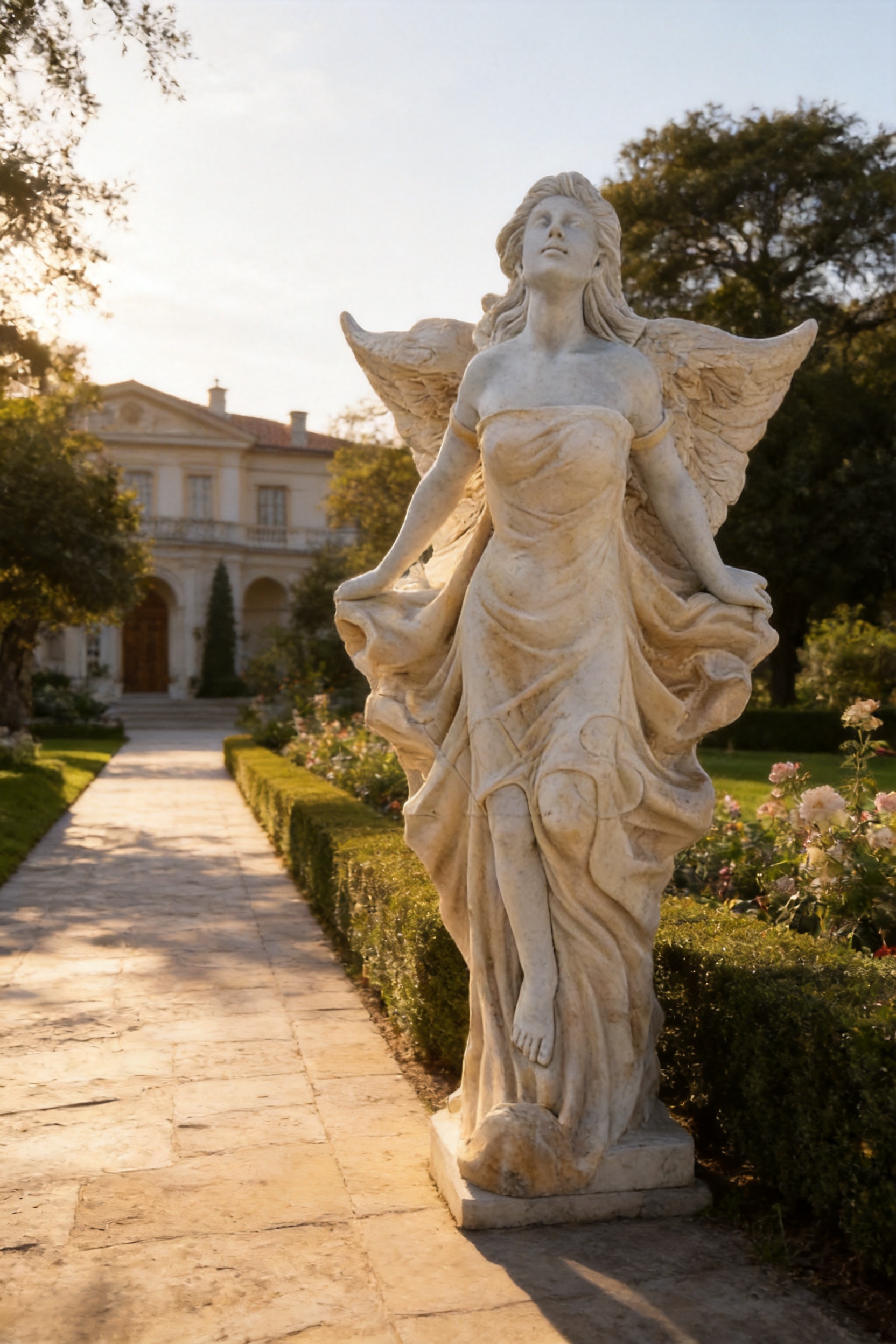
The best placement for an angel sculpture is one where the surrounding environment reinforces its character. Architectural alignment, planting design, lighting, paving, and sight lines should all be considered before installation.
In a classical setting, the sculpture may be aligned with a doorway, arch, colonnade, fountain, or central path. Repetition of vertical lines can make the angel appear intentionally connected to the building. If the sculpture is installed beside an entrance, the two-meter height can provide a human-scaled transition between visitors and the architecture.
In a contemporary setting, contrast may be more effective than similarity. The classical figure can be placed against a simple wall, a dark stone surface, a clean lawn, or a restrained architectural background. The lack of excessive ornament allows the carving to become the primary visual statement.
Planting should be selected with consideration for visibility and maintenance. Low ground cover can frame the base without hiding it. Tall shrubs may provide a dramatic background but should not block the face or wing silhouette. Seasonal flowers can introduce color, while evergreen planting can maintain the composition throughout the year.
Lighting can dramatically change the appearance of carved stone. Soft frontal lighting reveals the figure, while angled lighting emphasizes drapery and wing relief through shadow. Uplighting can increase the sense of height, but it should be carefully aimed to avoid harsh glare or an unnatural appearance. For a hotel or club, programmable evening lighting may allow the sculpture to become part of the overall guest experience.
Water features can create a particularly effective setting. The reflection of the angel in a pool or shallow basin can expand the visual composition and reinforce themes of tranquility. However, the foundation, splash zone, drainage, and long-term interaction between water and stone should be reviewed with the installation team.
A large natural stone sculpture must be planned as a substantial architectural object. The buyer should confirm the route from the delivery vehicle to the final location before shipment. Gates, pathways, doors, overhead clearances, slopes, and surface conditions may affect the choice of lifting equipment and installation method.
Because stone is heavy, the foundation must be appropriate for the sculpture and the ground conditions. A qualified local contractor or structural professional should determine the foundation design, anchoring method, drainage provisions, and any regional requirements. The manufacturer can provide dimensional and weight information when available, but site-specific engineering should be handled by professionals familiar with local conditions.
Delicate elements require protection during handling. Wings, hands, drapery edges, and other projecting details should be secured with suitable protective materials. The packing method should prevent movement, impact, abrasion, and moisture-related problems during transportation.
Installation should be carried out by experienced personnel. The sculpture must be lifted from approved points or with a method suitable for its geometry and weight. Improvised lifting can create stress in vulnerable areas. Once positioned, the work should be checked for level, alignment, stability, and visual relationship with the surrounding space.
Site planning should also consider future maintenance access. Garden growth, paving changes, lighting repairs, and cleaning may require personnel to approach the sculpture safely. A beautiful installation should remain practical to maintain throughout its service life.
Natural stone requires sensible maintenance rather than constant treatment. Routine inspection can identify dirt accumulation, biological growth, drainage problems, accidental impact, or changes around the foundation before they become serious issues.
Cleaning methods should be appropriate for the stone and finish. Harsh acids, abrasive tools, strong pressure, or untested chemical products may damage the surface or alter the aged appearance. A soft brush, clean water, and a manufacturer-approved or stone-specialist cleaning method are generally safer starting points, but the exact approach should depend on the material and local environmental conditions.
Vegetation should not be allowed to grow into cracks, joints, or drainage areas around the base. Irrigation systems should be positioned so that they do not constantly spray the sculpture. In regions with freezing temperatures, water management is particularly important because trapped moisture can expand and create stress in vulnerable areas.
Pollution, salt, dust, and organic deposits may affect sculptures in urban or coastal environments. The frequency of inspection should therefore reflect the site. A sheltered private garden may require less attention than a busy hotel entrance exposed to traffic, irrigation, and high visitor activity.
The aged finish should be preserved rather than aggressively polished away. If restoration is needed, the work should be entrusted to a qualified stone conservator or an experienced sculpture specialist. Repairs to broken details should be documented and matched carefully to the original design.
Before placing an order, the buyer should prepare a clear product brief. The brief can state the desired height, approximate width, preferred stone appearance, finish, installation location, viewing directions, delivery destination, and project schedule.
Questions about customization should be resolved before production. The buyer may wish to know whether the pose can be adjusted, whether the wings can be widened or narrowed, whether the base can be redesigned, and whether the aged finish can be matched to a particular architectural palette.
Material expectations should also be documented. Since natural stone varies, the buyer should understand that the final sculpture may not look exactly like a digital rendering or a reference photograph. A material sample or approved stone selection can reduce misunderstandings.
The commercial quotation should identify what is included in the stated price. Important points may include carving, finishing, internal reinforcement if applicable, packing, export preparation, shipping, insurance, unloading, foundation work, installation, taxes, and local fees. These items vary by project and destination, so they should not be assumed.
Schedule planning is equally important. A custom hand-carved sculpture requires time for design confirmation, material preparation, carving, finishing, inspection, packing, and transport. Clients should allow sufficient time for approvals and avoid treating a complex custom commission as an immediate stock purchase.
Professional buyers may also request production updates. Progress photographs can provide an opportunity to confirm the general direction of the work before the final surface treatment. Clear communication at this stage can reduce the need for late changes.
| Competitive Advantage | Benefit to the Buyer |
|---|---|
| Hand-carved production | Provides a more individual and expressive result than repetitive molded decoration |
| Natural stone construction | Offers authentic material character, substantial weight, and a refined architectural presence |
| Classical angel subject | Conveys protection, peace, elegance, and emotional meaning |
| Graceful drapery and wing details | Creates visual movement, depth, and a strong silhouette |
| Aged finish | Helps the sculpture integrate with traditional and established landscapes |
| Two-meter reference scale | Provides a visible focal point for courtyards, gardens, and entrance areas |
| Full-size customization | Allows the design to respond to the architecture, landscape, and viewing distance |
| Multi-material manufacturing background | Supports broader project coordination when several sculpture materials are required |
| Project-oriented production | Encourages attention to material selection, finish, packing, and installation requirements |
Together, these advantages position the European Style Stone Angel Carving as more than a decorative statue. It is a site-specific artistic feature capable of contributing to architecture, landscape identity, guest experience, and emotional atmosphere.
The sculpture is hand-carved from natural stone and is listed in the category of marble human sculptures. The exact stone selection, color, veining, and surface characteristics should be confirmed for each project because natural material varies from block to block.
The listed total height is approximately two meters. Full-size customization is available, so the height and overall proportions can be adjusted according to the site, viewing distance, architectural scale, and project requirements.
It is described as suitable for villa courtyards, gardens, and landscape decoration. Outdoor suitability depends on the selected stone, local climate, foundation, drainage, installation method, and maintenance plan. These conditions should be reviewed before final production.
The aged finish gives the sculpture a vintage and established appearance. It can help the angel integrate with traditional gardens, mature landscapes, classical architecture, weathered masonry, and other settings where a newly manufactured appearance may be less appropriate.
Full-size customization is available, and design adjustments may be possible depending on the project. The buyer should discuss changes to the pose, wing span, drapery, base, proportions, and finish with the manufacturer before production begins.
Hand carving allows the artisan to refine the form in response to the natural stone. It can produce more individual facial expression, drapery movement, wing transitions, and surface character. A molded statue may offer faster repetition, but it generally provides less individuality and material authenticity.
Yes. Natural stone may vary in tone, mineral pattern, veining, density, and small inclusions. These differences are normal characteristics of the material and help make each sculpture unique. A stone selection and approval process can be used when a particular appearance is required.
Recommended settings include villa courtyards, private gardens, hotel clubs, hospitality landscapes, entrance areas, reflective pools, memorial gardens, and formal architectural spaces. The final placement should provide a suitable foundation, clear sight lines, safe circulation, and access for installation and maintenance.
The buyer should confirm the material, dimensions, finish, customization, base design, quotation inclusions, production schedule, packing method, shipping responsibilities, installation arrangements, and any local site requirements.
Maintenance normally includes periodic inspection, gentle cleaning with methods suitable for the stone, control of nearby vegetation, protection from inappropriate chemicals, and monitoring of the base and drainage. A stone specialist should be consulted if restoration or repair is required.
Its natural stone construction, hand-carved details, classical subject, aged finish, substantial scale, and customization potential make it suitable for projects seeking an artistic focal point with permanence and refined visual character.
The listed manufacturer is Jiangsu Xinyesheng Sculpture Co., Ltd. Product inquiries can be directed through the company’s provided telephone numbers or email address. Buyers should request a project-specific quotation and confirm all commercial and technical details before placing an order.
The European Style Stone Angel Carving offers a strong combination of classical symbolism, natural material, hand craftsmanship, and architectural flexibility. Its graceful figure, detailed drapery, carefully rendered wings, and aged finish create a romantic European atmosphere suited to refined outdoor and hospitality environments.
Compared with mass-produced decorative ornaments, the sculpture provides greater individuality, authentic stone character, substantial presence, and the possibility of full-size customization. These qualities make it appropriate for buyers who want a meaningful artwork rather than a generic landscape accessory.
The manufacturing process is strengthened by the coordination of design interpretation, stone selection, hand carving, finishing, quality review, packing, and project communication. A specialized manufacturer with experience across marble, bronze, stainless steel, fiberglass, and weathering steel can also support broader sculpture programs and help clients compare materials for different applications.
For the best result, the sculpture should be selected as part of the complete site design. Scale, viewing distance, foundation, planting, lighting, drainage, transportation, and maintenance should all be considered. With appropriate planning, this angel carving can become a lasting focal point that brings elegance, serenity, and symbolic meaning to a villa, garden, hotel club, courtyard, or architectural landscape.
1. General principles of classical European figurative sculpture and garden ornament design.
2. Standard professional practices for natural stone selection, hand carving, finishing, packing, and installation.
3. Architectural landscape design principles concerning focal points, visual axes, scale, proportion, and material coordination.
4. Conservation principles for the cleaning and maintenance of marble and other natural stone artworks.
5. Product information supplied for the European Style Stone Angel Carving, including its approximate dimensions, material description, finish, customization availability, and recommended applications.
6. Manufacturer information supplied for Jiangsu Xinyesheng Sculpture Co., Ltd., including its stated sculpture material categories and product manufacturing scope.



Daniel H.

Amanda R.

Robert B.

Jennifer S.

James W.

Barry G.

Michael T.

Emily K.

David L.

Sarah M.


Mikey XV

Jagxue

 English
 Español
 عربى
 Français
 italiano
 Deutsch