A bathtub is usually treated as a practical bathroom fixture, yet a carefully designed marble bathtub can become much more than a place for bathing. It can serve as architectural furniture, a sculptural centerpiece, and a long-term investment in the character of an interior. The Marble Functional Bathtub Sculpture combines these roles in a single freestanding form. Its spacious oval profile supports comfortable bathing, while its natural stone body introduces visual depth, tactile warmth, and a refined sense of permanence.
Unlike mass-produced acrylic or ordinary ceramic tubs, this product is conceived as a functional sculpture. Its purpose is not limited to holding water. It is designed to influence the atmosphere of the entire bathroom, creating a focal point that connects natural material with understated luxury. Smooth contours, one-piece construction, and the individual character of marble allow the bathtub to stand out in private residences, luxury hotels, resorts, wellness facilities, and high-end hospitality projects.
The product is supplied by Jiangsu Xinyesheng Sculpture Co., Ltd., a China-based sculpture manufacturer specializing in custom artistic products and architectural decorative works. The company’s product range includes bronze sculptures, stainless steel sculptures, marble sculptures, fiberglass sculptures, weathering steel sculptures, and functional sculptural pieces. This broader experience is important because a marble bathtub requires more than ordinary stone cutting. It demands an understanding of proportion, sculpture, surface treatment, structural stability, bathroom use, and the relationship between a large object and its surrounding space.
The Marble Functional Bathtub Sculpture is available in approximate lengths of 1.7 to 1.9 meters, widths of 0.8 to 1 meter, and heights of 0.5 to 0.6 meters, including the tub rim and related structure. The listed price range is approximately US$3,124 to US$5,136, depending on size, marble selection, finish, detailing, customization, and project requirements. These dimensions provide a generous bathing area while maintaining a strong visual presence without overwhelming most spacious bathroom layouts.
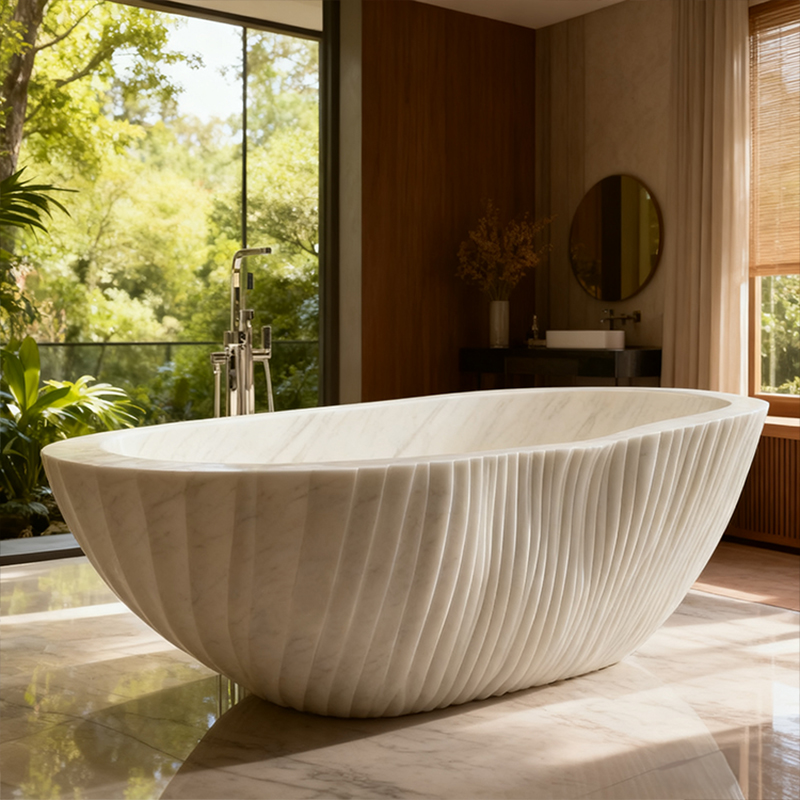
Marble Functional Bathtub Sculpture
Content
The fundamental distinction between this marble bathtub and a conventional bathroom product is its design intention. Standard tubs are often selected according to installation convenience, production efficiency, and basic ergonomics. A functional sculpture begins from a broader perspective. It considers how the object will be experienced visually, physically, and spatially throughout the day.
When the bathtub is not in use, it remains an important part of the interior composition. Its oval silhouette can soften rooms dominated by straight walls, rectangular tiles, cabinets, and linear lighting. The natural veins of marble can create a quiet visual rhythm across the surface. Rather than appearing as an isolated utility, the tub becomes a central object around which other design decisions can be organized.
When the bathtub is in use, its sculptural qualities are complemented by practical comfort. The spacious oval shape offers room for a relaxed posture and supports an uncluttered bathing experience. The freestanding configuration allows the surrounding floor, wall finishes, and lighting to remain visible, making the object feel independent rather than built into a cabinet or platform.
This dual identity gives the product an advantage in design-led projects. A buyer does not need to choose between a beautiful sculpture and a usable bath. The two functions are integrated. The result is especially suitable for interiors that value material authenticity, visual simplicity, and a connection with nature.
Oval forms have long been associated with balance, calmness, and organic movement. In a bathroom, an oval bathtub can reduce the visual hardness created by architectural edges. It can also make the room feel more open because the eye moves continuously around the curved exterior rather than stopping at sharp corners.
The profile is also adaptable. It can be positioned in the center of a large bathroom, near a window, against a feature wall, or within a private spa area. In a hospitality setting, it can serve as a memorable visual element in a premium guest suite. In a private residence, it can transform an ordinary bathroom into a retreat with the atmosphere of a boutique wellness space.
The dimensions of 1.7 to 1.9 meters in length provide flexibility for different users and room sizes. The width range of 0.8 to 1 meter creates a balance between interior comfort and efficient floor planning. The height of approximately 0.5 to 0.6 meters gives the tub a grounded but substantial appearance, while still allowing it to function as a practical bathing vessel.
Marble has been valued for centuries because it combines geological depth with refined surface quality. Each piece is formed through natural processes, which means that color, veining, density, and small variations contribute to its individual identity. A marble bathtub therefore has a character that cannot be completely duplicated by printed finishes or synthetic panels.
The surface can appear calm and monochromatic or visually expressive, depending on the selected stone. Light marble can support bright, minimalist interiors, while darker or more strongly veined marble can create a dramatic focal point. Because the product can be customized according to project requirements, the buyer has the opportunity to coordinate the stone with wall panels, flooring, vanity tops, decorative sculpture, or other architectural materials.
Natural marble also offers a distinctive tactile experience. Compared with thin metal or highly synthetic surfaces, a substantial stone body communicates solidity. When the bathtub is prepared and maintained correctly, its surface can remain smooth, refined, and comfortable to touch. This sensory quality is central to the idea of a bathroom as a restorative environment rather than merely a service room.
The Marble Functional Bathtub Sculpture competes with several categories of products, including acrylic bathtubs, fiberglass bathtubs, ceramic tubs, cast iron tubs, engineered stone tubs, and ordinary freestanding stone models. Each alternative has its own advantages, but the marble sculpture offers a distinctive combination of artistic value, material authenticity, customization potential, and long-term visual impact.
| Comparison factor | Marble Functional Bathtub Sculpture | Common acrylic or fiberglass tub | Typical ceramic or metal tub |
|---|---|---|---|
| Primary identity | Functional bathroom sculpture and bathing vessel | Standard bathroom fixture | Practical fixture with limited sculptural emphasis |
| Material character | Natural marble with individual color and veining | Manufactured synthetic surface | Ceramic, enamel, or metal surface with more uniform appearance |
| Visual presence | Strong architectural focal point | Generally understated or conventional | Dependent on model and finish |
| Form customization | Suitable for custom dimensions, textures, and design direction | Usually restricted to catalog forms | Often limited by production tooling or standard sizes |
| Construction concept | One-piece sculptural body without visible splicing in the main form | Manufactured shell with layered or reinforced construction | Varies by material and production method |
| Thermal experience | Natural stone mass supports strong heat retention | Warms quickly but may lose heat more rapidly | Varies; metal may feel cold initially, while ceramic performance depends on thickness |
| Design longevity | Timeless natural material suitable for high-end interiors | Contemporary but more dependent on surface condition and style trends | Often durable, though visual identity may be less distinctive |
One of the product’s defining features is its one-piece molding or one-piece body concept without visible splicing across the primary form. This is particularly valuable in a sculptural bathtub because joints, seams, or visually interrupted sections can weaken the impression of a solid natural object.
A continuous body produces a cleaner exterior silhouette. It allows the eye to follow the curve from the rim to the sides and down toward the base without encountering distracting transitions. The uninterrupted appearance also supports a more luxurious perception, because the bathtub resembles a single carved mass rather than an assembly of separate panels.
From a maintenance perspective, minimizing visible joints can also simplify cleaning around the main exterior surface. Any plumbing connections and installation interfaces still require professional planning, but the visible tub body remains visually coherent and easier to integrate into a calm, uncluttered interior.
Marble has significant mass compared with thin synthetic shells. Once the stone reaches the temperature of the water, it can help maintain a stable bathing environment. This characteristic contributes to a comfortable experience during longer bathing sessions and supports the atmosphere of a private spa.
Heat retention should not be confused with instant heating. A stone bathtub may require appropriate preheating or hot water management depending on the bathroom system, room temperature, and installation conditions. However, the substantial material body can offer a more stable thermal experience than lightweight products that cool rapidly after filling.
The product description emphasizes marble’s resistance to limescale buildup. In practical use, performance depends on the specific marble, surface treatment, water hardness, cleaning routine, and installation environment. A properly finished and regularly maintained surface can reduce the visual accumulation of mineral deposits and help preserve the clean appearance expected in a luxury bathroom.
Professional sealing and suitable cleaning products are important. Acidic household cleaners should generally be avoided unless specifically approved for the selected marble, because aggressive chemicals can dull or etch natural stone. With appropriate care, the smooth surface can remain attractive and hygienic for many years.
Customization is another important advantage over catalog-based competitors. The product can be adapted through marble selection, surface texture, dimensions, edge treatment, and coordination with the surrounding design. A buyer may prefer a quiet, lightly veined stone for a minimalist bathroom or a dramatic stone with bold movement for a statement interior.
Customization is not limited to color. Texture can influence how light moves across the body of the tub. A polished finish may create a reflective, luxurious effect, while a honed or more softly textured finish can produce a restrained, architectural appearance. The correct choice depends on the intended mood, lighting, safety considerations, and cleaning expectations.
For hotels and property developers, customization can also support brand identity. Several rooms may use a consistent silhouette while varying the stone according to room category. A residential designer may coordinate the bathtub with a fireplace, entrance sculpture, stone wall, or vanity. This flexibility makes the product suitable for individual projects rather than only standardized retail installations.
A marble bathtub requires a manufacturing process that combines stone fabrication with sculptural judgment. The company’s experience across marble, metal, fiberglass, and weathering steel sculpture categories indicates a production environment familiar with large-scale forms, surface finishing, custom orders, and the transformation of design concepts into physical objects.
The final quality of a bathtub is determined not by a single operation but by a sequence of carefully coordinated stages. These stages generally include design confirmation, material selection, block or slab preparation, rough shaping, interior excavation, structural refinement, surface finishing, quality inspection, packaging, and installation coordination.
Before cutting begins, the design must be reviewed as both a sculpture and a functional product. Dimensions, wall thickness, rim proportions, drainage location, overflow strategy, faucet position, access requirements, and transportation limitations should be considered together.
A professional manufacturer can use drawings, three-dimensional files, reference images, and project specifications to confirm the intended result. This stage helps identify potential conflicts before material is committed. For example, a design that looks elegant in a rendering may require adjustments to support safe lifting, drainage integration, or delivery through a building entrance.
Design confirmation is also where custom textures and decorative preferences can be discussed. The buyer can decide whether the exterior should remain visually close to the natural stone, whether the interior and exterior should share the same finish, and how the rim should relate to the overall curve.
Because every block of natural marble is different, material selection is critical. The manufacturer must consider not only the visible color but also the block’s dimensions, internal consistency, veining direction, fissures, density, and suitability for deep carving.
A large bathtub needs enough material to produce a stable body while allowing the interior cavity to be excavated accurately. The selected block must support the final form without compromising the rim or base. Veins should also be evaluated from an aesthetic perspective. Some projects may favor continuous, subtle movement, while others may intentionally use dramatic geological patterns.
Material planning can reduce waste and improve the relationship between the final design and the natural stone. A skilled team does not treat marble as a blank, interchangeable substance. It studies the material and determines how the form can reveal its strongest qualities.
Rough shaping removes excess material and establishes the primary oval geometry. Depending on the project, this work may involve advanced cutting equipment, shaping machinery, manual carving, or a combination of these methods. Machinery provides repeatable control over the main dimensions, while experienced craftspeople refine transitions and proportions.
Large stone objects require careful control during shaping. Removing material too quickly or unevenly can create stress, weaken a section, or reduce the manufacturer’s ability to make precise final corrections. A staged approach allows the body to be monitored as the profile develops.
The exterior curve is especially important because it determines how the bathtub reads from across the room. The interior cavity must also be shaped to provide comfortable bathing space while maintaining appropriate wall thickness. These two surfaces work together: the exterior creates the sculpture, and the interior creates the function.
Excavating the interior of a solid marble body is one of the most technically demanding parts of the process. The cavity must be deep enough for comfortable bathing but not so deep that the rim or base becomes structurally vulnerable. Curves should be smooth and continuous, with no abrupt transitions that could compromise comfort or cleaning.
Ergonomic refinement includes consideration of the backrest angle, base contour, shoulder area, usable water volume, and ease of entry and exit. A bathtub may be visually impressive but uncomfortable if these relationships are neglected. The functional sculpture concept therefore requires the manufacturer to balance artistic proportion with human use.
Because the final object is heavy, structural planning is also essential. The floor beneath the bathtub must be able to support the total weight of the stone, water, and occupants. Installation teams should confirm loading requirements and prepare the supporting surface before delivery.
Surface finishing determines how the marble responds to touch, water, light, and cleaning. It can also change the perceived scale of the bathtub. A high polish emphasizes reflection and veining, making the object appear more formal and luxurious. A honed finish reduces glare and creates a softer, more contemporary appearance. Other textures can be considered where appropriate for the design concept.
The finishing process generally moves from coarser refinement toward progressively smoother treatment. Edges, curves, the rim, and the transition between the inner and outer surfaces require special attention. In a one-piece sculptural form, small irregularities can become more visible because there are no decorative joints to distract the eye.
The manufacturer’s experience with sculpture is valuable at this stage. Sculptural finishing is not simply a matter of making a surface flat. It involves understanding how a curve should catch light, how a line should flow around the body, and how the final object will be viewed from different positions.
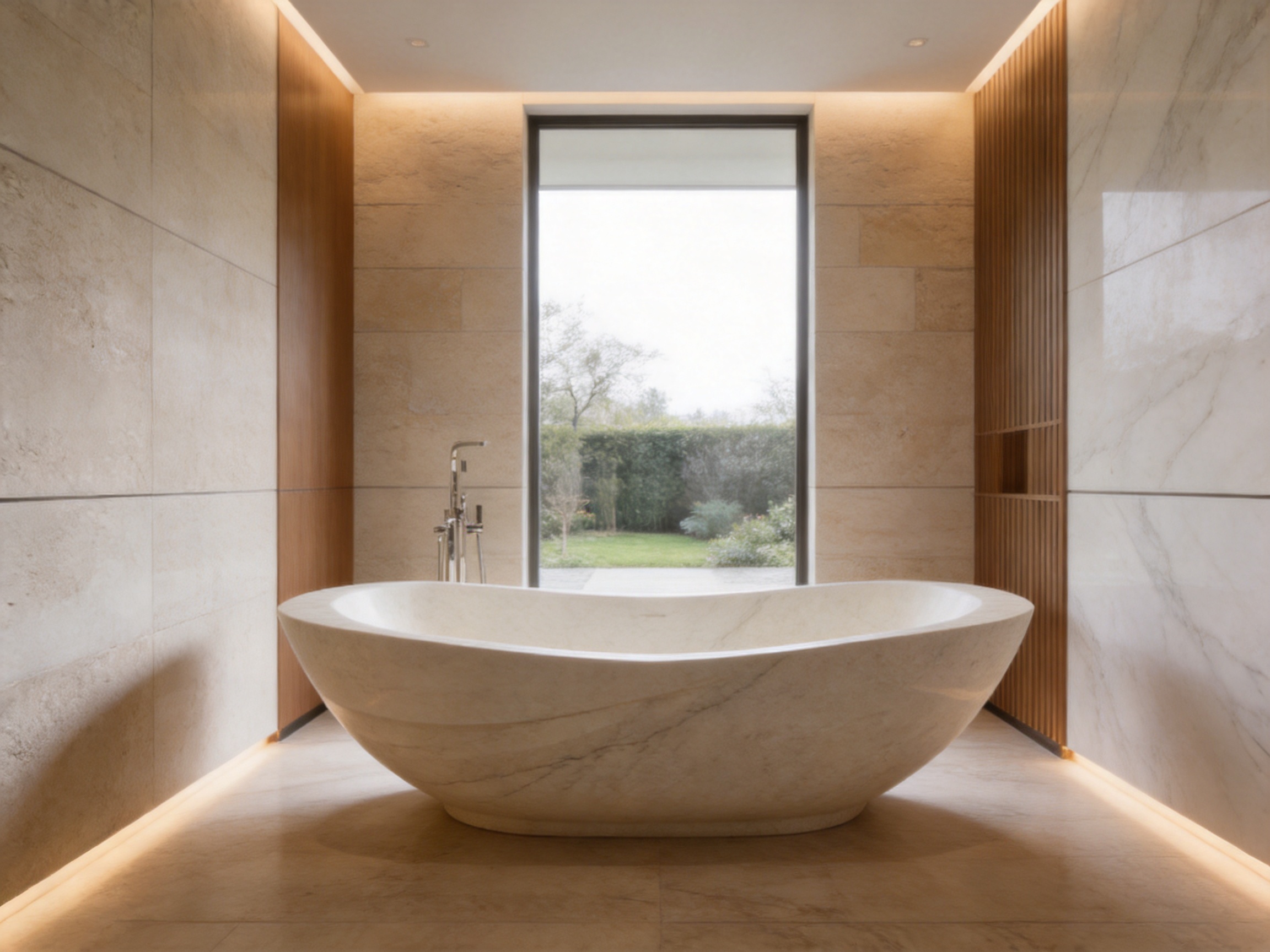
Quality control should address appearance, dimensions, structural integrity, drainage performance, and installation readiness. A bathtub intended for regular use must meet a higher practical standard than a decorative stone object that is only viewed from a distance.
The length, width, height, rim thickness, interior dimensions, and base geometry should be checked against the approved design. Dimensional control helps ensure that the bathtub will fit the intended bathroom and align with the specified plumbing layout.
For custom projects, even a small deviation may affect wall clearances, faucet positioning, floor transitions, or the relationship with nearby furniture. A documented inspection process gives the buyer greater confidence that the finished product corresponds to the agreed design.
The marble should be inspected for consistent finishing, unwanted chips, sharp points, visible processing marks, or irregular transitions. The rim deserves particular attention because it is highly visible and frequently touched. It should feel smooth and finished without appearing excessively thick or visually heavy.
The inner basin should also be checked for a continuous, clean surface. Proper finishing supports comfort and makes ordinary cleaning easier. Any approved natural variations in color or veining should be distinguished from manufacturing defects.
Drainage is a central functional requirement. The base and drain area must be designed to guide water effectively toward the outlet. The drain connection should be coordinated with the bathroom’s plumbing system, and the installation team should verify alignment before the bathtub is permanently positioned.
Overflow protection, if included in the selected design, should be reviewed as part of the project specification. The final configuration may vary according to local building requirements and the buyer’s preferred hardware. For this reason, the bathtub should be ordered with clear communication between the manufacturer, designer, plumber, and installer.
A marble bathtub is a heavy, high-value object. Packaging must protect the stone during handling, loading, shipping, unloading, and placement inside the building. Reinforced crates, cushioning, moisture control, and clear lifting instructions can reduce the risk of damage.
Transportation planning should begin before manufacturing is complete. Door widths, elevator dimensions, staircases, corridors, turning radii, and floor loading conditions should be measured. If access is limited, the project team may need to plan special lifting equipment or schedule delivery before other bathroom fixtures are installed.
The product is suitable for a range of design environments because it can be interpreted in different ways. Its material and form naturally support luxury, but the surrounding architecture determines whether the result feels classical, contemporary, minimalist, rustic, or resort-inspired.
In a private residence, the bathtub can become the centerpiece of a primary bathroom or personal spa. It works particularly well in rooms with generous circulation space, natural light, large-format stone, timber details, soft textiles, and carefully controlled lighting.
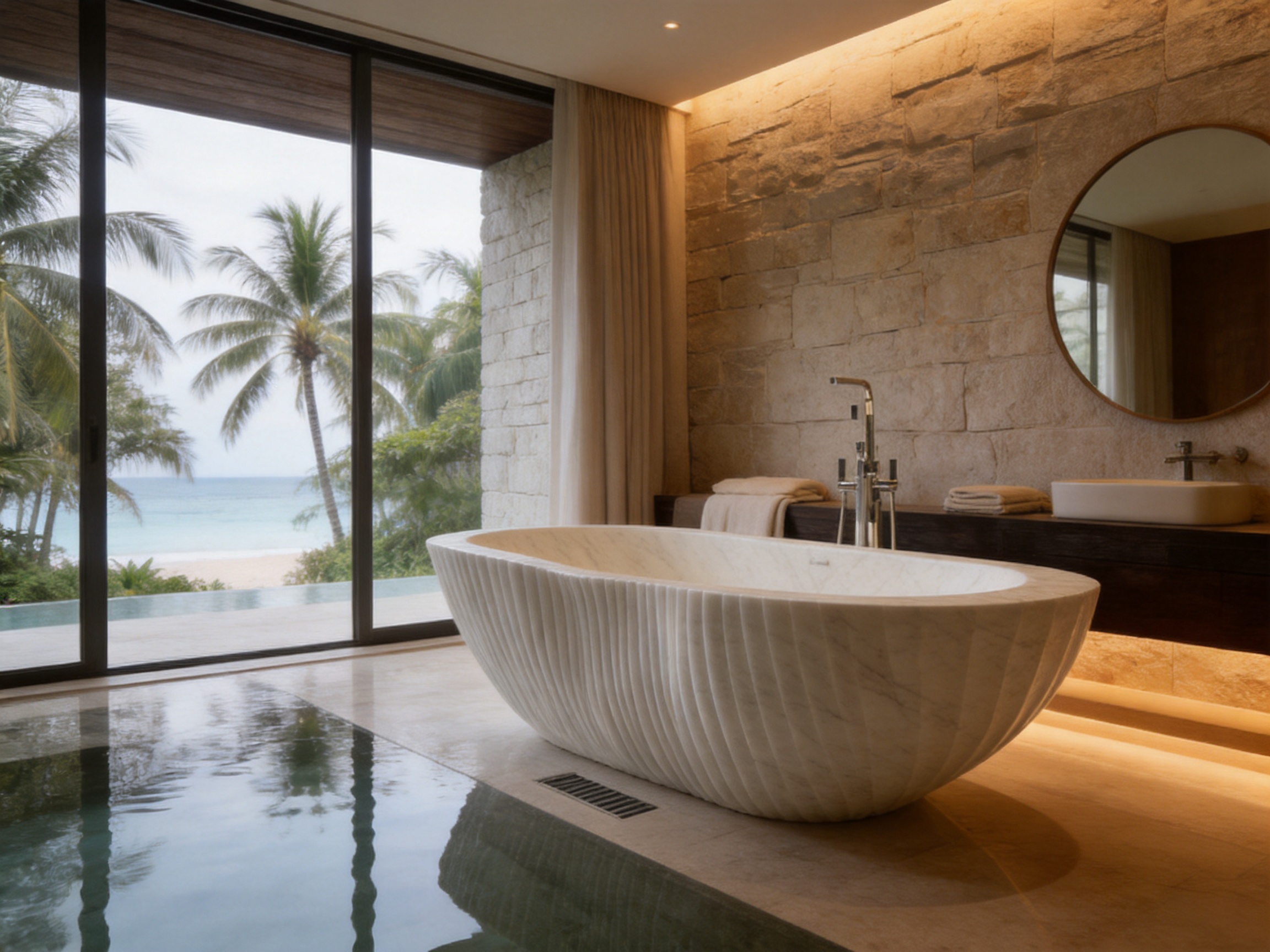
A freestanding installation allows the bathtub to be viewed from multiple angles. Positioning it near a window can connect the bathing experience with a garden, skyline, or natural landscape, provided privacy and moisture control are considered. A central placement creates a more ceremonial composition, while a wall-adjacent position may improve space efficiency.
The bathtub can also support a broader wellness concept. Combined with concealed storage, warm lighting, natural fragrance, and quiet mechanical systems, it can help create a calm environment for rest and recovery.
Hotels and resorts often use bathrooms as a way to distinguish premium rooms and suites. A sculptural marble bathtub provides strong visual content for interior photography and gives guests a memorable sense of place.
In a resort, the natural stone can reinforce a connection to local geology, landscape, and traditional craftsmanship. In an urban hotel, a dramatic marble bathtub can introduce a sense of residential comfort and exclusivity. Because the company supports custom design, project teams can explore repeatable forms with controlled variations for different room categories.
Commercial buyers should pay particular attention to maintenance planning, replacement procedures, floor loading, water management, and cleaning protocols. The aesthetic value of the product is strongest when operational requirements are considered from the beginning.
The substantial appearance and tactile quality of marble make the product suitable for wellness-oriented spaces. It can be installed in a private treatment suite, a high-end residential club, or a boutique spa where the object contributes to a quiet and premium atmosphere.
In these settings, the surrounding environment should support the bathtub rather than compete with it. Soft indirect lighting, natural wood, textured plaster, stone flooring, and restrained hardware can emphasize the sculptural profile. Slip-resistant flooring around the tub is essential, and staff should follow a consistent care procedure for the stone.
A marble bathtub can help show homes and exhibitions communicate a high level of finish. Visitors often remember large, distinctive objects more strongly than ordinary fixtures. The product can demonstrate how functional design and art can coexist within a residential environment.
For exhibitions, the manufacturer’s ability to work with custom dimensions and textures can be especially valuable. A temporary installation may require a particular visual effect, while a permanent project may prioritize long-term maintenance and integration with building services.
Choosing the right marble is a design decision as much as a technical decision. The stone should be evaluated under the actual lighting conditions of the bathroom, not only under showroom lighting or in a small sample.
White and pale marble can make the bathroom feel bright, spacious, and serene. Fine veining adds movement without overwhelming the room. This approach is well suited to minimalist, Scandinavian-inspired, contemporary, and classical interiors.
Light stone can also highlight the bathtub’s silhouette because the curved body receives light gradually. However, buyers should consider water hardness, cosmetics, and cleaning habits when selecting a finish. A professional sealing and maintenance plan remains important even when the stone appears visually uniform.
Strongly veined marble creates a more theatrical effect. It can turn the bathtub into a visual artwork, especially when the pattern flows around the oval body. Such stone is appropriate for statement interiors, luxury suites, gallery-like residences, and projects that use bold natural materials.
When choosing highly veined stone, the manufacturer should review how the pattern will appear after the exterior and interior are shaped. The position of major veins can influence the perceived balance of the finished object. Material planning is therefore closely connected to the artistic result.
A polished surface offers depth, clarity, and reflection. It can make the marble appear richer and more formal, but it may also show water marks and fingerprints more readily. A honed surface creates a softer visual effect and can be easier to incorporate into modern, understated interiors.
Custom textures provide another design direction. The exterior may be subtly textured while the interior remains smooth for comfort and cleaning. Alternatively, the entire object may follow a consistent finish for a monolithic appearance. The appropriate solution should be selected with consideration for touch, moisture, lighting, safety, and maintenance.
| Design objective | Recommended direction | Interior effect |
|---|---|---|
| Bright and tranquil bathroom | Light marble with restrained veining and a soft finish | Airy, calm, and spacious |
| Luxury statement suite | Dramatic veining with a refined polished surface | Bold, elegant, and highly memorable |
| Modern architectural interior | Honed marble with clean oval geometry | Quiet, sophisticated, and contemporary |
| Nature-inspired retreat | Organic stone movement with coordinated natural textures | Grounded, warm, and connected to the landscape |
| Classic European-style room | Light or richly veined marble with carefully shaped edges | Timeless and decorative |
The success of a marble bathtub depends on installation as much as manufacturing. The product should be treated as a major architectural element, not as a lightweight fixture that can be moved casually into place.
Before delivery, the project team should calculate the combined load of the bathtub, water, and users. The supporting floor must be capable of carrying this load safely. In upper-floor installations, a structural review may be necessary.
The floor should also be level and sufficiently stable. Uneven support can place stress on the stone, affect drainage, or create movement during use. A qualified installer should follow the approved installation method and use appropriate support materials.
Drainage, water supply, overflow arrangements, and faucet placement should be confirmed before the bathtub is shipped. Freestanding tubs may require floor-mounted or wall-mounted faucets, and the selected configuration must match the final position of the product.
Access to plumbing connections should be considered during design. While a clean visual appearance is important, serviceability should not be ignored. The installation plan should identify how future inspection or maintenance can be carried out without unnecessary risk to the marble.
Natural marble should be cleaned with a soft cloth or non-abrasive sponge and a cleaner specifically suitable for natural stone. Harsh acids, abrasive powders, and unapproved chemicals can damage the finish. Soap residue and standing water should be removed regularly, particularly in areas with hard water.
After bathing, a brief rinse and wipe-down can help preserve the appearance of the surface. Periodic professional resealing may be recommended depending on the marble type, finish, water conditions, and frequency of use. The care plan should be established with the manufacturer or stone-care professional.
Although marble is durable, it can be chipped or damaged by strong impact. Heavy metal objects, sharp tools, and careless handling should be kept away from the rim and outer body. During renovation, the tub should be protected from dust, debris, ladders, and construction equipment.
Proper care does not mean avoiding use. It means recognizing that the product is made from a natural stone and maintaining it in a way that respects its material properties. With thoughtful handling, its visual and functional value can remain strong over a long service life.
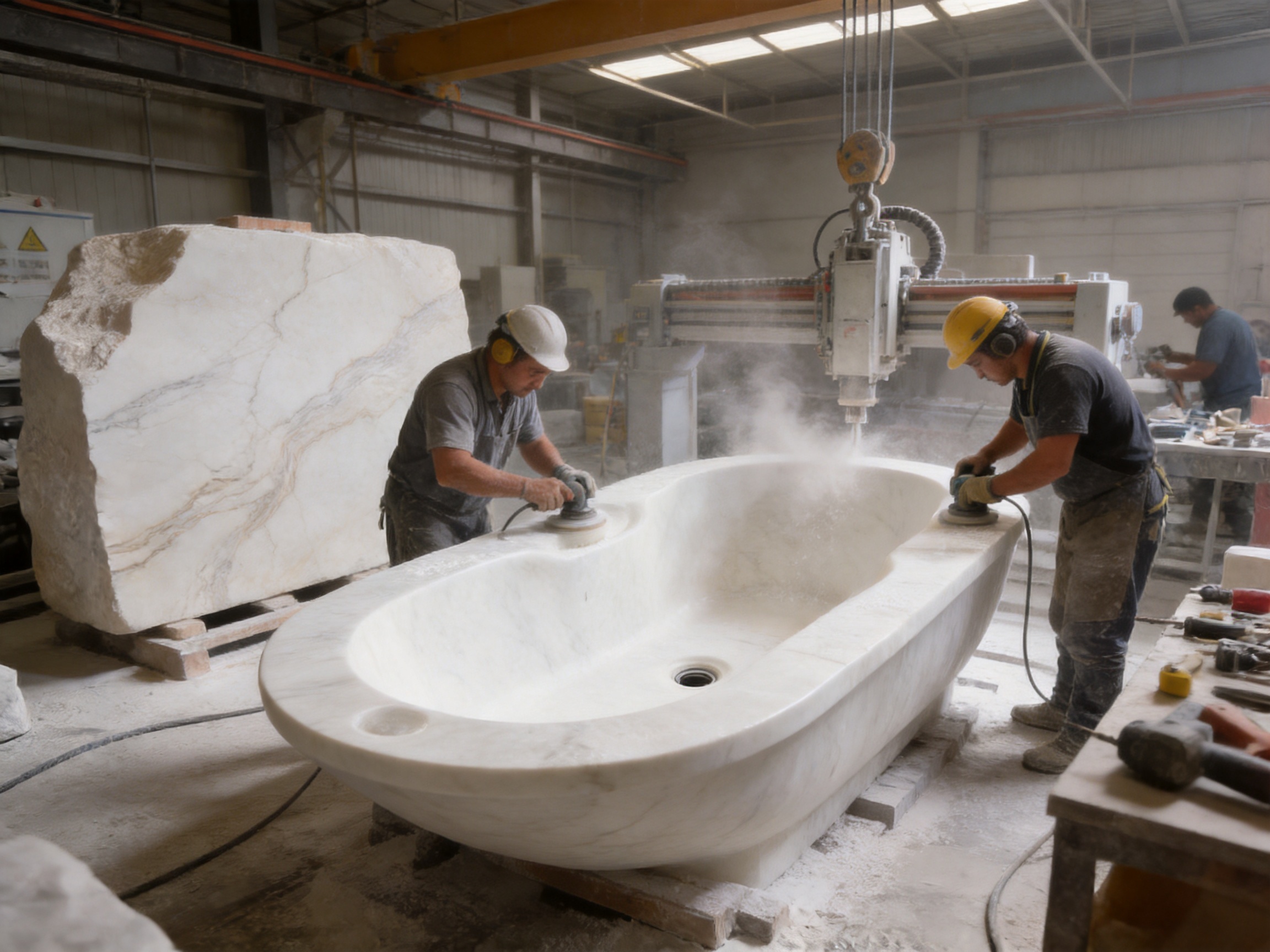
Purchasing a marble bathtub from a company with sculpture experience offers advantages beyond the material itself. Sculpture manufacturers are accustomed to interpreting three-dimensional forms, managing custom dimensions, working with unusual proportions, and producing objects that must look correct from every angle.
A conventional bathroom supplier may offer reliable standard products, but a sculpture manufacturer can provide a more design-oriented approach. The team is more likely to focus on the relationship between mass, curve, negative space, texture, and visual balance. This is particularly important for a freestanding bathtub, because its exterior is visible rather than hidden behind a wall or cabinet.
Jiangsu Xinyesheng Sculpture Co., Ltd. presents a broad product portfolio that includes several sculpture materials and categories. This range suggests experience with different fabrication conditions, surface treatments, project scales, and customer requirements. Marble work benefits from this multidisciplinary background because the final piece must combine artistic appearance with practical construction.
Custom design is valuable when a project has unusual dimensions, a strong architectural concept, or a specific visual identity. The company can discuss the desired shape, marble character, surface treatment, and decorative direction before production. This provides a path for designers and buyers who do not want to select a generic catalog model.
Customization can also address spatial limitations. A bathroom may require a slightly shorter length, a narrower width, a modified rim, or a special drain position. Any alteration should be reviewed for technical feasibility, but the ability to begin a dialogue around the design is an important advantage.
A functional bathtub must withstand repeated contact with water and regular cleaning while preserving its artistic qualities. The manufacturer’s role is therefore not simply to carve a visually attractive shape. It must integrate practical details into the sculpture so that drainage, support, comfort, and finish do not undermine the design.
This integration is where experience matters most. The smoother the relationship between practical elements and the sculptural body, the more complete the finished product appears. A well-designed drain, a carefully proportioned rim, and a properly finished inner basin allow the object to remain visually calm while performing its daily function.
Large custom products require clear communication among the buyer, designer, manufacturer, logistics provider, plumber, structural engineer, and installer. A manufacturer experienced in custom sculpture projects understands that the product cannot be considered in isolation from the building.
Important information should be confirmed in writing, including final dimensions, material selection, texture, finish, drainage requirements, packaging, delivery conditions, and installation responsibilities. Early communication reduces uncertainty and helps prevent costly changes after production has begun.
The listed price range of approximately US$3,124 to US$5,136 places the product within a specialized segment of the bathroom and sculpture market. The final quotation will depend on several factors, including marble type, size, thickness, complexity, finish, custom detailing, packaging, shipping, and installation conditions.
Price should be evaluated in relation to the product’s combined functions. A standard bathtub provides bathing utility, while a decorative sculpture provides visual value. This product brings both into one object. It can reduce the need for an additional focal sculpture in the same room and contribute significantly to the perceived quality of the entire interior.
Natural marble also offers a form of long-term design value. Trends in bathroom fixtures change frequently, but a well-proportioned stone object can remain relevant across different styles. Its natural material is not dependent on a temporary printed pattern or a short-lived color trend.
For commercial projects, the product may contribute to the identity and market positioning of a suite, villa, resort, or wellness facility. For residential buyers, it can become a lasting architectural feature that supports both daily enjoyment and the overall character of the property.
It is a freestanding bathtub carved and finished as a sculptural object from natural marble. It is designed to provide a comfortable bathing function while also serving as a focal point within the bathroom or spa environment.
The listed dimensions are approximately 1.7 to 1.9 meters in length, 0.8 to 1 meter in width, and 0.5 to 0.6 meters in height, including the tub structure. Exact dimensions may be customized according to the project and technical requirements.
Yes. The product description indicates that textures can be customized to suit different decorating styles. Marble selection, surface finish, and certain dimensional details can be discussed during the design confirmation stage.
The product is described as featuring one-piece molding without splicing in the primary body. The final technical construction should be confirmed for the specific order, including plumbing components and any installation accessories.
Natural marble has substantial material mass and can provide strong heat retention once warmed by the bathwater. Actual performance depends on water temperature, room conditions, bathtub thickness, installation, and the bathroom’s plumbing system.
Marble requires appropriate care but does not need an excessively complicated routine. Regular rinsing, wiping, use of stone-safe cleaners, and periodic professional sealing can help preserve the surface. Acidic and abrasive products should be avoided unless specifically approved for the selected stone.
It may be possible, but the combined weight of the marble, water, and users must be reviewed by a qualified professional. Floor loading, access, lifting, drainage, and plumbing conditions should be confirmed before ordering and delivery.
Yes. Its sculptural appearance and customizable design make it suitable for luxury hotel suites, resorts, private villas, wellness centers, and other hospitality projects. Commercial buyers should establish cleaning, maintenance, access, and replacement procedures in advance.
An acrylic bathtub is generally lighter and often easier to install, while the marble sculpture provides a more substantial natural material experience, stronger architectural presence, and greater customization potential. The best choice depends on the project’s structural conditions, budget, design goals, and maintenance plan.
Yes. Variations in veining, color, tone, and minor natural features are part of the character of genuine marble. Buyers should approve material samples or photographs carefully and understand that the final stone may not be identical to a small sample.
The buyer should confirm dimensions, marble type, finish, texture, drainage configuration, faucet position, floor support, access route, packaging, delivery terms, installation responsibilities, and care recommendations. A complete specification helps align the manufacturer’s work with the architectural project.
A successful purchase begins with a clear design brief. The brief should describe the bathroom’s dimensions, intended placement, preferred aesthetic, expected users, surrounding materials, plumbing arrangement, and desired level of customization.
The next step is material and finish review. Designers should evaluate marble samples under comparable lighting and consider how the stone will interact with flooring, walls, cabinetry, mirrors, and metal fittings. The selected finish should support both the visual concept and the practical cleaning routine.
After the design is approved, the manufacturer should confirm technical drawings and production details. This is the stage to resolve questions about the drain, overflow, rim, base, lifting points, and packaging. Any changes made after fabrication begins may be more difficult or expensive.
Before delivery, the installation site should be inspected. The route from unloading point to bathroom should be measured, and the floor should be prepared. Plumbing should be positioned according to the approved drawing, while other trades should protect the finished marble from accidental damage.
After installation, the buyer should receive care guidance and retain all product documentation. A simple maintenance schedule can protect the stone’s appearance and reduce the risk of preventable damage.
The Marble Functional Bathtub Sculpture represents a growing design preference for objects that combine utility, authenticity, and artistic expression. Instead of separating the practical bathroom fixture from the decorative artwork, it brings both purposes together in a single natural-stone form.
Its strongest advantages are its sculptural identity, oval comfort-oriented profile, natural marble character, one-piece visual continuity, heat-retention potential, customization possibilities, and suitability for high-end residential and commercial environments. These qualities distinguish it from lighter, more standardized alternatives.
The manufacturing process is equally important. Accurate design confirmation, careful marble selection, controlled shaping, ergonomic excavation, refined surface finishing, dimensional inspection, and protective transportation all contribute to the final result. The company’s broader experience in sculpture production supports an approach that treats the bathtub as a three-dimensional work rather than an ordinary prefabricated fixture.
For buyers seeking a bathroom centerpiece with lasting visual value, the product offers a compelling balance of performance and artistic presence. It can create a calm private retreat, elevate a hotel suite, define a luxury spa, or give a residential project a memorable architectural detail. With proper structural planning, installation, and stone care, the Marble Functional Bathtub Sculpture can remain both a useful bathing vessel and a distinctive work of functional art for many years.
1. Product specification materials for the Marble Functional Bathtub Sculpture, including stated dimensions, price range, construction features, and customization information.
2. General principles of natural marble selection, fabrication, finishing, sealing, and maintenance for interior architectural applications.
3. General guidance on freestanding bathtub planning, bathroom drainage coordination, structural support, and installation access.
4. General design principles concerning functional sculpture, natural materials, spatial composition, and luxury hospitality interiors.
5. Manufacturer-provided category information covering marble, bronze, stainless steel, fiberglass, and weathering steel sculpture production.



Daniel H.

Amanda R.

Robert B.

Jennifer S.

James W.

Barry G.

Michael T.

Emily K.

David L.

Sarah M.


Mikey XV

Jagxue

 English
 Español
 عربى
عربى Français
 italiano
 Deutsch