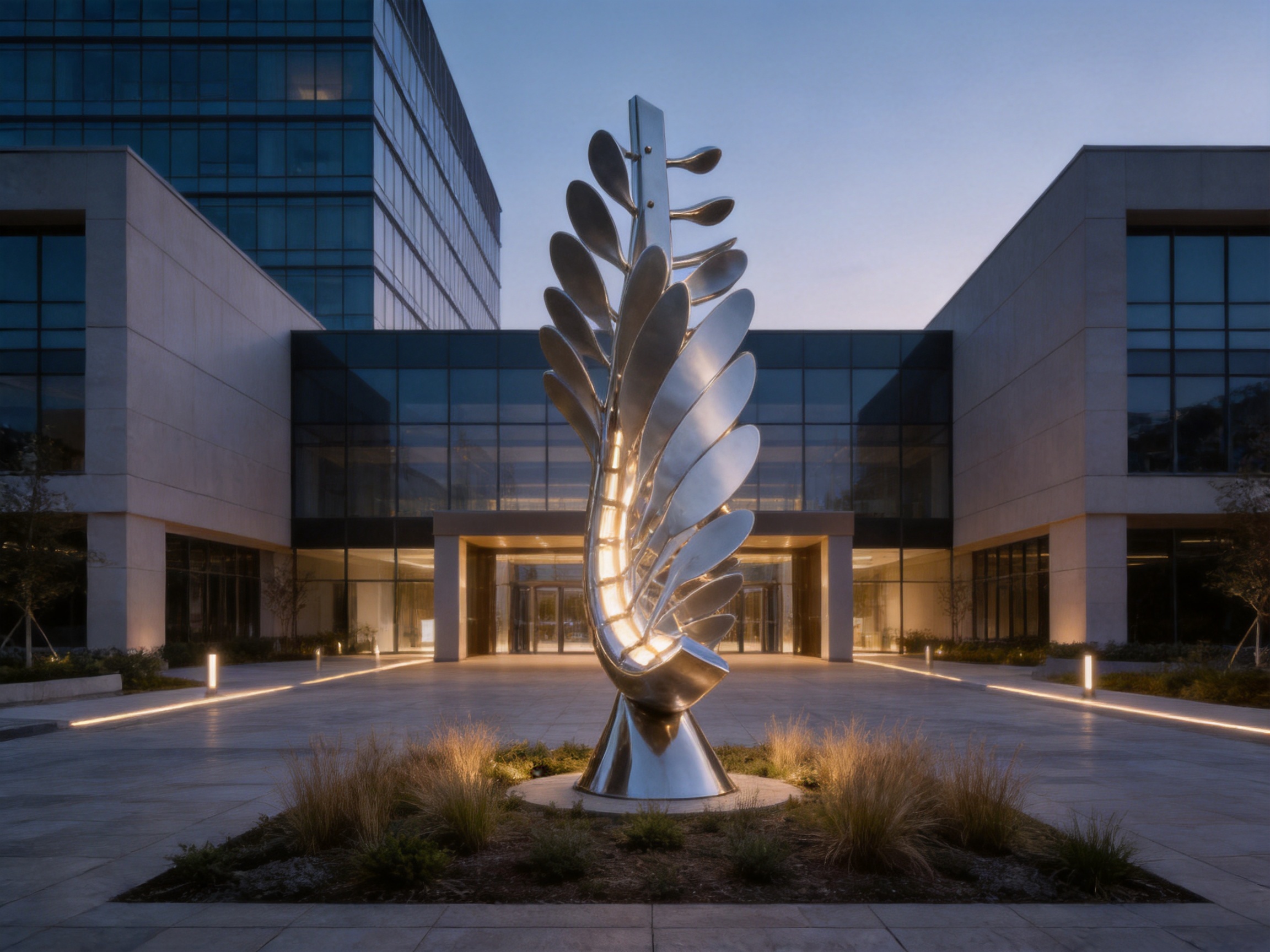
Outdoor sculpture has become an increasingly important element in the design of parks, commercial landscapes, real-estate developments, hospitality destinations, and civic environments. A successful sculpture must do more than occupy space. It should establish a visual identity, withstand changing weather conditions, complement its surroundings, and communicate an idea that remains meaningful over time. The Leaf-Form Boat Stainless Steel Sculpture achieves this balance by combining two highly recognizable images: the organic shape of a leaf and the purposeful structure of a boat.
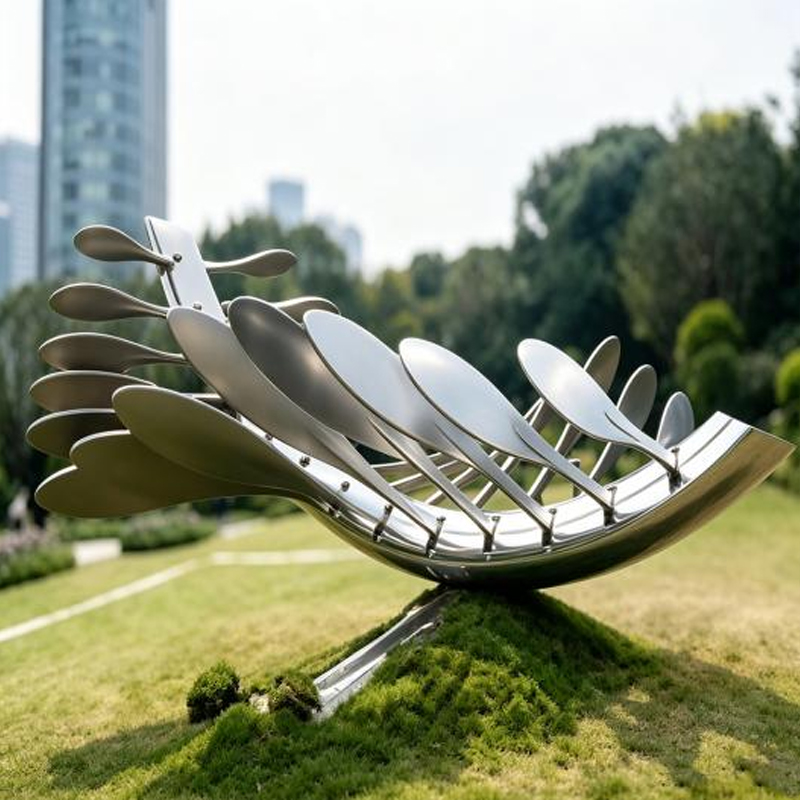
At first glance, the sculpture presents a streamlined boat-like hull. Along this curved structure, multiple leaf-shaped stainless steel panels are layered at carefully varied angles. The result is neither a conventional boat sculpture nor a simple arrangement of botanical forms. Instead, it is a carefully resolved composition in which the viewer can read both concepts simultaneously. The boat suggests travel, direction, opportunity, and progress, while the leaves suggest nature, renewal, growth, and continued flourishing.
This dual reading gives the sculpture a strong advantage over many decorative outdoor artworks that depend on a single visual idea. A purely abstract sculpture may be visually impressive but difficult to interpret. A literal figurative sculpture may be immediately understandable but less distinctive. The Leaf-Form Boat Stainless Steel Sculpture occupies a productive middle ground: its silhouette is recognizable, yet its meaning remains open enough to support different site narratives and design strategies.
Manufactured by Jiangsu Xinyesheng Sculpture Co., Ltd., the sculpture is assembled from matte-finished 304 or 316 stainless steel. Its construction depends on a series of demanding fabrication stages, including the accurate cutting, forming, finishing, and spatial positioning of individual leaf panels along a curved hull. These processes require more than the production of isolated metal parts. They require the manufacturer to coordinate proportion, curvature, spacing, surface treatment, structural stability, and visual rhythm so that the final sculpture reads as one unified work.
Available in heights from 2.6 to 9 meters, the sculpture can be adapted for different outdoor environments. Its listed price range of $2,400 to $6,760 provides a starting point for clients evaluating a distinctive metal sculpture for a landscape project. Final pricing may vary according to size, material grade, customization, surface treatment, lighting, perforation, engineering requirements, packaging, and installation conditions.
Leaf-Form Boat Stainless Steel Sculpture
Content
The central strength of this design lies in its combination of apparently different visual languages. Leaves belong to the natural world. They are associated with seasonal change, organic growth, regeneration, and ecological connection. Boats belong to the world of human movement and intention. They imply a destination, a journey, an expedition, or the beginning of a new stage.
When these two forms are combined, the sculpture communicates a layered message. It can suggest setting out toward prosperity, moving confidently into the future, or carrying the energy of natural growth into a new venture. This symbolic flexibility makes the piece suitable for a broad range of commercial and public settings.
In a city park, the sculpture may be interpreted as a vessel emerging from the landscape and carrying the vitality of the surrounding vegetation forward. In a business-park green space, it may symbolize innovation, expansion, collaboration, and long-term development. In a real-estate landscape belt, it can communicate a sense of opportunity and upward potential without relying on corporate lettering or overt advertising.
The design is especially effective because it avoids a forced symbolic explanation. Viewers do not need to read a plaque to understand that the composition relates to movement and growth. The layered leaves establish a visual connection to nature, while the hull gives the arrangement a directional form. The meaning develops naturally from the visual structure itself.
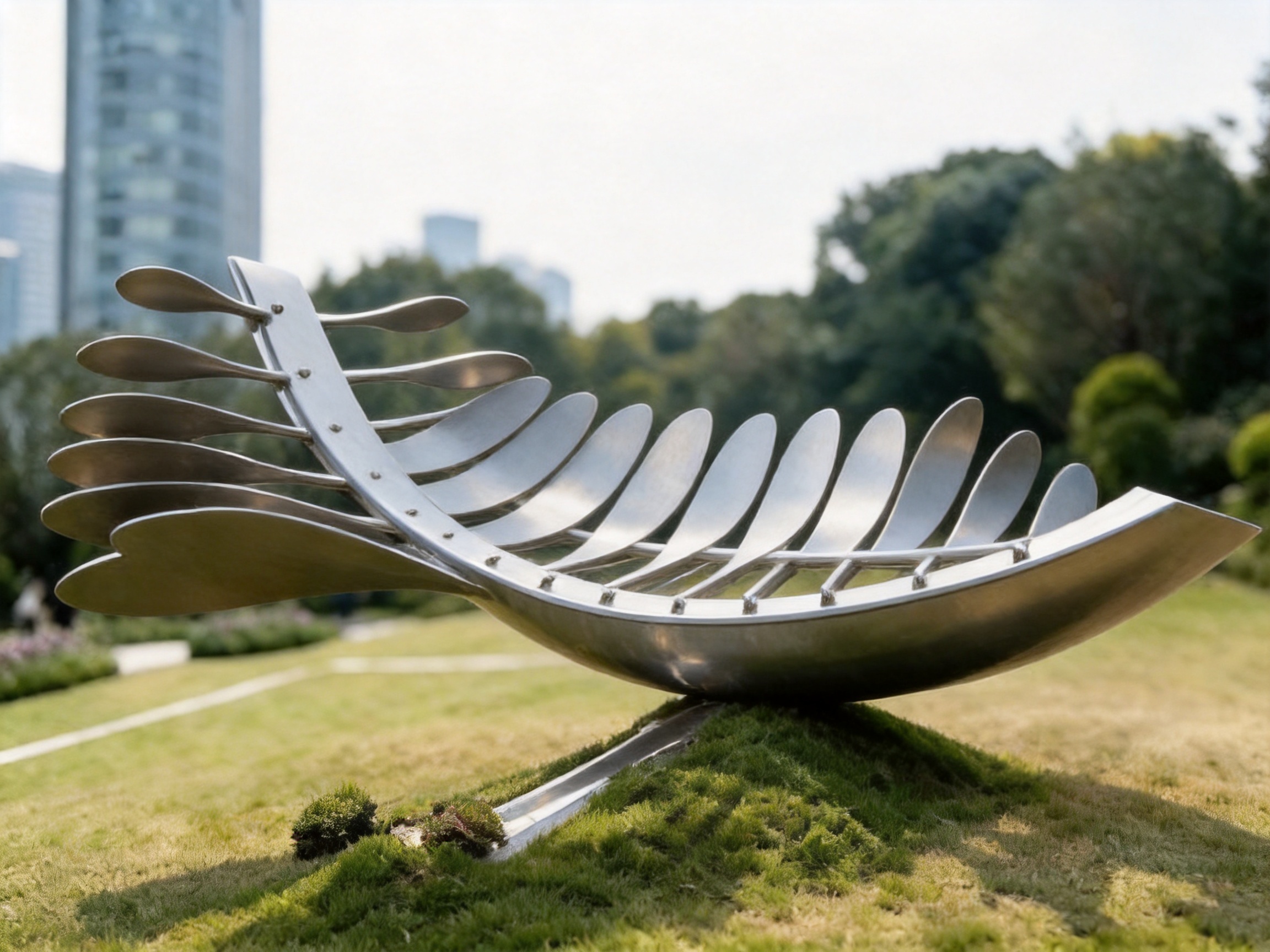
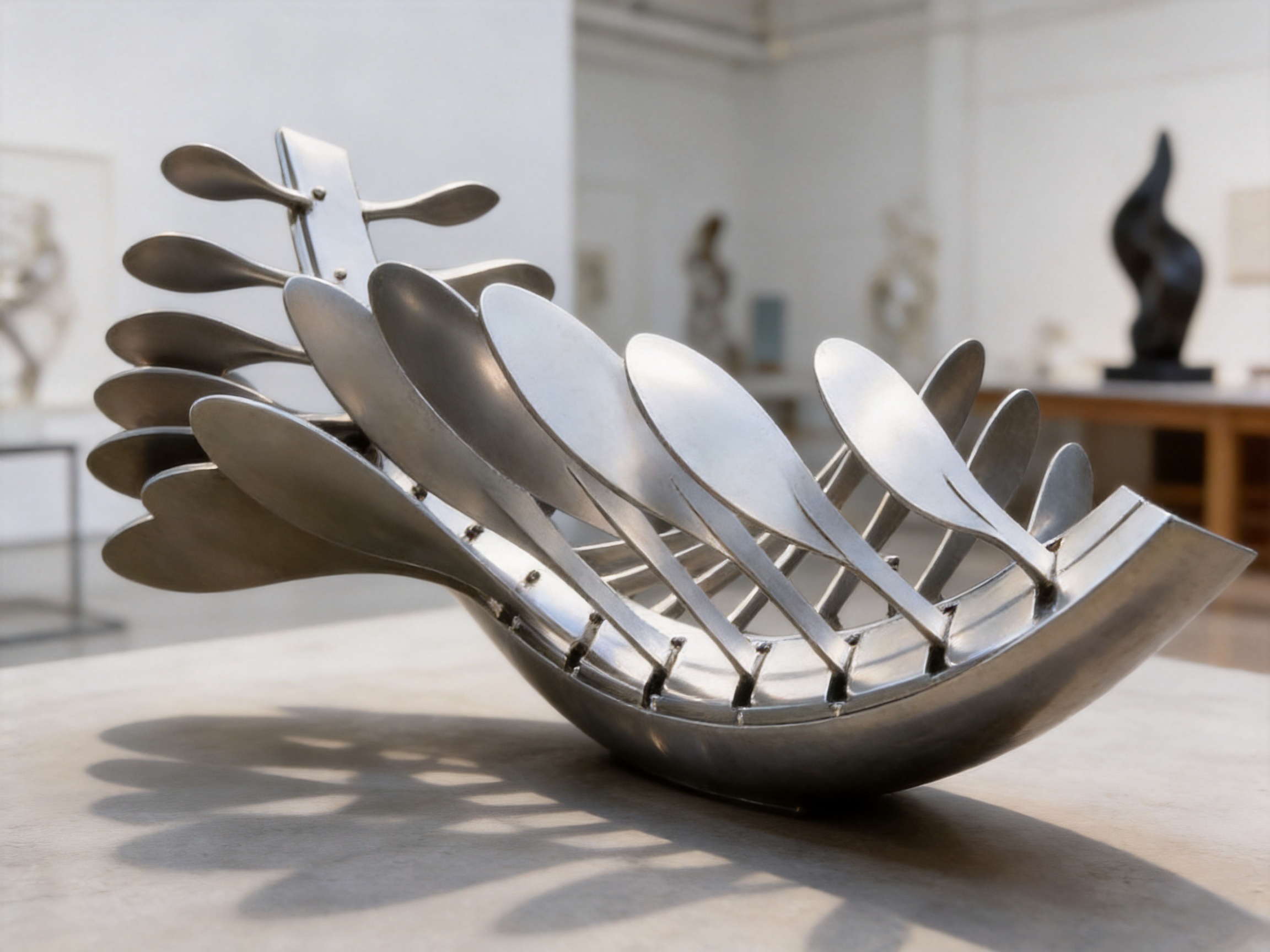
The individual leaf panels are not arranged as a flat decorative pattern. They are positioned along the curved hull at varied angles, creating depth and movement. This arrangement allows different panels to catch light differently, even though the sculpture uses a consistent matte finish. From one viewing position, the leaf forms may overlap into a dense, sculptural mass. From another, the spaces between them become more visible and the overall composition appears lighter.
The panels also use slightly increasing gaps toward the bow of the boat-form structure. This subtle taper is an important design detail. The denser arrangement near the stern creates a visual foundation, while the gradually expanding spacing toward the bow guides the eye forward. The result is a gentle sense of acceleration or release, as though the form is moving toward an implied destination.
This spatial rhythm gives the sculpture a more sophisticated appearance than a design in which every element is evenly spaced. Uniform spacing can make a composition feel mechanically repetitive. The progressive gap arrangement introduces variation without sacrificing order. It helps the sculpture appear intentionally designed, while preserving the sense that the leaf forms are part of a single flowing movement.
The spacing also affects transparency. Outdoor sculpture often needs to maintain a relationship with the landscape behind it. A completely solid object can block views, dominate a small garden, or appear visually heavy. The layered construction allows portions of the background to remain visible through and between the leaves. This makes the sculpture adaptable to lawns, planted areas, pathways, plazas, and broad landscape belts where visual permeability is desirable.
The sculpture uses a matte finish across both the hull and the leaf panels. This choice distinguishes it from mirror-polished stainless steel sculptures, which are designed to produce strong reflections and a highly contemporary, sometimes dramatic visual effect. A matte surface has a softer and more understated metallic character. It reflects light without becoming excessively bright, allowing the form, layering, and silhouette to remain the primary visual focus.
In a planted environment, a matte stainless steel surface can be particularly effective. It responds to daylight, foliage, sky, and seasonal changes while avoiding the intense glare that may occur with a highly polished surface. The result is a quieter relationship between sculpture and landscape. The work remains visibly metallic, but its appearance is less likely to compete with nearby trees, flowers, architectural materials, or pedestrian activity.
The matte treatment also supports the symbolic connection between the manufactured hull and the natural leaf forms. A mirror finish could emphasize the technological and industrial character of the metal. The matte finish, by contrast, allows the panels to appear more tactile and visually restrained. This makes the sculpture feel integrated with a garden or green space rather than inserted into it as a purely industrial object.
Because the surface finish is applied consistently across the hull and panels, the separate components are visually unified. The sculpture does not appear to be a collection of unrelated parts. The uniform treatment helps the eye understand the boat and leaf elements as a coherent composition, even though their shapes and spatial roles differ.
The use of 304 or 316 stainless steel gives clients a choice between two widely used stainless-steel grades for outdoor fabrication. Both options are valued for their resistance to corrosion and their suitability for long-term architectural and sculptural applications. The appropriate grade depends on the installation environment, project requirements, budget, and expected exposure conditions.
304 stainless steel is a practical choice for many outdoor settings, including city parks, business campuses, landscaped developments, and general commercial environments. It provides the strength and corrosion resistance expected from a durable stainless-steel sculpture while supporting cost-conscious project planning.
316 stainless steel may be considered for environments with more demanding exposure conditions. Projects near coastal areas, regions with airborne salt, or locations where additional corrosion resistance is a priority may benefit from discussing 316 stainless steel with the manufacturer. The final recommendation should be based on an evaluation of the specific site rather than a general assumption.
Offering both grades gives the manufacturer greater flexibility in serving different clients. It allows the basic design to remain consistent while the material specification is adjusted to suit the environment. This is an advantage over suppliers that offer only one material option or focus exclusively on decorative appearance without addressing long-term site conditions.
The apparent simplicity of the completed sculpture conceals a demanding fabrication process. A boat hull with layered leaves cannot be produced effectively by treating each component as an independent flat panel. Every leaf must relate to the curvature of the hull, the spacing of neighboring leaves, the direction of the composition, and the intended viewing angles.
The manufacturing process begins with the interpretation of the design into workable component geometry. The leaf silhouettes must be defined accurately so that their proportions remain consistent across the sculpture. If the leaves are too similar to one another, the arrangement may appear repetitive. If they vary without sufficient control, the composition may lose its unity. The manufacturer therefore needs to preserve a recognizable family resemblance among the panels while allowing their angles and positions to produce an organic rhythm.
Cutting is another important stage. The edges of the leaf panels must be clean and consistent, especially because the sculpture is intended to be viewed at close range as well as from a distance. Uneven edges or inconsistent proportions could reduce the visual quality of the layered arrangement. Accurate cutting supports both appearance and assembly.
After cutting, the panels must be curved or formed as required by the design. A flat leaf panel and a curved leaf panel respond to light differently and create different levels of visual depth. The forming process must be controlled so that the panels achieve their intended shape without unwanted distortion. This is particularly important when multiple leaves overlap in perspective.
Positioning is equally significant. The panels are arranged at carefully varied angles along the hull, and the spacing gradually changes toward the bow. These details require the assembly team to follow the design logic closely. The sculpture must remain balanced in three dimensions, not merely attractive from a single elevation.
Finally, the hull and leaf panels receive the specified matte surface treatment. Consistency in finish helps unify the composition. The completed work must preserve the subtle differences in orientation while maintaining an overall sense of visual harmony.
Many outdoor metal statues rely on a single mass or a single silhouette. They may be effective as landmarks, but their appearance can become static when viewed repeatedly from the same route or public space. The Leaf-Form Boat Stainless Steel Sculpture offers greater visual variation because its layered panels create depth, overlap, negative space, and changing light response.
As a viewer moves around the sculpture, the relationship between the leaves and hull changes. Some panels become more prominent, while others recede. The gaps reveal different portions of the background. The boat silhouette may be strongest from one direction, while the botanical character becomes more apparent from another. This multi-angle quality gives the sculpture a richer public experience.
The design also avoids excessive literalism. A traditional boat sculpture may focus entirely on nautical identity, which can limit its relevance to certain sites. A leaf sculpture may emphasize nature but lack a clear sense of direction. By combining both forms, this work can function in urban, commercial, landscaped, and institutional environments without being tied to a single theme.
Compared with highly reflective sculptures, the matte finish offers a more restrained visual presence. This is beneficial for clients who want a recognizable landmark without creating excessive glare or a visually aggressive focal point. The sculpture can attract attention while still allowing the landscape and architecture to remain part of the overall composition.
The option to customize size, color treatment, perforation pattern, and embedded lighting further strengthens its competitive position. A standard sculpture may force every client to accept the same proportions and finish. This design can instead be adapted to different site identities and technical requirements while preserving its core leaf-and-boat concept.
Customization is particularly valuable for outdoor sculpture because every installation site has its own scale, circulation pattern, architectural language, and environmental conditions. The available height range of 2.6 to 9 meters allows the sculpture to be specified for both medium-scale landscaped spaces and larger public or commercial settings.
A 2.6-meter version may be suitable for a garden, courtyard, entrance lawn, or pedestrian-scale landscape where viewers will encounter the sculpture at relatively close range. At this scale, the layered construction can be appreciated through detail, including the shape of individual leaves and the transitions between panels.
A larger version may be appropriate for an expansive park lawn, commercial development entrance, business campus, or real-estate landscape belt. Increased height gives the sculpture greater visibility across open space and allows it to function as a landmark. The scale can also help establish a stronger relationship with large buildings, broad roads, and extended pedestrian approaches.
Color treatment can be considered when a project requires stronger integration with an existing design palette. The original matte stainless-steel appearance provides a neutral and refined foundation, but customized color treatment may support a specific brand identity, landscape concept, or artistic direction. Any color treatment should be selected with attention to outdoor durability and the desired relationship between the sculpture and surrounding materials.
Perforation patterns offer another possible variation. Openings in selected leaf panels can alter transparency, shadow, weight, and airflow. A carefully planned perforation pattern may make the leaves appear lighter or more delicate, while also creating changing shadow effects during the day. The pattern can be decorative, abstract, or developed according to a project-specific visual language.
Embedded lighting can extend the sculpture's presence into the evening. Lighting may emphasize the layered leaves, outline portions of the hull, or create a softly illuminated landmark within a landscape. The lighting concept should be developed together with the sculpture design so that fixtures, wiring, access points, and maintenance requirements are considered from the beginning.
City parks require artwork that can engage different types of visitors. Families, pedestrians, joggers, tourists, and local residents may all experience the same sculpture from different distances and directions. The Leaf-Form Boat Stainless Steel Sculpture is well suited to such settings because its silhouette is easy to recognize while its layered construction rewards closer observation.
Placed on a lawn, the sculpture can become a visual destination without requiring a complicated architectural enclosure. Its open leaf arrangement allows surrounding planting to remain visible. When positioned near a path, the progressive taper toward the bow can reinforce the direction of pedestrian movement. When installed near a seating area, the overlapping forms provide a changing background as visitors move around the site.
The natural symbolism is also compatible with public landscapes. Leaves can connect the sculpture to environmental themes, seasonal change, urban greening, and ecological awareness. The boat can suggest exploration and progress, giving the work a civic meaning that extends beyond decoration.
In a larger park, the sculpture may serve as a landmark that helps organize the visitor's mental map of the site. A clearly visible form can identify an entrance, plaza, gathering lawn, or transition between landscape zones. The ability to produce the sculpture at different heights supports this kind of planning.
Business parks often seek landscape features that convey innovation and confidence without appearing overly commercial. A sculpture based on a recognizable but uncommon combination of forms can create a memorable environment for employees, clients, and visitors.
The boat suggests forward movement and purposeful direction, while the leaves communicate sustainable growth and connection with the natural environment. These associations can support the atmosphere of a business campus without requiring the artwork to display a company logo or promotional message.
Placed near an entrance, the sculpture can provide a distinctive arrival experience. Positioned within a central green space, it can become a visual anchor that helps define the identity of the campus. Installed alongside a pedestrian route, it can create a sequence of views in which the sculpture appears to change as people move past it.
The matte stainless-steel surface is also appropriate for commercial environments because it presents a professional appearance without excessive visual intensity. It can coordinate with glass, concrete, stone, planted areas, and contemporary architectural materials. The material's neutral metallic character supports a wide range of design palettes.
Real-estate developments frequently use landscape sculpture to create a sense of arrival and distinguish one project from neighboring properties. A well-placed sculpture can make an entrance more memorable, provide a recognizable point of reference, and communicate a sense of investment in the quality of the environment.
The Leaf-Form Boat Stainless Steel Sculpture can support these objectives through its strong silhouette and symbolic message. The boat-like structure creates a sense of direction, while the layered leaves suggest flourishing surroundings and future potential. This combination is appropriate for residential communities, mixed-use developments, commercial plazas, and property entrances seeking a meaningful visual feature.
Because the sculpture can be customized in size and finish, it may be coordinated with the scale of the development. A moderate version can support a refined entrance garden, while a larger version can command attention from a roadway or broad approach.
Landscape planners should consider the viewing distance, vehicle speed, pedestrian access, surrounding trees, lighting conditions, and maintenance routes when determining the final size and position. The manufacturer can then use this information to develop a more suitable specification.
| Project Setting | Recommended Design Consideration | Primary Visual Benefit |
|---|---|---|
| City park lawn | Use a scale that remains approachable and visible from nearby paths | Creates a public landmark connected to nature and movement |
| Business-park green space | Coordinate finish and lighting with contemporary architecture | Communicates progress, growth, and professional identity |
| Real-estate entrance | Increase scale and visibility according to road and arrival distances | Provides a memorable gateway feature |
| Garden or courtyard | Emphasize close-range detail and controlled proportions | Creates an intimate layered focal point |
| Large public plaza | Evaluate viewing angles, pedestrian circulation, and nighttime lighting | Offers a dynamic sculpture experience from multiple directions |
Jiangsu Xinyesheng Sculpture Co., Ltd. specializes in the production of metal sculptures and offers this work as part of a broader range that includes bronze, stainless steel, marble, fiberglass, and weathering steel sculptures. This material range is valuable because it indicates an ability to work across different artistic and architectural requirements rather than relying on one narrow product category.
For the Leaf-Form Boat Stainless Steel Sculpture, the relevant strength is the ability to manage a complex stainless-steel assembly in which multiple shaped parts must remain visually consistent. The product is not simply a prefabricated object with a fixed surface. It is a configurable sculpture whose scale, finish, perforation, lighting, and other details can be adjusted according to project needs.
The company's production approach must coordinate artistic interpretation with practical fabrication. The leaf panels need to preserve their intended silhouette after cutting and forming. The hull must provide the correct curved foundation. The spacing must remain controlled from stern to bow. The final finish must cover the components consistently. These requirements make quality control an essential part of the manufacturing process.
Its location in Jiangsu Province, China, places the company within a region with extensive metalworking, manufacturing, and industrial supply capabilities. This context can support the sourcing, fabrication, finishing, packaging, and coordination required for customized sculpture projects. Clients should discuss project-specific engineering, shipping, installation, and documentation requirements directly with the company before placing an order.
A successful custom sculpture project benefits from a structured development process. The first stage is usually a discussion of the site, intended message, approximate dimensions, material preference, and budget. For this design, the client may also need to consider whether the sculpture should emphasize the boat silhouette, the botanical layering, or an equal balance between both.
Site photographs, landscape plans, architectural elevations, and pedestrian circulation diagrams can help determine the appropriate size and orientation. A sculpture that appears balanced in a studio may require adjustment when placed beside a tall building, a dense planting bed, or a broad roadway.
The next stage involves confirming the basic geometry. The manufacturer and client can review the hull profile, leaf proportions, panel density, taper toward the bow, and overall height. This is an opportunity to identify potential changes before physical fabrication begins.
Material selection follows. The client may choose between 304 and 316 stainless steel after considering local environmental conditions and project priorities. The matte finish can be retained as the primary aesthetic direction, or a different color treatment can be evaluated.
Further technical decisions may include perforation, lighting, base structure, anchoring, access for maintenance, and installation conditions. For a large outdoor sculpture, these details should not be left until the final stage. They influence the fabrication and assembly process and may affect the structural design.
Once the design direction is approved, the manufacturer can proceed with component preparation, forming, trial assembly, surface finishing, final inspection, packaging, and delivery coordination. A disciplined sequence reduces the risk of visual inconsistency and helps ensure that the finished sculpture corresponds to the approved concept.
Outdoor sculpture must be considered as both artwork and long-term environmental installation. It is exposed to sun, rain, wind, humidity, dust, temperature changes, and sometimes pollutants or salt-laden air. Stainless steel is widely selected for outdoor sculpture because it offers a combination of structural performance, corrosion resistance, and relatively low routine maintenance.
The use of 304 or 316 stainless steel provides a durable foundation for the sculpture. However, material selection alone does not determine long-term performance. Site conditions, fabrication quality, weld treatment, drainage, anchoring, installation, cleaning, and maintenance all influence the life of the work.
The matte finish should be maintained through appropriate cleaning practices. Dust, pollution deposits, plant residue, and other contaminants should not be allowed to accumulate unnecessarily, especially in areas where moisture may remain trapped. A regular inspection schedule can help identify any issues involving fasteners, joints, lighting components, drainage, or the surrounding foundation.
For coastal or particularly aggressive environments, clients should discuss whether 316 stainless steel is preferable and whether additional surface or maintenance measures are appropriate. The manufacturer can provide project-specific recommendations based on the installation location.
Weather resistance is an important advantage over materials that require more frequent repainting or sealing. Stainless steel can retain a clean, contemporary appearance with comparatively straightforward care, making it appropriate for public and commercial landscapes where maintenance budgets and access may be limited.
The installation of a sculpture measuring several meters in height requires careful coordination. Before delivery, the project team should confirm the foundation, anchoring method, access route, lifting equipment, installation sequence, and local safety requirements.
The sculpture's layered configuration may affect how it is packaged and transported. Depending on the final dimensions and assembly strategy, the work may be delivered as a complete unit or in sections for installation at the site. This decision should be made in coordination with the manufacturer and the installation contractor.
The site foundation must be suitable for the sculpture's weight, dimensions, and environmental exposure. Wind loads and local conditions should be considered, particularly for a tall sculpture with open panels that create a complex surface area. Engineering requirements vary by location, so project-specific calculations and approvals may be necessary.
Lighting should also be coordinated early if embedded illumination is selected. Electrical access, weatherproof connections, maintenance access, control systems, and drainage must be integrated into the overall planning rather than added after the structure is complete.
A professional installation plan protects both the artwork and the surrounding landscape. It also helps ensure that the sculpture is oriented correctly so that the boat's implied direction, the leaf-panel taper, and the principal viewing angles work as intended.
The sculpture's appearance changes naturally with the movement of daylight. In morning light, the leaves may produce long shadows across the hull or nearby ground. At midday, the matte surface can appear quiet and evenly toned, emphasizing the overall profile. In late afternoon, changing angles of light may make individual panels more distinct and deepen the layered effect.
These variations make the work suitable for spaces that are used throughout the day. Office workers may see it during morning arrival and afternoon departure. Park visitors may encounter a different silhouette under changing weather conditions. In a real-estate setting, the sculpture can remain visually active during both daytime and evening events.
Embedded lighting can extend this effect after sunset. Carefully positioned lights may reveal the gaps between leaves, create a gentle progression toward the bow, or emphasize the curvature of the hull. The most effective lighting approach will depend on the desired atmosphere and the surrounding site design.
The matte finish is useful at night as well. Instead of producing uncontrolled reflections, it can accept a controlled wash of light and distribute the visual emphasis across the forms. This can help create an elegant landmark rather than a harshly illuminated object.
Commercial clients often need sculpture to fulfill several objectives at once. It should be distinctive enough to create identity, refined enough to suit the architecture, durable enough for outdoor use, and flexible enough to meet budget and technical conditions. The Leaf-Form Boat Stainless Steel Sculpture addresses these requirements through its combination of recognizable imagery, customizable fabrication, and durable material.
Its symbolic meaning is broad without being vague. Growth and prosperity are relevant to business, property development, public improvement, education, and community projects. The boat introduces a sense of forward movement, while the leaves soften the composition and connect it to landscape.
The design also avoids dependence on temporary trends. While its streamlined geometry is contemporary, the underlying images of leaves and boats are familiar and enduring. This can help the sculpture remain relevant as surrounding architecture, planting, and branding evolve.
For clients comparing suppliers, the most important distinction is often the ability to translate a visual concept into a reliable finished structure. The product's value lies not only in its appearance but also in the coordination of material grade, dimensional scale, panel spacing, surface finish, customization, and outdoor suitability.
Bronze, marble, fiberglass, weathering steel, and stainless steel each offer different aesthetic and technical characteristics. Bronze can provide warmth and historical association, but its patina and maintenance expectations may not suit every contemporary landscape. Marble offers natural luxury and mass, but it can be less suitable for a lightweight, layered composition with open spaces.
Fiberglass can support complex forms and relatively light construction, but its surface character differs from metal and may require different approaches to long-term weathering and repair. Weathering steel develops a rust-colored protective patina that can be visually powerful, although that color may conflict with a green landscape or a polished architectural setting.
Stainless steel is especially appropriate for this design because the material supports thin, precise panels, curved structural forms, and a clean modern finish. Its neutral color allows the sculpture to coordinate with vegetation, stone, glass, concrete, and painted architectural elements. The matte treatment further broadens its compatibility by reducing glare and visual severity.
The choice between materials should be based on the artistic direction and site conditions. For clients seeking a contemporary, layered, weather-resistant sculpture with a restrained metallic appearance, the stainless-steel version offers a particularly strong solution.
When commissioning a sculpture of this type, buyers should evaluate more than a product photograph. Important questions include the selected stainless-steel grade, finished dimensions, panel thickness, structural method, surface treatment, base and anchoring details, lighting provisions, packaging, delivery, installation, and maintenance recommendations.
Buyers should also request confirmation of how customization affects the visual balance. For example, increasing the number of leaves may make the composition denser, while enlarging the gaps may increase transparency and reduce the visual weight. A change in height may require corresponding adjustments to panel thickness, support structure, and foundation.
Finish samples can be useful when the project has strict landscape or architectural requirements. A matte finish may appear different under outdoor daylight than under indoor lighting, so it should be evaluated in relation to the proposed surroundings where possible.
For large installations, clients should clarify whether structural engineering, foundation drawings, installation guidance, and site supervision are included or must be arranged separately. Clear communication at the beginning helps prevent misunderstandings later in the project.
Begin by defining the purpose of the sculpture. Decide whether it is intended as a gateway, a central landmark, a landscape accent, a corporate identity feature, or a symbolic public artwork. This purpose will guide the size, location, orientation, and degree of customization.
Next, collect site information. Useful materials include photographs from several viewpoints, a plan showing nearby paths and buildings, measurements of the proposed area, local weather information, and details about existing or planned lighting.
Then determine the preferred material grade. 304 stainless steel may be appropriate for many general outdoor sites, while 316 may deserve consideration for coastal or more corrosive environments.
After that, review the design options. Discuss height, hull proportions, leaf density, panel spacing, finish, perforation, color treatment, and lighting. The most successful customization will preserve the recognizable leaf-boat concept while adapting it to the project's identity.
Finally, confirm the commercial and technical scope. The quotation should identify the material, dimensions, finish, customization, packaging, delivery terms, installation responsibilities, and any required engineering documentation. This gives all parties a clear basis for approval.
It is an outdoor sculpture composed of a curved boat-shaped hull and multiple layered leaf-shaped stainless-steel panels. The panels are cut, formed, and positioned at varied angles so that the finished work can be read as both a boat and a collection of leaves.
The sculpture combines the symbolism of natural growth with the symbolism of purposeful movement. It can suggest renewal, prosperity, progress, exploration, and setting out toward a flourishing future.
The sculpture is described as being assembled from matte-finished 304 or 316 stainless steel. The appropriate grade should be selected according to the installation environment, exposure conditions, project requirements, and budget.
No. The described version uses a matte finish across the hull and leaf panels. This creates a softer and more understated metallic appearance than mirror-polished stainless steel.
Yes. Customization options include size, color treatment, perforation pattern, and embedded lighting. The precise scope should be confirmed with the manufacturer because certain changes may affect structural design, engineering, pricing, and installation.
The listed height range is 2.6 to 9 meters. The best size depends on the viewing distance, surrounding architecture, landscape scale, pedestrian circulation, and desired landmark effect.
It is particularly suited to city park lawns, business-park green spaces, real-estate landscape belts, entrance areas, planted plazas, courtyards, and other outdoor locations seeking a decorative work with symbolic depth.
The gaps gradually increase toward the bow, creating a subtle visual taper. This guides the viewer's eye forward along the implied direction of travel and gives the composition a more dynamic rhythm than uniform spacing would provide.
A conventional boat statue generally emphasizes nautical identity alone. This sculpture adds a botanical layer, allowing it to communicate growth and environmental connection as well as movement and direction. That makes it more adaptable to landscaped and commercial settings.
A mirror-polished finish produces stronger reflections and a brighter, more dramatic appearance. The matte finish is quieter, softer, and less reflective, allowing the layered geometry and relationship with the landscape to take precedence.
304 and 316 stainless steel are commonly used for outdoor applications because of their corrosion resistance and durability. Long-term performance also depends on site conditions, fabrication quality, installation, cleaning, drainage, and maintenance.
A large outdoor sculpture normally requires an appropriate foundation and anchoring system. Requirements vary according to the height, weight, wind exposure, ground conditions, local regulations, and installation method. These matters should be reviewed with the manufacturer and qualified local professionals.
Yes. Embedded lighting is identified as an available customization. Lighting design should be coordinated early so that electrical access, weatherproofing, maintenance, and installation requirements are integrated into the sculpture.
The buyer should provide the proposed location, approximate dimensions, environmental conditions, preferred stainless-steel grade, finish preference, desired customization, lighting requirements, delivery destination, and installation expectations. Site photographs and plans can also help the manufacturer prepare a more accurate proposal.
Its competitive strengths include a distinctive dual-form concept, layered three-dimensional construction, matte-finished stainless steel, 304 or 316 material options, a broad height range, adaptability to planted landscapes, and customization of size, color, perforation, and lighting. The manufacturing process also requires careful coordination of cutting, forming, positioning, assembly, and finishing.
The Leaf-Form Boat Stainless Steel Sculpture offers a compelling solution for clients seeking contemporary outdoor art with both visual presence and symbolic meaning. Its curved hull creates a clear sense of direction, while the layered leaf panels introduce organic rhythm, transparency, and a connection to the surrounding landscape.
The sculpture's matte-finished 304 or 316 stainless steel provides a restrained metallic appearance that differs from brighter mirror-polished works. Its open, layered construction creates changing views as people move around it, helping the sculpture remain engaging from multiple angles. The increasing gaps toward the bow add a subtle sense of motion and give the composition a carefully controlled visual taper.
Its adaptability is another major advantage. With available heights from 2.6 to 9 meters and options for color treatment, perforation, and embedded lighting, the design can be developed for intimate gardens, city parks, business campuses, public plazas, and large real-estate landscapes. The sculpture can function as a landmark, entrance feature, symbolic artwork, or landscape focal point.
Jiangsu Xinyesheng Sculpture Co., Ltd. brings the product to market through a fabrication approach that must carefully manage shaped stainless-steel components, curved structural geometry, controlled spacing, consistent finishing, and project-specific customization. For buyers, the most important step is to communicate the site conditions and design objectives clearly so that material, scale, engineering, finish, and installation can be coordinated from the beginning.
By joining the imagery of a leaf with the form of a boat, this sculpture expresses a concise but expansive idea: growth is not passive, and progress can remain connected to nature. That combination gives the work lasting relevance for outdoor environments designed to represent renewal, ambition, movement, and a flourishing future.
1. Product information supplied for the Leaf-Form Boat Stainless Steel Sculpture, including material, dimensions, customization options, applications, and pricing.
2. Product category information supplied for stainless steel decorative sculptures and related bronze, marble, fiberglass, and weathering steel sculpture collections.
3. General technical reference principles concerning outdoor stainless-steel selection, surface finishing, corrosion resistance, installation planning, and maintenance.
4. General landscape-design principles concerning focal points, visual landmarks, pedestrian approaches, transparency, scale, and integration of sculpture with planted environments.
5. General public-art planning principles concerning symbolism, site-specific design, viewing angles, lighting, durability, and long-term landscape integration.




Daniel H.

Amanda R.

Robert B.

Jennifer S.

James W.

Barry G.

Michael T.

Emily K.

David L.

Sarah M.


Mikey XV

Jagxue

 English
 Español
 عربى
عربى Français
 italiano
 Deutsch