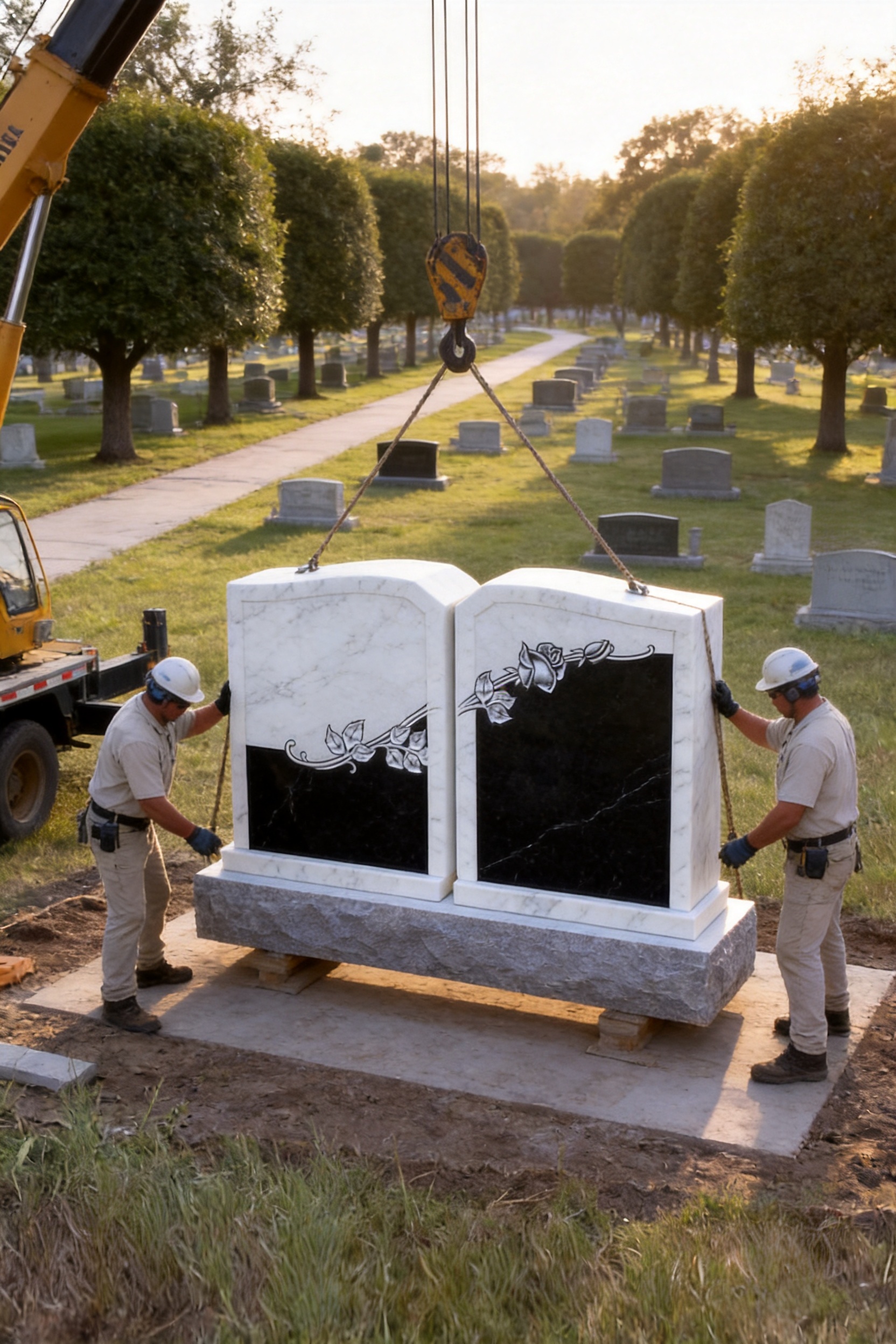
A memorial should do more than identify a burial place. It should preserve a relationship, communicate a family story, and provide a dignified point of remembrance for generations to come. The Black-and-White Contrast Rose-Pattern Marble Tombstone is designed around that purpose. Created for a couple buried together, this double memorial combines durable natural stone, restrained contemporary styling, carefully organized inscription space, and rose ornamentation that expresses affection without overwhelming the solemn character of a cemetery.
The monument uses a black-and-white visual contrast to make names, dates, and engraved details easy to recognize. Its rose pattern introduces a gentle symbolic element, representing enduring companionship and the continuing bond between two people. Rather than relying on excessive decoration, the design creates meaning through proportion, contrast, and carefully selected imagery.
Available in practical memorial dimensions, the tombstone can be specified at approximately 1.2 meters high by 1.5 meters wide and 0.2 meters thick, or at approximately 1.6 meters high by 1.8 meters wide and 0.25 meters thick. The quoted prices are US$2,350 for the smaller configuration and US$5,500 for the larger configuration. These options allow families, cemeteries, designers, and memorial professionals to select a scale appropriate to the burial space and the amount of information to be displayed.
Manufactured by Jiangsu Xinyesheng Sculpture Co., Ltd., the monument reflects the company’s focus on custom sculpture production, natural-stone fabrication, and memorial design. The manufacturer’s experience in producing sculpture and architectural forms supports a process that can combine design interpretation, stone selection, shaping, surface finishing, inscription preparation, and inspection into one coordinated workflow.
Content
The central purpose of this tombstone is to commemorate a couple in a single, unified monument. A double burial marker must acknowledge two individuals while also expressing the relationship that connects them. The design therefore provides a broad horizontal composition suitable for two names, shared dates, family information, and a central or balanced decorative arrangement.
Many ordinary grave markers focus primarily on individual identification. They may provide a name, birth date, death date, and a short inscription, but they do not always create a strong visual connection between two people. This rose-pattern marble tombstone is different because the full composition is planned around joint remembrance. The broad monument width creates room for two identities without making the stone appear crowded, while the paired presentation reinforces the idea of a shared life.
The monument can include the couple’s names, wedding date, family relationships, and other selected details. Depending on cemetery requirements and the family’s wishes, the inscription area may also accommodate a short epitaph, religious phrase, dedication, or statement of enduring love. The layout can be arranged symmetrically or adapted to the family’s preferred style.
Its design is particularly suitable for spouses who wish to be remembered together, parents whose children want to emphasize their lifelong partnership, or families seeking a single permanent memorial for a shared burial space. It can also be adapted for other close relationships when the cemetery permits a double or companion memorial.
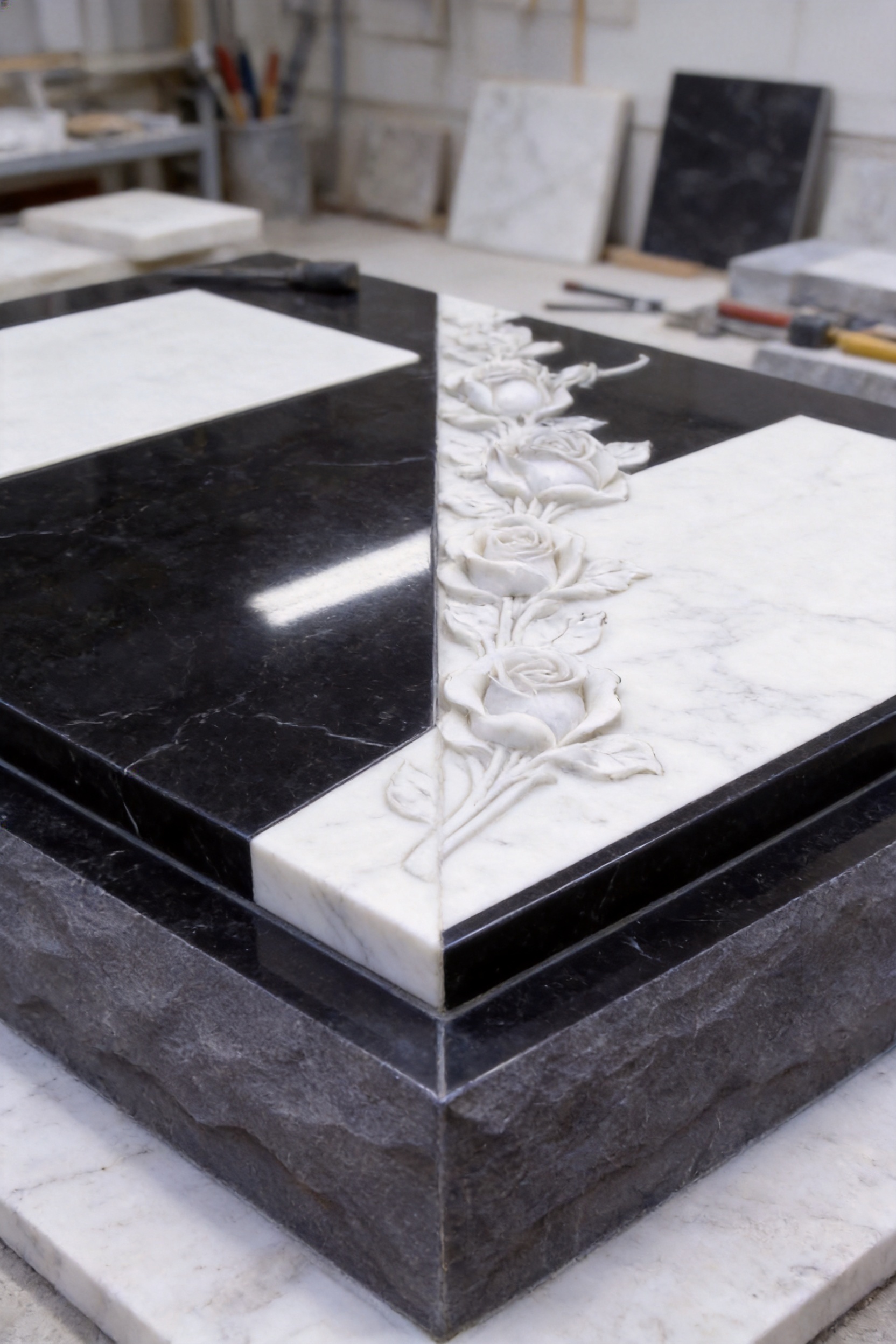
Color selection has a major effect on the emotional and practical character of a tombstone. Black marble provides depth, dignity, and visual seriousness. White marble or white contrasting details introduce clarity and balance. Together, these colors create a refined appearance that is solemn without feeling excessively heavy.
The contrast makes the monument easier to read from a reasonable viewing distance. Light-colored lettering, decorative elements, or polished sections stand out against a dark background, while dark details can provide definition on lighter stone areas. This approach is especially useful when the monument must remain visually legible in changing outdoor conditions.
Black and white also give the tombstone a timeless quality. Traditional memorials often use dark stone because it conveys permanence and respect. Contemporary memorial design frequently uses simple geometric organization and controlled contrast. This product combines both approaches. The result is a monument that can harmonize with traditional cemetery surroundings while still appearing clean and modern.
Compared with a highly colorful or heavily ornamented memorial, the black-and-white composition is less likely to appear dated. The restrained palette keeps attention on the people being commemorated. It also makes the rose pattern more meaningful because the floral element becomes a deliberate symbol instead of one decorative feature among many.
Roses have long been associated with love, devotion, beauty, remembrance, and spiritual continuity. On this tombstone, the rose pattern softens the formal appearance of the stone and introduces a human emotional dimension. The flowers can be positioned as a central feature, an upper border, side ornaments, or balanced elements around the inscription area, depending on the final design.
The rose is particularly appropriate for a couple’s memorial because it suggests affection that remains meaningful beyond a lifetime. Its form can symbolize the beauty of a shared marriage, while the permanence of the marble supports the idea of memory enduring through time.
The floral motif also prevents the monument from appearing overly institutional. A simple rectangular stone may communicate information effectively, but it can lack warmth. The rose pattern adds visual softness without compromising the dignity required in a cemetery. This balance is one of the principal strengths of the design.
Families may choose to preserve the rose pattern exactly as presented or use it as a starting point for a personalized arrangement. Additional floral details, anniversary references, initials, or small symbolic elements may be considered when permitted by the cemetery and appropriate to the stone’s proportions.
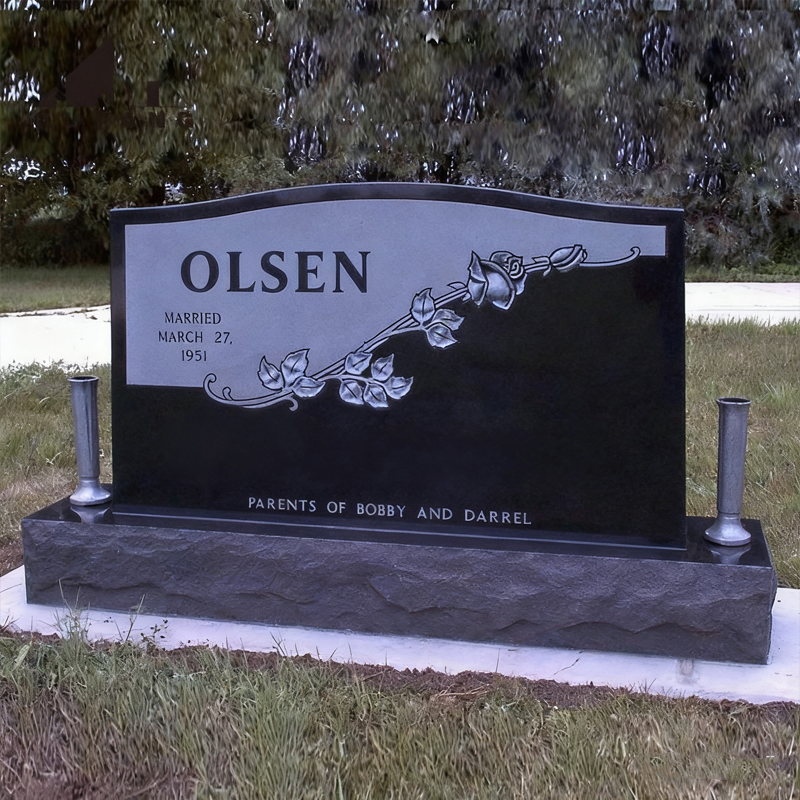
Black-and-White Contrast Rose-Pattern Marble Tombstone
Marble is valued in memorial construction because it combines natural beauty, substantial weight, and a surface suitable for detailed finishing. The material has been used for monuments, public sculpture, architectural interiors, and commemorative structures for centuries. Its veining, density, and polished appearance give each completed piece a character that manufactured substitutes cannot fully reproduce.
The proposed tombstone is described as using high-density black marble with contrasting white elements. High-density stone provides a solid foundation for an outdoor memorial. It can withstand normal exposure to wind, rain, seasonal temperature changes, and sunlight when selected, fabricated, installed, and maintained appropriately.
Marble is also well suited to lettering and ornamental work. Its surface can be polished, honed, carved, engraved, or combined with contrasting stone sections. This flexibility allows the manufacturer to coordinate the text, rose motifs, edges, and background surfaces as parts of one visual system.
No natural stone is completely unaffected by its environment. Long-term appearance depends on the particular quarry source, mineral composition, local climate, installation conditions, cleaning methods, and maintenance schedule. Nevertheless, a properly selected and professionally fabricated marble monument can provide a durable and dignified memorial surface for many years.
A cemetery monument remains outdoors through all seasons, so durability must be evaluated in practical terms. The stone must retain sufficient structural strength, maintain stable lettering, resist surface deterioration, and remain visually recognizable after repeated exposure to weather.
The high-density black marble specified for this product is intended to resist common outdoor stresses, including wind, rain, and ultraviolet exposure. Its dark surface supports a strong visual presence, while the contrasting details help preserve legibility. A carefully finished surface also makes routine dust and light atmospheric deposits easier to identify and remove.
Durability is not determined by the stone alone. Correct thickness, secure anchoring, a stable foundation, proper drainage, and professional installation are equally important. The recommended thicknesses of approximately 0.2 meters for the smaller monument and 0.25 meters for the larger monument provide substantial mass for a memorial of this type. The supporting base, listed at approximately 0.3 to 0.4 meters in width, must be engineered and installed in accordance with local cemetery rules and ground conditions.
The manufacturer and installation team should confirm the final dimensions, weight, anchoring method, foundation requirements, and transportation arrangements before production. This is particularly important for the larger 1.6-meter-high by 1.8-meter-wide configuration, which requires appropriate lifting and setting equipment.
The design dimensions are intended to create a balanced monument rather than a small plaque or an oversized architectural structure. The smaller option, approximately 1.2 meters high and 1.5 meters wide, offers enough space for two names and a moderate amount of inscription while remaining suitable for a compact burial plot.
The larger option, approximately 1.6 meters high and 1.8 meters wide, provides greater visual presence and more room for family information, longer inscriptions, or a more elaborate rose arrangement. It may be appropriate for a prominent family plot, a cemetery with larger memorial allowances, or families that want a stronger architectural statement.
The listed stone thicknesses help preserve the monument’s visual solidity. A memorial that is too thin may appear fragile, while excessive thickness can add unnecessary weight and cost. The specified proportions seek a practical balance between strength, appearance, and material efficiency.
The base is equally important. It visually anchors the upright stone and transfers its weight to the foundation. A properly proportioned base can also provide a transition between the monument and the surrounding ground surface. Its final design should account for the cemetery’s regulations, nearby memorials, planting, drainage, and maintenance access.
| Configuration | Approximate Height | Approximate Width | Approximate Thickness | Quoted Price |
|---|---|---|---|---|
| Compact double memorial | 1.2 meters | 1.5 meters | 0.2 meters | US$2,350 |
| Large double memorial | 1.6 meters | 1.8 meters | 0.25 meters | US$5,500 |
The dimensions and prices should be confirmed at the quotation stage because final costs may depend on stone selection, inscription complexity, edge treatment, custom ornamentation, packaging, shipping, installation, and local cemetery requirements.
The first advantage is the design’s direct response to a shared burial. Instead of placing two unrelated individual markers side by side, the monument presents the couple as a connected unit. This creates a more coherent visual statement and can make the memorial space feel more unified.
The black-and-white palette establishes a hierarchy between the stone, inscription, and ornamental details. Names and dates can remain the most important information, while the rose pattern supports the emotional message. This is preferable to a design in which decoration competes with the identity of the people being remembered.
Some memorial products are strongly traditional, while others are so minimal that they lose emotional warmth. This tombstone occupies a useful middle ground. Its contrast and simple structure create a contemporary appearance, while the rose motif retains a familiar and emotionally accessible symbol.
The wider horizontal format offers more space than a narrow individual headstone. The couple’s names can be arranged with equal importance, and shared milestones such as a wedding date can be placed prominently. Family relationships and a short dedication may also be integrated into the composition.
Strong contrast helps the memorial remain identifiable in a busy cemetery. The combination of dark marble and lighter details can make the stone easier to distinguish among neighboring monuments. This is a practical advantage for family members returning to visit after many years.
Two principal size options make the product suitable for different plots and budgets. The smaller version supports a dignified memorial where space is limited, while the larger version offers additional impact and inscription capacity. This flexibility is more useful than a single fixed size that may not suit every cemetery.
Jiangsu Xinyesheng Sculpture Co., Ltd. is identified as a sculpture manufacturer and supplier capable of producing custom stone and metal works. For a memorial of this type, the value of a manufacturer lies not only in access to raw material but also in the ability to coordinate design, fabrication, finishing, and delivery.
A professional production process begins with the customer’s requirements. The manufacturer can review the burial plot dimensions, cemetery regulations, preferred inscription, selected size, decorative expectations, and delivery location. This information is then translated into a proposed drawing or layout for approval before fabrication.
The stone selection stage is critical. The manufacturer should evaluate the slab or block for color consistency, structural integrity, natural veining, surface defects, and suitability for the intended finish. Because the visual impact of this product depends heavily on black-and-white contrast, the relationship between the dark and light sections should be reviewed before cutting.
Once the design is approved, the stone can be marked and cut according to the specified dimensions. Professional stone-processing equipment helps maintain straight edges, consistent thickness, accurate angles, and repeatable proportions. For a wide memorial, dimensional accuracy is especially important because even a small deviation can affect the alignment of the two sides or the fit between the upright slab and base.
Edge shaping and surface preparation follow the primary cutting stage. Edges may be squared, beveled, softened, or given another approved treatment. The surface can be polished or honed depending on the required appearance and the desired relationship between reflective and matte areas.
The rose pattern and inscription require careful coordination. Artwork can be converted into a production template so that the scale, location, and spacing remain consistent with the approved design. The manufacturer should verify spelling, dates, capitalization, family names, and all other inscription details before permanent work begins.
Depending on the chosen design, letters and floral motifs may be engraved, carved, sandblasted, finished with contrasting color, or produced through a combination of techniques. The exact method should be selected according to the marble’s characteristics, the desired depth, the visibility requirements, and the expected outdoor conditions.
After fabrication, the individual components should be cleaned, inspected, and checked for fit. A responsible quality-control process examines the overall dimensions, surface finish, inscription accuracy, edge condition, decorative balance, and packaging security. Photographs or approval records can be used to document the completed monument before shipment.
These coordinated stages are particularly important for custom memorials because the finished product cannot be evaluated only as a raw material purchase. The emotional importance of the monument makes accuracy, consistency, and communication essential parts of manufacturing quality.

A memorial often contains information that cannot be corrected casually after production. Names, dates, relationships, and quotations must therefore be confirmed carefully. The manufacturer’s custom-design capability is a significant advantage for families and professional buyers who want a product adapted to specific requirements.
The collaboration process can begin with a written design brief. This brief may include the names of the deceased, birth and death dates, wedding date, preferred wording, cemetery plot dimensions, desired rose arrangement, selected stone colors, and any religious or cultural considerations.
A preliminary layout should show how the names relate to one another, where the wedding date will be positioned, and how much space remains for family information. The rose pattern should be considered at the same time. If the flowers are too large, they may compete with the names. If they are too small, their symbolic role may be lost. Proportion is therefore as important as ornament.
Clients may request a symmetrical composition, with each person’s name given equal visual weight. Another option is a shared central inscription with names arranged on either side. A third arrangement may use a large rose motif between the two names, visually joining them. The appropriate solution depends on the family’s story and the cemetery’s design standards.
Color contrast can also be customized within the limits of the available marble. A family may prefer a predominantly black face with white lettering, a black-and-white split composition, or a lighter stone background with dark engraved details. The final decision should consider readability, maintenance, and the natural variation of stone.
Good inscription planning makes the monument both beautiful and useful. The most important information should be immediately visible, while secondary details can be positioned in supporting areas.
The couple’s names are normally the primary content. They may be displayed on separate lines, aligned horizontally, or combined with a shared family name. Birth and death dates can be placed below each name, while the wedding date may occupy a central line that emphasizes the couple’s life together.
Family relationships can be expressed through phrases such as beloved husband and wife, devoted parents, or cherished grandparents, subject to the family’s wishes. A short epitaph may add emotional meaning, but excessive text can reduce readability and make the surface appear crowded.
Before approval, customers should check every letter and number. Particular attention should be given to spelling, date formats, punctuation, initials, and the order of names. The approved inscription should be retained as the reference document for production.
Typography should match the monument’s character. Traditional serif lettering can complement the timeless quality of marble, while a clean sans-serif style may reinforce the contemporary contrast. Letter size, depth, spacing, and finish should be selected for visibility from the normal approach path.
The surface finish influences both appearance and care. A polished finish reflects light and can make black marble appear deep and rich. It may also enhance the contrast between the dark background and lighter inscriptions. A honed finish is softer and less reflective, which may suit families seeking a more understated appearance.
Different areas of the same monument may use controlled variations in finish. For example, a polished face can provide clarity for names, while a subtly textured decorative area can give the rose pattern additional definition. Any combination should be approved through a design sample or visual rendering before production.
Routine maintenance generally involves removing dust, leaves, soil, and bird deposits with clean water and a soft cloth or soft brush. Harsh acids, abrasive powders, wire brushes, and unapproved chemical cleaners should be avoided because they may damage the finish, alter the appearance of the stone, or weaken decorative details.
Cleaning procedures should also comply with cemetery policies. In some locations, maintenance may be performed only by authorized personnel. Families should ask the cemetery about cleaning, flower placement, seasonal access, and restrictions on waxes, sealants, or decorative attachments.
A professional inspection is useful after severe weather, accidental impact, ground movement, or nearby construction. The inspection should check the stability of the base, the condition of the anchoring system, visible cracks, water accumulation, and any changes in alignment.
Before ordering, buyers should confirm that the selected size is allowed by the cemetery. Regulations may control the maximum height, width, thickness, foundation type, base dimensions, inscription content, surface finish, and installation method.
The listed dimensions are product specifications rather than a substitute for local approval. The cemetery may require an engineering drawing, foundation plan, proof of ownership, or written authorization. The final design should be adjusted if the plot is narrower or if neighboring monuments limit the available space.
Installation should be performed by qualified personnel with appropriate lifting equipment. Marble is heavy, and an upright monument must be positioned securely. The foundation should be level, adequately supported, and designed to reduce the risk of settlement or tilting.
Transportation also requires planning. The stone should be protected from impact, vibration, moisture-related packaging problems, and shifting during transit. Corners and finished surfaces deserve particular protection. The manufacturer should communicate packing details and delivery procedures clearly with the buyer or installation contractor.
These practical steps protect both the product and the people handling it. A beautiful memorial cannot fulfill its purpose if it is damaged during delivery or installed without sufficient support.
For families, the product offers a complete visual concept rather than a blank stone requiring extensive design development. The black-and-white palette, rose motif, and companion-burial layout already establish a coherent direction, while customization remains possible.
For cemetery designers and memorial retailers, the two size options provide a straightforward starting point for client consultations. The product can be presented as a modern joint-burial memorial that retains the familiar dignity of natural stone. Its design can also serve as a base model for variations in inscription, surface finish, and ornamental arrangement.
For international buyers, working with an experienced sculpture manufacturer can simplify the coordination of material sourcing, custom artwork, fabrication, inspection, and export preparation. Jiangsu Xinyesheng Sculpture Co., Ltd. can be contacted for project-specific information, including design confirmation, production scheduling, packaging, and shipping arrangements.
Price should be evaluated in relation to the full scope of work. The quoted US$2,350 and US$5,500 figures identify the two stated stone configurations, but buyers should verify whether freight, duties, local installation, cemetery charges, foundation work, and special finishing are included. A detailed quotation avoids confusion and supports accurate budgeting.
Granite is often selected for memorials because of its hardness and broad range of colors. It can be an excellent material, but marble offers a different visual character. Marble’s softer visual texture and classic association with sculpture can make it especially suitable for a memorial that emphasizes love, elegance, and artistic form.
Concrete markers may offer lower initial costs, but they generally do not provide the same natural depth, polished appearance, or sculptural refinement. Artificial stone can provide consistency, yet it may lack the individual mineral character found in a natural marble slab.
Metal memorials can create a strong contemporary impression, but they require different considerations regarding corrosion, coatings, surface temperature, and long-term finish stability. The marble tombstone avoids those particular concerns while offering substantial mass and a traditional cemetery presence.
Compared with a basic single-color stone, the black-and-white design provides greater contrast and a more distinctive identity. Compared with an excessively elaborate monument, it is more restrained and easier to integrate into a range of cemetery environments. This balance is a key competitive advantage.
It is primarily designed for a couple buried together. The broad format allows two names and shared relationship information to be presented in one unified memorial. It may also be adapted for other companion burials if permitted by the cemetery.
The rose pattern symbolizes love, devotion, remembrance, and enduring companionship. In this design, it softens the solemnity of the black marble and visually expresses the continuing connection between the two people being commemorated.
The design can accommodate the couple’s names, birth and death dates, wedding date, family relationships, and a short epitaph. The exact amount of information depends on the chosen size, lettering style, and cemetery regulations.
The stated options are approximately 1.2 meters high by 1.5 meters wide by 0.2 meters thick, and approximately 1.6 meters high by 1.8 meters wide by 0.25 meters thick. The base width is described as approximately 0.3 to 0.4 meters. Final dimensions should be confirmed before production.
The compact configuration is quoted at US$2,350. The larger configuration is quoted at US$5,500. These prices should be reconfirmed because customization, packing, shipping, installation, taxes, and cemetery charges may affect the final project cost.
High-density marble is intended for long-term outdoor memorial use and can withstand normal exposure to wind, rain, and sunlight when properly selected, fabricated, installed, and maintained. Local environmental conditions and installation quality should always be considered.
Yes. The inscription, rose arrangement, typography, proportions, surface finish, and color balance may be discussed with the manufacturer. Any customization must remain compatible with the available stone, production methods, cemetery regulations, and structural requirements.
Routine cleaning with clean water and a soft cloth or soft brush is generally appropriate. Abrasive tools and harsh chemicals should be avoided. Buyers should follow the cemetery’s maintenance rules and consult a qualified professional for stains, damage, or instability.
The supplied product information lists prices for the stated monument configurations but does not specify all included services. Buyers should request a complete quotation that identifies whether packing, export preparation, freight, insurance, foundation work, local delivery, and installation are included.
Buyers should provide the complete inscription and plot requirements, review a layout or production drawing, verify every name and date, approve the stone and finish, and confirm the final dimensions before fabrication begins.
A specialized sculpture manufacturer can coordinate material selection, custom drawing, stone cutting, decorative work, finishing, inspection, and packaging. This integrated approach is valuable when a memorial includes both functional inscription and artistic ornamentation.
A successful order begins with accurate information. The buyer should prepare the cemetery plot measurements, applicable regulations, names and dates, preferred quotation, inscription wording, delivery location, and desired installation schedule.
The next step is design confirmation. The manufacturer should provide a layout showing the monument’s overall proportions, location of the rose pattern, inscription hierarchy, color contrast, base relationship, and any special edge treatment. The family should review the design carefully and obtain approval from the cemetery where necessary.
Material confirmation should identify the intended black marble and contrasting white marble, including any expected natural variation. Since natural stone is unique, the appearance of a final monument may differ slightly from a digital image or small sample. This variation is part of the character of natural marble, but it should be discussed before production.
Production timing depends on design complexity, material availability, fabrication workload, inspection requirements, and delivery distance. Buyers should request a realistic schedule rather than assuming that a custom memorial can be completed immediately.
Once finished, the monument should be inspected against the approved drawing. The inspection should cover dimensions, text, dates, color placement, rose details, surface quality, and component fit. Only after this review should the stone be packed for shipment or released for installation.
Jiangsu Xinyesheng Sculpture Co., Ltd. is based at No. 103, Building 22, No. 1585 Xicheng Road, Qingyang Town, Jiangyin City, Jiangsu Province, China. The company provides sculpture manufacturing and custom product communication for buyers seeking stone or metal artistic works.
For product inquiries, buyers may contact the company by telephone at +86-13812599789 or +86-18914187530, or by email at postmaster@xingyesheng.com. Communication should include the product name, desired size, inscription requirements, destination, and any cemetery documentation available.
When discussing a project, buyers should ask for information about stone availability, surface treatment, production drawings, quality inspection, packing, delivery terms, and installation coordination. Clear communication is especially important for memorial products because the design is personal, the inscriptions are permanent, and the finished monument may need to satisfy local regulations.
The Black-and-White Contrast Rose-Pattern Marble Tombstone offers a thoughtful answer to the challenge of commemorating two people in one dignified structure. Its broad companion-burial format creates a clear connection between the individuals, while the black-and-white palette gives the monument visual strength and long-term readability. The rose pattern adds warmth and expresses the idea of eternal companionship without overpowering the names and dates that form the memorial’s central purpose.
Its use of high-density marble, substantial proportions, contrasting surfaces, and custom inscription space gives it advantages over ordinary single-person markers and overly decorative alternatives. The two available configurations provide flexibility for different burial plots, information requirements, and budgets.
The product’s success ultimately depends on more than its appearance. Accurate design development, responsible stone selection, precise cutting, careful inscription, quality inspection, secure packaging, and professional installation are all essential. A manufacturer with sculpture-production experience can bring these stages together and help transform a family’s wishes into a permanent work of remembrance.
For families seeking a memorial that is modern yet timeless, personal yet restrained, and emotionally warm yet appropriately solemn, this marble tombstone provides a strong and meaningful choice. It is designed not merely to mark a place, but to preserve the story of a shared life in stone.
1. Product specification supplied for the Black-and-White Contrast Rose-Pattern Marble Tombstone, including dimensions, materials, design purpose, and quoted prices.
2. General principles of natural-stone selection, fabrication, surface finishing, inscription, and outdoor monument maintenance.
3. Common cemetery planning practices concerning memorial dimensions, foundations, anchoring, installation, and plot compatibility.
4. Traditional and contemporary memorial-design principles concerning visual hierarchy, symbolism, legibility, proportion, and personalization.
5. General reference knowledge regarding marble sculpture, architectural stonework, floral symbolism, and commemorative design.



Daniel H.

Amanda R.

Robert B.

Jennifer S.

James W.

Barry G.

Michael T.

Emily K.

David L.

Sarah M.


Mikey XV

Jagxue

 English
 Español
 عربى
عربى Français
 italiano
 Deutsch