Public art has become an important part of how streets, commercial districts, cultural destinations, and landscaped environments are experienced. A well-designed sculpture can provide more than decoration: it can create a recognizable landmark, invite interaction, support local identity, and encourage people to pause rather than simply pass through. The Stainless Steel Mouse Sculpture is designed for this purpose. Combining a playful animal form with a reflective metal surface, it introduces humor, movement, and visual interest into both traditional and modern surroundings.
This sculpture presents a stylized mouse in an anthropomorphic posture, giving the subject a friendly and approachable character. Its clear animal recognition makes it easy for visitors of different ages to understand, while the simplified cartoon-inspired expression allows it to fit naturally into commercial environments, tourism areas, family-oriented attractions, creative parks, and revitalized old-town streets. The design is decorative without becoming visually aggressive, making it suitable for locations that require a welcoming and memorable public-art feature.
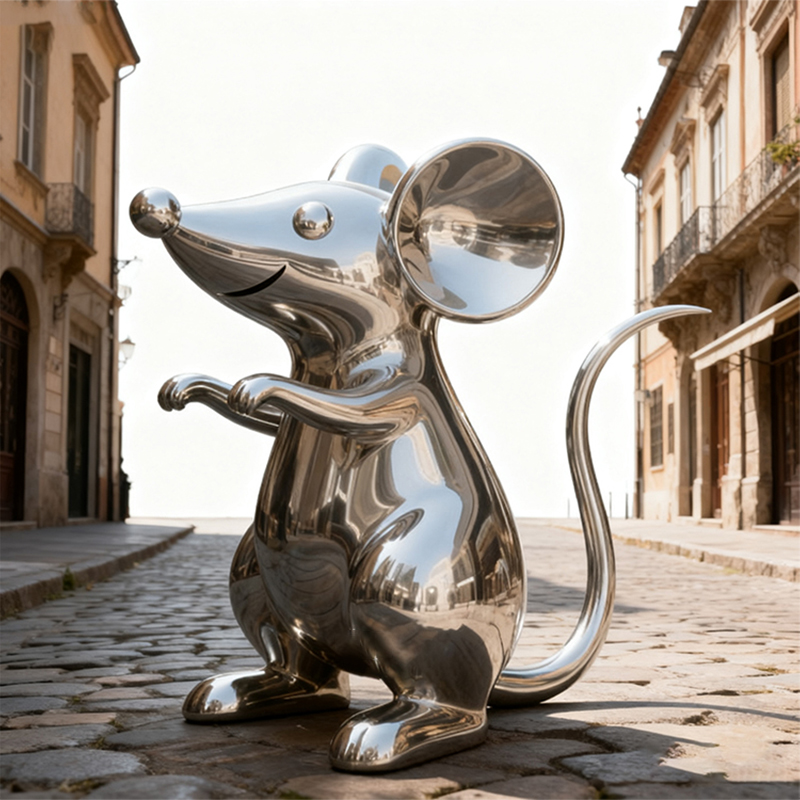
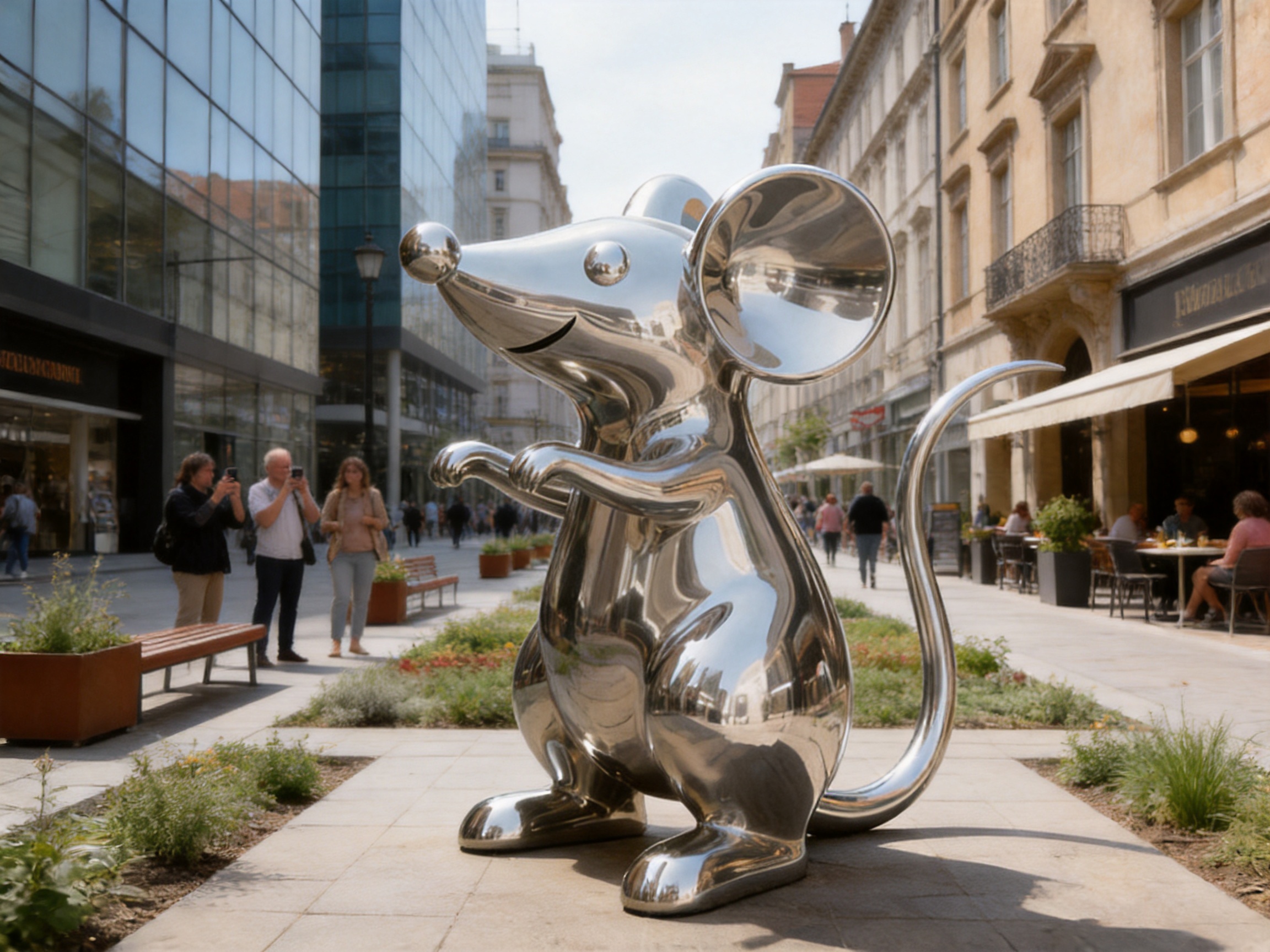
Manufactured from 304 stainless steel and finished with a mirror-polished surface, the sculpture is intended for long-term outdoor use. The material offers strong resistance to corrosion, while the polished exterior reflects nearby buildings, trees, lighting, pedestrians, and changing weather conditions. As a result, the sculpture does not appear exactly the same throughout the day. It continuously interacts with its surroundings, creating a changing visual experience that helps the artwork feel integrated into the landscape.
The available height is approximately 200–300 centimeters, with a listed price range of USD 4,544.77–7,498.89. Since public-art projects often involve different site dimensions, circulation patterns, and visual requirements, the sculpture supports customization in size and surface finishing. This flexibility allows buyers to order a version that is better matched to the scale and atmosphere of a particular location.
Stainless Steel Mouse Sculpture
Content
The Stainless Steel Mouse Sculpture is based on a familiar animal subject but presents it in an enlarged, artistic format. A mouse is normally associated with small scale and quick movement. Enlarging the figure to approximately two or three meters changes that familiar impression and gives the subject a surprising public presence. Visitors can recognize the animal immediately, yet the unusual scale encourages them to look again, approach the sculpture, and take photographs.
The anthropomorphic treatment adds another layer of communication. Rather than presenting a strictly realistic animal, the sculpture uses an expressive posture that can suggest curiosity, playfulness, alertness, or friendliness. This creates a stronger emotional connection than an ordinary decorative object. In a commercial district, the sculpture can make an otherwise standardized walkway feel more distinctive. In a cultural tourism area, it can function as a visual marker that visitors associate with a particular street or destination.
The design also benefits from visual simplicity. A complicated sculpture may require extensive explanation before viewers understand its subject. The mouse form, by contrast, is immediately legible. Its silhouette can be appreciated from a distance, while the reflective surface becomes more engaging as people move closer. This two-stage experience is valuable in public spaces: the sculpture first attracts attention through scale and outline, then rewards closer observation through surface detail and environmental reflections.
Because the sculpture is not tied to a highly specific narrative, it can be integrated into many project themes. It may complement a retro street, add a humorous contrast to a formal plaza, support a family-friendly shopping area, or contribute a contemporary accent to a landscaped park. The neutral subject also makes it easier for owners to connect the sculpture with local branding, seasonal programs, community activities, or photography campaigns.
Material selection is one of the most important decisions in public sculpture. Outdoor artwork must tolerate moisture, airborne pollutants, temperature changes, dust, sunlight, accidental contact, and regular cleaning. Stainless steel is widely used for these conditions because it combines structural reliability with a clean architectural appearance. For this product, 304 stainless steel provides a practical balance between corrosion resistance, workability, surface quality, and cost.
304 stainless steel is suitable for many outdoor environments because its chromium content supports the formation of a passive protective layer on the surface. This layer helps the metal resist ordinary atmospheric corrosion. The result is a material that is better suited to long-term public display than many untreated carbon-steel alternatives. While no metal is completely maintenance-free in every environment, 304 stainless steel can offer dependable performance when properly fabricated, installed, and maintained.
The material is also well suited to sculptural fabrication. Stainless-steel sheet can be cut, formed, rolled, bent, and welded into complex three-dimensional shapes. This enables manufacturers to create rounded bodies, tapered ears, curved limbs, expressive contours, and smooth transitions that would be difficult to achieve with less workable materials. The ability to form the metal accurately is particularly important for an animal sculpture, where a small change in proportion can affect the character of the entire figure.
Compared with painted metal, mirror-polished stainless steel provides a different kind of visual durability. Painted surfaces may eventually fade, chip, or require recoating. A polished stainless-steel surface does not depend on a separate color layer to create its primary appearance. Its visual effect comes from the metal itself and from the quality of the polishing work. This can reduce concerns about peeling paint and allows the sculpture to maintain a modern appearance when routine cleaning is performed.
Compared with stone, stainless steel is generally more adaptable in terms of form, surface treatment, and transportation. Stone sculptures can have substantial weight and may require larger foundations or specialized lifting equipment. Stainless steel can be fabricated as a carefully engineered hollow structure, reducing unnecessary mass while preserving a strong exterior form. This can simplify handling, shipping, and installation, although the final foundation and anchoring requirements must still be determined according to the sculpture’s dimensions and site conditions.
One of the most important advantages of this sculpture is its ability to communicate quickly. The mouse is a familiar subject, and its enlarged form can be identified from a distance. This makes it effective in areas where people are moving through the space and may only have a few seconds to notice a landmark. Once visitors recognize the subject, the playful posture and reflective finish create reasons to stop and take photographs.
In an era when social media images influence destination awareness, a sculpture that photographs well can provide continuing promotional value. The mirror surface reflects people and surroundings, producing images that change according to the visitor, weather, time of day, and camera angle. Each photograph can therefore look slightly different. This variety may encourage visitors to share their own images rather than seeing the sculpture as a static object that has already been photographed from only one viewpoint.
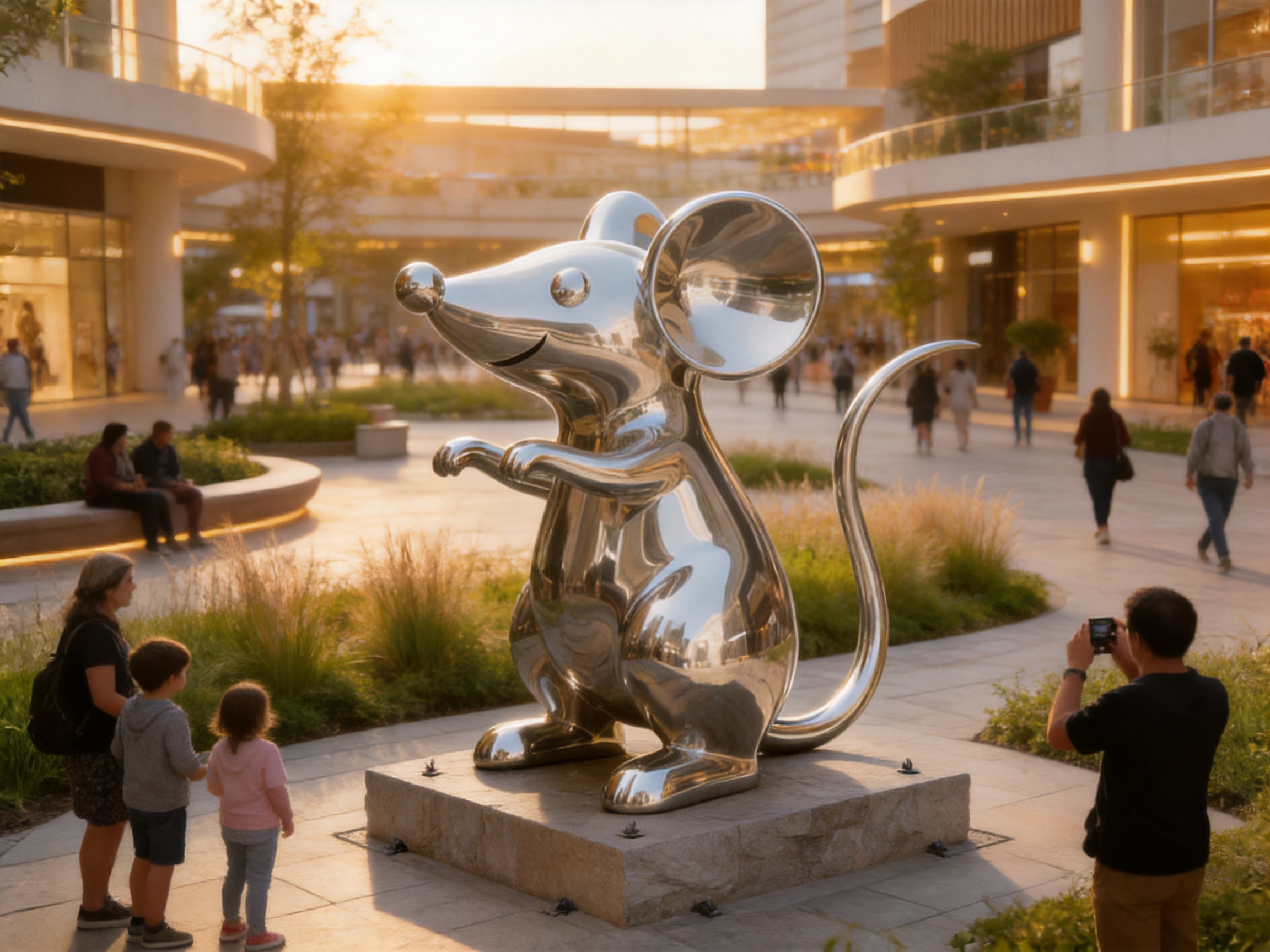
The mirror-polished surface is a major visual differentiator. Instead of presenting one fixed color, it captures fragments of the surrounding environment. Brick façades, shop signs, trees, streetlights, clouds, and moving pedestrians can all appear as distorted reflections across the curved body. This allows the sculpture to change with its context and creates a visual relationship between the artwork and its location.
Many outdoor statues rely on bronze patina, painted color, or a matte finish to establish their identity. Those finishes can be attractive, but they tend to remain visually consistent regardless of the surrounding landscape. The polished stainless-steel mouse offers a more interactive appearance. It becomes brighter under direct light, more atmospheric under cloudy skies, and more dramatic when illuminated at night. This flexibility makes it useful for sites that experience different lighting conditions throughout the day.
The sculpture’s subject and finish give it broad placement potential. In a commercial district, it can soften the hard lines of retail architecture and provide a friendly landmark near entrances, plazas, or pedestrian routes. In an old-town street, its contemporary metal surface can create an intentional contrast with traditional façades while its humorous animal form keeps the contrast approachable rather than severe.
In cultural tourism environments, the sculpture can become part of a visitor circulation strategy. It may be positioned near a rest area, a street intersection, a viewing platform, or an outdoor activity zone. In family-oriented spaces, its approachable shape can attract children and adults alike. In creative parks and design districts, it can reinforce an atmosphere of experimentation and visual play.
Standardized public art does not always suit every site. A sculpture that is appropriate for a broad plaza may appear too large in a narrow lane, while a small version may lose visibility in a busy commercial square. The available approximate height of 200–300 centimeters provides a substantial visual presence, and customization can help adjust the final dimensions to meet project requirements.
Surface finishing can also be adapted. A mirror polish creates the strongest reflective effect, but some projects may require a softer satin appearance, selected polished sections, or a combination of textures. Custom finishing allows the buyer to consider nearby architecture, lighting, branding, and maintenance expectations. It also gives designers an opportunity to create contrast between different parts of the mouse, such as the body, ears, facial details, or base.
304 stainless steel offers a strong foundation for an outdoor sculpture that must remain attractive over time. Its corrosion resistance is a practical advantage in ordinary urban and landscaped environments. The smooth surface also limits the amount of dirt that can remain attached compared with heavily textured finishes. When dust, fingerprints, or atmospheric deposits appear, the surface can generally be cleaned using appropriate non-abrasive methods.
Regular maintenance remains important. Stainless steel should not be treated as completely maintenance-free, particularly in locations exposed to salt, industrial emissions, construction dust, or contaminated runoff. However, its resistance to corrosion and ease of cleaning can help reduce the frequency and complexity of appearance-related maintenance when compared with materials that require repainting or sealing.
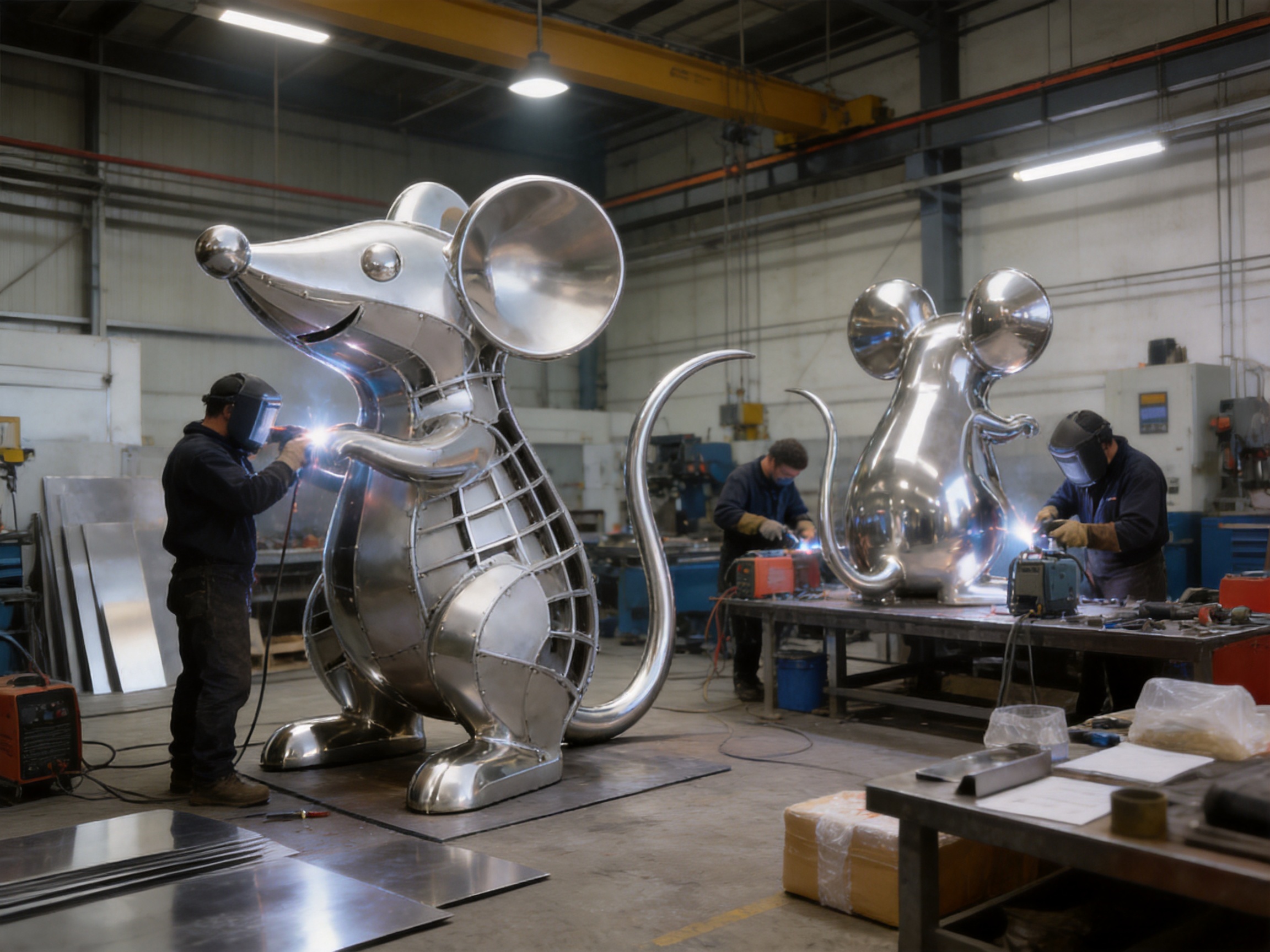
The visual simplicity of a polished animal sculpture depends on a carefully controlled manufacturing process. A successful result requires more than cutting metal into a recognizable outline. The manufacturer must coordinate design interpretation, structural planning, sheet-metal forming, welding, grinding, polishing, inspection, packaging, and installation preparation. Each stage affects the final appearance and long-term performance of the finished work.
The process begins with the interpretation of the selected mouse design. The manufacturer reviews the overall height, width, depth, posture, center of gravity, viewing angles, and intended installation environment. Since the sculpture may be seen from all sides, the form must be coherent in three dimensions rather than only attractive from a front elevation.
Proportion control is especially important for an anthropomorphic animal figure. The head, ears, body, limbs, and tail must work together to preserve mouse-like recognition. At the same time, the posture must remain stable and expressive. A manufacturer with experience in custom sculpture production can identify areas that may need reinforcement without making the external form appear heavy or awkward.
For larger orders or customized versions, digital modeling and technical drawings can help establish dimensions before production begins. These materials may be used to review the silhouette, confirm attachment points, plan internal support, and coordinate the foundation with the project contractor. Clear pre-production communication can reduce misunderstandings and improve consistency between the approved concept and the completed sculpture.
Once the design and specifications are confirmed, 304 stainless-steel sheets and related components are prepared. Material thickness should be selected according to the sculpture’s dimensions, curves, structural requirements, and installation conditions. Different sections may require different forming approaches or reinforcement methods.
Material preparation includes checking the sheet condition, removing contamination, organizing components, and transferring cutting information accurately. Keeping stainless steel clean during fabrication is important because iron particles from ordinary steel tools or nearby processes can contaminate the surface and later contribute to rust staining. Good workshop organization and appropriate tooling practices are therefore part of achieving a durable polished result.
The external skin of a sculpture is typically divided into manageable sections. These may include curved body panels, head sections, ears, legs, tail elements, and other details. Precision cutting allows each component to fit more closely during assembly, reducing unnecessary gaps and minimizing the amount of corrective grinding required later.
Forming operations then transform flat sheets into three-dimensional components. Rolling, bending, pressing, and manual shaping may be used depending on the geometry. Rounded sections of the mouse body require smooth curvature, while smaller parts may need more detailed forming to preserve the intended expression. The objective is to create continuous, natural lines rather than abrupt transitions or visible distortions.
Advanced manufacturing in this context is not limited to one machine or one technique. It is the coordinated use of accurate measurement, suitable forming methods, skilled metalwork, and quality control. Custom sculpture production often requires a balance between digital precision and artisan judgment. Digital planning helps establish repeatable dimensions, while experienced fabricators make practical adjustments when material behavior or three-dimensional assembly requires them.
A public sculpture must remain stable after installation. The outer skin provides the visible form, but an internal framework or reinforcement system may be required to support the shape and transfer loads to the base. The internal structure should be planned around the sculpture’s height, weight distribution, posture, wind exposure, and anchoring arrangement.
For an anthropomorphic mouse, the design may include projecting elements such as ears, limbs, or a tail. These areas can be more vulnerable to accidental impact or wind forces than the central body. Appropriate reinforcement can help maintain alignment and reduce deformation risk. The exact structural solution should be determined through project-specific engineering review, especially when the sculpture is installed in a high-wind area, on an elevated platform, or in a location accessible to large numbers of visitors.
The manufacturer’s role is to coordinate the visible design with practical fabrication requirements. Reinforcement should not compromise the appearance of the sculpture, while the external shell should not be expected to perform structural functions beyond its intended capacity. This balance is one of the important strengths of a specialized sculpture manufacturer compared with a general metal-fabrication workshop unfamiliar with public-art requirements.
Welding joins the formed components into a complete three-dimensional sculpture. Weld locations must be selected carefully so that the assembly remains strong and the finished surface can be refined without leaving visible irregularities. For a mirror-polished product, the quality of the welds is particularly important because uneven seams, excessive heat marks, pinholes, or surface distortion may become noticeable after polishing.
After welding, the surface is ground and blended. This stage removes excess weld material and smooths transitions between panels. It requires patience and control because excessive grinding can thin the material or create low spots, while insufficient grinding can leave visible seams. Curved surfaces must be treated consistently to preserve the intended geometry.
The refinement process may proceed through progressively finer abrasives. The aim is to eliminate scratches and surface imperfections before the final polishing stage. If coarse marks remain underneath, they may continue to appear after polishing. Careful preparation therefore directly influences the clarity and consistency of the final mirror finish.
Mirror polishing is one of the defining features of this sculpture. It is not simply a matter of applying a glossy coating. Instead, the stainless-steel surface is mechanically refined until it achieves a highly reflective appearance. The process requires control over abrasive grades, polishing direction, pressure, speed, and heat generation.
Large curved surfaces must be polished evenly so that reflections remain visually continuous. Areas around welds, edges, facial details, and transitions may require additional hand finishing. Skilled workers inspect the surface under different angles of light to identify haze, swirl marks, dull patches, or remaining scratches. The quality of this inspection is important because a surface that appears acceptable under workshop lighting may show defects under direct sunlight.
A high-quality mirror finish adds value in several ways. It improves the sculpture’s visual impact, increases its photography appeal, and creates a stronger relationship with the surrounding environment. It also provides a smooth surface that can be cleaned more easily than a deeply textured exterior. However, the finish must be protected during handling, packaging, transport, and installation to avoid scratches before the artwork reaches its final location.
Before shipment, the manufacturer should review the sculpture’s dimensions, surface condition, weld quality, visible symmetry, component security, and installation interfaces. A pre-delivery inspection can help identify issues while the sculpture remains in the workshop, where correction is more efficient than after delivery.
For customized projects, inspection should also compare the final piece with the approved drawings or reference images. The manufacturer can record measurements, check the position of anchor plates or base connections, and confirm that any requested finishing details have been completed. Protective film or suitable wrapping may then be applied to the polished surfaces during packaging.
Jiangsu Xinyesheng Sculpture Co., Ltd. provides custom metal sculpture production for products such as stainless steel animal sculptures. Its stated product information emphasizes 304 stainless steel, mirror finishing, outdoor suitability, and customization in size and surface treatment. These capabilities position the company as a specialized supplier for buyers seeking a sculpture that combines recognizable design with tailored fabrication.
Every sculpture material has advantages, and the best selection depends on the site, budget, visual objective, and maintenance plan. The following comparison explains why mirror-polished stainless steel can be a competitive choice for this type of playful outdoor landmark.
| Material | Typical Visual Character | Outdoor Considerations | Customization Potential | Fit for the Mouse Sculpture Concept |
|---|---|---|---|---|
| 304 stainless steel | Reflective, contemporary, clean, and dynamic | Strong resistance to ordinary atmospheric corrosion; routine cleaning recommended | High; size, form, and surface finish can be adapted | Excellent for interactive reflections and modern public spaces |
| Painted carbon steel | Colorful, graphic, and highly customizable in color | Paint may chip, fade, or require recoating; exposed damage can lead to corrosion | High in shape and color | Suitable where a specific color scheme is more important than reflective effect |
| Bronze | Traditional, substantial, and capable of developing patina | Durable but may require patina management and cleaning | High in form, with different patina options | Strong for classical or commemorative settings, less visually playful than mirror steel |
| Marble | Natural, monumental, and stone-like | Heavy; may be affected by staining, cracking, or weathering depending on conditions | High in carved form but more limited in thin projections | Appropriate for formal or naturalistic environments |
| Fiberglass | Lightweight, colorful, and suitable for molded forms | Requires careful protection against impact, ultraviolet exposure, and surface wear | High in shape and color | Useful for lightweight installations and bright themed displays |
| Weathering steel | Industrial, earthy, and rust-colored | Requires suitable drainage and site planning; runoff may stain adjacent surfaces | High in shape, usually limited to weathered surface character | Good for industrial landscapes, less suitable for a bright reflective effect |
The table demonstrates that the stainless-steel mouse occupies a distinctive position. It provides a contemporary appearance without relying on paint, offers a strong level of corrosion resistance for many outdoor conditions, and can be fabricated into a lightweight yet substantial public-art form. Its reflective surface also gives it a changing appearance that is difficult to reproduce with matte stone, painted steel, or weathering steel.
Choosing the right site is essential to the sculpture’s success. The mouse should be visible from the principal approach route, but it should not obstruct emergency access, pedestrian circulation, vehicle movement, fire equipment, drainage channels, or accessibility routes. A location with adequate viewing distance allows visitors to appreciate the complete silhouette before approaching for detailed observation.
Plazas, pedestrian streets, shopping-center forecourts, entrance gardens, cultural-tourism routes, and landscaped rest areas may all be suitable. The ideal location depends on the project’s intended use. If the goal is photography, the surrounding background should be visually attractive and provide enough open space for visitors to stand several meters away. If the goal is wayfinding, the sculpture should be positioned where it can be seen from multiple routes.
The foundation and anchoring system must be designed according to local site conditions. Relevant factors include soil type, concrete quality, wind exposure, sculpture height, overall weight, visitor access, and the configuration of the internal support. The final anchoring details should be confirmed with the project engineer or qualified installation contractor rather than assumed from the product height alone.
Transportation planning is also important for a polished stainless-steel sculpture. The surface should be protected from abrasion, impact, and contact with materials that could contaminate the metal. If the sculpture is shipped in sections, the connection points and assembly sequence should be documented clearly. The buyer should confirm whether unloading equipment, temporary storage, lifting points, and on-site assembly are included in the project scope.
The maintenance requirements of a mirror-polished stainless-steel sculpture are generally straightforward, but regular care helps preserve the intended appearance. Dust, fingerprints, water spots, bird deposits, and airborne particles may accumulate in public environments. Cleaning should be carried out with soft cloths, clean water, and products specifically appropriate for stainless steel when necessary.
Abrasive pads, harsh scouring powders, and tools that can scratch the surface should be avoided. Chloride-containing substances and inappropriate chemical cleaners may also damage the protective surface or create staining. In coastal or chemically aggressive locations, more frequent rinsing may be necessary to prevent salt or airborne contaminants from remaining on the metal for long periods.
Inspections should include the visible shell, weld areas, base connections, anchor covers, drainage points, and any internal access panels. If the sculpture is located in a high-traffic area, the owner should also look for signs of impact or unauthorized climbing. Prompt attention to small issues can help prevent more extensive repairs and maintain a safe visitor environment.
The reflective character of the sculpture means that cleanliness has a direct effect on visual quality. A clean surface captures the environment clearly and produces attractive photographs. A neglected surface may appear dull or spotted even if the underlying material remains structurally sound. For this reason, a simple cleaning schedule can provide considerable value in commercial and tourism settings.
The listed product height is approximately 200–300 centimeters, but custom sizing can help the sculpture work in locations with different spatial conditions. A larger version may be appropriate for a major plaza, entrance area, or open tourism destination. A smaller version may be better for a narrow pedestrian street, indoor atrium, retail frontage, or landscaped courtyard.
Changing the scale may require corresponding adjustments to the internal reinforcement, material thickness, base design, packaging method, and transportation plan. Buyers should therefore communicate the final installation location as early as possible. This allows the manufacturer to consider the complete relationship between the desired height and the practical requirements of fabrication and installation.
The mirror-polished finish is the primary visual feature of the standard product. Buyers may also discuss alternative or combined treatments if the project demands a different appearance. Satin areas can reduce reflection in selected sections, while contrasting finishes may emphasize facial details, clothing-like elements, or the boundaries between different forms.
Finishing decisions should consider surrounding materials and lighting. A mirror surface may be particularly effective near glass façades, colorful signs, water features, and active pedestrian routes. A more controlled finish may be preferable in locations where glare must be limited. Custom surface treatment gives designers greater control over how the sculpture participates in the larger environment.
Although the mouse sculpture has a universal character, it can be integrated into a specific destination through its setting. Landscaping, paving, lighting, seating, signage, and nearby architectural details can all influence the visitor’s interpretation. The sculpture may be placed as a standalone landmark or combined with other animal figures and public-art elements to create a broader themed environment.
For commercial projects, the sculpture can support a distinctive identity without functioning as a conventional advertisement. Its visual presence may help define a meeting point, entrance, or social-media-friendly location. For cultural projects, it can become part of a walking route in which visitors discover several artworks. The manufacturer can work with buyers to clarify the required scale and finish before production begins.
Jiangsu Xinyesheng Sculpture Co., Ltd. is identified in the supplied product information as a China-based sculpture manufacturer and supplier offering custom metal statues and European-style sculpture products. Its product categories include bronze sculptures, stainless steel sculptures, marble sculptures, fiberglass sculptures, and weathering steel sculptures. This range suggests experience across several material systems and visual styles, which can be useful when a project includes multiple sculpture types or requires material comparison before ordering.
The company’s listed capabilities for this product include the use of 304 stainless steel, mirror polishing, outdoor-oriented fabrication, and customization in size and surface finishing. These capabilities are relevant to buyers who need more than a ready-made decorative object. A custom public sculpture must be adapted to the site, budget, transport conditions, and visual objectives of the project.
A specialized sculpture manufacturer can contribute value at several stages. During design development, it can help translate an artistic concept into a fabricable structure. During production, it can coordinate sheet forming, welding, grinding, and polishing. During preparation for delivery, it can protect the surface and organize the sculpture for transport and installation. This integrated understanding is an advantage over suppliers that only resell standard products or subcontract unrelated processes without direct coordination.
Another strength is the ability to work across different sculpture categories. A buyer developing a public-art program may require a polished animal sculpture for a commercial area, a bronze figure for a commemorative plaza, a marble work for a formal garden, or a weathering-steel installation for an industrial landscape. Access to several materials through one manufacturer can simplify communication and help maintain consistency across a multi-location project.
Because the supplied information does not provide specific details about certifications, production equipment, factory size, engineering software, or inspection standards, buyers should request project-specific documentation before placing an order. Useful information may include material specifications, drawings, finish samples, installation recommendations, packaging details, warranty terms, and photographs of comparable completed work. Clear verification supports a more reliable procurement process while allowing the manufacturer’s stated customization strengths to be evaluated against the project’s actual requirements.
Before requesting a quotation, buyers should define the intended use of the sculpture. Important information includes whether the installation will be outdoors or indoors, the target height, the expected visitor volume, the local climate, the distance from the coast, the presence of industrial pollution, and the available foundation. These details help the manufacturer recommend suitable construction and finishing choices.
The buyer should also clarify whether the quoted price includes packaging, export preparation, shipping, unloading, installation, foundation hardware, or on-site assembly. The listed price range of USD 4,544.77–7,498.89 provides an initial reference, but the final price may depend on size, finish, structural design, quantity, customization, logistics, and project complexity.
Requesting a technical drawing or approval image before production is recommended. The drawing should show overall dimensions, base dimensions, important connection points, and the intended viewing orientation. If the sculpture will be installed in a public area, the buyer should coordinate with the site engineer regarding wind loads, anchoring, accessibility, and safety requirements.
Surface expectations should be discussed in precise language. “Mirror polished” may be interpreted differently by different suppliers, so the buyer may request close-up finish photographs, sample panels, or written acceptance criteria. It is also useful to confirm how the sculpture will be protected during transportation and whether protective materials will be removed only after installation.
Historic or retro streets often contain dense architectural details, textured façades, signs, paving, and irregular building lines. A polished stainless-steel mouse can introduce a contemporary element without competing with the historic setting through an overly formal or monumental appearance. Its playful character helps create a visual bridge between old architecture and present-day visitors.
Commercial environments benefit from memorable gathering points. The sculpture can be positioned near a shopping entrance, pedestrian square, open-air dining area, or retail promenade. Its large scale improves visibility, while the reflective surface creates a lively response to passing people and illuminated storefronts. It can also help reduce the visual monotony of repeated façades and standard paving.
Tourism projects often need recognizable features that encourage visitors to pause, photograph, and share their experience. The mouse sculpture’s approachable form is suitable for this purpose. It can serve as one element in a broader route of artworks, or it can function independently as a destination marker. Its appearance changes throughout the day, allowing returning visitors to experience different reflections and lighting effects.
Creative parks frequently use public art to express experimentation, humor, and contemporary identity. The anthropomorphic mouse aligns naturally with these themes. Its combination of familiar subject matter and industrial material can complement studios, galleries, cafés, event spaces, and renovated factory buildings. The sculpture can also provide a clear visual anchor for open courtyards and shared outdoor areas.
The sculpture is made from 304 stainless steel. This material is commonly selected for outdoor metalwork because it offers good resistance to ordinary atmospheric corrosion and can be fabricated into complex sculptural forms.
The listed height is approximately 200–300 centimeters. Custom dimensions can be discussed according to the available site, required visibility, transportation conditions, and project budget.
Yes. The product is intended to serve as an outdoor artistic landscape element. Its 304 stainless-steel construction and mirror-polished surface support use in streets, commercial districts, tourism areas, and landscaped environments. The final suitability should still be reviewed against local climate, coastal exposure, industrial pollution, wind conditions, and foundation requirements.
The mirror finish reflects nearby buildings, pedestrians, landscaping, lighting, and sky. This gives the sculpture a changing appearance and helps it visually coexist with its surroundings. The smooth surface can also be cleaned relatively easily when appropriate non-abrasive methods are used.
Yes. The product information states that customization in size is supported. Buyers should provide the installation dimensions, viewing distance, transport limitations, and desired visual impact so the manufacturer can evaluate the appropriate scale and structural requirements.
Yes. Customization in surface finishing is available. The buyer may discuss mirror polishing, softer finishes, or combinations of surface textures, depending on the architectural environment and the desired level of reflection.
Its friendly and recognizable form can work well in family-oriented environments, but the installation must be planned carefully. The owner should consider stable anchoring, smooth accessible surfaces, the prevention of climb-related risks, and local public-safety requirements. A qualified site professional should review the final installation.
Routine cleaning can generally use clean water, a soft cloth, and a stainless-steel-safe cleaning product when needed. Abrasive tools, harsh chemicals, and materials that may introduce iron contamination should be avoided. Cleaning frequency depends on the site’s dust, pollution, salt exposure, visitor contact, and weather conditions.
Bronze offers a traditional appearance and can develop a distinctive patina, while mirror-polished stainless steel provides a bright, contemporary, reflective effect. Stainless steel may be preferable for projects seeking a clean modern appearance and strong environmental interaction. Bronze may be more appropriate for classical, commemorative, or historically themed settings.
Fiberglass can be lightweight and highly adaptable in color and molded form. Stainless steel generally provides a more substantial architectural appearance and a naturally reflective exterior. The choice depends on the desired finish, site conditions, impact exposure, weight limitations, and maintenance plan.
A quotation request should include the desired height, quantity, installation location, indoor or outdoor use, preferred finish, delivery destination, target completion date, foundation conditions, and any drawings or reference images. Buyers should also ask which services are included in the price and request information about packaging, installation interfaces, and maintenance recommendations.
The supplied product information lists a price range of USD 4,544.77–7,498.89. The final quotation may vary according to dimensions, customization, surface treatment, structure, quantity, packaging, transportation, and installation arrangements.
The Stainless Steel Mouse Sculpture combines a universally recognizable animal form with the strong visual character of mirror-polished 304 stainless steel. Its anthropomorphic posture creates a friendly and memorable presence, while its enlarged scale transforms an ordinary subject into a public landmark. The sculpture can soften commercial streets, enrich old-town environments, support tourism photography, and add personality to creative or landscaped spaces.
Its principal competitive advantage is the relationship between form and surface. The mouse attracts attention through its playful silhouette, while the polished metal continuously reflects the surrounding environment. This gives the sculpture a dynamic quality that conventional painted, stone, or matte metal statues may not provide. At the same time, stainless steel offers practical outdoor performance, a smooth cleanable surface, and strong flexibility in fabrication.
Jiangsu Xinyesheng Sculpture Co., Ltd. offers the product with customization in size and surface finishing, supported by a broader range of sculpture materials that includes bronze, marble, fiberglass, and weathering steel. For buyers seeking a custom outdoor art feature, the manufacturer’s value lies in coordinating design interpretation, metal forming, welding, surface refinement, polishing, and delivery preparation.
Before ordering, purchasers should confirm the final dimensions, engineering requirements, finish expectations, packaging, installation scope, and maintenance plan. With these details properly coordinated, the Stainless Steel Mouse Sculpture can become more than a decorative object. It can function as a durable visual landmark, an approachable social focal point, and a changing reflective element that connects public art with the life of the surrounding place.
1. Product specification supplied for the Stainless Steel Mouse Sculpture, including material, approximate height, price range, finish, customization options, and intended outdoor applications.
2. General material reference information for 304 stainless steel and its use in architectural, landscape, and outdoor metal applications.
3. General public-art planning principles concerning sculpture placement, pedestrian circulation, visual landmarks, visitor interaction, and site integration.
4. General stainless-steel maintenance guidance concerning cleaning methods, abrasive materials, atmospheric deposits, and protection of polished surfaces.
5. General metal-sculpture fabrication practices covering design development, sheet forming, welding, grinding, polishing, reinforcement, inspection, packaging, and installation preparation.



Daniel H.

Amanda R.

Robert B.

Jennifer S.

James W.

Barry G.

Michael T.

Emily K.

David L.

Sarah M.


Mikey XV

Jagxue

 English
 Español
 عربى
عربى Français
 italiano
 Deutsch