Content
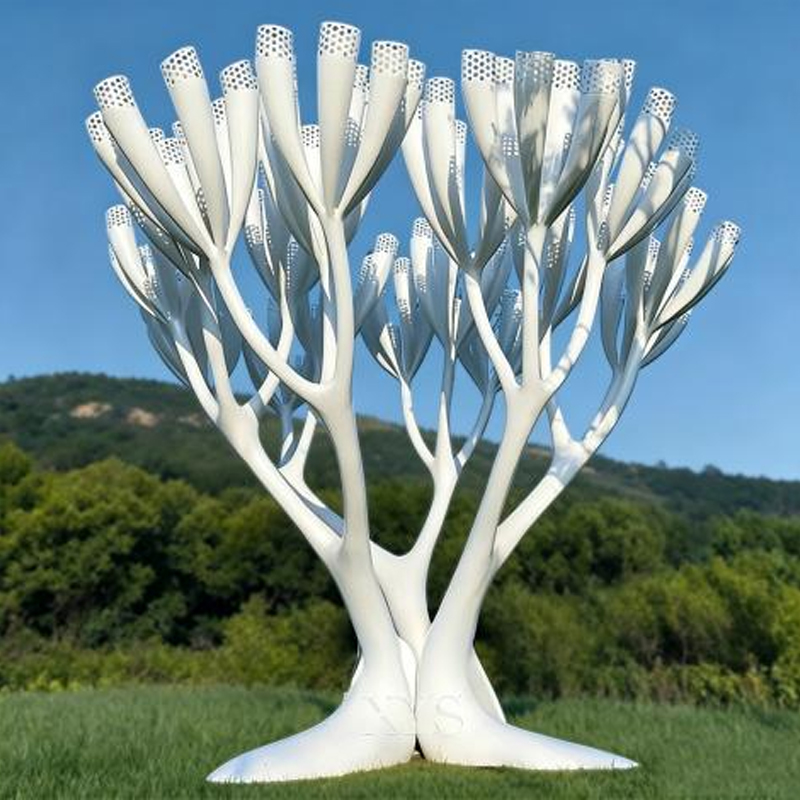
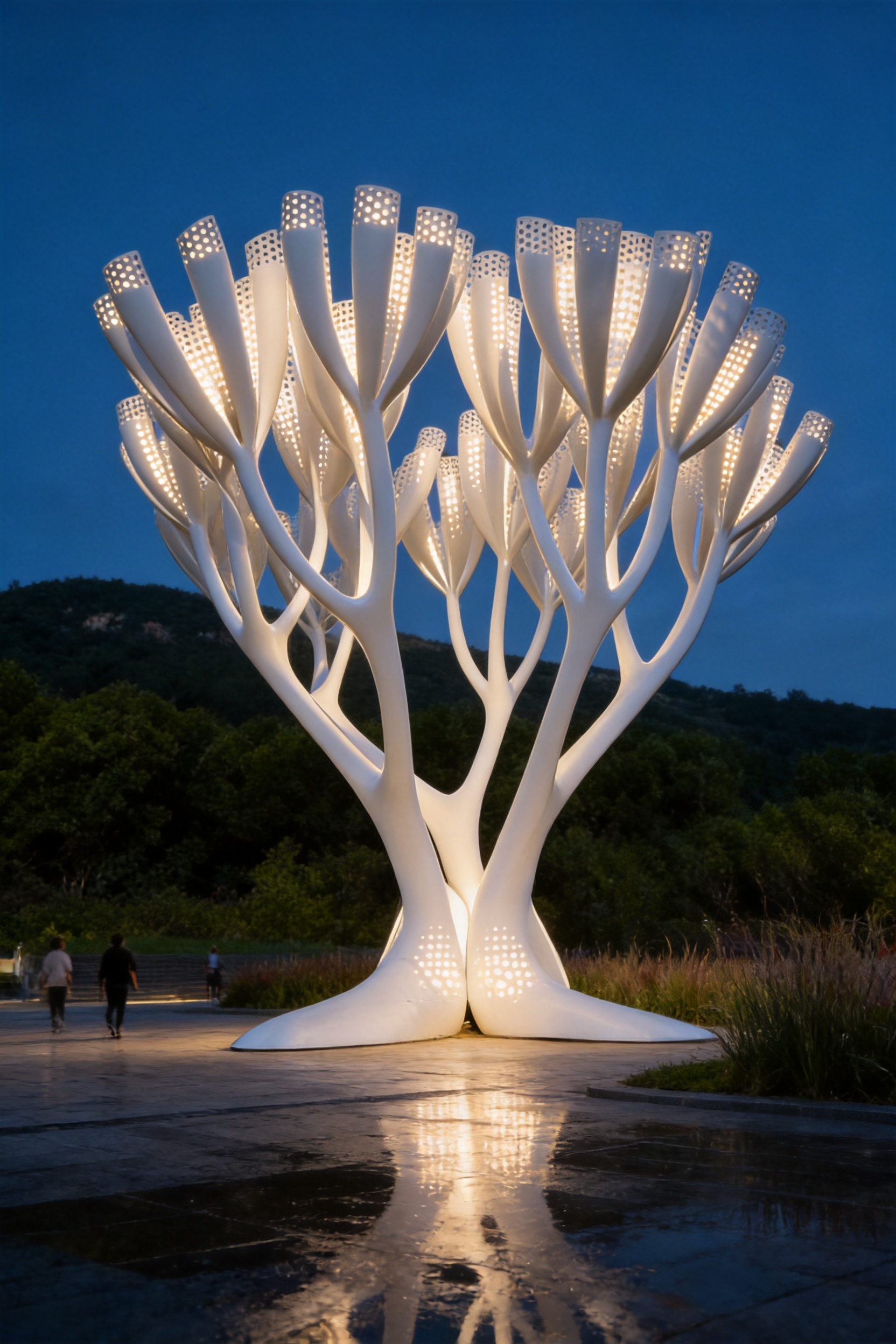
The Abstract Tree of Life Stainless Steel Sculpture is a large-scale outdoor artwork designed to combine structural presence, symbolic meaning, architectural clarity, and long-term landscape performance. Created as a hollow tree-form structure from 304 or 316 stainless steel, the sculpture features three principal trunks that converge into one unified base before separating into layered, upward-reaching branches. The branches extend toward the sky and finish in perforated tips that create a breathable visual rhythm while also helping rainwater move away from the internal lighting components.
Finished in a matte pure-white fluorocarbon coating, the sculpture offers an appearance that is contemporary, calm, and highly visible in natural environments. Its white surface contrasts strongly with green lawns, trees, shrubs, and planted public spaces. Unlike highly polished mirror-finish sculptures, which can create intense reflections and compete visually with surrounding architecture, this matte finish provides a softer and more controlled presence. It allows the complex branching silhouette to remain the primary visual feature.
The sculpture is available in total heights from 2.5 to 8.5 meters, making it suitable for both medium-scale landscape installations and major landmark projects. At smaller sizes, it can serve as a distinctive feature in courtyards, gardens, hospitality developments, or private estates. At larger sizes, it becomes a recognizable destination marker for city parks, tourism sites, real-estate show areas, campuses, and civic landscapes.
Its most significant advantage is the balance between artistic ambition and practical engineering. The form is not simply a decorative shell placed in an outdoor setting. The three converging trunks must act together as a stable load-bearing base for the entire network of branches above. Wind pressure, self-weight, outdoor exposure, internal lighting, installation conditions, and long-term drainage all need to be considered. The result is a sculpture that presents an expressive abstract tree while addressing the technical demands associated with a large outdoor landmark.
Abstract Tree of Life Stainless Steel Sculpture
The tree is one of the most enduring symbols in public art. It can represent life, continuity, family, knowledge, renewal, connection, and collective strength. This sculpture interprets that familiar symbol through a more architectural and contemporary language. Instead of reproducing a natural tree with realistic bark, leaves, and irregular limbs, it reduces the form to its essential structural gestures: roots or trunks, upward movement, branching, and expansion.
Three primary trunks converge near the base, creating the visual impression of separate forces joining together. Above this unified section, the trunks divide and develop into layered branches. This arrangement gives the sculpture a strong sense of movement. The viewer’s eye travels upward from the concentrated base to the expanding network above, following a visual narrative of growth and transformation.
The three-trunk composition also gives the sculpture a stronger identity than a conventional single-stem tree design. A single trunk can communicate stability and individual strength, while three converging trunks suggest cooperation, shared purpose, and the joining of different contributors. This interpretation is especially suitable for campuses, public institutions, corporate environments, community spaces, and tourism developments that want a symbolic centerpiece connected with unity and progress.
The layered branches add depth and visual complexity without depending on literal foliage. Their upward-reaching arrangement creates a skyline silhouette that changes as people move around the sculpture. From one angle, the branches may appear tightly interwoven; from another, they may open into separate arcs and perforated tips. This changing perspective makes the work more engaging than a static flat-panel monument.
The perforated tips are particularly important to the overall aesthetic. They prevent the ends of the branches from appearing visually heavy or closed. Instead, the tips appear light, breathable, and open to the surrounding environment. During daylight, the perforations allow the sky and landscape to remain visible through portions of the structure. At night, they can contribute to a subtle internal illumination effect when LED lighting is installed inside the hollow form.
The sculpture is manufactured from 304 or 316 stainless steel, two widely recognized grades used in architectural, industrial, marine, and outdoor applications. The choice between these grades can be adapted to the project location, environmental conditions, budget, and expected exposure.
304 stainless steel provides a practical combination of corrosion resistance, strength, formability, and cost efficiency. It is suitable for many inland public spaces, commercial landscapes, parks, campuses, gardens, and urban installations where the atmosphere is not heavily contaminated by salt or aggressive chemicals. Its clean metallic base also supports the application of a durable white fluorocarbon coating.
316 stainless steel contains molybdenum, which improves resistance to chloride-related corrosion. It is especially valuable for coastal locations, waterfront developments, areas exposed to salt spray, humid climates, and sites where long-term environmental aggressiveness is a significant concern. Specifying 316 stainless steel can provide an additional level of protection where the sculpture must retain its integrity under demanding conditions.
Compared with ordinary carbon steel, stainless steel offers a significant advantage in terms of corrosion resistance. Carbon steel sculptures can require more intensive protective systems, including repeated primer and topcoat maintenance, particularly at joints, exposed edges, drainage points, and areas where water may remain trapped. Stainless steel provides a stronger underlying material platform for long-term outdoor use. The additional fluorocarbon coating further enhances the intended appearance and provides a protective surface barrier.
Compared with aluminum, stainless steel offers greater mass, rigidity, and structural confidence for a tall branching sculpture. Aluminum can be advantageous in certain lightweight applications, but a large abstract tree must resist wind movement, vibration, and localized stress at branch connections. Stainless steel provides an appropriate balance of strength and durability for a landmark structure whose silhouette extends several meters above the ground.
Compared with fiberglass or other composite materials, stainless steel presents a more substantial architectural character. Fiberglass can support imaginative forms and may be relatively light, but it can be more vulnerable to surface aging, impact damage, ultraviolet exposure, and localized repair difficulties depending on the resin and coating system. Stainless steel communicates permanence and is better aligned with projects seeking a durable civic or institutional centerpiece.
The most technically demanding feature of the design is the transition where the three main trunks meet and form one unified base. This area must carry the combined weight of the branch network and transfer environmental forces into the foundation. It is also the point where the sculpture’s symbolic message and structural logic meet: multiple members become one stable support system.
A hollow structure reduces unnecessary material weight while preserving the large visual volume required by the design. However, a hollow form still requires careful engineering. The shell thickness, internal reinforcement, connection geometry, base plate, anchoring system, and access provisions must be coordinated. The structural solution must be strong enough to resist wind loading while avoiding excessive weight that would complicate transportation and installation.
At the taller end of the size range, the engineering requirements become more significant. A sculpture measuring 8.5 meters is exposed to greater wind pressure across a larger projected surface area. Its branches can also create complex patterns of pressure and suction as wind passes through, around, and between the layered elements. The perforated tips help maintain visual lightness and may reduce the sense of a solid wind-catching surface, but the full structure still requires a proper assessment of local site conditions.
The unified trunk section should therefore be treated as a carefully engineered load-transfer zone rather than simply a decorative intersection. The geometry must avoid abrupt weaknesses, and the internal structure must guide forces toward the foundation. Professional fabrication requires close attention to alignment, weld quality, reinforcement placement, dimensional accuracy, and the relationship between the sculpture and its anchoring arrangement.
For a project-specific installation, the final engineering review should account for local wind speed, terrain category, exposure, foundation conditions, seismic considerations where relevant, snow or ice loads where applicable, and the precise installation location. The sculpture’s height range makes it adaptable, but every large outdoor installation should still be evaluated according to the requirements of its site.
This engineering-conscious approach is one of the sculpture’s strongest advantages over lower-cost decorative products that may imitate a tree silhouette without addressing long-term structural performance. A visually attractive outdoor sculpture must also remain stable, durable, and maintainable. The three-trunk configuration demonstrates how expressive design can be integrated with practical structural thinking.
The manufacturing process begins with the translation of the artistic concept into a workable three-dimensional structure. Since the sculpture is available from 2.5 to 8.5 meters, the design must retain its visual proportions across different scales. A smaller version should not look like a simple reduction of a large landmark, while a larger version must not appear visually thin or structurally underdeveloped.
Scale planning includes the relationship between trunk diameter, branch spacing, branch thickness, perforated tips, base dimensions, and the overall height-to-width ratio. The visual center of gravity must remain convincing at every size. If the branches expand too far without enough support, the sculpture may appear unstable even when engineered correctly. If they are too compact, the symbolic sense of flourishing may be weakened.
Three-dimensional modeling and technical drawings help coordinate the artistic form with manufacturing requirements. The development stage should identify access points, internal lighting routes, drainage paths, connection details, lifting points, and installation interfaces before fabrication begins. Integrating these details early helps reduce the need for intrusive modifications after the outer shell has been completed.
The sculpture is described as being forged as a single-piece hollow tree-form structure. In practical production, this type of work requires a combination of forming, shaping, joining, reinforcement, and finishing operations. Large stainless-steel components must be manipulated carefully to achieve the flowing curves of the trunks and branches while maintaining the dimensional consistency required for assembly.
The hollow construction is valuable because it creates a large visual volume without making the sculpture unnecessarily solid or excessively heavy. It also creates an internal cavity where LED lighting, wiring, inspection access, and selected reinforcement components can be accommodated. The cavity must be planned as an integrated part of the sculpture rather than as empty space left over after the exterior is completed.
Curved and tapered components require controlled forming so that the surface does not develop unwanted flat areas, buckling, or irregular transitions. Branches that appear delicate from a distance may still need carefully calculated internal support. The manufacturing team must preserve the organic flow of the abstract tree while ensuring that each member connects properly to the larger load-bearing network.
The point where the three trunks converge is a critical fabrication area. Multiple members meet at different angles, and the transition must appear visually unified rather than mechanically patched together. Welded joints, internal plates, stiffeners, and reinforcement members must be positioned to provide strength without creating visible distortions on the finished exterior.
Stainless-steel welding requires appropriate process control because heat can affect surface appearance, dimensional stability, and corrosion resistance. Fabricators must manage heat input, joint preparation, alignment, and post-weld treatment. A high-quality result depends not only on the strength of the weld but also on the cleanliness and finishing of the surrounding stainless-steel surface.
The trunk convergence should be checked for symmetry, continuity, and load-transfer logic. Even in an intentionally abstract design, the branches need to look as though they grow naturally from the unified base. This visual continuity is essential to the sculpture’s symbolic message and to its perceived quality when viewed from close range.
The perforated tips require a balance between appearance, drainage, structural integrity, and lighting performance. The openings must be shaped and distributed so that they create a breathable appearance without weakening the ends of the branches. Their dimensions and spacing should remain consistent with the scale of the sculpture.
These tips also serve a practical purpose. They are angled slightly to encourage rainwater to drain away from the LED lighting components housed within the hollow branches. This detail helps reduce the chance of prolonged moisture accumulation around internal wiring. In climates with frequent or heavy seasonal rainfall, drainage planning is particularly important because water trapped inside a hollow sculpture can contribute to staining, corrosion at vulnerable interfaces, electrical problems, or freeze-related damage.
Drainage does not eliminate the need for proper electrical protection and maintenance. LED components should still be suitable for the intended environment, wiring should be appropriately protected, and access should be provided for inspection or replacement. Nevertheless, designing the branch tips to assist natural drainage demonstrates a practical understanding of how outdoor artwork behaves after installation.
The matte pure-white fluorocarbon coating is central to the sculpture’s identity. Achieving a clean white finish on a large, complex form requires thorough surface preparation. The stainless-steel substrate must be cleaned, degreased, and prepared so that the coating bonds consistently across trunks, branches, perforations, joints, and concealed transitions.
A fluorocarbon coating is selected for its resistance to weathering, ultraviolet exposure, and color fading. Outdoor white surfaces can be particularly demanding because dirt, airborne pollutants, water marks, and biological residue may be visible against the light background. A durable coating helps the sculpture retain its intended appearance over years of exposure to sun and rain.
The matte finish has a practical visual advantage over a mirror-polished finish in planted environments. Highly reflective metal can produce glare, strong highlights, and reflections of surrounding structures. Those effects may be desirable for some architectural projects, but they can make a sculpture visually restless in a green landscape. The matte white surface absorbs and diffuses light more evenly, allowing the silhouette to remain readable under changing weather and daylight conditions.
Quality control should include inspection of coating uniformity, edge coverage, perforation interiors, branch transitions, and areas around welds. The final result should present a consistent white appearance without visible runs, pinholes, uneven gloss, or exposed substrate. For a landmark sculpture, surface quality matters because viewers may encounter it from multiple distances and under both direct and indirect lighting.
Outdoor buyers frequently compare stainless steel sculptures with bronze, marble, fiberglass, weathering steel, aluminum, and painted carbon steel. Each material has its own character, but the abstract tree design demonstrates specific advantages when stainless steel and a white fluorocarbon coating are combined.
| Material or design approach | Typical visual character | Relevant consideration for a large outdoor tree sculpture | Advantage of this stainless-steel design |
|---|---|---|---|
| Bronze | Traditional, warm, and richly patinated | Strong artistic heritage, but generally heavier and often associated with darker tones | Provides a brighter, more contemporary landmark appearance with a clean white finish |
| Marble | Natural, monumental, and solid | High weight and limited ability to express a large hollow branching network | Creates greater height and visual openness with a lighter hollow structure |
| Fiberglass | Flexible, colorful, and comparatively lightweight | Surface aging, impact resistance, and long-term coating performance must be carefully managed | Offers the permanence, rigidity, and architectural presence of stainless steel |
| Weathering steel | Rust-colored, industrial, and earthy | Develops a deliberately oxidized surface that may stain adjacent paving or conflict with bright landscapes | White coating provides stronger contrast with lawns, foliage, and modern architecture |
| Mirror-polished stainless steel | Reflective, dramatic, and high-contrast | Can create glare and visually compete with planted surroundings | Matte white finish offers controlled reflection and a calmer visual presence |
| Single-trunk tree design | Stable and centralized | May communicate individual growth but offers less emphasis on unity and collaboration | Three converging trunks create a distinctive collective-growth narrative |
The comparison does not mean that one material is universally superior. Bronze may be ideal for historic or commemorative settings, marble may be appropriate for a monumental classical environment, and weathering steel may suit an industrial landscape. The advantage of this product is that its material, finish, and form are closely matched to contemporary outdoor projects seeking brightness, openness, durability, and symbolic unity.
Color strongly influences how a sculpture interacts with its surroundings. The matte pure-white surface creates immediate visibility without requiring excessive ornament. Against a green lawn, the sculpture appears crisp and legible. Against darker trees or planted borders, the branches remain easy to distinguish. Against blue or cloudy skies, the silhouette takes on a different atmospheric quality while retaining its clean, minimal identity.
White also supports a wide range of architectural contexts. It can complement contemporary buildings with glass, concrete, stone, or metal facades. It can also provide contrast in traditional gardens and public parks where the surrounding palette is dominated by earth tones and vegetation. Because the sculpture is abstract rather than historically specific, the white finish helps it function across different design languages.
The matte surface is especially useful when the sculpture is viewed by pedestrians, motorists, visitors, or guests from multiple directions. Glare can be uncomfortable or distracting when polished surfaces face the sun. A matte fluorocarbon finish reduces sharp reflections and creates a more stable visual experience throughout the day.
At night, the white exterior becomes an effective surface for internal illumination. LED light placed inside the hollow structure can filter through openings and reflect softly against the inner surfaces. The result can be a gentle glowing tree rather than a harshly lit object. Lighting designers can adjust color temperature, intensity, timing, and control systems to suit the character of the site.
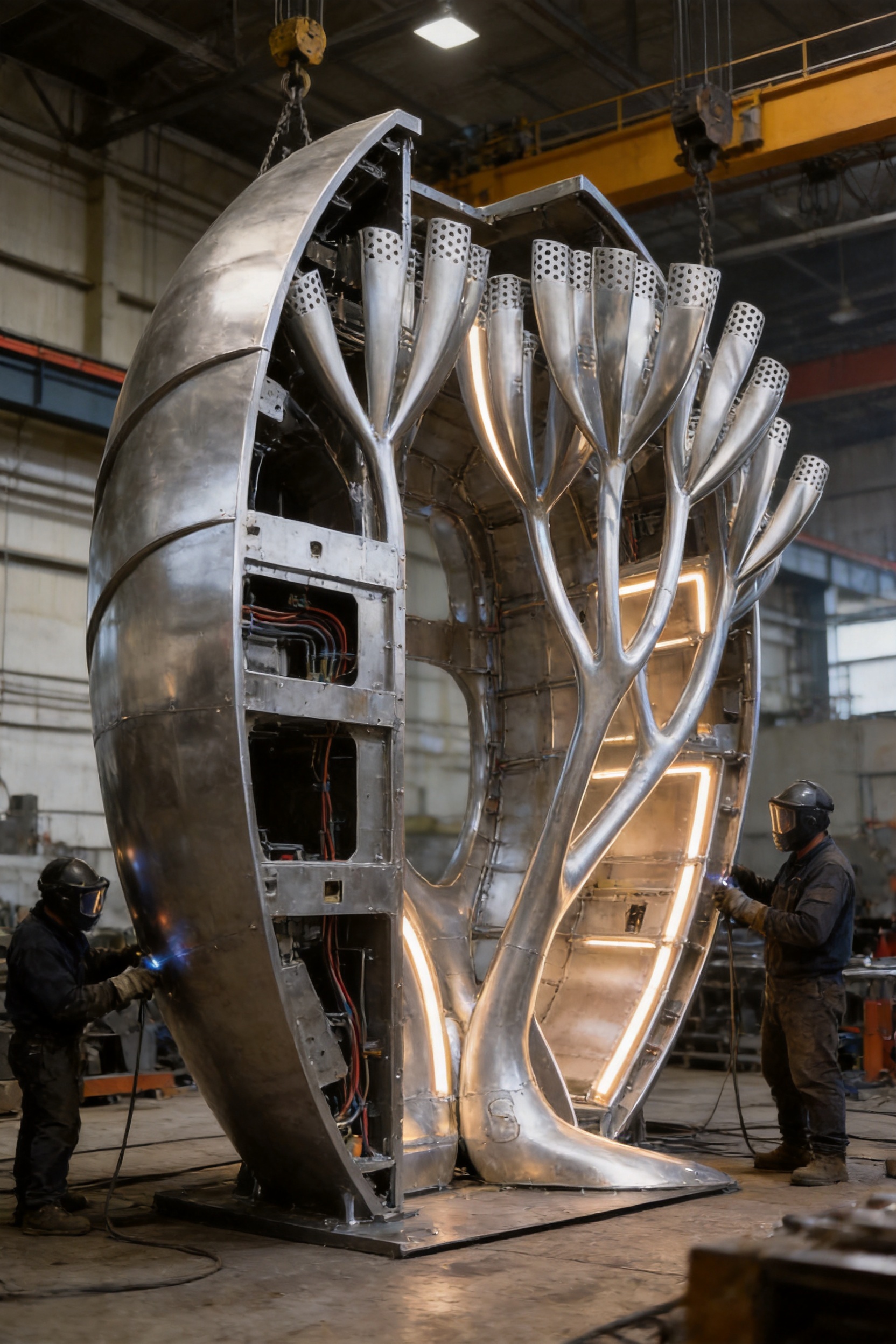
Optional embedded LED lighting extends the sculpture’s function beyond daylight hours. Many outdoor art installations are most visible during the day and become inactive after sunset. This tree-form sculpture can continue to act as a landmark in the evening, supporting the identity of a park, tourism destination, campus, hospitality property, or commercial development.
Because the branches are hollow, lighting components can be installed within the structure rather than attached prominently to the exterior. This preserves the purity of the abstract silhouette during the day. After dark, light can emerge through perforations and selected openings, creating a sense that the tree is illuminated from within.
The lighting concept can be kept subtle and architectural. A warm-white tone may create a welcoming and refined atmosphere, while a neutral-white tone may reinforce the sculpture’s modern character. Programmable systems can also support seasonal or event-based lighting, provided that changes remain appropriate to the surrounding environment and do not compromise the artwork’s long-term visual identity.
Electrical planning should be completed during manufacturing or before final installation. Wiring routes, access panels, drainage points, junctions, and power connections should be coordinated with the hollow structure. Components intended for outdoor use should be selected according to the site’s moisture, temperature, and exposure conditions.
The angled perforated branch tips provide a useful passive drainage feature. By encouraging water to move away from internal LED components, they help reduce the risk associated with standing moisture. This feature is particularly valuable in rainy climates, though it should be supported by properly sealed electrical connections, suitable cable protection, and periodic inspection.
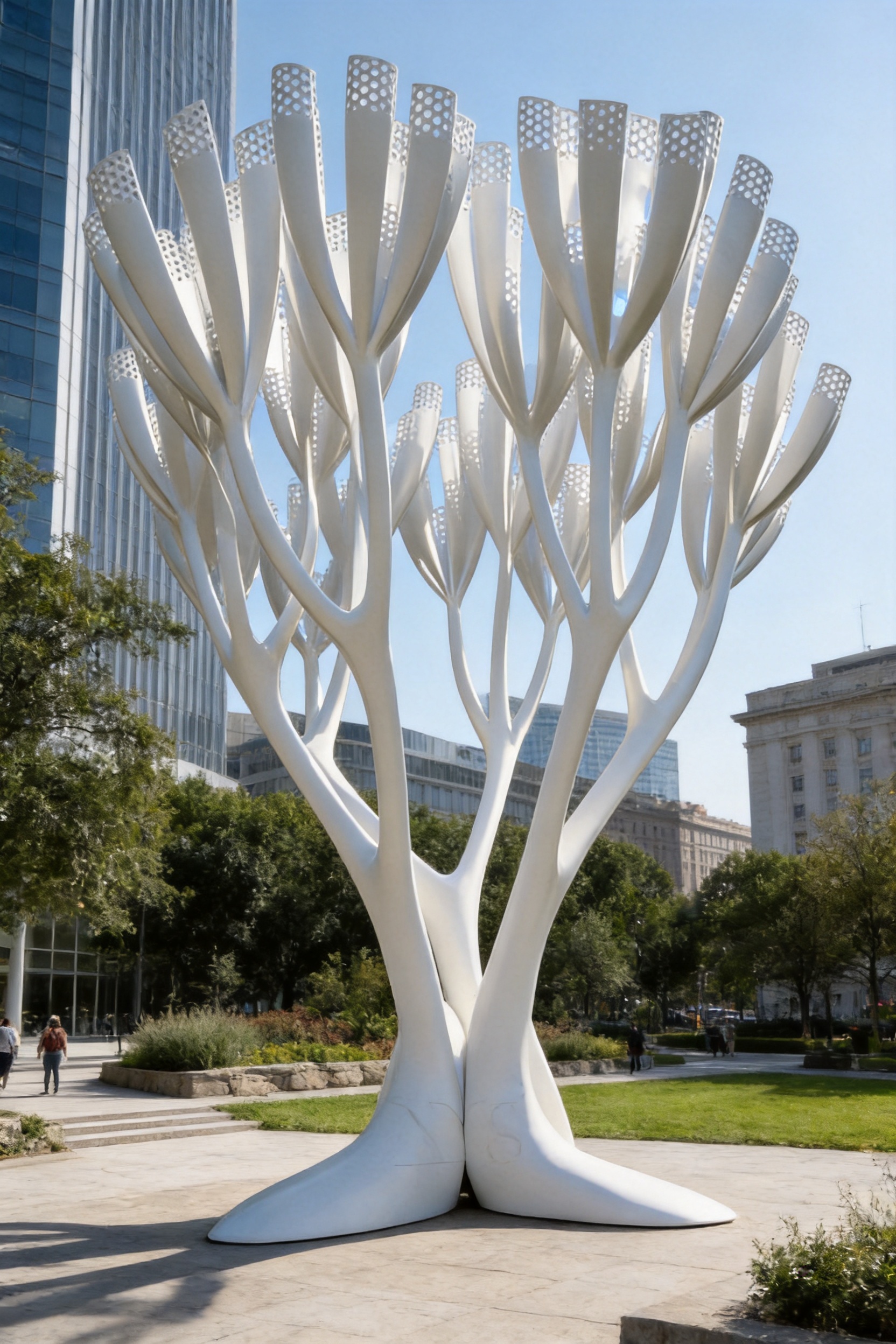
In a city park, a large abstract tree can serve as a gathering point, orientation marker, or symbolic centerpiece. The three converging trunks can represent community cooperation, while the upward branches suggest public vitality and future growth. The white finish gives the sculpture strong visibility across an open lawn without requiring an overly complex surrounding installation.
At larger sizes, the sculpture can define a major axis, mark a plaza entrance, or create a visual endpoint at the end of a pedestrian route. Its perforated structure maintains openness, allowing visitors to see portions of the landscape through the branches rather than presenting a completely solid barrier.
Tourism sites benefit from recognizable visual landmarks. A distinctive sculpture can help establish a memorable identity and create a natural location for photographs. The abstract tree’s unusual three-trunk structure provides a strong silhouette that can be recognized from a distance and revisited in different lighting conditions.
When positioned near an entrance, viewpoint, visitor center, or central plaza, the sculpture can help organize the visitor experience. Its symbolic relationship with life, growth, and shared connection can also be adapted to ecological parks, cultural attractions, botanical gardens, and nature-oriented destinations.
Real-estate show areas often require landscape features that communicate quality, aspiration, and long-term value. The white stainless-steel tree can act as a flagship installation near a sales center, entrance boulevard, model-home area, or central garden. Its contemporary appearance can support branding without relying on an aggressively commercial form.
The sculpture can also help prospective buyers imagine the completed development. During the day, it provides a clean architectural accent. At night, internal illumination can create a welcoming atmosphere and reinforce the perception that the landscape has been carefully designed for extended use.
Schools, universities, research parks, and training campuses often seek artwork that expresses collective learning, growth, and collaboration. The three trunks are well suited to these themes. They can represent students, faculty, and community; knowledge, practice, and discovery; or different academic disciplines joining in a larger institution.
The sculpture’s durable material and adaptable height range make it suitable for courtyards, library forecourts, central lawns, innovation districts, and campus gateways. Its abstract character allows it to remain relevant as campus architecture evolves.
Hotels, resorts, office campuses, and corporate headquarters can use the sculpture as a signature feature in arrival areas, gardens, terraces, and event spaces. The matte white surface photographs well and can be integrated with landscape lighting, water features, paving, and contemporary architectural materials.
For corporate settings, the unified three-trunk composition can communicate collaboration, shared responsibility, and sustainable growth. For hospitality environments, the sculpture can function as a calm visual centerpiece that adds character without overwhelming guests or competing with the surrounding landscape.
The available height range of 2.5 to 8.5 meters allows the sculpture to be specified according to the scale of the site. A 2.5-meter version can fit into a garden, courtyard, hotel entrance, or smaller public plaza. It can be viewed closely and appreciated for its surface details, perforated tips, and layered branches.
Medium sizes can occupy larger lawns, campus spaces, residential developments, and commercial landscapes. They provide enough height to become a visible focal point while remaining compatible with pedestrian-scale surroundings.
At 8.5 meters, the sculpture becomes a landmark feature. It can be seen above lower planting, along an approach road, across an open park, or from nearby buildings. A sculpture at this scale should be planned as part of the site’s complete infrastructure, including foundation design, crane access, transport route, lifting strategy, lighting supply, drainage, maintenance access, and landscape protection.
| Project factor | Planning question | Why it matters |
|---|---|---|
| Site scale | Will the sculpture be viewed from close range, across an open lawn, or from nearby roads and buildings? | Determines the most suitable height and visual proportion |
| Environmental exposure | Is the location inland, coastal, humid, polluted, or exposed to salt spray? | Helps guide the selection of 304 or 316 stainless steel |
| Wind conditions | What are the local wind speeds, terrain conditions, and exposure characteristics? | Supports project-specific structural review and foundation planning |
| Lighting requirements | Should the sculpture glow continuously, on a schedule, or during special events? | Influences wiring, controls, access, and power planning |
| Landscape relationship | Will the sculpture stand among dense greenery, paving, water, or architectural surfaces? | Helps determine the best location and viewing angles |
| Maintenance access | How will the surface, lighting, and internal components be inspected? | Supports long-term appearance and operational reliability |
| Foundation and installation | Can the site accommodate anchor bolts, concrete works, transport, and lifting equipment? | Ensures safe installation and stable long-term performance |
The listed price range is approximately $2,320 to $6,680, depending on size and project configuration. Buyers should confirm the final quotation according to the selected height, stainless-steel grade, finish requirements, LED system, packaging, shipping, foundation conditions, installation scope, and any custom modifications.
A large outdoor sculpture rarely fits every site without adjustment. The surrounding landscape may have a specific axis, a restricted foundation area, a defined viewing direction, or a particular architectural theme. Custom manufacturing allows the tree’s height, width, branch arrangement, coating specification, lighting arrangement, and installation details to be coordinated with the project.
Customization can also address environmental conditions. A coastal project may require 316 stainless steel, enhanced drainage attention, and a maintenance plan suited to salt exposure. An inland campus may choose 304 stainless steel with the same white fluorocarbon appearance. A tourism site may request lighting controls that coordinate with visitor hours or seasonal programming.
The manufacturer’s value lies in managing the complete relationship between artistic design and production feasibility. A design may look compelling in a digital rendering but become difficult to fabricate if branch transitions are too thin, internal access is absent, or drainage has not been considered. Experienced sculpture manufacturing requires the ability to preserve the artistic concept while resolving these practical challenges before they become expensive site problems.
Custom design also provides an opportunity to adapt the sculpture to a project’s symbolic objectives. The number and arrangement of branches, the degree of openness, the density of the layered structure, and the lighting intensity can all influence how the work is perceived. The three-trunk concept can remain the central identity while the detailed proportions are adjusted to suit the client’s landscape.
Quality control for a large stainless-steel sculpture should cover more than the final visual inspection. It should begin with material selection and continue through modeling, cutting, forming, welding, reinforcement, surface preparation, coating, lighting integration, packing, and installation.
Material verification helps confirm that the selected stainless-steel grade corresponds to the project specification. Dimensional checks help ensure that the trunks, branches, and overall height match the approved design. Weld inspections help identify visible defects, incomplete joints, distortion, or irregular transitions. Surface inspection confirms that the coating is even and that the intended matte white appearance has been achieved across complex areas.
The hollow form should also be reviewed for accessibility and drainage. Internal water management is essential for outdoor structures with enclosed cavities. The perforated tips are angled to encourage rainwater drainage away from embedded LED components, but the full system should be evaluated to ensure that water does not collect in lower sections or concealed pockets.
Long-term performance depends on both manufacturing quality and site maintenance. The white surface may require periodic washing to remove dust, pollen, bird residue, and airborne pollutants. Cleaning should use methods compatible with the fluorocarbon coating. Harsh abrasives or inappropriate chemicals may damage the finish even when the underlying stainless steel remains sound.
Lighting systems should be inspected according to the equipment manufacturer’s recommendations. Electrical connections, seals, access panels, and drainage points should be checked after severe weather and at regular maintenance intervals. A preventive approach is generally more effective than waiting for a visible lighting failure or surface problem.
When properly specified, fabricated, installed, and maintained, the sculpture is designed to retain its structural and visual qualities through years of outdoor exposure. Its stainless-steel construction, weather- and fade-resistant fluorocarbon coating, hollow engineered form, and drainage-conscious branch design all contribute to that objective.
Installation planning should begin before the sculpture leaves the factory. The final height and branch spread determine transport requirements, lifting points, access routes, and whether the sculpture will arrive as one completed piece or in coordinated sections. The product description identifies the work as a single-piece hollow form, but the practical delivery arrangement should be confirmed for each project according to size, shipping limitations, and site access.
The foundation must be designed for the sculpture and its local conditions. The base connection should transfer vertical loads, lateral forces, and overturning effects safely into the ground. Anchor bolts, embedded plates, concrete strength, curing time, and foundation dimensions should be coordinated between the sculpture manufacturer, structural engineer, contractor, and site owner.
Before lifting, the installation team should confirm that the foundation has reached the required condition, the anchor layout is accurate, and all lifting equipment is suitable for the sculpture’s dimensions and weight. Temporary bracing or controlled positioning may be needed during the final alignment process.
Landscape protection is another important consideration. A large sculpture may need to be installed after major paving and planting works are complete, or the access route may need temporary protection. Careful sequencing helps prevent damage to lawns, irrigation lines, planting beds, paving, and nearby structures.
After placement, the sculpture should be checked for vertical alignment, base security, coating damage, drainage performance, and lighting operation. Any minor transport or installation marks should be addressed using an approved repair procedure compatible with the specified finish.
The sculpture creates a strong visual relationship with natural planting without attempting to imitate nature literally. Its tree form references organic growth, while its stainless-steel body and white finish clearly identify it as a contemporary human-made object. This balance can support landscape designs that seek both environmental association and modern architectural expression.
Because the sculpture is hollow and open, it does not create the same visual mass as a solid monument of comparable height. The branches allow light, sky, and surrounding views to pass through portions of the structure. This openness can help maintain sightlines in public spaces and reduce the feeling of obstruction.
The matte white finish also supports visual clarity without depending on excessive lighting or decorative color. During daylight, the sculpture is legible through contrast. At night, a carefully controlled LED system can make it visible without requiring a large number of external floodlights. Reduced reliance on strong external illumination may help limit glare and improve the comfort of nearby users, subject to the lighting design and local regulations.
For developments seeking a long-term landscape investment, durable outdoor sculpture can contribute to place identity. A recognizable landmark may help visitors navigate a site, remember a destination, or associate a particular space with a shared experience. The abstract tree is especially suited to this role because its symbolism is broadly accessible and does not depend on a highly specific cultural reference.
Jiangsu Xinyesheng Sculpture Co., Ltd. is presented as a China-based sculpture manufacturer and supplier specializing in custom metal statues and European-style sculpture. The available product information identifies its capabilities across bronze sculptures, stainless steel sculptures, marble sculptures, fiberglass sculptures, and weathering steel sculptures. This broader material range indicates an ability to work with different artistic languages and project requirements.
For the Abstract Tree of Life Stainless Steel Sculpture, the relevant strengths are the handling of large metal forms, hollow structural construction, stainless-steel fabrication, custom sizing, surface finishing, and outdoor application planning. The product’s three-trunk convergence, layered branches, perforated tips, white fluorocarbon coating, and optional internal LED system require multiple production disciplines to be coordinated in one project.
A manufacturer experienced in custom sculpture production can support clients through concept confirmation, size selection, material recommendation, finish approval, fabrication, quality inspection, packing, and delivery coordination. For major projects, communication should also address engineering documentation, installation instructions, lighting specifications, foundation interface details, and maintenance recommendations.
The company’s listed contact details are Jiangsu Xinyesheng Sculpture Co., Ltd., located at No. 103, Building 22, No. 1585 Xicheng Road, Qingyang Town, Jiangyin City, Jiangsu Province, China. The provided telephone contacts are +86-13812599789 and +86-18914187530, and the listed email address is postmaster@xingyesheng.com. Buyers should verify current specifications, quotation details, production schedules, shipping conditions, and installation responsibilities directly before placing an order.
The product is also positioned within a larger range of sculpture categories, including bronze, stainless steel, marble, fiberglass, and weathering steel. This is useful for landscape designers and developers who may be comparing several material directions for the same site. The manufacturer can potentially help determine whether the white stainless-steel tree is the most appropriate solution or whether another material better matches the project’s architectural and environmental goals.
The first advantage is visual distinction. The three converging trunks make the design immediately recognizable, while the layered upward branches create a dynamic silhouette that differs from common single-trunk tree sculptures.
The second advantage is material durability. 304 or 316 stainless steel offers a strong foundation for outdoor use, with 316 providing an especially appropriate option for coastal or chloride-rich environments.
The third advantage is finish control. The matte pure-white fluorocarbon coating creates a clean, contemporary appearance, reduces the glare associated with mirror polishing, and contrasts effectively with greenery, lawns, and darker architectural backgrounds.
The fourth advantage is integrated functionality. The hollow structure can accommodate LED lighting, and the angled perforated tips support rainwater drainage away from internal lighting elements. The sculpture therefore performs as both a daytime artwork and an evening landmark.
The fifth advantage is size flexibility. A height range of 2.5 to 8.5 meters allows the design to serve a garden, courtyard, public lawn, campus, commercial development, or major tourism site.
The sixth advantage is symbolic versatility. The three trunks can be interpreted as family members, community groups, business partners, academic disciplines, or different paths joining into one shared future. This makes the design adaptable to both public and private commissions.
The seventh advantage is customization potential. Buyers can discuss stainless-steel grade, height, lighting, branch proportions, finish requirements, installation details, and environmental conditions rather than purchasing an inflexible mass-produced ornament.
The sculpture is made from 304 or 316 stainless steel and finished with a matte pure-white fluorocarbon coating. The choice of stainless-steel grade can be considered according to the environmental conditions of the installation site.
The total height is available from 2.5 meters to 8.5 meters. The appropriate size depends on the viewing distance, landscape scale, surrounding architecture, local regulations, foundation requirements, and desired landmark effect.
The listed price range is approximately $2,320 to $6,680. The final cost may vary according to height, material grade, lighting, customization, packaging, shipping, installation, and project-specific engineering requirements.
The three trunks converge into one unified base to symbolize different strengths, people, or contributors growing together. The form can represent unity, cooperation, family, community, institutional collaboration, or shared progress.
Yes. It is intended for outdoor applications such as city parks, tourism sites, real-estate show areas, campus landscaping, gardens, hospitality spaces, and other public or commercial environments. Site-specific engineering and installation planning remain important, especially for taller versions.
304 stainless steel is suitable for many inland and ordinary outdoor environments. 316 stainless steel offers enhanced resistance to chloride exposure and may be preferable for coastal, waterfront, salty, or especially humid locations. The final choice should be based on a professional assessment of the site.
Yes. LED lighting can be embedded within the hollow branch structure. This allows the sculpture to glow from within after dark while preserving a clean exterior appearance during the day.
The perforated branch tips are angled slightly to encourage natural rainwater drainage away from the LED lighting components inside. Proper electrical protection, sealing, access, and maintenance are still required for reliable outdoor operation.
The matte white finish creates a softer and more controlled appearance. It contrasts clearly with greenery and reduces the glare and visual competition that can occur with highly reflective mirror-polished surfaces.
Custom discussions can address height, proportions, stainless-steel grade, finish, lighting, branch arrangement, installation interface, and project conditions. Any customization should be confirmed through approved drawings and a final quotation.
Yes. Maintenance may include periodic cleaning of the white surface, inspection of weld and base areas, checking drainage points, and testing or servicing the LED system. Maintenance frequency depends on climate, pollution, planting density, and site exposure.
The product information identifies Jiangsu Xinyesheng Sculpture Co., Ltd. in Jiangyin City, Jiangsu Province, China, as the manufacturer and supplier. Buyers should confirm current production, shipping, documentation, and installation arrangements directly with the supplier.
The Abstract Tree of Life Stainless Steel Sculpture offers a carefully balanced solution for landscape projects that require more than a decorative object. Its three converging trunks create a powerful message of unity, while the layered branches express continuous growth and shared flourishing. The hollow stainless-steel construction supports a large visual scale without unnecessary solid mass, and the perforated branch tips provide both visual openness and a practical drainage function.
The use of 304 or 316 stainless steel gives buyers flexibility for different outdoor environments. The matte pure-white fluorocarbon coating provides a contemporary appearance, strong contrast with planting, reduced glare compared with mirror polishing, and resistance to weather and fading. Optional embedded LED lighting allows the sculpture to remain a visible landmark after sunset.
Its available height range from 2.5 to 8.5 meters makes the work adaptable to gardens, campuses, parks, tourism destinations, real-estate developments, corporate sites, and hospitality landscapes. Most importantly, the sculpture demonstrates how artistic symbolism can be supported by practical fabrication decisions, including hollow construction, engineered trunk convergence, controlled surface finishing, and rainwater-aware lighting integration.
For buyers comparing bronze, marble, fiberglass, weathering steel, or reflective stainless-steel alternatives, this product is particularly compelling when the project calls for a bright, durable, contemporary, and highly recognizable outdoor feature. With appropriate site engineering, installation, and maintenance, it can serve as a long-term visual centerpiece and a meaningful symbol of collective strength.
1. Product specification and descriptive materials for the Abstract Tree of Life Stainless Steel Sculpture.
2. General technical references concerning 304 and 316 stainless-steel grades and their outdoor corrosion-resistance characteristics.
3. General architectural coating references concerning fluorocarbon finishes, ultraviolet resistance, weathering performance, and exterior color retention.
4. General structural engineering references concerning wind loading, hollow metal structures, branch-like frames, anchoring, and foundation design for outdoor sculptures.
5. General landscape design references concerning public art placement, visual landmarks, pedestrian experience, and the integration of sculpture with planting and architecture.
6. General outdoor lighting references concerning LED integration, moisture protection, drainage, access, and maintenance for illuminated architectural artwork.




Daniel H.

Amanda R.

Robert B.

Jennifer S.

James W.

Barry G.

Michael T.

Emily K.

David L.

Sarah M.


Mikey XV

Jagxue

 English
 Español
 عربى
عربى Français
 italiano
 Deutsch