The Abstract Face Marble Seat is a distinctive work of functional art that combines the expressive power of contemporary sculpture with the practical purpose of a refined outdoor or indoor seat. Carved from a single block of natural marble, it presents an avant-garde interpretation of the human face while preserving the visual authority, tactile richness, and long-term value associated with fine stone sculpture.
Unlike an ordinary bench, the Abstract Face Marble Seat is designed to become a focal point. Its sculptural face rises approximately 1.2 meters, while the coordinated seat reaches approximately 0.7 meters in height. Together, these elements create a composition that can anchor a villa courtyard, art park, luxury hotel lobby, private garden, cultural venue, or high-end club.
The work is especially notable because it does not treat sculpture and furniture as separate categories. The face is an artistic statement, while the seat gives the piece an immediate practical purpose. This combination makes the product suitable for buyers who want more than decoration: they want a memorable spatial experience, a conversation piece, and a durable object that can be used.
With a listed price of $18,150, the Abstract Face Marble Seat occupies the premium custom-art and architectural-feature segment. Its value comes from the natural stone itself, the one-piece carving concept, the sculptural individuality of the design, the possibility of customization, and the specialized production expertise required to transform a heavy marble block into a stable and visually refined work.
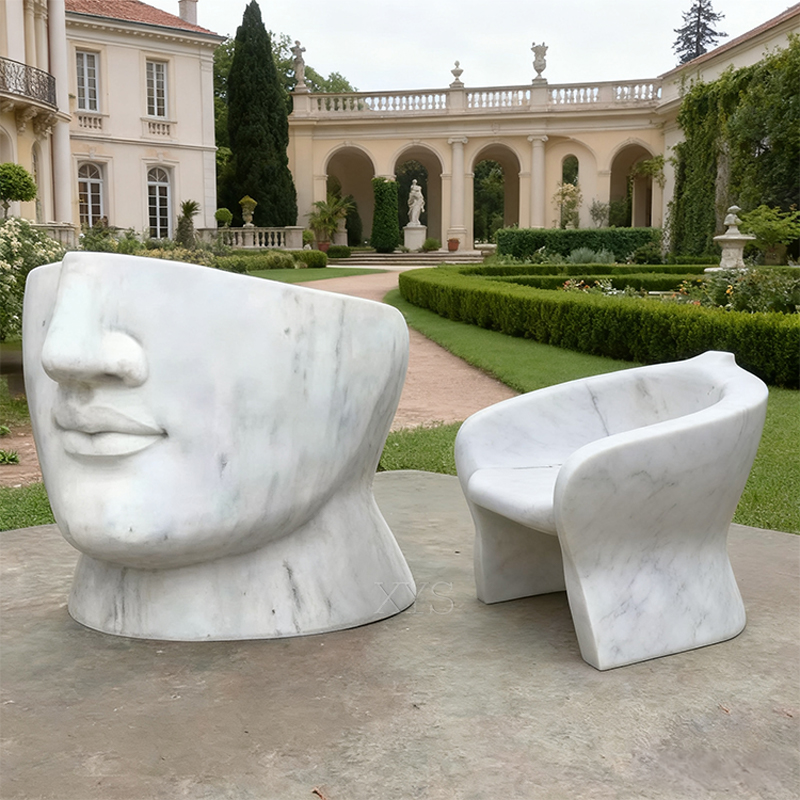
Abstract Face Marble Seat
Content
The human face has been one of the most enduring subjects in the history of sculpture. Classical artists pursued realistic proportions, Renaissance sculptors explored ideal beauty, and modern artists often broke the face into simplified planes, distorted contours, or symbolic forms. The Abstract Face Marble Seat belongs to this modern tradition. It does not attempt to reproduce a particular individual. Instead, it uses the recognizable idea of a face to create a bold visual identity.
The design is described as natural, fluid, avant-garde, and exaggerated. These qualities suggest that the sculpture is intended to remain open to interpretation. Viewers may see emotion, movement, serenity, strength, or mystery in its contours. Such ambiguity is an important advantage in architectural settings because the work can support different atmospheres without being limited to a single narrative.
The face-shaped element creates vertical emphasis, while the seat introduces a horizontal and human-scale component. This contrast gives the composition balance. A purely vertical sculpture may be admired from a distance but can feel detached from everyday life. A conventional seat may be useful but visually unremarkable. By joining the two, this product creates a relationship between the observer, the sculpture, and the surrounding environment.
The piece can therefore be understood in three ways. First, it is a contemporary marble sculpture. Second, it is a functional seat. Third, it is an architectural feature capable of organizing a space. This threefold identity is one of its strongest differentiators in comparison with mass-produced statues or standard outdoor furniture.
Marble has been selected by sculptors and architects for centuries because it combines visual luminosity, structural strength, and a refined surface. Its crystalline composition allows light to interact with the stone in a way that painted metal, plastic, or synthetic resin cannot fully reproduce. Depending on the variety, marble may display subtle veining, soft tonal changes, translucent edges, or dramatic geological patterns.
The Abstract Face Marble Seat is carved from a single block of precious natural marble. This is an important characteristic. A one-block construction creates a sense of unity that is difficult to achieve with assembled pieces. The visual flow of the stone can continue across the sculptural form, allowing natural texture and veining to become part of the design rather than appearing as unrelated fragments.
Every block of natural marble is different. Even when two pieces come from the same quarry or share a similar color family, their veining, mineral inclusions, tone, and translucency will vary. This means that each finished seat possesses a degree of individuality. Buyers receive a sculpture that is not merely one item from a uniform production line, but a work shaped by both human design and geological history.
Compared with painted steel, marble does not depend on a surface coating for its basic appearance. The visual character is inherent in the material. Compared with fiberglass, it has a greater sense of density and permanence. Compared with ordinary concrete, it can provide a more refined surface and a more sophisticated luxury impression. Compared with wood, it offers stronger resistance to rot, insects, and many forms of weather-related deterioration when properly selected, finished, and maintained.
Marble also ages in an authentic manner. Outdoor exposure may gradually soften the brightness of the surface or enhance the relationship between the sculpture and its surroundings. In an interior setting, routine care can preserve the stone’s polish and clarity for many years. The result is a product that can mature with a property rather than becoming visually obsolete after a short period.
The natural texture of marble is particularly valuable in an abstract design. The face does not need to rely on painted details or artificial color contrasts. Veins can emphasize a cheek, forehead, jawline, or curved transition. A variation in tone may create the impression of movement or shadow. Small mineral patterns can add depth to otherwise broad surfaces.
This gives architects and collectors an opportunity to work with the stone as an active design element. The final appearance can be selected according to the intended environment. A pale marble may support a minimalist courtyard or bright hotel lobby. A darker or more strongly veined stone may create a dramatic contrast against pale walls, polished floors, or green planting.
The market includes many forms of decorative sculpture and outdoor seating, but the Abstract Face Marble Seat occupies a distinctive position because it addresses several needs at once. Its advantages become clearer when compared with common alternatives.
A standard bench is usually designed around utility, efficiency, and repetition. It may be comfortable and durable, but it rarely creates a strong artistic identity. In a luxury project, a conventional bench can appear interchangeable with furniture found in many other locations.
The Abstract Face Marble Seat offers a more memorable solution. It can still serve as a place to sit, but its sculptural profile gives the area a recognizable character. In a villa, it can become a focal point in the garden. In a hotel lobby, it can provide both guest seating and a visual landmark. In an art park, it can encourage visitors to interact with the work rather than simply walk past it.
Mass-produced statues often use standardized molds, repeated poses, and limited surface variation. While they may be economical, they can lack individuality. Their forms may also be difficult to integrate into a high-end project that requires a more specific relationship between artwork, architecture, and landscape.
The Abstract Face Marble Seat is based on a more individualized concept. Natural stone selection, carving direction, surface finishing, and optional design adjustments all contribute to a unique result. Its function as seating also gives it a practical identity that many decorative statues do not possess.
Fiberglass and resin can be useful materials for lightweight installations, temporary exhibitions, and projects requiring complex color effects. However, they generally do not provide the same visual weight or natural material value as a large block of marble. Their surfaces may also be more vulnerable to scratching, fading, impact, or long-term environmental exposure, depending on the formulation and finish.
Marble communicates solidity. Its weight can be an advantage in a permanent installation because it contributes to stability and a sense of permanence. The stone also offers a tactile experience that is difficult to replicate with molded synthetic materials. For buyers seeking a premium, architectural, and enduring impression, the natural stone option is often more persuasive.
Bronze, stainless steel, and weathering steel each have important advantages. Bronze can provide warmth and historical association. Stainless steel can create a polished contemporary effect. Weathering steel can develop a strong rust-colored surface suited to landscape architecture. Nevertheless, metal sculptures often depend on fabrication, welding, polishing, patination, or protective systems that produce a different visual language from carved stone.
The Abstract Face Marble Seat is not intended to replace every metal sculpture. Instead, it offers an alternative for projects that require quiet luxury, natural texture, and an unmistakable connection to traditional stone carving. Its form can be modern while its material remains timeless.
The flexibility of the Abstract Face Marble Seat allows it to function in several environments. Its installation should be planned according to scale, lighting, pedestrian movement, ground conditions, and the desired relationship between the artwork and its audience.
In a private courtyard, the sculpture can act as a central visual point or as a quieter feature near a wall, water element, or planting bed. Its approximately 1.2-meter face component is large enough to be noticed without overwhelming a residential space. The 0.7-meter seat height provides a familiar human scale, allowing residents and guests to use the piece naturally.
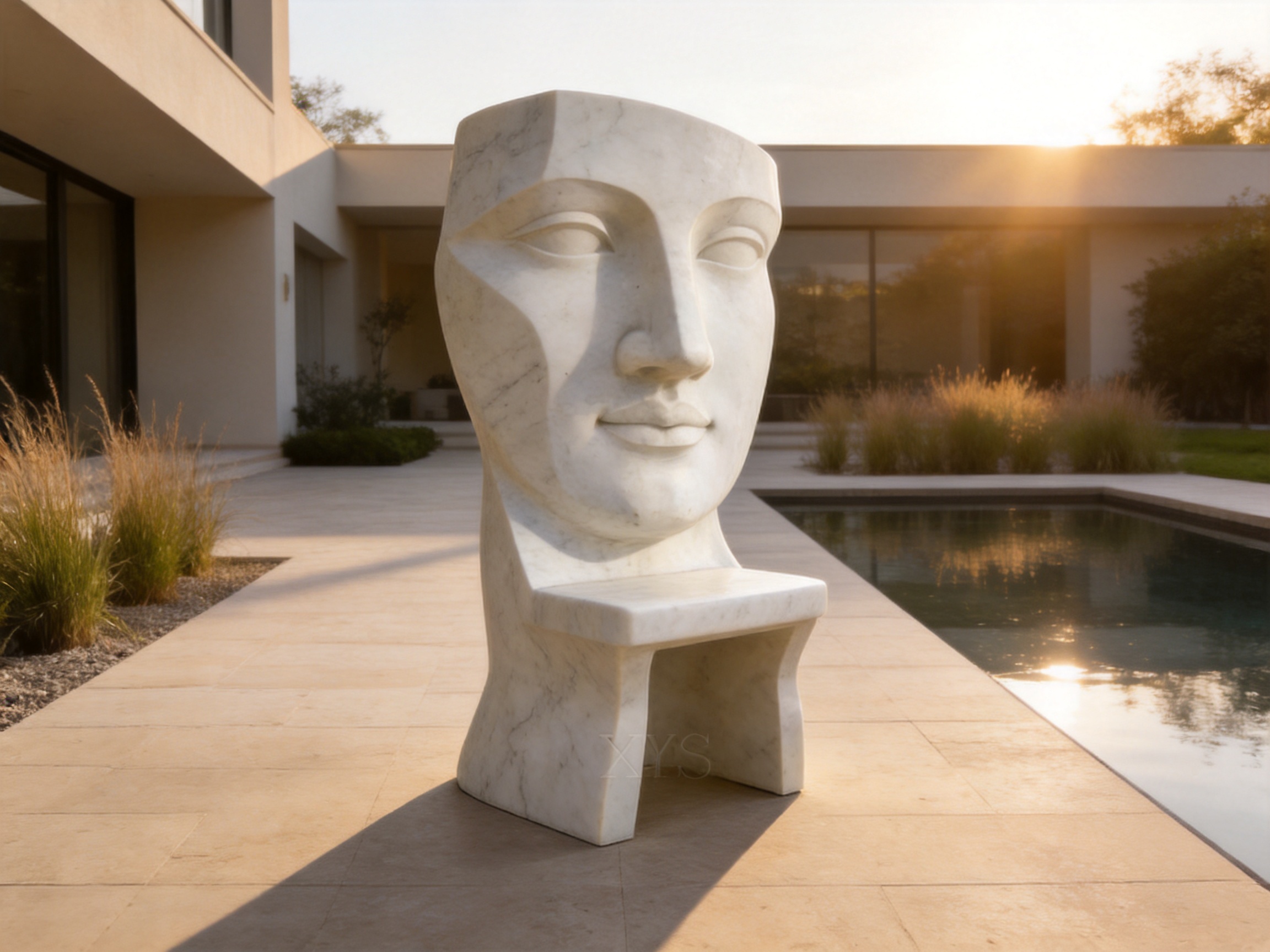
The sculpture can be positioned near an entrance, at the end of a garden axis, beside a reflecting pool, or within a sheltered seating area. Light and shadow are especially important. Morning or afternoon light can reveal the face’s contours, while evening illumination can emphasize the profile and natural stone texture.
In an art park, functional sculpture can increase visitor engagement. People may photograph the piece, sit beside it, discuss its meaning, or use it as a meeting point. This type of interaction gives the work a social role in addition to its aesthetic purpose.
The abstract face also supports curatorial programs focused on identity, emotion, the human body, modern design, or the relationship between art and public space. Because the design is not tied to a specific historical figure, it can be interpreted in different cultural contexts.
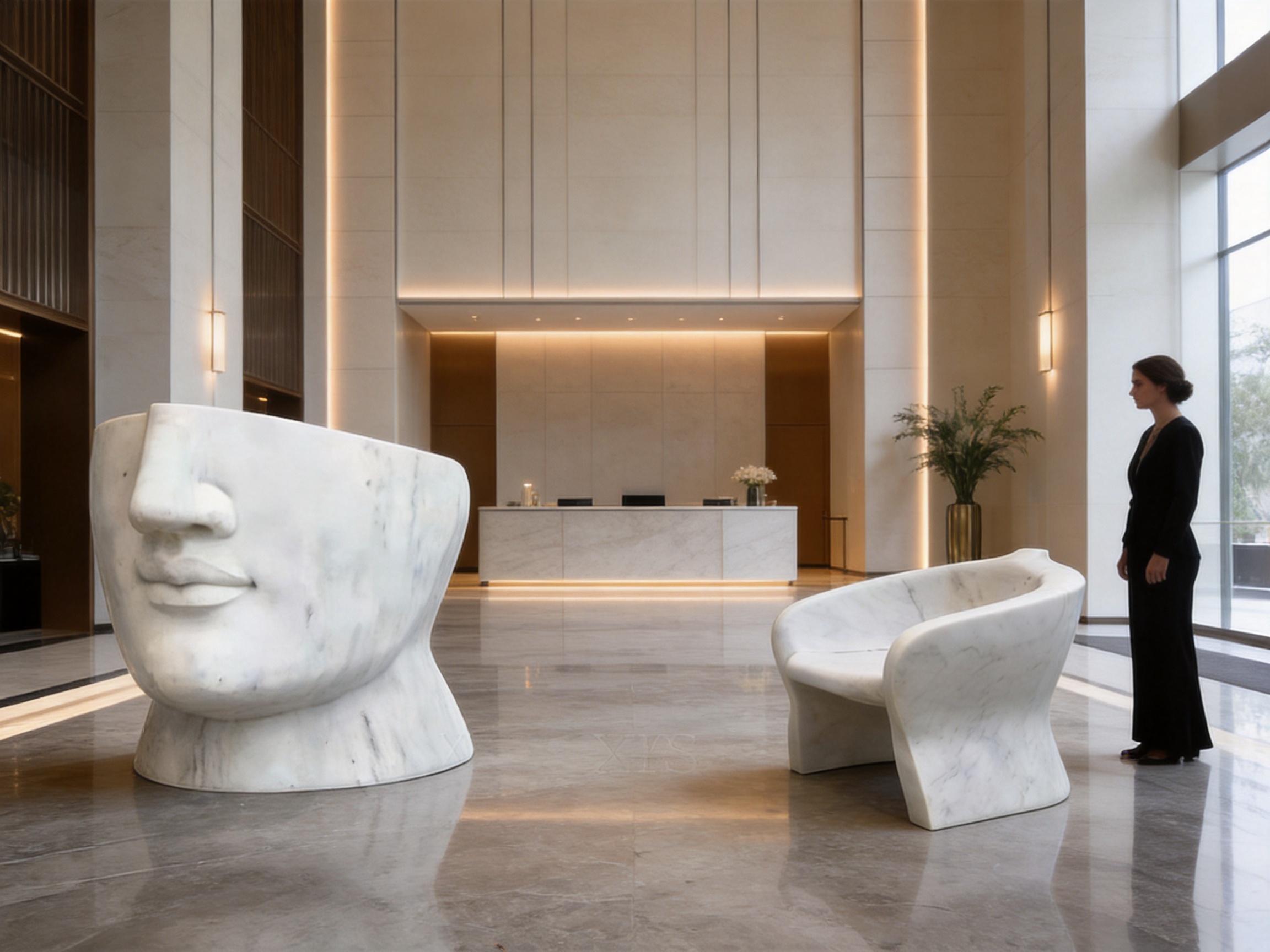
Hospitality environments often require strong visual features that communicate quality from the moment a guest arrives. A sculptural seat can help establish an atmosphere of exclusivity and sophistication in a lobby, lounge, private club, spa, or reception area.
Placed near a reception desk or under a feature light, the piece can serve as a signature installation. In a hotel, it may also become a recognizable image associated with the property. Because it combines art and seating, it can occupy space efficiently while offering a more distinctive result than separate furniture and decorative objects.
Although the product is especially suited to luxury and cultural environments, it can also work in corporate headquarters, design studios, galleries, showrooms, and premium retail spaces. In such locations, the sculpture can communicate creativity, confidence, and attention to material quality.
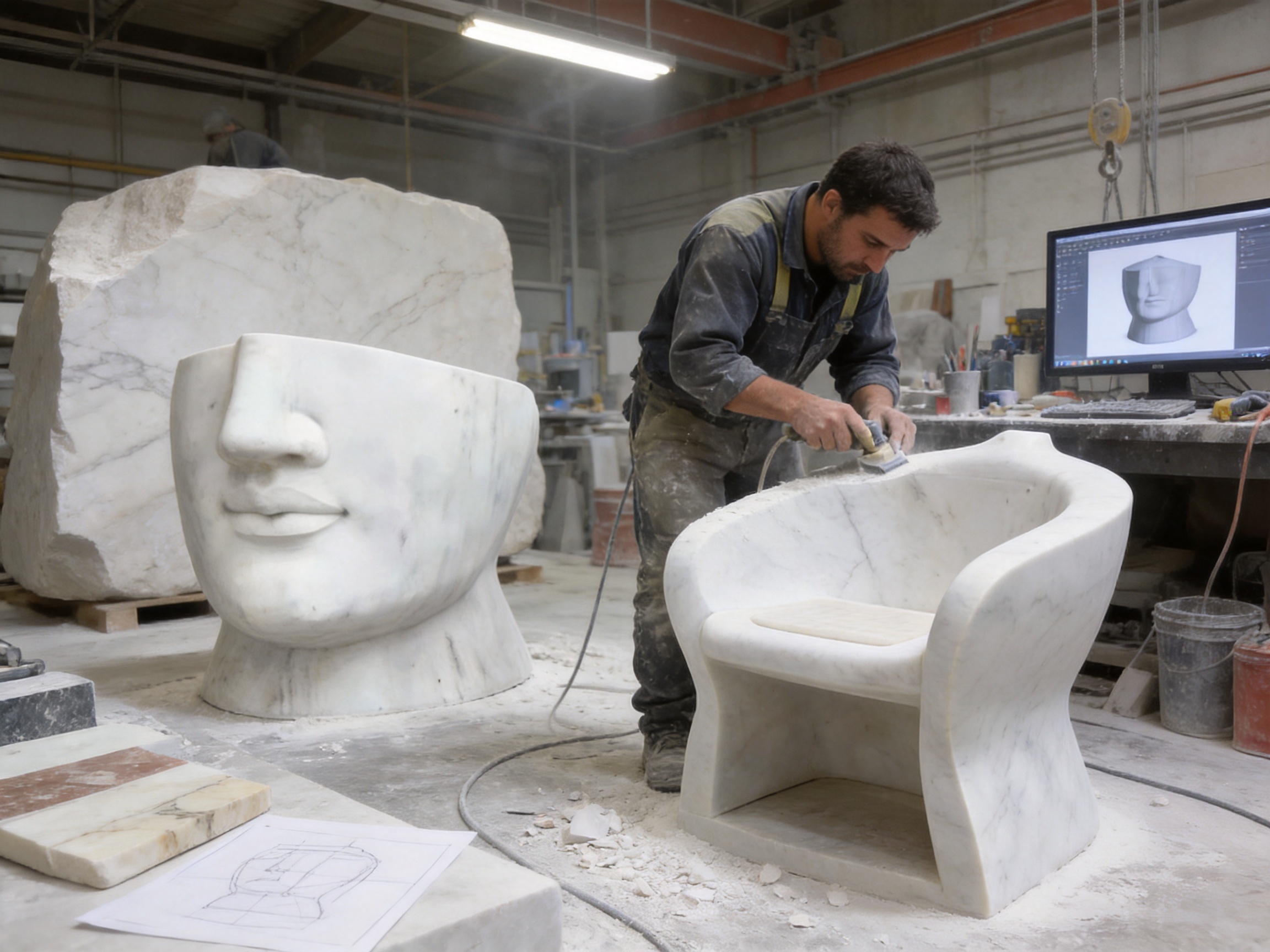
The quality of a large marble sculpture depends on far more than the initial design. It requires appropriate stone selection, accurate interpretation of the form, controlled material removal, careful structural judgment, detailed hand finishing, and reliable inspection. Jiangsu Xinyesheng Sculpture Co., Ltd., based in Jiangyin City, Jiangsu Province, China, presents this product as part of a broader sculpture manufacturing capability covering bronze, stainless steel, marble, fiberglass, and weathering steel works.
This range of materials is significant because it indicates experience with different production methods and finishing requirements. Marble carving demands knowledge of stone behavior. Metal sculpture requires fabrication and surface treatment. Fiberglass involves mold-making and composite finishing. Weathering steel requires attention to controlled oxidation and surface development. A manufacturer familiar with these categories can evaluate a project according to material performance rather than forcing every design into one production method.
The first critical stage is selecting a marble block suitable for the intended design. The block must be assessed for dimensions, internal consistency, visible veining, color, potential inclusions, and structural soundness. For a face sculpture with integrated seating, the relationship between the block and the final form must be considered from the beginning.
One-block carving demands efficient planning because the design must be developed within the natural limitations of the raw material. The block cannot simply be treated as an unlimited blank surface. Its grain direction, natural fractures, density, and visible features all influence the carving strategy.
A careful selection process helps reduce the risk of losing important design features during carving. It also allows the manufacturer to choose a stone whose natural patterns enhance the abstract face rather than compete with it.
Contemporary stone manufacturers commonly combine artistic modeling with digital planning. A sculptural concept can be reviewed through drawings, three-dimensional models, scale studies, and dimensional checks before the full-size block is processed. This is particularly useful when the buyer requests changes to the face proportions, seat dimensions, surface character, or overall silhouette.
Digital planning does not replace artistic judgment. Instead, it helps translate an expressive form into a buildable object. Curves can be evaluated from multiple viewpoints, contact points can be reviewed, and the relationship between the face and the seat can be adjusted before significant material is removed.
For customized projects, this planning stage can also help coordinate the sculpture with the architectural site. The manufacturer and client may confirm the available footprint, preferred viewing angles, walkway clearances, lighting positions, and installation requirements.
Large-scale marble carving generally begins with controlled removal of excess material. The objective is to establish the broad mass, major planes, and overall proportions while preserving enough material for later refinement. The process must balance efficiency with caution because removing too much stone cannot be reversed.
For a form that includes an abstract face, the rough-carving stage must protect the key visual landmarks. These may include the forehead, nose, cheeks, chin, neck, and transitions into the seat structure. The design is not dependent on realistic anatomical detail, but it still requires intentional control of mass and proportion.
Advanced production combines appropriate mechanical equipment with skilled manual supervision. Machines can improve consistency during large-scale material removal, while experienced artisans remain responsible for interpreting the design, responding to the stone, and preserving the intended character of the sculpture.
The character of an abstract sculpture is often determined during refinement. Broad surfaces may be softened, edges may be sharpened or deliberately blurred, and transitions may be adjusted to create a sense of fluid movement. The final surface can range from highly polished to honed, satin-like, or lightly textured, depending on the desired aesthetic.
Hand finishing is especially important for a face-inspired design. Even an exaggerated form needs visual rhythm. If every area is equally smooth, the sculpture may lose definition. If every area is aggressively textured, the face may become visually confusing. Skilled finishing creates a controlled balance between clarity and abstraction.
The seat surface deserves additional attention because it must support practical use. It should be visually integrated with the face while remaining appropriate for contact, cleaning, and routine maintenance. Edge treatment, smoothness, drainage considerations, and user comfort should be addressed during this stage.
A professional manufacturing process should include inspection of dimensions, surface consistency, visible defects, stability, and the relationship between the sculpture and its supporting base. Before delivery, the work should be reviewed from multiple angles and under suitable lighting.
Because marble is heavy, installation planning is essential. The project team should confirm the ground condition, access route, lifting equipment, base design, and final positioning before shipment. A carefully produced sculpture can still be damaged if transport or installation is not handled correctly. Manufacturer coordination at this stage contributes to the overall reliability of the purchase.
The product information states that both style and stone texture are customizable. This gives buyers the opportunity to adapt the Abstract Face Marble Seat to a particular project rather than selecting an entirely fixed item.
| Customization Area | Possible Direction | Design Benefit |
|---|---|---|
| Marble selection | Light, dark, warm, cool, plain, or veined stone | Coordinates the sculpture with architecture and landscape |
| Face expression | Calm, dramatic, mysterious, softened, or more exaggerated | Changes the emotional atmosphere of the installation |
| Surface finish | Polished, honed, satin, or selectively textured | Controls reflection, touch, and visual contrast |
| Seat proportions | Adjusted height, width, depth, or contour | Improves site suitability and practical use |
| Overall scale | Modified dimensions for interior or exterior settings | Supports different spatial requirements |
| Base and anchoring | Integrated plinth, concealed support, or site-specific foundation | Improves stability and installation integration |
Customization should be handled through a documented approval process. Buyers may request sketches, digital views, material samples, and dimensional drawings before production begins. It is also useful to define which aspects must remain consistent with the original concept and which can be modified freely.
For example, a hotel may request a more serene face and a pale stone surface to match a calm interior. An art park may prefer a stronger exaggeration and dramatic veining. A private villa may require a wider seat, a lower profile, or a finish that coordinates with nearby paving.
The success of a sculptural seat depends on its surroundings. The work should not be treated as an isolated object without considering the visual field around it.
The approximately 1.2-meter face height creates a strong presence at close and medium distances. At a distance of several meters, the silhouette will be more important than fine surface details. At close range, viewers will notice the stone texture, carving transitions, and tactile finish.
For a public or hospitality setting, a clear viewing zone should be maintained around the sculpture. Excessive furniture, signage, or decorative clutter may reduce its impact. A simple background often allows the abstract form to communicate more effectively.
Lighting can transform the appearance of marble. Soft frontal lighting may reveal the overall expression, while side lighting can emphasize curves and recesses. Ground-level lighting can make the face appear more monumental, but excessive contrast should be avoided if the piece is intended for a calm seating area.
Natural light is equally important. The sculpture may appear different in morning, afternoon, and evening conditions. Before final placement, the buyer should observe how shadows move across the face and seat during the day.
Marble works well with greenery, water, stone paving, timber, and architectural concrete. Plants can soften the sculpture’s edges and create a dialogue between natural growth and carved geology. However, vegetation should not hide the face or create persistent moisture problems around the base.
In a formal courtyard, symmetrical planting may emphasize the object’s architectural role. In a more natural garden, irregular planting can make the sculpture appear as if it has emerged from the landscape. The choice depends on whether the project seeks order, contrast, or organic integration.
Although the product is a work of art, the seating function should be communicated clearly through its placement. If the seat is blocked by planting or positioned on an uneven surface, visitors may hesitate to use it. A level approach, suitable surrounding paving, and adequate clearance can make the work more inviting.
In a private setting, cushions may be used if they are compatible with the stone surface and the overall design. In a public environment, the natural marble finish may be preferable because it is easier to maintain than fabric accessories.
Natural marble is durable, but it is not maintenance-free. Proper care will help preserve the stone’s appearance and ensure that the functional seat remains attractive over time.
Dust, soil, leaves, and other surface debris should be removed regularly using a soft cloth, brush, or low-pressure water rinse where appropriate. A pH-neutral stone cleaner can be used when deeper cleaning is necessary. Abrasive pads and harsh acidic chemicals should be avoided because they may dull or etch the surface.
For outdoor installation, drainage and ground preparation are important. Water should not remain trapped around the base. In climates with freezing temperatures, the project team should consider local conditions, stone selection, installation details, and protective measures. The manufacturer or qualified stone professional should advise on the most appropriate finish for the site.
The seat may come into contact with beverages, food, cosmetics, soil, and other staining materials. Prompt cleaning is recommended, especially if the marble has a lighter color or a more absorbent finish. A suitable professional sealant may be considered, although the choice should be based on the specific marble and desired surface appearance.
Owners should avoid placing sharp metal objects directly on the seat and should not use aggressive cleaning methods on the face. If a repair or refinishing process becomes necessary, it should be performed by a qualified stone specialist familiar with sculptural marble rather than a general construction contractor.
With suitable care, the Abstract Face Marble Seat can remain a valuable feature for many years. Its long-term value is not limited to physical durability. It also comes from its ability to remain visually relevant. Abstract forms are less dependent on short-lived decorative trends than highly literal or heavily themed objects.
A premium sculptural seat can contribute to the identity of a property. In hospitality, memorable design details influence how guests photograph, discuss, and remember a space. In residential projects, a distinctive sculpture can make a courtyard or garden feel individually designed rather than assembled from catalog items.
For developers and architects, the product may provide several functions within one footprint. It is artwork, furniture, a landmark, and a design statement. This multifunctional quality can be especially useful in projects where every element must contribute to both atmosphere and usability.
The listed price of $18,150 should be evaluated in relation to the full project context. Buyers should consider marble quality, custom design work, production complexity, packing, shipping, installation, site preparation, and any special finishing requirements. A direct price comparison with a standard bench or a molded decorative statue would not reflect the different material and manufacturing categories.
Compared with commissioning separate sculpture and furniture, an integrated piece may also simplify visual coordination. The face and seat are conceived as one composition, reducing the risk that unrelated objects will compete for attention.
Large stone sculptures require more than artistic inspiration. They require production discipline. The manufacturer must understand how to convert a concept into a stable object, how to manage material risk, and how to coordinate the final work with the client’s site.
Jiangsu Xinyesheng Sculpture Co., Ltd. offers a product range that includes bronze sculptures, stainless steel sculptures, marble sculptures, fiberglass sculptures, and weathering steel sculptures. This cross-material capability is valuable for buyers who work on multiple projects or who need advice about selecting the right medium for a particular environment.
The company’s location in Jiangyin City, Jiangsu Province, places it within a significant Chinese manufacturing region with access to industrial supply chains, skilled fabrication resources, transportation networks, and material-processing services. For international buyers, this can support custom production and coordinated export arrangements, subject to project-specific confirmation.
The company can be contacted by telephone or email for product consultation, customization discussion, quotation confirmation, and installation planning. Since the product is customizable, buyers should request current information about available marble, production lead time, packing method, shipping terms, finish options, and warranty or after-sales provisions before placing an order.
A successful purchase should begin with a clear project brief. The buyer should identify the intended location, indoor or outdoor conditions, approximate viewing distance, expected use, preferred style, and target completion date.
The next step is to confirm the marble. Buyers may request photographs, videos, samples, or a material approval process. Because natural stone varies, it is important to understand whether the images show a representative material or the exact block intended for production.
Design confirmation should follow. The final drawings or digital models should show the face profile, seat dimensions, overall height, base, finish, and any requested changes. If the sculpture is intended for public use, the buyer should also discuss safety, accessibility, stability, and maintenance requirements.
Production approval should be documented before carving begins. The buyer and manufacturer should confirm the price, payment schedule, production period, packaging, delivery conditions, installation responsibilities, and procedures for handling natural variation.
During production, progress photographs can help maintain communication. For a custom piece, photographs at the block-selection, rough-carving, refinement, and finishing stages can provide useful checkpoints. Final inspection should confirm that the completed work corresponds to the approved design and material expectations.
It is a contemporary marble sculpture that incorporates a practical seat. The design features an abstract and exaggerated human face carved from a single block of natural marble, with an approximate face height of 1.2 meters and a matching seat height of approximately 0.7 meters.
The product description states that it is carved from a single block of precious natural marble. Buyers should confirm the final construction, block dimensions, and any base or anchoring details with the manufacturer for their specific order.
Yes. The product information states that the style and stone texture are customizable. Marble selection should be discussed early because natural blocks differ in color, veining, mineral pattern, and availability.
Customization should be possible in accordance with the manufacturer’s design process. Buyers may discuss proportions, expression, degree of abstraction, surface treatment, and overall scale. A drawing or digital approval should be completed before production.
The sculpture is described as suitable for villa courtyards and art parks, which indicates outdoor applications. However, the final suitability depends on the selected marble, local climate, finish, drainage, foundation, and installation method. These factors should be confirmed for the intended site.
Yes. Hotel lobbies are specifically identified as suitable environments. The sculpture can function as a visual landmark and a usable seat. Interior placement also reduces exposure to weather, although cleaning and protection from impact remain important.
A conventional marble bench primarily emphasizes seating. The Abstract Face Marble Seat adds a strong sculptural identity through its abstract human-face form. It is designed to serve as furniture, artwork, and an architectural focal point at the same time.
The natural marble construction provides greater visual weight, geological variation, tactile authenticity, and a sense of permanence. Fiberglass may offer advantages in lightness and complex surface color, but it does not provide the same carved-stone character.
Metal sculptures are fabricated through processes such as forming, welding, casting, polishing, or patination. The Abstract Face Marble Seat is shaped through stone carving and finishing. It offers a more natural, solid, and mineral-based appearance than most metal alternatives.
Routine dust and debris can be removed with a soft cloth or brush. For deeper cleaning, use a suitable pH-neutral stone cleaner. Acidic chemicals, abrasive pads, and harsh powders should be avoided because they can damage the marble surface.
The listed price is $18,150. The final quotation may depend on marble selection, customization, dimensions, finishing, packaging, shipping, installation, and other project requirements.
The supplied information does not specify whether shipping or installation is included. These items should be confirmed directly with the manufacturer before ordering.
Installation should be planned around the sculpture’s weight, access route, foundation, lifting equipment, drainage, and final position. A qualified installer should handle the work, with the manufacturer providing relevant dimensions and recommendations.
Yes. The stated customization options make it suitable for commissioned applications. The buyer should provide site information, preferred dimensions, design references, material preferences, and required completion dates.
The product is presented by Jiangsu Xinyesheng Sculpture Co., Ltd., a sculpture manufacturer based in Jiangyin City, Jiangsu Province, China. The company’s listed product categories include bronze, stainless steel, marble, fiberglass, and weathering steel sculptures.
The Abstract Face Marble Seat is a strong choice for buyers seeking a sculptural object with practical value and a highly individual appearance. Its central advantage is the integration of art and function. The abstract face gives the piece identity, while the seat makes it approachable and useful.
Its construction from a single block of natural marble adds visual continuity, material authenticity, and long-term presence. Natural veining and stone texture ensure that each piece has its own character. The design can also be adapted through changes to the marble, surface finish, proportions, and style, allowing it to respond to different architectural and landscape requirements.
In comparison with ordinary benches, it offers far greater visual distinction. In comparison with mass-produced statues, it provides practical use and a more individualized natural material. In comparison with fiberglass and some metal alternatives, it offers the solidity, tactile richness, and geological uniqueness of carved stone.
The manufacturing process is equally important. Selecting an appropriate block, planning the form, controlling rough carving, refining the surface, checking stability, and preparing installation all require specialized knowledge. The manufacturer’s broader experience with multiple sculpture materials supports a production approach capable of serving different artistic and architectural briefs.
For a villa courtyard, art park, luxury hotel, high-end club, or carefully designed interior, the Abstract Face Marble Seat can become more than an object placed in a room or garden. It can become the element that defines the space around it. Its scale, natural texture, expressive abstraction, and functional character make it a durable design investment for clients who value originality, craftsmanship, and a strong connection between art and daily life.
1. Product specification and descriptive materials for the Abstract Face Marble Seat, including dimensions, price, material, applications, and customization information.
2. General principles of natural stone selection, marble carving, surface finishing, installation, and maintenance.
3. Architectural design practices for integrating sculpture, seating, landscape elements, and hospitality interiors.
4. Contemporary approaches to functional sculpture and the relationship between public art and human interaction.
5. General comparative considerations regarding marble, bronze, stainless steel, fiberglass, and weathering steel sculpture production.
6. Manufacturer information supplied for Jiangsu Xinyesheng Sculpture Co., Ltd., including product categories and business contact details.



Daniel H.

Amanda R.

Robert B.

Jennifer S.

James W.

Barry G.

Michael T.

Emily K.

David L.

Sarah M.


Mikey XV

Jagxue

 English
 Español
 عربى
عربى Français
 italiano
 Deutsch