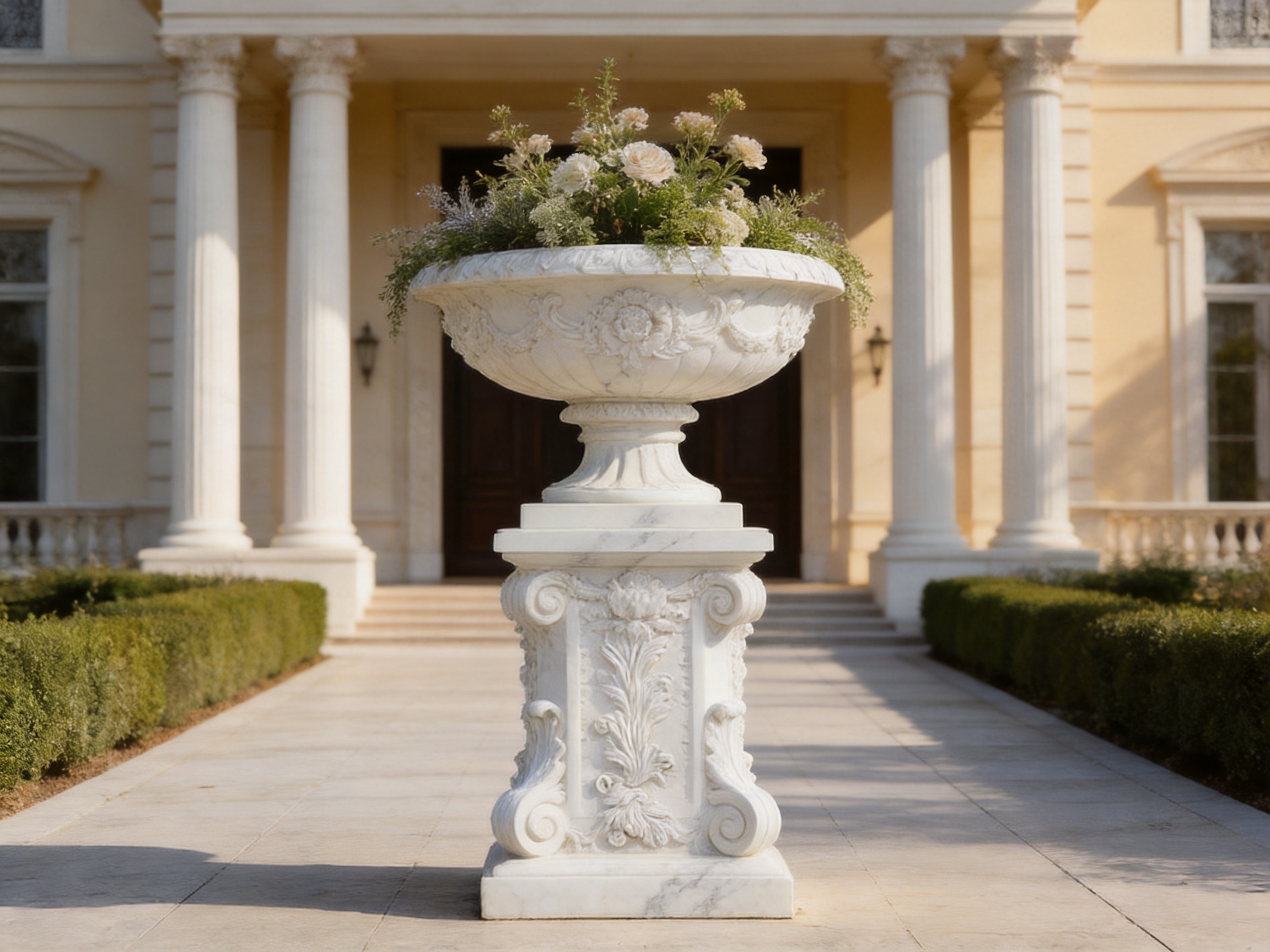
A beautifully designed planter can do far more than hold flowers. It can establish a focal point, frame an entrance, define a courtyard, and communicate the architectural character of an entire property. The European Stone Carved Flower Planter is designed for precisely this purpose. Created from natural marble and shaped with classical European ornamentation, it combines practical planting function with the visual authority of a fine architectural sculpture.
With an overall height of approximately 160–200 cm and a planter diameter of approximately 70–90 cm, this substantial stone feature is intended for prominent outdoor settings. It is suitable for villa courtyards, hotel entrances, public plazas, luxury clubs, landscaped gardens, and other spaces where durability and presentation are equally important. Its monumental proportions allow it to remain visually significant even when positioned beside large buildings, broad walkways, or formal landscape designs.
The planter is produced by Jiangsu Xinyesheng Sculpture Co., Ltd., a China-based sculpture manufacturer specializing in custom and architectural sculpture production. The company’s product range includes bronze sculptures, stainless steel sculptures, marble sculptures, fiberglass sculptures, and weathering steel sculptures. This broad material experience supports a practical understanding of stone selection, sculptural form, surface treatment, structural design, and the demands of outdoor installation.
Unlike ordinary commercial planters, this piece is conceived as a complete sculptural composition. Its carved body, decorative details, generous scale, and natural stone presence create an impression of permanence. It can be used as a single centerpiece or arranged as part of a symmetrical group, allowing designers and property owners to build a cohesive European-style landscape concept.
Content
The European Stone Carved Flower Planter is a high-end functional sculpture made from natural marble. It is designed to accommodate plants while also functioning as a decorative architectural element. The planter’s form is inspired by traditional European ornamental stonework, in which flower vessels, columns, balustrades, fountains, and garden monuments were used to express elegance and status.
The product is available in two listed size options. The first option measures approximately 160 cm in total height with a planter diameter of approximately 70 cm and is priced at $12,375. The second option measures approximately 200 cm in total height with a planter diameter of approximately 90 cm and is priced at $16,500. Actual dimensions, marble selection, surface appearance, packaging requirements, and installation conditions should be confirmed before final production or purchase.
| Item | Option One | Option Two |
|---|---|---|
| Product type | European-style carved marble flower planter | European-style carved marble flower planter |
| Total height | Approximately 160 cm | Approximately 200 cm |
| Planter diameter | Approximately 70 cm | Approximately 90 cm |
| Primary material | Natural marble | Natural marble |
| Primary use | Outdoor planting and landscape decoration | Outdoor planting and landmark landscape decoration |
| Listed price | $12,375 | $16,500 |
The two size choices provide flexibility for different site conditions. The 160 cm version may be appropriate for courtyards, entrance terraces, hotel garden paths, and areas where the planter must complement nearby architectural features without overwhelming them. The 200 cm version has a stronger monumental character and may be preferred for large plazas, grand driveways, commercial developments, and formal garden axes.
Because the planter is made from natural stone, each finished piece will possess individual variations in veining, color, grain, and surface character. These variations are not defects; they are part of the identity of genuine marble. As a result, every planter has a distinctive appearance while maintaining the intended carved form and decorative composition.
Natural marble has been used in architecture and sculpture for centuries because it offers a rare combination of strength, visual refinement, and workability. When properly selected, shaped, finished, and installed, marble can withstand long-term outdoor exposure while retaining a dignified appearance. Its mineral composition provides a solid, substantial feel that is difficult to reproduce with lightweight or artificial materials.
For an outdoor planter, material quality is particularly important. The container must support soil, plants, irrigation water, and the weight of the stone itself. It must also remain visually attractive while exposed to sunlight, rain, wind, dust, temperature variation, and seasonal changes. Natural marble provides the mass and stability needed for a large-format sculpture, reducing the risk that the planter will appear temporary or visually insubstantial.
Compared with fiberglass or thin metal planters, a solid marble planter offers a more authoritative presence. Fiberglass can be useful when low weight, rapid installation, or economical replication is the priority, but it generally does not provide the same tactile depth or natural mineral character. Metal planters can deliver a contemporary appearance, yet their surface behavior, thermal expansion, corrosion considerations, and design language may not suit a classical European landscape.
Marble is also well suited to detailed carving. Its surface can be shaped into scrolls, leaves, floral elements, moldings, recessed panels, borders, and other ornamental features. These details catch light and shadow throughout the day, giving the planter a changing visual rhythm. The result is more sophisticated than a simple molded container or a plain stone block.
The product is described as solid, weatherproof, and weather-resistant, making it suitable for long-term outdoor use. These qualities are especially valuable for commercial and hospitality properties, where landscape elements must remain presentable over many years and where frequent replacement would create additional cost and disruption.
Weather resistance does not mean that marble is completely unaffected by its surroundings. All natural stone should be selected and maintained with consideration for local climate, freeze-thaw cycles, pollution, salts, drainage, and cleaning practices. Proper installation should prevent standing water, and the planting cavity should be designed to drain effectively. In cold climates, drainage is particularly important because trapped water can expand during freezing conditions.
When the stone type, carving method, drainage design, and installation foundation are appropriately coordinated, the planter can provide dependable service for long periods. Its aging process can also contribute to its character. Rather than looking disposable, a well-maintained marble planter may become more integrated into the landscape as the surrounding plants mature and the site develops a sense of history.
One of marble’s strongest advantages is its ability to combine a clean architectural surface with subtle natural variation. Depending on the selected stone, the planter may display soft white, warm ivory, gray, beige, or gently veined tones. These variations can work with classical facades, contemporary buildings, mature vegetation, paved plazas, and water features.
Natural veining provides visual movement without requiring bright colors or applied decoration. In formal landscapes, this understated complexity helps the planter appear luxurious without becoming visually aggressive. The carved ornamentation creates the primary pattern, while the marble’s natural grain adds secondary detail.
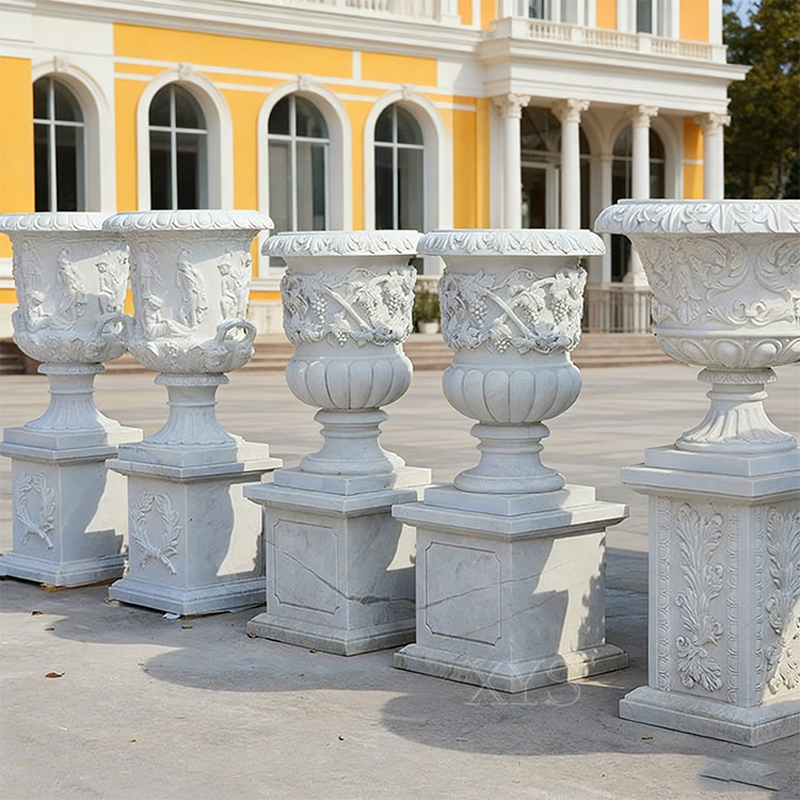
European Stone Carved Flower Planter
The defining feature of this product is its classical European ornamental language. Instead of treating the planter as a purely utilitarian vessel, the design uses proportion, relief, symmetry, and carved detail to create a sculptural object. Its presence can evoke historic garden architecture while remaining suitable for modern luxury developments.
European garden traditions often use monumental planters to establish rhythm and hierarchy. A pair of decorated vessels may frame a gate or staircase. A sequence of planters may guide visitors along a path. A large central planter may serve as the visual anchor of a courtyard. This product can participate in all of these arrangements because its scale and decorative character allow it to read clearly from a distance.
The carved details are intended to be fine and three-dimensional. Three-dimensional carving is important because it gives the ornament visual depth. Shallow printed patterns or painted decorations tend to lose clarity when viewed from across a plaza. Properly carved reliefs retain a more convincing relationship with natural light, creating highlights on raised surfaces and shadows within recessed areas.
Successful classical design depends on balance. A planter that is too small may disappear beside a large building, while one that is too large may obstruct circulation or overpower nearby features. The available 160 cm and 200 cm height options help address this issue by offering different levels of visual impact.
The diameter is also important. A 70 cm planter diameter creates a substantial planting area while retaining a relatively controlled footprint. A 90 cm diameter gives the larger option a more generous visual and horticultural presence. The relationship between total height and bowl diameter should be reviewed in connection with the height of surrounding walls, doors, columns, trees, stairs, and furniture.
For symmetrical compositions, matching dimensions are usually preferred. For a more relaxed estate or garden setting, designers may combine different sizes or use one primary planter with smaller supporting vessels. Custom projects may also require adjustments to height, diameter, base design, carving details, or marble color, subject to technical review and production confirmation.
Many decorative landscape products are attractive but offer limited practical use. Conversely, many functional planters are efficient but visually generic. This marble planter occupies the space between these two categories. It holds living plants while also serving as a permanent sculptural statement.
This dual role can improve the efficiency of a landscape budget. A property owner does not need to choose between purchasing a sculptural monument and purchasing a planter when one carefully designed object can perform both functions. The result can be particularly effective in hospitality environments, where every visible element contributes to the guest experience and brand atmosphere.
The European Stone Carved Flower Planter competes with a wide range of outdoor containers, including concrete planters, cast stone vessels, metal planters, fiberglass products, ceramic containers, and mass-produced synthetic units. Each material has practical applications, but this marble sculpture offers several advantages for buyers seeking permanence, luxury, and a highly distinctive appearance.
Concrete planters can be economical and structurally reliable, but standard concrete often presents a plain, industrial appearance. Decorative concrete can imitate stone, yet its surface may lack the natural variation and refined translucency associated with marble. Concrete can also show casting lines, aggregate inconsistencies, stains, or surface wear that may be difficult to conceal in prestigious settings.
Natural marble offers a more premium visual identity. Its surface is not merely manufactured to resemble stone; it is stone. The carved reliefs can therefore appear more authentic, particularly when viewed closely at an entrance, reception area, or garden terrace. For projects where perceived quality is essential, this distinction can be meaningful.
Fiberglass and resin planters are lightweight and convenient, and they can be suitable for temporary installations or locations with strict load limitations. However, their low weight can become a disadvantage in windy outdoor environments. They may require additional anchoring, internal ballast, or protective measures to prevent movement.
A solid marble planter naturally provides substantial weight and stability. Its mass helps it remain securely positioned when installed on a properly engineered foundation. It also provides the visual authority expected from a landmark object. While the additional weight requires careful transportation and site planning, it is an advantage once the planter is installed.
Artificial materials may also fade, crack, blister, or lose surface realism under prolonged ultraviolet exposure and weather changes. High-quality products can reduce these concerns, but natural marble avoids the problem of artificial printed stone effects. Its visual character comes from the actual material and carving rather than from a surface image.
Stainless steel and weathering steel planters are popular in contemporary landscapes. They can create crisp geometric forms, bold colors, or industrial character. However, their appearance may conflict with classical facades, traditional gardens, and European-inspired architecture.
The marble planter provides a softer and more historically connected alternative. Its pale stone presence can complement columns, arches, balustrades, fountains, and masonry walls. It does not depend on painted color or intentional rust development to achieve its identity. The carved ornamentation creates its visual interest through form, proportion, and shadow.
Ceramic planters can offer attractive glazes and decorative patterns, but very large ceramic pieces may be vulnerable to impact, frost, thermal shock, and accidental damage. Their scale may also be limited by firing and transportation constraints. A carved marble planter is better suited to settings where a heavy, permanent architectural object is desired.
Marble also allows a more integrated relationship with stone paving and building materials. A ceramic vessel may appear as a separate accessory, while a carved marble planter can appear to belong to the architecture itself.
Hotels, clubs, luxury residences, and commercial plazas often need landscape elements that are recognizable and memorable. Generic planters may fulfill a practical requirement but contribute little to the identity of a property. A large carved marble vessel can become a signature feature that visitors associate with the entrance, courtyard, or central garden.
This distinctiveness is especially valuable in photographs and promotional images. A sculptural planter can frame a doorway, enrich a wedding venue, add formality to a restaurant terrace, or create a strong visual backdrop for events. The product therefore contributes not only to landscape design but also to the perceived quality and market positioning of the site.
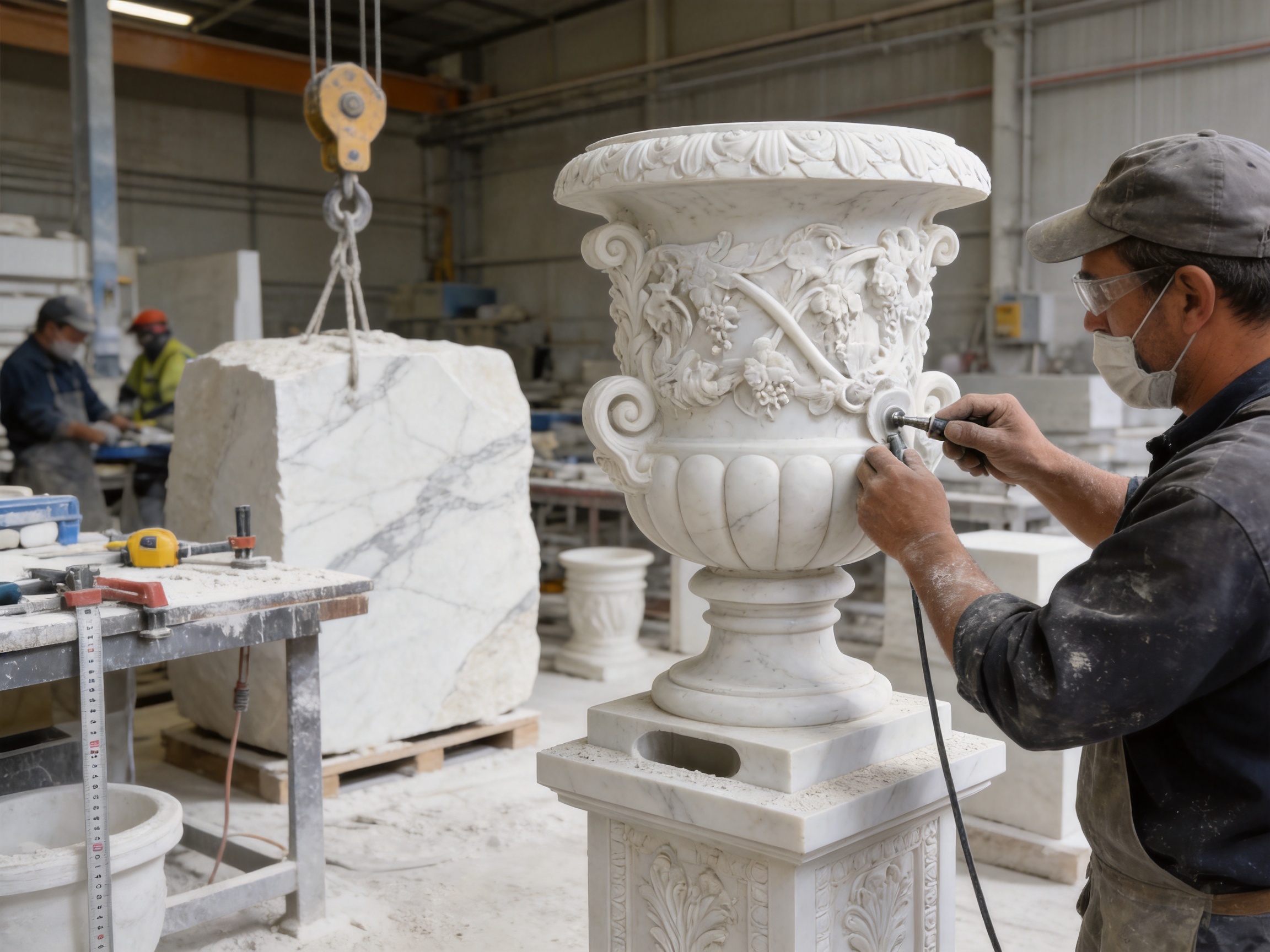
The quality of a large carved stone planter depends on more than the appearance of a finished photograph. It depends on the coordination of material selection, design interpretation, stone preparation, carving, assembly, surface finishing, inspection, packing, and delivery. Jiangsu Xinyesheng Sculpture Co., Ltd. operates as a sculpture manufacturer with experience across multiple sculpture materials, including marble and several metal and synthetic categories.
This multi-material background is an important manufacturing strength. It indicates familiarity with different structural behaviors, fabrication methods, surface requirements, and installation conditions. Although the planter itself is made from marble, knowledge of bronze, stainless steel, fiberglass, and weathering steel can support a broader understanding of how sculpture performs in outdoor environments.
Natural stone production begins with the selection of suitable material. For a large planter, the stone must be evaluated not only for color and visual quality but also for soundness, consistency, thickness, and suitability for carving. Areas with excessive fissures, unstable inclusions, or structural weaknesses should be identified before detailed work begins.
Material selection should also consider the desired relationship between the carved ornament and the natural pattern of the marble. Strong veining may create a dramatic effect, while a more uniform stone may allow the ornamental details to dominate. The selection can therefore be aligned with the architectural setting and the client’s design objectives.
Inspection at this stage helps reduce the risk of discovering major material problems after carving has begun. It also provides a basis for planning the orientation of the stone, positioning of decorative features, and management of visible surfaces.
European-style ornamentation requires careful interpretation of proportion and relief. The production team must understand the intended profile, base, bowl, rim, decorative panels, transitions, and overall silhouette. A strong manufacturing process translates the design concept into measurable forms while preserving the character of hand-finished sculpture.
Depending on project requirements, the design may be developed through drawings, digital modeling, reference images, or physical templates. Digital tools can assist with scaling, symmetry, repeated motifs, and dimensional coordination. Skilled sculptural judgment remains essential because ornamental carving is not only a matter of copying lines; it requires control of depth, rhythm, edge quality, and visual balance.
For custom work, the manufacturer can review proposed modifications before production. Clients may request changes to the planting bowl, base proportions, ornamentation, marble tone, or overall dimensions. Such changes should be discussed in advance because even a modest alteration can affect structural stability, material consumption, packaging, and installation.
Large stone forms are generally developed in stages. Rough shaping removes excess material and establishes the main mass. Subsequent carving refines the profile, transitions, decorative elements, and surface planes. This staged approach is efficient because it reserves detailed work for areas that have already been confirmed as structurally sound.
Precision carving is particularly important around thin ornamental edges, deep reliefs, corners, rims, and transitions between decorative and structural zones. The manufacturer must remove material carefully to preserve the strength of the stone while achieving crisp visual detail. Excessive removal can weaken a section, while insufficient removal can make the ornament appear flat or unfinished.
Modern equipment may be used to improve repeatability and establish major dimensions, while experienced artisans refine the surface and decorative character. This combination of technology and skilled manual work can offer advantages over either approach alone. Machines can support accuracy and efficiency; craftspeople can judge subtle changes in surface, proportion, and detail that are difficult to reduce to automated instructions.
Surface finishing influences both appearance and maintenance. Depending on the specified design, marble may receive a polished, honed, matte, or selectively textured finish. A polished surface can emphasize color and reflect light, while a honed surface may create a softer and more understated architectural effect. Textured areas can help distinguish ornamental relief from background planes.
Finishing should be applied consistently across the composition while preserving the intended contrast between raised and recessed details. The final surface should be reviewed for tool marks, uneven transitions, chips, unwanted discoloration, and areas where the carving does not read clearly under normal lighting.
Quality control for a large carved planter should include visual inspection, dimensional checking, review of the planting cavity, confirmation of drainage provisions, and examination of bases and connection points. The overall height and diameter should correspond to the approved specification. The planter should sit securely and present a balanced profile from multiple viewing angles.
For projects involving several matching planters, consistency is particularly important. The manufacturer should compare the pieces for proportion, ornament placement, base height, rim profile, and finish. Natural marble variation will remain, but the designed forms should maintain a coherent appearance as a group.
Packaging is another important part of production strength. Large marble sculptures require protection against impact, vibration, abrasion, and moisture during transport. Properly designed crates, padding, bracing, lifting points, and handling instructions can reduce the risk of damage before the piece reaches the installation site.
Architectural clients rarely have identical requirements. A residential courtyard may need one centerpiece, while a hotel development may require a coordinated series of planters in different locations. A public plaza may require custom anchoring, special drainage, accessibility coordination, and precise alignment with paving patterns.
A manufacturer experienced in custom sculpture can help translate these needs into a production plan. The process may include reviewing site dimensions, confirming the intended plant type, evaluating transportation access, discussing lifting equipment, and determining how the planter will connect to the foundation or surrounding landscape.
Customization may involve changes to size, carving style, decorative motifs, stone color, surface finish, base profile, planting cavity, or quantity. The available product establishes a strong European ornamental foundation, while project-specific adjustments can help the piece relate more closely to the client’s architecture.
Custom production is also useful when a project requires a consistent visual language across multiple materials. For example, a marble planter may be paired with a bronze figure, stainless steel signage, a weathering steel garden screen, or fiberglass display elements. A manufacturer familiar with these categories can help coordinate scale and finish so that the installation does not appear visually disconnected.
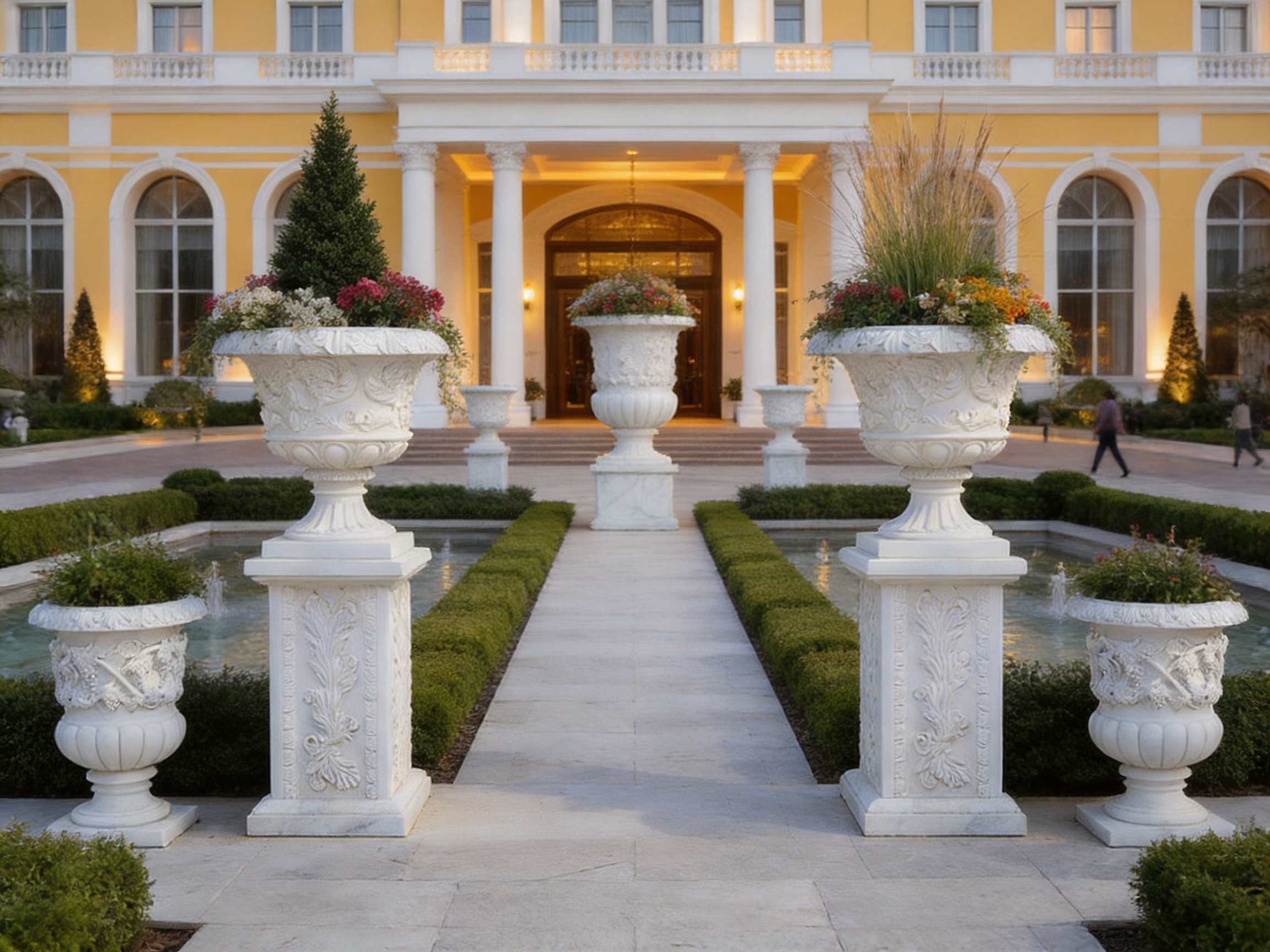
In a villa courtyard, the planter can establish a formal center or frame an entrance. One large planter may be placed at the end of a visual axis, while two matching pieces can define a doorway, staircase, or driveway. The marble surface can complement stone walls, stucco facades, wrought iron gates, and clipped hedges.
For private residences, plant selection should reflect the scale of the planter. Tall ornamental grasses, structured shrubs, flowering standards, palms, or carefully pruned evergreen forms may be suitable, depending on climate and maintenance capacity. The plant should enhance the sculpture without completely hiding the carved bowl or decorative base.
Hotel entrances benefit from objects that communicate welcome, quality, and permanence. A pair of European-style marble planters can create a ceremonial approach and help guests identify the main entrance. The planters can also guide vehicle movement without relying solely on barriers or signage.
Because hotels operate continuously, outdoor materials must tolerate repeated exposure and regular cleaning. Marble’s solid construction and formal appearance make it appropriate for properties that want landscape elements to remain attractive throughout changing seasons and high visitor traffic.
Clubs and private estates often use classical or traditional design elements to create a sense of exclusivity. A carved marble planter can support this atmosphere at reception areas, terraces, garden paths, or event spaces. Its scale makes it appropriate for broad lawns and large masonry buildings, while its ornamentation gives smaller formal gardens a stronger focal point.
In a public plaza, planters may serve several functions at once. They can organize pedestrian movement, provide greenery, soften hard paving, define gathering areas, and establish a memorable civic identity. A heavy stone planter can be more resistant to accidental movement than a lightweight container, although the foundation and placement should still be designed by qualified professionals.
Public projects should also consider accessibility, clear walking widths, maintenance access, irrigation, drainage, and potential impact from equipment or vehicles. The sculpture should be positioned so that its beauty does not compromise safe circulation.
Resorts and event venues often require decorative elements that look impressive in person and in photography. A carved marble planter can provide a sophisticated background for ceremonies, receptions, photographs, and seasonal displays. Flowers may be changed according to events, allowing the same permanent sculpture to support different themes throughout the year.
The success of a monumental planter depends on how it relates to its surroundings. Before ordering, designers should study sightlines, pedestrian movement, building scale, sunlight, prevailing winds, maintenance routes, and the mature size of the selected plants. The planter should be visible enough to function as a focal point but not placed where it blocks doors, signage, emergency routes, or important architectural views.
A single planter can be used as a focal object at the end of a path, in the center of a roundabout, or within a geometric garden. Pairs create symmetry and are especially effective at entrances. Groups of three or more can establish rhythm along a terrace, boulevard, or promenade.
Spacing should be determined by the overall width of the planter, the mature spread of the plants, and the desired degree of formality. Too much distance can make the group appear disconnected, while too little space can create visual congestion and restrict maintenance access.
Plants should be selected to complement the carved marble rather than compete with it. Structured greenery can reinforce the planter’s classical geometry. Flowering plants can introduce seasonal color, while trailing plants can soften the rim and create movement. Evergreen selections may be preferred where a consistent appearance is required throughout the year.
Planting media should be appropriate for the selected species and should not retain excessive water. Irrigation should be controlled to avoid persistent wetting of the exterior surface. Fertilizers, salts, and acidic residues can stain or affect natural stone over time, so maintenance teams should use suitable products and promptly clean spills.
A planter of this scale and material requires a properly prepared base. The foundation should be level, sufficiently strong for the combined weight of the sculpture, soil, water, plants, and possible environmental loads, and designed to prevent settlement. The exact foundation method depends on soil conditions, climate, local construction standards, and the final weight of the selected marble.
Installation should be carried out by qualified personnel using appropriate lifting equipment. Workers should not attempt to move a large stone sculpture manually. The manufacturer, logistics provider, landscape contractor, and project engineer should coordinate lifting points, access routes, protective surfaces, and final positioning.
Natural marble is durable, but regular care will help preserve its appearance. Maintenance should begin with proper drainage and planting practices. Water should be allowed to escape from the planting cavity, and the planter should not be exposed to unnecessary standing water at its base.
Dust, soil, leaves, and organic debris should be removed using gentle cleaning methods. A soft brush, clean water, and a stone-safe cleaner are generally preferable to aggressive acids, abrasive pads, or harsh chemicals. Before applying any cleaning product, it should be tested in an inconspicuous area or reviewed by a stone-care professional.
Oil, rust, fertilizer, and hard-water deposits should be addressed promptly because prolonged exposure can make removal more difficult. Pressure washing should be used cautiously. Excessive pressure can damage delicate carved details, erode weak edges, or force water into joints and fissures.
In climates with freezing temperatures, the drainage system should be inspected before winter. Water trapped inside the planter or beneath the base may expand during freezing and create stress. Seasonal plant replacement should be performed carefully to avoid striking the rim or decorative reliefs with tools.
Sealing may be considered depending on the marble type, finish, exposure, and maintenance plan. A suitable breathable stone sealer can help reduce staining in some environments, but sealing does not eliminate the need for cleaning or drainage. The correct product should be selected by a qualified stone-care specialist rather than applied solely for convenience.
Buyers should define the intended application before confirming an order. Important questions include whether the planter will be installed indoors or outdoors, whether the climate includes freezing conditions, what plants will be used, how the piece will be transported, and whether site access can accommodate a large stone object.
The purchaser should also confirm the final dimensions, marble selection, finish, carving details, planting cavity, drainage arrangement, packaging, delivery terms, and installation responsibilities. The listed prices of $12,375 for the approximately 160 cm version and $16,500 for the approximately 200 cm version provide a reference point, but project-specific costs may vary according to customization, shipping, insurance, taxes, site conditions, and installation requirements.
For commercial projects, it is advisable to request approval drawings or production details before fabrication. These documents can help the architect, landscape designer, contractor, and client verify that the piece fits the intended space. They can also reduce misunderstandings regarding the difference between total height, base height, bowl height, and planting depth.
Color and veining should be discussed realistically. Because marble is natural, a sample may not exactly predict the appearance of a large finished piece. The goal should be an acceptable range of natural variation rather than absolute uniformity. If the project requires multiple planters, the manufacturer should be informed so that the stone can be selected and grouped with visual coordination in mind.
A large carved planter is not a simple commodity. It is a combination of sculpture, stonework, landscape equipment, and architectural installation. Manufacturer experience matters because weaknesses in any one of these areas can affect the final result.
A company with experience producing different categories of sculpture is more likely to understand the relationship between artistic design and practical fabrication. Bronze and stainless steel require knowledge of metal forming, welding, finishing, and corrosion considerations. Fiberglass requires attention to molds, reinforcement, surface coatings, and weight control. Weathering steel requires understanding of oxidation and drainage. Marble requires stone selection, carving, structural judgment, and careful handling.
This broad production background can support more effective communication with architects, decorators, landscape contractors, developers, and private buyers. It can also make it easier to develop coordinated artwork packages for a complete project rather than treating each decorative object as an unrelated purchase.
The manufacturing base in Jiangsu provides access to established industrial and craft resources, while the company’s stated product range demonstrates a focus on sculpture rather than only standard gardening products. For buyers seeking a custom European-style sculpture, this distinction may be important. The project can be approached as a designed work of architectural art with functional requirements, not merely as a container selected from a general catalog.
The value of this marble planter should be assessed over more than its initial price. A low-cost planter may require replacement, repainting, repair, or seasonal repositioning. A durable carved stone feature can remain in place for many years and continue contributing to the appearance of the property.
Its long-term value also comes from adaptability. The planter can hold different plants as landscape preferences change. It can support seasonal displays, formal greenery, flowering arrangements, or restrained evergreen compositions. The permanent stone vessel remains constant while the living material provides variation.
For property owners, this adaptability can reduce the need to redesign a major entrance feature whenever the landscape changes. For designers, it creates an opportunity to combine permanent architectural form with temporary horticultural expression. For hospitality venues, it can support different event styles without requiring a new sculpture for every occasion.
The planter’s European style is also sufficiently established to remain recognizable beyond short-lived design trends. Classical ornamentation can be integrated into traditional properties and can provide contrast within contemporary developments. When used thoughtfully, it creates a sense of continuity rather than appearing tied to a narrow fashion cycle.
| Evaluation factor | Carved natural marble planter | Lightweight synthetic planter | Standard metal planter | Plain concrete planter |
|---|---|---|---|---|
| Visual character | Natural, architectural, and highly sculptural | Can imitate stone but may appear manufactured | Contemporary or industrial | Usually simple and utilitarian |
| Outdoor presence | Substantial and permanent | Lightweight and easier to move | Depends on thickness and anchoring | Substantial but often less refined |
| Decorative detail | Suitable for deep carved ornamentation | Usually molded or surface-applied | More suitable for formed or geometric detail | Detail depends on mold quality |
| Natural variation | Distinctive stone veining and mineral character | Limited or simulated | Limited, depending on finish | Aggregate and color variation |
| Architectural compatibility | Excellent for classical and luxury settings | Flexible but less prestigious | Strongest in contemporary settings | Broad but generally understated |
| Key consideration | Requires careful handling and installation | May need ballast or anchoring | Requires finish and corrosion review | May show staining or casting defects |
This comparison does not suggest that one material is ideal for every project. Lightweight planters may be the right choice for rooftops, temporary exhibitions, or locations with limited structural capacity. Metal may be preferable for minimalist architecture. Concrete may satisfy cost-sensitive developments. The marble planter is most competitive where the priorities are permanence, natural material quality, classical detail, and a strong visual statement.
The planter is made from natural marble. The material is solid and intended for long-term outdoor use when properly selected, installed, drained, and maintained.
The listed options are approximately 160 cm in total height with a 70 cm planter diameter, and approximately 200 cm in total height with a 90 cm planter diameter. Final production dimensions should be confirmed with the manufacturer.
The approximately 160 cm high version with a 70 cm diameter is listed at $12,375. The approximately 200 cm high version with a 90 cm diameter is listed at $16,500. Shipping, customization, taxes, insurance, and installation may be additional.
Custom sculpture production is part of the manufacturer’s business focus. Buyers may discuss possible changes to size, marble selection, carving details, surface finish, base design, or planting cavity. Customization should be confirmed before production because it can affect structure, price, schedule, and packaging.
Yes. The product is described as weatherproof and weather-resistant and is intended for outdoor locations such as villas, plazas, hotels, and clubs. Site-specific considerations such as drainage, foundation design, climate, and maintenance remain important.
It may be suitable for cold climates when the selected stone, drainage design, foundation, and maintenance plan are appropriate. Water should not be allowed to remain trapped in the planter or beneath the base. Local stone and landscape professionals should review freeze-thaw conditions before installation.
The appropriate plants depend on the local climate, available sunlight, irrigation system, and desired appearance. Structured shrubs, flowering plants, ornamental grasses, palms, and evergreen specimens may all be considered. The planting media and drainage must match the selected species.
Yes. Natural marble can vary in tone, grain, and veining. These variations are normal characteristics of genuine stone. Buyers seeking multiple matching pieces should discuss visual coordination with the manufacturer in advance.
Use gentle methods, such as clean water, a soft brush, and a cleaner specifically approved for natural stone. Avoid strong acids, abrasive tools, and untested chemicals. Stains and mineral deposits should be treated promptly and professionally when necessary.
A large marble planter should be placed on a stable, level, properly engineered base. The foundation must support the combined weight of the sculpture, soil, water, and plants. A qualified contractor or project engineer should determine the appropriate foundation for the site.
It should be handled with suitable lifting equipment and professional rigging. The transport and installation plan should account for the planter’s weight, dimensions, lifting points, access routes, protective surfaces, and final placement.
Yes. A single piece can serve as the centerpiece of a courtyard, the endpoint of a garden axis, or a landmark feature at an entrance. Its scale allows it to function as a sculptural focal point even in a large outdoor space.
Yes. Matching pairs are effective for entrances, stairways, and gateways. Multiple units can also create rhythm along a terrace, plaza, promenade, or formal garden. For group installations, visual coordination of size, finish, and stone selection should be discussed during ordering.
It combines planting function with the visual role of a carved architectural sculpture. Its natural marble construction, European ornamentation, large proportions, and three-dimensional details provide a more formal and permanent presence than a standard commercial planter.
The planter is particularly suitable for luxury villas, hotel entrances, clubs, resorts, landscaped plazas, private estates, event venues, formal gardens, and developments seeking a European architectural atmosphere.
The European Stone Carved Flower Planter is a substantial natural marble sculpture designed to elevate outdoor planting into an architectural experience. Its value lies in the combination of solid weather-resistant material, classical European ornamentation, generous scale, practical planting capacity, and long-term visual impact.
Compared with ordinary concrete, synthetic, ceramic, or metal planters, it offers a distinctive balance of permanence and refinement. It is especially competitive in projects where the landscape must communicate luxury, heritage, craftsmanship, and stability. The carved details give the object depth and personality, while the natural marble ensures that each finished piece has an individual material identity.
The two listed size options allow buyers to select an appropriate level of monumentality. The 160 cm version can provide a strong feature for more controlled spaces, while the 200 cm version is suited to grander settings requiring a landmark element. Both can be used alone, in pairs, or as part of a broader landscape composition.
Manufacturing quality remains central to the success of such a product. Material inspection, design interpretation, staged carving, surface finishing, dimensional review, packaging, and professional installation all contribute to the final result. The manufacturer’s experience with marble and other sculpture materials provides a foundation for custom production and coordinated architectural projects.
For buyers seeking a planter that does more than contain plants, this European-style marble sculpture offers a compelling solution. It can define an entrance, enrich a courtyard, organize a plaza, enhance a hotel, and mature with the landscape around it. Properly selected and maintained, it is not simply a garden accessory but a lasting stone feature capable of giving an entire property a stronger sense of place.
1. General principles of natural stone selection for exterior architecture and landscape applications.
2. Traditional European garden design practices involving carved vessels, architectural ornaments, and formal planting arrangements.
3. Standard considerations for marble carving, surface finishing, handling, packaging, and installation.
4. Landscape planning principles for outdoor planters, including drainage, plant selection, pedestrian circulation, and foundation preparation.
5. Natural stone care guidance concerning cleaning methods, staining prevention, sealing, and freeze-thaw protection.
6. Product specifications and commercial information supplied for the European Stone Carved Flower Planter.



Daniel H.

Amanda R.

Robert B.

Jennifer S.

James W.

Barry G.

Michael T.

Emily K.

David L.

Sarah M.


Mikey XV

Jagxue

 English
 Español
 عربى
عربى Français
 italiano
 Deutsch