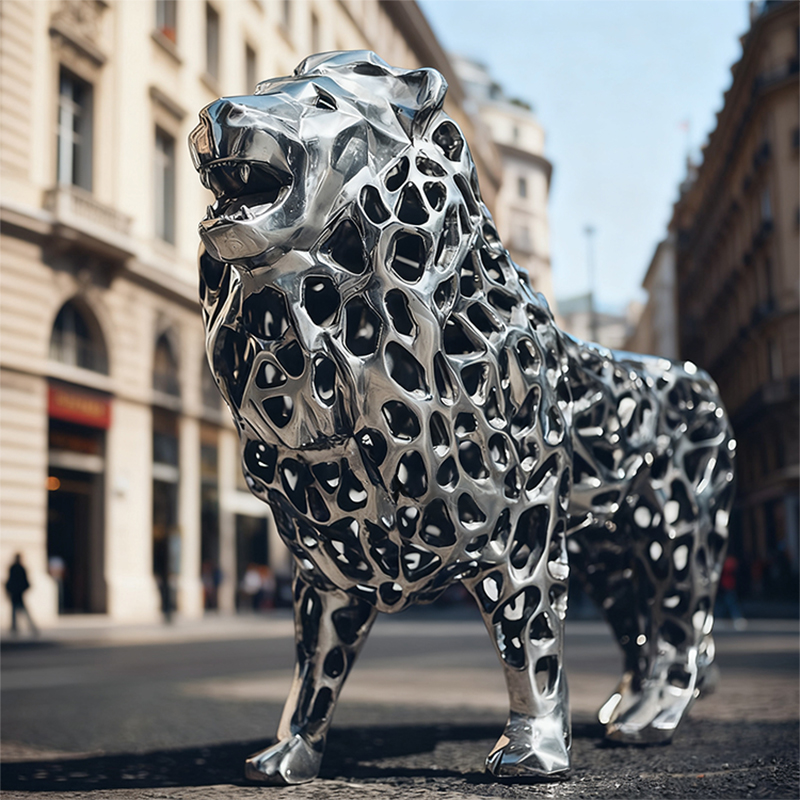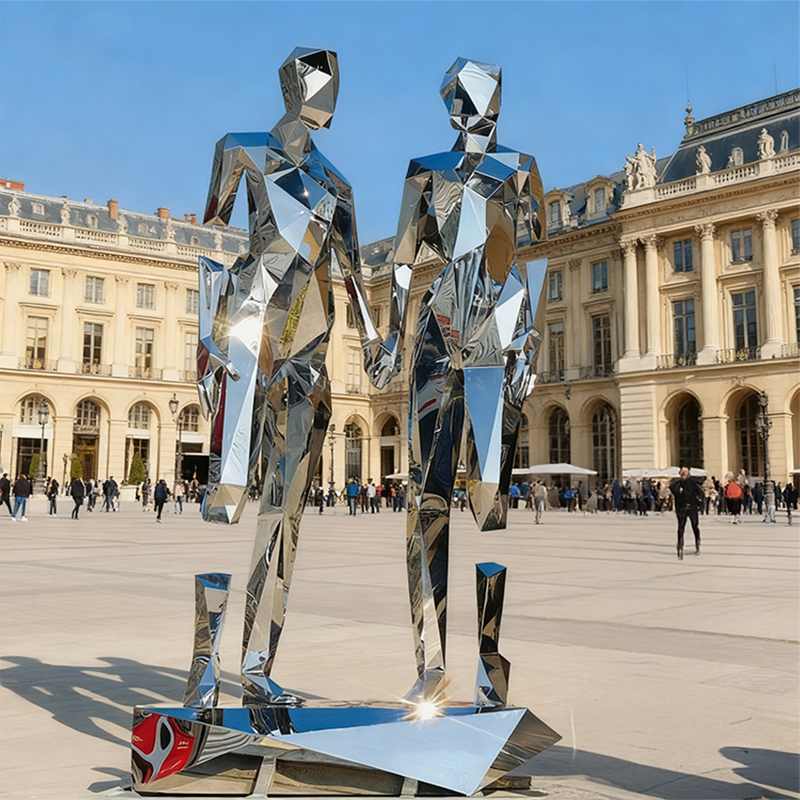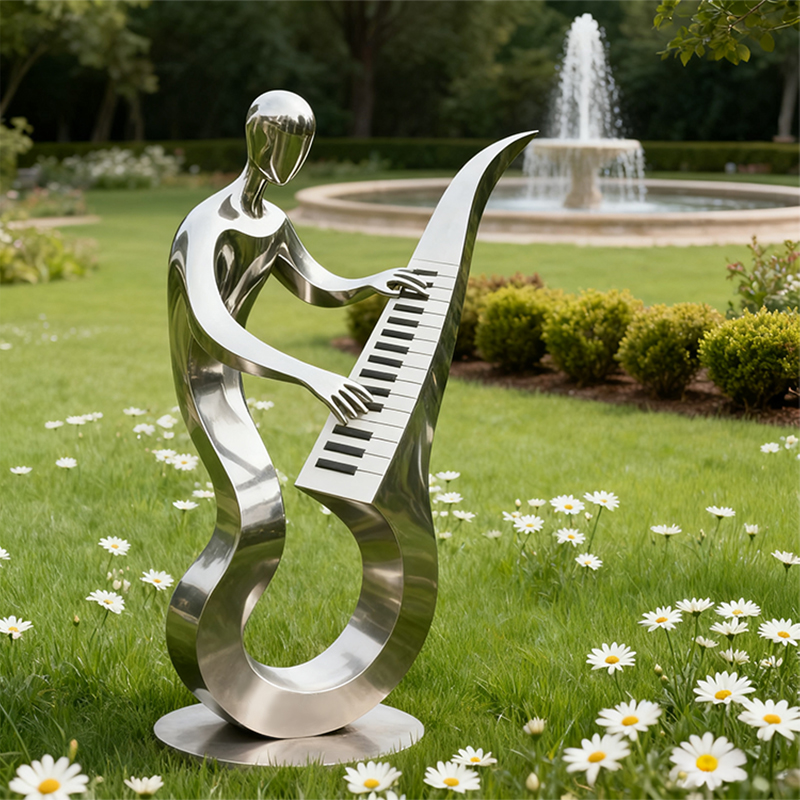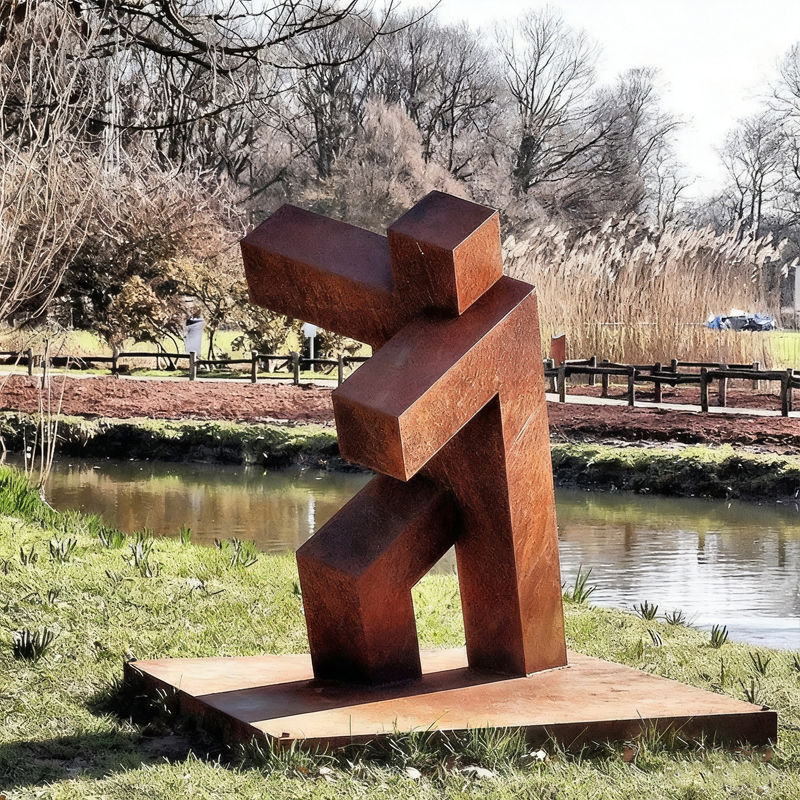
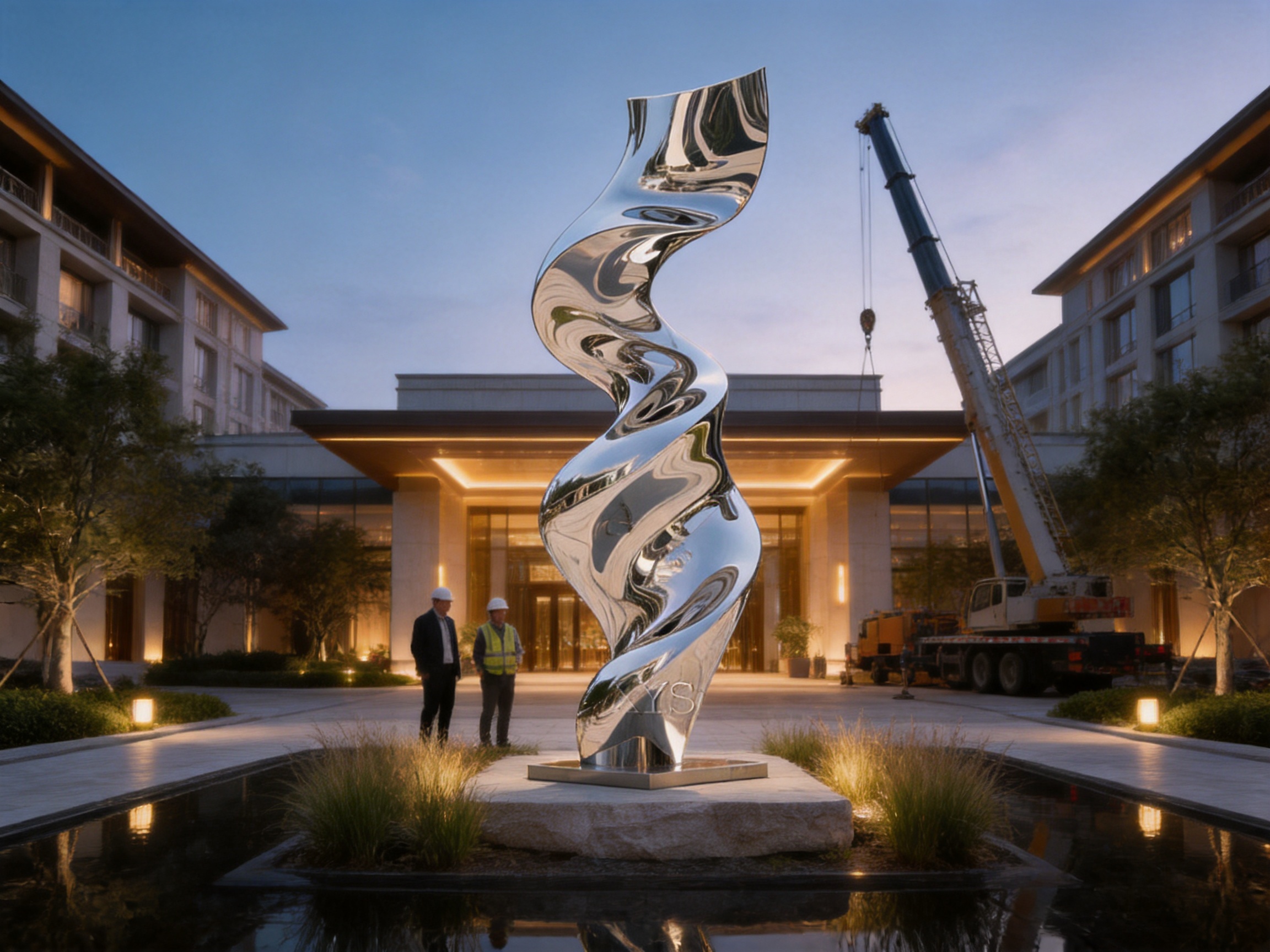
The Rising Dance Mirror Stainless Steel Sculpture is a contemporary outdoor artwork designed to combine expressive movement, architectural presence, and durable material performance. Standing between 3 and 6 meters tall, the sculpture presents a smooth, twisting form that appears to rise continuously into the air. Its polished surface reflects the surrounding sky, buildings, landscaping, people, and changing daylight, allowing the artwork to interact with its setting rather than remain visually isolated from it.
Manufactured from high-mirror 304 stainless steel and formed into a flowing forged structure, the sculpture is intended for prominent public and private environments. Corporate headquarters, municipal plazas, commercial complexes, luxury developments, hotels, cultural venues, and residential entrances can all benefit from a landmark sculpture with a strong vertical silhouette and a refined contemporary finish.
Its central visual idea is upward movement. The rising form may suggest ambition, progress, personal growth, collective achievement, or the dynamic energy of a modern city. Unlike a conventional static monument, the sculpture changes character according to its surroundings. In direct sunlight, it can appear bright and energetic. Under overcast conditions, it may take on a softer silver tone. At night, carefully planned architectural lighting can create an entirely different visual experience.
This combination of symbolic meaning, reflective material, custom sizing, and weather-resistant construction gives the Rising Dance Mirror Stainless Steel Sculpture several advantages over ordinary decorative statues and less carefully engineered outdoor artworks.
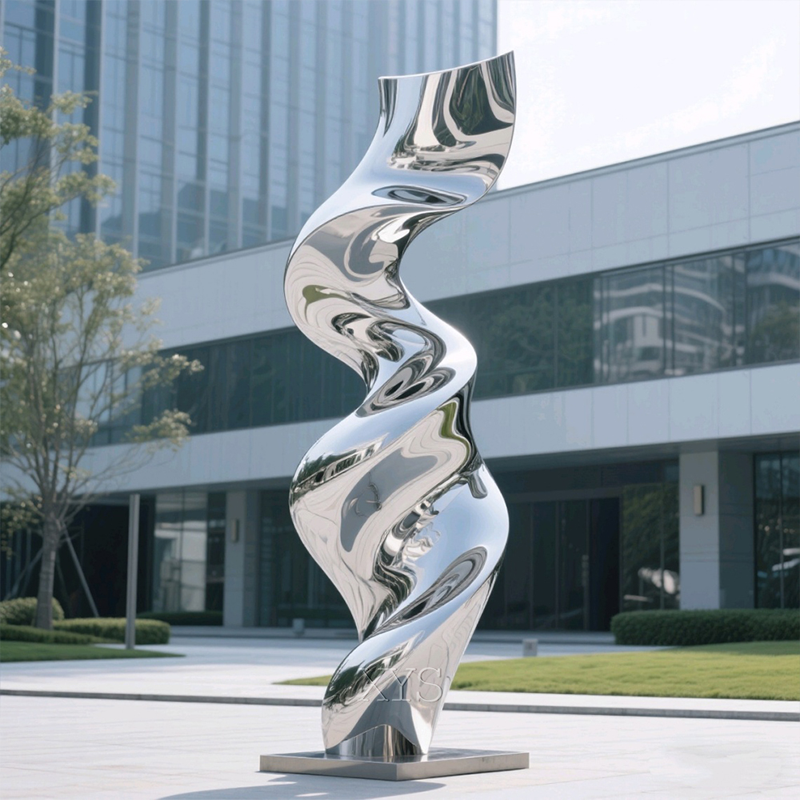
Rising Dance Mirror Stainless Steel Sculpture
Content
The Rising Dance Mirror Stainless Steel Sculpture belongs to the stainless steel decorative sculpture category. It is designed as a large-scale landscape artwork rather than a small indoor ornament. The available height range of 3 to 6 meters allows the sculpture to be adapted to different spatial conditions, from a landscaped entrance and hotel forecourt to a large civic plaza or corporate campus.
The title “Rising Dance” reflects the sculpture’s visual language. Its shape is not based on a rigid geometric tower or a traditional figurative pose. Instead, it uses an upward-twisting movement to create the impression of energy, rhythm, and transformation. The form may be interpreted as a person in motion, a ribbon of metal rising through space, a flame, a wave, or an abstract symbol of achievement.
The high-mirror finish is an essential part of the design. It does not simply add brightness to the sculpture; it makes the sculpture responsive to its environment. Trees, paving, clouds, nearby architecture, and moving visitors can all appear as fragmented reflections across the curved surface. The result is an artwork that visually changes throughout the day and across the seasons.
The product specification identifies 304 stainless steel as the primary material. This grade is widely used in architectural, decorative, and industrial applications because it offers a useful balance of corrosion resistance, strength, workability, and surface quality. For an outdoor sculpture, the material provides a practical foundation for long-term use while supporting a highly polished contemporary appearance.
| Product Element | Specification or Characteristic | Practical Benefit |
|---|---|---|
| Product type | Large-scale stainless steel decorative sculpture | Creates a strong focal point for landscape and architectural projects |
| Material | 304 stainless steel | Provides corrosion resistance, structural strength, and suitability for outdoor applications |
| Surface | High-mirror polished finish | Reflects the surrounding environment and produces a refined modern appearance |
| Form | Smooth twisting upward shape | Expresses motion, ambition, growth, and dynamic energy |
| Available height | Approximately 3–6 meters | Supports installation in medium and large public or private spaces |
| Customization | Customizable design and dimensions | Allows coordination with site scale, concept, color, and architectural style |
| Environmental suitability | Corrosion-resistant and weatherproof design intent | Supports use in exterior landscapes and exposed architectural locations |
The strongest feature of the Rising Dance sculpture is its sense of movement. Many outdoor sculptures depend on recognizable figures, animals, or historical themes. This artwork takes a more abstract approach. Its meaning is conveyed through direction, balance, curvature, and reflection rather than through literal representation.
The upward direction naturally communicates aspiration. A form that rises from a stable base toward the sky can represent progress, growth, ambition, innovation, and confidence. This makes the sculpture particularly appropriate for corporate headquarters, business parks, technology campuses, financial institutions, educational facilities, and public developments that want to communicate a forward-looking identity.
The word “dance” introduces a second layer of interpretation. The sculpture does not appear to rise in a straight or mechanical line. Its twisting movement suggests flexibility and rhythm. The curves may appear different from one viewing angle to another, giving visitors a reason to walk around the sculpture and experience it from multiple perspectives.
This changeability is a significant benefit when compared with flat decorative panels or simple vertical monuments. A flat panel usually presents one primary face. A conventional column may have a consistent appearance from every direction. The Rising Dance sculpture creates a sequence of visual impressions as the viewer moves through the site.
The reflective exterior strengthens this effect. Because the polished metal mirrors its environment, the sculpture does not have a single fixed color in visual terms. Its appearance may include blue from the sky, green from nearby planting, warm tones from surrounding walls, and bright highlights from the sun. The surrounding landscape becomes part of the visual composition.
This quality can help designers integrate the sculpture into a project without forcing it to compete with every other feature. The artwork remains visually prominent, but its reflected colors can also echo the tones of the site. In a green landscape, it may appear connected to the planting. In a modern plaza, it can reinforce glass, stone, concrete, and metal architecture.
Material selection is especially important for sculpture installed outdoors. Outdoor artworks must remain visually attractive while being exposed to rain, humidity, airborne pollutants, temperature changes, sunlight, dust, and physical contact. A material that looks impressive when new but deteriorates quickly can create high maintenance costs and reduce the long-term value of the installation.
304 stainless steel is a practical choice for this type of application. It is known for its corrosion-resistant properties and is widely used in architectural metalwork, public facilities, decorative structures, commercial interiors, food-processing environments, and many other settings where a clean and durable surface is required.
For the Rising Dance sculpture, the stainless steel surface supports both structural durability and artistic presentation. The material can be formed into smooth curves, finished to a mirror polish, and fabricated into a large-scale composition with an elegant appearance. This combination is more difficult to achieve with materials that require frequent repainting or protective coatings.
Painted steel, for example, may offer many color choices, but its visible coating can eventually be scratched, faded, chipped, or damaged by weather. Once the coating is compromised, maintenance may require localized repair, stripping, repainting, or complete refinishing. A high-mirror stainless steel sculpture does not depend on a conventional decorative paint layer to create its main visual effect.
Stone and concrete can provide substantial mass and permanence, but they generally do not offer the same reflective, fluid, and lightweight visual impression. Fiberglass can support complex shapes and relatively low weight, but its surface coating and color stability require careful consideration for long-term outdoor exposure. Weathering steel offers an intentionally oxidized appearance, while the Rising Dance sculpture is designed for a clean, bright, contemporary character.
The use of 304 stainless steel therefore gives the sculpture a distinctive position among outdoor art materials. It combines a modern architectural appearance with useful resistance to environmental exposure, while allowing the twisting form to remain visually smooth and continuous.
A high-mirror finish requires careful attention because surface irregularities become more visible as reflectivity increases. On a dull or textured finish, small variations may be visually subdued. On a mirror-polished surface, uneven transitions, dents, scratches, weld marks, and inconsistent polishing can interrupt the reflection and reduce the quality of the entire sculpture.
The stated product description emphasizes a high-mirror 304 stainless steel surface and a smooth twisting form. These two characteristics must be considered together. The sculpture is not simply a metal object that has been polished after fabrication. Its visual success depends on maintaining a coherent surface across curved and changing planes.
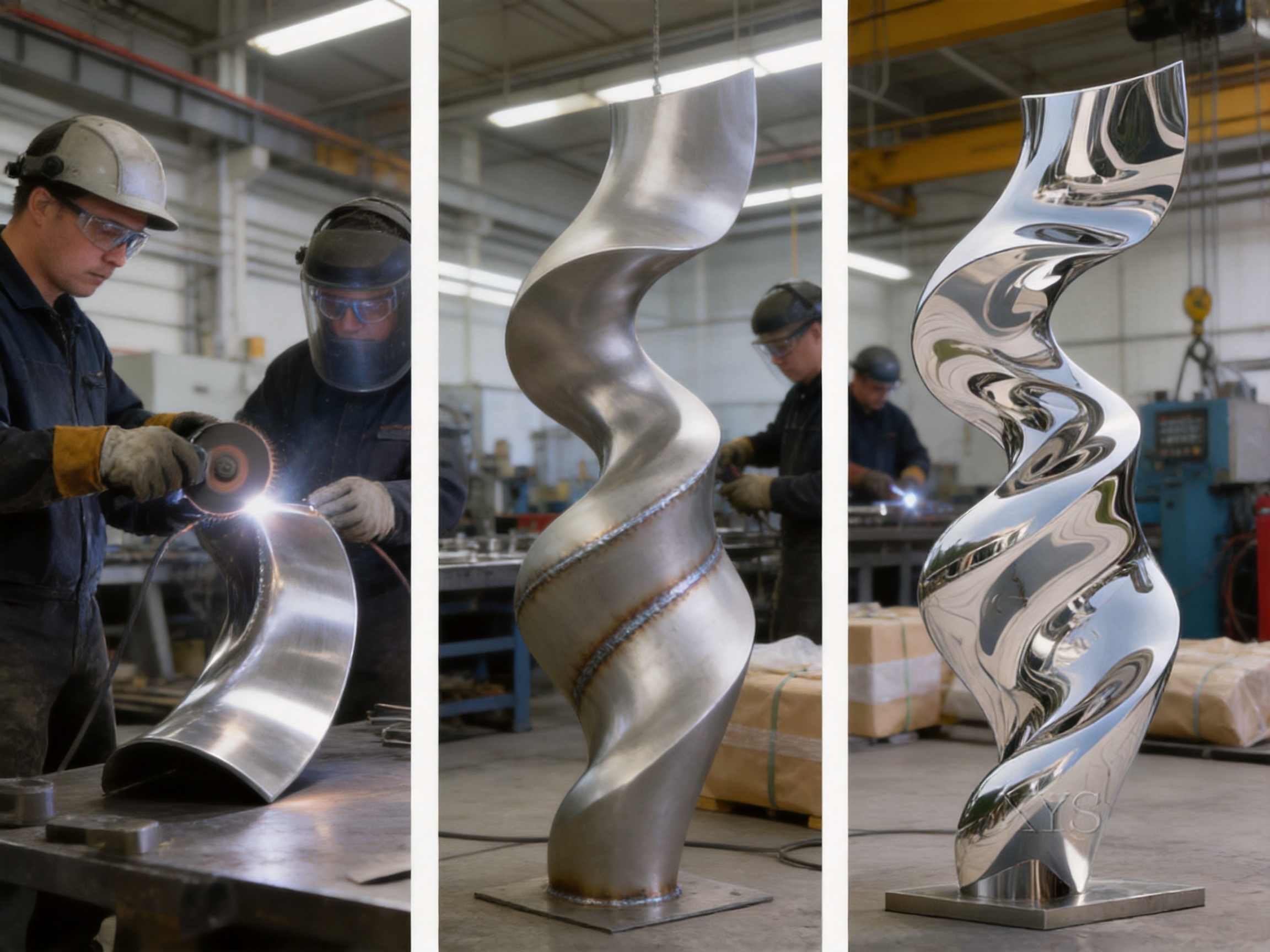
In a well-organized manufacturing process, the design, forming, joining, grinding, polishing, cleaning, and inspection stages must work together. Curves must be developed carefully so that the final form remains balanced. Seams and transitions should be controlled to preserve the continuity of the surface. Polishing should be performed progressively, with attention to the direction and consistency of the finish.
The result is intended to be a sculpture that looks refined from a distance and remains convincing at closer viewing distances. This is especially important in public spaces where visitors may approach the artwork, photograph it, or walk around it at arm’s length.
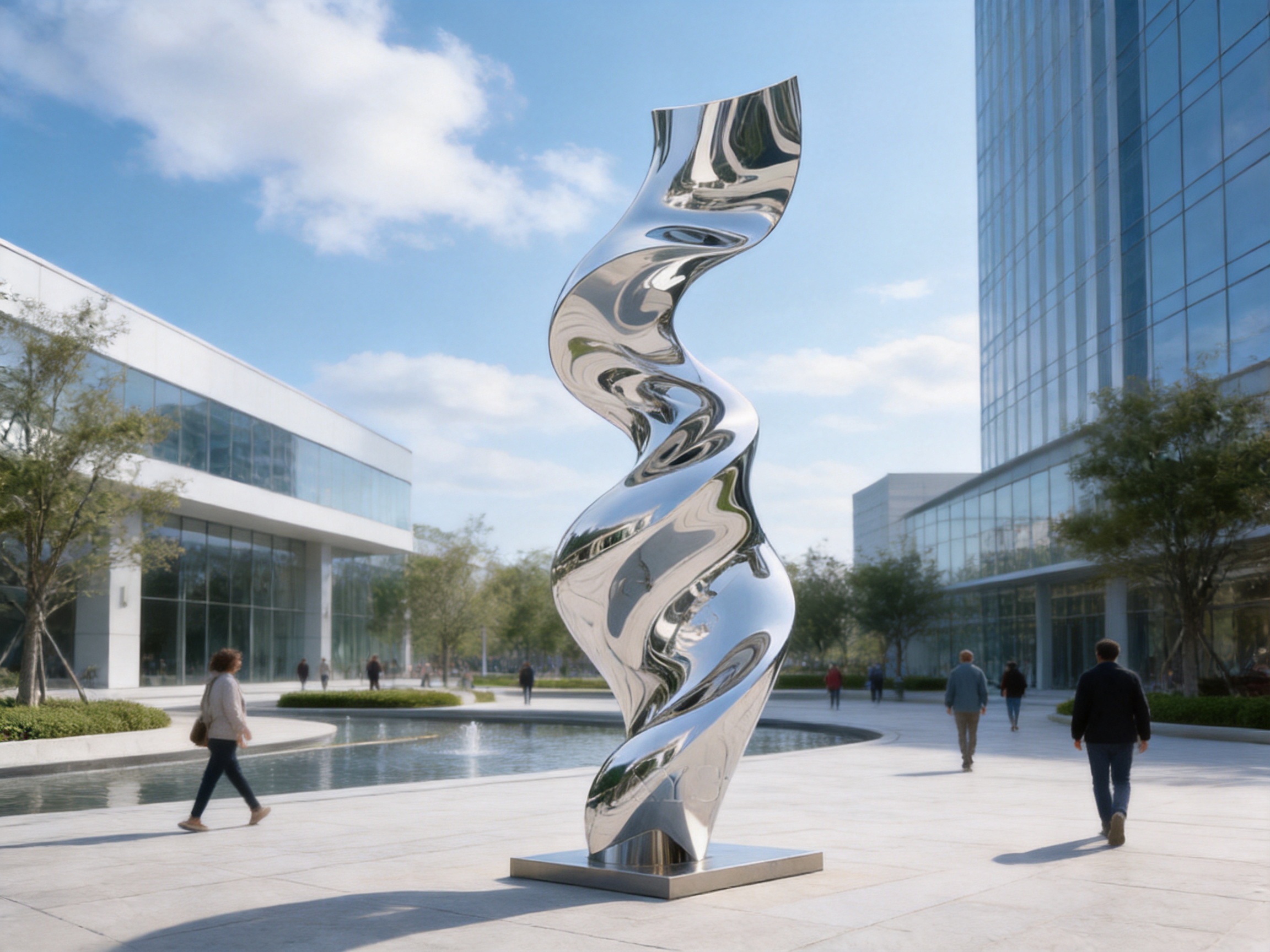
The manufacturer identified for this sculpture is Jiangsu Xinyesheng Sculpture Co., Ltd., a China-based sculpture manufacturer and custom metal statue supplier. The product information states that the artwork is made from high-mirror 304 stainless steel and forged into a smooth twisting form. The company also presents customization as part of its service offering.
Because the product is custom-oriented and available in multiple heights, manufacturing is not limited to producing a small standardized object. Large-scale sculpture production requires coordination between design interpretation, material preparation, forming, surface treatment, structural planning, and site delivery. Each stage affects the quality of the final artwork.
The first stage is the development of the sculpture concept and its relationship to the installation site. A 3-meter sculpture and a 6-meter sculpture may share the same design language, but they will not have identical structural, transport, foundation, or visual requirements. The selected height should correspond to the scale of nearby buildings, pathways, trees, signs, lighting elements, and viewing distances.
For a commercial entrance, the sculpture may need to be visible from approaching vehicles while remaining proportionate to the building facade. In a civic plaza, the design may be evaluated from many directions and from a greater distance. In a residential development, the artwork may need to create prestige without overwhelming pedestrian movement or sight lines.
A custom manufacturer can use the basic Rising Dance concept as a starting point and adapt the height, width, twist, base arrangement, surface treatment, and installation requirements. This is an important advantage over mass-produced decorative statues, which may be available only in fixed dimensions and limited forms.
The product description identifies a forged stainless steel construction. Forging and controlled forming contribute to the sculpture’s smooth, energetic appearance by allowing the metal to be shaped into a strong, continuous, and expressive composition.
Large abstract forms require more than simply cutting flat sheets and assembling them into an approximate shape. The forming process must preserve the intended curvature and help prevent unwanted visual breaks. The twisting body needs to maintain a convincing relationship between its base, central movement, and upper termination.
Forming operations must also account for material behavior. Stainless steel can be shaped, but it requires suitable tooling, controlled force, experienced handling, and careful sequencing. Excessive deformation or poorly planned forming may result in distortion, stress, surface damage, or difficult-to-correct geometry. A disciplined process helps protect both the structure and the mirror finish.
For a large-scale work, the sculpture may be fabricated in sections for production, transportation, and installation. Sectional construction can make it possible to produce a tall artwork while keeping individual components within practical handling and shipping limits. The section joints must then be planned so that the assembled sculpture preserves its intended silhouette and surface continuity.
Joining is a critical part of large stainless steel sculpture production. Welded or mechanically connected areas must be strong enough for the intended installation while remaining visually discreet. The joining strategy should be considered at the design stage rather than treated as an afterthought.
The sculpture’s base is particularly important. A tall, twisting form creates visual movement, but the foundation and anchoring system must provide stability against wind, vibration, accidental contact, and long-term environmental loading. Actual foundation design depends on site conditions, local regulations, soil characteristics, wind exposure, sculpture dimensions, and engineering calculations. These requirements should be confirmed for each project before fabrication and installation.
A professional custom sculpture order normally benefits from coordination among the artwork manufacturer, project architect, landscape designer, structural engineer, general contractor, and installation team. This coordination helps ensure that the final product can be safely installed and that the prepared foundation matches the sculpture’s base and anchoring requirements.
After forming and joining, the surface treatment becomes central to the sculpture’s appearance. Grinding may be required to smooth transitions and prepare fabricated areas. Polishing can then be performed through progressively finer stages until the desired high-mirror effect is achieved.
This process requires patience and consistency. The curved shape means that polishing tools and techniques must adapt to changing angles. Areas near seams, edges, and tight curves can be particularly demanding. A poorly controlled finishing process may leave visible halos, uneven reflectivity, scratches, or areas that reflect light differently from the rest of the artwork.
Cleaning is also important before the sculpture leaves the manufacturing site. Metal dust, abrasive residue, fingerprints, oils, and packaging contaminants should be removed so that the surface reaches the client in an appropriate condition. Protective wrapping must then be applied carefully to prevent scratches during handling and transport.
Quality review should cover more than the general shape of the sculpture. A comprehensive inspection may consider dimensions, form accuracy, surface uniformity, visible seams, edge safety, base alignment, packaging, component identification, and installation documentation.
For a mirror-finished sculpture, inspection under different lighting conditions can be useful. Bright directional light may reveal surface waves or scratches that are less visible under diffuse light. Viewing the sculpture from several angles helps confirm that the twisting form maintains the intended movement and balance.
The available product information does not provide a detailed list of factory certifications, testing standards, or inspection documents. Project buyers should therefore request the specific technical documentation required for their application. This may include material information, fabrication drawings, installation guidance, packing details, maintenance instructions, and engineering documents where applicable.
The Rising Dance Mirror Stainless Steel Sculpture competes not only with other stainless steel sculptures but also with artworks made from bronze, marble, fiberglass, painted steel, aluminum, and weathering steel. Each material has its own visual character and practical benefits. The choice depends on the project’s architectural language, budget, environment, maintenance expectations, and symbolic goals.
| Material or Product Type | Typical Visual Character | Potential Limitation Compared with Mirror Stainless Steel | Strength of the Rising Dance Sculpture |
|---|---|---|---|
| Bronze sculpture | Warm, traditional, historical, or artistic patina | Heavier visual character and generally less reflective; patina may require monitoring | Provides a bright, contemporary surface with a strong architectural presence |
| Marble sculpture | Natural stone texture, classical permanence | Heavy, vulnerable to staining or weathering, and less suited to a fluid reflective form | Offers a lighter visual impression and dynamic reflective movement |
| Fiberglass sculpture | Lightweight and adaptable to complex shapes | Surface coatings may require maintenance and can be affected by ultraviolet exposure | Uses durable stainless steel with a refined metallic finish |
| Painted steel sculpture | Wide color range and bold graphic appearance | Paint may fade, chip, scratch, or require recoating | Mirror effect is created through polished metal rather than ordinary paint |
| Weathering steel sculpture | Rust-colored, industrial, earthy appearance | Intentional oxidation may not suit bright modern architecture or clean formal entrances | Provides a clean silver surface and reflects the surrounding environment |
| Basic stainless steel statue | Durable metallic appearance | May lack a distinctive large-scale concept or carefully controlled reflective form | Combines a recognizable upward composition with a high-mirror finish |
Bronze is valued for its heritage, warmth, and association with classical and figurative sculpture. It can be an excellent choice for historical settings, memorials, and traditional public art. However, the warm color and dense visual character of bronze create a very different experience from the Rising Dance sculpture.
The mirror stainless steel version is better suited to projects that emphasize innovation, clarity, progress, technology, and contemporary architecture. Its reflections allow the artwork to merge visually with glass facades, polished stone, water features, and modern landscaping.
Marble offers natural variation and a long association with monumental sculpture. Yet marble is substantially heavy, and its natural surface is generally opaque rather than reflective. A marble work may appear stable and permanent, while the Rising Dance sculpture is intended to appear active and continually in motion.
The stainless steel form can create a greater sense of vertical lift without relying on the same apparent mass. This makes it particularly effective where the design objective is to create a landmark with an elegant, energetic, and visually lighter presence.
Fiberglass can be useful when low weight, unusual color, or economical production is a priority. It can support highly complex shapes and can be finished in many ways. However, the long-term condition of a fiberglass outdoor sculpture depends significantly on its surface coating, pigmentation, ultraviolet resistance, and repair history.
The Rising Dance sculpture offers a different value proposition. Its visual identity comes from polished stainless steel, and its outdoor suitability is supported by the corrosion-resistant nature of 304 stainless steel. Buyers seeking a premium architectural metal appearance may prefer this material over a coated composite surface.
Weathering steel is often chosen for its controlled rust appearance and connection with industrial or natural themes. It can be highly effective in parks, cultural landscapes, and architectural projects that use earth tones. It is not, however, a direct visual substitute for mirror-polished stainless steel.
The Rising Dance artwork is more appropriate when the project requires brightness, reflection, cleanliness, and a visually polished finish. Its appearance can also adapt more readily to changing surroundings because it reflects nearby colors instead of maintaining a fixed rust tone.
The sculpture’s height, finish, and symbolism make it suitable for a wide range of architectural and landscape settings. Its final impact depends on placement, background, lighting, pedestrian circulation, and the scale of the surrounding site.
At a corporate headquarters, the sculpture can function as an arrival marker and a visual expression of organizational ambition. The upward form can be associated with growth, leadership, innovation, and future-oriented thinking. Positioned near the main entrance, it can help establish a memorable identity for employees, visitors, and business partners.
The reflective surface may also complement a glass or metal facade. During the day, the sculpture can echo the building’s architectural materials. At night, integrated landscape lighting can emphasize its contours and make the entrance recognizable after dark.
Public squares require artworks that can be appreciated from multiple directions and that contribute to a shared civic environment. The sculpture’s abstract form avoids dependence on a specific portrait, event, or cultural symbol, allowing it to serve as a broadly interpretable landmark.
Its reflective surface can capture activity in the plaza, including pedestrians, trees, paving patterns, and seasonal decorations. This can encourage visitors to stop, take photographs, and explore the sculpture from different viewpoints.
Retail centers, office parks, mixed-use developments, and commercial complexes often need a memorable feature near an entrance, central courtyard, or public circulation zone. A tall sculpture can help define a particular district or provide orientation within a large site.
The Rising Dance form is especially useful where the developer wants to create a premium, modern, and visually distinctive atmosphere. Its height allows it to remain visible over planting and low structures, while its reflective surface can support the polished image often associated with luxury commercial environments.
Hotels and resorts can use the sculpture as a signature arrival feature. Its changing reflections may complement water, gardens, stone paving, and architectural lighting. In a resort setting, the abstract movement can suggest vitality, celebration, and an elevated guest experience.
Because the sculpture is customizable, the proportions can be considered in relation to the porte-cochere, lobby facade, driveway, or pool landscape. The installation should be positioned so that it is visible without obstructing vehicle movement, emergency access, or important wayfinding information.
Luxury residential developments often use sculpture to create a sense of identity and exclusivity. At a residential entrance, the artwork can serve as a recognizable landmark for residents and visitors. A 3-meter version may be appropriate for a more intimate entrance, while a larger version may suit a broad boulevard, central garden, or shared amenity area.
The reflective finish should be evaluated in relation to privacy and neighboring buildings. Site designers can choose a location where the sculpture captures attractive landscape views rather than undesirable service areas or visual clutter.
Universities, museums, galleries, and cultural centers may use abstract sculpture to express creativity, discovery, and intellectual movement. The upward design can be connected with learning and aspiration without imposing a literal narrative.
In educational settings, the sculpture can also become a meeting point or orientation feature. Its changing appearance offers opportunities for photography, student projects, landscape studies, and discussions about material, light, architecture, and public art.
Customization is one of the main strengths of a made-to-order sculpture. The available product range indicates a height of approximately 3 to 6 meters, but a successful project requires more than selecting a dimension from a list. The sculpture should be adjusted to its surroundings and to the client’s artistic and architectural objectives.
Height affects visibility, perceived importance, transportation, installation, foundation requirements, and budget. A 3-meter work may create an intimate focal point near a pedestrian entrance. A 6-meter work can operate as a large landmark visible across a plaza or from a nearby road.
The width and twist should be considered together with height. A taller sculpture with insufficient visual mass may look too thin in a large open space, while an overly broad form may feel crowded in a narrow entrance court. Custom proportioning allows the manufacturer and design team to create a balanced relationship between the artwork and the site.
The high-mirror finish is the defining surface treatment of the presented product. Depending on the project, the client may wish to discuss the degree of reflectivity, the treatment of specific sections, or the relationship between mirror areas and other stainless steel finishes.
Any change to the surface should be evaluated carefully. A mirror finish produces the strongest contemporary effect, while satin, brushed, or partially textured areas would create a different visual language. If the project requires a specific finish, the final sample should be reviewed under representative lighting before full production.
The base can influence how the sculpture meets the landscape. A simple base may make the form appear to emerge directly from paving. A plinth can provide elevation and separation. A landscaped surround can soften the transition between metal and ground, while a water feature can intensify reflections and movement.
The installation interface should be coordinated with the foundation, anchor system, drainage, paving, lighting, and maintenance access. These details are particularly important for outdoor projects where rainwater, cleaning, and long-term inspection must be considered.
A custom version can be developed to respond to a project’s cultural theme, architectural geometry, branding guidelines, or landscape concept. The central upward movement can remain intact while the precise twist, opening, curvature, scale, or orientation is adapted to the site.
Clients should provide drawings, photographs, dimensions, preferred viewing points, and information about surrounding materials. This helps the manufacturer understand how the sculpture will be seen and how its reflections will interact with the environment.
Large outdoor sculpture installation should be planned from the beginning of the project rather than after manufacturing is complete. The artwork may be visually elegant, but its long-term success depends on correct handling, anchoring, alignment, and site preparation.
The first consideration is the foundation. A structural engineer should evaluate the local soil, wind conditions, seismic requirements where applicable, and the sculpture’s final dimensions. The foundation must be designed to support the completed work and transfer loads safely into the ground.
Access is another important issue. Delivery vehicles, cranes, lifting equipment, temporary storage, and site routes should be reviewed before fabrication. If the sculpture is shipped in sections, the installation team needs clear identification of each component and an assembly plan.
Protective packaging is essential for a mirror-polished surface. The artwork should be protected from contact with abrasive materials, metal tools, loose straps, and construction debris. Protective films or wrapping should be removed at an appropriate stage so that the surface is not exposed to avoidable damage during other construction work.
Placement should be evaluated from the primary viewing points. The sculpture may look different when seen from the main entrance, a driveway, an upper-level window, a pedestrian path, or an adjacent building. Orientation can be adjusted so that the most expressive curves and reflections are visible from the locations that matter most to the project.
Lighting design can extend the sculpture’s visual impact into the evening. Low-glare ground lights, concealed linear lighting, or carefully aimed projectors may emphasize the twisting profile. Lighting should be coordinated with the mirror surface to avoid excessive glare for pedestrians, drivers, or neighboring properties.
Stainless steel is comparatively low-maintenance, but low-maintenance does not mean maintenance-free. A mirror-polished sculpture should be inspected and cleaned periodically to preserve its reflective quality and remove accumulated dust, water spots, fingerprints, bird residue, airborne pollution, and other contaminants.
Cleaning procedures should be appropriate for polished stainless steel. Soft, non-abrasive cloths and compatible cleaning solutions are generally preferable. Steel wool, rough pads, harsh acids, chloride-rich products, and abrasive powders can scratch or stain the surface and should not be used unless specifically approved for the material and finish.
The cleaning frequency depends on the environment. An artwork in a sheltered inland garden may require less frequent cleaning than one near heavy traffic, industrial emissions, coastal salt air, or an active construction site. Areas exposed to irrigation spray or standing water should be monitored because mineral deposits can reduce the clarity of reflections.
Routine inspection should include the visible surface, base, anchor covers, drainage around the foundation, lighting equipment, and any joints or access panels. If the sculpture is installed in a public area, the site operator should also check for accidental impact, vandalism, unauthorized climbing, or damage caused by nearby maintenance equipment.
Early attention to small issues can help prevent larger repairs. If a scratch, dent, discoloration, or loose component is observed, the site manager should contact a qualified stainless steel fabricator or the original supplier for suitable advice. Repairing a mirror finish requires skill because an inconsistent repair may be visible across a large reflective surface.
The value of the Rising Dance sculpture extends beyond the physical material cost. A landmark artwork can improve the identity, memorability, and perceived quality of a site. It can create a strong first impression at an entrance, establish a destination within a development, and support photographs and public recognition.
For developers, a distinctive sculpture may help differentiate a project from competing properties. In a commercial environment, an attractive public artwork can contribute to the atmosphere of a shopping district, office campus, hotel, or mixed-use development. In a residential project, it can reinforce the premium character of common areas and entrances.
For architects and landscape designers, the sculpture offers a design element that can connect architecture and environment. Its mirror surface can repeat nearby colors and forms, while its vertical movement can provide contrast against horizontal paving, low planting, and rectangular buildings.
For public art buyers, the abstract symbolism provides flexibility. The sculpture can represent progress, cooperation, innovation, or aspiration without being tied to a narrow narrative. This broad interpretive potential can be valuable in civic and institutional settings with diverse audiences.
The available price range is approximately $3,352.34 to $8,599.48. The final cost should be confirmed according to the selected height, degree of customization, construction method, surface treatment, packaging, delivery, installation, foundation work, engineering, taxes, and destination requirements. The listed range provides an initial product reference rather than a complete project budget.
A custom sculpture manufacturer can provide more than a catalog object. The manufacturer can interpret a concept, adjust dimensions, coordinate fabrication details, and prepare the artwork for the practical conditions of a specific site. This is particularly important for an abstract sculpture whose proportions and surface continuity strongly affect its visual quality.
Jiangsu Xinyesheng Sculpture Co., Ltd. identifies itself in the supplied information as a China Sculpture Manufacturer and custom design metal statue supplier. Its product range includes bronze sculptures, stainless steel sculptures, marble sculptures, fiberglass sculptures, and weathering steel sculptures. This range indicates experience across several sculpture materials and provides clients with a broader basis for comparing material solutions.
The company’s stated product strengths include high-mirror 304 stainless steel, a forged smooth twisting form, corrosion resistance, weatherproof suitability, and customization. These features align with the needs of buyers seeking a durable contemporary landmark rather than a generic decorative object.
Because no detailed company or website introduction is available in the supplied information, prospective buyers should verify project-specific capabilities directly. Useful questions may concern production drawings, sample approval, material documentation, fabrication tolerances, surface inspection, packaging, shipping, installation support, and after-sales service.
This verification process is normal for a major custom artwork. It protects both the buyer and manufacturer by making expectations clear before production begins. A well-defined specification should include dimensions, material, finish, structural requirements, foundation responsibilities, delivery terms, inspection procedures, and the accepted standard for surface appearance.
Before placing an order, the buyer should prepare a clear project brief. The brief can include the intended location, target height, viewing distances, preferred orientation, surrounding materials, lighting concept, local climate, expected completion date, and budget range.
The material specification should identify 304 stainless steel and confirm the required surface finish. If the project is located in an especially aggressive environment, the buyer should discuss whether a different stainless steel grade or additional protective strategy is appropriate. Material selection should be based on the actual site conditions rather than appearance alone.
The design specification should define whether the artwork follows the standard Rising Dance form or requires custom alterations. Drawings or three-dimensional renderings should be reviewed before production. The client should confirm the overall dimensions, base footprint, section divisions, connection points, and any relationship to lighting or landscape elements.
The commercial specification should separate the sculpture price from transportation, customs, unloading, crane hire, foundation construction, installation, electrical work, taxes, and local engineering. This prevents confusion when comparing quotations from different suppliers.
The acceptance specification should explain how the finished surface will be inspected. For a mirror-polished sculpture, the buyer may wish to agree on acceptable viewing distance, lighting conditions, protective film removal, and the treatment of minor marks that may occur during transport or installation.
It is a large-scale contemporary outdoor sculpture made from high-mirror 304 stainless steel. The artwork features a smooth twisting form that rises upward and is designed to symbolize ambition, momentum, progress, and dynamic energy.
The stated product size range is approximately 3 to 6 meters in height. Custom dimensions may be discussed according to the project site, viewing distance, transportation conditions, and installation requirements.
Yes. The product is described as corrosion-resistant and weatherproof, making it suitable for exterior locations such as municipal plazas, corporate entrances, commercial complexes, landscaped developments, and residential gateways. Site-specific environmental conditions should still be reviewed before final material confirmation.
The high-mirror finish reflects the surrounding environment. It can capture sky, buildings, plants, paving, light, and passing visitors, causing the sculpture to change visually throughout the day. This creates a more interactive appearance than a fixed-color or opaque surface.
A painted steel statue depends on a coating for its visible color and protection. The Rising Dance sculpture uses polished stainless steel to create its primary appearance. This produces a reflective architectural finish and avoids the ordinary painted look, although the mirror surface still requires careful cleaning and protection from scratches.
Bronze generally provides a warm, traditional, or patinated appearance. The Rising Dance sculpture offers a bright, cool, and contemporary appearance with environmental reflections. It is more suitable for projects emphasizing modernity, innovation, clarity, and visual movement.
Yes. The product information identifies the sculpture as customizable. Buyers can discuss height, proportions, site adaptation, base design, surface requirements, and fabrication or installation details with the manufacturer.
Potential locations include corporate headquarters, municipal plazas, commercial complexes, office parks, hotels, resorts, cultural institutions, universities, luxury residential entrances, landscaped courtyards, and other prominent outdoor areas.
A large outdoor sculpture normally requires a properly designed foundation and anchoring system. The exact solution depends on the sculpture dimensions, site soil, wind conditions, local codes, and engineering requirements. A qualified local professional should confirm the foundation design.
The surface should be cleaned with soft, non-abrasive materials and suitable stainless steel cleaning products. Abrasive pads, steel wool, harsh chemicals, and chloride-rich cleaners should be avoided. The recommended cleaning schedule depends on the local climate and surrounding environmental conditions.
The supplied product information lists a price range of approximately $3,352.34 to $8,599.48. The final quotation may vary according to height, customization, packaging, shipping, installation, engineering, taxes, and destination.
Buyers should request drawings, dimensions, material information, finish details, installation requirements, packaging information, delivery terms, maintenance guidance, and any available quality or engineering documentation relevant to the project.
Its 3-to-6-meter height, upward movement, reflective finish, and customizable design make it suitable for landmark applications. The final impact will depend on site scale, placement, lighting, background, landscaping, and the quality of installation.
The Rising Dance Mirror Stainless Steel Sculpture is designed for clients seeking a strong contemporary statement with practical outdoor performance. Its high-mirror 304 stainless steel construction provides a refined metallic appearance, while the smooth twisting form introduces movement, rhythm, and symbolic upward energy.
Compared with bronze, marble, fiberglass, painted steel, and weathering steel, the sculpture offers a distinctive combination of reflection, modernity, corrosion resistance, and visual adaptability. It does not simply occupy space; it responds to the space around it. Every change in daylight, weather, landscape, and visitor movement can alter the appearance of the polished surface.
The stated forged construction and customizable height range support adaptation to different architectural and landscape conditions. At the same time, successful delivery of a large mirror-finished sculpture depends on careful design development, controlled forming, accurate joining, progressive polishing, protective packaging, engineering coordination, and professional installation.
For corporate, civic, commercial, hospitality, institutional, and residential projects, the sculpture can serve as an entrance marker, gathering point, architectural complement, or recognizable landmark. Its meaning remains open enough to support different project narratives while its material and form provide a clear visual identity.
Clients considering this artwork should evaluate the site, confirm the required scale, review the finish carefully, coordinate the foundation and installation plan, and request complete project documentation before production. With appropriate planning and maintenance, the Rising Dance sculpture can provide a durable and memorable focal point for a contemporary outdoor environment.
1. Product specification supplied for the Rising Dance Mirror Stainless Steel Sculpture, including material, dimensions, finish, applications, customization, and price information.
2. General architectural metalwork principles relating to stainless steel fabrication, polishing, corrosion resistance, handling, and outdoor installation.
3. General landscape architecture principles concerning landmark placement, pedestrian circulation, visual scale, lighting, and integration of public artwork.
4. General conservation and maintenance guidance for polished stainless steel surfaces used in exterior environments.
5. General public art project planning practices concerning site surveys, engineering coordination, transportation, foundation preparation, installation, and inspection.



Daniel H.

Amanda R.

Robert B.

Jennifer S.

James W.

Barry G.

Michael T.

Emily K.

David L.

Sarah M.


Mikey XV

Jagxue

 English
 Español
 عربى
عربى Français
 italiano
 Deutsch