A companion tombstone is more than a cemetery marker. It is a permanent expression of family, faith, memory, and the lasting relationship between two people. The Cross Rose-Pattern Granite Companion Tombstone is designed for couples, close relatives, and loved ones who are buried together and whose stories deserve to be preserved in one unified memorial.
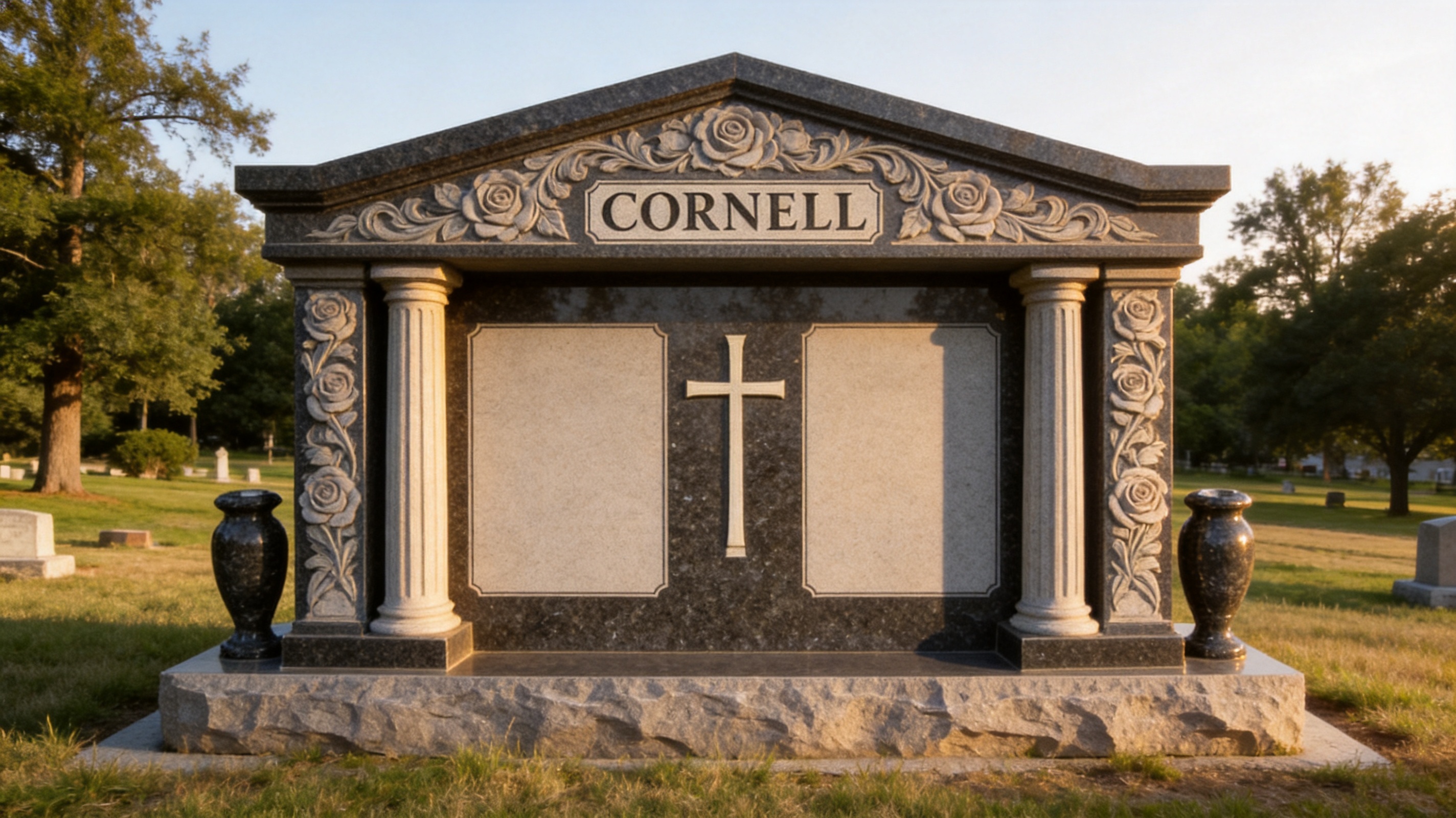
Combining a dignified cross motif, carefully arranged rose-pattern detailing, and the natural strength of granite, this joint burial tombstone offers a balanced appearance that is both religious and emotionally expressive. Its double-column structure creates dedicated areas for recording the information of two individuals, while its shared central design visually connects their lives.
With an overall height of approximately 1.2 to 1.5 meters, a width of approximately 1.4 to 1.6 meters, and a thickness of approximately 0.3 to 0.4 meters, the monument has a substantial presence without appearing excessive in a cemetery setting. Available specifications include a 1.2-meter-high model priced at US$1,200 and a 1.5-meter-high model priced at US$2,050, subject to final confirmation based on material selection, carving, finishing, lettering, packaging, and shipping requirements.
Manufactured by Jiangsu Xinyesheng Sculpture Co., Ltd., the tombstone reflects the company’s experience in sculpture production, stone-based memorial design, customized decorative work, and export-oriented manufacturing. Its value lies not only in the visual design but also in the combination of stone selection, precision shaping, surface finishing, engraving preparation, structural stability, quality inspection, and customized production support.
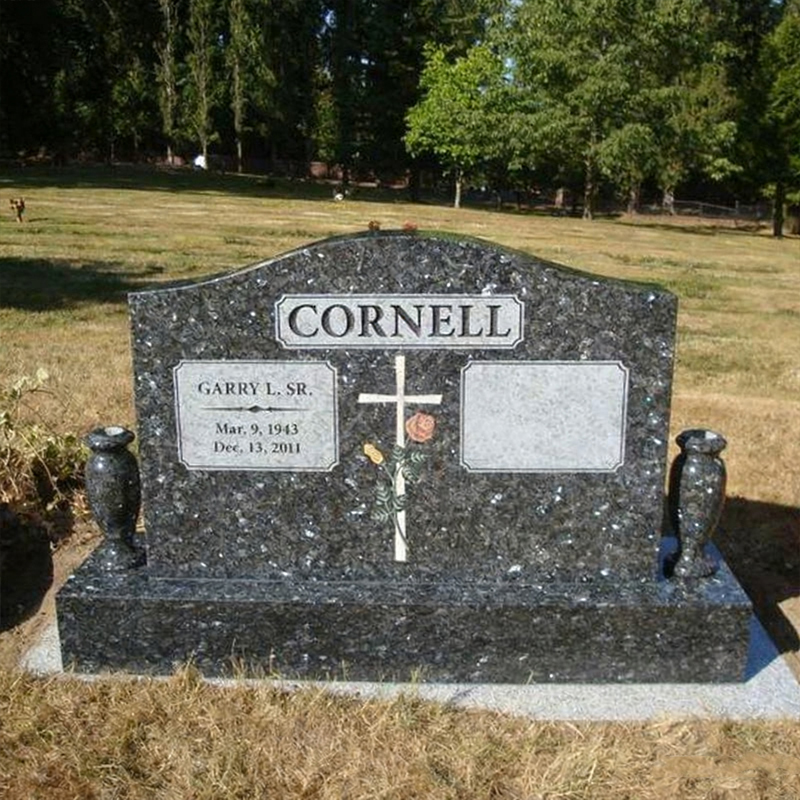
Cross Rose-Pattern Granite Companion Tombstone
Content
A companion tombstone is specifically created for two people who share a burial location. In many families, this type of monument is selected for married couples, siblings, parents and children, or other relatives whose lives were closely connected. Unlike two completely separate markers, a joint tombstone presents the relationship as an essential part of the memorial story.
The Cross Rose-Pattern Granite Companion Tombstone communicates this connection through its unified structure. Rather than placing two unrelated stones next to one another, the design brings both memorial spaces together under one architectural composition. Each person can have an individual inscription area, portrait panel, birth and death dates, or personal statement, while the overall monument remains visually cohesive.
This arrangement is especially appropriate when a family wants to express the idea that two people remain connected beyond life. The design does not depend on excessive ornamentation. Instead, it uses recognizable symbolic elements—a cross, roses, balanced columns, and a strong stone body—to create a dignified sense of permanence.
In a cemetery environment, the monument functions on several levels. It identifies the burial site, protects and displays biographical information, provides a place for remembrance, and creates a visual setting for prayer or reflection. The large surface area also allows families to include more complete information than would normally be possible on a narrow individual marker.
The cross is one of the most widely recognized Christian memorial symbols. In a tombstone design, it may represent faith, salvation, hope, sacrifice, and spiritual continuity. Its vertical form also gives the monument a clear visual center, helping the eye move upward from the inscription areas toward the symbolic focal point.
The cross in this design supports the solemn atmosphere of a cemetery while giving the monument a distinct religious identity. It can be adapted according to the preferences of the purchaser, including changes to its proportions, border treatment, relief depth, and relationship to the surrounding stone surface.
Roses are traditionally associated with love, remembrance, beauty, devotion, and the fragility of life. When incorporated into a memorial, a rose pattern can soften the strength of the stone and add emotional warmth to the composition. It is particularly suitable for a companion tombstone because the flower motif can symbolize affection between two people.
The rose details also create a decorative transition between the religious symbol and the inscription fields. Instead of leaving the granite as a completely flat surface, the pattern introduces rhythm, texture, and visual interest. Depending on the chosen production method, the rose design may be carved, engraved, raised, or combined with contrasting polishing effects.
The most important feature of the tombstone is its balanced double-column arrangement. The two primary vertical sections provide separate spaces for the identities of the deceased. At the same time, the shared base, upper structure, cross, and decorative details make clear that the monument belongs to a connected burial site.
This balance is important in joint memorial design. If the two sections are too independent, the monument may look like two separate stones placed together. If they are too unified, there may not be enough room to distinguish the lives and information of each person. The double-column concept addresses both needs by providing individuality within a larger composition.
The listed dimensions give the tombstone a substantial architectural character. The height range of 1.2 to 1.5 meters allows the monument to be clearly visible among surrounding cemetery landscaping and neighboring markers. Its width range of approximately 1.4 to 1.6 meters provides enough room for paired inscriptions and decorative elements.
A thickness of approximately 0.3 to 0.4 meters gives the monument a strong visual and physical presence. Thick granite is less likely to appear delicate or temporary, and it creates a deeper edge profile for architectural shaping. It can also support a more substantial base and more clearly defined transitions between polished and textured areas.
The final dimensions should always be coordinated with cemetery regulations, foundation requirements, transportation limitations, and local installation practices. Some cemeteries impose restrictions on height, width, color, finish, or religious imagery. Confirming these requirements before production helps prevent costly changes later.
Granite offers a wide range of visual possibilities. A polished surface can provide a reflective background for lettering and carved details. A honed surface can create a softer, less reflective appearance. Flame-finished or textured sections can add contrast and help emphasize the cross, roses, borders, or base.
The design may use one primary finish or several finishes in combination. For example, a highly polished face can be paired with a lightly textured border. Alternatively, the rose pattern can be carved into a polished panel so that shadows define the floral form. These choices allow the monument to be adapted to different cemetery settings and family preferences.
A companion tombstone needs to accommodate two sets of information without creating a crowded appearance. Typical content may include full names, dates of birth, dates of death, marriage dates, religious quotations, family messages, epitaphs, portraits, and decorative symbols.
The double-column structure makes it possible to assign a clear visual field to each person. Shared wording can be placed in the central or upper portion, while personal information can be positioned on the corresponding side. This arrangement improves readability and helps future visitors understand the relationship between the individuals commemorated.
Lettering can be produced through sandblasting, hand carving, CNC engraving, laser-assisted layout, or other suitable methods depending on the required finish and level of detail. The depth, font, spacing, and color enhancement should be selected together to ensure that the inscription remains legible under changing outdoor light.
The core performance of this tombstone depends on granite. Granite is a naturally hard, dense stone widely used in architecture, public monuments, outdoor sculpture, steps, paving, and cemetery memorials. Its high hardness and low porosity, when compared with many softer stones, make it well suited to long-term outdoor exposure.
A cemetery monument must withstand rain, wind, sunlight, temperature changes, airborne dust, biological growth, and occasional cleaning. It also needs enough density to support carving, polishing, lettering, and structural shaping. Granite meets these requirements with a combination of strength, weight, durability, and natural visual variation.
Weathering affects every outdoor material, but the rate and appearance of change depend greatly on the material’s structure. Granite generally resists surface wear and environmental deterioration effectively because of its dense mineral composition. Its hard surface can retain carved borders, lettering fields, and polished areas for many years when the stone is correctly selected, fabricated, installed, and maintained.
The use of granite is a major advantage over materials that may fade, corrode, crack, or deteriorate more rapidly in outdoor conditions. Metal can develop oxidation or require protective coatings. Fiberglass may experience color changes or surface damage if exposed to strong sunlight and physical impact. Some artificial materials can be easier to produce but may not provide the same weight, depth, and natural permanence associated with stone.
No stone is completely immune to environmental change. Local climate, pollution, freeze-thaw cycles, foundation movement, salt exposure, cleaning chemicals, and installation quality all influence long-term performance. For that reason, material selection should be based on the intended location and the cemetery’s maintenance conditions.
The weight of granite gives the monument a grounded and permanent character. A heavy stone structure is visually convincing as a memorial and can provide stability when installed on a properly engineered foundation. Its mass also contributes to a sense of seriousness that is difficult to reproduce with lightweight alternatives.
Because of this weight, transportation and installation must be carefully planned. Proper lifting equipment, reinforced packaging, secure loading, and an appropriate foundation are essential. The manufacturer, installer, and cemetery should coordinate the handling process so that the monument is not exposed to unnecessary stress during loading, shipping, unloading, or placement.
Every granite block has its own mineral pattern, grain, color variation, and visual depth. This gives each completed monument a natural identity. Even when two tombstones follow the same design, no two pieces will be exactly identical because the stone itself contains unique patterns.
This natural quality can make a memorial feel more personal. Families may select a dark granite for a formal, understated appearance, a lighter granite for a brighter atmosphere, or a stone with visible grain for a more organic character. The final selection should consider how the color interacts with engraved lettering, relief carving, surrounding landscaping, and local sunlight.
The Cross Rose-Pattern Granite Companion Tombstone has several advantages when compared with ordinary single markers, separate adjacent stones, and memorials made from less durable materials. Its strongest competitive benefit is that it combines individualized information with a unified visual statement.
Two separate tombstones may require more space and may not communicate the relationship between the deceased as clearly as a single companion monument. They can also create differences in height, color, style, or inscription layout if purchased at different times.
A joint tombstone establishes one coordinated design from the beginning. The cross, roses, columns, base, and inscription areas can be planned together. This creates a more harmonious appearance and makes the burial site easier to recognize as a shared memorial.
Purchasing one integrated monument may also simplify design coordination, documentation, production scheduling, shipping, and installation. However, final cost comparisons should include the foundation, cemetery fees, lettering, delivery, and installation of each option rather than comparing stone prices alone.
Many individual markers have limited surface area. This can make it difficult to include full names, multiple dates, portraits, quotations, and decorative imagery without reducing the size of the lettering. The wider format of the companion tombstone provides greater flexibility.
The larger face also enables better visual hierarchy. Shared information can be positioned in the center, while each person’s details can be placed in an independent column. This improves organization and allows the memorial to remain readable from a reasonable viewing distance.
Softer stones can produce beautiful carving, but they may be more vulnerable to surface wear, staining, erosion, or loss of fine detail over long outdoor exposure. Granite’s hardness makes it a practical choice for families seeking a durable memorial with a strong exterior surface.
Granite can also support a wide range of finishes, from mirror polishing to textured carving. This makes it possible to achieve both refined lettering and expressive decorative relief without depending on paint or applied ornament alone.
Fiberglass and other lightweight materials may offer advantages in transportation or special installations, but they generally do not provide the same natural mass, mineral texture, and stone permanence as granite. Lightweight memorials may also require different anchoring methods and may not convey the same traditional cemetery appearance.
For a family seeking a monument that feels substantial, traditional, and enduring, granite remains a highly competitive option. Its weight, hardness, polish, and natural pattern give it a presence that is immediately recognizable.
A simple cross marker can communicate faith effectively, but the addition of rose-pattern details and companion columns allows this monument to express more than religious identity alone. It also communicates affection, partnership, and shared remembrance.
The design therefore appeals to families who want a meaningful religious symbol without sacrificing decorative refinement. It has enough ornamentation to appear carefully designed, while the granite structure keeps the overall impression solemn and appropriate.
| Comparison Factor | Cross Rose-Pattern Granite Companion Tombstone | Separate Individual Markers | Lightweight Synthetic Marker |
|---|---|---|---|
| Memorial relationship | Clearly presents two people as a connected pair | May appear visually separate | Can be connected, but often lacks traditional stone character |
| Material presence | Dense, heavy, natural granite | Depends on the selected material | Usually lighter and less mineral in appearance |
| Inscription capacity | Wide paired layout with shared and individual areas | Each stone has limited independent space | Depends on design and surface treatment |
| Outdoor suitability | High resistance to ordinary weathering when properly selected and installed | Varies according to material | Varies according to resin, coating, and exposure |
| Visual symbolism | Cross and roses express faith, love, and companionship | May require separate symbolic designs | May rely more heavily on applied decoration |
| Customization potential | Names, dates, epitaphs, carving, portraits, and finish options | Customization is divided between two pieces | Depends on the production method |
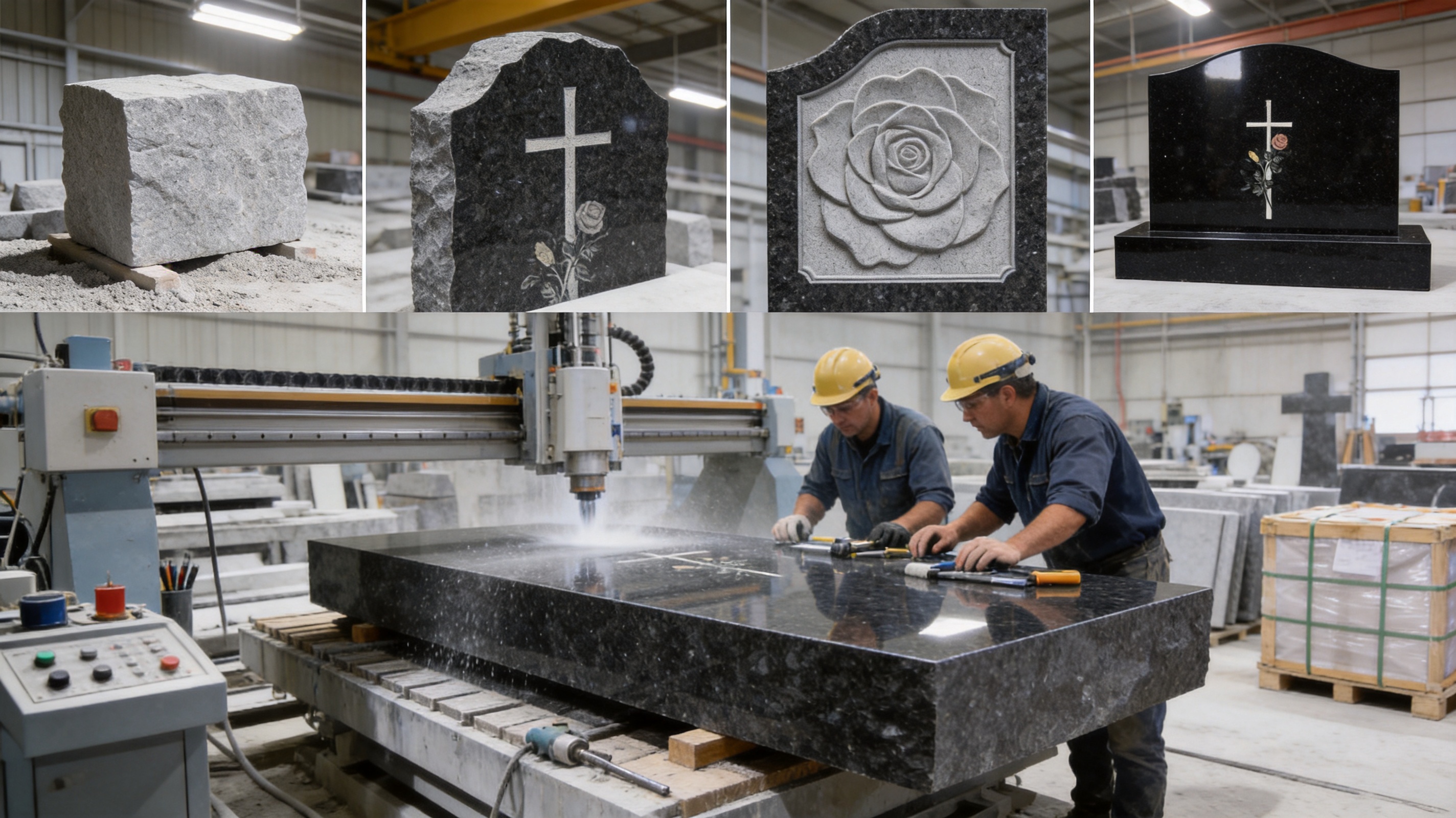
The quality of a granite tombstone depends on more than the raw stone. A successful memorial requires coordinated design development, stone inspection, cutting, shaping, surface treatment, carving, lettering, assembly, quality control, packaging, and installation preparation. Jiangsu Xinyesheng Sculpture Co., Ltd. can use a structured sculpture-manufacturing workflow to support this type of customized product.
Because the product combines architectural proportions with decorative sculpture, production requires both technical accuracy and artistic judgment. The cross must be visually centered, the paired columns must remain balanced, and the roses must be detailed enough to read clearly without overpowering the inscriptions.
Production should begin with a detailed review of the customer’s requirements. This stage may include the preferred granite color, overall dimensions, inscription language, font style, religious details, floral design, portrait requirements, finish, cemetery regulations, and delivery destination.
Designers can then prepare dimensional drawings, layout sketches, or digital visualizations. These documents help confirm the location of the cross, rose pattern, columns, base, lettering panels, and any optional decorative elements. Approval before fabrication is particularly important for a memorial because names and dates must be accurate and permanent.
For customized orders, the design process should also consider how the monument will be viewed from the front and sides. Edge profiles, rear finishing, base connections, and lifting points may be planned according to the installation method. A well-developed drawing reduces material waste and prevents conflicts between decorative carving and inscription placement.
After the design is confirmed, suitable granite is selected. The material should be reviewed for color consistency, visible cracks, mineral inclusions, edge stability, surface condition, and compatibility with the intended finish. A memorial with a large paired face benefits from careful selection because strong variation in the central area may affect the appearance of lettering or relief details.
Natural variation is not necessarily a defect. Veins, speckles, and mineral patterns can contribute to the beauty of the finished monument. The key is to distinguish acceptable natural character from structural weakness. Experienced stone workers inspect the material before cutting so that the most important visible surfaces are positioned advantageously.
Large granite components can be cut using industrial stone-cutting equipment designed for dimensional accuracy. Precision cutting creates the basic slab or block forms and establishes the overall height, width, thickness, and primary geometry.
Accurate cutting is essential for a companion tombstone because the two sides must remain visually balanced. Uneven margins or inconsistent column widths can be noticeable once the stone is polished and installed. Computer-assisted layout and calibrated machinery can improve repeatability, while experienced operators make adjustments based on the natural structure of the stone.
After rough cutting, the granite can be shaped into the intended architectural profile. This may include rounded edges, stepped borders, bevels, raised panels, recessed fields, or a shaped upper section surrounding the cross.
Edge treatment affects both appearance and durability. A carefully rounded edge can reduce the risk of sharp corners and create a softer visual transition. Beveled borders can catch light and frame the inscriptions. Raised or recessed sections can provide depth to the design without requiring excessive ornamentation.
The cross and rose motifs can be produced through a combination of digital layout, CNC carving, abrasive tooling, hand finishing, and surface polishing. CNC equipment is useful for establishing consistent outlines, proportions, and repeated decorative elements. Hand finishing remains valuable for refining transitions, correcting small irregularities, and giving the relief a natural sculptural character.
The depth of carving should be selected according to the granite type and the desired visual effect. Shallow engraving may create an understated appearance, while deeper relief can produce stronger shadows and a more sculptural result. The rose pattern should be proportionate to the monument so that it supports the inscription areas rather than competing with them.
A skilled production team can combine mechanical precision with manual craftsmanship. This is particularly important for floral details, because roses contain curved petals, overlapping forms, and subtle changes in depth. Overly sharp or mechanically uniform petals can appear unnatural, while carefully softened transitions create a more refined memorial aesthetic.
Polishing is one of the most visible stages of granite production. A properly polished face reveals the stone’s color and mineral pattern while creating a clean background for lettering. Other areas may receive a honed, brushed, flamed, or naturally textured finish to create contrast.
The surface should be processed consistently across broad areas. Uneven polishing can create unwanted patches, while excessive polishing around carved details may soften the edges of the design. For a high-quality result, the finishing sequence should be planned together with the carving sequence.
Contrast between finishes can improve readability. For instance, a polished lettering panel against a matte border can guide attention toward the names. A textured rose background can make the floral design visible without requiring strong color contrast. These choices can be adjusted during the design approval stage.
Personalization is the stage that transforms a prepared monument into a specific family memorial. The customer should provide names, dates, wording, photographs, and layout instructions in a verified format. All spelling, punctuation, religious quotations, and date conventions should be checked carefully before engraving begins.
Lettering may be carved directly into the granite, sandblasted, or produced using another approved method. The selected font should be readable and appropriate for the stone’s scale. Decorative scripts can be attractive but should not become so complex that they are difficult to read from a distance.
Portraits and emblems require special attention. A high-resolution source image helps the designer create a clear layout. The manufacturer may convert the image into a suitable engraving pattern or relief format. The final result depends on the original image quality, stone color, contrast, engraving depth, and viewing distance.
Before packaging, the finished monument should be inspected for dimensional accuracy, edge integrity, surface consistency, engraving correctness, decorative detail, and visible damage. Particular attention should be given to the spelling of names, numerical dates, symmetry of the paired columns, and alignment of the cross.
Quality inspection is not limited to checking the finished front face. The sides, rear surface, base, joints, corners, and lifting areas should also be examined. If the monument includes multiple assembled parts, the connection points should be checked for stability and proper fit.
Granite is strong in service but can still be damaged by impact during transportation. Heavy memorial components require protective packaging that prevents movement, corner contact, abrasion, and concentrated pressure. Suitable cushioning, reinforced crates, moisture control, labeling, and lifting instructions can reduce transportation risk.
Export orders also require careful documentation and coordination. The manufacturer should confirm the packing dimensions, gross weight, loading method, delivery terms, customs documents, and installation responsibilities. Because the monument is heavy and valuable, logistics planning should begin before fabrication is complete.
Jiangsu Xinyesheng Sculpture Co., Ltd. is presented as a sculpture manufacturer and supplier capable of producing customized sculpture products. Its product range includes bronze sculptures, stainless steel sculptures, marble sculptures, fiberglass sculptures, and weathering steel sculptures. This broad material experience is relevant to granite memorial production because it indicates familiarity with different fabrication methods, surface treatments, scale requirements, and customer-specific design work.
A supplier with experience across multiple sculpture materials can approach a memorial from both an artistic and technical perspective. Stone requires different tools and finishing methods from metal or fiberglass, but the general production disciplines—drawing review, proportion control, surface quality, customized fabrication, inspection, and export coordination—remain important across product categories.
The tombstone can be adapted in size, decorative arrangement, lettering layout, finish, and inscription content. Customization is valuable because burial customs, cemetery regulations, religious preferences, and family traditions vary by region.
A custom-design workflow also allows buyers to make the monument more personal. The rose arrangement may be modified, the cross may be simplified or elaborated, and the paired columns may be adjusted to accommodate unequal amounts of biographical information. A family can therefore preserve a common visual language while still giving each person an individual memorial space.
A memorial requires more than a standard stone slab. The form must be aesthetically balanced, structurally appropriate, and suitable for long-term outdoor use. The manufacturing team must understand how relief depth, edge shape, grain direction, finish, and lettering interact.
The combination of digital design tools and skilled manual finishing can help achieve this balance. Digital methods support accurate layout and repeatability, while craftsmanship adds refinement to carved floral elements and surface transitions. This integrated approach is especially valuable for products that combine architecture, sculpture, and personalized text.
International customers often require more than product fabrication. They may need assistance with drawings, dimensions, material selection, packing, shipping coordination, and communication across different time zones and cemetery standards.
The supplier’s export-oriented contact structure allows buyers to discuss specifications and production requirements directly. For a large granite memorial, clear communication is essential because the product cannot be economically returned or easily modified after shipment.
The listed product dimensions include both a more compact 1.2-meter model and a larger 1.5-meter model. This range gives buyers an opportunity to select a size based on available cemetery space, visibility, budget, and local restrictions.
A manufacturer accustomed to producing sculpture and architectural forms can coordinate the scale of the cross, roses, lettering, and base so that the design remains proportionate in either size. Enlarging a monument should not simply mean increasing every element mechanically; the visual hierarchy may need to be recalculated to preserve clarity and dignity.
The 1.2-meter-high specification measures approximately 1.2 meters in height, 1.4 meters in width, and 0.3 meters in thickness. Its listed price is US$1,200. This option may be appropriate for cemeteries with stricter size limits, smaller plots, or families seeking a balanced companion monument with a more moderate overall scale.
The 1.5-meter-high specification measures approximately 1.5 meters in height, 1.5 meters in width, and 0.3 meters in thickness. Its listed price is US$2,050. The taller version creates a stronger vertical presence and may provide greater visual prominence for a larger cemetery plot or a location where the monument is intended to serve as a principal family memorial.
The stated price should be treated as a product reference rather than a complete installed project quotation. The final amount may be affected by granite color, carving complexity, lettering, portraits, base design, foundation work, crating, insurance, shipping, customs charges, local delivery, and installation.
| Specification | Approximate Height | Approximate Width | Approximate Thickness | Listed Price | Typical Consideration |
|---|---|---|---|---|---|
| Standard companion model | 1.2 meters | 1.4 meters | 0.3 meters | US$1,200 | Suitable for a moderate-scale memorial and locations with tighter space limits |
| Larger companion model | 1.5 meters | 1.5 meters | 0.3 meters | US$2,050 | Suitable when greater visibility and stronger architectural presence are desired |
Even the highest-quality granite monument requires correct installation. The foundation should be designed for the weight and dimensions of the stone and should comply with cemetery requirements. An uneven or unstable foundation can lead to settlement, tilting, joint stress, or visible alignment problems over time.
The installation area should be prepared so that water does not collect beneath or around the monument. Drainage, soil conditions, frost movement, and nearby roots should be considered. The installer should use appropriate lifting equipment and avoid dragging the stone across hard surfaces.
Routine cleaning can usually be performed with clean water, a soft brush, and a mild stone-safe detergent when necessary. Abrasive powders, strong acids, harsh bleach solutions, and unapproved chemicals should be avoided because they may damage polished surfaces, lettering treatments, sealers, or decorative contrast.
Before using any cleaning product, it should be tested on a small, inconspicuous area. Cemetery authorities may also have specific maintenance instructions. Regular gentle cleaning is generally safer than infrequent aggressive cleaning.
Lettering and relief details should not be scrubbed with hard metal tools. Moss, dirt, and organic growth should be removed carefully so that the edges of the cross and roses remain intact. If color enhancement or protective treatment has been applied, the maintenance method should follow the manufacturer’s recommendation.
Families or cemetery personnel may periodically check the monument for movement, cracks, standing water, biological growth, or damage caused by landscaping equipment. Early identification of a foundation or joint problem can help prevent more serious deterioration.
Granite itself is durable, but installation systems, bases, adhesives, anchors, and surrounding soil can require attention. A professional should evaluate any significant leaning, separation, or structural damage.
Before placing an order, buyers should prepare the information needed for both design and production. This includes the full names of the deceased, correct dates, desired wording, religious quotations, photographs, preferred granite color, finish, dimensions, and delivery location.
It is also important to determine whether the cemetery has approved the design. Some cemeteries limit the use of crosses, roses, portraits, polished finishes, or specific heights. Written approval can protect the buyer from ordering a monument that cannot be installed.
Natural granite varies from block to block. Buyers should request material samples, photographs, or digital previews when possible. A sample cannot display every variation in a large stone, but it can help establish the general color, grain, and finish.
The buyer should also confirm whether the stone will be fully polished, partially polished, honed, textured, or finished through a combination of methods. The appearance of black, gray, red, brown, or light-colored granite can change significantly depending on the surface treatment.
Names and dates should be checked by at least two family members or authorized representatives. A proof drawing should show the exact wording, font, alignment, punctuation, symbols, and placement. Once engraving or carving has started, corrections may be difficult or impossible without replacing a component.
A product price may not include every service required for a completed cemetery installation. Buyers should ask whether the quotation includes the base, lettering, decorative carving, packing, export handling, shipping, insurance, customs clearance, local delivery, and installation.
For international orders, the parties should also confirm the delivery term, estimated production period, port or destination arrangements, and responsibility for damage claims. A clear written quotation helps avoid misunderstandings.
Although the design is primarily intended for couples, its companion format can also be used for close relatives who share a burial site. It may be suitable for siblings, parents and children, or members of a family whose relationship is important to the memorial narrative.
The design can also serve as a family cemetery focal point when adapted to a larger scale. Additional plaques or nearby markers may be coordinated with the central monument, creating a consistent visual language throughout a private burial area.
Memorial parks, religious cemeteries, funeral service providers, monument dealers, churches, and family estate planners may all find this type of product useful. Its combination of traditional symbolism and customized layout makes it adaptable to different memorial programs.
A cemetery is a landscape of memory. Tombstones are viewed not only as individual objects but also as elements within paths, lawns, trees, chapels, gardens, and neighboring memorials. The Cross Rose-Pattern Granite Companion Tombstone is designed to hold its own visual identity while remaining appropriate to a solemn environment.
The upright profile gives it a clear silhouette. The cross provides a recognizable upper focal point. The rose pattern introduces organic detail, and the granite surface connects the monument to traditional architectural materials. Together, these elements create a composition that can remain meaningful across changing seasons and generations.
The monument’s visual strength also comes from restraint. The use of two principal symbols prevents the design from becoming visually confused. Families can add personal details without needing to cover every available surface. This balance is one reason the design can appeal to buyers who want a memorial that is expressive but not overly elaborate.
Durability is an important part of sustainable memorial design. A monument that remains serviceable for generations does not need to be replaced frequently, reducing the consumption of additional materials and the environmental impact associated with repeated production and transportation.
Granite is a natural material that can be finished without relying on large painted surfaces or complex applied coatings. Its long service life is one of its practical strengths. Responsible production should nevertheless include careful material planning, efficient cutting, reuse of suitable offcuts where possible, safe dust control, water management, and appropriate disposal of fabrication waste.
Customers interested in responsible sourcing may ask about the origin of the granite, production practices, packaging materials, and waste-handling procedures. These questions are increasingly relevant for architectural stone and memorial projects.
The purpose of a memorial is not only to withstand weather. It must also support the emotional needs of the living. A well-designed companion tombstone gives families a permanent place to visit, pray, leave flowers, and remember shared experiences.
The two-column structure can reflect the individuality of each person while the unified stone expresses the relationship that connects them. This is particularly meaningful for couples who spent many years together. The cross may represent shared faith, while the roses can suggest affection and the beauty of a life remembered.
Because the monument can carry names, dates, quotations, and personal messages, it becomes a concise record of a family story. Visitors who did not know the deceased can still understand that the burial site represents two connected lives.

It is primarily designed for couples or close relatives who are buried together. The double-column arrangement allows the monument to present two individual memorial records within one unified design.
The product title and content identify it as a granite tombstone, while the supplied category is listed as Marble Tombstones. Buyers should confirm the exact stone type, color, and finish in the final quotation before production. The described performance advantages are based on granite.
The general range is approximately 1.2 to 1.5 meters in height, 1.4 to 1.6 meters in width, and 0.3 to 0.4 meters in thickness. Two listed specifications are 1.2 meters high by 1.4 meters wide by 0.3 meters thick, and 1.5 meters high by 1.5 meters wide by 0.3 meters thick.
The listed price for the 1.2-meter specification is US$1,200. The listed price for the 1.5-meter specification is US$2,050. These prices should be confirmed because customization, stone selection, lettering, packaging, shipping, installation, and local charges may affect the final quotation.
The design can be discussed as a customized sculpture and memorial product. Possible adjustments may include the size of the cross, the arrangement of the roses, the level of relief, the border style, and the relationship between decorative areas and inscription panels.
Portraits, names, dates, epitaphs, religious quotations, and other approved information can generally be incorporated into the design. The buyer should supply accurate text and high-quality image files and approve a final proof before production.
Granite is widely used for outdoor monuments because of its hardness, density, natural durability, and ability to receive polished and carved finishes. Its long-term performance still depends on the particular stone, local climate, foundation, installation, and maintenance.
A joint monument offers a coordinated design and presents the two people as a connected pair. It can provide a larger shared inscription area and avoid differences between separately purchased markers. However, the best choice depends on cemetery rules, family preferences, available space, and total project cost.
The supplied information lists product prices but does not state that installation is included. Buyers should request a complete quotation identifying whether the price covers the base, carving, packing, freight, customs, local delivery, foundation work, and installation.
Buyers should confirm cemetery approval, exact dimensions, stone type and color, finish, inscription content, decorative layout, foundation requirements, packaging, delivery terms, and the complete price. All names and dates should be checked carefully before fabrication.
A customized memorial may involve drawing confirmation, stone inspection, precision cutting, mechanical shaping, CNC or abrasive carving, hand finishing, polishing, engraving, final inspection, and reinforced packaging. The exact process depends on the approved design and material.
Routine care generally involves gentle cleaning with water and a mild stone-safe product when necessary. Harsh chemicals, abrasive tools, and aggressive pressure washing should be avoided unless specifically approved. The foundation and monument should also be checked periodically for movement or damage.
When comparing this monument with competing products, buyers should evaluate the complete value rather than looking only at the initial stone price. The following points are especially important:
First, compare the material. Ask whether the product is granite, marble, engineered stone, metal, fiberglass, or another material, and determine whether that material is appropriate for the cemetery’s climate.
Second, compare the structure. A companion monument should have enough space for two sets of information and should maintain visual balance between the two columns.
Third, compare the craftsmanship. Examine the quality of edges, carving, polishing, lettering, relief depth, surface transitions, and assembly.
Fourth, compare the customization process. A reliable supplier should provide drawings or proofs and should confirm all text before production.
Fifth, compare the logistics. The monument’s dimensions and weight require careful packaging, loading, shipping, unloading, and installation planning.
Sixth, compare communication and after-sales support. International buyers should know whom to contact regarding design changes, damage claims, documentation, and installation questions.
The Cross Rose-Pattern Granite Companion Tombstone is a dignified and durable choice for families who want to commemorate two connected lives within one permanent memorial. Its double-column structure provides individual inscription areas, while the unified granite body, cross, and roses express faith, love, remembrance, and eternal companionship.
Its principal advantage over many competing options is the combination of emotional meaning, practical durability, customization flexibility, and substantial architectural presence. Granite offers high hardness, resistance to ordinary weathering, natural beauty, and a weight that reinforces the sense of permanence expected from a cemetery monument.
The manufacturing quality depends on a complete process: careful design confirmation, appropriate stone selection, accurate cutting, sculptural shaping, controlled polishing, detailed carving, precise lettering, final inspection, and protective export packaging. Jiangsu Xinyesheng Sculpture Co., Ltd. brings experience as a sculpture manufacturer working with multiple materials and customized forms, supporting the technical and artistic requirements of this memorial product.
For buyers, the most important next steps are to confirm cemetery regulations, select the stone and finish, approve the exact dimensions, verify all names and dates, clarify the full quotation, and coordinate installation requirements. With these details properly managed, the monument can provide a lasting and meaningful place of remembrance for generations.
1. ASTM International. Standard practices and specifications relating to natural stone products and dimensional stone.
2. Marble Institute of America. Dimension Stone Design Manual and guidance on natural stone selection, fabrication, and installation.
3. Natural Stone Institute. Technical guidance on granite, stone finishes, cleaning, maintenance, and memorial applications.
4. International Council on Monuments and Sites. General principles concerning the conservation and maintenance of stone cultural objects.
5. National Funeral Directors Association. General considerations for cemetery memorial planning and family remembrance.
6. Industry guidance on granite quarrying, stone fabrication, CNC carving, polishing, engraving, packaging, and export handling.



Daniel H.

Amanda R.

Robert B.

Jennifer S.

James W.

Barry G.

Michael T.

Emily K.

David L.

Sarah M.


Mikey XV

Jagxue

 English
 Español
 عربى
عربى Français
 italiano
 Deutsch