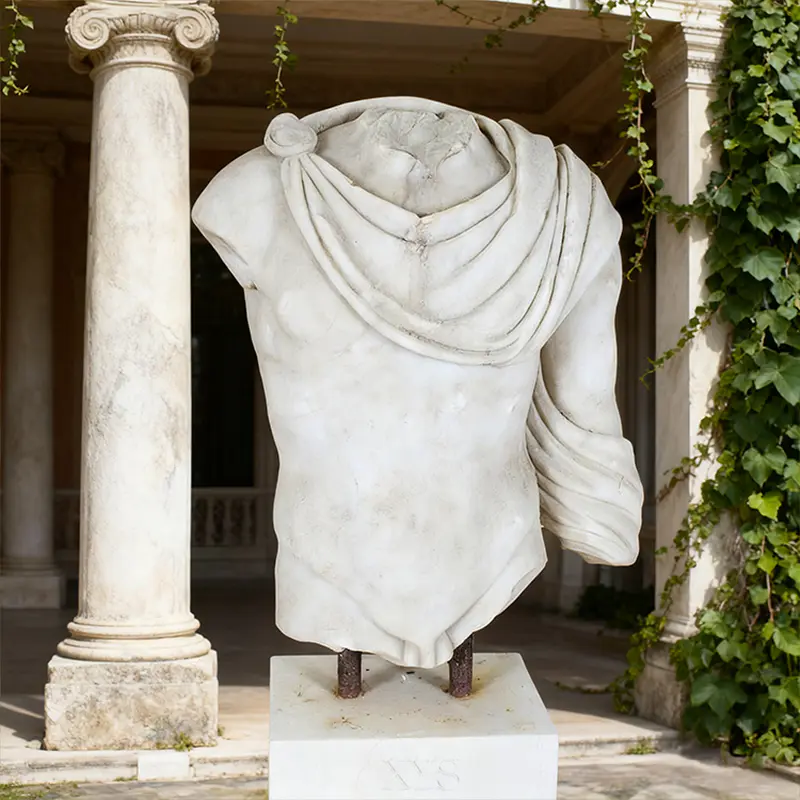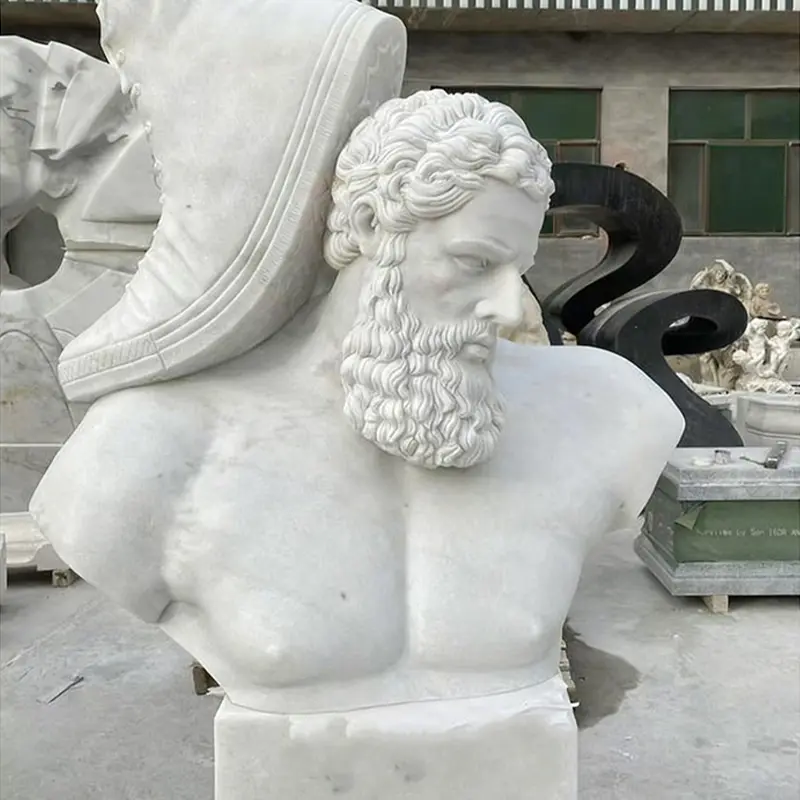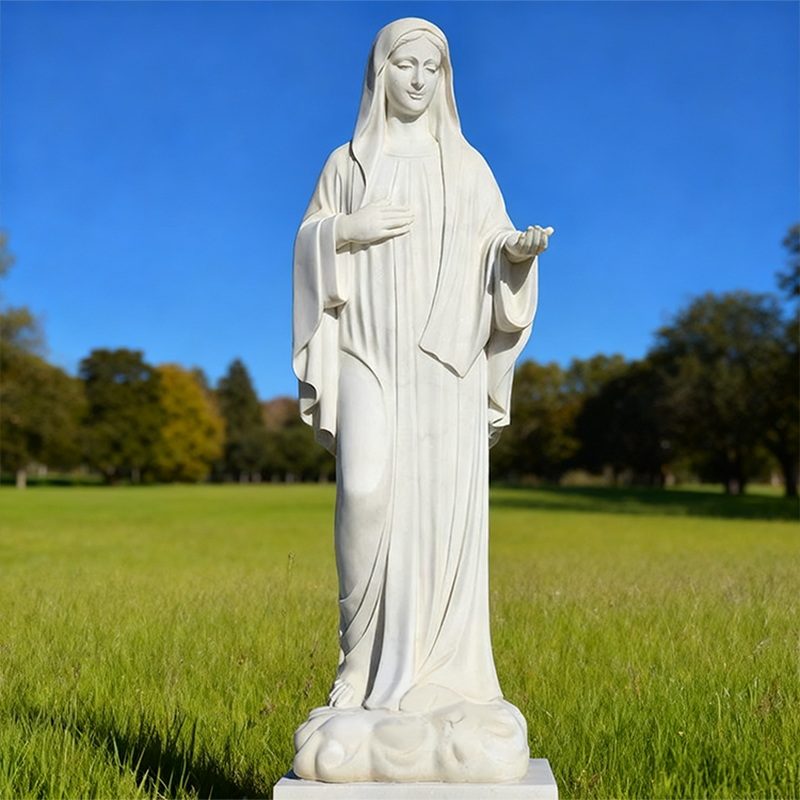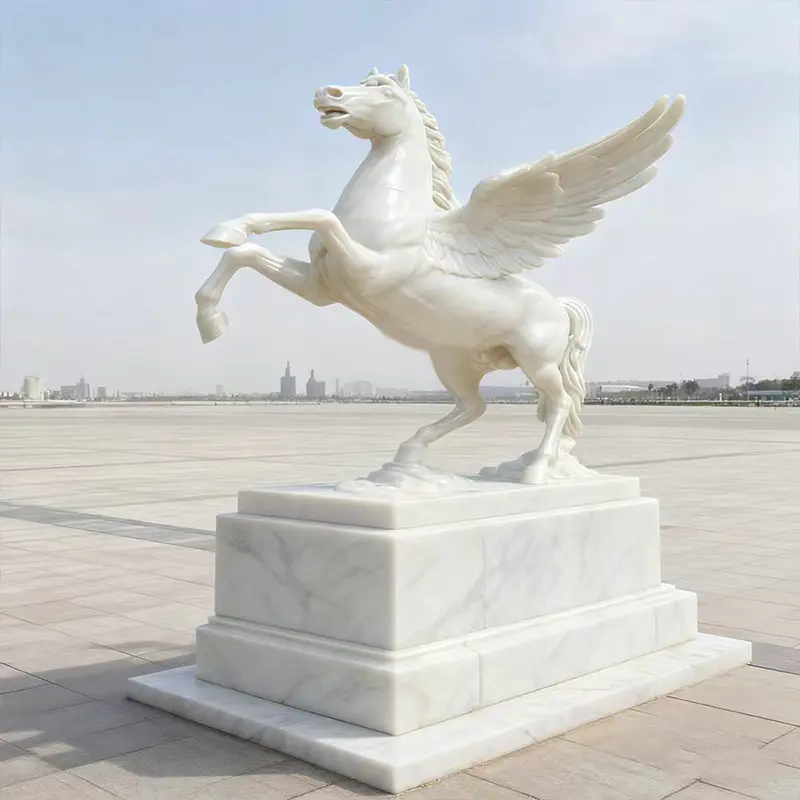
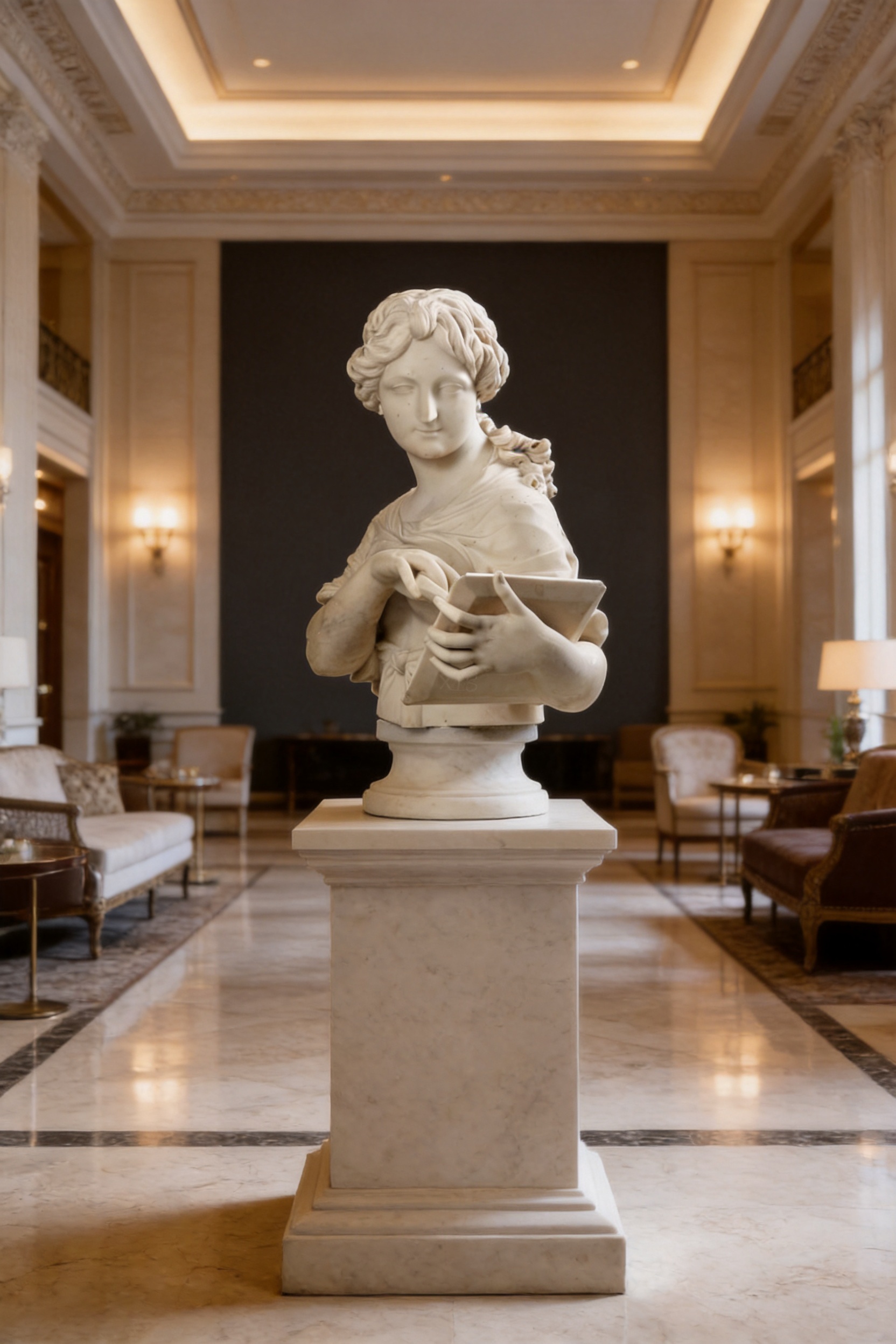
A white marble European figure bust is more than a decorative object. It is a carefully composed work of art that combines classical form, natural stone, skilled hand carving, architectural proportion, and enduring visual appeal. Designed for refined interiors and prestigious outdoor settings, this type of sculpture can create a quiet focal point in a villa, club, gallery, hotel, estate, or private collection.
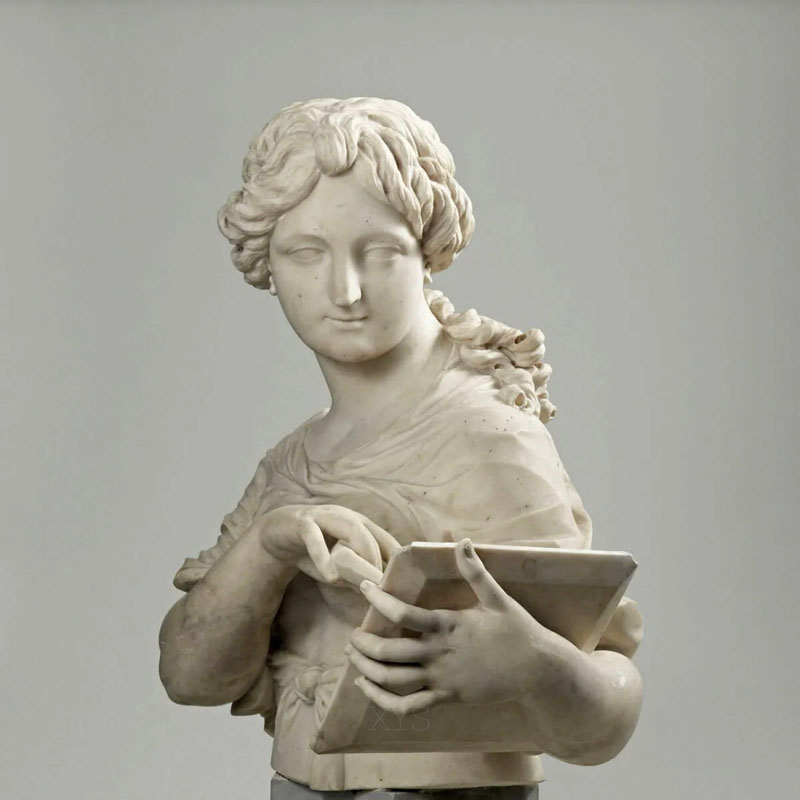
This particular European-style figure bust is hand-carved from natural marble and designed with an elegant combination of gentle facial expression, flowing hair, and faithfully rendered drapery. Its full-size presence, available in total heights of approximately 100 to 130 centimeters including the base, gives it enough scale to command attention without overwhelming a room. The sculpture can function as a collectible art object, a formal architectural accent, or a high-end decorative centerpiece.
Natural white marble provides the foundation for the sculpture’s character. Unlike painted, molded, or mass-produced decorative products, each stone block has its own subtle texture, grain, density, and tonal variation. These natural differences ensure that every finished bust has an individual surface identity. The result is an artwork with a warm, delicate appearance that changes gently under daylight, spot lighting, and ambient interior illumination.
Manufactured by Jiangsu Xinyesheng Sculpture Co., Ltd., a China-based sculpture producer specializing in custom sculpture work, the piece reflects the company’s focus on artistic reproduction, hand-finished stonework, and made-to-order design. The supplier also works across bronze, stainless steel, fiberglass, and weathering steel sculpture categories, allowing buyers to source different materials and artistic styles from one experienced production partner.
The white marble European figure bust is especially suitable for buyers who want the visual authority of classical sculpture while retaining the flexibility of custom production. Size, proportions, base treatment, surface finish, and related design details can be discussed for individual projects. This makes the sculpture appropriate not only for private purchase but also for hospitality projects, architectural developments, gallery programs, and landscape installations.
White Marble European Figure Bust
Content
The human figure has been one of the most important subjects in the history of sculpture. From ancient civilizations to Renaissance workshops and modern academic studios, artists have used the human face and body to explore beauty, emotion, identity, dignity, and ideal proportion. A bust focuses attention on the head, neck, shoulders, and upper torso, allowing the artist to emphasize expression and surface detail without the visual complexity of a complete standing figure.
A European-style figure bust traditionally draws from the aesthetic language of classical and neoclassical art. This language often includes balanced facial features, composed posture, carefully arranged hair, formal drapery, and a calm or contemplative expression. The approach is not simply decorative. It creates a sense of order and permanence that can complement architectural environments built around symmetry, proportion, and carefully selected materials.
The subject of this sculpture has a gentle expression that contributes to its welcoming character. Instead of appearing aggressive or overly theatrical, the face creates a sense of quiet refinement. This quality is valuable in interior design because the sculpture can remain visually prominent without making the surrounding space feel crowded or emotionally intense.
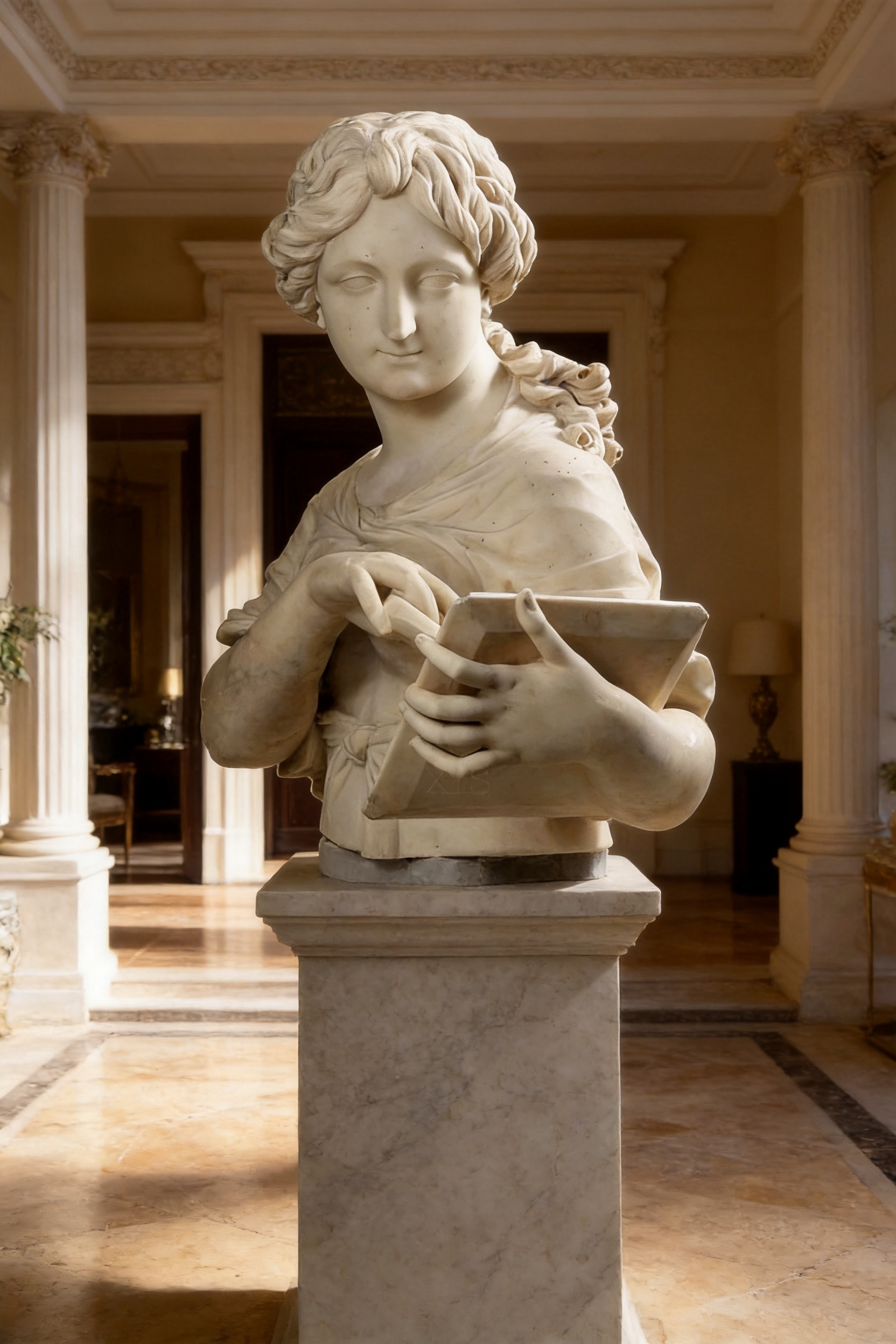
The hair and drapery are also important to the sculpture’s appearance. Fine carved lines introduce movement across the otherwise stable form, while folds in the fabric create changing areas of light and shadow. These details help the viewer read the piece from different angles. When natural or artificial light moves across the marble, the carved recesses become more pronounced and the surface gains additional depth.
A high-quality bust should be convincing from the front, sides, and three-quarter views. Although the frontal view is usually the primary presentation angle, collectors and designers often walk around a sculpture or view it from oblique positions. Faithfully rendered hair, shoulders, clothing, and base transitions therefore contribute to the complete experience of the piece.
White marble has been associated with sculpture for centuries because it offers a rare combination of strength, workability, luminosity, and visual neutrality. Its pale surface allows form to take priority over color. Facial planes, eyelids, lips, cheekbones, hair strands, and fabric folds can be understood through the interaction of light and shadow rather than through painted decoration.
The warm and delicate texture of natural marble is one of the principal advantages of this figure bust. Although white marble may appear visually simple at first glance, it often contains subtle variations in tone and mineral structure. These details give the material a living quality. Under close inspection, the viewer can see that the sculpture is not a flat white object but a natural stone artwork with depth, variation, and tactile richness.
Compared with synthetic resin or standard fiberglass products, marble tends to provide greater material authenticity and a more substantial impression. A molded product may reproduce an outline efficiently, but natural marble communicates permanence through its weight, density, and mineral surface. For clients creating a long-term collection or an architectural environment intended to convey prestige, this distinction can be important.
Marble also offers a refined relationship with surrounding materials. It can be paired with wood flooring, polished stone, brushed metal, plaster walls, glass, leather furnishings, or dark architectural finishes. In a traditional interior, the bust can reinforce a classical atmosphere. In a contemporary space, the contrast between the historic artistic language and minimalist surroundings can create a sophisticated focal point.
Its neutral color provides considerable flexibility. White marble can coordinate with warm beige interiors, cool gray palettes, deep green walls, dark timber, or metallic accents. Unlike strongly colored sculpture, it is less likely to conflict with the existing design scheme. This makes it suitable for projects where the sculpture must remain elegant across future changes in furniture, lighting, or wall finishes.
Natural stone is never completely uniform. Small differences in tone, vein structure, grain, and translucency may appear from one block to another. These variations should not automatically be regarded as defects. In many cases, they are evidence of the stone’s natural origin and contribute to the individuality of the finished work.
For collectors, natural variation means that a hand-carved marble bust is not identical to every other example. Even when a design is based on a reference model, the final result will possess its own subtle material character. This is an advantage over highly standardized decorative objects that are reproduced through identical industrial molds.
The product is described as hand-carved from natural stone. Hand carving is significant because it permits direct artistic interaction between the craftsperson and the material. Instead of relying only on a fixed mold or automated surface, the carving process allows the maker to respond to the density, grain, and behavior of the marble during production.
Creating a figure bust begins with the selection and preparation of a suitable stone block. The block must offer adequate volume for the planned height and sufficient structural integrity for delicate areas such as the nose, lips, hair edges, shoulders, and drapery projections. Careful orientation is also important because the direction and distribution of natural stone characteristics can influence both appearance and carving stability.
The broad form is established before the smaller details are developed. Larger tools and controlled material removal define the head, neck, shoulders, garment mass, and relationship to the base. At this stage, proportion is more important than surface polish. The sculptor must ensure that the total silhouette is balanced and that the weight of the composition is distributed appropriately.
Once the major volumes have been established, the craftsperson refines facial planes and secondary forms. The brow, cheeks, chin, mouth, and eye area require particular care because small changes can affect the entire emotional impression. A gentle expression depends on subtle transitions rather than exaggerated features. The maker must preserve softness while retaining enough definition for the face to remain legible under different lighting conditions.
Hair and drapery require a different type of attention. Their forms are often more linear and directional, with grooves and folds creating repeated patterns. Excessive uniformity can make these details appear mechanical, while insufficient definition can make the surface look unfinished. Skilled carving creates variation in line depth and direction so that the details remain natural and visually integrated.
The final stages involve surface refinement, edge control, and finishing. Different areas may require different degrees of smoothness. Facial surfaces often benefit from a refined finish, while selected recesses can retain slightly deeper shadow. The objective is not merely to make every part equally polished; it is to create a coherent surface in which the material, form, and lighting work together.
Mass-produced decorative busts can be useful when a project requires low cost and rapid delivery, but they generally offer less individuality and tactile credibility. Molded products may have simplified facial features, repeated surface patterns, visible casting seams, or a lightweight feel. Their appearance can be acceptable for temporary decoration, yet they may not deliver the same sense of permanence expected in a high-end environment.
A hand-carved marble bust offers advantages in three main areas: material authenticity, surface depth, and artistic individuality. The natural stone gives the work physical presence. Direct carving allows the details to respond to the design rather than merely repeating a mold. The final surface can communicate the labor and judgment invested in the piece.
These qualities are particularly valuable for galleries, collectors, and designers who want an object that can withstand close viewing. In a prestigious setting, visitors may examine the sculpture from a short distance. The quality of the face, hair, drapery, base, and transitions then becomes an important part of the product’s perceived value.
The sculpture market includes many materials, and each material has a legitimate role. Bronze offers expressive patination and excellent outdoor tradition. Stainless steel provides a contemporary reflective appearance. Fiberglass can reduce weight and make large forms more economical. Weathering steel is valued for its architectural rust finish and strong modern character. Marble, however, has a distinctive set of advantages for a classical figure bust.
| Material | Typical Strength | Visual Character | Advantages of White Marble for a Figure Bust |
|---|---|---|---|
| White marble | Natural stone with strong structural presence | Luminous, refined, classical, and tactile | Authentic material, subtle natural variation, excellent facial modeling, timeless architectural compatibility |
| Bronze | Durable metal suitable for detailed casting | Warm metallic color with patina options | Marble provides a lighter, quieter, and more traditionally classical appearance |
| Stainless steel | Strong metal with corrosion resistance | Modern, reflective, and industrial | Marble offers more softness, visual warmth, and historical association |
| Fiberglass | Lightweight and adaptable for large forms | Painted or coated surface, often uniform | Marble offers greater material authenticity, weight, and collectible value |
| Weathering steel | Robust architectural metal | Rust-toned, bold, and contemporary | Marble is better suited to delicate classical expression and refined interiors |
Bronze is a respected sculpture material with a long artistic tradition. It can support complex casting, strong silhouettes, and durable exterior installations. Its patina can range from golden brown to deep green or dark umber. For monumental outdoor sculpture, bronze may be the preferred choice.
White marble creates a different atmosphere. It emphasizes light, purity, and carved form rather than metallic color. For a European figure bust, this difference can be decisive. The pale surface allows the expression and drapery to appear calm and architectural. Marble is particularly appropriate where the buyer wants a classical gallery, villa, museum, or neoclassical interior effect.
Fiberglass is often selected for its relatively low weight and manufacturing flexibility. It can be useful for temporary exhibitions, commercial displays, large-scale props, and projects where installation weight is a major concern. However, fiberglass normally depends on paint, gel coat, or another surface treatment to imitate stone or metal.
Natural marble does not need to imitate another material. Its color, weight, texture, and mineral structure are intrinsic. This gives the bust a stronger sense of authenticity. The physical weight also contributes to stability and perceived value when the sculpture is displayed in a permanent location.
Stainless steel and weathering steel belong naturally to modern architectural environments. Their strength is expressed through clean edges, planar surfaces, large geometric forms, reflective qualities, or controlled rust coloration. They can make powerful statements in plazas, corporate developments, and contemporary landscape designs.
A white marble bust is more suited to spaces that value intimacy, classical reference, and human-scale detail. The face, hair, and fabric create a different emotional register from industrial metal. Marble can soften a highly technological interior or reinforce the established language of a historic property.
Jiangsu Xinyesheng Sculpture Co., Ltd. presents itself as a sculpture manufacturer capable of producing multiple categories, including bronze sculptures, stainless steel sculptures, marble sculptures, fiberglass sculptures, and weathering steel sculptures. This multi-material capability is a practical advantage for buyers seeking a long-term production partner rather than a supplier limited to one material.
For a design studio, developer, hotel group, or art procurement team, working with a manufacturer that understands different materials can simplify the planning process. The buyer may begin with a marble figure bust and later require bronze garden sculpture, stainless steel signage art, fiberglass display work, or weathering steel landscape elements. A broad production range allows related projects to be coordinated through one source.
The company’s listed product information specifically indicates full-size customization availability. This is important because sculpture projects often have architectural requirements that cannot be met by a standard catalog dimension. A bust intended for a console, niche, entrance hall, stair landing, or gallery plinth may need a carefully adjusted height and base proportion.
Customization can include overall height, base height, shoulder width, drapery arrangement, surface treatment, and the relationship between the sculpture and its display environment. In a professional project, the manufacturer can review reference drawings, images, dimensions, and intended placement before confirming the production plan. A customized sculpture should be evaluated not only as an isolated object but also as part of the surrounding architecture.
Good sculpture manufacturing begins before stone is cut. Design review helps identify potential issues such as unsupported projections, insufficient material thickness, unstable proportions, difficult undercuts, or a mismatch between the sculpture’s scale and its destination. For custom work, early communication can reduce revisions and improve the final result.
Reference images are useful, but they should be accompanied by dimensions and placement information whenever possible. A front image may not communicate the depth of the head, the angle of the shoulders, or the intended shape of the back. Side and three-quarter references can help the production team understand the complete form.
For architectural buyers, the base should be considered from the beginning. The base influences the apparent height, stability, visual weight, and relationship to the floor or plinth. A tall, narrow base may create elegance, while a broader base can provide a more grounded appearance. The correct choice depends on the surrounding architecture and the viewing distance.
Material selection is one of the most important stages in natural marble production. The stone should be appropriate for the sculpture’s size, detail level, finish, and intended location. A figure bust with fine facial details requires stone that can hold crisp edges and delicate transitions.
Stone preparation includes checking the block, establishing the working orientation, and removing unsuitable outer material where necessary. This process helps the manufacturer understand how the stone’s natural characteristics will interact with the planned design. It also supports more predictable carving and finishing.
Because marble is a natural material, complete uniformity cannot be promised in the same way as a synthetic product. Professional communication should therefore distinguish between acceptable natural variation and structural concerns. Veining, small tonal changes, and mineral patterns may add character, while cracks or unstable areas require careful assessment.
Quality evaluation should consider more than general appearance. A carefully made bust should be reviewed for facial proportion, expression, symmetry, hair transitions, drapery logic, surface consistency, base integration, and overall stability. The quality of the finish should be appropriate to the intended use and viewing distance.
For a gallery or collector, close-range inspection is likely. Facial transitions and small details therefore deserve high attention. For a hotel lobby or large villa entrance, the sculpture may be viewed from several meters away, making silhouette, scale, lighting response, and base proportion especially important.
The manufacturer’s experience across different sculpture categories can also support broader quality awareness. Metal and stone require different production methods, but all sculpture work depends on accurate interpretation of the design, controlled finishing, careful packing, and communication with the purchaser.
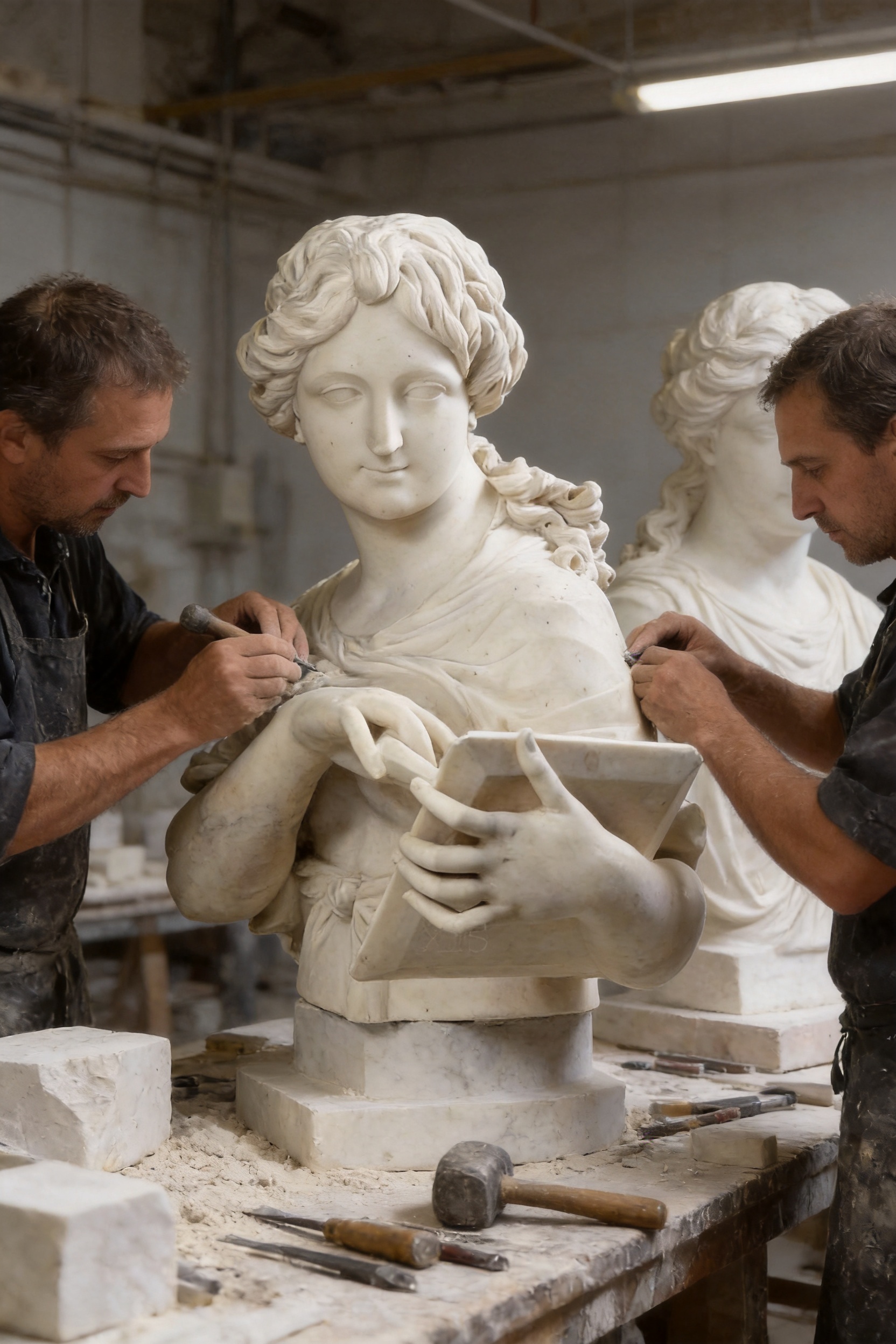
In a private villa, the bust can be placed in an entrance hall, library, formal living room, stairwell, gallery corridor, or covered terrace. Its classical appearance can complement architectural features such as columns, moldings, stone flooring, arched openings, and decorative wall panels.
A villa installation should consider sightlines. The sculpture should be visible from a natural approach rather than hidden behind furniture or placed in a congested corner. A console, pedestal, or purpose-built niche can establish an appropriate viewing height. Lighting should reveal the face and drapery without creating harsh glare on the marble surface.
Private clubs, luxury hotels, restaurants, and members’ lounges often use sculpture to communicate identity and atmosphere. A white marble figure bust can contribute to a sense of heritage, exclusivity, and cultural refinement. It can be used near reception desks, in a lounge, at the entrance to a dining room, or within a quiet corridor connecting different zones.
Hospitality environments benefit from durable decorative pieces that remain visually relevant over time. Trends in furniture and lighting may change, but classical human-form sculpture can maintain its appeal. The bust also photographs well, making it suitable for spaces that appear in event photography, interior design publications, and social media content.
In an art gallery, the sculpture can be presented as a standalone work or placed in dialogue with paintings, drawings, antique objects, and contemporary installations. The neutral white surface provides visual separation from colorful artworks while maintaining a strong presence.
Gallery display requires attention to lighting color temperature, shadow control, visitor circulation, and label placement. Because the sculpture has detailed facial and drapery forms, directional lighting from an appropriate angle can reveal the carving depth. Excessively flat lighting may reduce the visual impact of the work, while overly sharp lighting can create distracting shadows.
Corporate headquarters, financial institutions, law offices, private medical facilities, and luxury retail spaces sometimes use classical sculpture to express stability and confidence. The bust can be placed in a reception area, executive lounge, conference center, or private client room.
In these environments, the sculpture should support the brand atmosphere without becoming a literal logo or promotional object. Its value lies in the associations of craftsmanship, permanence, culture, and quality. A custom size can help ensure that it remains proportionate to the reception desk, wall height, and circulation area.
Libraries, museums, academies, cultural institutions, and historic properties can also benefit from the presence of a European-style figure bust. The work may support educational programs concerning sculpture, art history, architecture, or material culture. A well-designed display can explain how natural stone is selected, carved, finished, and preserved.
The listed product range has a total height of approximately 100 to 130 centimeters including the base. This scale is large enough to function as a major decorative element while remaining manageable for many interior applications. Buyers should confirm the exact division between sculpture height and base height during the quotation process, especially when the piece must fit into a niche or beneath a specific ceiling detail.
A 100-centimeter version can be appropriate for a console, low plinth, private room, or smaller gallery setting. A 130-centimeter version may create a more commanding statement in a grand entrance, hotel lobby, large club, or spacious villa. The correct choice depends on viewing distance, ceiling height, furniture scale, and the desired level of visual prominence.
| Approximate Total Height | Potential Application | Primary Design Effect |
|---|---|---|
| 100 cm including base | Private interior, console display, study, smaller gallery | Elegant, intimate, and easy to integrate |
| 110–120 cm including base | Villa entrance, club lounge, boutique hotel, formal corridor | Balanced focal point with strong presence |
| 130 cm including base | Grand lobby, large gallery, institutional interior, spacious residence | More commanding and monumental presentation |
Viewing height is another important factor. If the bust is placed on a high pedestal, the viewer may look upward at the face, which can make the sculpture feel formal or monumental. If it is positioned close to eye level, the relationship becomes more intimate. A designer should consider the average viewer’s eye line and whether the sculpture is intended to be approached directly or seen from a distance.
Background color also affects the presentation. Pale marble against a very light wall may produce a quiet, low-contrast effect, while a dark or saturated wall can emphasize the silhouette and surface highlights. Both approaches can be successful. The choice should reflect the mood of the space and the amount of visual drama desired.
Lighting is essential for marble sculpture because the form is revealed through highlights and shadows. A soft directional source positioned slightly above and to one side can emphasize the brow, nose, cheeks, lips, hair, and folds of the drapery. Multiple sources can provide more even visibility, but excessive uniformity may flatten the sculpture.
Natural daylight can produce an attractive changing appearance throughout the day. Morning light may create cooler shadows, while afternoon light can produce warmer tonal transitions. If the sculpture is placed near a window, direct sunlight should be considered carefully because intense exposure can create strong glare and may contribute to dust accumulation or uneven environmental conditions.
Artificial lighting provides greater control. Adjustable spotlights can be aimed at the face and upper torso, while low-intensity fill light can prevent important details from disappearing into shadow. The lighting system should be tested after installation because the same sculpture can appear dramatically different under different beam angles and color temperatures.
The surface should generally be kept free from dust and abrasive contact. A soft, clean cloth or an appropriate conservation method may be used, but aggressive chemicals and rough tools should be avoided unless recommended by a qualified stone-care professional. Marble is durable, but its surface can still be scratched, stained, or affected by unsuitable cleaning products.
The available pricing information lists a price of approximately $8,250 for the 100-centimeter version and $19,800 for the 130-centimeter version. These figures reflect a substantial difference in scale and may also relate to the amount of stone, labor, carving complexity, finishing, packaging, and customization involved.
Buyers should request a complete quotation that confirms the final size, material specification, base details, surface finish, packaging method, production schedule, shipping terms, and any applicable installation requirements. If the product is intended for an international project, logistics and customs arrangements should be reviewed separately.
Price should be evaluated in relation to the product’s intended lifespan and role within the project. A hand-carved natural marble sculpture can remain relevant for decades when properly displayed and maintained. It may therefore offer stronger long-term value than a lower-cost decorative object that requires replacement or lacks the visual authority expected in a high-end setting.
Customization may affect the final price. Changes to height, base design, drapery, facial treatment, or reference interpretation can require additional design review and production labor. Clear approval of drawings or reference images before carving can help minimize misunderstandings.
Before placing an order, the buyer should confirm the exact marble type, approximate color range, expected natural variation, final dimensions, base construction, packing method, and inspection process. It is also useful to ask whether progress photographs or approval images will be provided during production.
For a large or high-value piece, buyers should discuss installation access. Door widths, elevators, staircases, floor loading, turning radius, and final placement can all affect delivery planning. Although the listed sculpture is not a monumental outdoor figure, natural marble has considerable weight and should be moved with suitable equipment and professional care.
Custom production gives buyers access to a more precise relationship between artwork and architecture. Instead of selecting a generic object and attempting to fit it into an existing space, the client can define the scale and presentation requirements in advance. This is especially valuable in high-end projects where every visible element must support the overall design concept.
The European-style design language also has broad market recognition. It can be understood by viewers familiar with classical art, yet it does not depend on a narrow contemporary trend. The combination of a composed human expression, flowing drapery, and white marble can work in traditional, transitional, and selected modern interiors.
Compared with competitors that offer only standardized catalog products, a manufacturer with custom capability can respond more effectively to project-specific requirements. The ability to work in several sculpture materials further expands the supplier’s usefulness. A buyer may obtain a marble figure bust for an interior while commissioning metal sculpture for an exterior landscape, maintaining consistency in communication and production management.
The strongest competitive advantages of this product can be summarized as follows:
| Advantage | Benefit to the Buyer |
|---|---|
| Natural white marble | Provides authentic texture, visual luminosity, weight, and long-term artistic appeal |
| Hand-carved production | Supports nuanced facial expression, detailed hair, refined drapery, and individual character |
| Classical European-style composition | Fits villas, clubs, galleries, hotels, and formal architectural interiors |
| Full-size customization | Allows the sculpture to match site dimensions, plinths, niches, and viewing requirements |
| Multi-material manufacturing capability | Gives buyers access to marble, bronze, stainless steel, fiberglass, and weathering steel solutions |
| Large-scale production experience | Supports coordination for individual commissions and broader architectural sculpture programs |
Installation should be planned according to the sculpture’s weight, base design, and final location. A stable, level surface is essential. If the bust is placed on a separate pedestal, the pedestal should be strong enough to support the stone and broad enough to prevent accidental tipping.
For commercial or public spaces, the sculpture should not obstruct emergency routes, doorways, accessibility paths, or fire safety equipment. It should be positioned where visitors can appreciate it without creating a collision hazard. In busy environments, a discreet protective arrangement may be appropriate.
Indoor placement generally offers the best protection for a detailed white marble bust. If the sculpture is installed outdoors, the buyer should confirm the suitability of the selected stone and finish for local weather conditions. Freeze-thaw cycles, pollution, moisture, salt, biological growth, and direct exposure may influence the long-term appearance of natural stone.
Routine maintenance should be gentle and consistent. Dust can be removed with a soft brush or clean cloth. Spills should be addressed promptly using methods suitable for marble. Acidic cleaners, abrasive powders, strong solvents, and untested sealants should be avoided. When in doubt, the owner should consult a stone-care specialist or conservator.
Good environmental control can help preserve the sculpture. Stable indoor humidity, moderate temperature, adequate ventilation, and protection from accidental impact all contribute to long-term condition. The sculpture should also be moved only when necessary, using trained personnel and suitable lifting equipment.
The sculpture is hand-carved from natural white marble. Because the stone is natural, subtle differences in color, texture, grain, or mineral pattern may appear in the finished piece.
It represents a European-style classical figure bust. The design emphasizes a gentle expression, carefully rendered hair, flowing drapery, balanced proportions, and a refined architectural presence.
The listed total height is approximately 100 to 130 centimeters including the base. The stated prices are $8,250 for the 100-centimeter version and $19,800 for the 130-centimeter version. Exact dimensions should be confirmed before production.
Yes. Full-size customization is available. Buyers can discuss the required overall height and related proportions according to the intended location, plinth, niche, or architectural setting.
No. Hand carving and natural marble ensure that each piece has individual characteristics. Even when the same design is followed, slight differences in stone pattern, surface response, and hand-finished details may occur.
Fiberglass is lighter and can be economical for certain large or temporary displays. Marble offers greater material authenticity, weight, tactile richness, and collectible value. It is particularly appropriate for permanent high-end interiors and classical environments.
Bronze provides a metallic appearance and supports many outdoor applications. White marble creates a lighter, calmer, and more classically luminous effect. For a refined European figure bust, marble highlights facial modeling and drapery through natural light and shadow.
Suitable locations include villas, private residences, clubs, galleries, hotels, reception halls, libraries, corporate interiors, cultural institutions, and formal corridors. The final location should provide adequate stability, access, lighting, and viewing space.
The decision should be based on room size, ceiling height, viewing distance, pedestal dimensions, and the desired visual impact. The 100-centimeter version is more intimate and flexible, while the 130-centimeter version creates a stronger focal presence.
The provided product categories include bronze, stainless steel, marble, fiberglass, and weathering steel sculptures. This range can be useful for buyers planning multiple sculpture types across interior, exterior, and architectural projects.
The bust is especially well suited to protected interior environments. Outdoor suitability depends on the selected marble, finish, climate, installation method, and maintenance plan. These factors should be reviewed with the manufacturer before an exterior installation.
Dust should be removed gently with a soft, clean cloth or brush. Abrasive materials, acidic products, harsh solvents, and untested chemicals should be avoided. For stains or conservation concerns, professional stone-care advice is recommended.
Buyers should provide the desired height, installation location, reference images, preferred base arrangement, viewing distance, interior or exterior conditions, delivery destination, and any architectural drawings that affect the sculpture’s proportions.
The base affects stability, total height, visual weight, and the relationship between the sculpture and its surroundings. A suitable base also helps define whether the work feels intimate, formal, monumental, or architectural.
Yes. Natural marble may contain subtle tonal shifts, grain, mineral marks, and other variations. These characteristics are part of the stone’s natural identity and make each hand-carved sculpture distinctive.
The white marble European figure bust combines classical artistic language with the enduring qualities of natural stone. Its gentle expression, detailed hair, flowing drapery, and refined proportions make it suitable for spaces that require elegance without excessive visual noise. The sculpture can serve as a collectible artwork, a formal architectural accent, or a lasting decorative centerpiece.
Its principal advantages over many competing products are the authenticity of hand-carved marble, the depth of natural surface texture, the individuality of each stone, and the timeless compatibility of the European-style figure. Unlike lightweight molded products, it offers substantial physical presence. Unlike strongly colored or highly reflective materials, it provides a calm and versatile visual foundation.
The manufacturer’s experience across marble and multiple other sculpture materials adds practical value for buyers managing individual commissions or larger design programs. Full-size customization further supports architectural integration, allowing the sculpture to respond to the requirements of villas, clubs, galleries, hotels, and other prestigious environments.
With appropriate scale selection, lighting, installation, and care, this marble figure bust can remain a meaningful part of an interior for many years. It is a product designed not only to occupy space but also to establish atmosphere, communicate craftsmanship, and connect contemporary environments with the long tradition of human-form sculpture.
1. Product specification and descriptive materials supplied for the White Marble European Figure Bust.
2. Product category information covering bronze, stainless steel, marble, fiberglass, and weathering steel sculptures.
3. General principles of natural stone selection, hand carving, sculpture finishing, installation, and maintenance.
4. Classical and neoclassical traditions in European figure sculpture and architectural ornament.
5. General interior design principles concerning scale, proportion, lighting, display, and material coordination.
6. Standard professional considerations for the handling, transport, installation, and conservation of marble sculpture.



Daniel H.

Amanda R.

Robert B.

Jennifer S.

James W.

Barry G.

Michael T.

Emily K.

David L.

Sarah M.


Mikey XV

Jagxue

 English
 Español
 عربى
 Français
 italiano
 Deutsch