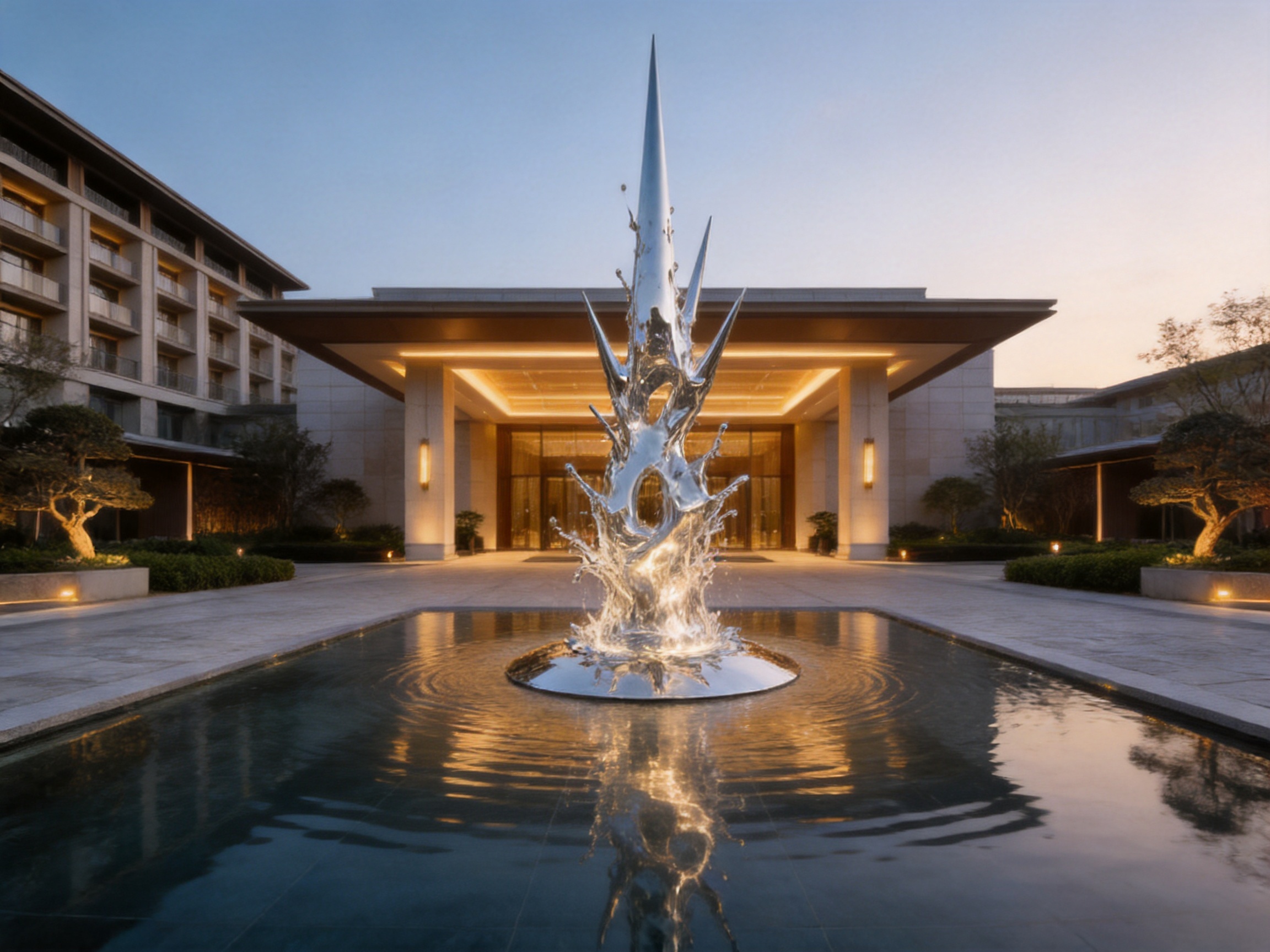
A convincing water sculpture must do more than resemble a familiar object. It must communicate movement, tension, balance, and atmosphere even when the surrounding water is perfectly still. The Splasing Water Stainless Steel Sculpture is designed around that demanding idea. Its form captures the instant when water rises, breaks apart, curls outward, and falls back toward the surface. Instead of presenting a conventional solid monument, it transforms a fleeting splash into a durable architectural artwork forged from stainless steel.
The sculpture is intended for settings where visual drama, durability, and long-term outdoor performance are equally important. It can serve as the focal point of a residential water feature, a hotel landscape, a sales-office reflecting pool, a civic plaza, or a commercial entrance. Available in sizes from 1.4 meters to 5.6 meters, it can be selected for both intimate landscape compositions and large public installations. Its listed price range is approximately $1,820 to $5,590, depending on the selected size and specification.
At the heart of the design is a carefully controlled contrast. The shape appears irregular and spontaneous, like a real splash frozen at the exact instant of maximum energy. Yet the sculpture must be engineered and proportioned with considerable discipline. Each spike, droplet, curl, and outward-reaching form has to contribute to one unified visual event. If the elements are too uniform, the sculpture loses its natural character. If they are too scattered, the result may look like a collection of unrelated metal projections rather than a coherent splash.
This balance between apparent randomness and deliberate construction is one of the product’s defining strengths. It gives the sculpture a lively character that remains legible from multiple viewing angles while preserving the sense of a single burst of water. The result is a sculptural centerpiece that looks active even when it is not connected to a fountain system.
Content
Water is one of the most difficult natural subjects to represent permanently. It has no fixed shape, reflects changing light, and constantly responds to gravity and movement. A successful water-inspired sculpture therefore cannot depend only on literal imitation. It must suggest the behavior of water through silhouette, rhythm, spacing, and surface treatment.
The Splasing Water Stainless Steel Sculpture approaches this challenge through a rising, outward-moving composition. The main form suggests an explosive upward release, while smaller projections create the impression of droplets separating from the central body. Curved edges evoke the elastic motion of water, and pointed forms suggest the sharp breaks that occur when a splash reaches its highest point. Together, these features create a visual rhythm that guides the eye from the base upward and outward.
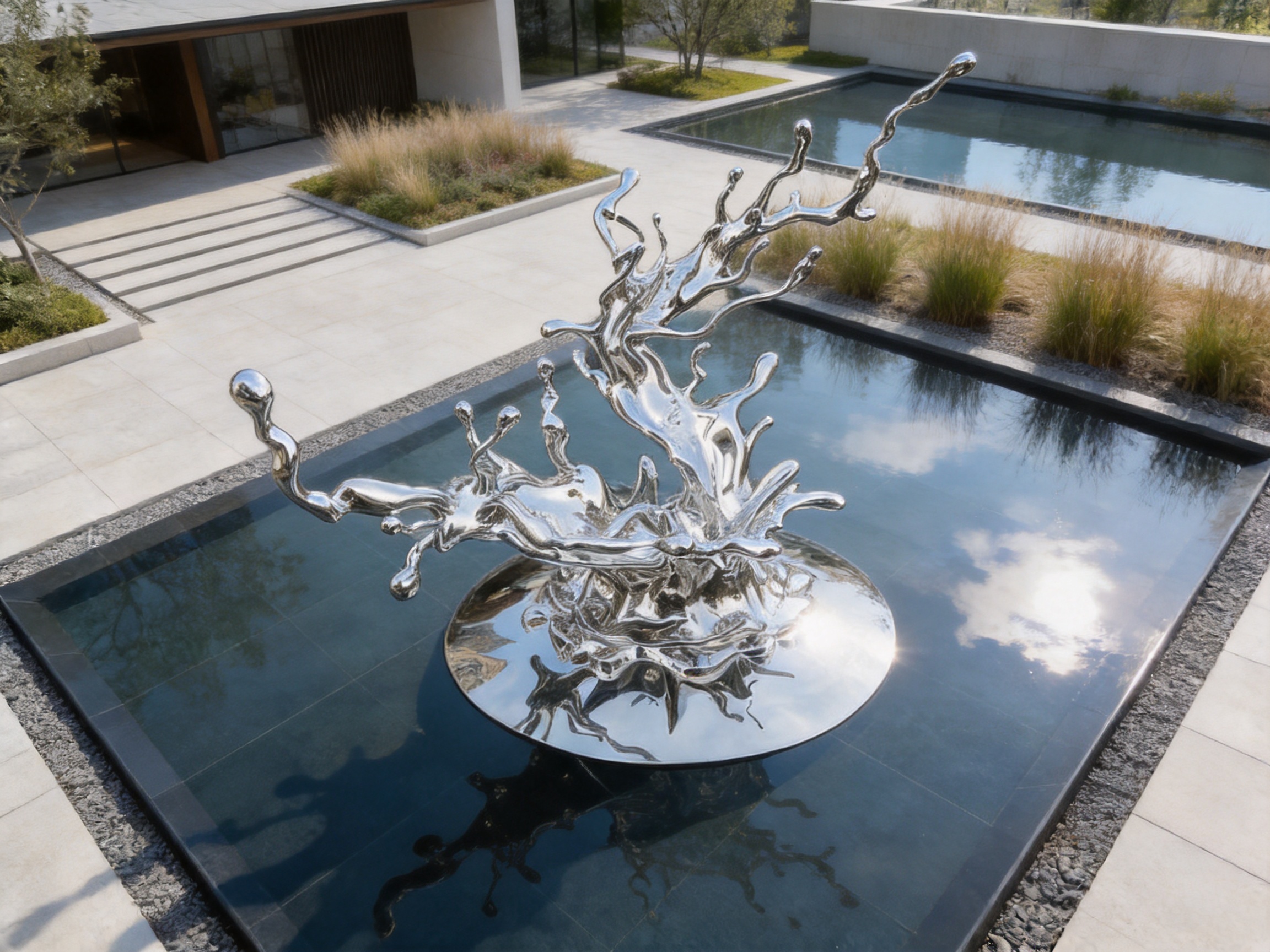
Because the sculpture is produced as a single integrated piece, the viewer experiences it as one event rather than as a group of independent objects. This is especially important when the piece is installed in a reflecting pool. Actual ripples around the base can appear to continue the sculptural movement, making the boundary between the metal splash and the surrounding water less obvious.
The design also carries a symbolic association with sudden release, upward movement, and the arrival of good fortune. In commercial and hospitality environments, these associations can support a welcoming and optimistic atmosphere. In private gardens, the piece can represent vitality and abundance. In public landscapes, it can act as a memorable landmark whose shape is easy to recognize from a distance.
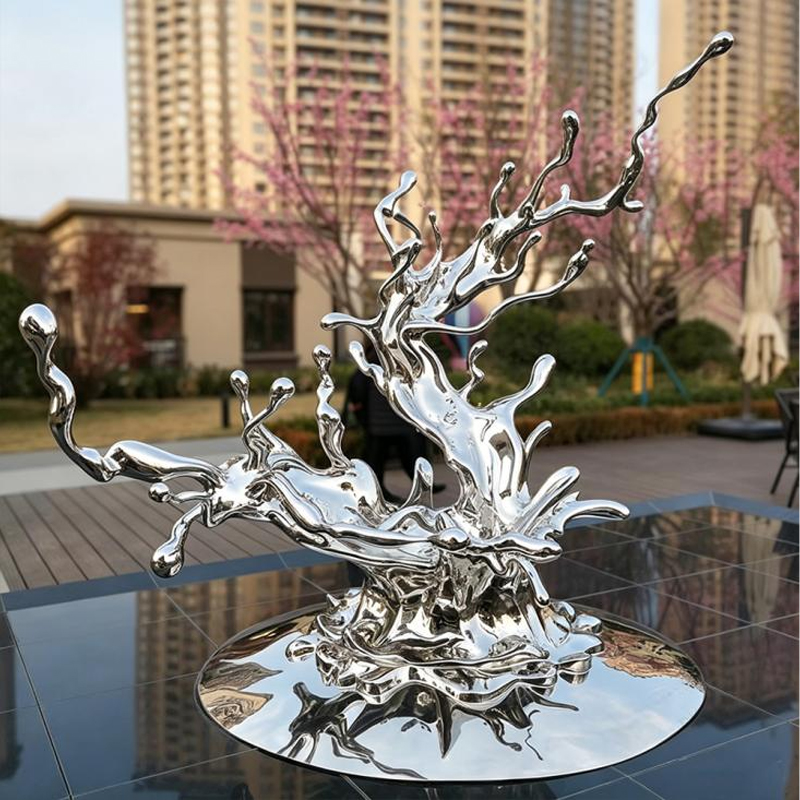
Splashing Water Stainless Steel Sculpture
Material selection is fundamental to the performance of an outdoor sculpture. A water feature exposes artwork to moisture, splashing, mineral deposits, cleaning chemicals, temperature changes, and repeated cycles of wetting and drying. A material that performs well in a dry interior may be unsuitable for a fountain or reflecting pool.
This sculpture is made from 304 or 316 stainless steel. Both grades are widely valued for their corrosion resistance, strength, and suitability for architectural applications. Their resistance to ordinary atmospheric moisture makes them appropriate for many outdoor environments, while their clean metallic appearance provides an excellent foundation for a high-polish finish.
The use of 316 stainless steel can be particularly advantageous in more demanding conditions, including areas exposed to higher levels of chlorides or salt-laden air. Selection between 304 and 316 should be considered according to the installation environment, water chemistry, maintenance plan, and project budget. A qualified project team can help determine the appropriate grade for a specific site.
Compared with ordinary carbon steel, stainless steel offers a major advantage in visual consistency and maintenance. Carbon steel may develop a deliberate weathered surface, but it requires a different design language and maintenance strategy. For a sculpture intended to resemble bright, moving water, a rust-colored surface would not provide the same visual effect. Stainless steel preserves the relationship between the splash form and the reflective qualities associated with water.
Compared with painted metal, mirror-polished stainless steel does not rely on a coating to create its primary appearance. Paint can chip, fade, or require recoating, particularly in high-traffic outdoor locations. A polished stainless surface can still require care, but its appearance is integral to the material and can be maintained through appropriate cleaning and surface care.
Compared with stone, stainless steel makes it possible to create thinner projections, sharper directional changes, and a more visually weightless composition. Marble and granite are excellent materials for monumental solidity, but they generally communicate permanence and mass. The splash sculpture requires the opposite impression: speed, lift, fragmentation, and lightness. Stainless steel is therefore not simply a durable option; it is closely aligned with the artistic purpose of the design.
The full 8K mirror polish is one of the most prominent features of the finished sculpture. A polished surface reflects the environment across the irregular geometry, causing highlights to travel along the edges as viewers move around the work. This changing reflection reinforces the impression that the sculpture is active and fluid.
On a conventional flat object, a mirror finish may produce a relatively uniform reflection. On the splash sculpture, the many angled surfaces create a more complex visual response. One projection may catch the sky, another may reflect nearby landscaping, and a curved edge may produce a bright line that shifts as the viewing position changes. This creates a constantly changing relationship between the sculpture and its surroundings.
The polish also helps the sculpture interact with artificial lighting. In an evening installation, carefully placed architectural lights can emphasize the upward direction of the splash, pick out individual droplets, or create a halo of reflected illumination across the surrounding pool. During daylight, the surface can respond to clouds, trees, buildings, and human movement. The sculpture therefore remains visually engaging under different lighting conditions without requiring mechanical motion.
Achieving a consistent mirror finish on a complex, irregular form is more demanding than polishing a simple sheet or symmetrical sphere. Operators must account for narrow projections, concave areas, changing angles, and transitions between large and small surfaces. Uneven preparation can cause dull patches, visible abrasions, or inconsistent reflections. The product’s manufacturing process must therefore combine accurate shaping with careful surface refinement.
The mirror finish also makes the quality of the underlying form more visible. Any distortion, poor transition, or unnecessary interruption may be emphasized by reflected highlights. This is why surface treatment cannot be separated from sculptural judgment. The final polish is most effective when the composition beneath it has already been proportioned and formed with precision.
Creating the appearance of natural chaos is a controlled design problem. A real splash does not consist of identical spikes placed at equal intervals. Its droplets differ in size, direction, length, and curvature. Some forms remain connected to the central mass, while others appear to separate. The sculpture must reproduce this variety without becoming visually disorganized.
The design process begins with an understanding of the visual characteristics that make a splash recognizable. These include upward thrust, outward dispersion, asymmetry, changing scale, and a relationship between a central source and peripheral droplets. Each of these characteristics has to be translated into a durable metal form.
Proportion is especially important. If every projection is too large, the sculpture may appear heavy and aggressive. If every projection is too small, the silhouette may lose its authority when viewed from a distance. The selected size must also relate to the installation environment. A 1.4-meter piece can work within a compact garden or a smaller residential pool, while a 5.6-meter sculpture may be better suited to a broad plaza, hotel forecourt, or large water landscape.
Viewing distance also influences the design. At close range, visitors can notice the changing curves, polished highlights, and individual droplet-like elements. From farther away, the sculpture must read as a unified upward burst. The composition therefore needs both fine detail and a strong overall outline.
The manufacturing team’s task is not to eliminate irregularity but to organize it. Each irregular element needs a reason to exist within the composition. Its direction should support the overall movement, and its scale should help establish depth and rhythm. This is one area in which a carefully developed sculpture can distinguish itself from less considered decorative metalwork.
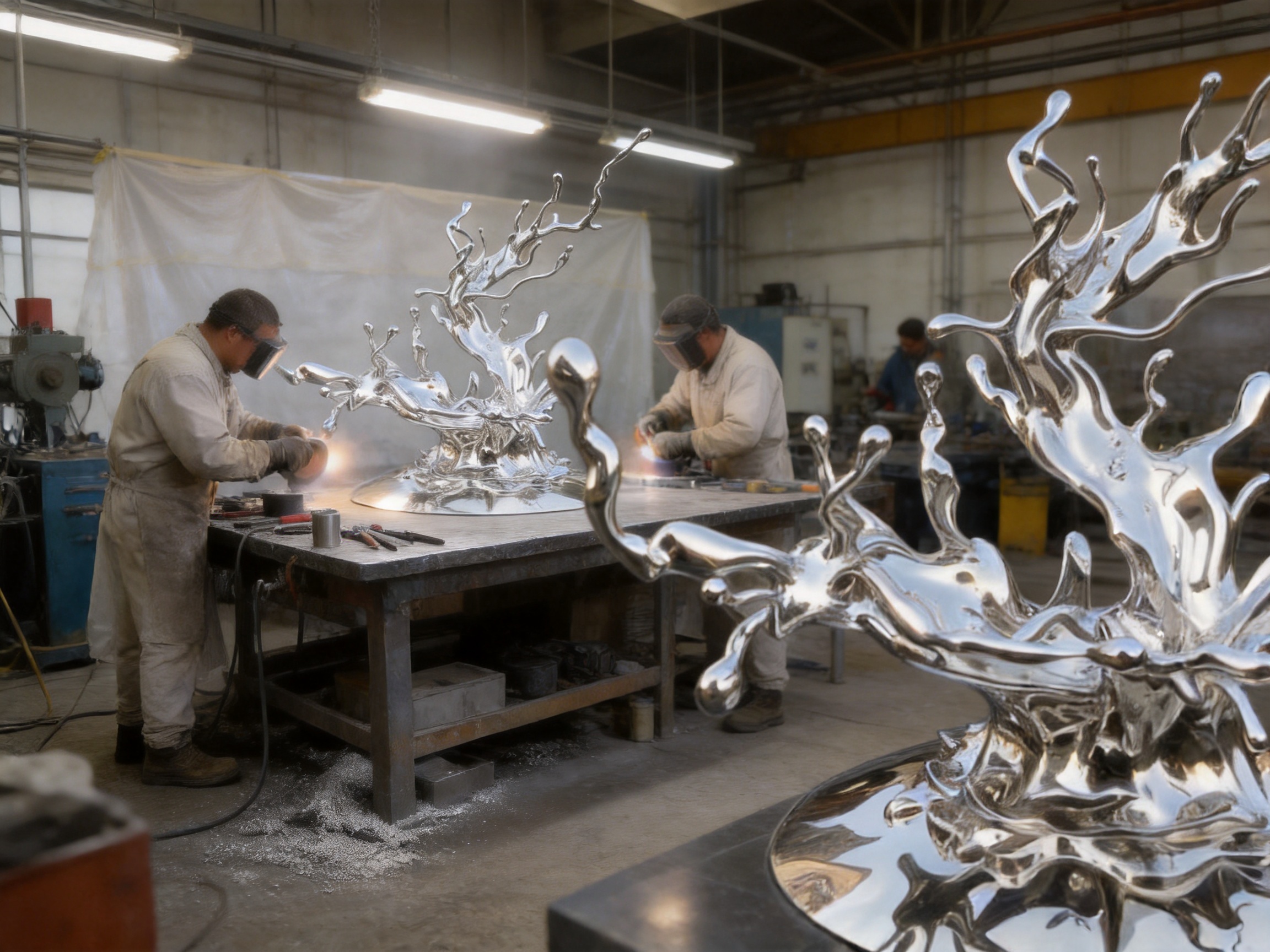
The product description identifies the sculpture as forged as a single piece from 304 or 316 stainless steel. This integrated approach supports the visual idea of one continuous splash and reduces the sense that the work is assembled from unrelated parts. The method also places demanding requirements on forming accuracy, material control, and finishing.
A single-piece concept is especially valuable for an organic design. Visible seams or strongly separated components can interrupt the illusion of fluid movement. When the surface transitions are carefully controlled, the eye can move continuously from the base through the central body and toward the outer projections. This continuity helps the sculpture appear more like a frozen natural event than a fabricated construction.
Forging and forming stainless steel into an irregular three-dimensional shape requires planning around the material’s strength and response to pressure. The form must be developed so that the metal retains adequate structural integrity while achieving the desired curves and projecting elements. The process involves a balance between artistic ambition and practical stability.
The single-piece approach can also support long-term visual consistency. If the principal splash body is made from multiple components with different surface treatments, slight variations in reflection may become visible. A coherent body provides a better foundation for the final polishing stage, particularly when the sculpture will be seen under strong daylight or architectural lighting.
It is important to distinguish between visual simplicity and manufacturing simplicity. A viewer may perceive one elegant splash, but the production team must solve questions involving shape, weight distribution, handling, installation, support, and site conditions. The product’s value lies partly in concealing this complexity behind a clean and apparently spontaneous form.
The manufacturer’s principal strength, based on the supplied product information, is the ability to produce custom-oriented metal sculpture in a range of materials and styles while focusing on large decorative works. Its product categories include bronze sculptures, stainless steel sculptures, marble sculptures, fiberglass sculptures, and weathering steel sculptures. This broader material experience can be useful when a project requires comparison between different finishes, visual effects, or installation environments.
For the Splasing Water Stainless Steel Sculpture, the most relevant manufacturing strengths are material selection, sculptural forming, irregular-shape control, and high-level surface polishing. These capabilities must work together. A technically strong metal body will not be sufficient if the proportions do not communicate water. Conversely, an attractive concept will not succeed outdoors if the material and finish are not appropriate for moisture exposure.
The company presents itself as a China-based sculpture manufacturer and supplier specializing in custom design metal statues and European-style sculpture. This positioning can be valuable for buyers seeking a direct manufacturing source rather than a purely retail product. Direct communication with a manufacturer may support adjustments to dimensions, finish preferences, installation requirements, and project-specific visual expectations.
Customization is particularly important for water-feature sculpture because every site has a different scale, basin geometry, surrounding architecture, and viewing distance. A piece that works in a private courtyard may need different proportions for a hotel entrance. A sculpture for a wide public plaza may require a stronger silhouette than one intended for a narrow garden channel. The available size range provides a starting point, while project discussions can help determine the best fit.
A further strength is the ability to produce a design in multiple scale options without abandoning its primary identity. The upward splash remains recognizable at sizes from 1.4 to 5.6 meters. This makes it easier for landscape designers, architects, developers, and private clients to coordinate the sculpture with the dimensions of the site.
The sculpture offers several advantages over conventional decorative forms. First, it has an active visual language. A static sphere, column, or abstract block may provide a strong focal point, but the splash form introduces a sense of motion and narrative. It suggests an event taking place rather than an object simply occupying space.
Second, its relationship with water is direct and intuitive. When placed in a pool, it does not merely sit beside the water as a separate ornament. Its form appears to emerge from the water or return to it. This integration can make a landscape installation feel more intentional and cohesive.
Third, the mirror polish gives the artwork a dynamic appearance that changes throughout the day. A matte sculpture may present a stable tone, while the polished splash reflects weather, lighting, and surroundings. This creates variety without changing the physical design.
Fourth, stainless steel offers a more contemporary architectural character than many traditional materials. It can complement glass façades, stone paving, concrete structures, landscaped planting, and modern lighting. At the same time, the organic splash shape prevents the material from feeling excessively industrial.
Fifth, the sculpture is available in a wide size range. Buyers are not restricted to a single monumental scale. This supports broader use across residential, hospitality, commercial, and public projects.
Finally, the sculpture has a strong symbolic dimension. Its upward movement can express energy, prosperity, welcome, celebration, or renewal. This gives the piece value beyond its surface appearance and allows it to contribute to the identity of a place.
| Feature | Splasing Water Stainless Steel Sculpture | Conventional Solid Monument | Painted Decorative Metalwork |
|---|---|---|---|
| Primary visual effect | Motion, lift, reflection, and fluidity | Mass, permanence, and stability | Color and graphic decoration |
| Material | 304 or 316 stainless steel | May use stone, bronze, or solid metal | Usually carbon steel or coated metal |
| Surface treatment | 8K mirror polish | Polished, honed, textured, or patinated | Paint or applied coating |
| Relationship with water | Designed to appear integrated with pools and fountains | Often positioned beside water as a separate object | Depends on coating and site conditions |
| Viewing experience | Changes with light, movement, and viewing angle | Usually more visually stable | Primarily dependent on fixed color |
| Available scale | Approximately 1.4 to 5.6 meters | Varies by material and project | Varies by fabrication method |
| Best suited applications | Reflecting pools, plazas, hotels, residences, and sales offices | Monuments, civic spaces, and formal gardens | Decorative entrances and themed environments |
In a residential setting, the sculpture can serve as the focal point of a courtyard, garden pool, or entrance water feature. The 1.4-meter size range is suitable for locations where the artwork needs to create interest without overwhelming the surrounding architecture. It can be positioned in a shallow basin, on a central plinth, or within a carefully designed water landscape.
The reflective surface can visually enlarge a compact space by capturing fragments of sky, planting, paving, and nearby walls. The sculpture’s open and irregular silhouette may also feel lighter than a solid monument of the same height. This can be useful in modern gardens where the client wants a strong artwork without creating a heavy visual barrier.
Placement should consider the direction of sunlight, the principal viewing routes, and the relationship between the sculpture and the pool. A position that allows visitors to walk around the piece will reveal the changing mirror reflections. If the sculpture is viewed mainly from one direction, the most expressive part of the silhouette should face the main approach.
In a private landscape, the symbolic meaning of rising water can add a personal dimension. The sculpture may mark an entrance, a gathering area, or a transition between architectural and natural zones. Its movement can create a sense of welcome and vitality while its stainless steel construction supports a clean, contemporary appearance.
Hotels, resorts, restaurants, and clubs often require landscape features that can be recognized quickly and remembered easily. A splash sculpture can provide a signature visual element in a lobby courtyard, arrival court, spa garden, or outdoor dining area.
Its reflective finish can work particularly well in hospitality environments because it responds to both natural and designed lighting. During the day, it can reflect planting and architecture. At night, concealed uplights or pool lighting can emphasize the upward projections and create a dramatic arrival experience.
The design also photographs well from multiple angles. This matters in hospitality spaces where guests frequently share images of distinctive interiors and landscapes. The irregular silhouette provides a recognizable subject, while the mirror surface adds changing visual detail that can vary according to the time of day and surrounding decoration.
For hotels near the coast or in humid climates, material selection should be discussed carefully. The choice between 304 and 316 stainless steel, as well as the water treatment program, should reflect local exposure conditions. Routine cleaning remains important because salt, mineral residue, dust, and water spots can reduce the clarity of a mirror finish even when the underlying metal is corrosion resistant.
Sales offices, corporate developments, shopping centers, and commercial plazas often use sculpture to establish a premium image and provide a memorable point of arrival. A polished stainless steel splash can communicate investment in design quality while remaining compatible with modern architecture.
At a development entrance, the sculpture can form a visual anchor visible from approaching vehicles and pedestrians. At a sales office, it can support a message of growth, movement, and future-oriented design. In a commercial plaza, it can help organize open space by giving visitors a clear landmark around which seating, planting, and circulation can be arranged.
The symbolism of upward movement can be especially appropriate for business-oriented environments. While the sculpture remains an artwork rather than a literal sign, its energy and association with flowing good fortune can contribute to the emotional character of the site.
For a large plaza, the 5.6-meter option may provide the visual scale needed to compete with surrounding buildings. The sculpture should be coordinated with paving, drainage, lighting, access paths, and any fountain equipment. Its base and support system must be planned as part of the overall installation rather than treated as an afterthought.
A successful installation begins before the sculpture arrives at the site. The landscape architect, fountain contractor, structural consultant, and sculpture manufacturer should coordinate the dimensions and support requirements at an early stage. This is particularly important for large pieces with projecting forms and a polished surface that must be protected during handling.
The basin should be designed to support the intended visual relationship between the sculpture and the water. A shallow reflecting pool can create the impression that the sculpture rises directly from the surface. The depth, edge treatment, and water circulation should be considered together. Ripples extending from the base can reinforce the illusion of movement, but excessive turbulence may obscure the form or produce unwanted splashing on nearby paving.
Drainage is another important consideration. Standing water, mineral-rich deposits, and poorly directed runoff can create marks on the metal surface. The site should allow water to drain effectively and should provide access for routine cleaning.
Lighting should be tested from several angles before final installation. Mirror-polished stainless steel can produce intense highlights if a fixture is aimed directly at a narrow projection. Indirect or carefully diffused lighting may provide a more balanced effect. The objective is to reveal the shape, not to create glare for viewers or nearby traffic.
Handling procedures should protect the polished surface from scratches, impact, and contamination. Protective wrapping and suitable lifting equipment may be required, especially for larger sizes. Once the sculpture is in position, the final cleaning should be completed after surrounding construction work has ended so that dust, cement residue, and other materials do not compromise the finish.
Stainless steel is comparatively easy to maintain, but “low maintenance” does not mean “no maintenance.” The 8K mirror surface displays fingerprints, dust, water spots, and mineral deposits more readily than a textured or matte finish. A consistent cleaning program helps preserve the intended visual quality.
Routine cleaning normally begins with clean water and a soft, non-abrasive cloth or sponge. If a mild cleaning solution is needed, it should be compatible with stainless steel and thoroughly rinsed away. The surface should be dried after cleaning to reduce water spotting, particularly in regions with hard water.
Harsh abrasive pads, steel wool, aggressive acids, and unsuitable chlorine-based products can damage or discolor the surface. Cleaning should follow the direction of any visible polishing pattern where applicable, even though a mirror-polished sculpture may appear visually uniform at first glance.
Water-feature operators should monitor the chemical balance of the basin. Excessive concentrations of salts, chlorides, or other chemicals can increase the risk of staining or corrosion over time. The sculpture’s stainless steel grade should be matched to the water conditions and environmental exposure.
Periodic inspections should check the base area, support connections, drainage behavior, and any locations where debris may collect. A maintenance schedule can be adjusted according to the installation environment. An indoor or sheltered reflecting pool may require less frequent cleaning than an outdoor coastal installation surrounded by trees and airborne dust.
The available size range provides flexibility, but custom development may also involve more than height. Project teams may need to discuss the overall width, visual density, orientation, base treatment, water relationship, and surface specification. These details can affect how the sculpture fits within the architecture and landscape.
For a narrow site, a more vertically emphasized composition may be appropriate. For a broad pool, a wider outward spread may better fill the available space. The viewing angle can also influence the preferred orientation. A sculpture placed at the end of a long axis may require a silhouette that reads clearly from one principal direction, while a central plaza installation should be compelling from all sides.
Material grade is another customization decision. In ordinary inland outdoor conditions, 304 stainless steel may provide an appropriate balance between performance and cost. In coastal or high-chloride environments, 316 stainless steel may be preferable. The final choice should be made with attention to the site, water chemistry, cleaning practices, and project requirements.
The company’s broader product experience in bronze, marble, fiberglass, weathering steel, and stainless steel can support comparative material discussions. A buyer may begin with a visual concept and then evaluate whether a bright mirror finish, a warm bronze surface, a natural stone body, or a weathered steel appearance best suits the surrounding environment.
Buyers should evaluate a sculpture through both artistic and technical criteria. From an artistic perspective, the splash should read as one unified movement. The projections should have varied but coordinated directions, and the overall silhouette should remain engaging from the expected viewing routes.
From a manufacturing perspective, the surface should be inspected for visible dents, ripples unrelated to the intended form, polishing inconsistencies, sharp unfinished edges, and areas where the reflection appears interrupted. Organic irregularity is part of the design, but accidental defects should be clearly distinguished from intentional variation.
The buyer should also request confirmation of the selected stainless steel grade, dimensions, installation orientation, and surface finish. For a water-feature application, it is useful to clarify recommended cleaning methods and any environmental limitations. The base and support arrangements should be discussed with the site contractor before fabrication is finalized.
Large projects may benefit from drawings, rendered views, finish samples, or approval images before production. These materials help ensure that the client, designer, and manufacturer share the same understanding of the intended form. They are especially useful when the sculpture will be viewed from multiple levels or from a considerable distance.
The commercial value of the Splasing Water Stainless Steel Sculpture comes from the combination of design recognition, material durability, and installation flexibility. It is not merely a decorative metal object. It is a focal-point product that can shape how visitors experience a landscape.
Its recognizable water-inspired form gives it immediate visual communication. People do not need extensive explanation to understand the suggestion of a splash. This makes it suitable for spaces that must create an impression quickly, including entrances, reception areas, public plazas, and hospitality destinations.
The mirror finish increases the visual return of the investment because the sculpture changes with its environment. The same piece can appear different in morning light, under a cloudy sky, beside seasonal planting, or beneath evening illumination. This adaptability helps the artwork remain interesting over time.
The range of available sizes supports projects with different budgets and spatial constraints. A smaller sculpture can establish a refined focal point in a private or compact setting, while a larger version can anchor a major public landscape. The listed price range gives buyers an initial planning reference, although final pricing may depend on size, material grade, customization, packaging, and delivery requirements.
Finally, the product can be sourced directly from a manufacturer with experience across several sculpture materials. For professional buyers, direct manufacturing communication may simplify specification, customization, and project coordination.
It represents a burst of water rising and spreading outward at the moment of maximum movement. The irregular spikes, curling forms, and droplet-like projections are arranged to suggest a real splash frozen in time.
The sculpture is described as being made from 304 or 316 stainless steel. The appropriate grade depends on environmental exposure, water chemistry, coastal conditions, maintenance practices, and project budget. Buyers should confirm the final grade during project specification.
The 8K mirror polish creates a highly reflective surface that catches changing highlights across the sculpture’s curved and irregular forms. As viewers move, the reflections shift, strengthening the impression of motion and allowing the sculpture to respond to its surroundings.
Yes. It is particularly suited to reflecting pools, shallow fountains, hotel water landscapes, residential water features, and commercial plazas. Installation should be coordinated with the basin, drainage, support, lighting, and water-treatment systems.
The listed size range is approximately 1.4 meters to 5.6 meters. The appropriate size depends on the pool dimensions, viewing distance, surrounding buildings, landscape scale, and desired visual impact.
It may be suitable for coastal environments, but the material grade and maintenance program should be selected carefully. 316 stainless steel may be considered for more demanding chloride exposure. Regular cleaning and removal of salt deposits remain important even when corrosion-resistant stainless steel is used.
Routine cleaning with clean water and a soft, non-abrasive cloth is generally appropriate. Mild stainless-steel-compatible cleaners may be used when necessary, followed by thorough rinsing and drying. Abrasive pads, steel wool, and harsh chemicals should be avoided.
The manufacturer offers sculpture production and custom design capabilities. Custom discussions may cover size, material grade, proportions, orientation, finish, and installation requirements. The scope of customization should be confirmed before an order is placed.
Recommended settings include residential pools, sales-office landscapes, hotel entrances, resort gardens, commercial plazas, public reflecting pools, and architectural courtyards. The design is most effective where visitors can see both the sculpture and its relationship with water.
No. Its form creates the impression of movement without motors or moving parts. Real water may be added around the base to strengthen the illusion, but the sculpture itself remains a stable, permanent artwork.
Bronze and stone can provide warmth, weight, and traditional monumentality. The stainless steel splash offers a different visual language based on brightness, reflection, thin projections, and apparent movement. The best choice depends on the architectural style, environmental conditions, and desired symbolism of the project.
Buyers should confirm the final dimensions, stainless steel grade, finish, base and support details, lifting method, basin coordination, drainage, lighting, water chemistry, access for cleaning, and protection requirements during construction.
The Splasing Water Stainless Steel Sculpture turns a brief natural event into a durable architectural centerpiece. Its strongest qualities come from the relationship between concept and execution: the splash must look spontaneous, but its form requires careful proportioning; the surface must look fluid, but it is formed from resilient stainless steel; the sculpture must appear light and energetic, but it must remain stable in an outdoor environment.
The use of 304 or 316 stainless steel supports long-term placement in and around water features, while the 8K mirror polish adds changing reflections that reinforce the sense of motion. The single-piece forged approach helps preserve visual coherence, and the available 1.4-meter to 5.6-meter range allows the design to serve both private landscapes and large public spaces.
For buyers seeking a focal-point artwork with contemporary character, strong symbolic value, and practical outdoor suitability, this sculpture provides a compelling combination. Its ability to interact with water, light, architecture, and movement makes it more than a static ornament. It becomes a visual event that continues to change as the surrounding environment changes.
1. Product specification and supplied descriptive materials for the Splasing Water Stainless Steel Sculpture.
2. General technical literature on 304 and 316 austenitic stainless steel and their corrosion-resistant applications.
3. General guidance on architectural stainless-steel cleaning, maintenance, and surface preservation.
4. Landscape architecture principles concerning reflecting pools, water features, sculpture placement, and site-scale composition.
5. General principles of public-art fabrication, outdoor sculpture installation, and lighting for reflective metal surfaces.



Daniel H.

Amanda R.

Robert B.

Jennifer S.

James W.

Barry G.

Michael T.

Emily K.

David L.

Sarah M.


Mikey XV

Jagxue

 English
 Español
 عربى
 Français
 italiano
 Deutsch