
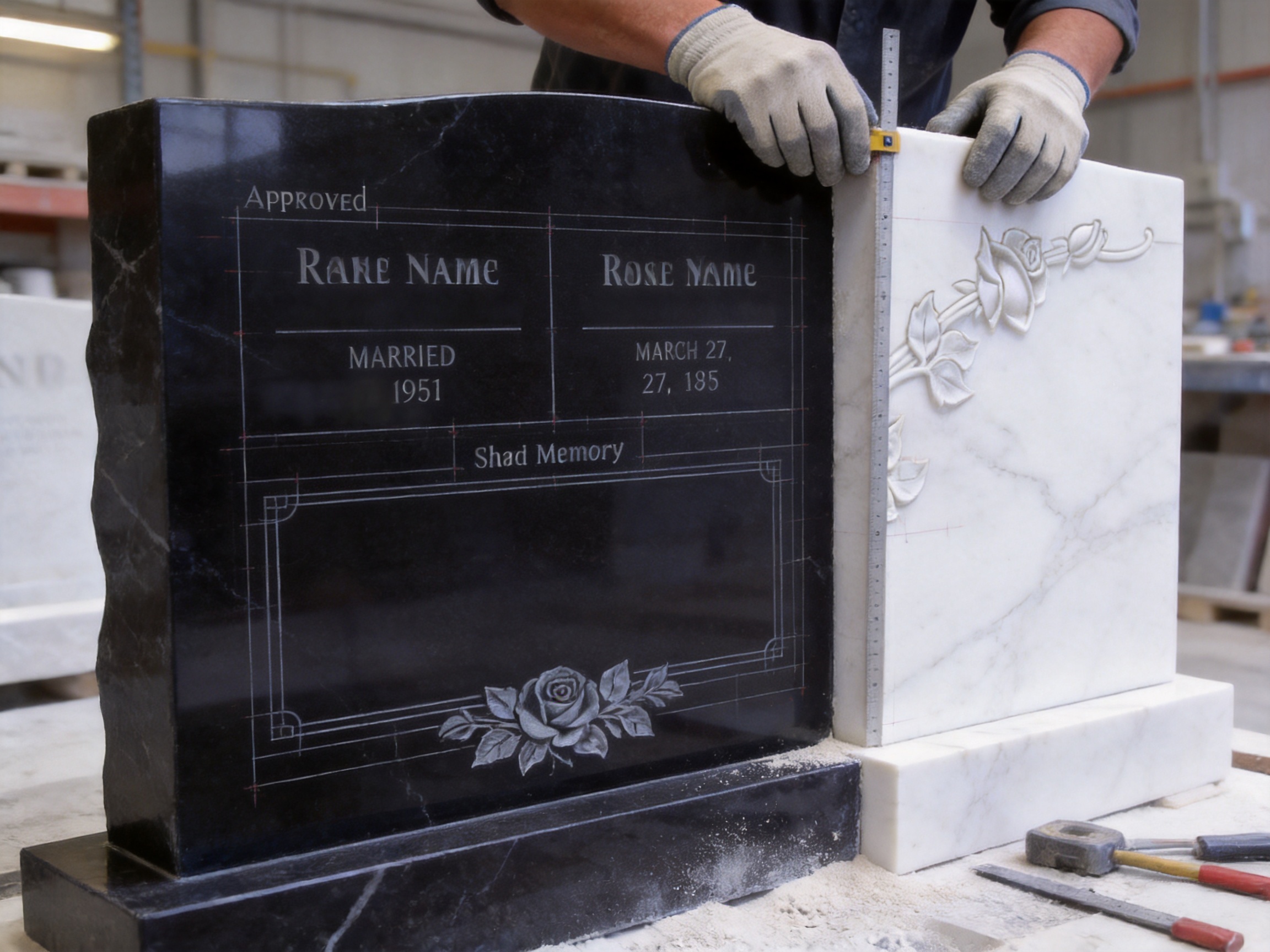
A memorial marker is more than a stone placed at a gravesite. It is a lasting expression of identity, family connection, affection, and remembrance. The Black-and-White Contrast Rose-Pattern Marble Tombstone has been designed for couples buried together, combining practical memorial information with a restrained, contemporary visual language. Its contrasting black-and-white composition provides strong legibility, while the rose motif introduces warmth and symbolism into an otherwise solemn setting.
Created for double burial memorial spaces, this marble tombstone can display the names of both individuals, their wedding date, relevant family relationships, and other details selected by the family. The design recognizes the shared history of a couple rather than presenting two unrelated individual markers. In this way, the monument becomes a visual record of companionship, marriage, family, and a life experienced together.
The tombstone is available in two principal size and price configurations. A version measuring approximately 1.2 meters high, 1.5 meters wide, and 0.2 meters thick is priced at US$2,350. A larger version measuring approximately 1.6 meters high, 1.8 meters wide, and 0.25 meters thick is priced at US$5,500. Final pricing may depend on lettering, carving, rose-pattern treatment, packaging, shipping, installation requirements, and other customization details.
Content
Many traditional tombstones are designed around a single name, a single portrait, or a single date. While such monuments serve an important purpose, they may not fully express the relationship between two people who shared a marriage and family life. This rose-pattern marble tombstone takes a different approach. Its proportions, layout, and decorative treatment are intended to identify a couple as a united family memorial.
The broad monument face provides enough visual space for two names and their associated information. Rather than forcing the inscriptions into a narrow layout, the double-marker format can create a balanced composition. The central or shared area may be used for a family name, a short memorial phrase, a wedding date, or a symbol representing the couple’s life together.
The rose design contributes an important emotional layer. Roses are widely associated with love, devotion, beauty, remembrance, and enduring affection. On a cemetery monument, the rose does not need to dominate the surface. A carefully integrated pattern can soften the architectural appearance of the stone and create a subtle connection between decoration and meaning. The result is neither overly ornate nor purely utilitarian.
This balance is one of the product’s principal advantages. The tombstone maintains the dignity expected of a cemetery memorial while introducing a modern contrast and a gentle floral element. It can therefore suit families looking for a design that is traditional in purpose but contemporary in presentation.
| Specification | Standard Option One | Standard Option Two |
|---|---|---|
| Product type | Double-burial marble tombstone | Double-burial marble tombstone |
| Approximate height | 1.2 meters | 1.6 meters |
| Approximate monument width | 1.5 meters | 1.8 meters |
| Approximate monument thickness | 0.2 meters | 0.25 meters |
| Base width range | Approximately 0.3–0.4 meters | Approximately 0.3–0.4 meters |
| Quoted price | US$2,350 | US$5,500 |
| Primary material | Marble | Marble |
| Color concept | Black-and-white contrast | Black-and-white contrast |
| Decoration | Rose-pattern treatment | Rose-pattern treatment |
| Intended use | Couples buried together | Couples buried together |
Dimensions are approximate product specifications and should be confirmed before production. Cemetery regulations can differ significantly regarding overall height, foundation depth, monument width, setback requirements, anchoring, and the use of decorative elements. Families and purchasing representatives should verify local rules before selecting the final size.
Color is a fundamental part of memorial design because it influences visibility, mood, and perceived permanence. The black-and-white contrast of this tombstone has both practical and aesthetic value. Dark marble provides a strong visual field, while lighter lettering, inlay, carving, or decorative details can stand out clearly against it. The resulting contrast helps visitors identify names and dates from a respectful viewing distance.
Compared with a monument using only one subdued color, the contrasting composition can make important information easier to locate. Names, dates, and relationship details do not disappear into a visually uniform surface. The design can also be more recognizable within a cemetery containing many similar gray or light-colored markers.
At the same time, black-and-white is a restrained color combination. It does not depend on bright colors that could appear unsuitable in a solemn outdoor environment. The palette communicates dignity, order, and clarity. Its minimalist character also allows the rose pattern to remain meaningful without making the tombstone appear crowded.
The contrast can be achieved through several design approaches, depending on the selected production specification. It may involve the natural relationship between two marble tones, a contrasting inset, polished and honed surfaces, engraved details, raised relief, or a combination of finishing treatments. The exact method should be confirmed during the design approval stage because natural stone varies in color, veining, grain, and density.
Marble has been used for monuments, architecture, sculpture, and public memorials for centuries. Its appeal comes from a combination of physical durability, visual depth, workability, and cultural association with permanence. When properly selected, processed, finished, transported, and installed, marble can remain an effective outdoor memorial material for many years.
The product description identifies high-density black marble as the principal material. Density is important because a compact stone structure can provide a substantial, stable feel and a suitable surface for lettering and pattern work. The material is intended to withstand outdoor exposure, including wind, rain, and sunlight. Its long-term performance will also depend on local climate, the quality of the stone, installation practice, drainage, maintenance, and the specific surface finish.
Marble also has a tactile and visual character that is difficult to reproduce with painted metal, resin, or printed decorative panels. Its natural mineral structure gives every completed monument a degree of individuality. Even when a design is based on a standard model, the final stone may contain subtle differences in veining or tone. These variations are not necessarily defects; they are part of the natural identity of the material.
For a family memorial, this natural variation can be meaningful. The monument is not an interchangeable manufactured panel. It is a substantial stone object prepared for a particular couple and a particular place. Its weight, surface, and mineral character reinforce the sense that the memorial is intended to endure.
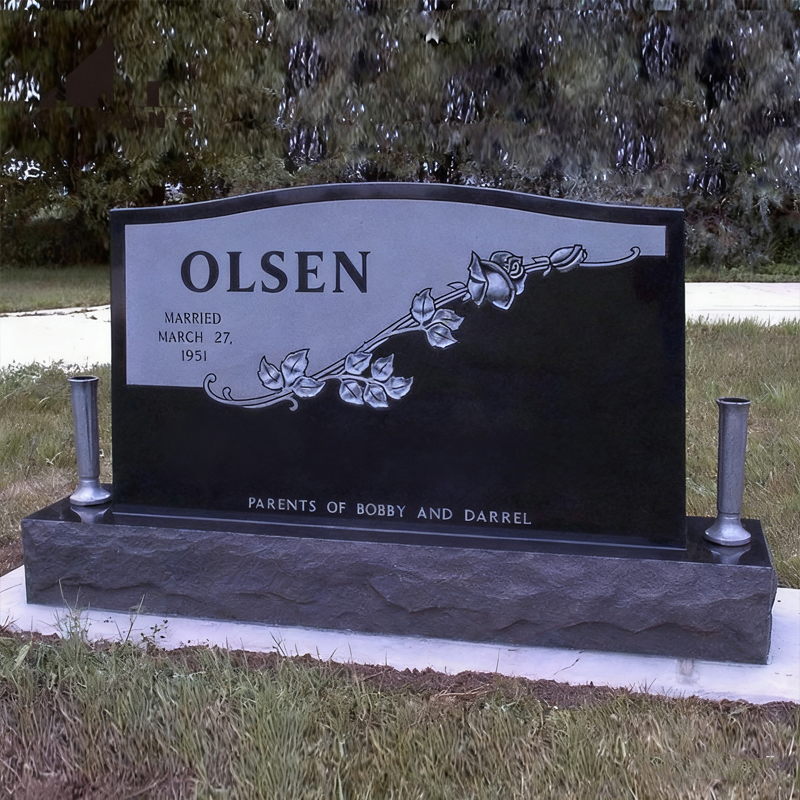
Black-and-White Contrast Rose-Pattern Marble Tombstone
The rose pattern is the most emotionally expressive feature of the design. A rose can represent romantic love, marriage, family affection, beauty, and remembrance. These associations make it especially appropriate for a shared tombstone commemorating spouses or long-term partners.
The pattern can be treated in a variety of ways according to the preferred visual effect. A shallow engraving may create a quiet, understated appearance. A deeper relief can give the rose stronger shadows and a more sculptural character. A polished detail set against a honed background may create a refined contrast without introducing additional colors. The selected method should be matched to the stone thickness, the design scale, and the desired maintenance profile.
Design proportion is important. If the rose is too small, it may lose clarity when viewed from a distance. If it is too large or repeated too frequently, it may compete with the names and dates. The strongest memorial compositions usually establish a hierarchy: the couple’s names remain the first point of attention, the dates provide supporting information, and the rose motif adds emotional and visual context.
The pattern may be placed near the upper portion of the monument, around an inscription, between the two names, or along a border. Each arrangement communicates something different. A central rose can symbolize the shared bond between two people. A pair of roses can suggest two individuals united in one memorial. A border can create a sense of completeness and frame the written information.
Families may also discuss whether the design should include additional symbols. However, because the product is based on minimalist aesthetics, restraint is recommended. Too many symbols, long quotations, or complex decorative elements could reduce legibility and weaken the clean black-and-white composition.
A tombstone performs an important information function. It identifies the individuals remembered at the site and records the dates and relationships that give context to their lives. For a double burial, the design must present two sets of information in a way that is easy to read and emotionally balanced.
The monument can accommodate the names of both members of the couple, birth and death dates, wedding information, family connections, and a short memorial message. The final arrangement should be reviewed at actual or near-actual scale before production. Letter height, spacing, line weight, and contrast all affect readability.
Long inscriptions may appear attractive in a digital layout but become difficult to read when carved into stone. A concise phrase often has greater impact than a lengthy paragraph. Families may choose a shared line such as a statement of eternal companionship, a family phrase, or a short expression of love. The selected text should be checked carefully for spelling, punctuation, dates, and names before production begins.
The black-and-white treatment can help separate different information levels. Names may receive the strongest contrast or largest lettering. Dates can be smaller but still clearly visible. A family relationship or wedding date may be placed in a central position to reinforce the couple’s shared history.
Visibility is also influenced by viewing conditions. Outdoor light changes during the day, and wet stone may appear darker than dry stone. A design approval should therefore consider not only a computer rendering but also examples of the proposed finish, engraving depth, and contrast method. This helps the purchaser understand how the finished memorial may appear under natural light.
The product’s design concept can be described as the fusion of joint-burial commemoration and minimalist aesthetics. This means that the tombstone does not rely on excessive ornament to communicate importance. Instead, it uses scale, proportion, contrast, material, and one carefully selected floral motif.
Minimalism is especially useful in a cemetery environment because it supports quiet reflection. A simple layout allows visitors to focus on the people being remembered. The black-and-white surface gives the monument a contemporary appearance, while the marble and rose pattern preserve traditional associations with memorial art.
This balance may provide an advantage over highly elaborate competitors. Some ornate tombstones contain numerous carved borders, symbols, portraits, and decorative panels. Although these features can be beautiful, they may also create visual competition and increase production complexity. The present design keeps the core message visible and gives the family an option that is distinctive without being excessive.
The monument may also coordinate with different cemetery landscapes. Its restrained geometry can suit formal memorial gardens, family burial plots, religious cemeteries, and private memorial spaces. The final suitability will depend on local regulations and the architectural character of the surrounding site, but the neutral palette offers broad compatibility.
Metal memorials can be strong and highly customizable, but painted or coated surfaces may require attention to corrosion protection, coating wear, and color change. A marble monument offers a solid mineral surface without relying on a painted exterior for its primary appearance. Its visual identity comes from the stone itself, its finish, and its carved or inset details.
Metal remains an excellent material for many sculpture and signage applications, especially where thin profiles or complex structural forms are required. However, for a substantial couple’s tombstone, the weight and material presence of marble can provide a more traditional sense of permanence.
Fiberglass and resin can reproduce decorative forms at relatively low weight and may be useful for temporary displays or large ornamental features. They can also support vivid surface effects. Nevertheless, they generally do not provide the same natural stone character, tactile solidity, or mineral depth associated with a marble memorial.
For families seeking a marker intended to remain in place for a long period, a properly prepared marble monument may offer a more fitting material impression. The decision should still account for transportation, foundation requirements, local weather, and budget.
Granite is widely used for cemetery monuments and is recognized for its durability. A marble tombstone may appeal to customers who place greater emphasis on a refined surface, classical memorial tradition, and the ability to create a softer floral pattern. Marble can provide a different visual character from the harder, more uniform appearance often associated with standard granite markers.
The choice between marble and granite should be based on the family’s preferred appearance, local environmental conditions, maintenance expectations, and cemetery requirements. The black-and-white rose-pattern concept is particularly suitable for customers who want a distinctive design rather than a completely conventional rectangular marker.
Large ornamental monuments can be impressive, but they may require more material, more carving time, more complicated installation, and a larger memorial space. The present product offers a more focused alternative. Its dimensions are substantial enough to provide visibility for a double burial while remaining centered on the couple’s names and relationship.
This balance can make the design easier to review, easier to coordinate with a cemetery plot, and potentially more efficient to produce than a monument filled with numerous independent decorative elements.
Jiangsu Xinyesheng Sculpture Co., Ltd. is identified as the supplier of this marble tombstone and operates as a sculpture manufacturer in Jiangsu, China. The company’s product range includes bronze sculptures, stainless steel sculptures, marble sculptures, fiberglass sculptures, and weathering steel sculptures. This range indicates experience with several different sculpture materials and the distinct processing requirements associated with each one.
For a custom marble tombstone, manufacturing quality begins with design interpretation. The customer’s selected names, dates, family relationships, rose pattern, dimensions, and color concept must be converted into a production-ready drawing. This stage is essential because errors in text or layout are difficult to correct after stone cutting and carving have begun.
A responsible production workflow normally includes material review, digital or manual layout preparation, dimensional confirmation, stone cutting, surface preparation, lettering and pattern processing, finishing, inspection, and protective packing. The exact machinery and sequence may vary according to the selected stone and decoration method, but each stage contributes to the final accuracy and appearance of the memorial.
The production process should begin with a clear design brief. This brief can identify the names, dates, desired typography, rose-pattern reference, preferred color balance, dimensions, base configuration, and installation environment. The supplier can then prepare a drawing or rendering for approval.
For a double tombstone, layout accuracy is particularly important. The two names should be visually balanced without suggesting that one person is secondary. The wedding date or shared family information should have a clear location. The rose pattern should support the composition rather than interrupt the reading order.
Before fabrication, the purchaser should approve the final spelling, capitalization, dates, punctuation, font, image references, and measurements. This approval acts as a practical control point and reduces the risk of expensive rework.
Natural marble must be selected with attention to color, density, dimensions, visible veining, surface consistency, and potential inclusions. A black marble slab or block may show variations that are not visible in a small sample. For this reason, customers seeking a highly uniform appearance should request material photographs or a stone-selection confirmation when available.
The stone is then cut to the specified height, width, and thickness. The larger option, approximately 1.6 meters high and 1.8 meters wide, requires careful handling because of its mass and dimensions. Proper support during cutting, finishing, packing, and transport is essential to reduce the risk of edge damage or stress-related breakage.
Surface finishing has a direct effect on the black-and-white contrast. A polished surface can provide reflection, depth, and a sharper appearance. A honed or matte surface can reduce glare and create a quieter, softer visual effect. Combining different finishes may help separate the background, lettering, and rose pattern.
Edges should be processed according to the approved design and installation requirements. A carefully finished edge improves the monument’s appearance and helps reduce the chance of sharp or irregular areas. The base and monument should also be designed as compatible components so that the assembled structure appears stable and proportionate.
Lettering may be engraved, carved, raised, inlaid, or treated through another approved stone-decoration method. The chosen process should be suitable for outdoor exposure and consistent with the desired contrast. The rose motif can be produced using a related technique so that the decorative element and text appear integrated rather than unrelated.
For complex patterns, a digital template can help maintain symmetry and repeatability. For a more individualized appearance, the rose may be adjusted by hand during finishing. The appropriate method depends on the design, quantity, desired detail, and customer expectations.
Inspection should cover dimensions, surface condition, edge quality, lettering accuracy, rose-pattern placement, color contrast, and component fit. Because a memorial contains personal information, text inspection deserves particular attention. The supplier and customer should confirm that the finished inscription matches the approved artwork.
Packaging is also a significant part of manufacturing strength. Marble is durable in service but can be vulnerable to impact at corners and edges during transportation. Suitable protective materials, internal bracing, moisture control, and clear handling instructions can help protect the monument before installation. The final packaging method should be appropriate for the shipping route and unloading equipment.

The standard design provides a strong starting point, but memorial requirements differ from family to family. Customization can address both emotional meaning and site-specific limitations. Possible options include adjustments to overall height and width, revised base dimensions, alternate rose arrangements, different lettering styles, a family crest, a religious symbol, a portrait area, or a short quotation.
Customization should be controlled carefully. Each additional element affects visual balance, production time, cost, and sometimes structural requirements. A good design process distinguishes between essential information and optional decoration. The names, dates, and relationship details should remain easy to read even after all optional elements have been added.
Families may also choose between a more traditional arch, a simple rectangular silhouette, or a gently shaped top. The supplied concept is compatible with minimalist treatment, so the shape should be selected according to the surrounding cemetery and the desired level of formality.
Color customization should be approached with realistic expectations. Marble is a natural material, and the final result may not exactly match a digital image. A white area may contain gray movement or mineral variation, while black marble may show subtle veining. These characteristics contribute to natural-stone authenticity but should be discussed before production.
A high-quality tombstone can only perform properly when it is installed on a suitable foundation. The cemetery or local contractor should confirm the required base, anchoring method, foundation depth, drainage provisions, and equipment access. Installation requirements may differ according to soil, climate, cemetery policy, and monument size.
The larger product option has a broad visual presence and considerable weight. It may require mechanical lifting equipment, a prepared foundation, and experienced installers. The base should be level and capable of supporting the monument over time. If the site experiences freeze-thaw cycles, ground movement, or heavy rainfall, additional engineering or local installation guidance may be appropriate.
The monument should not be installed solely on the basis of appearance. Safe lifting, stable placement, and compliance with cemetery rules are essential. The installer should inspect the stone after unloading and before final placement, recording any transportation damage immediately.
Orientation can also influence the memorial experience. The family may wish the names and rose pattern to face a pathway, a shared family plot, or a particular direction. Sunlight can affect glare on polished areas, so the position of the monument should be considered alongside the selected finish.
Marble memorials require reasonable care to preserve their appearance. Routine maintenance generally involves removing loose dirt, leaves, and biological growth with suitable water and gentle cleaning methods. Abrasive tools, harsh acids, strong solvents, and unapproved chemicals should be avoided because they may scratch the surface, dull the finish, or affect lettering and decorative treatments.
Cleaning practices should follow cemetery rules and any recommendations supplied with the monument. A small, discreet test area may be used before applying a cleaning method across the visible face. Families should also avoid attaching permanent objects, adhesives, or metal fittings without confirming that they will not stain or damage the stone.
Weather exposure will gradually influence any outdoor material. Rain, airborne pollutants, dust, plant growth, temperature changes, and sunlight can alter the surface over time. High-density marble is intended to provide strong outdoor durability, but durability does not mean that the stone is entirely unaffected by its environment. Periodic inspection can identify staining, loose components, settlement, or drainage problems before they become serious.
The rose pattern and inscriptions should be checked during routine visits. If the design includes contrasting treatments or inlays, maintenance should be performed in a way that preserves the intended visual difference. Professional restoration may be appropriate if the stone requires repolishing, recarving, or structural correction.
Purchasing a custom memorial should be approached as a staged process. The first stage is the selection of the basic design and approximate size. The second stage is the review of the cemetery’s technical and administrative requirements. The third stage is the preparation of the artwork and inscription schedule.
After the artwork is prepared, the family should review every detail. Names should be compared with official documents. Birth and death dates should be checked independently. Wedding dates, family relationships, quotations, and symbols should be verified by the person authorized to approve the order.
The supplier should then confirm the material, dimensions, finish, price, production schedule, packing approach, and shipping terms. The stated prices of US$2,350 and US$5,500 provide reference points for the two listed size configurations, but they should not automatically be interpreted as complete delivered or installed prices. Freight, customs duties, local handling, foundation work, and cemetery charges may be separate.
Once production begins, changes may become difficult or costly. The most effective way to prevent misunderstandings is to maintain one approved drawing and one written specification containing all final details. Photographs or inspection records may also be requested before shipment when appropriate.
International customers often need a supplier capable of handling more than one material and more than one type of sculpture process. Jiangsu Xinyesheng Sculpture Co., Ltd. lists bronze, stainless steel, marble, fiberglass, and weathering steel among its product categories. This broad scope can be useful for buyers who manage several memorial, architectural, landscaping, or public-art projects.
A supplier familiar with different materials may be better positioned to discuss the practical distinctions between stone, metal, and composite solutions. It can help customers compare weight, finish, outdoor behavior, decorative techniques, and installation considerations rather than selecting a product based only on an image.
The company’s location in Jiangsu, China, also places the manufacturing operation within a region known for industrial production and access to domestic transportation networks. For international buyers, the success of an order will depend on clear communication, accurate technical documents, secure packaging, and coordination with a local receiving or installation team.
Customers should request confirmation of all project-specific information, including the exact stone, approved dimensions, finish, production lead time, export packing, shipping responsibilities, and after-sales procedures. These steps are particularly important for a memorial because replacement or correction can be complicated once the monument has been transported overseas and installed.
The 1.2-meter by 1.5-meter option may be appropriate where the cemetery plot has moderate space or where the family prefers a more compact memorial. Its dimensions can still provide a clear double-name layout and room for the rose pattern, shared dates, and a short memorial message.
The 1.6-meter by 1.8-meter option offers greater visual presence and more room for typography and decoration. It may be preferred when the site is spacious, the monument must be visible from a longer distance, or the family wants a more substantial architectural statement. The larger option also carries greater transportation and installation considerations.
Neither size is universally better. The correct choice depends on the plot, cemetery regulations, viewing distance, available budget, foundation, and the amount of information the family wishes to include. A simple design on the smaller monument may appear more elegant than an overcrowded design on the larger one.
Families should also consider whether the monument will be viewed mainly from a pathway, from the front of the plot, or from several directions. If visitors approach from multiple angles, the side profile, base, and edge treatment become more important. If viewing is primarily frontal, the face layout and contrast may receive greater emphasis.
It is primarily designed as a double-burial memorial for a married couple or two people whose lives and family connection are intended to be commemorated together. The broad face can accommodate shared and individual information.
The design can display the couple’s names, birth and death dates, wedding date, family relationships, and a short memorial message. The final amount of information should be balanced against readability and the available surface area.
The rose pattern can symbolize love, eternal companionship, beauty, devotion, and remembrance. Its precise meaning may be personalized by the family, but it is especially appropriate for a shared spouse memorial.
The listed dimensions include an option approximately 1.2 meters high, 1.5 meters wide, and 0.2 meters thick, as well as an option approximately 1.6 meters high, 1.8 meters wide, and 0.25 meters thick. The base width is described as approximately 0.3–0.4 meters. Final measurements should be confirmed before production.
The smaller listed configuration is priced at US$2,350, while the larger listed configuration is priced at US$5,500. Additional expenses may apply for customization, packing, shipping, installation, taxes, foundation work, or cemetery services.
The product is intended for outdoor memorial use, and the high-density black marble is described as resistant to wind, rain, and ultraviolet aging. Actual service life will depend on the local environment, installation quality, surface finish, maintenance, and the specific stone selected.
Customization can generally address dimensions, lettering, dates, rose placement, inscriptions, symbols, surface finishes, and other design details. Each requested change should be reviewed for technical feasibility, cost, appearance, and compatibility with cemetery regulations.
Customers should provide names and dates in writing, review a final production drawing, compare the drawing with official documents, and give written approval before fabrication. All punctuation, capitalization, spelling, and numerical dates should be checked carefully.
The supplied price information does not state that installation is included. Buyers should request a complete quotation that clearly separates the stone, processing, packing, shipping, unloading, foundation, installation, taxes, and other charges.
The contrast can make lettering and decorative details more visible while giving the monument a solemn, modern appearance. It also allows the rose pattern to stand out without depending on bright colors or excessive ornament.
Routine care should use gentle cleaning methods suitable for natural marble. Abrasive tools, harsh chemicals, and unapproved adhesives should be avoided. Families should follow cemetery rules and seek professional advice if the surface, lettering, or structure requires restoration.
The buyer should confirm the cemetery’s size and installation rules, the exact marble, dimensions, design, lettering, rose pattern, finish, price, production schedule, packaging, shipping terms, and responsibility for installation. A final approved drawing should be retained by both parties.
The Black-and-White Contrast Rose-Pattern Marble Tombstone is a carefully focused memorial concept for couples buried together. Its primary strength lies in the way it combines identity, information, emotion, and material permanence. The black-and-white composition improves visual clarity, the rose pattern adds a language of love and remembrance, and the broad double-marker format recognizes the shared life of a couple.
Compared with more generic memorial markers, the design offers a distinctive balance between traditional stone craftsmanship and minimalist contemporary aesthetics. Compared with lightweight composites or coated materials, marble provides a substantial natural presence and a surface suited to long-term memorial use. Compared with highly ornate monuments, its restrained layout keeps the couple’s names and family connection at the center.
The listed size options provide flexibility for different plots and budgets, while the manufacturing approach can support customized inscriptions, patterns, finishes, and proportions. Jiangsu Xinyesheng Sculpture Co., Ltd.’s broader experience with marble and multiple sculpture materials provides a foundation for handling varied design and fabrication requirements. As with every natural-stone memorial, the final result depends on accurate design approval, suitable material selection, careful processing, secure transportation, professional installation, and appropriate maintenance.
For families seeking a memorial that is solemn but not severe, decorative but not excessive, and contemporary while remaining deeply traditional in purpose, this rose-pattern marble tombstone offers a meaningful and durable solution. It is designed not simply to mark a burial place, but to preserve the visible connection between two people and the family story they shared.
1. General principles of natural-stone selection, fabrication, finishing, and maintenance for exterior architectural applications.
2. Professional guidance on cemetery monument design, memorial inscription planning, foundation preparation, and installation safety.
3. Technical literature concerning the weathering behavior of marble and other natural stones in outdoor environments.
4. Standard practices for quality inspection, protective packaging, and international transportation of large stone products.
5. Product specifications and pricing information supplied for the Black-and-White Contrast Rose-Pattern Marble Tombstone.



Daniel H.

Amanda R.

Robert B.

Jennifer S.

James W.

Barry G.

Michael T.

Emily K.

David L.

Sarah M.


Mikey XV

Jagxue

 English
 Español
 عربى
 Français
 italiano
 Deutsch