
Contemporary landscape sculpture increasingly favors forms that create an immediate visual impression while remaining open to interpretation. The Twisted Line Abstract Stainless Steel Sculpture answers that demand with a simple but technically sophisticated idea: a single continuous metal form shaped into a flowing, twisted line without sharp corners, hard angles, or distracting visual interruptions. Its silhouette suggests movement, energy, balance, and forward momentum, while its polished stainless steel surface reflects the surrounding architecture, sky, planting, and light.
Unlike decorative pieces based on repeated components or complex figurative details, this sculpture relies on the quality of its curve, the precision of its fabrication, and the uninterrupted finish of its surface. The result is an artwork that can function in a broad range of environments, from a hotel entrance and corporate plaza to a private courtyard, art gallery, sales center, public lawn, or landscaped commercial development.
The sculpture is produced from 304 or 316 stainless steel and is available in approximate heights from 1.3 meters to 5.3 meters. Its listed price range is approximately $1,740 to $5,260, depending on size, configuration, and project requirements. Custom proportions and overall height can also be adjusted to accommodate a particular site, viewing distance, foundation condition, or architectural composition.
More than a decorative object, the piece demonstrates how demanding metalworking techniques can be used to create a visually quiet yet memorable landmark. Every transition along the form must be controlled so that the line appears to flow naturally from base to tip. Hand-grinding, progressive polishing, and final 8K mirror finishing are essential to achieving the desired appearance. These processes distinguish the sculpture from lower-cost products that may use flat panels, faceted construction, visible seams, or inconsistent polishing.
Content
The defining characteristic of this sculpture is its continuous line. Instead of presenting a collection of disconnected sections, the form is developed as one uninterrupted visual gesture. It rises, bends, and twists in a manner that allows the eye to travel smoothly along the entire body. There is no sharp corner where the form suddenly changes direction and no hard-edged transition that breaks the impression of motion.
This approach gives the sculpture a strong presence without making it visually heavy. The form can be read as a wave, a ribbon, a flowing force, a rising current, or an abstract movement frozen in metal. Because it does not represent a specific animal, person, object, or symbol, different viewers can interpret it according to their own experiences. One person may see merging forces, while another may see growth, transformation, or an idea moving forward.
That open-ended quality is particularly useful for commercial and public settings. A figurative sculpture may communicate a very specific message, which can be unsuitable for some architectural environments. An abstract line sculpture, by contrast, can support a brand identity, landscape concept, or architectural theme without imposing a literal narrative. It becomes a flexible visual accent rather than an object that dictates the meaning of the space.
The absence of rigid geometry also helps the work integrate with modern architecture. Glass façades, concrete walls, stone paving, water features, and planted landscapes often contain strong horizontal or vertical lines. The sculpture introduces a contrasting organic movement while retaining a minimalist appearance. Its curves soften the built environment, and its reflective finish echoes the clean surfaces commonly found in contemporary design.
A sculpture with simple-looking curves can be more difficult to manufacture than a design composed of flat planes or deliberately angular sections. Flat-faceted geometry allows fabricators to cut, join, and align individual sections with comparatively predictable transitions. A continuous flowing form demands much tighter control over the relationship between every neighboring area.
When stainless steel is bent and twisted along a long path, even a small inconsistency can become noticeable. A localized flat spot, an unexpected change in radius, or an uneven transition may interrupt the visual rhythm of the sculpture. Under a mirror finish, these imperfections become especially visible because reflected lines from the sky, buildings, and surrounding landscape will suddenly break or distort.
For this reason, the manufacturing process must address both structural shaping and visual continuity. The steel must be formed into the intended profile, while the surface must be refined so that no sharp edge or rough transition undermines the design. Hand-grinding is used to smooth areas that require close attention, and polishing is carried out progressively to establish a consistent reflective surface.
The production of a genuinely edgeless curve across a large metal form requires patience and skilled inspection. Fabricators must assess the silhouette from multiple directions rather than checking only one profile. A curve that looks correct from the front may appear uneven from the side or at an oblique angle. Since the sculpture is intended for outdoor viewing, it must also be evaluated under changing light conditions, including direct sun, overcast skies, and artificial lighting at night.
The technical challenge is therefore not merely to bend steel. It is to coordinate geometry, proportion, structural stability, welding or joining, surface preparation, and final reflection. The appearance of simplicity is achieved through careful control of many separate manufacturing stages.
The sculpture is offered in 304 or 316 stainless steel, two widely recognized grades used in architectural, industrial, and outdoor applications. Both grades provide corrosion resistance and a clean, modern appearance. Their suitability makes them practical choices for a sculpture expected to remain outdoors and exposed to changing weather.
Grade 304 stainless steel is commonly selected for general outdoor environments where the atmosphere is not unusually aggressive. It provides a durable base for polished architectural artwork and is appropriate for many landscaped courtyards, commercial properties, hotel grounds, public gardens, and inland installations.
Grade 316 stainless steel contains additional alloying elements that improve resistance in more demanding environments. It can be particularly appropriate for coastal areas, locations exposed to salt-laden air, or sites where the sculpture may encounter higher levels of atmospheric contamination. Final material selection should be based on the installation environment, maintenance expectations, local conditions, and project specifications.
Choosing a suitable grade is one of the advantages of working with a manufacturer able to provide project-specific recommendations. A sculpture located in a dry inland plaza may have different material requirements from one installed beside the sea or near a heavily trafficked road. The ability to discuss grade selection, dimensions, finish, and installation conditions helps ensure that the completed artwork is appropriate for its intended location.
Stainless steel also offers a visual advantage over painted carbon steel in this particular design. The sculpture’s identity depends heavily on reflected light. A painted surface would provide color and protection, but it would not create the same changing relationship with the surroundings. The polished stainless steel surface allows the sculpture to appear different throughout the day and across the seasons.
The final 8K mirror finish is central to the visual performance of the sculpture. It gives the surface a high level of reflectivity, allowing nearby colors, shapes, and light conditions to appear across the curved metal. Blue sky may create cool tones, green planting may add soft color, and adjacent stone or glass may be echoed in distorted reflections.
On a straight or flat surface, reflection can appear stable and predictable. On this sculpture, the curved and twisted geometry continuously changes the reflected image. As viewers move around the artwork, the surroundings appear to flow across the surface. This creates a sense that the sculpture is active even though it is physically stationary.
The mirror finish also increases the importance of surface preparation. A highly reflective finish does not hide irregularities. Scratches, sanding lines, weld discoloration, dents, and uneven polishing can all affect the final appearance. Achieving a convincing mirror finish therefore requires more than applying a glossy treatment. The underlying stainless steel must be carefully prepared, refined, and polished in stages.
Progressive polishing typically involves moving from coarser surface correction toward finer levels of refinement. The purpose is to remove the marks created during earlier fabrication stages and create a more uniform surface before the final polishing operation. Handwork remains especially important around curves, transitions, joins, and areas where access is limited.
For a sculpture with a simple silhouette, this quality of finish has a major influence on perceived value. Viewers may not know the exact sequence of fabrication, but they can recognize when a surface appears deep, even, and visually coherent. The continuous reflection reinforces the impression that the form was produced as a carefully considered whole.
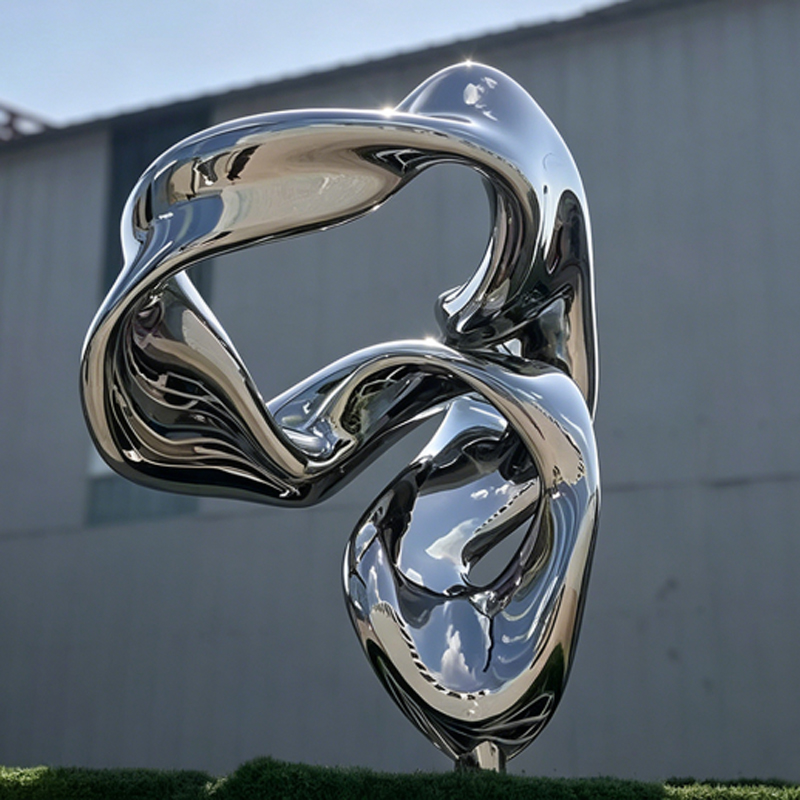
Twisted Line Abstract Stainless Steel Sculpture
The production of the Twisted Line Abstract Stainless Steel Sculpture involves several connected stages. Although the final work appears minimal, its quality depends on careful coordination from initial design through finishing and preparation for installation.
The process begins with defining the overall gesture of the sculpture. Designers and fabricators consider the height, width, center of gravity, curvature, twist, base relationship, and viewing angles. The proportions must be strong enough to remain legible from a distance while retaining elegance when viewed closely.
For a smaller 1.3-meter installation, the sculpture may be used as an intimate courtyard feature, entrance accent, or interior gallery object. At approximately 5.3 meters, the work becomes a larger landmark capable of anchoring a lawn, plaza, hotel forecourt, or corporate campus. The same basic concept can therefore serve different architectural scales.
Site conditions are also important during design development. A sculpture placed beside a pedestrian path may be viewed from close range and from many changing angles. A piece located in a broad lawn may be seen primarily from a distance. A hotel entrance may require a more controlled relationship with vehicle circulation and building signage. Adjusting the overall proportions helps ensure that the artwork is visually appropriate rather than simply oversized or undersized.
Once the dimensions and geometry are established, suitable stainless steel is prepared for forming. The material must be handled carefully to avoid unnecessary contamination, dents, or surface damage that could complicate later polishing.
The steel is then shaped along the intended flowing path. Depending on the specific design and production requirements, forming may involve controlled bending, twisting, shaping, and structural assembly. The objective is to create a stable three-dimensional form while preserving the smooth visual transition from one section to the next.
Forming a twisted line requires attention to how different forces affect the metal. Bending changes the direction of the material, while twisting changes its orientation around the central path. These actions must be coordinated so that the surface does not develop unintended buckling or abrupt changes in profile.
At this stage, the sculpture is evaluated not only for its general outline but also for its overall balance. The form must have a convincing relationship between its lower support area and upper extension. A carefully designed transition at the base helps the sculpture appear to rise naturally rather than simply being attached to a platform.
Where construction requires separate prepared sections or structural components, joining must be performed with attention to both strength and appearance. Welded areas and connection points require additional refinement so that they do not become visible interruptions in the continuous surface.
Heat from fabrication can affect stainless steel coloration and surface condition. Such areas must be treated and prepared before polishing. The goal is to produce a clean, stable, and visually consistent exterior while maintaining the structural integrity required for outdoor use.
Because the sculpture may reach several meters in height, engineering considerations are significant. Wind exposure, foundation conditions, anchoring, transportation, and site access all influence the final installation. Exact structural details depend on the selected size and location, so project-specific confirmation is appropriate before fabrication is completed.
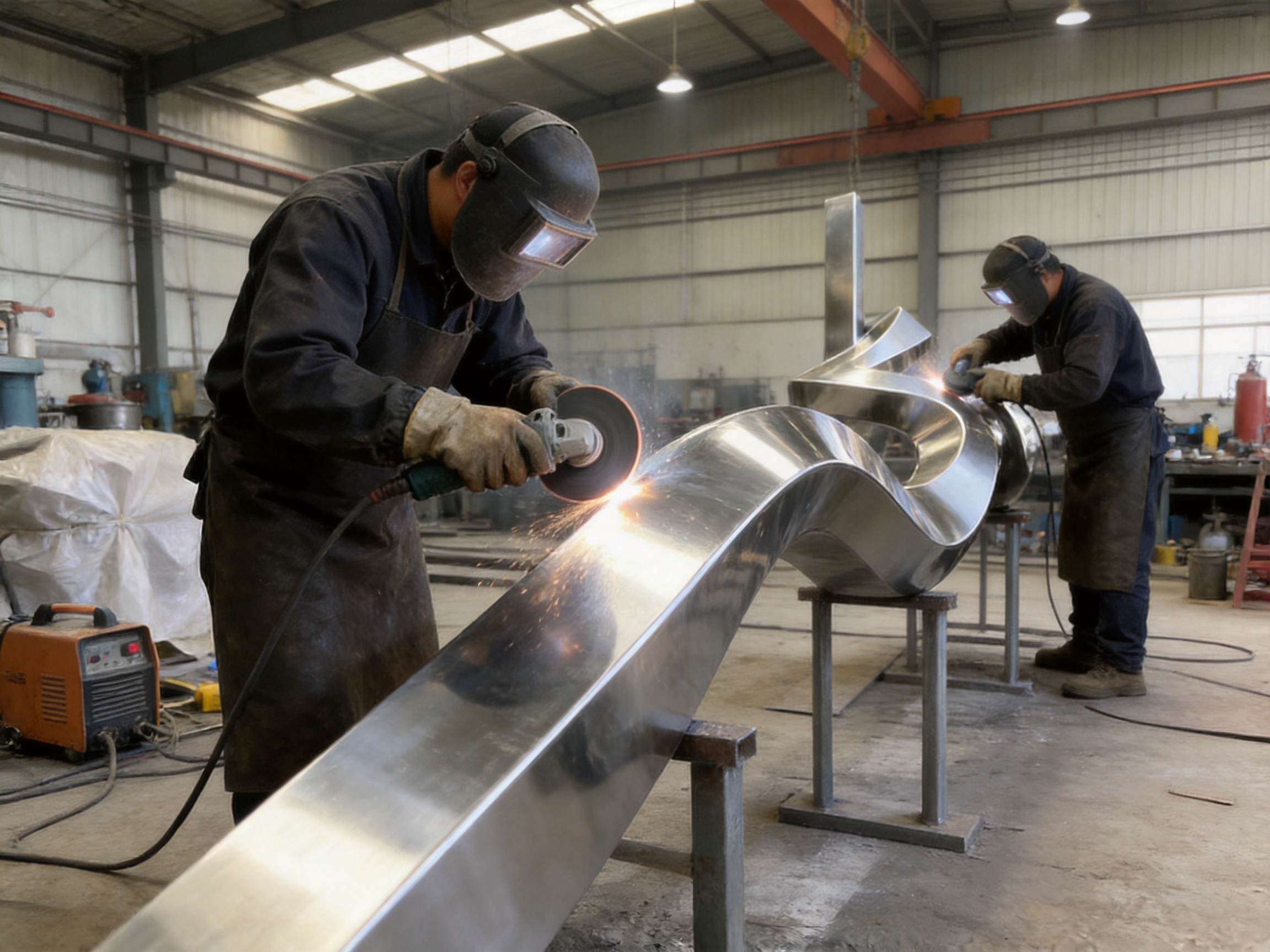
Hand-grinding is one of the most important stages in creating the edgeless character of the work. Fabrication marks, localized unevenness, and hard transitions must be carefully reduced. Skilled workers follow the intended curvature rather than treating each surface as an isolated flat area.
The objective is not simply to make the metal smooth to the touch. The surface must also produce a continuous visual flow under reflection. This requires repeated inspection from different viewpoints. A transition that feels acceptable under diffuse workshop lighting may become noticeable when exposed to bright sunlight or when reflected lines move across it.
Hand refinement is especially valuable around the points where the sculpture changes direction. These areas carry much of the visual energy of the design. If they are too tight, the form may appear mechanical; if they are too loose, the gesture may lose its sense of momentum. Consistent smoothing allows the curve to remain expressive without becoming aggressive or angular.
After the surface has been prepared, polishing progresses through increasingly fine stages. Each stage improves the uniformity of the surface and removes marks from the previous level. This work requires controlled technique because excessive pressure, uneven movement, or contamination can create visible inconsistencies.
The final 8K mirror finish is achieved only after the surface has been sufficiently refined. The result should show a clear, deep reflection across the form without obvious changes in texture. On a sculpture with multiple curves, polishing must follow the shape of the metal and preserve the continuity of the reflected image.
This manufacturing sequence is more labor-intensive than producing a design made from untreated plate, painted sections, or deliberately rough textures. However, it directly supports the artistic purpose of the piece. The uninterrupted reflection is not an incidental detail; it is a major part of the sculpture’s identity.
Before delivery, the sculpture can be examined for surface consistency, visible fabrication marks, overall proportions, and installation-related requirements. Protective packaging is important because a mirror-polished surface can be damaged by careless contact, abrasive materials, or exposure to construction debris.
Delivery planning should account for the sculpture’s dimensions, transportation route, unloading equipment, and access to the installation site. Larger versions may require coordinated handling and a prepared foundation. Providing site dimensions and access information early helps the manufacturer evaluate practical requirements before final production.
The Twisted Line Abstract Stainless Steel Sculpture offers several advantages when compared with conventional outdoor decorative sculptures. These advantages relate to material performance, visual flexibility, fabrication quality, and maintenance.
Many metal sculptures use geometric plates, repeated rings, assembled cubes, or segmented shapes. Such designs can be effective, but they often emphasize joints and individual components. The Twisted Line sculpture takes the opposite approach. Its value comes from making the eye perceive one flowing entity.
This uninterrupted visual flow gives it a refined appearance suitable for minimalist and contemporary projects. It can become a focal point without relying on excessive ornament, bright color, or complicated symbolism.
A painted or matte sculpture generally maintains a relatively stable appearance. The mirror-finished stainless steel surface changes according to its surroundings. This allows the work to connect with the site rather than appearing visually isolated from it.
The reflective surface can repeat the colors of landscaping, architecture, water, paving, and sky. As a result, the sculpture may feel integrated into its setting even when its form is highly distinctive. This is especially beneficial for projects where the artwork needs to complement existing design elements.
304 and 316 stainless steel are appropriate materials for many outdoor environments because of their corrosion resistance. Compared with ordinary untreated steel, stainless steel reduces the risk of rapid rust formation and helps preserve a clean architectural appearance.
Material selection should still consider the local environment. Coastal, industrial, or heavily polluted areas may require additional attention to grade selection and cleaning schedules. Nevertheless, the stainless steel construction provides a strong basis for long-term outdoor use.
The abstract form is visually distinctive but not tied to one particular cultural or commercial theme. It can therefore be used in a wide range of projects. The same design language can support a business headquarters, luxury hotel, public garden, residential development, gallery, or private estate.
This broad compatibility can simplify the selection process for architects, landscape designers, developers, and procurement teams seeking a modern sculpture that will remain relevant as surrounding décor changes.
Available sizes from 1.3 to 5.3 meters allow the sculpture to work across different spatial conditions. A smaller version may create an elegant focal point without overwhelming a compact site. A larger version can establish a visible landmark in a spacious plaza or lawn.
The possibility of adjusting exact proportions and overall height further improves project flexibility. A custom-sized sculpture can be designed to align with a façade, frame a view, fit within a planting zone, or maintain appropriate clearance from pedestrian circulation.
Corporate landscapes often require artwork that communicates innovation, progress, and confidence without becoming overly literal. The flowing stainless steel line can express movement and forward thinking while maintaining a professional, restrained appearance.
Placed near an entrance, the sculpture can provide a recognizable visual marker for visitors. Positioned on a lawn or beside a pedestrian route, it can organize an open space and create a destination within the landscape. Its reflective surface may also echo the glass and metal materials commonly used in contemporary corporate buildings.
Hotels and resorts frequently use sculpture to establish an atmosphere before guests enter the building. The mirror finish offers a polished, premium appearance, while the abstract form remains elegant rather than overly thematic.
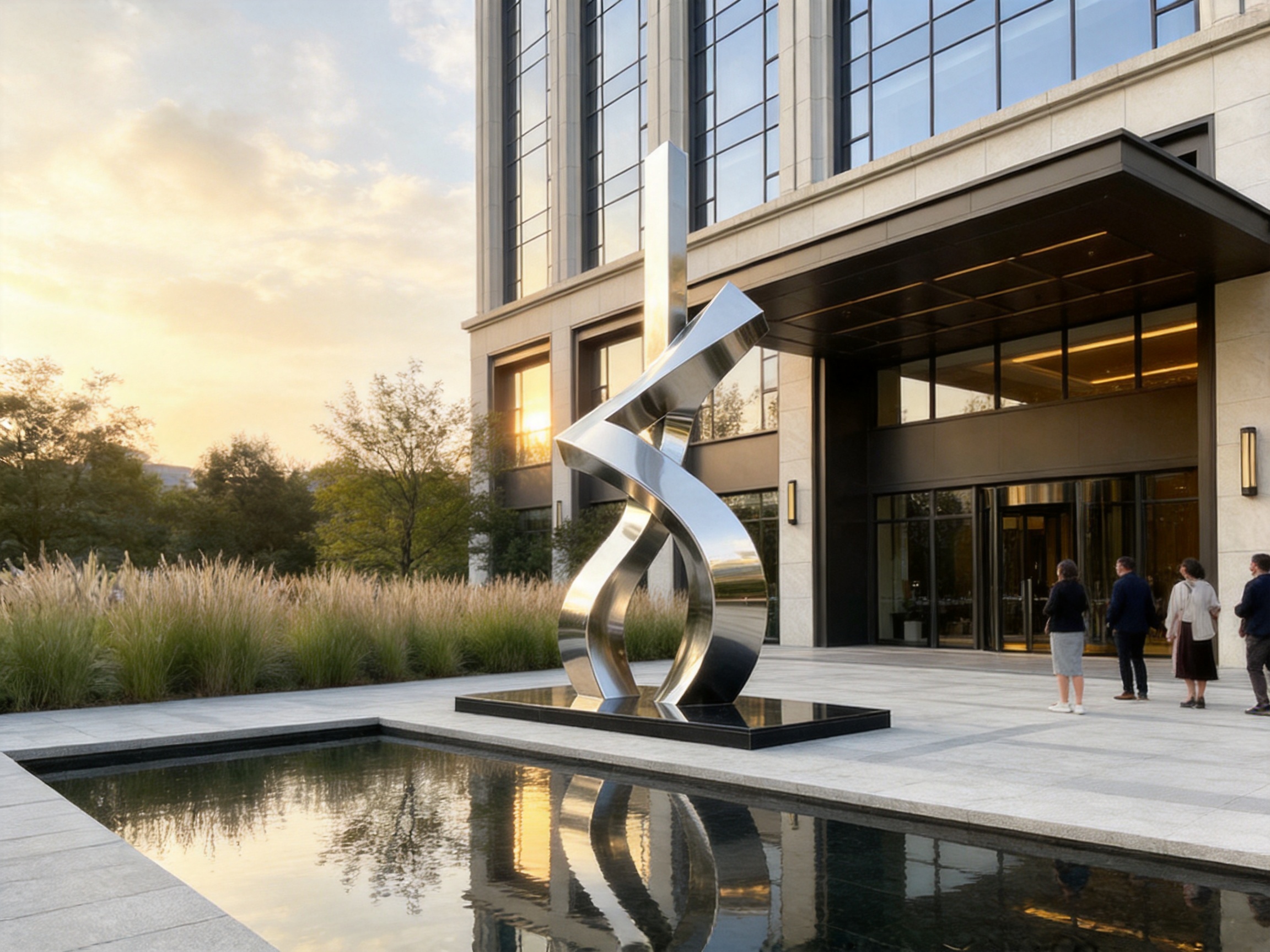
At a driveway entrance, the sculpture can function as a landmark visible to arriving guests. In a garden, the curves may contrast with clipped hedges, ornamental grasses, water, and stone. At night, carefully positioned landscape lighting can emphasize the silhouette and create changing highlights across the polished surface.
Real estate sales centers often use artwork to reinforce the perceived quality and identity of a development. A stainless steel sculpture can help create a memorable arrival experience and provide a strong background for photographs and promotional events.
Because the sculpture is abstract, it can remain compatible with different project phases and future landscape changes. It does not necessarily depend on a single architectural style, which can be helpful when a development includes several building types or a long construction timeline.
The work is also suitable for galleries and cultural spaces seeking a minimalist contemporary object. Its material and finish invite close observation, while its open-ended form encourages viewers to consider movement, balance, reflection, and spatial perception.
In a gallery setting, lighting can be used to control the intensity of reflections and emphasize the sculpture’s changing profile. In an outdoor cultural garden, the polished surface can create a dialogue with trees, pathways, stone walls, and changing daylight.
For private properties, a smaller version can become a refined focal point in a courtyard, entrance garden, terrace, or poolside setting. The sculpture’s clean surface can complement modern residences while also providing contrast in more traditional gardens.
Since the form does not require a large collection of decorative details, it can remain visually strong without creating a crowded appearance. This makes it suitable for spaces where the owner wants a distinctive artwork but prefers a calm and uncluttered design language.
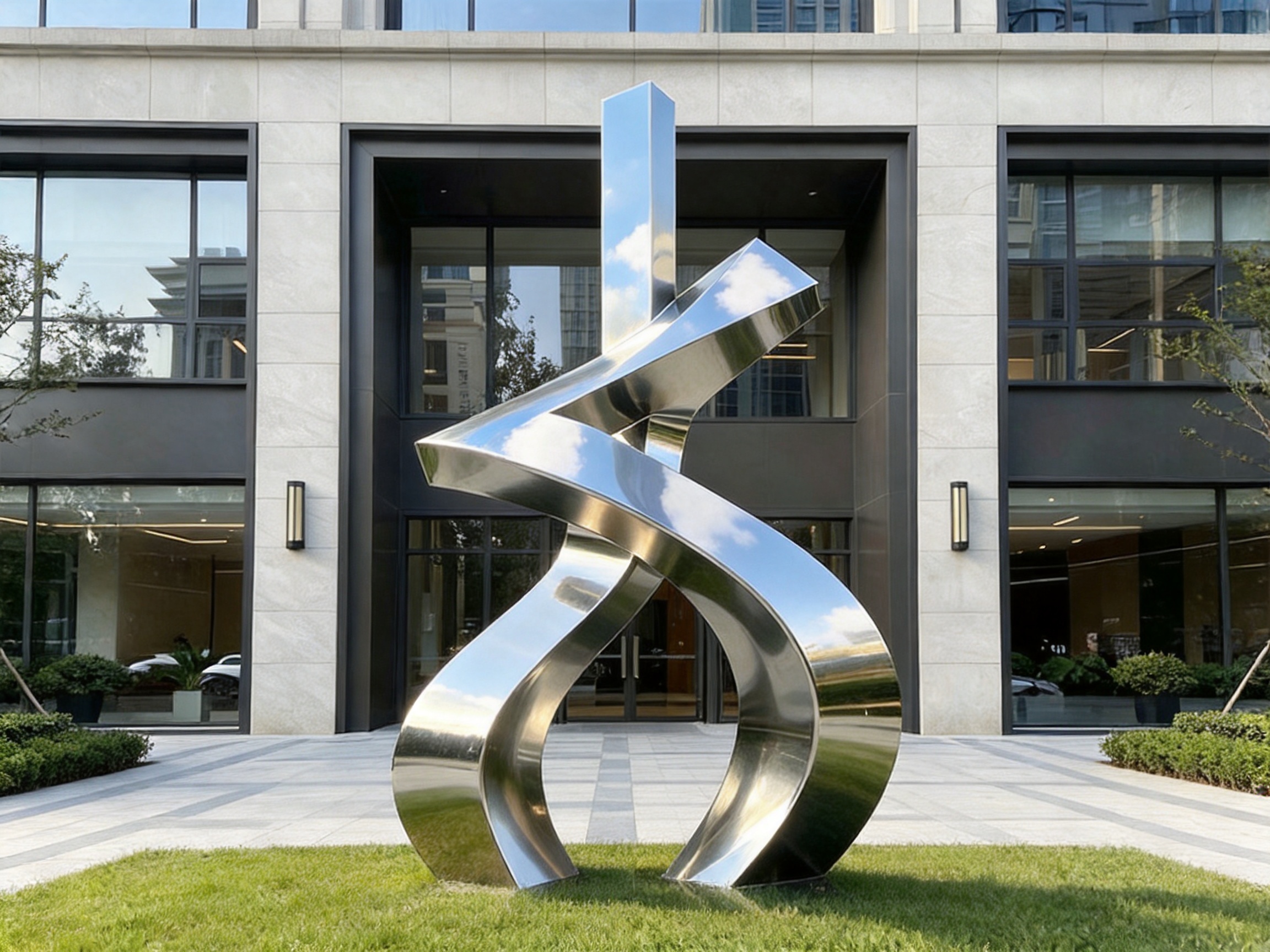
The best results depend on treating the sculpture as part of the overall site rather than as an isolated object. Before selecting the final size, planners should review viewing distances, pedestrian movement, building lines, landscaping, lighting, and maintenance access.
A 1.3-meter sculpture may be most effective where visitors can approach it closely. A taller version should be evaluated from the primary arrival route, nearby buildings, and surrounding open space. The artwork should be large enough to remain visible but proportionate enough to avoid overwhelming the architecture.
Because the form is slender and curved, its visual impact depends on silhouette as well as volume. A clear background, such as a lawn, wall, or open sky, may help define the outline. Dense planting can create an attractive setting, but excessive visual clutter may reduce the clarity of the continuous line.
Outdoor installation normally requires a stable foundation and appropriate anchoring. Exact requirements depend on height, weight, wind conditions, soil, and local construction standards. These details should be reviewed with the project’s engineer or installation contractor.
The base should be designed to support the sculpture without competing with it. A clean stone plinth, concealed anchoring system, or integrated paved area may be considered according to the architectural context. The connection between the artwork and the ground should appear secure and intentional.
Lighting can extend the sculpture’s presence into the evening. Soft directional lighting may reveal the outer silhouette, while grazing light can emphasize the changing reflections on the curves. Care should be taken to avoid glare that makes the artwork uncomfortable to view or causes excessive reflection toward drivers and nearby buildings.
Lighting should also account for the surroundings. Reflections may become more dramatic when the background is dark, while a lighter background may produce a softer and more integrated effect. The most suitable approach depends on the intended atmosphere and the sculpture’s location.
Although the form avoids sharp corners and hard angles, the installation must still be positioned responsibly. Clearances around pedestrian paths, service routes, driveways, and emergency access areas should be reviewed. The base and nearby paving should not create trip hazards or interfere with routine landscape maintenance.
One of the practical advantages of the sculpture’s smooth surface is that it does not contain recessed details or perforations that easily trap dirt, leaves, or moisture. Routine cleaning can therefore be relatively straightforward when carried out with suitable materials and methods.
Dust and light surface dirt can generally be removed with clean water and a soft, non-abrasive cloth or sponge. For heavier deposits, a mild cleaning solution appropriate for stainless steel may be used. The surface should then be rinsed thoroughly so that cleaning residue does not dry into marks.
Avoiding abrasive pads, rough brushes, harsh acids, and inappropriate chemical cleaners is important. These materials can scratch or stain a mirror finish. Cleaning tools should be free from particles that may drag across the surface, and separate tools should be used for stainless steel rather than equipment contaminated with carbon steel particles.
Outdoor sculptures should be inspected periodically, particularly after storms, construction work, or periods of heavy pollution. Salt deposits may require more frequent cleaning in coastal locations. Regular light maintenance is generally preferable to allowing contaminants to accumulate for long periods.
The frequency of cleaning depends on climate, exposure, nearby traffic, irrigation systems, trees, and the desired appearance. A sculpture beside a busy road may need more attention than one installed in a protected private garden. Proper maintenance helps preserve the visual depth and reflective quality that define the piece.
The sculpture is available in a range of heights and can be adjusted in overall proportions to suit the specific footprint and sightlines of an installation site. Customization may involve height, width, curvature, orientation, base treatment, or related project details, subject to technical review.
Customization is valuable because sculpture is rarely viewed in isolation. The artwork may need to align with a building entrance, correspond to a landscape axis, remain visible from a particular road, or fit beneath a canopy or within a courtyard. A standard object may not always achieve the correct relationship with its surroundings.
Project teams should provide information about the proposed location, available dimensions, preferred viewing directions, local climate, foundation conditions, and delivery access. Photographs, site plans, and approximate sightline information can help the manufacturer evaluate the most appropriate configuration.
The manufacturer’s experience in stainless steel sculpture production is especially relevant when customization involves continuous curves and polished surfaces. A change in height is not always a simple matter of scaling the design mechanically. The proportions of the curve, twist, base, and upper extension may need to be adjusted so that the sculpture remains visually balanced at the new dimension.
Similarly, a change in finish or material grade may affect the overall appearance and maintenance requirements. Discussing these details before production helps keep the final result consistent with the project’s aesthetic and technical objectives.
Jiangsu Xinyesheng Sculpture Co., Ltd. is presented as the manufacturer of this stainless steel artwork and operates from Jiangyin City, Jiangsu Province, China. The supplied product information identifies the company as a producer of bronze, stainless steel, marble, fiberglass, and weathering steel sculptures.
For this product, the company’s principal strength is its ability to combine large-scale metal forming with detailed surface finishing. The sculpture requires more than general metal fabrication. It requires an understanding of how to shape a continuous abstract form, how to control transitions, and how to prepare stainless steel for an 8K mirror finish.
The company’s production capabilities are reflected in the sculpture’s material options, size range, and customization potential. Providing both 304 and 316 stainless steel allows projects to consider different environmental conditions. Offering sizes from approximately 1.3 to 5.3 meters indicates flexibility across intimate and monumental applications.
Another important strength is the use of hand-grinding and polishing. These labor-intensive operations are essential for a design in which the surface must appear uninterrupted. The ability to refine curves manually is particularly important where machine processes alone may not deliver the desired visual continuity.
The company’s broader sculpture range, including bronze, marble, fiberglass, and weathering steel, also suggests experience with different materials, finishes, and artistic requirements. While each material demands its own technical approach, cross-material sculpture production can support a wider understanding of scale, form, surface, outdoor durability, and installation.
For buyers, architects, developers, and landscape designers, the practical benefit is the possibility of discussing a project directly with a manufacturer familiar with custom sculpture requirements. This can help coordinate design adjustments, material selection, dimensions, finish expectations, and delivery planning in one production relationship.
| Specification | Details |
|---|---|
| Product type | Abstract decorative stainless steel sculpture |
| Design character | Continuous twisted line with smooth, flowing curves |
| Primary materials | 304 or 316 stainless steel |
| Surface finish | 8K mirror finish |
| Approximate size range | 1.3 meters to 5.3 meters |
| Price range | Approximately $1,740 to $5,260 |
| Outdoor suitability | Suitable for many outdoor architectural and landscape environments |
| Customization | Exact proportions and overall height can be adjusted for site requirements |
| Recommended applications | Corporate parks, hotel grounds, sales centers, galleries, plazas, courtyards, and landscaped lawns |
| Maintenance profile | Routine wiping and suitable stainless steel cleaning methods can preserve the reflective surface |
Contemporary architecture often seeks a balance between simplicity and identity. A building may use a restrained palette of glass, steel, stone, and concrete, yet still require a distinctive feature to make the site memorable. This sculpture provides that feature through proportion, movement, and reflection rather than through excessive decoration.
Its abstract nature supports multiple design narratives. In a technology campus, the flowing line may suggest innovation and connectivity. In a hotel setting, it may convey elegance and movement. In a public garden, it can introduce an artificial but harmonious contrast to organic planting. In a private residence, it may serve as a personal expression of modern taste.
The reflective surface also supports the idea of changing experience. The sculpture is not visually fixed in the same way as a solid painted object. Its appearance evolves with the weather, time of day, surrounding activity, and viewer position. This gives it a dynamic quality without mechanical movement or electronic lighting.
Its minimalism can also contribute to long-term design relevance. Trends in color, furniture, signage, and planting may change, but a well-proportioned abstract form in stainless steel can remain compatible with future updates. This is an important consideration for commercial properties and developments expected to operate for many years.
When evaluating this sculpture for a project, buyers should begin by identifying the intended location and primary viewing conditions. The best size depends on the available space, the distance from the main audience, and the role the sculpture is expected to play.
Material grade should be considered in relation to climate and exposure. 304 stainless steel may be appropriate for many general outdoor settings, while 316 stainless steel may be preferable for more aggressive environments. The manufacturer or project engineer can help determine the most suitable option.
Finish expectations should also be discussed clearly. An 8K mirror finish is highly reflective and requires careful handling during transport, installation, and maintenance. Protective packaging, clean installation procedures, and suitable post-installation care are important to preserve the surface.
Buyers should request confirmation of final dimensions, approximate weight, foundation needs, anchoring arrangements, packaging, shipping method, and installation responsibilities. If the project requires custom proportions, these details should be agreed upon before fabrication begins.
It is also useful to consider how the sculpture will be viewed in different seasons. Deciduous planting, snow, rain, low winter sunlight, and nighttime lighting can all affect its appearance. A site that looks ideal in a digital rendering may produce a different visual effect in actual conditions, so physical context and long-term maintenance should be considered during planning.
The sculpture is defined by a single continuous flowing gesture rather than a figurative subject or collection of angular components. It avoids sharp corners and hard angles from base to tip, creating a smooth visual path that emphasizes motion and uninterrupted reflection.
Yes. It is made from 304 or 316 stainless steel, materials commonly used in outdoor architectural and industrial applications. The most suitable grade depends on the local environment, especially in coastal or highly polluted areas.
An 8K mirror finish is a highly refined reflective surface produced through progressive polishing. It allows the stainless steel to reflect surrounding light, colors, and shapes. Because it is very reflective, it requires careful surface preparation and non-abrasive maintenance.
Hand-grinding helps smooth fabrication marks and refine transitions along the curved form. It is particularly important where the sculpture must appear edgeless and where reflected lines need to remain visually continuous.
Yes. The listed size range is approximately 1.3 to 5.3 meters, and exact height and proportions can be adjusted to suit a specific site, viewing distance, footprint, or architectural composition.
Yes. Both grades are available, and material selection can be discussed according to climate, atmospheric exposure, proximity to the sea, maintenance expectations, and project specifications.
Potential applications include corporate park lawns, hotel grounds, sales-center show areas, art galleries, public plazas, private courtyards, residential landscapes, commercial developments, and landscaped entrances.
Light dirt can generally be removed with clean water and a soft, non-abrasive cloth or sponge. Mild stainless steel cleaning products may be used when necessary. Abrasive pads, rough brushes, harsh chemicals, and contaminated tools should be avoided.
Outdoor installation requires a stable foundation and suitable anchoring, especially for taller versions. Exact requirements depend on the sculpture’s dimensions, weight, wind conditions, soil, and local construction standards. These details should be confirmed for each project.
The design can also be considered for large interior atriums, galleries, reception spaces, and commercial interiors where the height and access conditions are suitable. Indoor projects may have different requirements for transport, anchoring, surface protection, and lighting.
The supplied price range is approximately $1,740 to $5,260. Final pricing may vary according to size, material grade, custom proportions, finishing requirements, packaging, shipping, and installation arrangements.
A precise lead time depends on the selected dimensions, customization, production schedule, finishing requirements, and delivery destination. Since the sculpture requires forming, hand-grinding, polishing, inspection, and protective preparation, the schedule should be confirmed before an order is placed.
Its form is visually strong but not overly ornate. The continuous curve adds movement, while the mirror finish reflects the surrounding landscape and architecture. This allows the artwork to create a focal point without competing with the overall design.
The manufacturer can discuss size, proportions, material grade, finish, and site-related requirements. Providing project drawings, photographs, dimensions, and installation information can help establish a suitable configuration before fabrication.
The Twisted Line Abstract Stainless Steel Sculpture demonstrates how a restrained design can require advanced craftsmanship. Its flowing silhouette appears simple, but achieving a truly continuous, edgeless curve in large stainless steel demands careful forming, structural control, hand-grinding, progressive polishing, and detailed inspection.
The use of 304 or 316 stainless steel supports outdoor durability, while the 8K mirror finish creates a changing visual relationship with the surrounding environment. Reflections of sky, architecture, planting, and light allow the sculpture to remain visually active throughout the day. Its abstract character gives viewers room for personal interpretation, making it suitable for a wide variety of cultural, commercial, hospitality, and residential settings.
Compared with conventional decorative sculptures that may rely on flat panels, sharp geometry, painted surfaces, or numerous visible components, this piece offers a more unified and refined visual language. Its smooth form, scalable dimensions, custom potential, weather-resistant construction, and relatively straightforward maintenance make it a practical choice for contemporary landscape and architectural projects.
Jiangsu Xinyesheng Sculpture Co., Ltd. contributes to the product through its experience in metal sculpture production, stainless steel forming, surface refinement, and custom fabrication. The company’s ability to work with multiple sculpture materials and provide project-specific size and material options supports the needs of architects, landscape designers, developers, collectors, and procurement teams.
Whether installed as a compact courtyard accent or a large landmark on a corporate lawn, the sculpture offers the same central experience: a continuous line of polished metal that appears to gather movement, reflect its surroundings, and carry the eye forward.
1. International Stainless Steel Forum. Stainless Steel in Architecture, Building, and Construction.
2. ASTM International. Standard Specifications and Practices for Stainless Steel Products and Finishes.
3. American Institute of Steel Construction. Structural Considerations for Exterior Steel Installations.
4. European Committee for Standardization. Stainless Steel Surface Finishes and Architectural Applications.
5. Architectural Metalwork Practice. Principles of Surface Preparation, Grinding, and Polishing for Stainless Steel.
6. Landscape Design Association Publications. Integrating Public Art with Contemporary Landscape Architecture.
7. Conservation and Maintenance Guidance for Outdoor Metal Sculpture. General Principles for Cleaning and Surface Protection.
8. Product information supplied for the Twisted Line Abstract Stainless Steel Sculpture.
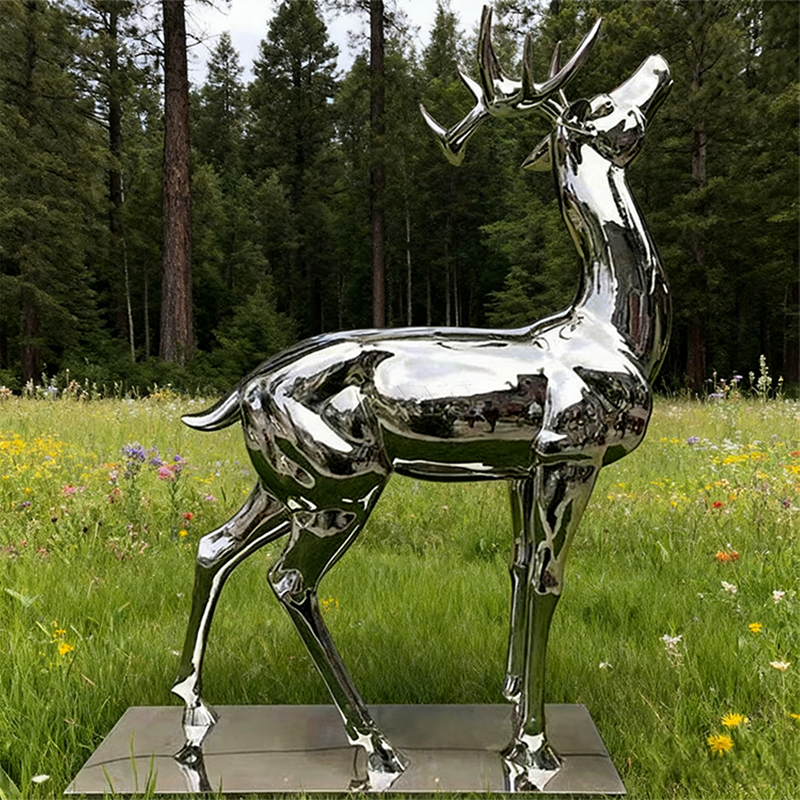 Mirror-Polished Stainless Steel Reindeer Sculpture
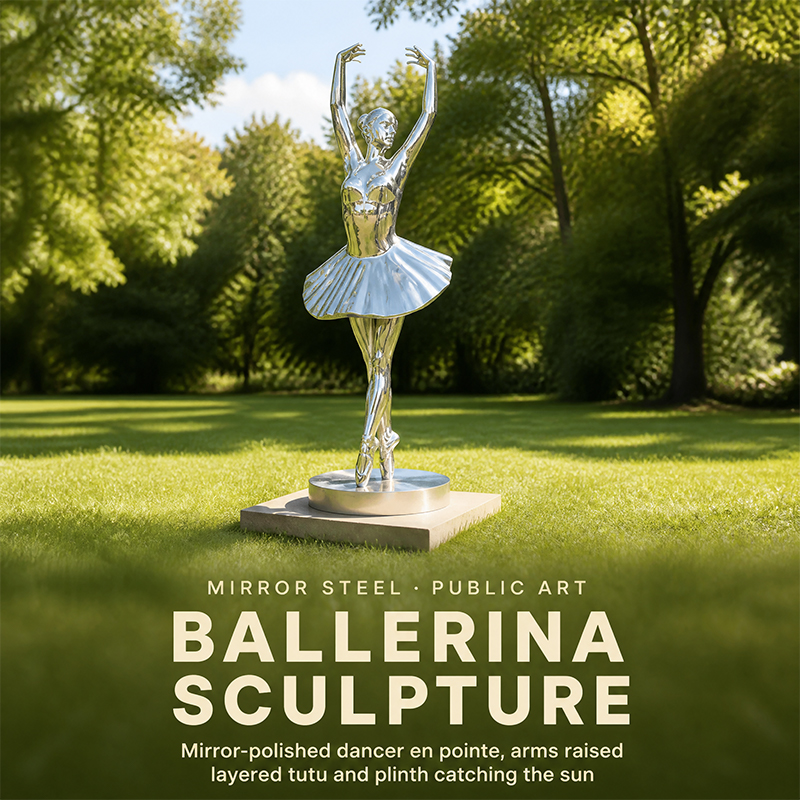 Life-Size Custom Mirror Polished Dancing Woman Stainless Steel Sculpture
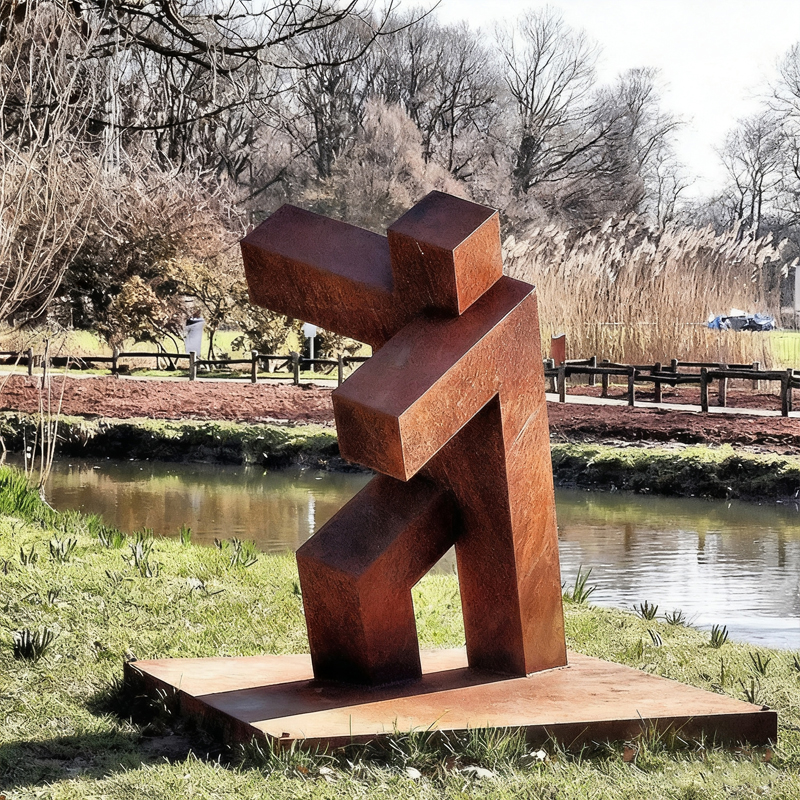 Abstract Weathering Steel Decorative Sculpture
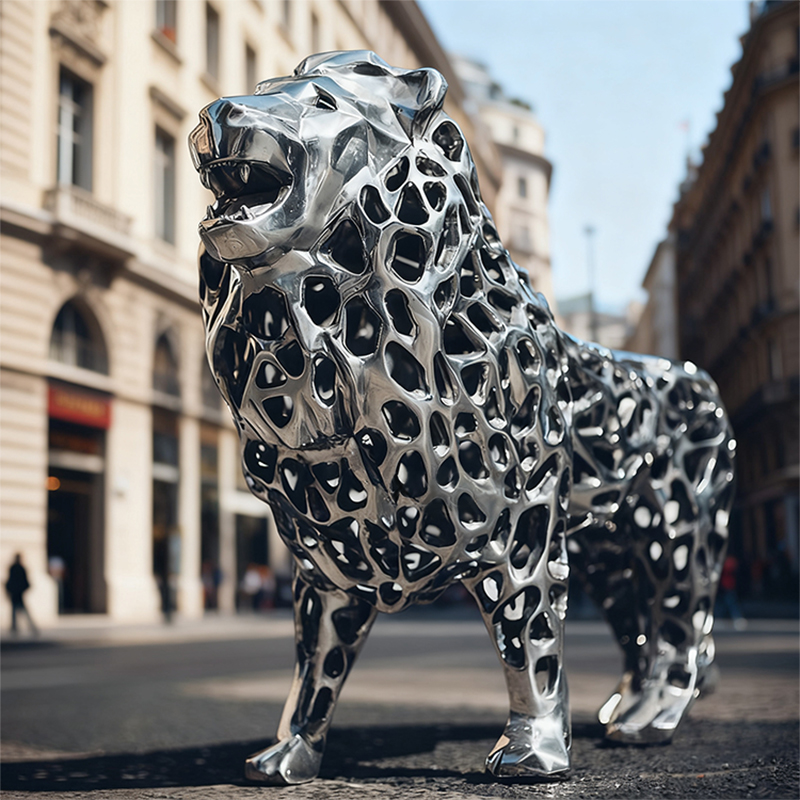 Stainless Steel Cheetah Sculpture
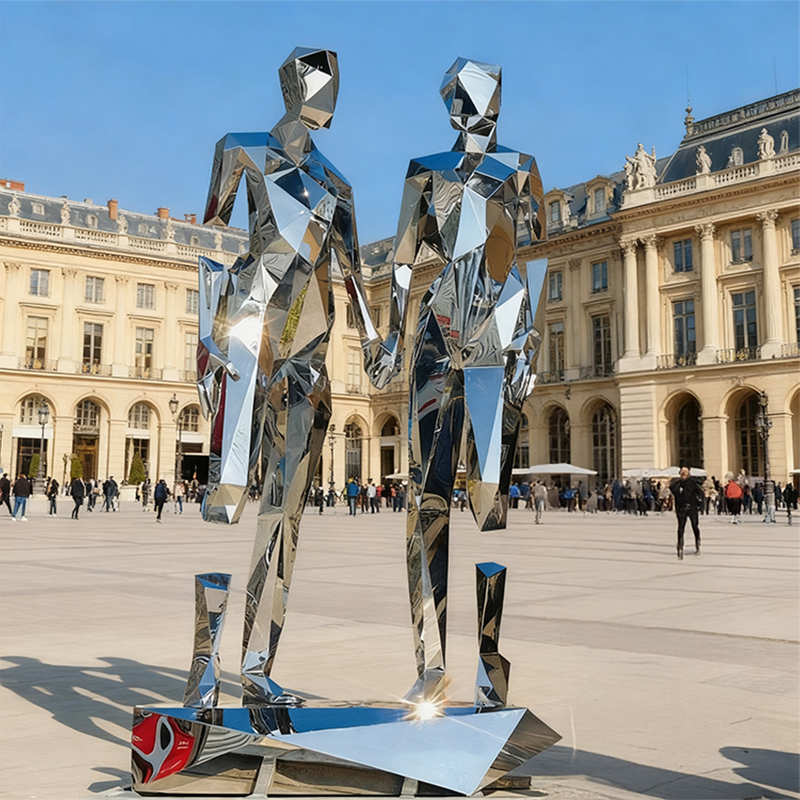 Geometric Faceted Mirror Stainless Steel Double Figure Sculpture
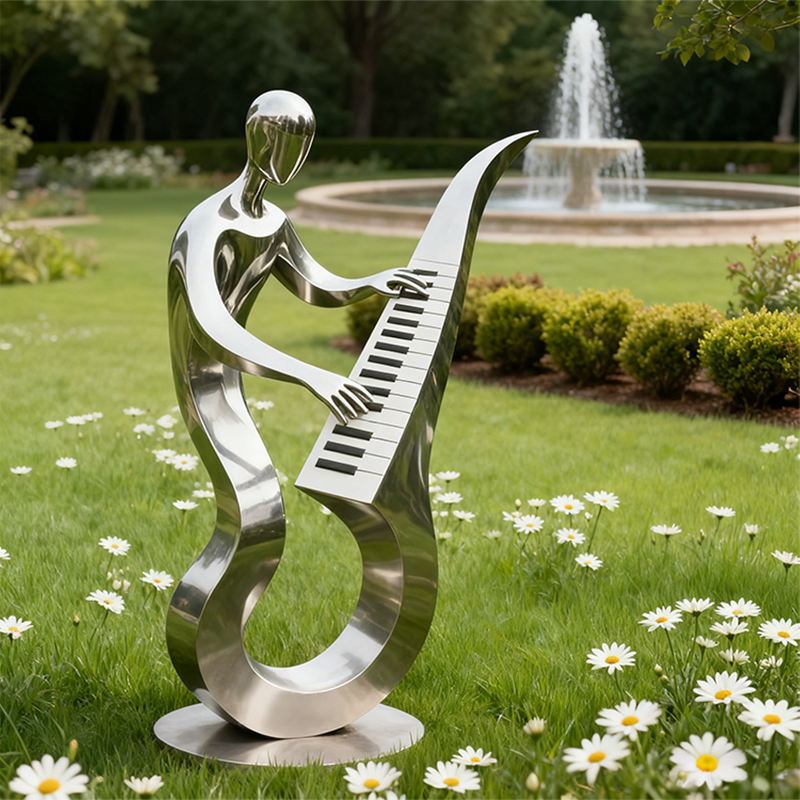 Stainless Steel Piano Player Sculpture



Daniel H.

Amanda R.

Robert B.

Jennifer S.

James W.

Barry G.

Michael T.

Emily K.

David L.

Sarah M.


Mikey XV

Jagxue

 English
 Español
 عربى
 Français
 italiano
 Deutsch