In contemporary public art, a successful landmark sculpture must do more than decorate a site. It must communicate identity, confidence, stability, and long-term value within seconds. The realistic eagle on globe stainless steel sculpture is designed precisely for that purpose. With a lifelike eagle spreading its wings above an engraved globe, the work combines natural power with international symbolism, making it especially suitable for corporate headquarters, financial institutions, industrial parks, civic plazas, and high-profile business entrances.
This sculpture belongs to the category of stainless steel animal sculptures, yet it moves beyond ordinary animal representation. Instead of presenting a simplified or purely decorative bird form, it emphasizes anatomical realism, layered feather detail, a commanding posture, and a precisely engraved world-map globe. The result is a statement piece that can serve as a flagship visual identity for organizations that want to project ambition, global reach, strength, and enduring success.
Made from high-quality 304 or 316 stainless steel and finished with an 8K mirror polish, the sculpture is engineered for outdoor durability as well as refined visual impact. Its scale can range from approximately 1.8 meters to 7 meters, allowing it to fit both compact entrance areas and monumental open plazas. At larger dimensions, it becomes a true architectural landmark; at smaller dimensions, it remains a powerful executive, institutional, or commemorative installation.
Realistic Eagle on Globe Stainless Steel Sculpture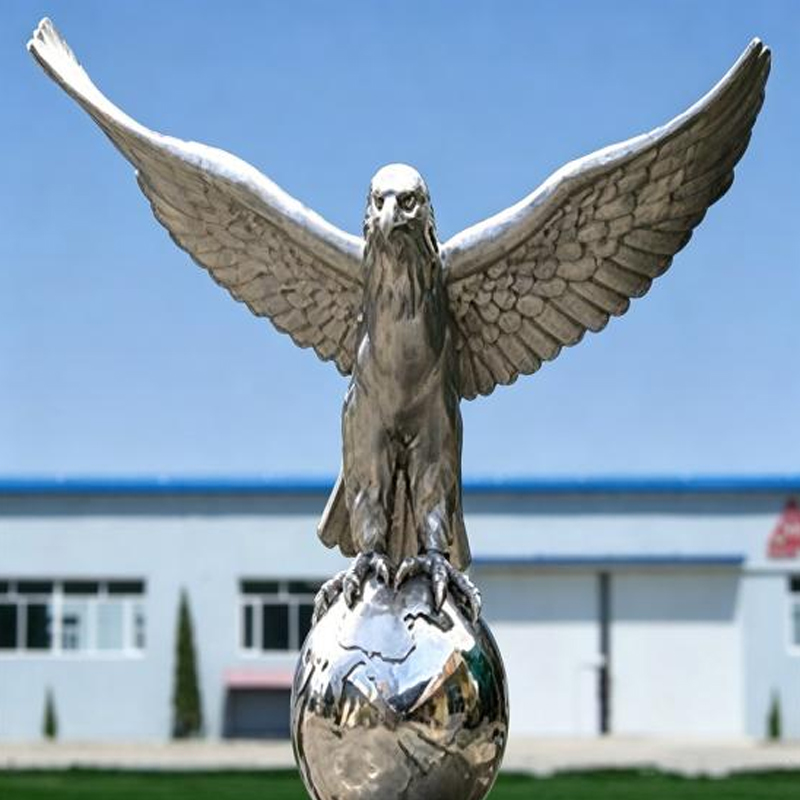
Content
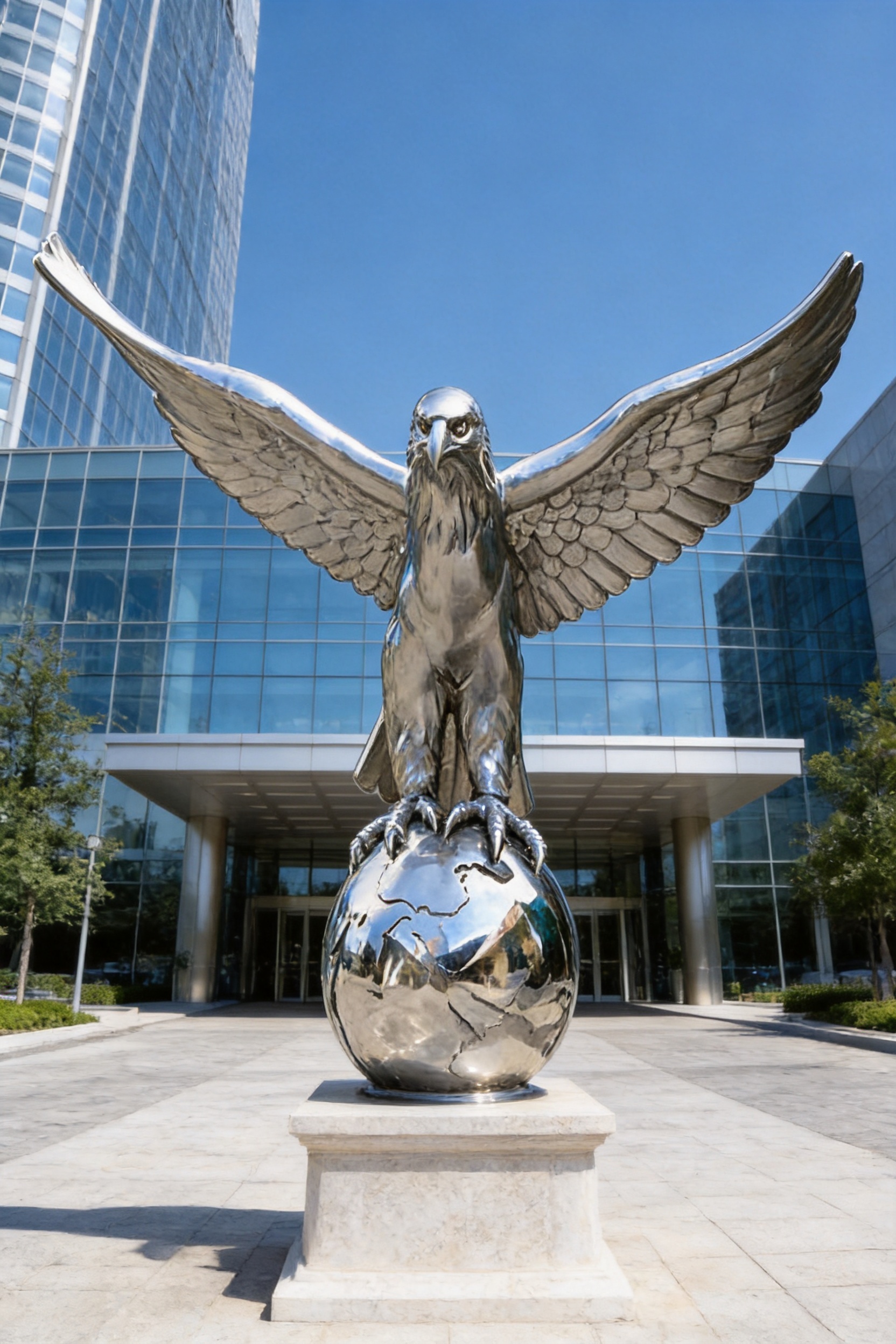
The central visual theme of the sculpture is direct, memorable, and universally understandable: a powerful eagle standing above the globe. The eagle is shown with wings fully extended, creating a dramatic silhouette that suggests flight, expansion, vision, and authority. Its talons grip the globe firmly, reinforcing the idea of command, confidence, and global presence.
The eagle has long been associated with leadership, courage, freedom, focus, and strategic vision. When combined with a globe, the symbolism becomes more specific. The artwork no longer speaks only of strength; it also speaks of international ambition, global commerce, cross-border cooperation, and a forward-looking worldview. For organizations operating across multiple markets, this symbolic combination can be far more relevant than a generic abstract sculpture or a standard animal statue.
The globe beneath the eagle is not a plain sphere. It is engraved with world-map contours, giving the base of the composition both visual complexity and conceptual meaning. Continents and major geographic features are carefully arranged across the curved spherical surface, requiring a deliberate mapping process rather than random surface decoration. This detail allows viewers to immediately recognize the global theme and connect it to the mission or identity of the installation site.
Unlike many eagle sculptures that rely on rough outlines or stylized panels, this piece is designed with realism at its core. Individual feathers are shaped, layered, and polished to create a lifelike surface. The sculpture retains the drama of monumental metal art while preserving the natural characteristics of the eagle. This balance between realism and grandeur is one of its defining strengths.
Realistic sculpture requires a higher level of craftsmanship than simple geometric or abstract representation. In an abstract eagle sculpture, the artist may use broad planes, faceted surfaces, or symbolic lines to imply the bird’s form. Those methods can be visually striking, but they do not deliver the same biological intensity as a highly realistic interpretation.
In this sculpture, realism is achieved through careful attention to feather layering, wing structure, body proportion, head posture, talon form, and surface rhythm. Each major area of the eagle must appear coherent from a distance while still rewarding close inspection. The viewer should first feel the impact of the extended wings and elevated stance, then notice the individual feather rows, carved transitions, and polished details.
This level of realism creates emotional immediacy. A viewer does not need specialized knowledge of sculpture to understand the image. The eagle appears strong, alert, and alive. Its wings generate upward movement, while its grip on the globe suggests control and purpose. For a business entrance or public plaza, that instant readability is extremely valuable.
Realism also helps the sculpture remain timeless. Highly trend-driven styles can become dated as architectural tastes change. A well-made realistic eagle, however, draws from enduring natural symbolism. Its relevance does not depend on a short-lived design fashion. This makes it especially appropriate for long-term installations intended to represent institutional stability.
The sculpture is produced in 304 or 316 stainless steel, two materials widely used for outdoor architectural and sculptural applications. Stainless steel is selected because it provides corrosion resistance, structural strength, clean reflectivity, and a modern premium appearance. For a large outdoor sculpture, material selection directly affects service life, maintenance requirements, and visual performance.
304 stainless steel is a reliable and widely used grade suitable for many outdoor environments. It offers good resistance to atmospheric corrosion and can be polished to a bright mirror finish. For standard urban, commercial, and inland environments, 304 stainless steel provides a strong balance of performance and cost efficiency.
316 stainless steel contains molybdenum, which improves resistance to chloride corrosion. This makes it especially valuable for coastal areas, humid environments, marine-influenced climates, and locations where de-icing salts or industrial pollutants may be present. For clients seeking maximum long-term corrosion resistance, 316 stainless steel is often the preferred option.
The availability of both material options gives the sculpture practical flexibility. A project located in an inland corporate campus may choose 304 stainless steel, while a coastal hotel, port authority, financial district, or seaside public plaza may select 316 stainless steel for enhanced environmental durability. This material adaptability is an advantage over sculptures made from lower-grade metals, painted steel, resin, or thin decorative sheet materials.
The 8K mirror polish is one of the sculpture’s most visible premium features. An 8K polish creates an exceptionally smooth, reflective surface that interacts dynamically with its surroundings. Sky, architecture, trees, lighting, and pedestrian movement all become part of the sculpture’s changing appearance.
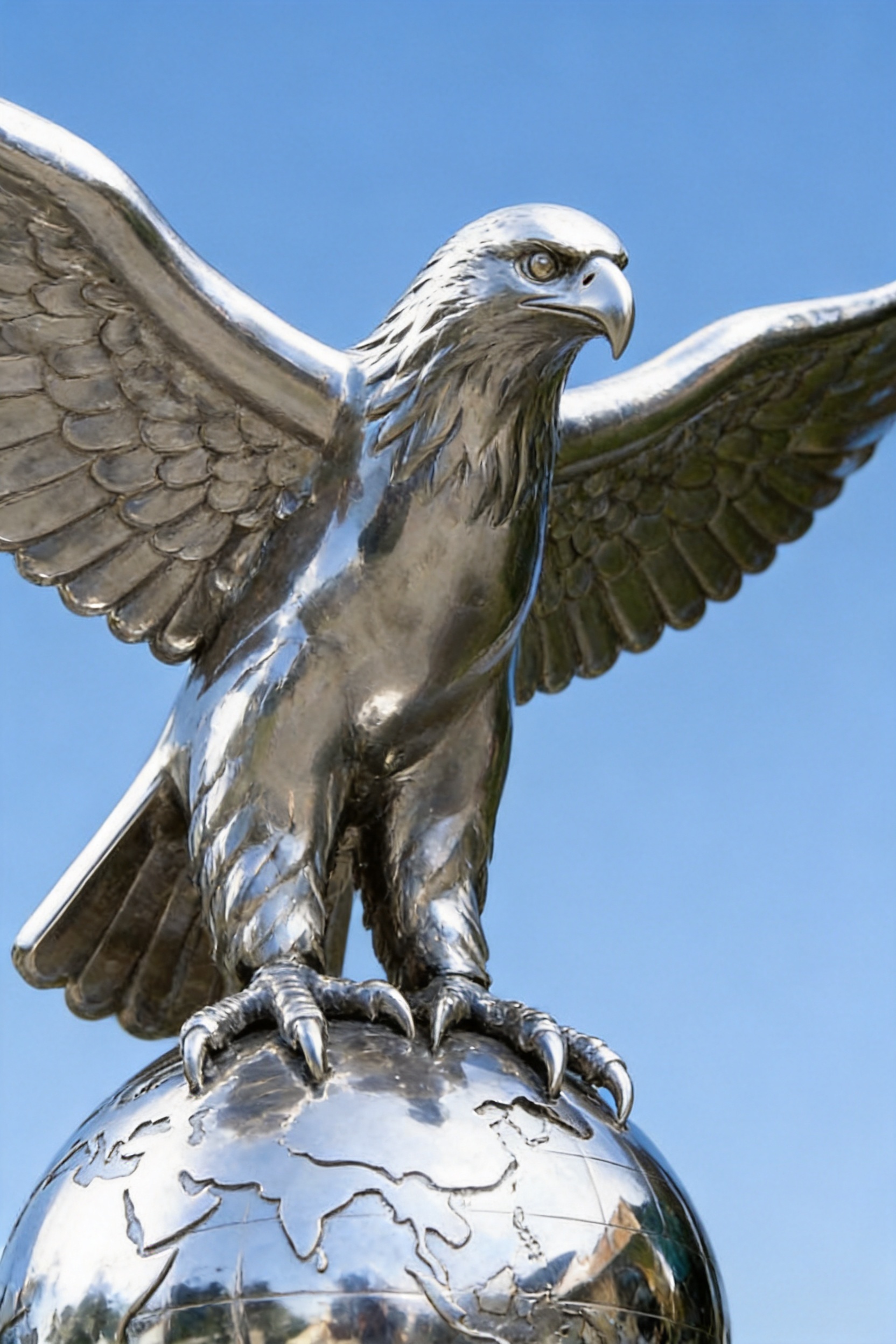
On a realistic eagle form, the mirror finish offers a distinctive contrast. The sculpture is not merely shiny; it reveals the fine ridges and layered surfaces of the feather detailing. Light catches the edges of individual feather forms, creating depth and movement across the wings. This makes the sculpture visually active in daylight and especially dramatic under night lighting.
A high-grade mirror polish also communicates manufacturing precision. Poorly finished stainless steel can show distortion, uneven grinding marks, visible weld seams, or dull patches. A true high-quality polish requires repeated sanding, grinding, buffing, and inspection. The surface must be refined progressively until the metal achieves a clean reflective finish without obvious imperfections.
For luxury commercial spaces, corporate headquarters, and financial institutions, surface quality matters. Visitors often judge an organization’s identity through its physical environment. A highly polished stainless steel sculpture suggests discipline, investment, and attention to detail. In this sense, the finish is not only aesthetic; it becomes part of the organization’s image.
The production of a realistic stainless steel eagle on globe sculpture involves multiple technical stages. It is not simply cut, welded, and polished. The process requires digital planning, artistic modeling, structural engineering, metal shaping, welding, grinding, polishing, inspection, packaging, and installation coordination.
The first stage is concept confirmation. The client may choose the sculpture size, installation location, stainless steel grade, surface finish, base style, and any requested customization for the globe engraving. Because the sculpture may range from 1.8 meters to 7 meters, the proportions and structural requirements must be adjusted according to the final scale.
After the design is confirmed, digital modeling or technical drawings are prepared. For a sculpture with realistic feather detail, digital reference is especially useful. The wing shape, body posture, feather flow, globe diameter, support points, and internal framework can be studied before fabrication begins. This reduces risk and ensures that the final artwork remains balanced from all viewing angles.
The internal structure is then engineered. A large stainless steel sculpture must withstand its own weight, wind loads, transportation forces, and long-term outdoor exposure. Internal frames, reinforcement points, base connection plates, and lifting arrangements must be designed carefully. This is particularly important for an eagle with wide wings, because extended forms can place significant stress on support areas.
Next comes metal forming. Stainless steel sheets or components are shaped to follow the complex contours of the eagle and globe. For realistic feathers, the work requires more than basic bending. Each feather area must be formed with dimensional variation, layered edges, and proper directional flow. Skilled metalworkers use forming, forging, hammering, cutting, and welding techniques to create the intended surface.
Welding is a critical stage. The sculpture’s many parts must be joined securely while preserving the visual continuity of the form. Welds must be strong enough for structural safety but refined enough to disappear into the finished surface. After welding, the seams are ground and blended so the sculpture appears continuous and clean.
The globe engraving requires a separate technical approach. The world map must be adapted to the sphere. Continents and geographic features must remain recognizable even when projected onto a curved surface. Digital mapping files can be used to guide engraving, and the design may be adjusted to highlight a particular region, headquarters location, trade route, or strategic market. This customization gives the sculpture added relevance for corporate and institutional clients.
Polishing follows fabrication and engraving. The 8K mirror polish is achieved through repeated surface refinement. Grinding removes weld marks and surface irregularities. Finer abrasives progressively smooth the metal. Buffing compounds then bring the stainless steel to a reflective finish. Final inspection checks for distortion, scratches, visible seams, and consistency across the entire sculpture.
The completed sculpture is then prepared for transportation and installation. For large-scale works, packaging must protect the mirror surface from abrasion and impact. The installation system may include anchor bolts, embedded plates, stone bases, steel foundations, or site-specific structural supports. Proper coordination between manufacturer, installer, architect, and project owner helps ensure safe and accurate placement.
A sculpture of this complexity requires more than basic metalworking capability. It requires a manufacturer with experience in large-scale stainless steel sculpture, realistic animal modeling, mirror polishing, structural fabrication, and project customization. The strength of the manufacturing team is reflected in the final artwork’s durability, accuracy, and finish quality.
One key manufacturing strength is the ability to handle both artistic and engineering requirements. A large eagle sculpture must look graceful and powerful, but it must also remain structurally stable. The extended wings, elevated posture, and globe support point must be carefully calculated. A capable workshop understands how to create expressive forms without compromising safety.
Another strength is experience with stainless steel surface treatment. Mirror polishing is unforgiving. Any uneven welding, poor grinding, or distorted sheet shaping can become obvious once the surface becomes reflective. Advanced polishing teams know how to refine complex curves, feather layers, globe engravings, and tight transitions without destroying the sculptural detail.
Customization capability is also important. Many clients do not want a completely generic landmark. They may want a specific size, a particular base height, a highlighted geographic region, a customized map engraving, or installation integration with lighting and landscaping. A strong manufacturer can adapt the standard concept to match the site’s identity while preserving the sculpture’s overall symbolic power.
Production scale is another advantage. With sizes available from 1.8 meters to 7 meters, the sculpture can serve different project levels. Smaller versions may suit executive office entrances, indoor lobbies, resort courtyards, or commemorative areas. Larger versions can anchor plazas, industrial park gates, city landmarks, and corporate headquarters. The ability to produce both modest and monumental versions reflects flexible fabrication capacity.
Finally, project communication matters. Large sculpture projects often involve architects, developers, designers, business owners, contractors, and logistics providers. A manufacturer experienced in international sculpture supply can help clarify material choices, dimensions, packaging, shipping, base preparation, and maintenance recommendations. This reduces uncertainty and improves project execution.
The realistic eagle on globe stainless steel sculpture has several advantages over competing products in the public art and commercial landmark market. These advantages relate to material, craftsmanship, symbolism, customization, durability, and site impact.
Compared with bronze sculptures, stainless steel offers a more contemporary visual language. Bronze has traditional warmth and historical character, but stainless steel provides a clean, modern, reflective appearance that pairs well with glass towers, corporate parks, financial buildings, and contemporary architecture. The mirror surface can make the sculpture feel integrated with its surroundings, reflecting the sky and nearby structures.
Compared with marble sculptures, stainless steel provides higher resistance to many outdoor environmental stresses. Marble can be elegant, but it is vulnerable to staining, weathering, acid rain, surface erosion, and impact damage. Stainless steel is generally easier to maintain in busy commercial settings and can support more dynamic wing shapes without the same risk of stone fracture.
Compared with fiberglass sculptures, stainless steel offers superior prestige and longevity. Fiberglass can be cost-effective and lightweight, but it often lacks the perceived value, structural permanence, and premium finish expected for a flagship landmark. Over time, fiberglass surfaces may fade, crack, or require repainting. A properly fabricated stainless steel sculpture maintains its identity as a durable long-term investment.
Compared with painted carbon steel or low-grade metal sculptures, 304 and 316 stainless steel provide better corrosion resistance and a more refined finish. Painted surfaces depend on coating integrity; once damaged, corrosion may spread. Stainless steel retains corrosion resistance through the material itself, making it better suited for long-term outdoor display.
Compared with abstract eagle sculptures, this realistic version offers stronger emotional and symbolic clarity. Abstract works can be beautiful, but their meaning may require explanation. A lifelike eagle gripping a globe communicates immediately. Visitors, employees, clients, and passersby can understand the message without reading a plaque.
Compared with simple eagle statues without a globe, this sculpture offers a more internationally focused message. The globe changes the narrative from general power to global ambition. That distinction is especially important for multinational companies, export businesses, financial institutions, logistics groups, aviation companies, technology firms, and organizations involved in international cooperation.
| Comparison Factor | Realistic Eagle on Globe Stainless Steel Sculpture | Typical Competing Option | Practical Advantage |
|---|---|---|---|
| Material | 304 or 316 stainless steel | Fiberglass, painted steel, marble, or lower-grade metal | Stronger outdoor durability and premium appearance |
| Surface Finish | 8K mirror polish | Painted, matte, rough, or low-polish finish | Higher visual impact and more refined presentation |
| Artistic Style | Realistic feather detailing and lifelike anatomy | Simplified, generic, or abstract form | Greater emotional recognition and symbolic clarity |
| Symbolism | Eagle combined with engraved world-map globe | Eagle alone or plain decorative animal | Clear message of international ambition and leadership |
| Customization | Adjustable globe mapping and scalable dimensions | Limited size or fixed surface design | Better adaptation to corporate identity and site planning |
| Installation Role | Suitable as a flagship landmark | Often decorative rather than iconic | Stronger value for entrances, plazas, and business landmarks |
The sculpture’s visual power begins with the eagle’s wings. Fully extended wings create width, movement, and elevation. This broad horizontal spread makes the sculpture highly visible from a distance and gives it a monumental presence even before viewers notice the detailed feather work.
The feather design is especially important. Feathers are not treated as flat decorative marks. They are shaped and layered to replicate authentic feather texture. This creates depth across the surface and avoids the lifeless look that can occur in simplified metal birds. The layered feathers also interact beautifully with the 8K polish, catching and reflecting light in different directions.
The head and beak of the eagle contribute to the feeling of alertness. A successful eagle sculpture must convey focus and authority. The angle of the head, the intensity of the beak line, and the shape of the neck all influence the viewer’s emotional response. In this work, the eagle’s posture suggests strategic vision rather than aggression alone.
The talons are another essential detail. They grip the globe firmly, connecting the eagle to the world below. This contact point must look strong and natural while also serving the sculpture’s structural logic. The talons communicate control, but they also help visually anchor the bird to the spherical base.
The globe itself adds both form and meaning. As a sphere, it contrasts with the sharp feathers and angular talons. It provides a stable compositional center beneath the wide wings. The engraved map turns the sphere into a recognizable world symbol, reinforcing the artwork’s international theme.
The mirror finish unifies all these elements. It gives the sculpture a premium contemporary identity while emphasizing the complexity of the realistic modeling. The result is a work that feels powerful from afar and finely crafted up close.
This sculpture is particularly suitable for corporate group entrances. At the entrance to a headquarters or office campus, it can act as a symbolic welcome statement. Employees see it as a reminder of ambition and shared direction, while visitors understand the organization’s confidence before entering the building.
Industrial parks can also benefit from this type of landmark. Many industrial zones want a central sculpture that represents development, innovation, and global trade. The eagle and globe combination is ideal for export-oriented manufacturing parks, technology clusters, logistics centers, and economic development zones.
Financial institutions may use the sculpture to project strength, trust, and international perspective. Banks, investment firms, insurance groups, and asset-management organizations often prefer symbols that suggest stability and long-term vision. The eagle’s commanding posture and the globe’s world-map engraving align well with these values.
Business landmarks and commercial plazas are another strong application. A large stainless steel eagle can become a meeting point, photo destination, and identity marker for a commercial district. Its reflective surface makes it visually engaging in changing weather and lighting conditions.
The sculpture is also suitable for civic or commemorative sites where the themes of courage, aspiration, and international connection are appropriate. It can be installed in public squares, exhibition centers, cultural parks, aviation-related facilities, and diplomatic or trade-related venues.
The sculpture is available in sizes from approximately 1.8 meters to 7 meters, making it adaptable to different spatial needs. Scale is one of the most important decisions in sculpture planning because it affects visibility, cost, structural requirements, transportation, foundation design, and audience experience.
A 1.8-meter version may be suitable for an indoor lobby, executive reception area, private garden, courtyard, or smaller entrance. At this size, the sculpture remains impressive but does not overwhelm the surrounding architecture. It can be viewed at close range, allowing visitors to appreciate the detailed feather work and globe engraving.
A medium-size version may be suitable for hotel entrances, office plazas, business parks, and institutional courtyards. This scale provides stronger outdoor presence while remaining manageable for many sites. It can be paired with landscaping, stone paving, water features, or architectural lighting.
A large version approaching 7 meters becomes a true landmark. At this scale, the sculpture can dominate a plaza, define a main gate, or become a signature icon for a corporate campus. Large-scale production requires more advanced structural design, stronger foundations, careful transportation planning, and professional installation equipment.
The ability to choose scale makes the sculpture more competitive than fixed-size products. A client can match the artwork to the site rather than forcing the site to accommodate an unsuitable object. This improves both visual harmony and project efficiency.
One of the most distinctive customization features is the engraved globe. The standard world-map engraving already communicates international ambition, but the digital mapping file can also be adjusted to highlight a specific region, headquarters location, trade route, or business network.
For example, a multinational corporation may want the map to emphasize the regions where it has major operations. A logistics company may choose to highlight key shipping routes. A financial institution may want a subtle focus on global financial centers. An export manufacturer may prefer to show connections between production bases and overseas markets.
This customization transforms the sculpture from a general symbol into a site-specific statement. Viewers may still see an eagle above the world, but the organization can understand a deeper internal meaning. This is especially valuable for commemorative projects, anniversary installations, new headquarters openings, and international trade-related venues.
Because the globe is curved, customized map engraving must be handled carefully. Distortion, placement, and scale must be considered. A professional fabrication process ensures that the final engraving remains recognizable and visually balanced. Poorly executed map engraving can look confusing or decorative rather than meaningful, so digital preparation and skilled execution are essential.
The sculpture pairs especially well with a stone base. A stone pedestal adds visual weight and dignity, helping the stainless steel eagle appear elevated and ceremonial. Stone also provides a useful contrast: the reflective metal feels modern and dynamic, while the stone base feels stable and permanent.
The base can be designed according to the installation environment. A low plinth may be appropriate for open plazas where viewers should feel close to the artwork. A taller pedestal may be better for entrance roads, traffic circles, or large squares where the sculpture needs additional visibility. The base may also include a plaque, organizational message, or discreet mounting system.
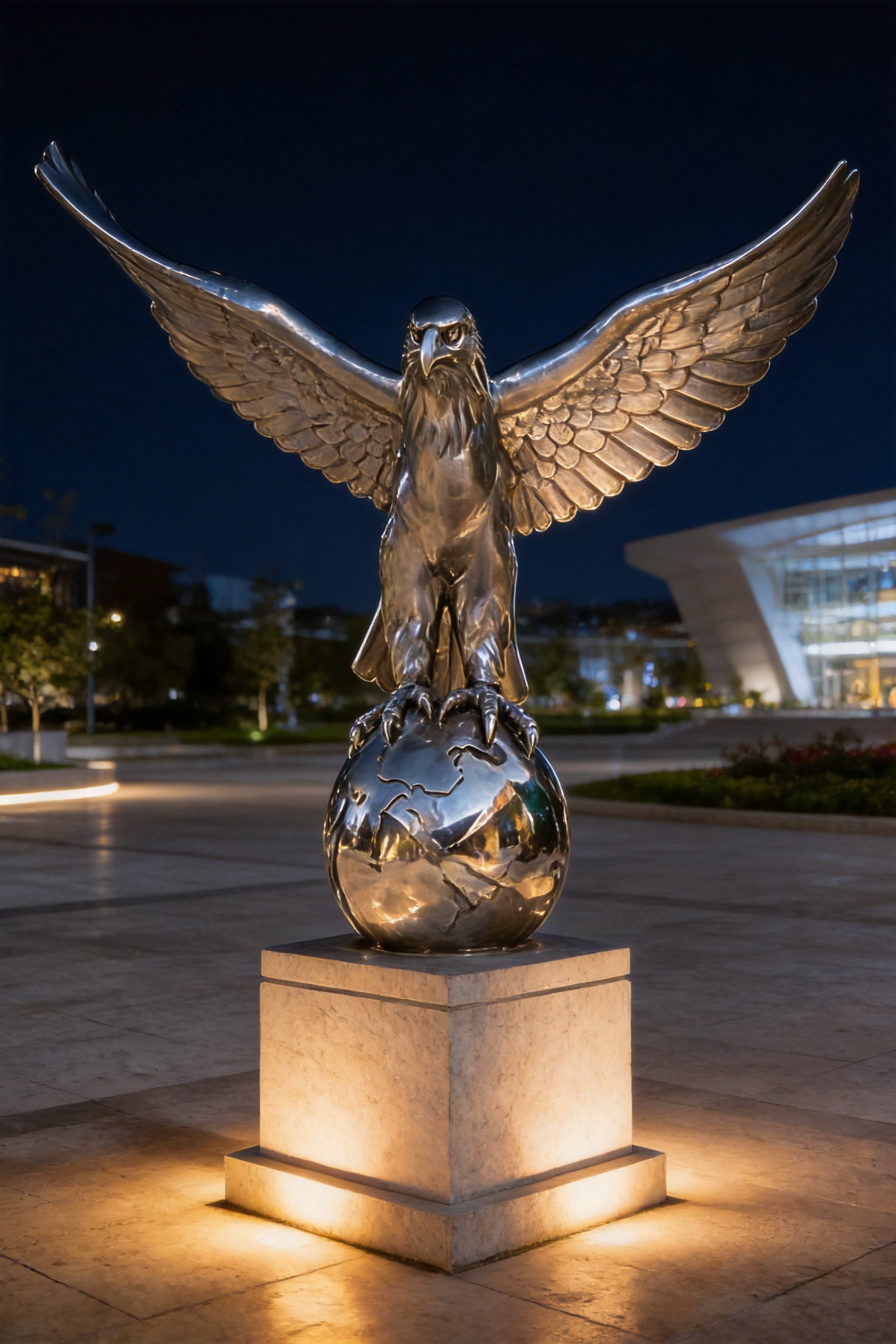
In-ground uplighting is strongly recommended for high-profile installations. At night, lights directed upward can emphasize the wings, feather layers, talons, and globe engraving. The mirror-polished stainless steel reflects the light dramatically, creating a powerful evening presence. For corporate or commercial sites operating after dark, this can significantly increase the sculpture’s value.
Lighting design should be planned carefully. The goal is to reveal the sculpture’s form without creating excessive glare. Multiple light sources may be used to illuminate the wings and globe evenly. Warm or neutral white light often works well, while colored lighting may be used for special events if it matches the site’s visual identity.
Outdoor sculpture must withstand sun, rain, wind, temperature changes, dust, and pollution. Stainless steel is an excellent material for this purpose, especially when proper grades and fabrication methods are used. The sculpture’s 304 or 316 stainless steel construction gives it strong resistance to corrosion and weather-related deterioration.
Maintenance is relatively straightforward compared with many other materials. The mirror surface should be cleaned periodically with appropriate non-abrasive methods to remove dust, fingerprints, rain marks, or airborne contaminants. In coastal or industrial environments, more frequent cleaning may be recommended to reduce salt or pollutant buildup.
Harsh abrasive tools should be avoided because they can scratch the mirror finish. Acidic or chloride-heavy cleaning chemicals should also be avoided unless specifically approved for stainless steel. Proper maintenance helps preserve the reflective quality and keeps the sculpture looking prestigious for many years.
For major public installations, periodic inspection of anchor points, base connections, weld areas, and surface condition is advisable. This is standard practice for large outdoor artworks and ensures that the sculpture remains safe and visually excellent throughout its service life.
A landmark sculpture is not only an art purchase; it is also an investment in place identity. For commercial developments, a strong visual landmark can improve memorability, create a premium atmosphere, and support branding without relying on ordinary signage. The realistic eagle on globe sculpture is especially effective because its message is immediate and aspirational.
For corporate sites, the sculpture can become part of the organization’s public image. It may appear in visitor photographs, promotional materials, news coverage, internal culture campaigns, and ceremonial events. Over time, it can become associated with the company’s ambition and identity.
For industrial parks and business districts, a flagship sculpture can help distinguish the location from competing developments. Many parks have similar buildings, roads, and landscaping. A powerful stainless steel landmark gives the site a recognizable center and can contribute to a stronger sense of prestige.
For financial institutions and multinational organizations, the sculpture’s symbolism supports messages of trust, strength, and international reach. These are qualities that many clients, partners, and employees value. The artwork can therefore contribute to the emotional atmosphere of the site.
The price range of approximately $2,380 to $6,620, depending on size, specification, and project requirements, makes the sculpture accessible for a broad range of commercial and institutional buyers. Larger customized versions, special material choices, base systems, lighting, and installation requirements may affect final cost, but the combination of stainless steel construction, realistic detailing, and landmark symbolism provides strong value.
Quality control is essential for a sculpture with mirror polish and realistic detailing. Every production stage affects the final result. If the initial model is inaccurate, the sculpture may look stiff. If the metal forming is poor, the feathers may lack depth. If welding is careless, seams may remain visible. If polishing is rushed, the surface may show distortion or scratches.
A strong manufacturing process includes dimensional checks, visual inspections, welding quality control, surface preparation review, polishing inspection, and packaging verification. For large sculptures, trial assembly or structural review may also be necessary before shipment.
Mirror-polished sculptures should be inspected under different lighting conditions because surface imperfections may appear differently in natural light, workshop light, and night illumination. The globe engraving should be checked for clarity and correct map placement. The talons and connection points should be reviewed for both appearance and strength.
Packaging is also part of quality control. A polished stainless steel sculpture can be damaged if packed carelessly. Protective film, soft materials, reinforced crates, and stable internal supports may be used to reduce the risk of scratches or impact during transportation. For international shipments, packaging must also account for long-distance handling and environmental changes.
Many high-end organizations prefer subtle symbolic branding rather than excessive logos or advertising elements. A landmark sculpture can express values in a more refined way. The eagle suggests leadership, vision, and strength. The globe suggests international reach and strategic ambition. Together, they communicate a brand message without requiring direct promotional language.
This is particularly useful for companies that host international visitors. The sculpture creates a shared visual language across cultures. Even if viewers speak different languages, the image of an eagle above the world remains understandable. It offers a dignified message suitable for formal business environments.
At the same time, the sculpture can be customized to align more closely with a specific organization. The globe engraving can highlight relevant regions or trade routes. The base can include a plaque or inscription. The scale and placement can be designed to match the site’s architectural character. This balance of universal symbolism and project-specific adaptation is a major advantage.
Proper site selection is crucial. The sculpture should be placed where its wingspan, height, and reflective surface can be fully appreciated. Ideal locations include main entrances, central plazas, roundabouts, front lawns, ceremonial axes, and open courtyards. The sculpture should not be crowded by walls, trees, or signage that disrupt its silhouette.
Viewing distance should be considered. A large sculpture needs sufficient space so viewers can see the entire form. At the same time, pathways should allow close viewing of the feather details and globe engraving. The best installations often combine long-distance impact with close-range craftsmanship.
Foundation design depends on size, wind conditions, soil conditions, and base style. For a large outdoor sculpture, professional foundation planning is recommended. Anchor bolts, embedded plates, reinforced concrete, or steel supports may be required. The installation should be coordinated with structural engineers or qualified contractors when necessary.
Because the sculpture has a mirror finish, environmental reflections should also be considered. Nearby architecture, landscaping, water, sky, and lighting will appear on the surface. This can be a major advantage if planned well. A carefully placed sculpture can visually connect the building, landscape, and sky into one unified landmark.
The sculpture is well suited to buyers seeking more than ordinary decoration. Typical buyers may include corporate groups, property developers, financial institutions, industrial park managers, municipal project planners, hotels, resorts, export companies, logistics enterprises, aviation-related organizations, cultural parks, and private collectors with large outdoor spaces.
Corporate buyers often choose this sculpture because it communicates ambition and leadership. Developers may use it to create a memorable entrance feature. Financial institutions may appreciate the message of strength and global perspective. Industrial parks may select it as a symbol of production capability and international trade.
For public or semi-public spaces, the sculpture offers strong accessibility. The eagle is a recognizable subject, and the globe provides clear meaning. This makes the artwork easier for broad audiences to understand than highly conceptual sculpture. At the same time, the stainless steel finish and detailed craftsmanship keep it visually sophisticated.
Private clients may also choose the sculpture for estates, gardens, or commemorative spaces. In these settings, the artwork can symbolize personal achievement, family legacy, or international vision. Smaller sizes may be especially practical for private installations.
The sculpture is made from high-quality 304 or 316 stainless steel. 304 stainless steel is suitable for many standard outdoor environments, while 316 stainless steel offers enhanced corrosion resistance for coastal, humid, or more demanding conditions.
The main differences are its realistic feather detailing, engraved world-map globe, 8K mirror polish, and strong global symbolism. Many eagle sculptures are abstract or simplified, but this work emphasizes lifelike anatomy and a clear international message.
Yes. The world-map engraving can be adjusted through a digital mapping file. A specific region, market, headquarters location, or trade route can be highlighted to make the sculpture more meaningful for a particular organization or project.
The sculpture can be produced in sizes from approximately 1.8 meters to 7 meters. Smaller sizes are suitable for lobbies, courtyards, and private spaces, while larger sizes are ideal for plazas, entrances, industrial parks, and landmark installations.
Yes. The stainless steel construction and weather-resistant finish make it suitable for outdoor installation. For coastal or highly corrosive environments, 316 stainless steel is recommended for improved long-term performance.
The mirror-polished surface should be cleaned periodically with non-abrasive methods. Dust, fingerprints, rain marks, salt, and pollutants should be removed using appropriate stainless steel cleaning practices. Abrasive tools and unsuitable chemicals should be avoided.
A base is recommended for many installations, especially outdoor public or commercial projects. A stone base can enhance dignity, improve visibility, and provide a stable mounting platform. The final base design should match the sculpture size and site conditions.
Yes. In-ground uplighting is highly recommended. Proper lighting emphasizes the wings, feather layers, globe engraving, and mirror finish at night, making the sculpture a strong visual landmark after dark.
Stainless steel provides a modern appearance, strong corrosion resistance, high durability, and a premium mirror finish. Bronze is traditional, marble is elegant, and fiberglass is lightweight, but stainless steel offers an excellent combination of contemporary style, outdoor performance, and long-term landmark value.
The sculpture is especially suitable for corporate headquarters, financial institutions, industrial-park plazas, business landmarks, commercial entrances, civic spaces, exhibition centers, and organizations seeking a strong symbol of global ambition.
The realistic eagle on globe stainless steel sculpture is a powerful landmark artwork designed for organizations and spaces that want to express strength, vision, and international ambition. Its lifelike eagle form, engraved world-map globe, premium stainless steel construction, and 8K mirror polish distinguish it from ordinary decorative sculptures.
Its advantages are both artistic and practical. Artistically, it offers a dramatic and universally understandable symbol. Technically, it benefits from durable 304 or 316 stainless steel, advanced metal forming, careful welding, precise map engraving, and refined polishing. Commercially, it helps create a memorable site identity for entrances, plazas, headquarters, and institutional spaces.
With scalable dimensions, customization options, outdoor durability, and strong visual impact, the sculpture can serve as a long-term flagship installation. Whether placed at a corporate gate, financial plaza, industrial park, or civic landmark, it communicates a message that is direct and enduring: strength with vision, ambition with direction, and success on a global stage.
1. Penny, Nicholas. The Materials of Sculpture. Yale University Press.
2. Scott, David A. Metallography and Microstructure of Ancient and Historic Metals. Getty Conservation Institute.
3. Gardner, Helen. Gardner’s Art Through the Ages: A Global History. Cengage Learning.
4. Sedlacek, Gerhard, and Müller, Christian. Design of Steel Structures: General Rules and Rules for Buildings. European Convention for Constructional Steelwork.
5. International Stainless Steel Forum. Stainless Steel in Architecture, Building and Construction.
6. Lippincott, Louise, and Blühm, Andreas. Fierce Friends: Artists and Animals, 1750–1900. Van Gogh Museum Publications.



Daniel H.
Amanda R.

Robert B.

Jennifer S.

James W.

Barry G.

Michael T.

Emily K.

David L.

Sarah M.


Mikey XV

Jagxue

 English
 Español
 عربى
عربى Français
 italiano
 Deutsch