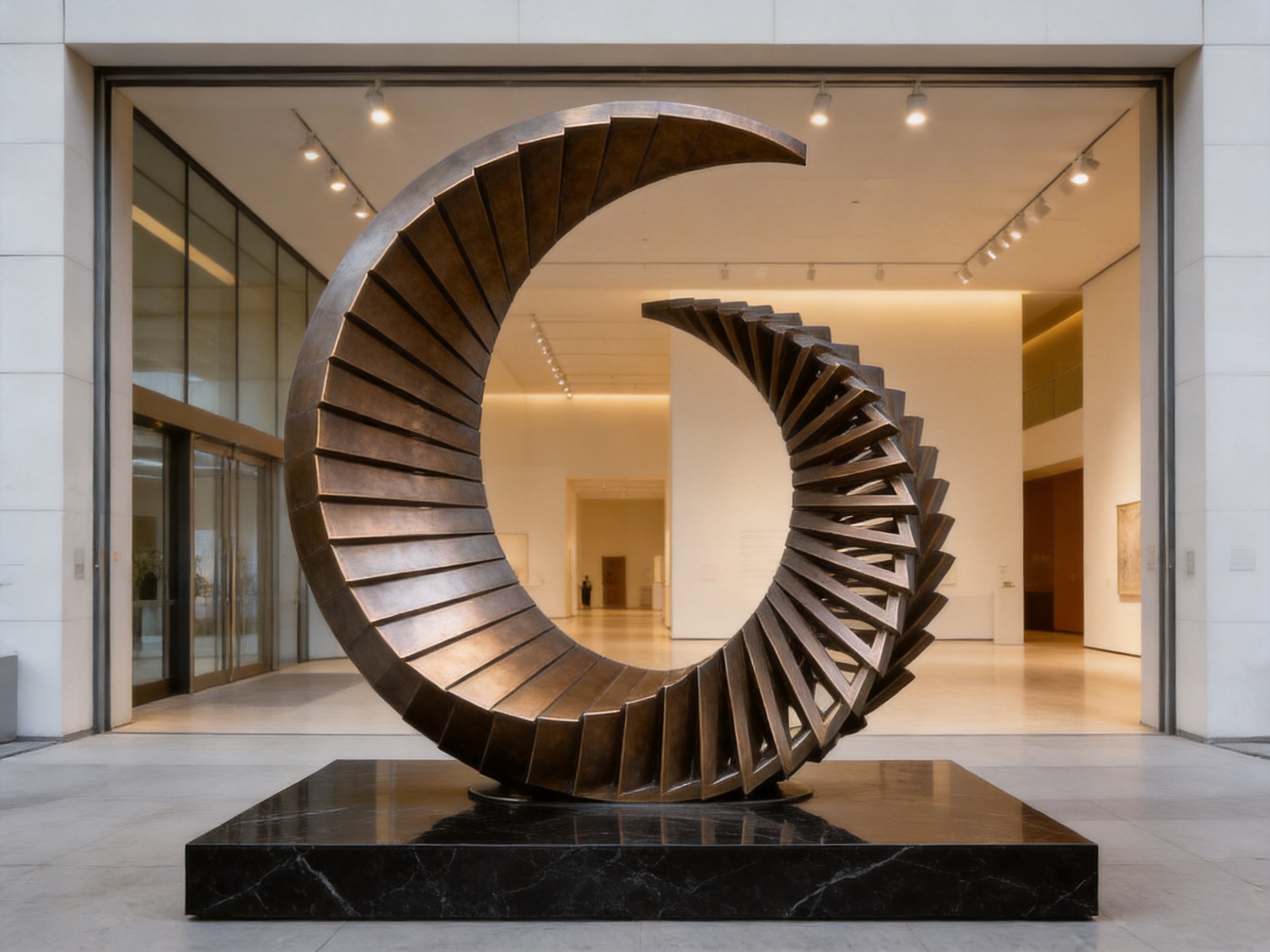
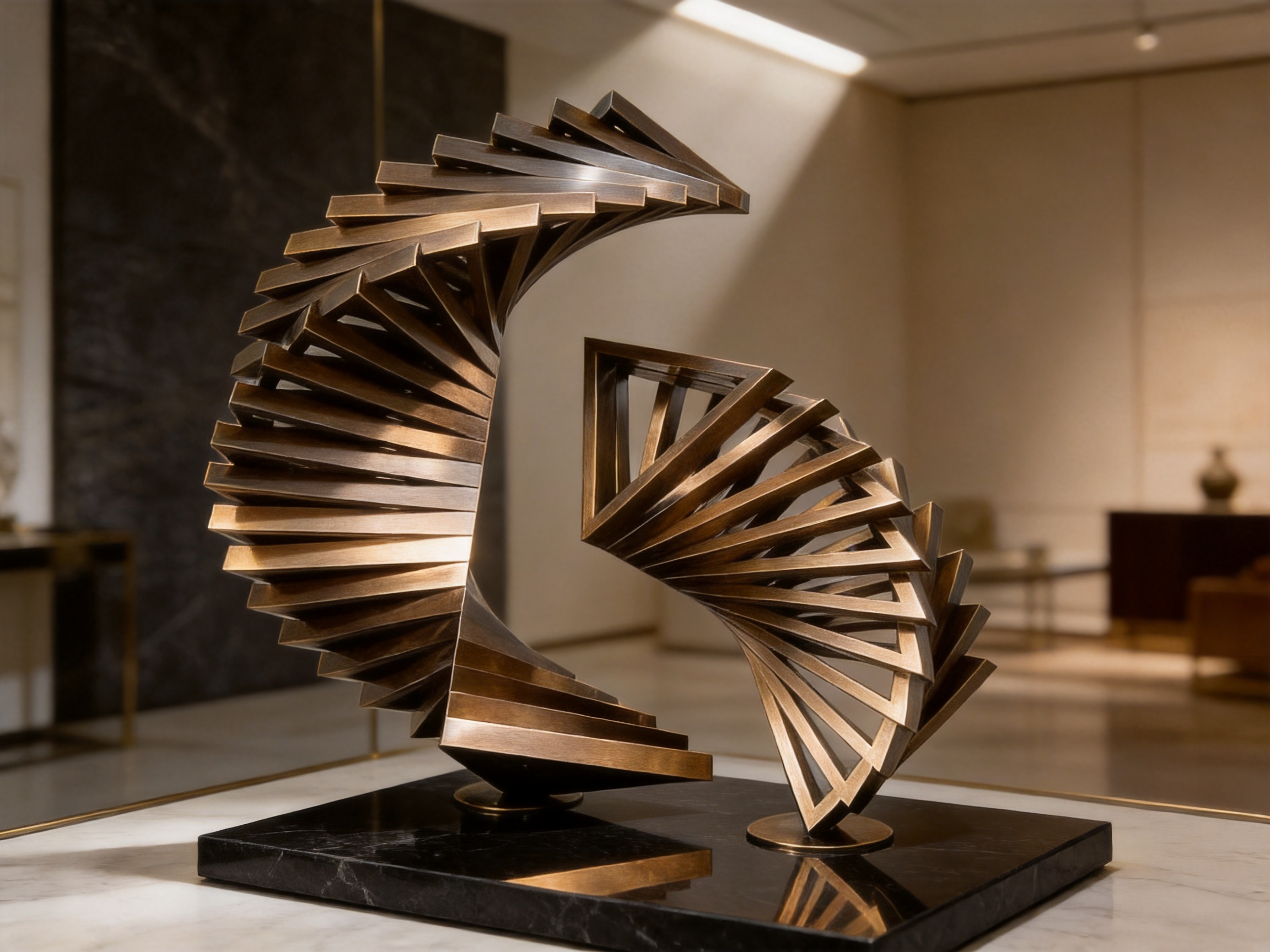
The Layered Crescent Spiral Geometric Stainless Steel Sculpture is an interior architectural artwork designed for spaces that require more than a decorative object. It combines the structural strength of heavy-gauge stainless steel, the warmth of an antique bronze brushed finish, the rhythm of repeated geometric panels, and the grounding presence of a glossy black marble base. Together, these elements create a sculpture that is visually distinctive, technically durable, and especially effective in lobbies, galleries, reception areas, hospitality interiors, and upscale clubs.
Unlike many polished stainless steel sculptures intended to produce maximum outdoor reflection, this piece is deliberately developed for controlled interior environments. Its surfaces are not designed to flash brightly under changing daylight. Instead, the staggered rectangular panels are arranged to create a carefully modulated pattern of highlights and shadows when illuminated by recessed or directional interior lighting. This makes the sculpture particularly suitable for designers who want to control the relationship between artwork, architecture, and ambient light.
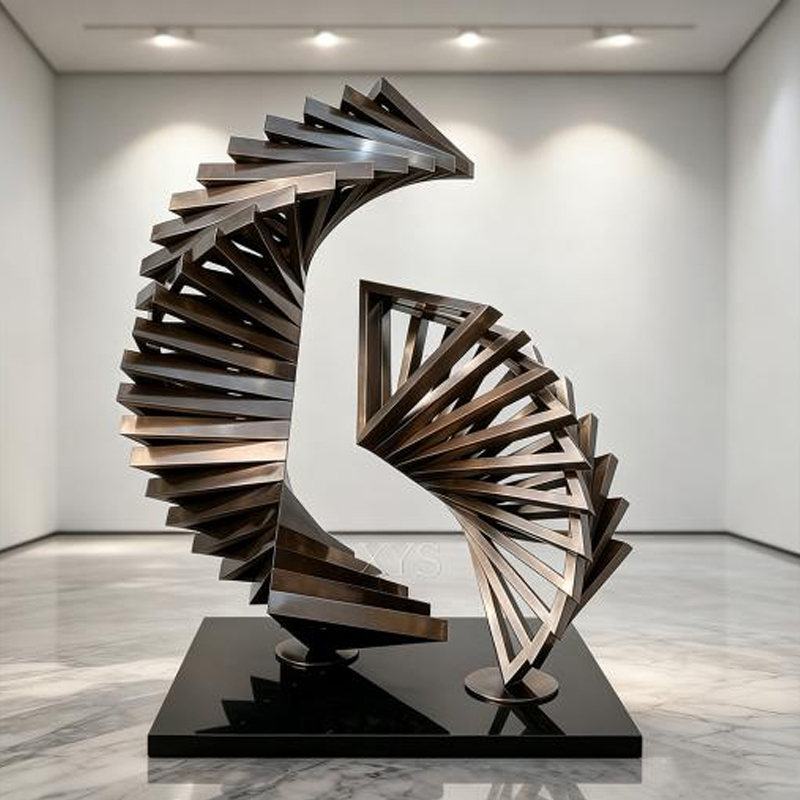
The sculpture is formed from a series of cut stainless steel panels arranged in layers. These panels create a symmetrical double-crescent silhouette with a stepped, almost architectural profile. Viewed from the front, the composition presents balance and order. Viewed from an angle, the overlapping panels reveal depth, separation, and a more dynamic spiral-like movement. The result is a work that can change visually as visitors move through a room.
Available in sizes from 1.1 to 3.6 meters, the sculpture can be selected for smaller reception zones, large commercial interiors, gallery settings, or prominent hotel entrance spaces. Its listed price range of $1,690 to $5,140 provides options for different project scales while retaining the essential design language of the original composition.
Content
Light is central to the identity of the Layered Crescent Spiral Geometric Stainless Steel Sculpture. The individual rectangular panels do not sit in a single flat plane. They are staggered and layered so that each edge can catch illumination differently from the next. This produces a sequence of narrow highlights, soft shadows, and darker recesses across the crescent forms.
The effect is intentionally more controlled than the mirror-like glare often associated with outdoor stainless steel art. In open plazas, polished metal may reflect the sky, surrounding buildings, vehicles, and constantly changing sunlight. That visual character can be powerful, but it is not always appropriate for an interior environment. In a lobby or gallery, uncontrolled reflections may compete with architectural finishes, signage, furniture, or artwork.
This sculpture takes a different approach. Its antique bronze brushed treatment reduces the cold, highly reflective appearance of bright stainless steel and introduces a warmer, more settled tone. The finish allows the geometry to remain prominent without making the sculpture feel overly industrial. Under carefully positioned accent lighting, the bronze-toned panels develop a rich range of values, from muted copper-brown highlights to deep shadowed recesses.
For interior designers, this creates an opportunity to treat the sculpture as part of a lighting composition. A recessed spotlight or narrow-beam fixture can be positioned to rake across the panels. As the light travels across the staggered surfaces, the steps become more legible, and the crescent outline gains additional depth. Under flat, even lighting, the same texture becomes quieter and more understated.
This responsiveness gives the artwork a practical advantage over simpler decorative objects. A flat metal wall panel may depend almost entirely on its color or pattern. A smooth polished sculpture may depend on reflections that are difficult to control. The layered crescent composition offers both material character and three-dimensional surface behavior, allowing the project team to adjust its appearance through lighting design.
Layered Crescent Spiral Geometric Stainless Steel Sculpture
The central form consists of paired, symmetrical crescent shapes. Symmetry gives the artwork a sense of calm and stability, while the internal layering introduces movement and complexity. The two crescent forms can be read as complementary elements, creating a visual dialogue between left and right, solid and void, surface and shadow, or stillness and progression.
The crescent silhouette is familiar enough to be immediately readable but abstract enough to remain suitable for contemporary architectural settings. It does not rely on a literal figure, historical symbol, or specific cultural reference. Instead, it presents a geometric language that can work with a wide range of interior styles, including modern hospitality, European-inspired interiors, corporate reception areas, gallery environments, and luxury club spaces.
The stepped rectangular panels add a second layer of meaning. Their gradual arrangement suggests structured advancement, progression, and controlled development. Each panel is individual, yet each depends on the surrounding panels to complete the overall form. This creates a visual analogy for cooperation, balance, and advancement through carefully organized stages.
Because the composition is symmetrical, it can be positioned on a central axis, such as behind a reception desk, at the end of a corridor, or within a large entrance hall. It can also be placed off-center as a counterpoint to architectural features. The sculpture is therefore capable of functioning either as a primary focal point or as one element in a larger interior design scheme.
Its three-dimensional structure also supports multiple viewing distances. From across a room, visitors first perceive the strong crescent outline and warm metallic color. At a medium distance, the stepped layers become apparent. Up close, the viewer can examine the panel edges, changes in surface direction, and relationship between the steel composition and the marble base.
The sculpture is cut from heavy-gauge 304 or 316 stainless steel plate. These stainless steel grades are widely recognized for their strength, corrosion resistance, and suitability for demanding fabrication applications. In this sculpture, the material provides a stable foundation for the layered panel construction while supporting the visual precision required by the geometric design.
Heavy-gauge plate is particularly important for a sculpture composed of multiple staggered sections. Thin sheet material may be more vulnerable to vibration, deformation, or visible distortion, especially when panels extend away from the main support structure. A heavier plate provides greater stiffness and gives the panels a more substantial presence. It also supports the deliberate, architectural character of the work.
Using 304 or 316 stainless steel gives the manufacturer flexibility in matching material selection to project needs. Grade 304 is a practical choice for many normal interior environments and offers a strong combination of durability and fabrication performance. Grade 316 may be considered when a project requires additional resistance in more demanding conditions. For the intended indoor applications, both grades provide a durable metal substrate for the antique bronze brushed treatment.
The choice of stainless steel also distinguishes the sculpture from works made from ordinary mild steel or lower-grade metal. Mild steel can require more extensive protective systems to prevent corrosion, while lower-quality substrates may compromise long-term appearance or structural reliability. Stainless steel gives the piece a robust internal material identity even though the visible finish is intentionally warm and bronze-like.
The material is also well suited to custom fabrication. Stainless steel plate can be measured, cut, formed, aligned, and finished according to a specific design pattern. This allows the layered crescent composition to retain consistent proportions across different production sizes, from approximately 1.1 meters to 3.6 meters in height.
The antique bronze brushed treatment is one of the sculpture’s most important competitive advantages. Many stainless steel sculptures emphasize a bright silver appearance, mirror polishing, or a highly reflective contemporary finish. Those approaches can be effective in outdoor plazas and modern public spaces, but they may feel too cool or visually aggressive for refined interior environments.
The bronze-toned brushed surface gives this piece a warmer architectural presence. It can coordinate with wood, leather, stone, dark metal, warm lighting, and neutral textile finishes. In hospitality settings, this makes the sculpture easier to integrate into an overall palette that emphasizes comfort and sophistication rather than industrial brightness.
The brushed quality also contributes to the perception of depth. Instead of reflecting the surrounding room like a mirror, the surface distributes light across fine directional texture. When the panel faces are arranged at different angles, the brushed treatment helps each panel display a slightly different tonal response. This reinforces the stepped construction without overwhelming the viewer with sharp glare.
The antique effect gives the artwork a sense of maturity and permanence. Although the composition is contemporary and geometric, the finish prevents it from appearing overly technological or temporary. It can sit comfortably alongside classic architectural details, dark marble, rich woodwork, decorative wall panels, or European-style interior elements.
At the same time, the finish does not disguise the stainless steel substrate. The edges, planes, and layered construction remain visually legible. This balance between modern fabrication and aged metallic color allows the sculpture to bridge different design languages. It can serve a contemporary project that needs warmth or a classic project that needs a controlled geometric accent.
The glossy black marble base performs both a practical and an aesthetic function. Its first role is to provide a stable, level foundation for the layered steel composition. Because the sculpture rises vertically and contains multiple offset panels, a substantial base is essential to help keep the artwork securely upright in an interior setting.
The second role is visual. The cool, dark surface of the polished marble contrasts with the warm bronze tone of the stainless steel. This contrast separates the sculpture from the floor while giving the complete work a more finished, furniture-like presence. The base does not compete with the crescent form; instead, it provides a calm visual platform from which the metal composition emerges.
The glossy surface also reflects the lower edges of the bronze panels. This subtle reflection extends the layered effect downward and makes the artwork appear more integrated with its foundation. The reflection is intentionally restrained compared with a mirrored metal surface, but it adds another level of depth for viewers who approach the sculpture closely.
Compared with a simple painted plinth, a polished marble base offers greater material richness. It can coordinate with marble flooring, reception counters, stone walls, and other luxury finishes. Its dark color also helps conceal minor visual distractions near the floor, allowing attention to remain on the warm metallic crescent forms.
Routine dusting is generally sufficient to preserve the visual quality of the base under normal indoor conditions. As with any natural stone surface, project owners should follow appropriate care practices and avoid harsh chemicals that could affect the polish. The combination of stainless steel and black marble creates a durable and refined assembly suitable for long-term interior display.
The Layered Crescent Spiral Geometric Stainless Steel Sculpture offers several advantages over conventional decorative sculptures. Its most important strength is the combination of geometric clarity and surface complexity. A simple solid form may be easy to understand but can appear visually static. A highly irregular form may be dynamic but difficult to integrate into a carefully planned interior. This sculpture occupies a productive middle ground: its silhouette is orderly, while its layered panels create movement.
Compared with bright polished stainless steel sculptures, the antique bronze brushed finish is better suited to warm interior palettes and controlled lighting. It avoids excessive glare and creates a more sophisticated, gallery-appropriate atmosphere. This is especially useful in locations where visitors should be able to examine the artwork comfortably from different angles.
Compared with sculptures made from ordinary steel, the stainless steel substrate provides a stronger foundation for long-term durability under normal indoor conditions. The metal does not rely solely on a thin decorative coating to create its identity. The underlying material is selected for structural and material performance, while the finish provides the desired visual tone.
Compared with flat wall art, the layered composition offers a genuine three-dimensional presence. It creates shadows, changes with movement, and occupies space rather than merely decorating a surface. Compared with bulky figurative sculpture, its open crescent structure can feel lighter and more architectural, making it easier to position in circulation areas and reception spaces.
The sculpture also offers a clear scale advantage. Its available range from 1.1 to 3.6 meters allows a project to maintain the same design concept across different room sizes. A smaller version may suit a private club, executive office, or boutique reception area. A larger version can command a hotel lobby or expansive gallery entrance.
| Design and Performance Factor | Layered Crescent Sculpture | Typical Flat Metal Art | Typical Bright Polished Sculpture |
|---|---|---|---|
| Primary visual effect | Layered highlights, shadows, and geometric depth | Graphic surface pattern | Strong reflections and smooth continuous shine |
| Finish character | Warm antique bronze brushed treatment | Often painted or uniformly finished | Bright silver or mirror-polished appearance |
| Interior lighting response | Designed for raking and accent light | Usually dependent on color or printed design | Can create uncontrolled glare |
| Material substrate | Heavy-gauge 304/316 stainless steel | Varies by supplier | Often stainless steel, with emphasis on polish |
| Visual weight | Strong presence with open, layered geometry | Usually flatter and less spatial | Can appear visually intense or reflective |
| Recommended setting | Lobby, gallery, reception area, club interior | Walls and decorative panels | Outdoor plazas or highly contemporary spaces |
Jiangsu Xinyesheng Sculpture Co., Ltd. presents itself as a China-based sculpture manufacturer and supplier of custom design metal statues and European-style sculptures. For a product such as the Layered Crescent Spiral Geometric Stainless Steel Sculpture, manufacturing quality depends on more than the final surface finish. The geometry, panel alignment, structural balance, edge treatment, and base connection must all work together.
The production process begins with the translation of the design into a series of measurable geometric components. The crescent silhouette must be divided into individual rectangular panels with consistent proportions and carefully planned offsets. Because the composition depends on symmetry, the corresponding panels on the two sides need to maintain a coherent relationship in size, spacing, and orientation.
Heavy-gauge 304 or 316 stainless steel plate is then selected for the structural components. The material choice supports precise cutting and fabrication while giving the finished sculpture the rigidity expected of a substantial architectural artwork. Panel dimensions, thickness, support points, and base connections should be reviewed before fabrication begins, particularly for larger versions approaching 3.6 meters.
Cutting the plate into rectangular panels requires attention to dimensional accuracy. Clean and consistent edges are important because the stepped arrangement makes each panel boundary visible. Irregular edges or inconsistent spacing would disrupt the visual rhythm of the crescent and reduce the precision of the overall composition.
After cutting, the panels are arranged according to the layered design. Alignment at this stage is essential. The sculpture must preserve the balance between the two crescent forms while also maintaining the intended depth between individual sections. The fabrication team must manage the relationship between the visible surfaces and the concealed structural supports so that the composition remains visually light without sacrificing stability.
The metalwork is then prepared for the antique bronze brushed treatment. Surface preparation is a significant part of the process because the final appearance depends on the condition and consistency of the stainless steel beneath the finish. A controlled preparation sequence helps the bronze tone appear even across the panels while preserving the directional character of the brushed surface.
Quality control should include inspection of panel dimensions, symmetry, surface consistency, weld or connection areas, base alignment, and overall vertical stability. These checks are especially important for a sculpture that will be seen from close range in a lobby or gallery. Interior artwork is often examined at distances of only a few feet, so workmanship that might go unnoticed in a distant outdoor installation can become highly visible indoors.
The manufacturing strength of a specialized sculpture supplier lies in coordinating these individual stages. Cutting, structural assembly, surface finishing, and base integration must be treated as a single design process rather than unrelated operations. The visual success of the artwork depends on the manufacturer’s ability to keep the intended geometry intact from initial layout through final inspection.
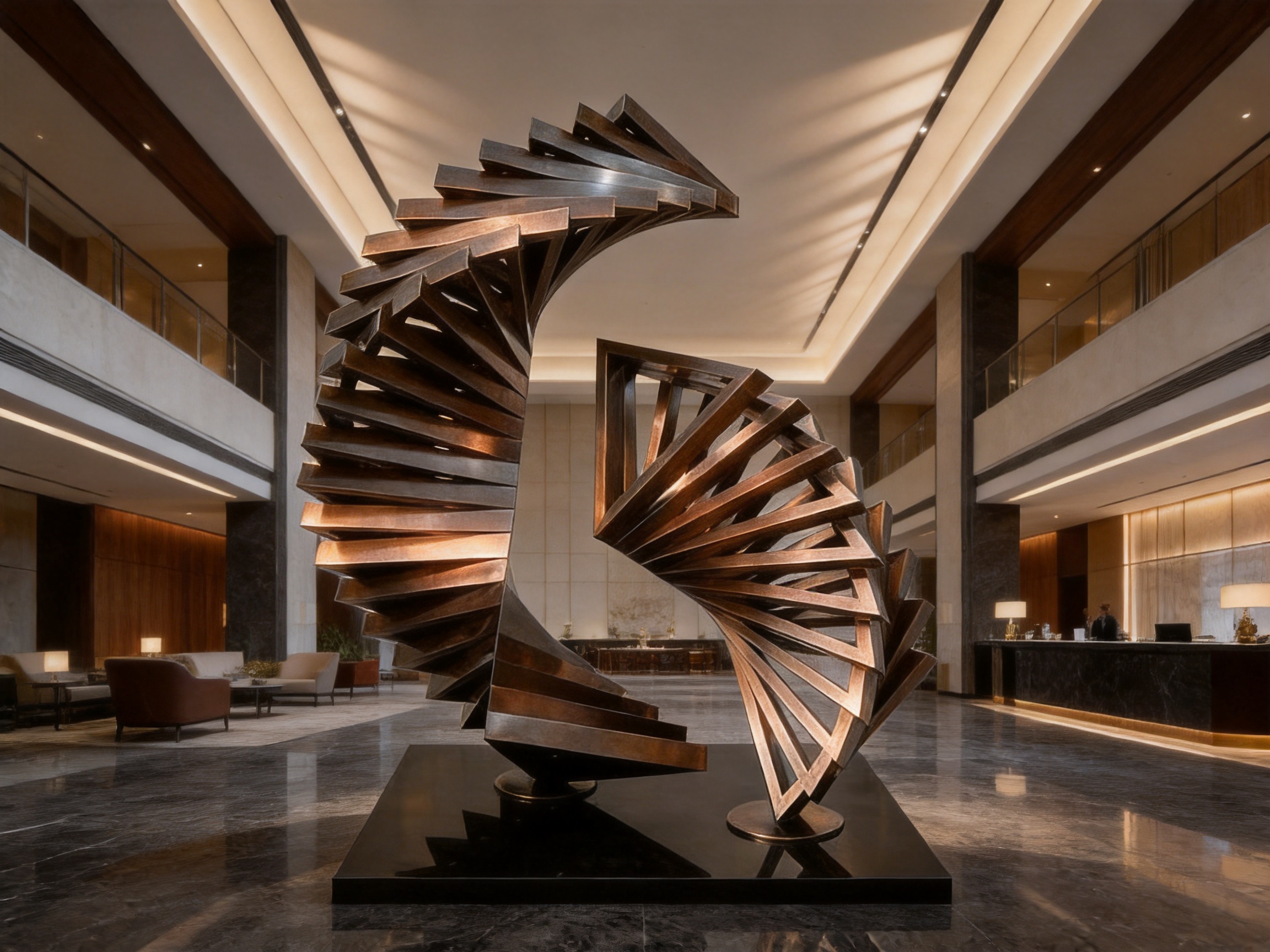
The layered construction is not simply a decorative stacking method. It is the main device that gives the artwork its identity. Each rectangular panel contributes to the silhouette, the shadow pattern, and the sense of controlled movement. The distance between panels must therefore be carefully managed.
If the panels are placed too closely together, the shadows may become weak and the composition may read as a nearly flat sheet. If they are separated too widely, the crescent may lose visual continuity and appear fragmented. The ideal arrangement maintains enough overlap for the eye to read a unified form while preserving enough depth for the individual steps to remain visible.
Symmetry also requires careful control. The paired crescents should feel balanced without appearing mechanically repetitive. The design achieves this by using repeated rectangular components within a larger curved or spiral-like progression. The result has the order of an engineered structure but the movement of an abstract organic form.
For larger installations, the manufacturer must also consider how the sculpture behaves during handling, transportation, placement, and final positioning. A three-meter-plus metal artwork is not simply a larger version of a small object. Its mass, center of gravity, access route, and installation conditions require additional planning. The substantial marble base supports stability, while the fabrication layout must allow the work to be moved and positioned safely.
The company’s ability to produce a range of sizes is valuable for architects, interior designers, art consultants, and property developers. A project may need a particular height to align with a ceiling, reception counter, stairwell, or wall feature. Offering a size range allows the artwork to be coordinated with the architecture rather than forcing the architecture to accommodate a single fixed dimension.
In a hotel lobby, the sculpture can serve as a visual anchor near the entrance, reception desk, elevator hall, or lounge area. Its warm bronze finish complements hospitality materials such as wood veneer, leather seating, stone flooring, and soft textiles. The symmetrical form communicates order and welcome, while the layered panels give guests a reason to look more closely.
Hotel lighting often includes a combination of downlights, wall washers, decorative pendants, and concealed accent fixtures. The sculpture can be positioned where a narrow beam creates shadows across the panel surfaces. This allows the artwork to contribute to the atmosphere during both daytime and evening operations.
Corporate reception areas require artwork that communicates professionalism without becoming distracting. The double-crescent composition offers a disciplined geometric character that can work with modern corporate interiors. Its stainless steel construction suggests precision and durability, while the antique bronze tone prevents the piece from feeling excessively cold.
The sculpture can be placed behind a reception desk, in a visitor waiting area, or within a double-height entrance zone. The available size range makes it possible to select a version that supports the scale of the office without overwhelming desks, seating, signage, or circulation paths.
Gallery interiors benefit from artworks that respond to lighting and reward extended observation. The sculpture’s stepped arrangement offers a subject for close study, including repetition, symmetry, material contrast, and the relationship between solid panel and open space. Its abstract form can also sit comfortably among other works without imposing a specific narrative.
Because the finish is more subdued than mirror-polished steel, the sculpture is less likely to produce disruptive reflections in a carefully controlled exhibition environment. Curators and designers can use accent lighting to emphasize one side, create a symmetrical wash across both forms, or produce a more dramatic contrast between the bronze-toned panels and the dark marble base.
Private clubs, executive lounges, and upscale residential interiors often require decorative objects with a sense of exclusivity and material richness. The bronze finish and glossy black marble base provide this richness, while the geometric design keeps the sculpture current and adaptable.
In a club interior, the sculpture may be displayed near a bar, lounge, library, stair landing, or private dining space. Warm lighting can deepen the antique tone and make the piece appear more integrated with the surrounding atmosphere. Its open structure also helps preserve visual flow in rooms that contain substantial furniture and decorative finishes.
The sculpture is specifically intended for display under controlled interior lighting rather than variable outdoor sunlight. This does not mean that it requires a complex lighting system. Instead, it means that its strongest visual qualities become more apparent when the direction and intensity of light can be considered as part of the installation.
Raking light is particularly effective. A fixture positioned at a low angle across the panel surfaces can emphasize the difference between adjacent layers. The raised edges catch the light, while the recessed areas create shadow. This makes the geometric progression more pronounced and adds a sense of movement to the crescent forms.
Lighting from directly above can create a more restrained effect. It may emphasize the top edges of the panels and allow shadows to fall downward across the composition. This approach can be useful in spaces where the sculpture should appear elegant and quiet rather than theatrical.
Symmetrical lighting from both sides reinforces the paired nature of the design. Slightly asymmetrical lighting, by contrast, can make one crescent appear more prominent and produce a changing balance between the two forms. Designers can select the approach according to the desired mood of the room.
The color temperature of the light also affects the bronze finish. Warm or neutral-white lighting generally supports the antique metallic character, while cooler light may produce a sharper contrast between the warm-toned steel and the black marble base. The final choice should be coordinated with the room’s other materials and light sources.
For installation planning, designers should consider sightlines from entrances, seating areas, circulation routes, and nearby stairs. Because the panel edges change appearance with viewing angle, the sculpture can be positioned where visitors naturally move around it. A location that offers only one frontal view will not reveal its full spatial character.
The 1.1-meter version is appropriate for compact lobbies, reception counters, private offices, boutique hospitality spaces, and smaller galleries. It can function as a substantial decorative object without requiring a double-height room or a large floor area.
Mid-sized versions can be used in standard commercial lobbies, club interiors, and hotel lounge areas. These sizes offer enough presence to serve as a focal point while remaining proportionate to surrounding furniture and architectural elements.
The largest versions, extending to approximately 3.6 meters, are intended for more generous spaces. They can occupy a double-height lobby, a broad entrance hall, a gallery threshold, or a major corporate reception area. At this scale, the crescent silhouette becomes an architectural feature rather than a simple accessory.
Placement should allow sufficient viewing distance for the complete outline to be understood. At the same time, visitors should be able to approach closely enough to appreciate the panel edges and brushed finish. A clear zone around the base helps protect the artwork from accidental contact and preserves the intended visual separation from nearby objects.
The base should be placed on a level floor capable of supporting the combined weight of the stainless steel structure and marble foundation. Project teams should review access, floor transitions, door clearances, elevator dimensions, and installation routes before selecting the largest available size.
The sculpture is designed for normal indoor conditions, where the antique bronze brushed finish over stainless steel can remain durable with routine care. Dust should be removed with a soft, clean cloth or an appropriate non-abrasive cleaning method. Abrasive pads, harsh chemicals, and aggressive polishing should be avoided because they may alter the brushed texture or affect the intended antique appearance.
Cleaning should follow the direction of the brushed surface rather than using random circular motions. This helps preserve the consistency of the finish across the rectangular panels. Before applying any cleaning product to the visible surfaces, facility teams should test it on an inconspicuous area or consult the supplier’s care recommendations.
The layered construction creates narrow spaces between panels where dust may collect. These areas can be addressed with soft brushes, low-pressure air, or carefully controlled cleaning tools. Maintenance staff should avoid applying excessive force to the panel edges or internal connections.
The glossy black marble base should be dusted regularly to preserve its reflective appearance. Spills should be removed promptly, and cleaning products intended for polished natural stone should be used when necessary. The base should not be treated as a cutting or storage surface, since scratches and abrasive particles can reduce the quality of the polish.
Routine inspection is also advisable for commercial installations. Facility managers can check that the sculpture remains level, that the base is stable, and that no nearby furniture or equipment is pressing against the metal panels. These simple practices help preserve both safety and appearance over time.
As a custom design metal statue supplier, Jiangsu Xinyesheng Sculpture Co., Ltd. is positioned to support projects that require adaptation in scale, material grade, finish, or installation context. The listed product establishes a clear design direction, but architectural projects often involve specific requirements related to room dimensions, lighting, circulation, and interior color schemes.
Customization may involve selecting a suitable height within the available range, reviewing the use of 304 or 316 stainless steel, coordinating the antique bronze tone with adjacent materials, or confirming the dimensions of the marble base. Project teams should communicate the intended location, viewing distance, lighting conditions, access limitations, and preferred installation schedule during the planning phase.
The advantage of working with a specialized sculpture manufacturer is the ability to discuss the complete artwork rather than purchasing unrelated components from separate suppliers. The steel panels, structural assembly, surface treatment, and marble base can be considered as one coordinated product.
For designers seeking a European-style sculpture with a contemporary geometric identity, this piece offers an alternative to figurative statues, classical replicas, and highly polished abstract forms. Its visual language is refined without being dependent on historical ornament. It can therefore support projects that want an artistic centerpiece with a strong architectural relationship.
A premium interior sculpture must succeed at several levels. It must be visually distinctive enough to justify its position, technically reliable enough for long-term display, and adaptable enough to work within a carefully designed environment. The Layered Crescent Spiral Geometric Stainless Steel Sculpture addresses these requirements through the interaction of form, material, finish, lighting, and base design.
Its double-crescent silhouette provides immediate recognition. Its staggered panels create depth and shadow. Its heavy-gauge stainless steel construction supports durability. Its antique bronze brushed treatment adds warmth. Its glossy black marble base provides stability and contrast. Each feature contributes to the overall result without becoming isolated from the others.
The sculpture also avoids a common problem in decorative art: visual interest that disappears after the first glance. The basic outline can be understood quickly, but the layered surfaces reveal more as the viewer changes position or as the lighting shifts. This makes the sculpture suitable for places where people pass by repeatedly, such as hotel entrances, office lobbies, and club corridors.
Its controlled interior orientation is another important strength. The work does not attempt to be everything to every environment. It is not primarily designed to reflect direct outdoor sunlight or function as a monumental plaza installation. Instead, it has a focused purpose: to provide a warm, structured, light-responsive geometric presence inside an architectural setting.
Jiangsu Xinyesheng Sculpture Co., Ltd. is identified in the supplied product information as a China sculpture manufacturer specializing in custom design metal statues and European-style sculpture. Its product range includes bronze sculptures, stainless steel sculptures, marble sculptures, fiberglass sculptures, and weathering steel sculptures.
This range indicates experience with multiple sculptural materials and finish requirements. For the Layered Crescent Spiral Geometric Stainless Steel Sculpture, the relevant strengths are the ability to work with heavy-gauge stainless steel, develop layered geometric assemblies, apply a bronze-toned brushed treatment, and integrate the metal composition with a polished marble base.
The manufacturer’s role is especially important for a design whose quality depends on disciplined repetition. The rectangular panels need to remain consistent, the paired forms need to retain symmetry, and the completed object needs to remain stable despite its open layered construction. These demands call for coordinated fabrication and inspection rather than a purely decorative finishing process.
For commercial buyers, architects, and design firms, supplier communication should include confirmation of final dimensions, material grade, finish sample, base details, packing method, installation requirements, and maintenance guidance. Clear technical coordination helps ensure that the finished sculpture performs as intended within the project environment.
The sculpture is made from heavy-gauge 304 or 316 stainless steel plate. The steel is cut into rectangular panels, arranged in layers, and finished with an antique bronze brushed treatment.
The piece is specifically intended for controlled indoor display. It is particularly recommended for lobbies, galleries, reception areas, hotels, offices, and upscale clubs rather than locations exposed to changing outdoor sunlight and weather.
The antique bronze brushed treatment gives the stainless steel a warm, aged metallic tone instead of a bright silver or mirror-like appearance. It reduces harsh reflections and works well with warm interior materials and accent lighting.
The staggered rectangular panels create stepped light and shadow across the double-crescent silhouette. Each panel edge can respond differently to the light, so the sculpture changes subtly as the viewer moves or as the lighting direction changes.
Recessed or directional accent lighting that rakes across the panel surfaces is recommended. This approach emphasizes the edges, recesses, and layered geometry. Flat, even ambient lighting creates a quieter and more understated effect.
The listed size range is approximately 1.1 to 3.6 meters. Smaller versions suit compact interiors, while larger versions can serve as focal points in spacious hotel lobbies, galleries, and double-height reception areas.
The listed price range is $1,690 to $5,140, depending on the selected size and project requirements. Buyers should confirm the final quotation, specifications, packing, and installation arrangements with the supplier.
The glossy black marble base provides a stable, level foundation for the steel structure. It also creates a strong contrast with the warm bronze finish and subtly reflects the lower edges of the layered panels.
Routine dusting with a soft cloth is generally appropriate for normal indoor conditions. Abrasive tools and harsh chemicals should be avoided. Cleaning should follow the direction of the brushed finish to help preserve its consistent appearance.
The marble base should be dusted regularly and cleaned with products suitable for polished natural stone. Spills should be removed promptly, and abrasive materials should not be placed directly on the surface.
Yes. Its symmetrical geometry, durable stainless steel construction, and refined bronze tone make it suitable for office reception areas, visitor lounges, executive spaces, and corporate entrance halls.
The supplied company information identifies product categories including bronze, stainless steel, marble, fiberglass, and weathering steel sculptures. Buyers seeking related work in another material can discuss the requirements with the manufacturer.
This piece is a stronger choice when the project requires warmth, controlled reflection, and compatibility with interior lighting. Its antique bronze brushed finish emphasizes texture and shadow rather than producing intense mirror-like glare.
The sculpture’s geometric form and warm metallic finish can be coordinated with dark stone, wood, leather, neutral walls, warm lighting, and contemporary or European-style interiors. Size and placement should be selected according to the room’s proportions and circulation.
The Layered Crescent Spiral Geometric Stainless Steel Sculpture is a carefully focused interior artwork rather than a generic metal ornament. Its strongest qualities come from the relationship between heavy-gauge stainless steel, layered rectangular panels, a symmetrical double-crescent silhouette, an antique bronze brushed finish, and a glossy black marble base.
Its design provides a distinctive alternative to flat decorative panels, ordinary steel sculptures, and brightly polished stainless steel works. The stepped geometry creates changing light and shadow, while the warm finish supports a more refined and comfortable interior atmosphere. The marble base adds both stability and material contrast, completing the sculpture as a self-contained architectural feature.
Supported by stainless steel fabrication, geometric panel assembly, controlled finishing, and coordinated base construction, the product is suitable for hotel lobbies, galleries, office reception areas, private clubs, and other upscale interiors. Its available range from 1.1 to 3.6 meters allows the same design concept to be adapted to different architectural scales.
For projects seeking a custom European-style sculpture with contemporary structure, durable materials, and a controlled response to interior lighting, this layered crescent composition offers a balanced and versatile solution. It brings together precision, warmth, stability, and visual movement in a form designed to remain engaging long after the first impression.
1. Product specification and descriptive materials for the Layered Crescent Spiral Geometric Stainless Steel Sculpture.
2. General material information concerning 304 and 316 stainless steel plate used in architectural and sculptural fabrication.
3. General conservation and maintenance principles for brushed metal finishes in interior environments.
4. General care guidance for polished natural stone and glossy black marble surfaces.
5. Interior lighting principles related to raking light, directional accent lighting, and the enhancement of three-dimensional surface texture.
6. Manufacturer-provided company and product category information for custom bronze, stainless steel, marble, fiberglass, and weathering steel sculptures.



Daniel H.

Amanda R.

Robert B.

Jennifer S.

James W.

Barry G.

Michael T.

Emily K.

David L.

Sarah M.


Mikey XV

Jagxue

 English
 Español
 عربى
عربى Français
 italiano
 Deutsch