Outdoor sculpture is increasingly expected to do more than occupy space. In contemporary gardens, parks, commercial developments, tourism destinations, and residential landscapes, a successful installation must combine visual identity, material durability, safe operation, and long-term value. The Illuminated Hollow-Out Mushroom Stainless Steel Sculpture answers these requirements by bringing together three functions in one carefully engineered form: it is a sculptural object during the day, a landscape-lighting feature at night, and a recognizable landmark that can help define the atmosphere of an outdoor environment.
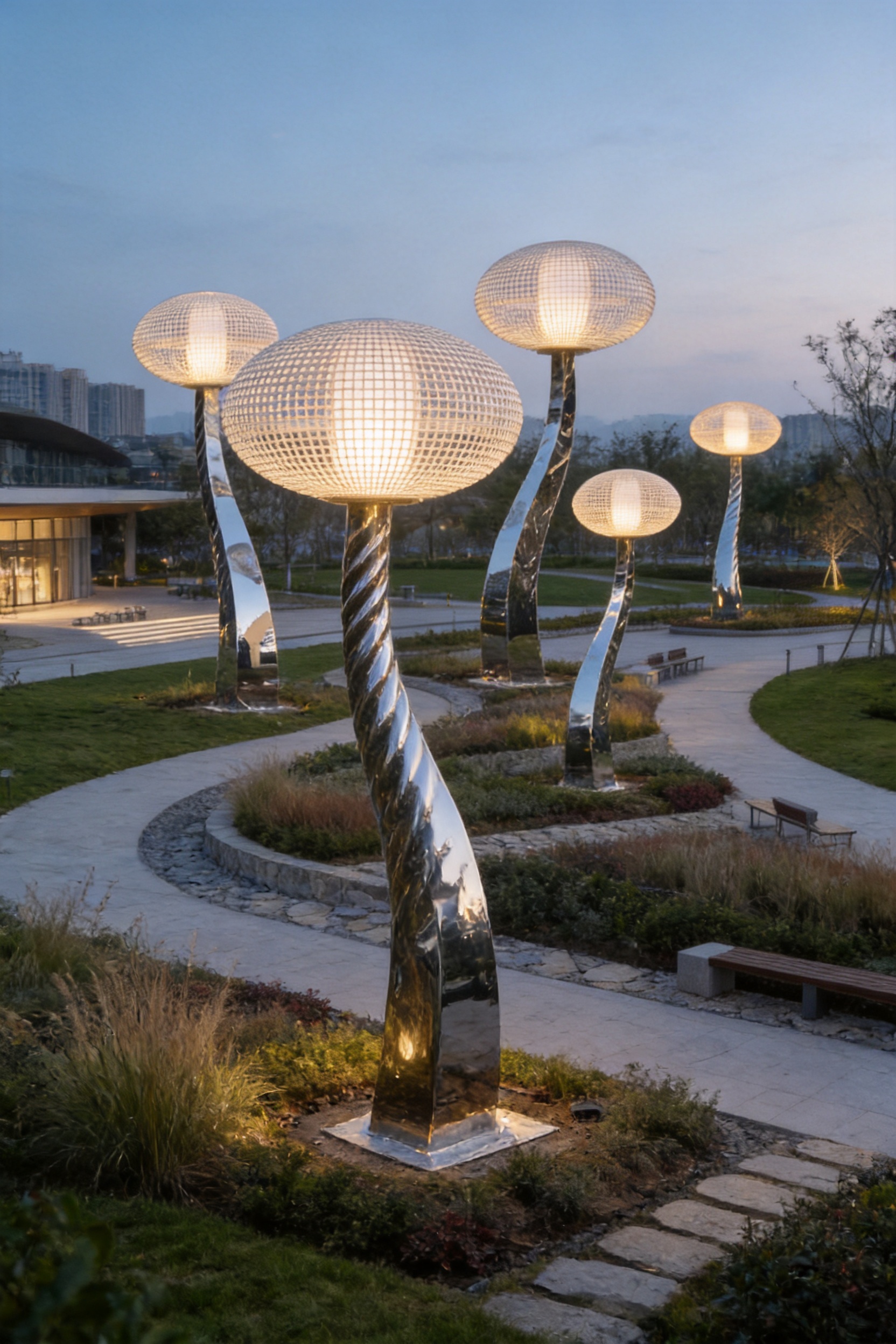
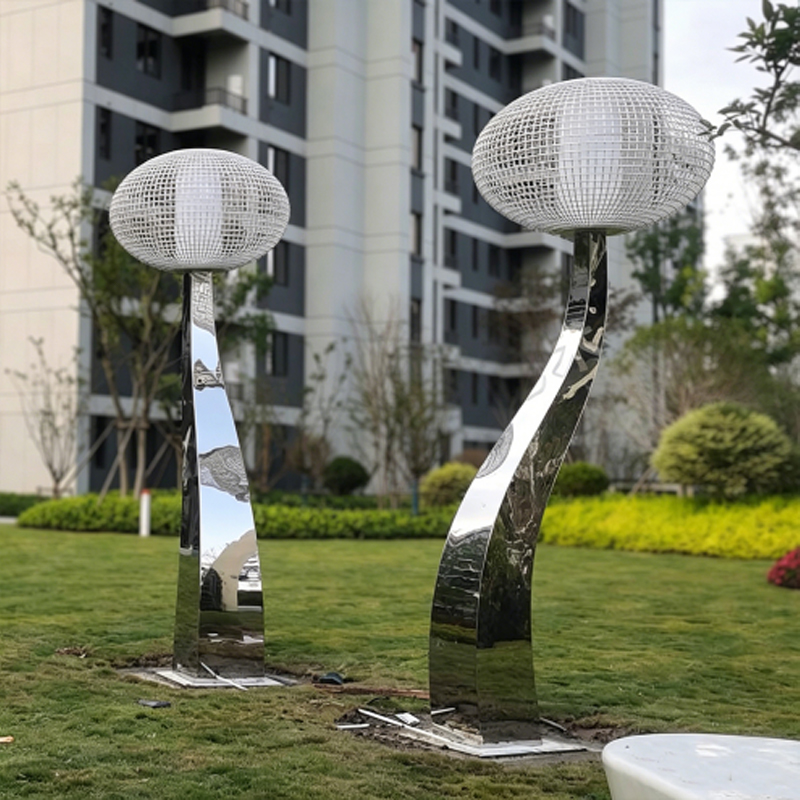
Designed as a two-part stainless steel composition, the sculpture consists of a gently twisted stem and a rounded mushroom cap formed with an extensive network of hollow-cut perforations. The stem is mirror polished to create a refined, reflective appearance, while the cap is structured around deliberate open spaces that accommodate an integrated LED lighting system. When the light is switched on after dark, the cap becomes a glowing lantern-like volume. Light passes through the perforations and produces a soft, dappled pattern across nearby paving, planting, lawn, and architectural surfaces.
This combination of art and illumination gives the sculpture a practical advantage over conventional outdoor statues that are visible only in daylight. It also offers greater artistic flexibility than ordinary landscape lights, which are generally designed to provide illumination without becoming a major visual object. The mushroom sculpture performs both roles while maintaining a strong identity in either lighting condition.
Illuminated Hollow-Out Mushroom Stainless Steel Sculpture
Content
The most important quality of this stainless steel mushroom sculpture is its dual-time character. During the day, the polished stem reflects the changing colors and forms of its surroundings. Sunlight, clouds, nearby greenery, paving, and adjacent buildings can all appear subtly across the curved surface. The cap provides contrast through its perforated construction, allowing the sculpture to read as a light, open, and contemporary interpretation of a natural mushroom form.
After sunset, the visual experience changes completely. The integrated LED source illuminates the hollow interior of the cap, and the light escapes through the carefully arranged openings. Instead of presenting a single harsh point of light, the cap becomes a glowing field of punctuated illumination. This creates a gentle atmosphere that can be playful in a family park, elegant in a hotel garden, welcoming in a sales-center landscape, or imaginative in a tourism destination.
Many decorative statues lose their visual impact when natural light disappears. They may require separate floodlights, uplights, or spotlights to remain visible at night. Such additional equipment can introduce extra design work, more cabling, more installation points, and a risk that the lighting will appear detached from the sculpture. In contrast, the lighting system in this design is planned as part of the sculpture itself. The cap is not merely illuminated from outside; it is conceived as a luminous architectural shell.
The result is a more unified appearance. The light source remains visually integrated with the form, while the perforations control the way the illumination reaches the exterior. This allows the sculpture to serve as a visual centerpiece without requiring a large collection of supplementary fixtures around its base.
The sculpture is fabricated from 304 or 316 stainless steel, two grades widely selected for demanding architectural, landscape, and public-art applications. Stainless steel provides a strong balance of structural performance, corrosion resistance, clean appearance, and design flexibility. These characteristics are especially valuable for outdoor sculptures that must remain exposed to rain, humidity, sunlight, temperature changes, and airborne pollutants.
Grade 304 stainless steel is a practical choice for many residential, commercial, garden, and inland public environments. It offers a durable surface and a refined appearance while supporting forming, cutting, welding, and finishing operations. Grade 316 stainless steel provides enhanced resistance in more aggressive conditions, including coastal areas or locations where salt and moisture may be persistent. The appropriate grade can be selected according to the installation environment, project specification, budget, and expected service conditions.
Compared with ordinary painted mild steel, stainless steel does not depend on a conventional paint film as its primary visual protection. Painted steel can be attractive, but scratches, impact damage, edge exposure, and long-term weathering may eventually require repair and recoating. Stainless steel offers a different maintenance profile. Its natural metallic character remains part of the design, and a properly finished surface can retain a clean, contemporary appearance with routine cleaning.
Compared with many nonmetallic materials, stainless steel also provides a stronger sense of permanence. Fiberglass, resin, and plastic-based sculptures can support complex forms, but their surfaces may be more susceptible to fading, impact damage, thermal movement, or surface aging depending on the formulation and finish. Marble and stone have their own advantages, yet they cannot easily provide a thin perforated cap with integrated illumination in the same lightweight, open, and reflective manner.
The use of 304/316 stainless steel therefore supports both artistic ambition and practical performance. It allows the manufacturer to form a twisted stem, create precisely cut openings, weld the cap sections into a unified body, and finish selected surfaces to create a strong contrast between solid metal and transmitted light.
The stem is more than a support column. Its gentle torsion gives the sculpture a sense of movement and distinguishes it from a basic cylindrical mushroom form. The curve rises continuously from the base toward the cap, creating an organic transition that suggests growth rather than mechanical assembly.
Producing this visual effect requires careful forming and welding. The stem must be shaped so that its twist remains smooth and proportionate over the full height of the sculpture. Abrupt changes in direction could make the object appear unstable or overly fabricated. A controlled, continuous curve gives the stem a more natural rhythm and allows the cap to appear supported by a living, growing form.
Welding is also important to the finished appearance. Joints must be planned so that the assembled sections behave visually as one continuous stem. Poorly positioned or insufficiently finished seams could interrupt the polished surface and reduce the sense of refinement. Careful welding, grinding, and surface preparation help maintain the clean transition expected from a high-quality stainless steel sculpture.
The stem can be produced in different proportions according to the requested height and installation context. A shorter version may be suitable for a private garden, courtyard, entrance path, or children’s activity area. A taller version can create a stronger landmark effect in a public park, resort, commercial plaza, or large planting bed. Because the height is customizable, the sculpture can be coordinated with surrounding trees, buildings, pathways, seating zones, and other landscape elements.
The rounded cap is the signature element of the sculpture. It is fabricated from cut stainless steel sections that are welded together while retaining deliberate gaps and hollow-cut openings. These perforations are not decorative details added after the form is completed; they are central to both the visual identity and the nighttime performance of the piece.
In daylight, the openings make the cap appear lighter and more breathable. They interrupt the solid volume, reveal fragments of the background, and create changing patterns of shadow as the sun moves. From different viewpoints, the sculpture can appear denser or more open, allowing visitors to experience a subtle variation in its silhouette.
At night, the openings become a light-distribution system. The integrated LED source illuminates the internal volume, and the perforations release the light in multiple directions. This creates a soft pattern rather than a uniform opaque glow. On the ground, the effect can resemble scattered points of light. On foliage, nearby walls, and paving, it may produce an atmospheric texture that adds depth to the landscape.
The size, spacing, and arrangement of openings influence the final effect. Smaller openings can produce a more delicate, star-like appearance, while larger openings can create bolder patches of illumination. A balanced perforation network helps preserve the structural integrity of the cap while giving the light enough pathways to create a visible nighttime pattern.
This design provides a competitive advantage over solid metal sculptures that require external lighting. It also differs from simple perforated light fixtures because the cap is designed as a recognizable sculptural form with a natural reference. The object remains meaningful and attractive even when the lighting is turned off.
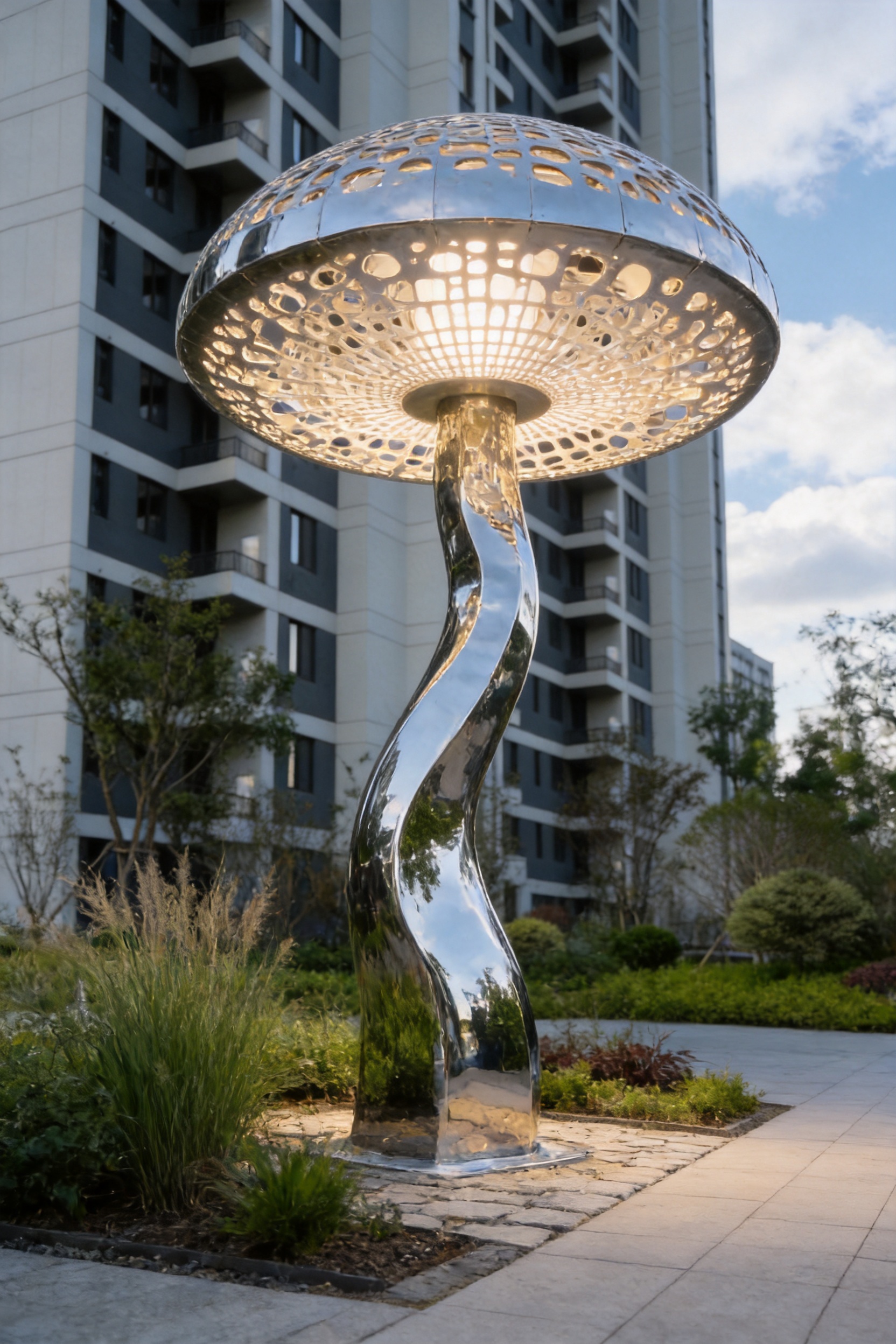
The lighting system is integrated within the hollow interior of the mushroom cap. This arrangement protects the light source from direct visual exposure while allowing the cap itself to glow. It also reduces the need for external spotlights that might create glare, harsh shadows, or an inconsistent appearance.
LED technology is well suited to this type of installation because it can provide strong illumination with comparatively low energy consumption and a compact form factor. The light source can be positioned within the cap so that the internal space distributes the glow before it reaches the perforations. This helps create a softer and more even visual result than placing a bare lamp directly behind a single opening.
The lighting system may be specified according to project requirements, including operating schedule, desired brightness, color appearance, control method, and electrical conditions. A warm white setting can support a relaxed garden or hospitality environment. A neutral or cooler white appearance may suit a modern commercial plaza or contemporary public-art setting. For projects that require changing scenes, the lighting arrangement can be discussed during customization, subject to the selected electrical and control configuration.
As with any outdoor electrical installation, the final project should include suitable grounding, cable protection, drainage planning, connection points, and professional installation. The sculpture’s sealed LED components are intended for reliable outdoor operation, but performance depends on correct site preparation and compliance with local electrical standards.
Another advantage is operational continuity. A conventional statue may require separate lighting equipment to remain visible after dark. A standard garden lamp may illuminate the ground but have little presence during the day. This sculpture bridges the gap. Its lighting function is built into the artwork, reducing the visual conflict between object and fixture and helping the entire installation feel intentional.
The manufacturing process begins with the development of the sculpture’s overall proportions. Height, cap diameter, stem profile, base requirements, perforation pattern, surface finish, and lighting arrangement must be considered together. This integrated planning is essential because changes to one element can affect the others. For example, a taller sculpture may require a different internal structure, while a denser perforation pattern may influence the way light spreads across the cap.
After the design direction is confirmed, the stainless steel sections are prepared for forming and cutting. The stem components are shaped to achieve the required torsion and continuous curve. The cap sections are cut to create the intended rounded profile and openwork network. Precise preparation at this stage helps reduce distortion during assembly and supports cleaner alignment between adjacent sections.
The formed sections are then welded into the stem and cap assemblies. Welding is central to the sculpture’s structural integrity, but it also affects its appearance. The manufacturer must manage joint placement, alignment, heat input, and finishing so that the assembled piece retains the visual smoothness of the original design. A carefully executed welded structure allows the sculpture to appear fluid rather than visibly segmented.
For the stem, the principal manufacturing challenge is preserving the elegant twist. The curve must be sufficiently expressive to create an organic impression, yet controlled enough to support the cap and distribute loads toward the base. For the cap, the challenge is balancing openwork with strength. The perforations need to be visually generous without compromising the stability of the fabricated shell.
Following welding, visible areas can be ground and prepared for finishing. The stem is mirror polished, creating a reflective surface that emphasizes the sculpture’s continuous curve. Mirror polishing requires careful surface preparation because scratches, uneven transitions, or residual weld marks may become more noticeable on a reflective finish. The cap may retain a complementary stainless steel appearance while relying on its perforated geometry and internal glow as its principal visual characteristics.
The LED assembly is installed within the hollow cap after the main metal fabrication has been completed and the relevant interior spaces have been prepared. The lighting components must be arranged so they illuminate the cap effectively without interfering with the structure, access points, or drainage considerations. Sealing and protection are important for outdoor use, particularly where rain, humidity, dust, and temperature variation are expected.
Final inspection should consider the dimensional accuracy of the sculpture, the continuity of the stem curve, the quality of perforation edges, the appearance of welds and polished surfaces, the stability of the base, and the operation of the lighting system. These checks help ensure that a sculpture intended for a prominent landscape position meets both aesthetic and functional expectations.
The ability to combine metal forming, precision cutting, stainless steel welding, surface finishing, and lighting integration within one production workflow is a significant strength. Many suppliers specialize in either sculpture fabrication or outdoor lighting, but this product requires both disciplines to work together. The manufacturer’s experience in custom metal sculpture allows the lighting system to be treated as part of the artwork rather than as an unrelated accessory.
The available size range is approximately 1.8 to 5.5 meters, with fully customizable height. This range enables the sculpture to serve different spatial roles. At around the lower end, it can function as an intimate garden accent or a welcoming feature near a path. At the higher end, it can become a landmark visible across a broad lawn, public plaza, resort garden, or tourism park.
Customization can also address the proportions between the stem and cap. A slender stem may create an airy, elegant appearance, while a more substantial stem can provide a stronger visual anchor. The cap can be adjusted in scale to suit the height, surrounding landscape, and desired lighting presence.
Projects may also consider whether one sculpture or a group arrangement is more appropriate. A single unit can provide a clear focal point at an entrance, beside a water feature, near a seating area, or within a formal planting bed. Multiple units at varying heights can create a more natural cluster that resembles mushrooms emerging from the ground. This arrangement is particularly effective in family-oriented parks, resort landscapes, and experiential outdoor spaces.
Grouping different sizes also creates a layered nighttime effect. The smaller forms can provide low-level visual interest, while taller forms establish the main silhouette. When positioned with appropriate spacing, each cap can contribute to the overall light pattern without overwhelming neighboring units. The result may feel more like a designed landscape scene than a collection of identical products.
Clients can discuss the preferred stainless steel grade, overall dimensions, finish requirements, lighting specification, base design, installation conditions, and quantity during the customization process. Since outdoor sculpture projects vary greatly in climate, public access, maintenance expectations, and visual language, project-specific communication is important before production begins.
A conventional outdoor statue may provide a strong daytime presence but remain visually inactive at night. If it is located in a landscape that is used after sunset, separate illumination is usually necessary. The mushroom sculpture addresses this limitation through its integrated glowing cap, allowing the object to remain part of the landscape experience after dark.
Another advantage is its lighter visual character. Solid statues can appear heavy, especially when placed in planting beds or near pedestrian routes. The perforated cap introduces transparency and shadow, reducing the impression of mass while preserving a clear form. The mirror-polished stem further enhances this effect by reflecting its surroundings rather than presenting a completely opaque surface.
The mushroom shape also offers a more approachable emotional language than many monumental or abstract sculptures. Its association with natural growth, new life, and emergence can be appropriate for family environments, educational spaces, leisure destinations, and landscaped commercial developments. The form is recognizable without being overly literal, allowing it to function as both a decorative object and a contemporary art piece.
Compared with generic garden lighting, the sculpture delivers a much stronger identity. A standard bollard or lantern may illuminate a path, but it rarely serves as a memorable landmark. This mushroom design can support wayfinding, establish a themed area, and give visitors a reason to pause, photograph, and remember the location.
Ordinary outdoor light fixtures are generally optimized for brightness, coverage, and utility. They may be practical, but their artistic contribution is often limited. The Illuminated Hollow-Out Mushroom Stainless Steel Sculpture begins with an artistic form and incorporates illumination into that form. This difference gives landscape designers more freedom to use lighting as a creative and spatial tool.
The perforated cap creates a pattern of light that is more nuanced than the direct beam of a spotlight. Because the openings are distributed across the rounded surface, the visual effect can be experienced from several directions. Visitors approaching from different paths may see a changing balance of glowing openings, reflective metal, and dark silhouette.
The sculpture also performs in daylight, when ordinary lighting fixtures may be visually secondary. Its polished stem and sculptural cap remain active elements within the landscape even when the LEDs are switched off. This improves the return on investment for sites that need strong daytime presentation as well as evening atmosphere.
By combining a recognizable natural form, custom scale, stainless steel durability, and integrated light, the product occupies a distinctive position between public art, garden sculpture, and architectural lighting. That combination is difficult to achieve with a standard fixture or a separately illuminated statue.
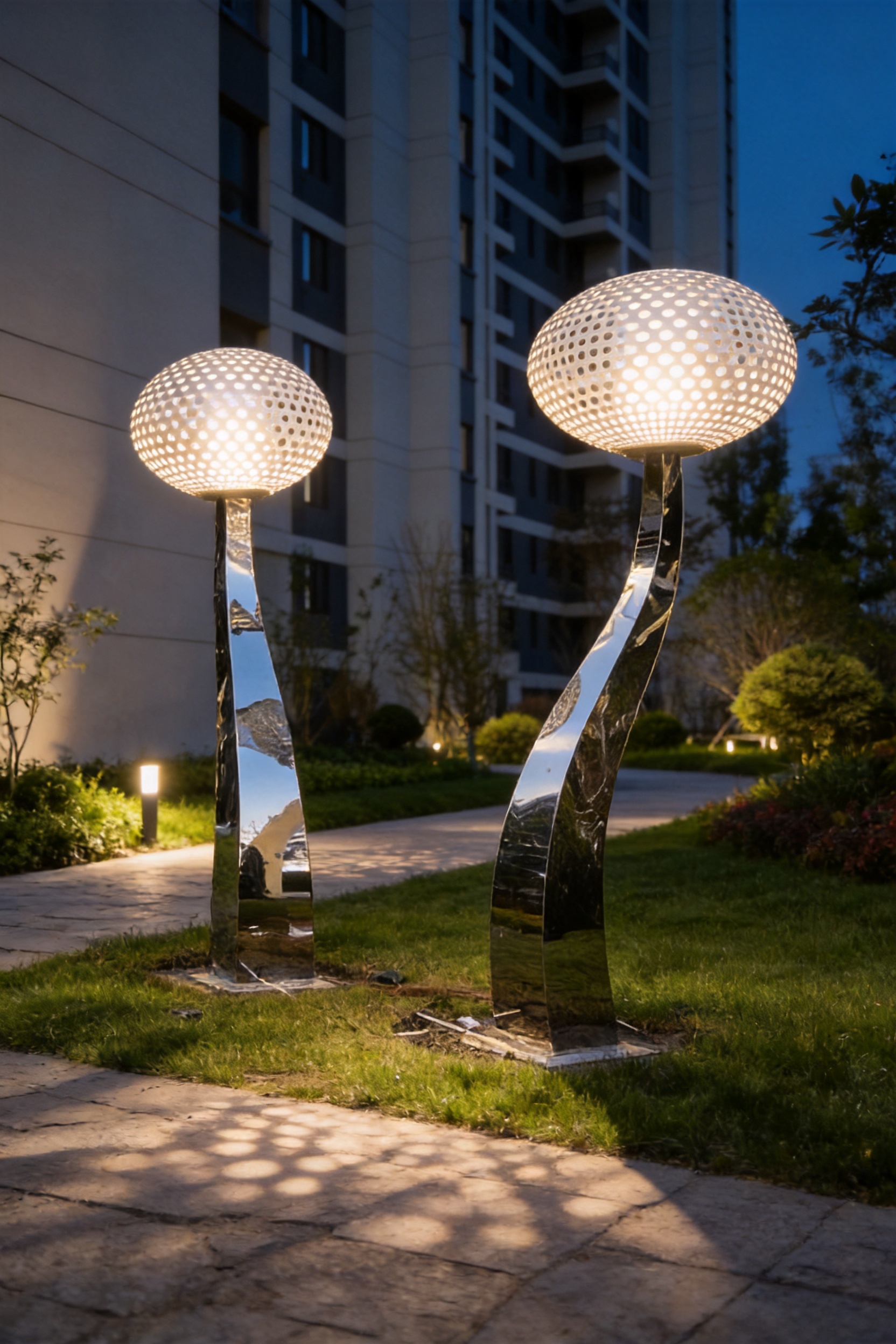
In a residential lawn or private garden, a single mushroom sculpture can become a focal point at the end of a pathway, beside a terrace, or within a planting bed. Its moderate size options allow it to be selected according to the scale of the property. The illuminated cap can provide a subtle evening glow without requiring a visually dominant lighting installation.
For larger private estates, a group of sculptures can be arranged along a garden route or near an outdoor entertaining area. Varying heights can produce a more natural composition, while the stainless steel surfaces introduce a contemporary contrast with grass, shrubs, trees, and stone paving.
The mushroom form is especially suitable for parks and leisure environments where visitors may respond positively to imaginative, nature-inspired objects. During the day, the sculpture can become part of a playful visual scene. At night, the glowing caps can help establish a safe and welcoming atmosphere along selected routes or around gathering areas, provided the overall site lighting plan is properly coordinated.
In family-oriented spaces, the rounded cap and organic stem can appear friendly rather than imposing. A cluster of different sizes may suggest a small illuminated mushroom garden, creating an area that encourages observation, photography, and exploration without relying on complex figurative imagery.
Sales-center landscapes often need memorable features that communicate a sense of quality and lifestyle. The sculpture can be positioned near an entrance, water feature, model-home garden, or central lawn. Its day-and-night performance allows the site to maintain a coherent visual identity during evening tours and events.
The reflective stainless steel can reinforce a modern architectural setting, while the natural mushroom form can soften hard building lines. This contrast may help create a more inviting environment for visitors and provide a recognizable feature that can be incorporated into promotional photography and project branding without placing company or product text directly on the sculpture.
Resorts and tourism parks frequently use themed landscape elements to create memorable visitor experiences. The mushroom sculpture can support woodland, garden, ecological, fantasy, or family-oriented themes. A group arrangement along a resort path can guide guests visually while adding atmosphere to evening walks.
Because the sculpture remains attractive in daylight, it does not need to be hidden or treated as a purely nighttime attraction. The polished stem can reflect seasonal planting and architectural surroundings, while the cap provides a strong visual focus in photographs and visitor viewpoints.
In public plazas, shopping districts, and mixed-use developments, the sculpture can help break up large paved areas and introduce a more organic visual element. Its open cap reduces the heaviness that a solid metal object might create, while the integrated lighting gives the piece continued relevance after sunset.
Multiple sculptures can be used to define a seating zone, mark a transition between hardscape and planting, or create a visual route through a public space. The final placement should account for pedestrian circulation, maintenance access, visibility, electrical connections, and the relationship between light levels and nearby buildings.
Successful installation begins with a review of the site. The design team should consider ground conditions, foundation requirements, wind exposure, drainage, access for delivery, lifting equipment, cable routing, and the location of electrical connections. A taller sculpture or a group installation may require more substantial foundation planning than a small garden accent.
The sculpture should be installed on a stable, appropriately engineered base. The base must transfer the weight and environmental forces safely into the ground while preserving the intended visual relationship between the stem and surrounding landscape. In public areas, the installation should also consider impact protection, pedestrian safety, and the possibility of visitors approaching or touching the sculpture.
Lighting connections should be completed by qualified professionals in accordance with local regulations. Outdoor electrical systems require appropriate weather protection, grounding, cable management, and access for inspection. The lighting enclosure and connection details should remain protected from standing water and unnecessary mechanical damage.
Maintenance is generally straightforward when the sculpture is correctly installed. Stainless steel surfaces can be cleaned periodically to remove dust, fingerprints, mineral deposits, pollution residue, or organic material. Cleaning methods should be selected according to the finish, and abrasive tools that may scratch the mirror-polished stem should be avoided.
The LED system should be checked as part of routine landscape maintenance. Depending on the selected configuration, maintenance may include inspection of seals, cables, connection points, control equipment, and light output. If a replaceable lighting component is used, replacement should follow the supplier’s technical instructions. A regular inspection schedule is especially advisable in public or coastal environments.
Routine care helps preserve the contrast between the reflective stem, the open cap, and the nighttime glow. It also allows minor issues to be identified before they affect the sculpture’s appearance or operation. Stainless steel is durable, but proper cleaning and inspection remain important for achieving the best long-term result.
| Product Type | Daytime Appearance | Nighttime Function | Weather and Maintenance Considerations | Design Flexibility |
|---|---|---|---|---|
| Illuminated hollow-out stainless steel mushroom | Mirror-polished stem with a perforated contemporary cap | Integrated LED glow with patterned light transmission | 304/316 stainless steel with routine cleaning and lighting inspection | Custom height, proportions, finish, lighting, and group arrangement |
| Solid painted mild-steel statue | Opaque painted form with a broad range of colors | Usually requires separate external lighting | Paint may require periodic repair or recoating after weathering or impact | Flexible form, but lighting is generally a separate design element |
| Stone or marble sculpture | Natural, carved, and substantial appearance | Usually requires external illumination | Heavy material; may require attention to staining, cracking, or surface weathering | Strong sculptural presence but limited thin openwork and internal lighting options |
| Fiberglass or resin sculpture | Lightweight and capable of complex shapes | Can include lighting, depending on construction | Performance varies with coating, UV exposure, impact, and temperature changes | High shape flexibility, but metallic reflectivity may be less authentic |
| Standard landscape light fixture | Primarily functional rather than sculptural | Provides practical illumination | Requires fixture and electrical maintenance | Many fixture styles, but limited landmark and artwork value |
The value of this sculpture is not limited to the material cost or the lighting function. It is a combined investment in visual identity, nighttime atmosphere, landscape enhancement, and long-term usability. A project that purchases a conventional statue may later need to budget for separate lighting. A project that purchases only a light fixture may lack a memorable daytime feature. This product addresses both needs in a single coordinated object.
The sculpture’s versatility also supports different project phases. It can be installed as a central landmark during the initial landscape design, or added later as an enhancement to an existing garden, park, or commercial environment. Because the height and arrangement can be customized, the product can be adapted to a broad range of budgets and spatial conditions.
The listed size range of approximately 1.8 to 5.5 meters and price range of about 1,960 to 5,680 U.S. dollars provide a starting point for project planning. Final pricing may vary according to height, stainless steel grade, structural requirements, lighting configuration, finish, quantity, packaging, shipping, and installation conditions. A detailed quotation should therefore be prepared after the project requirements are confirmed.
For buyers comparing suppliers, the key question is not simply whether a manufacturer can produce a mushroom shape. The more important question is whether the supplier can coordinate the sculpture’s structural form, openwork cap, polished surface, weld quality, LED integration, weather resistance, and custom dimensions. The production strengths of Jiangsu Xinyesheng Sculpture Co., Ltd. are relevant because the company specializes in custom metal statues and sculptures and can address these elements as one manufacturing project.
Custom sculpture production requires more than a catalog design. Each project may involve different dimensions, site conditions, finish preferences, lighting requirements, and delivery arrangements. A manufacturer experienced in custom metal sculpture can help translate a general concept into a buildable object while preserving the visual qualities that made the concept attractive.
For the illuminated mushroom sculpture, manufacturing expertise is particularly important in the relationship between the cap and stem. The cap must appear naturally supported, yet contain sufficient internal space for the lighting assembly. The stem must remain visually smooth, structurally dependable, and proportionate to the selected cap. The perforation network must be attractive from multiple viewpoints while remaining suitable for fabrication and long-term outdoor exposure.
The company’s stated product capabilities include stainless steel sculpture fabrication, custom design, metal forming, welding, polishing, and outdoor decorative sculpture production. These capabilities support a production approach in which the customer’s selected size and site requirements can be incorporated before fabrication begins. They also make it possible to produce individual pieces or coordinated groups for larger landscape schemes.
A professional manufacturing workflow should maintain communication at key stages: design confirmation, material selection, dimensional review, production, surface finishing, lighting integration, inspection, and packing. Clear approval of these stages reduces uncertainty and helps ensure that the delivered sculpture matches the intended visual and functional specification.
For international buyers, packaging and transport planning are also important. A sculpture with a large rounded cap and polished stem must be protected against abrasion, impact, moisture, and deformation during handling. The shipping arrangement should be discussed according to the final dimensions and the destination. Installation instructions and component identification can also help the receiving team prepare the site efficiently.
Although one sculpture can function effectively as a focal point, a cluster often creates a more immersive landscape experience. The concept is simple: several mushroom sculptures are placed together at different heights and, where appropriate, with varied cap sizes. The group appears to emerge from the ground as a natural colony, while the illumination turns the planting bed into a subtle nighttime scene.
Cluster design should avoid an overly rigid grid unless a formal architectural effect is desired. Slight differences in spacing and orientation can create a more organic impression. The tallest sculpture may be placed toward the rear of the composition, with shorter forms positioned closer to the pathway or viewing area. This arrangement helps preserve visibility and creates a layered silhouette.
Planting can reinforce the concept. Low grasses, groundcovers, shrubs, mulch, stones, and seasonal flowers may be selected to frame the stems without hiding the lower portions. The surrounding planting should also allow access for cleaning, electrical inspection, and future landscape maintenance.
At night, the spacing between the sculptures affects how the light patterns overlap. If units are too close together, their glow may merge into one indistinct mass. If they are too far apart, the cluster may lose its sense of connection. A thoughtful layout can create a progression from one illuminated form to the next, guiding visitors through the space.
The use of durable stainless steel can support a longer service life than materials that require frequent replacement or complete refinishing. A long-lasting sculpture reduces the need to remove and replace a major landscape feature, which can help limit future material consumption and disruption to established planting.
LED illumination can also support more efficient operation than many older lighting technologies, especially when the system is controlled through appropriate schedules, timers, sensors, or centralized landscape-management equipment. The lighting does not need to operate continuously if the site is closed during certain hours. Timed operation can preserve the nighttime effect while reducing unnecessary energy use.
Responsible design should also consider light spill. The perforated cap naturally distributes light in multiple directions, but the final brightness and placement should be coordinated with nearby residences, roads, wildlife-sensitive areas, and neighboring facilities. A well-planned installation can create atmosphere without producing excessive glare or disturbance.
The environmental suitability of the sculpture depends on the complete project, including material selection, electrical design, foundation construction, operating schedule, maintenance methods, and eventual end-of-life handling. These factors can be reviewed with the manufacturer and project consultants during the planning stage.
Before requesting a formal quotation, buyers should prepare several basic details. These include the intended installation location, required height, estimated quantity, preferred stainless steel grade, desired finish, lighting schedule, electrical conditions, delivery destination, and expected installation date. Photographs, landscape plans, or approximate dimensions of the site can help the manufacturer understand the context.
It is also useful to clarify whether the sculpture will be viewed mainly from one direction or from multiple pedestrian routes. A sculpture in the center of a plaza should be visually resolved from all sides, while a piece placed against a planting border may have a more defined primary viewpoint. This information can influence cap perforation patterns, stem orientation, and the preferred proportions.
Clients should ask for confirmation of the final dimensions, material grade, surface treatment, lighting specification, structural arrangement, connection requirements, packing method, and installation recommendations. These details are particularly important for large custom pieces because minor changes can affect shipping, foundation preparation, and onsite assembly.
When ordering several units, the buyer may choose between identical repetition and coordinated variation. Identical sculptures create a clean, consistent visual language. Different heights and proportions create a more natural cluster. Both approaches are valid, and the choice should reflect the architectural character and visitor experience of the site.
The sculpture is made from 304 or 316 stainless steel. The appropriate grade can be selected according to the site environment, corrosion exposure, project requirements, and budget. Grade 316 may be particularly suitable for coastal or more aggressive conditions.
Yes. The hollow cap contains an integrated LED lighting system. When illuminated, light passes through the perforations and creates a glowing, lantern-like appearance with a dappled pattern on nearby surfaces.
Yes. During the day, the mirror-polished twisted stem and perforated stainless steel cap provide a complete sculptural composition. The sculpture is designed to function as artwork in daylight and as an illuminated landscape feature after dark.
The standard range is approximately 1.8 to 5.5 meters in height. The height can be customized, and proportions may be discussed according to the site, viewing distance, landscape scale, and desired visual impact.
Yes. Multiple units can be grouped at varying heights to create the appearance of a natural mushroom cluster. This arrangement is well suited to parks, resorts, family-oriented destinations, residential gardens, and planting beds near public walkways.
The 304/316 stainless steel construction and sealed LED components are intended for outdoor operation. Correct installation, suitable grounding, weather-protected electrical connections, proper foundation design, and periodic maintenance are still required for reliable long-term performance.
Maintenance generally includes periodic cleaning of the stainless steel surface and inspection of the LED system, seals, cables, and connection points. The mirror-polished stem should be cleaned with methods that avoid scratching. Lighting components should be serviced or replaced according to the selected system and technical instructions.
Lighting requirements can be discussed during the design and quotation stage. Depending on the selected configuration, the project may specify the preferred light appearance, brightness, control method, and operating schedule. Final options should be confirmed with the manufacturer before production.
The cap is fabricated from cut stainless steel sections that are assembled and welded together. The construction leaves deliberate hollow-cut openings for the openwork appearance and for the light to pass through the cap.
Its illumination is integrated into the hollow cap rather than added as a separate external spotlight. The perforations distribute the light, while the polished twisted stem and recognizable mushroom form provide a strong daytime identity. It combines public art, decorative sculpture, and landscape lighting in one coordinated product.
Useful information includes the requested height, quantity, installation location, stainless steel grade, finish, lighting requirements, delivery destination, preferred delivery schedule, and any available site drawings or photographs. These details help the manufacturer prepare an accurate proposal.
The listed price range is approximately 1,960 to 5,680 U.S. dollars, depending on size and specifications. The final quotation may change according to customization, material grade, lighting configuration, packaging, shipping, and installation requirements.
The Illuminated Hollow-Out Mushroom Stainless Steel Sculpture is designed for projects that need more than a static outdoor ornament. Its 304/316 stainless steel construction provides a durable and refined material platform. The twisted mirror-polished stem contributes movement and elegance, while the perforated cap creates both a distinctive daytime silhouette and an atmospheric nighttime glow.
Its strongest competitive advantage is the integration of sculpture and lighting. Instead of treating illumination as an afterthought, the product makes light part of the form. This allows it to remain visually useful throughout the day and evening, while reducing the need for separate decorative lighting equipment. Its natural mushroom theme also gives it a welcoming, flexible character suitable for gardens, parks, sales centers, resorts, tourism parks, and commercial landscapes.
The manufacturer’s custom metal-sculpture capabilities support the product’s key requirements, including stainless steel forming, section cutting, controlled welding, mirror polishing, perforated cap fabrication, and LED integration. Through customizable height, finish, lighting, and group arrangement, the sculpture can be adapted from a small garden accent to a large public-space landmark.
For landscape designers, developers, architects, hospitality operators, and private clients seeking a memorable outdoor feature, this sculpture offers a balanced combination of durability, artistry, functionality, and nighttime atmosphere. Proper site planning and professional installation will help ensure that the finished work performs as intended and remains an engaging part of the landscape for years to come.
1. Product specification information for the Illuminated Hollow-Out Mushroom Stainless Steel Sculpture, including material, dimensions, lighting, applications, and pricing.
2. General technical guidance on 304 and 316 austenitic stainless steel for outdoor architectural and landscape applications.
3. General principles of stainless steel forming, fabrication, welding, grinding, and mirror polishing.
4. General guidance on LED lighting integration, outdoor electrical protection, grounding, sealing, and maintenance.
5. Landscape design principles for focal points, pathway illumination, planting-bed composition, public-space art, and nighttime visitor experience.
6. General considerations for custom outdoor sculpture planning, transportation, foundation preparation, installation, and long-term care.



Daniel H.

Amanda R.

Robert B.

Jennifer S.

James W.

Barry G.

Michael T.

Emily K.

David L.

Sarah M.


Mikey XV

Jagxue

 English
 Español
 عربى
عربى Français
 italiano
 Deutsch