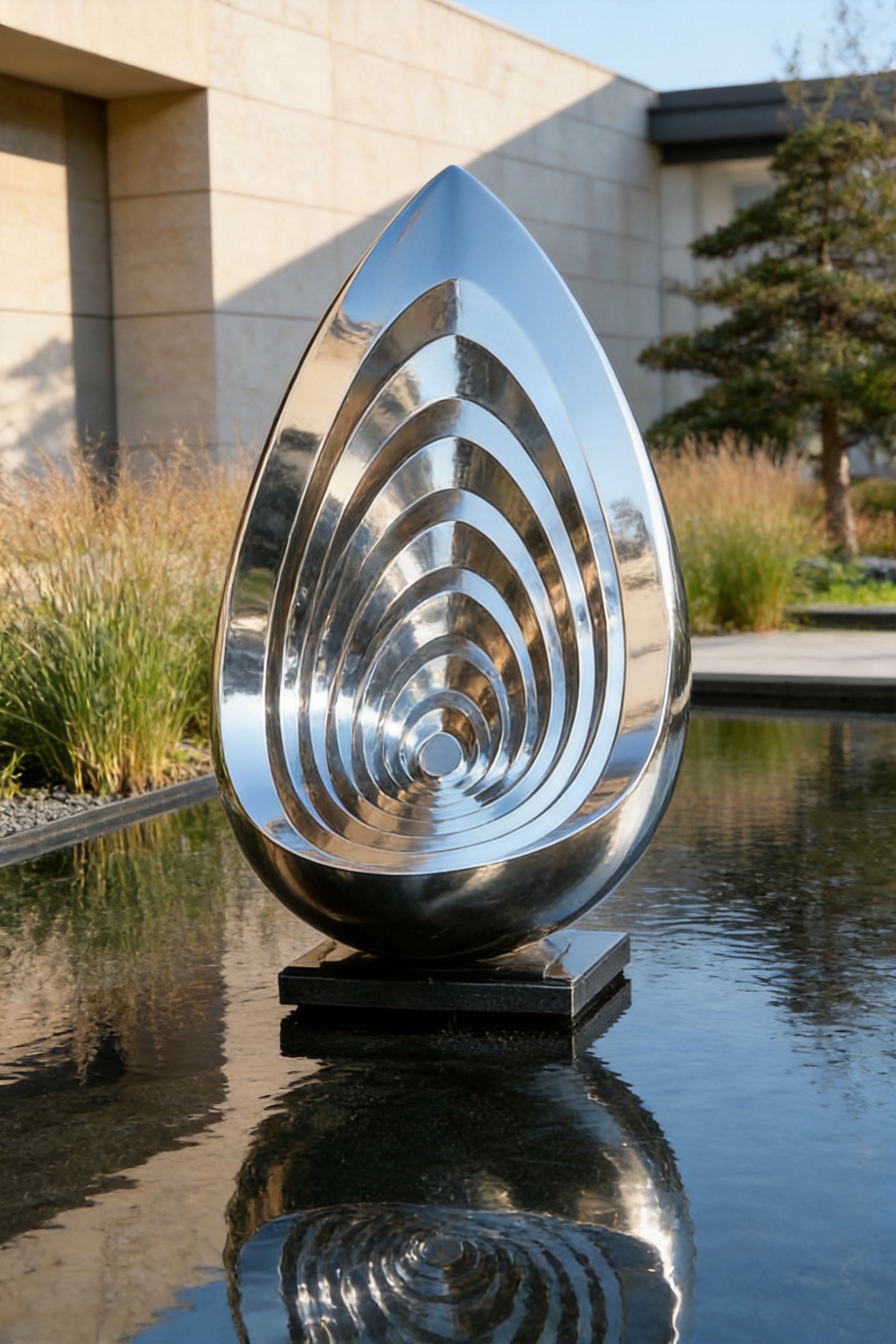
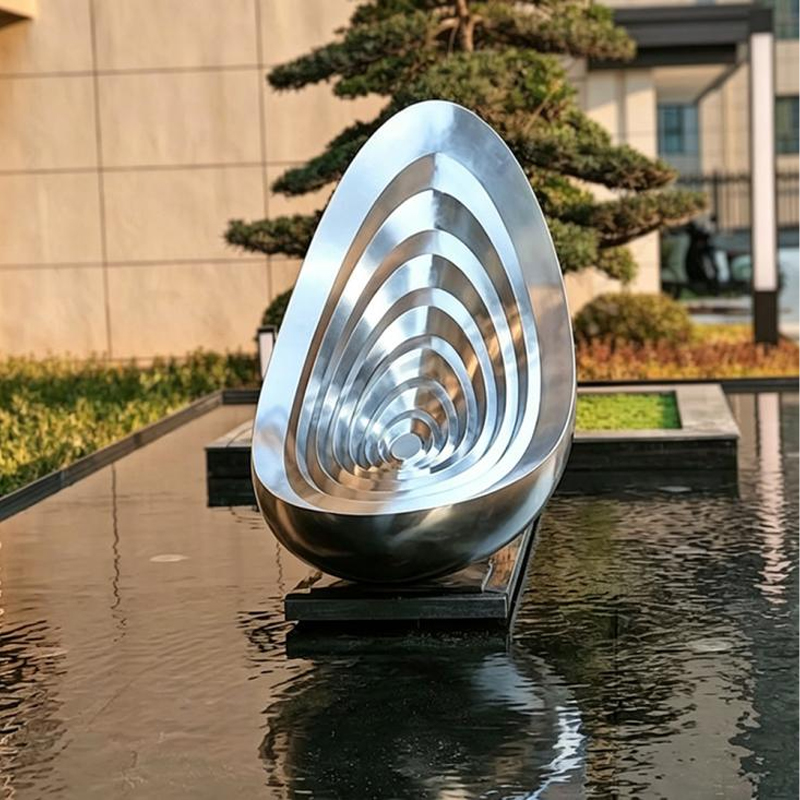
Rippled Water-Drop Stainless Steel Sculpture
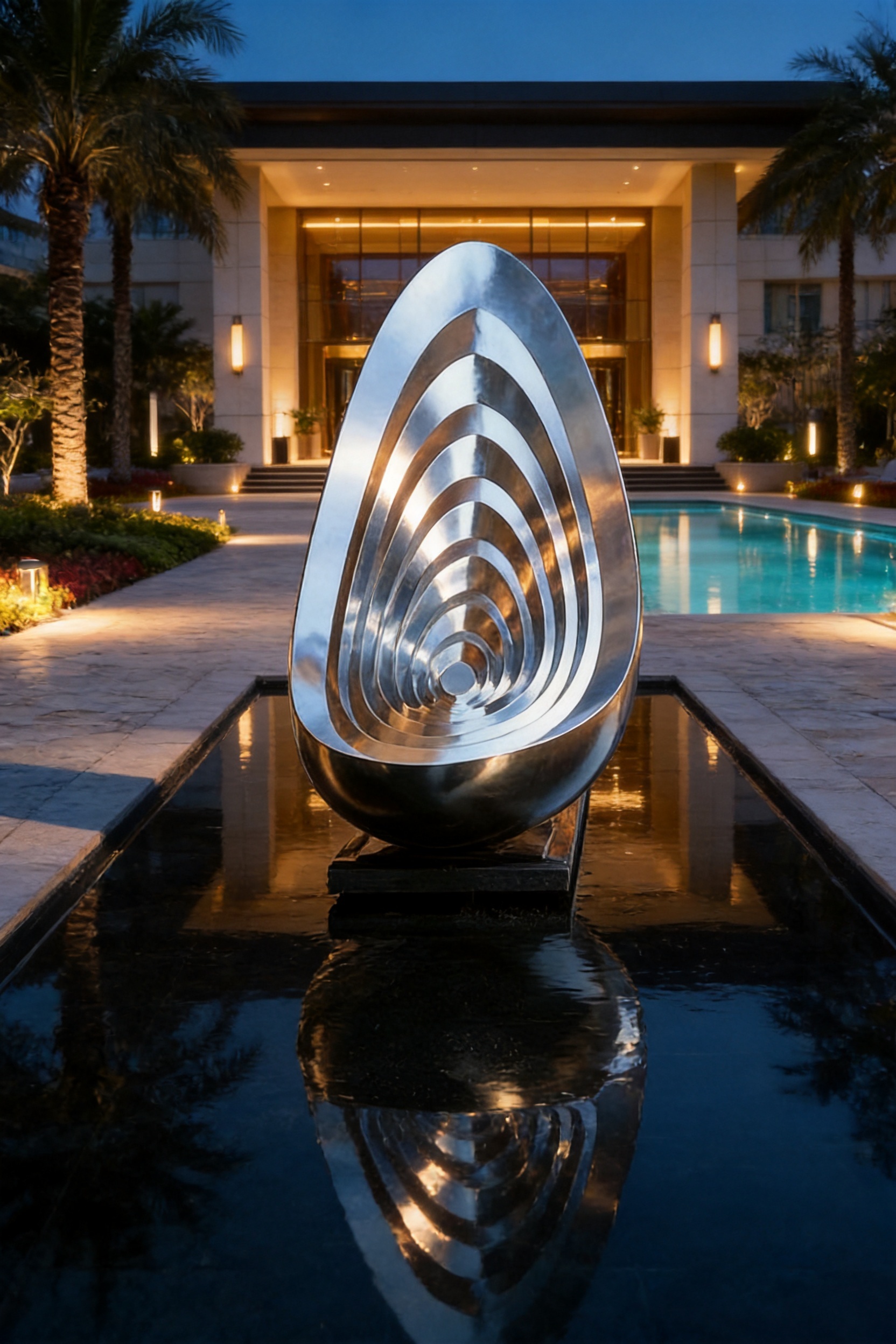
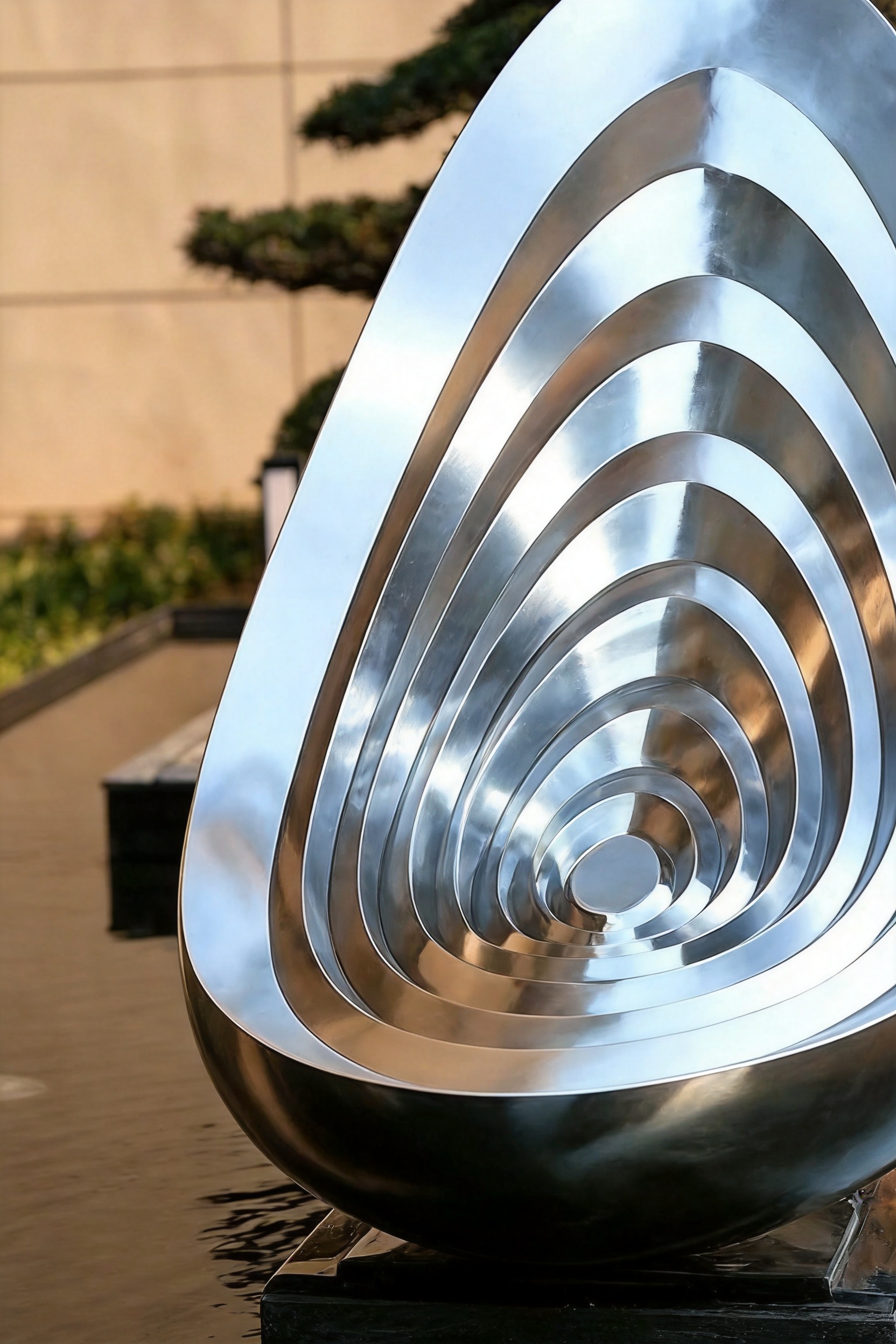
The Rippled Water-Drop Stainless Steel Sculpture transforms the visual language of a single drop striking calm water into a permanent three-dimensional work of art. Rather than representing a splash through a flat relief or a simple circular outline, the sculpture is built from distinct concentric layers of stainless steel. Each layer is separately forged, shaped, finished, and assembled so that the completed form resembles an expanding ring of water suspended in motion.
Its design combines the serenity of still water with the precision of architectural metalwork. The surface rises and recedes through carefully arranged ridges and channels, creating an alternating rhythm of reflection and shadow. When daylight, landscape lighting, or nearby water moves across the sculpture, the mirror-polished surfaces appear to shift continuously. The result is a sculptural focal point that feels both calm and dynamic: calm because of its balanced circular composition, and dynamic because the layered geometry suggests outward movement.
Manufactured in 304 or 316 stainless steel and finished with an 8K mirror polish, the sculpture is intended for demanding interior and exterior environments. It can be installed beside a still-water feature, within a landscaped garden, near a hotel pool, in a sales office, at a private club, or as a freestanding public-facing artwork. Available sizes range from 1.1 meters to 4.6 meters, allowing the design to function as a relatively intimate decorative piece or as a highly visible architectural centerpiece.
For buyers seeking a custom design metal statue with a refined European-style presence, this sculpture offers a distinctive alternative to conventional statues, abstract blocks, or generic circular ornaments. Its strongest advantage is not merely the use of stainless steel. It is the combination of a recognizable natural metaphor, complex concentric fabrication, carefully controlled surface finishing, and suitability for both dry landscapes and water-oriented installations.
Content
The central image behind the sculpture is simple and universally understandable: a single drop touches still water, and a series of ripples travels outward from the point of impact. This moment contains a sense of cause and consequence. A small event creates a pattern that extends across a much larger surface. In a commercial or hospitality setting, that visual idea can suggest influence, connection, prosperity, and good fortune spreading from one point to another.
The sculpture captures this metaphor through a three-dimensional arrangement of concentric forms. The central area establishes the visual starting point, while the surrounding layers expand in measured intervals. Unlike a printed image or a shallow decorative panel, the work gives the ripple structure physical volume. The viewer can observe the form from the front, side, and oblique angles, with each viewpoint revealing different relationships between the raised ridges and recessed channels.
The circular organization also gives the sculpture a naturally balanced appearance. Concentric forms draw the eye toward the center while simultaneously guiding it outward. This creates a visual experience that can be read in two directions: inward toward the original point of impact, or outward toward the spreading rings. Such flexibility allows the sculpture to remain engaging when viewed from different distances or when positioned in a large open setting.
In a water garden, the form can echo the actual circular movement of water around it. Beside a pool or still-water feature, the sculpture becomes part of a visual dialogue between solid metal and liquid surface. The artwork seems to preserve a ripple in a permanent state, while the nearby water provides changing reflections, movement, and sound. This connection can help a landscape feel more intentional and integrated than one containing an isolated decorative object.
The design is equally effective without water. In a garden, entrance court, sales center, or hotel landscape, the ripple pattern remains legible as a symbol of movement and continuity. Because the form does not depend on a mechanical water system, it can provide a water-inspired atmosphere in locations where a functioning fountain or pool would be impractical.
The sculpture’s visual quality begins with its construction method. It is built up from separate concentric layers rather than being treated as a single undifferentiated mass. Each layer must be formed to follow the intended curvature and then positioned so that it aligns smoothly with the layers surrounding it. This approach gives the final work a clear sense of depth and makes the ripple pattern more pronounced than a simple polished disc or stamped metal surface.
Separate layer construction also allows the fabricator to control the spacing, height, profile, and transitions of the ripples with greater precision. The raised ridges must remain visually consistent as they travel around the form, while the recessed channels must maintain enough depth to create visible shadow. If the intervals become irregular, the natural rhythm of the design can be weakened. If adjacent sections do not meet accurately, the sculpture may lose the impression of a continuous expanding wave.
For this reason, the process requires planning before fabrication begins. The overall three-dimensional geometry must be considered in relation to the individual pieces. Designers and fabricators need to anticipate how the layers will curve, how they will be assembled, and how the final surface will appear under direct and reflected light. A ripple that looks evenly spaced in a drawing must remain evenly spaced after it has been shaped around a continuously curving form.
The construction method also contributes to the sculpture’s visual hierarchy. The center can be defined as the origin of the water-drop impact, while each surrounding layer creates a progressively larger wave. The eye recognizes the relationship immediately, yet the physical depth rewards closer inspection. This balance between instant readability and detailed craftsmanship is an important advantage over mass-produced decorative objects with little variation in surface structure.
Once the layers have been formed and assembled, the sculpture is refined as a unified work. The transitions between neighboring sections must support a continuous visual flow. The finished piece should not appear to be a collection of unrelated rings placed together. Instead, it should read as one coherent ripple whose components have been carefully coordinated from the center to the outer edge.
The sculpture is available in 304 or 316 stainless steel. Both grades are widely valued for their corrosion resistance, clean appearance, and suitability for architectural and decorative applications. Their use provides a durable foundation for a sculpture that may be exposed to outdoor air, moisture, landscape irrigation, pool surroundings, or prolonged contact with a humid environment.
For installations close to water, material selection is especially important. A sculpture placed beside a still-water feature or pool must tolerate repeated exposure to moisture without quickly losing its surface quality. The stainless-steel construction is designed to resist corrosion under these conditions, while the choice between 304 and 316 can be considered according to the installation environment and the purchaser’s project requirements.
316 stainless steel is often selected for more aggressive or moisture-intensive environments, while 304 stainless steel remains a reliable option for many indoor and outdoor applications. The appropriate grade should be discussed during project planning, particularly when the sculpture will be installed in a coastal area, near treated pool water, or in a location exposed to salts and industrial contaminants. Proper site assessment, drainage, installation, and routine maintenance remain important regardless of the selected grade.
Compared with ordinary painted steel, stainless steel offers a more permanent visual character. Painted surfaces can chip, fade, or require refinishing when exposed to weather. Stainless steel does not depend on a decorative paint film to create its primary appearance. Its polished metal surface is integral to the design, allowing the sculpture to retain a crisp, contemporary character when properly maintained.
Compared with many soft or porous materials, stainless steel also provides practical advantages in public and commercial environments. It is nonporous, visually clean, and compatible with routine surface cleaning. These characteristics are useful for hotels, clubs, commercial courtyards, and other locations where an artwork must maintain a refined appearance while being exposed to frequent visitors and changing environmental conditions.
| Feature | Project Benefit | Typical Relevance |
|---|---|---|
| 304 or 316 stainless steel | Corrosion-resistant metal construction | Gardens, pools, water features, entrances, and interior spaces |
| Distinct concentric layers | Creates physical depth and a recognizable ripple pattern | Contemporary landscapes and architectural focal points |
| 8K mirror polish | Produces strong reflections and highlights the form | Daylight settings, landscape lighting, and reflective water environments |
| Raised ridges and recessed channels | Generates contrast between bright metal and deep shadow | Long-distance visibility and close-range visual detail |
| Sizes from 1.1 to 4.6 meters | Supports different spatial and architectural requirements | Private gardens, commercial courtyards, hotels, and public-facing sites |
| Routine-cleaning maintenance | Helps preserve surface clarity without complex restoration | Hospitality and commercial properties |
The sculpture’s mirror-polished finish is central to its identity. An 8K polish creates a highly reflective surface capable of capturing the surrounding environment. Sky, planting, architecture, water, and artificial lighting can all appear across the metal, causing the sculpture to change visually as the conditions around it change.
Reflection alone, however, does not explain the sculpture’s impact. The layered geometry determines how the reflected light is distributed. Raised ridges catch bright highlights, while the recessed channels remain comparatively dark. This produces a rhythmic alternation between light and shadow that emphasizes the circular construction. The surface therefore works in two ways at once: it reflects the setting and reveals its own form.
In direct sunlight, the polished ridges may appear bright and energetic, while the channels add visual depth. Under softer daylight, the reflections can become more subdued, allowing the overall outline to feel calmer. At night, carefully positioned landscape lights can emphasize the concentric layers without requiring excessive illumination. Lighting designers can use grazing angles to reveal the relief or broader illumination to create a luminous, reflective centerpiece.
The finish also gives the sculpture a changing relationship with its surroundings. A garden installation may reflect green foliage during the day, warm architectural lighting in the evening, and darker silhouettes after sunset. Beside water, the reflected surface can take on additional movement as ripples in the adjacent pool or feature distort the reflected image. This makes the sculpture feel responsive without incorporating motors or mechanical components.
Many competing decorative sculptures use a uniform matte finish or a single painted color. Those finishes can offer strength and simplicity, but they generally produce a more fixed appearance. The 8K mirror-polished surface offers a broader range of visual experiences. It can appear silver, blue, green, gold, dark, or nearly transparent depending on the surrounding environment and time of day.
The contrast between reflection and shadow also makes the sculpture readable from a distance. In a large garden or hotel courtyard, visitors may first notice the bright circular outline. As they move closer, the recessed channels and layered profiles become more apparent. This progression gives the work both landmark value and intimate detail.
The Rippled Water-Drop Stainless Steel Sculpture has several advantages over common alternatives used in landscape and architectural decoration. Its strongest competitive distinction is the relationship between concept and fabrication. The form is not an arbitrary arrangement of curves. It is a recognizable interpretation of a natural event, translated into a carefully layered metal structure.
Traditional figurative statues can communicate identity, history, or narrative, but they may not suit every contemporary setting. They can also dominate a landscape with a specific human or animal theme. This ripple sculpture is more adaptable. Its abstract natural motif can complement modern architecture, classical landscaping, hospitality interiors, and private residences without imposing a narrow cultural or thematic message.
Simple metal discs and circular ornaments may offer a similar outline, but they typically lack the layered depth required to create a convincing ripple effect. The distinct concentric construction of this design produces more complex light behavior and a stronger sense of motion. The sculpture can therefore occupy a focal location without relying on excessive size or complicated additional decoration.
Painted metal sculptures may provide color, but their appearance depends heavily on the condition of the coating. The mirror-polished stainless-steel surface offers an enduring metallic identity and can be cleaned rather than periodically repainted. This can be an important consideration for property owners who want a long-term feature with manageable upkeep.
Stone sculptures can deliver substantial presence and permanence, yet the material is generally opaque and does not reflect the environment in the same way. Marble may show natural veining, while granite or cast stone may create visual weight. Stainless steel introduces a lighter, more dynamic quality. Its reflective surface can make the work appear to change size, brightness, and color as the surroundings change.
Fiberglass sculptures may offer flexibility in shape and comparatively low weight, but they often depend on paint or gel-coat systems for their final appearance. The stainless-steel version provides a more substantial metal presence and a surface that is directly connected to the material itself. This can support a more premium impression in hotel, commercial, and high-end residential settings.
The design also competes effectively with mechanical fountains. A fountain creates sound and movement, but it requires pumps, plumbing, filtration, water management, and regular technical maintenance. The sculpture can be placed beside a genuine water feature for a combined effect, but it can also function independently. This flexibility helps designers achieve a water-inspired visual statement without making the artwork itself dependent on machinery.
Jiangsu Xinyesheng Sculpture Co., Ltd. produces custom metal statues and sculptures for buyers seeking distinctive architectural and decorative works. For this product, manufacturing strength is reflected in the ability to coordinate design development, metal shaping, layered assembly, surface treatment, and final presentation as parts of one integrated process.
The geometry of the ripple requires more than basic cutting and welding. Each layer must be interpreted as part of a three-dimensional system. Its size, curvature, position, and relationship to adjacent layers affect the final silhouette. Fabrication must therefore begin with a clear understanding of the complete form rather than treating each ring as an isolated component.
Separate shaping of the layers allows the workshop to address the specific behavior of each part. Inner layers may have different curvature and proportions from outer layers. Their visual alignment must remain consistent even as the overall diameter increases. The process calls for careful layout, controlled forming, and accurate assembly so that the ripple reads as continuous.
Assembly is especially important because the channels between layers are not merely construction gaps. They are visual elements that create shadow and define the rhythm of the sculpture. If the spacing is too narrow, the shadows may disappear under certain lighting conditions. If the spacing is too wide, the form may lose its sense of natural continuity. Proper assembly preserves the intended balance.
Surface finishing follows the structural work. Achieving a consistent 8K mirror polish across a complex, continuously curving surface requires attention to the transitions between sections. Uneven polishing, visible abrasions, or inconsistent reflection can interrupt the visual flow. A professional finishing process should address the entire sculpture so that the central region, intermediate layers, and outer edges share a coherent reflective quality.
The company’s experience in producing bronze, stainless steel, marble, fiberglass, and weathering steel sculptures provides a broad material background for custom art fabrication. Each material requires different forming, finishing, and installation considerations. This range can be useful to buyers who are developing several sculptural elements for the same project and need a manufacturer capable of working across multiple material categories.
Custom production also allows the sculpture to be considered in relation to a project’s dimensions, architectural style, and installation environment. The listed size range of 1.1 to 4.6 meters provides a starting point, while project discussions can determine the most appropriate scale, material grade, finish, and placement strategy. For a manufacturer, this kind of flexibility is valuable because commercial projects rarely have identical spatial conditions.
A sales office often needs a memorable focal point that communicates quality without overwhelming visitors. Installed beside a still-water feature, the sculpture can suggest growth, expanding opportunity, and prosperity. Its reflective surface can also make a reception area or model-display environment feel more spacious and polished.
Because the design is abstract, it can suit residential developments, commercial projects, villa communities, and mixed-use properties. It does not compete with a particular building style. Instead, it can connect the sales environment with the landscape or architectural vision being presented to prospective buyers.
In a private villa garden, the sculpture can function as a central object around which planting, paving, and water are arranged. The circular form can complement curved pools, circular ponds, linear water channels, or more naturalistic garden settings. Its reflective surface can bring surrounding greenery into the artwork and create a refined contrast with stone, wood, and water.
The size should be selected according to the viewing distance and the scale of the garden. A smaller 1.1-meter version may suit a sheltered courtyard or intimate pond, while a larger piece can anchor an expansive lawn, entrance court, or long-axis garden composition.
Hotels often require visual elements that remain attractive at different times of day. The sculpture can serve as a lobby feature, poolside artwork, garden landmark, or entrance statement. Its ability to reflect daylight and artificial lighting makes it suitable for environments where visitors may encounter it from morning through evening.
The water-drop concept is particularly appropriate for resorts because it reinforces ideas of calm, refreshment, and connection with nature. In a pool landscape, the sculpture can create a visual bridge between the built environment and the water. In a lobby, it can provide a quieter alternative to highly animated or brightly colored decorative installations.
Private clubs often seek artwork that feels exclusive without becoming excessively theatrical. The layered ripple has a refined and controlled appearance. Its detail rewards attentive viewing, while the overall form remains sufficiently understated for lounges, courtyards, spa environments, and landscaped outdoor areas.
Placed near a reflective pool or garden seating area, the sculpture can encourage quiet contemplation. Its circular rhythm may also support a sense of continuity and community, making it appropriate for spaces designed around long-term membership and social connection.
In a corporate or public landscape, the sculpture can represent the idea that one decision, innovation, or interaction can create a wider effect. Its scale and reflective surface help it function as a landmark, while its abstract form allows it to remain relevant to different audiences.
For these installations, the project team should consider viewing angles, pedestrian circulation, lighting, drainage, cleaning access, and protection from accidental impact. The sculpture should be positioned where its reflective highlights enrich the setting without creating unwanted glare for drivers, pedestrians, or nearby offices.
The available size range of 1.1 to 4.6 meters allows the sculpture to serve several spatial roles. Size should not be chosen only according to the available budget. It should be considered in relation to viewing distance, surrounding architecture, planting maturity, water-feature dimensions, and the amount of visual competition in the site.
A 1.1-meter sculpture can work well in a small courtyard, private garden, interior reception area, or compact water feature. At this scale, visitors can examine the surface more closely, making the layered construction and polishing quality especially important.
Medium sizes can suit hotel gardens, villa entrances, club courtyards, and sales-office landscapes. They provide sufficient presence to serve as a focal point while remaining compatible with nearby furniture, planting, and architectural details.
Larger versions, including sculptures approaching 4.6 meters, are appropriate for expansive landscapes, major entrances, resort grounds, and public-facing architectural compositions. At this scale, the broad silhouette becomes the primary visual statement. The spacing of the layers and the contrast between highlights and shadows must remain clear from long distances.
The installation base should also be considered carefully. A large reflective sculpture can appear lighter than it physically is because of its polished surface, but its foundation and anchoring requirements must still be planned by qualified project professionals. Site-specific structural, wind, transport, and installation assessments are recommended for every large outdoor work.
The sculpture is designed to require routine cleaning rather than complex restoration. Dust, water spots, fingerprints, airborne pollutants, and environmental deposits can reduce the clarity of a mirror-polished surface, particularly in outdoor settings. Regular maintenance helps preserve the distinction between bright ridges and dark recessed channels.
Cleaning procedures should follow the recommendations provided for the selected stainless-steel grade and finish. In general, a soft, clean cloth and a suitable non-abrasive stainless-steel cleaning method are preferable to rough pads or harsh materials that could create scratches. Cleaning should be performed in a way that reaches both the visible ridges and the recessed channels.
Water-feature installations deserve particular attention because mineral deposits may accumulate when water evaporates on the surface. Irrigation systems should be directed away from the sculpture whenever possible, and standing deposits should be removed before they become difficult to clean. Nearby pool chemicals, coastal salts, and industrial particles may also require a more frequent maintenance schedule.
Maintenance is not only a practical matter. The sculpture’s artistic effect depends on surface clarity. A clean mirror finish reflects the environment with precision, while a neglected surface may appear dull or uneven. Establishing a routine cleaning plan at the time of installation helps property owners protect both the material and the intended visual experience.
The sculpture can be installed as a freestanding garden artwork or positioned as the centerpiece of a still-water feature. In either case, the surrounding composition should support the concentric form rather than conceal it. Planting, stones, paving, walls, and lighting should be arranged to provide enough visual space around the sculpture.
When placed near water, the relationship between the sculpture and the waterline is especially important. The sculpture does not need to stand directly in the pool to create a convincing connection. A position beside the water may allow reflections to appear across the polished surface while protecting the artwork from unnecessary immersion and making maintenance easier.
Landscape designers should evaluate the sculpture from the main approach routes. A front view may reveal the complete ripple pattern, while oblique views may emphasize the depth of the layers. If visitors move around the installation, the work should be positioned so that its changing profiles remain visible rather than being blocked by walls or dense planting.
Lighting should be planned after considering the mirror finish. Broad, controlled illumination can reveal the full form, while low-angle lighting can accentuate the recessed channels. Fixtures should be placed carefully to avoid uncomfortable glare and excessive reflection toward nearby buildings or walkways. A lighting mock-up or on-site test may be helpful for major projects.
Transportation and installation planning are also essential for larger sculptures. Access routes, lifting equipment, temporary protection, foundation readiness, and final positioning should be coordinated before shipment. A clear installation plan reduces the risk of damage to the polished surface and helps ensure that the sculpture is aligned correctly within the landscape.
One of the principal benefits of working with a custom sculpture manufacturer is the opportunity to adapt the work to a specific project. The Rippled Water-Drop Stainless Steel Sculpture has a defined artistic concept, but its scale, material grade, placement, and supporting environment can be considered according to the client’s requirements.
Architects, landscape designers, property developers, hotel operators, and private collectors may have different priorities. One project may need a compact sculpture for a quiet courtyard. Another may require a monumental form visible from a long driveway. A coastal resort may place greater emphasis on material selection and maintenance planning, while an interior lobby may focus primarily on reflections, lighting, and visitor circulation.
Early communication can help align the artwork with the project’s architectural language. Information such as site photographs, dimensions, viewing distances, environmental conditions, preferred finish, and installation method can guide the manufacturing discussion. The more clearly these conditions are understood, the more effectively the sculpture can be integrated into the final setting.
Customization does not mean losing the identity of the design. The essential characteristics remain the expanding water-drop form, concentric layered construction, mirror-polished stainless steel, and contrast between raised and recessed surfaces. Adaptation allows these characteristics to perform successfully within different environments rather than forcing every project into the same visual scale.
Commercial environments often need artwork that is memorable but not distracting. The ripple sculpture offers a clear visual idea that can be understood quickly, while the craftsmanship provides additional detail for visitors who spend more time with it. This combination supports both immediate recognition and long-term appreciation.
The reflective finish can make the surrounding architecture part of the artwork. A building facade, garden canopy, pool surface, or evening light installation may appear across the sculpture, allowing the piece to respond to the identity of the property. As the environment changes, the sculpture remains familiar while presenting a different surface experience.
The water-drop metaphor can also support brand-neutral messages such as growth, continuity, influence, prosperity, and connection. Because these ideas are not tied to a single industry, the sculpture can be used in real estate, hospitality, private development, corporate landscaping, wellness spaces, and luxury residential projects.
In comparison with decorative products selected only for color or novelty, the ripple sculpture has a more durable conceptual foundation. Its theme comes from a natural physical process, and its construction directly expresses that process. This connection between meaning, material, and form can give the installation greater longevity in the eyes of both property owners and visitors.
It is a three-dimensional stainless-steel sculpture formed from distinct concentric layers. The layers are shaped and assembled to resemble the rings that spread outward when a drop strikes still water. Its raised ridges and recessed channels create a pronounced pattern of reflection and shadow.
The sculpture is available in 304 or 316 stainless steel. The appropriate grade can be considered according to the installation environment, moisture exposure, coastal conditions, pool surroundings, and project requirements.
The sculpture is finished with an 8K mirror polish. This highly reflective finish captures surrounding light, architecture, planting, and water while emphasizing the difference between the raised layers and recessed channels.
Yes. It is suitable for outdoor applications such as gardens, villa water features, hotel pools, private clubs, entrance courts, and commercial landscapes. Site-specific planning is important, including foundation design, drainage, lighting, access, and maintenance.
Yes. The sculpture works as a freestanding garden or architectural artwork even when no pool or fountain is present. Its form remains recognizable as a permanent interpretation of expanding water ripples.
The listed size range is approximately 1.1 to 4.6 meters. The most appropriate size depends on the viewing distance, surrounding architecture, landscape scale, and role of the sculpture within the project.
The sculpture has physical depth because each concentric layer is separately formed and assembled. This creates stronger highlights, deeper shadows, and a more convincing sense of motion than a flat printed, engraved, or shallow metal panel.
Unlike painted steel, the sculpture’s primary appearance comes from the polished stainless-steel surface rather than a paint coating. This provides a refined metallic character and avoids dependence on a colored surface film for its visual identity. Routine cleaning remains important to preserve the polish.
Yes. Its calm water-inspired theme, adaptable size range, and reflective finish make it appropriate for hotel entrances, lobbies, gardens, pool areas, and resort landscapes. It can be designed as a focal point without creating a loud or overly complex visual effect.
Routine cleaning is recommended to remove dust, fingerprints, mineral deposits, salts, and other environmental contaminants. Non-abrasive cleaning methods should be used, and the maintenance schedule should be adapted to the local climate and the sculpture’s proximity to water.
Custom project discussions can address size, stainless-steel grade, placement, installation conditions, and the relationship between the sculpture and its surrounding architecture or landscape. The core ripple concept and layered construction remain the defining features of the design.
The sculpture is produced by Jiangsu Xinyesheng Sculpture Co., Ltd., a China-based manufacturer working with bronze, stainless steel, marble, fiberglass, and weathering steel sculptures. The company supports custom design metal statue projects and decorative architectural sculpture production.
Project teams should prepare the intended installation location, approximate size, viewing distance, indoor or outdoor conditions, proximity to water, preferred stainless-steel grade, lighting concept, access for delivery, and foundation or anchoring requirements. These details help the manufacturer and project professionals coordinate an appropriate solution.
The Rippled Water-Drop Stainless Steel Sculpture offers a carefully resolved interpretation of expanding water movement. Its distinct concentric layers give the work physical depth, while the 8K mirror polish turns the surrounding environment into part of its changing appearance. Raised ridges catch light, recessed channels create shadow, and the complete form maintains a recognizable connection to a single drop spreading outward across still water.
Its use of 304 or 316 stainless steel supports installation in demanding indoor and outdoor environments, including gardens, pools, water features, hotels, private clubs, sales offices, and corporate landscapes. The size range from 1.1 to 4.6 meters allows the sculpture to serve as a subtle decorative accent or a substantial architectural landmark.
Compared with conventional painted, flat, stone, fiberglass, or mechanically operated decorative features, this sculpture combines conceptual clarity with material durability and visual adaptability. It can suggest prosperity, continuity, influence, and calm without restricting the project to one architectural style or cultural theme.
The manufacturing process is equally important. Separate layer forming, careful alignment, controlled assembly, and consistent mirror polishing are necessary to achieve the intended ripple effect. These requirements demonstrate the value of working with a manufacturer capable of coordinating custom design, metal fabrication, finishing, and project-specific production.
For buyers seeking a refined custom metal statue with strong landscape presence and lasting visual interest, the sculpture provides a distinctive solution. Installed beside water or presented independently, it preserves a moment of natural movement in stainless steel and turns that moment into an enduring focal point.
1. General technical literature on 304 and 316 stainless-steel corrosion resistance and architectural applications.
2. General fabrication references covering stainless-steel forming, layered metal assembly, welding, and surface finishing.
3. Landscape design references concerning sculpture placement near pools, still-water features, gardens, and architectural entrances.
4. Architectural lighting references concerning reflective metal surfaces, grazing illumination, shadow definition, and glare control.
5. Conservation and maintenance references concerning routine cleaning of polished stainless-steel artworks in indoor and outdoor environments.
6. Product information supplied for the Rippled Water-Drop Stainless Steel Sculpture, including its layered construction, 304/316 stainless-steel options, 8K mirror polish, size range, applications, and maintenance characteristics.



Daniel H.

Amanda R.

Robert B.

Jennifer S.

James W.

Barry G.

Michael T.

Emily K.

David L.

Sarah M.


Mikey XV

Jagxue

 English
 Español
 عربى
 Français
 italiano
 Deutsch