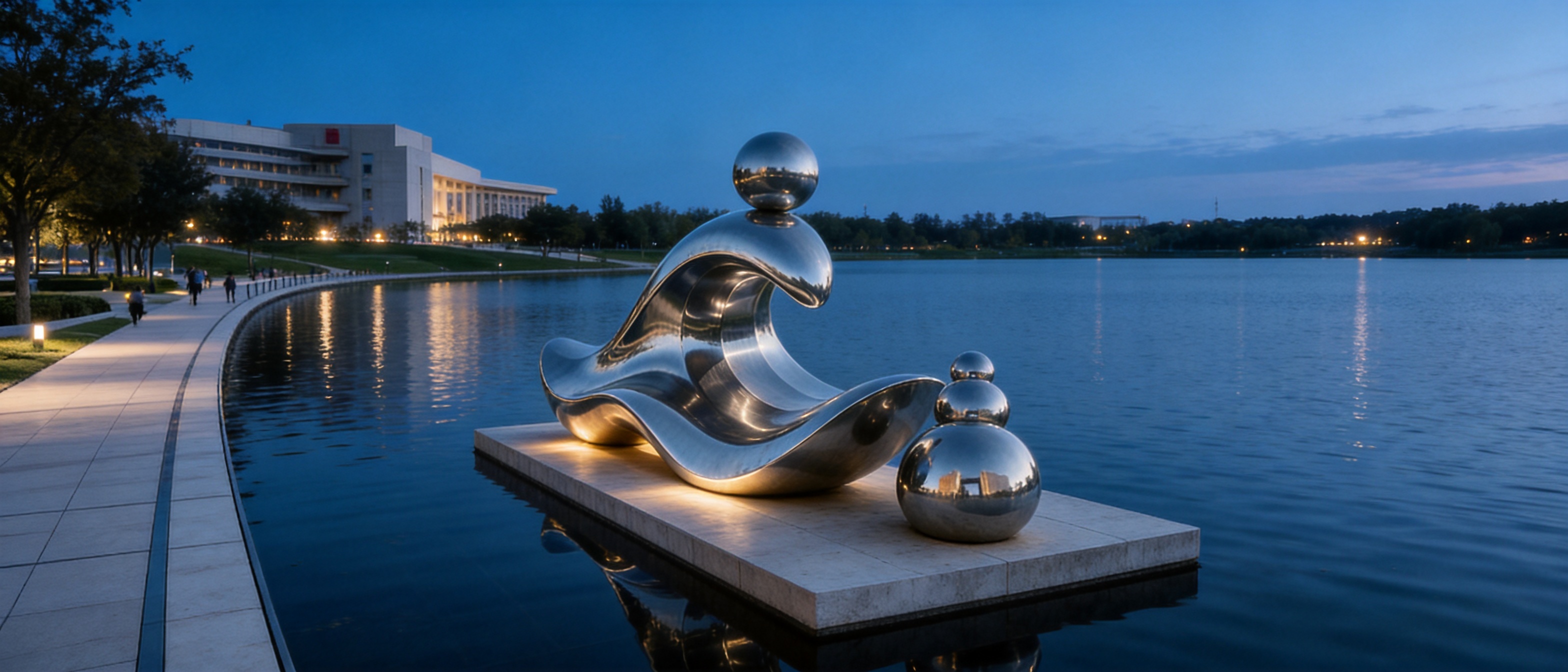
A successful water-feature sculpture must do more than occupy space beside a pool, lake, or entrance plaza. It must create a recognizable visual idea, interact with its surroundings, withstand long-term outdoor exposure, and remain visually compelling from multiple viewing angles. The Wave and Crescent Stainless Steel Water-Feature Sculpture is designed around these requirements. Its principal form rises in a sweeping curve that evokes a cresting wave, while three graduated mirror-polished spheres extend upward from the curl like droplets lifted into the air. Together, these elements create a sense of movement, rhythm, and upward energy within an otherwise still landscape.
Manufactured by Jiangsu Xinyesheng Sculpture Co., Ltd., the sculpture is intended for residential, commercial, civic, and public landscape projects that require a durable metal landmark with strong photographic appeal. It is available in sizes from approximately 1.6 meters to 6 meters, allowing the concept to be adapted to intimate courtyards, private mirror pools, sales-office entrances, public lakesides, riverside walkways, and large-scale architectural developments.
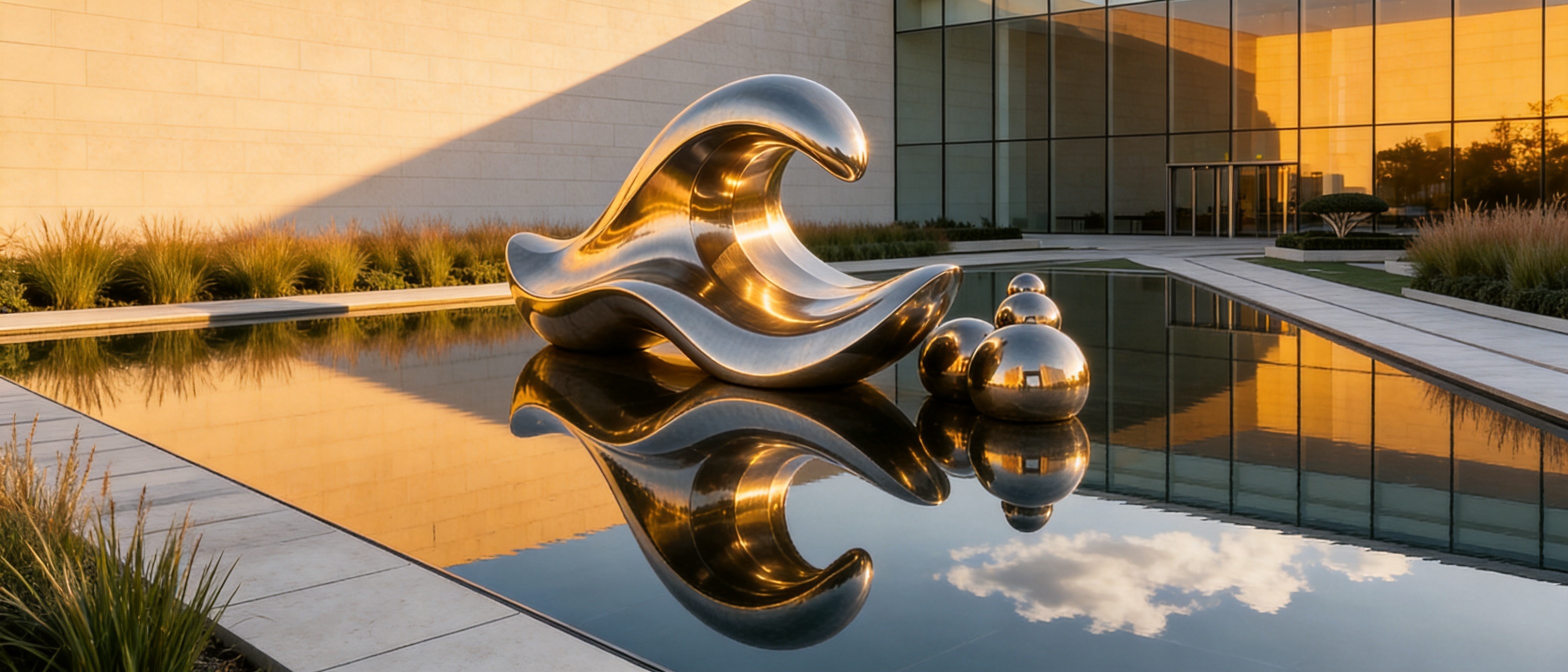
The sculpture’s principal material is 304 or 316 stainless steel. These grades offer a useful combination of structural strength, corrosion resistance, surface quality, and suitability for permanent outdoor installation. The mirror-polished finish reflects the sky, surrounding buildings, landscape planting, and water surface, so the sculpture changes visually according to weather, season, time of day, and viewing position. At sunset, the curved surfaces can catch warm horizontal light, producing golden reflections that emphasize the wave’s profile and the separate droplets.
Unlike a simple abstract metal loop or an ordinary decorative water ornament, this design communicates a specific visual narrative. The wave suggests motion and natural force; the rising spheres suggest droplets, energy, and release; and the reflection in the pool visually doubles the composition. This combination gives the work both sculptural presence and a clear relationship with water, even when the water feature itself is calm.
Content
The central challenge of a wave-inspired sculpture is making a solid, static material appear to be moving. Water is flexible, transparent, and constantly changing, while stainless steel is rigid and highly reflective. The design therefore depends on silhouette, proportion, curvature, and spacing rather than on actual fluid movement. The main curved form must be shaped carefully enough to read as a breaking wave instead of an arbitrary abstract ribbon.
The sculpture uses a broad, rising curve that gathers visual weight toward the crest. The form can be read from a distance because its outer contour remains clear against the sky, architecture, or landscape background. At closer range, the polished surface introduces additional layers of reflection and highlights. This gives the sculpture two distinct visual experiences: a strong graphic outline from far away and a more complex, changing surface quality from nearby.
The three spheres are not identical ornaments placed at equal intervals. They are graduated in size and positioned at calculated heights and spacing to suggest droplets thrown upward from the wave’s curl. The change in scale helps the eye follow the implied trajectory. Instead of appearing like three unrelated balls mounted on a frame, the spheres form a visual sequence that supports the motion of the main wave.
During installation, the exact height and spacing of the three spheres can be adjusted. This feature is particularly useful because every site has different proportions, sightlines, lighting conditions, and surrounding structures. A configuration that works well beside a narrow residential pool may not be ideal beside a broad public lake. Adjustable placement gives project designers and installation technicians an opportunity to refine the arc in relation to the site rather than accepting a completely fixed composition.
The design can also be understood symbolically. A wave is associated with flow, momentum, renewal, and natural power. In commercial and residential developments, these associations may support themes of prosperity, movement, and forward progress. The upward direction of the spheres adds a sense of aspiration and energy. Because the interpretation remains open, the sculpture can function in formal architectural spaces as well as in more relaxed garden or landscape environments.
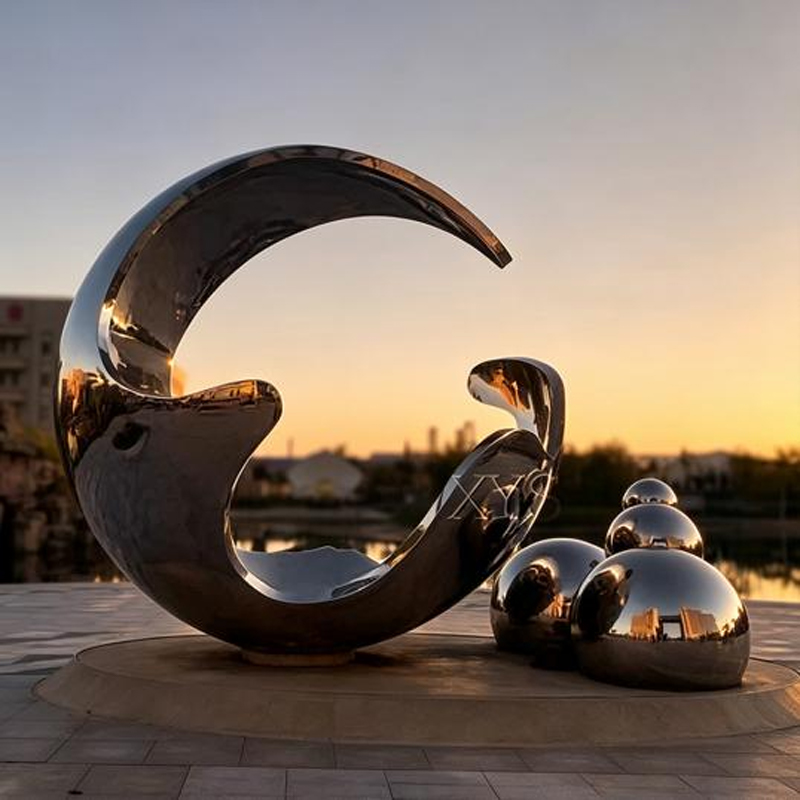
Wave and Crescent Stainless Steel Water-Feature Sculpture
Material selection is one of the most important decisions in an outdoor sculpture project. A water-feature installation is exposed to moisture, changing temperatures, airborne pollutants, cleaning chemicals, mineral deposits, and repeated cycles of wetting and drying. The material must therefore provide more than an attractive appearance at the time of delivery. It must support reliable performance throughout the expected service life of the installation.
304 stainless steel is widely used in architectural and decorative applications because it combines strength with good general corrosion resistance. It is suitable for many residential, commercial, and landscape environments. 316 stainless steel contains additional alloying elements that generally improve resistance in more demanding conditions, particularly where chlorides or coastal exposure may be present. The appropriate grade can be selected according to the installation environment, water chemistry, local climate, and project requirements.
For this sculpture, stainless steel offers several advantages over ordinary painted mild steel. Painted steel can provide a wide range of colors, but its protective coating may eventually be scratched, chipped, or weathered. Once exposed areas develop, maintenance and refinishing become more important. Stainless steel, by contrast, derives much of its corrosion resistance from the material itself. Its surface can remain visually consistent without relying entirely on a decorative paint layer.
Stainless steel also offers advantages over some other sculpture materials. Fiberglass can be lightweight and versatile, but its surface may be more vulnerable to impact, ultraviolet aging, and coating deterioration. Marble provides natural character and visual weight, but its porous or crystalline structure may require different care, and its form is limited by stone-cutting considerations. Weathering steel develops a deliberate oxidized surface, yet that appearance may not suit a mirror pool or a project seeking bright reflections. Stainless steel provides a clean, contemporary, reflective appearance that is particularly compatible with water.
The polished surface is an important part of the design rather than a final decorative afterthought. The wave’s curvature creates changing bands of light, while the spheres provide concentrated highlights. Reflections of blue sky, clouds, trees, buildings, and water can move across the surface as viewers walk around the sculpture. At night, carefully positioned architectural lighting can emphasize the outline, crest, and droplets without requiring the sculpture itself to have an overly complicated lighting system.
In permanent water exposure, routine cleaning is still necessary. Water can contain minerals, dust, organic matter, and other deposits that affect the appearance of any outdoor surface. The advantage of stainless steel is that regular cleaning can help preserve the original brightness without requiring frequent repainting or major surface renewal. Maintenance procedures should be selected according to the finish and local water conditions, with non-abrasive tools and suitable stainless-steel cleaning methods used to avoid scratching.
Producing a large curved sculpture from stainless steel requires a combination of design control, metal-forming skill, welding experience, surface finishing, and quality inspection. A wave-shaped object may look simple in a digital drawing, but its final success depends on whether the fabricated form maintains the intended curve, balance, proportions, and surface continuity.
Jiangsu Xinyesheng Sculpture Co., Ltd. specializes in metal sculpture production and custom decorative sculpture applications. The company’s product range includes bronze sculptures, stainless steel sculptures, marble sculptures, fiberglass sculptures, and weathering steel sculptures. This broader material experience is valuable because it indicates familiarity with different fabrication methods, finishing requirements, structural behaviors, and installation conditions.
The Wave and Crescent sculpture begins with the relationship between the visual concept and the installation scale. A 1.6-meter version must retain a readable wave silhouette without overwhelming a smaller setting. A 6-meter version must maintain proportion and structural stability while remaining visually elegant at a much larger scale. Scaling is not simply a matter of enlarging every measurement. Curvature, thickness, sphere size, support points, and visual spacing may all need to be reviewed to preserve the character of the original composition.
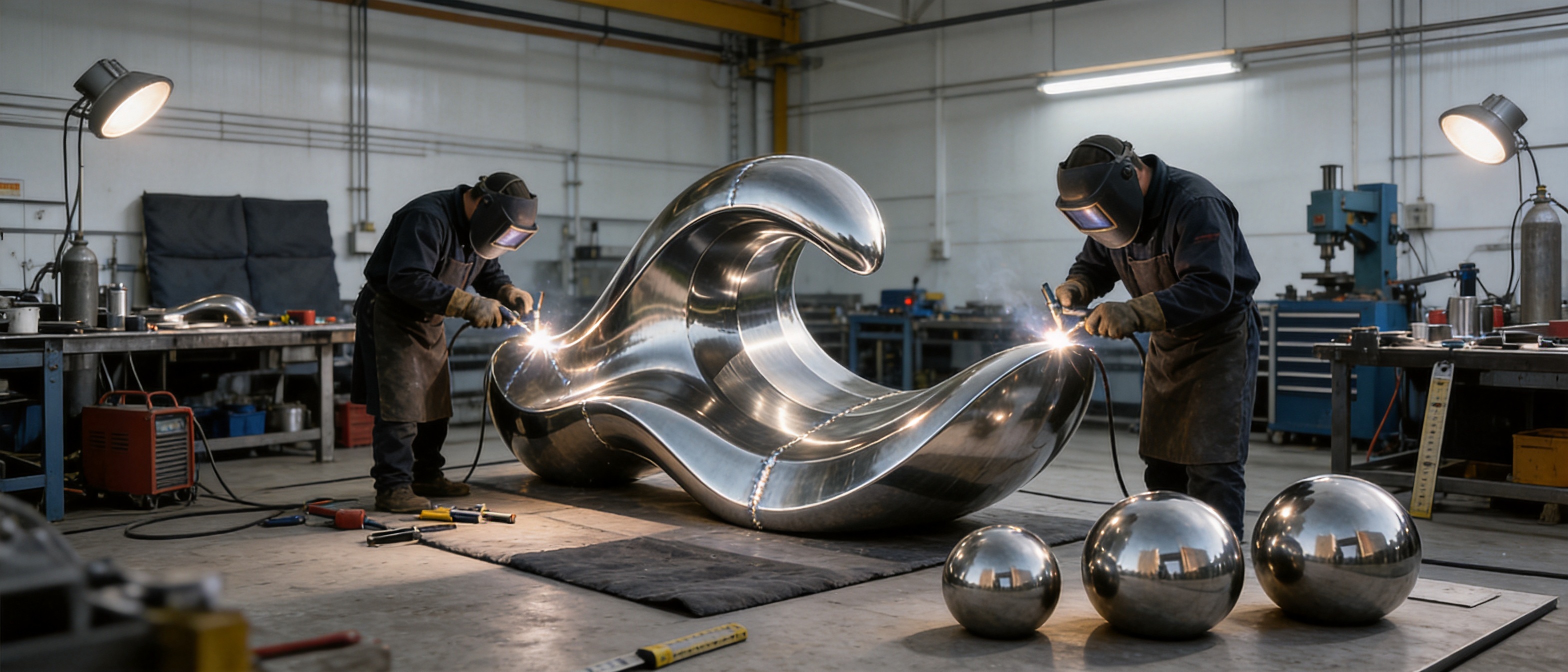
Depending on the approved design and required dimensions, production may involve digital modeling, pattern development, sheet or plate preparation, controlled forming, component assembly, and precision welding. Digital design tools can help establish the wave’s contour, sphere locations, viewing angles, and relationship to a pool or platform. Physical fabrication then translates that geometry into a durable metal structure capable of surviving transport, installation, and outdoor use.
Forming stainless steel into a broad curved profile demands control over distortion. Heat, pressure, welding sequence, and material thickness can all influence the final shape. If the fabrication process is not carefully managed, a large polished surface may show unwanted waviness, local dents, inconsistent curvature, or visible transition lines. These defects can become especially noticeable when the object reflects a straight architectural edge or a strong line of sunlight.
Welding is another important consideration. The welds must provide structural continuity while supporting a clean external appearance. After welding, surfaces may require grinding, blending, smoothing, and progressive polishing. The goal is not only to hide the weld but also to maintain a consistent reflective response across adjacent areas. On a sculpture with a continuous wave silhouette, poor transitions can interrupt the visual flow and make the form appear assembled rather than unified.
The three spheres require separate attention. Each must be formed or fabricated with a sufficiently regular surface so that it reflects light evenly. Because the spheres are graduated, their relationship must be checked as a group. The smallest sphere should not be placed so close to the largest that the three merge visually. At the same time, excessive spacing could weaken the sense that they originated from the breaking wave. Their final positions should support a natural arc and remain legible from the principal viewing areas.
Surface finishing is one of the production stages where manufacturing experience directly affects the perceived value of the sculpture. Mirror polishing is a multistage process rather than a single operation. The surface may need to be prepared, leveled, refined, and polished through progressively finer stages. Edges, curved transitions, joints, and difficult-to-reach areas require particular care because inconsistent finishing can create dull patches or irregular reflections.
A professional production workflow should include checks for dimensional accuracy, surface consistency, component alignment, weld quality, and finish uniformity. For a project sculpture, the final inspection may also involve checking how the wave reads from primary approach routes and how the spheres align with the crest. These checks help ensure that the completed work corresponds to the approved design rather than merely satisfying basic fabrication requirements.
One of the strongest advantages of a custom sculpture manufacturer is the ability to adapt the design to a specific project. Standard decorative products may be limited to one size, one base arrangement, or one fixed sphere configuration. The Wave and Crescent sculpture is offered in a range from 1.6 to 6 meters, and the adjustable droplet positions provide an additional level of site responsiveness.
Customization may involve overall height, width, curvature, sphere diameter, support arrangement, finish specification, anchoring method, and relationship to the surrounding water feature. A project in a narrow courtyard may need a more vertical emphasis, while a lakeside installation may benefit from a broader horizontal profile. A sculpture placed near a low pool edge may require a different viewing angle from one installed on a raised platform.
Site-specific design should consider the main approach routes, pedestrian circulation, nearby trees, building elevations, water depth, maintenance access, lighting positions, and local wind conditions. The sculpture should be visually balanced from the perspectives that matter most to the project. The adjustable spheres make it possible to fine-tune the composition after the principal form has been positioned, which can be particularly useful when the final surrounding landscape differs slightly from the initial drawings.
Custom manufacturing also allows the company to coordinate practical requirements with the artistic concept. The sculpture may need to interface with a plinth, concealed support, concrete foundation, water-edge coping, or lighting infrastructure. Early communication between the designer, fabricator, landscape contractor, and installation team can reduce the risk of costly modifications later.
Large polished sculptures require protection during handling and transportation. Even a small scratch can become visually prominent on a mirror finish, especially when the sculpture is installed in an open space with strong sunlight. Proper packaging, protective films or coverings, padded supports, and careful loading procedures are therefore important parts of the delivery process.
Quality control should continue after fabrication and before dispatch. Dimensions can be compared against the approved drawings, and the relative positions of the wave and spheres can be documented. Photographs or inspection records may help the installation team understand the intended orientation. If the sculpture is delivered in sections for transport, each connection should be clearly identified and checked so that assembly does not alter the intended curvature or alignment.
At the installation site, care should be taken to avoid dragging the sculpture across hard surfaces or allowing construction debris to contact the polished steel. Cement dust, abrasive particles, welding residue, and metal filings can compromise the appearance if not removed promptly. Final cleaning should be carried out after surrounding construction work is substantially complete.
The sculpture’s competitive value comes from the combination of concept, material, finish, adjustability, and scale. Many outdoor sculptures may offer one or two of these qualities, but fewer combine all of them in a single water-oriented composition.
| Comparison factor | Wave and Crescent stainless steel sculpture | Painted mild-steel sculpture | Fiberglass sculpture | Stone sculpture |
|---|---|---|---|---|
| Visual character | Dynamic wave silhouette with reflective droplets | Dependent mainly on paint color and form | Can be highly varied but often coating-dependent | Natural and solid, with less reflective movement |
| Relationship with water | Reflects the pool and surrounding landscape | May reflect little unless specially finished | Usually provides a painted or matte surface | May absorb or scatter light rather than mirror it |
| Outdoor material performance | 304/316 stainless steel supports long-term outdoor use | Requires protection of paint and exposed metal | Requires attention to coating and ultraviolet exposure | Depends on stone type, porosity, and local climate |
| Maintenance character | Routine cleaning can preserve the polished appearance | May require repainting or corrosion repair | May require coating repair and color renewal | May require stain removal, sealing, or specialist care |
| Site flexibility | Available in multiple sizes with adjustable sphere placement | Often custom but may have heavier corrosion-control needs | Lightweight and customizable, but impact and finish must be considered | Limited by stone weight, quarry characteristics, and carving constraints |
| Lighting response | Strong highlights and changing reflections | Usually provides a more stable color response | Depends on gloss level and surface coating | Emphasizes texture and form rather than mirror reflections |
Compared with painted mild steel, stainless steel removes some dependence on a surface coating for corrosion protection. This does not mean that stainless steel is maintenance-free, but it can offer a more stable long-term appearance in a wet landscape. The absence of a conventional decorative paint layer also means that the sculpture’s color remains closely connected to its environment. It can appear silver, blue, gray, gold, or nearly black depending on reflected surroundings and light.
Compared with fiberglass, stainless steel generally provides a more substantial architectural presence. A large metal wave can function as a landmark in an open plaza or lakeside setting, while fiberglass may be selected when low weight is the primary concern. Fiberglass can be highly effective in some applications, but its final performance depends greatly on the quality of the gel coat, paint, reinforcement, and ultraviolet protection. Stainless steel offers a distinctive surface identity that is especially effective beside still water.
Compared with marble, stainless steel makes it easier to create a visually light and elevated composition. The three spheres appear to rise from the wave without adding the visual heaviness associated with carved stone. Stainless steel can also produce crisp edges and continuous curves that would be more difficult or costly to achieve in a single stone block. Marble remains valuable where natural texture, permanence, and classical character are desired, but polished stainless steel is often better suited to contemporary developments and reflective pools.
Compared with weathering steel, stainless steel offers a completely different aesthetic direction. Weathering steel creates a warm rust-colored surface that can blend with earth, brick, and natural planting. Stainless steel creates brightness, reflection, and a more fluid association with water. For a project seeking a clean, modern landmark that photographs strongly in changing light, the polished surface may provide greater versatility.
The sculpture is particularly effective when placed beside or within a mirror pool. The still water acts as a second visual plane, reflecting the wave and the spheres beneath the actual sculpture. This reflection can make the composition appear taller and more expansive, while the boundary between the physical object and its reflected image introduces a subtle sense of illusion.
Water quality and surface calmness influence the strength of the reflection. A pool with minimal surface disturbance will show the clearest mirrored image. Gentle circulation can still be used, but pumps, outlets, and overflow details should be positioned so that they do not create excessive ripples around the sculpture’s primary reflection zone. Where a more dynamic effect is desired, controlled movement in the water can create broken reflections that complement the wave concept.
The placement of the sculpture should be considered in relation to the pool’s edge. If the work is positioned too far from the water, the reflection may be lost and the connection between the metal wave and actual water may become weaker. If it is placed too close without adequate access, cleaning and maintenance may become difficult. A suitable setback should provide visual integration, structural stability, and safe access for inspection.
The sculpture can also be installed near a park lake, riverside walkway, or broad reflecting basin. In such settings, the natural horizon becomes part of the composition. Trees and sky may be reflected across the wave, making the surface appear to change throughout the day. At sunset, low-angle sunlight can accentuate the crest and spheres. In the morning, cooler light may produce a silver or blue appearance. Under cloudy conditions, the sculpture may become more subdued and architectural.
For sales offices, hotels, residential developments, and commercial entrances, the sculpture can serve as a recognizable landmark. Visitors may use it as a meeting point, orientation feature, or photographic background. A distinctive water feature can also help establish an identity for a development without relying exclusively on signage. The wave motif is visually understandable across many cultural and architectural contexts, while the polished material gives it a contemporary and premium appearance.
Lighting should support the sculpture’s form rather than flatten it with excessive brightness. Low-angle lighting from the side can reveal the curvature of the wave and create a gradient of highlights across the polished surface. Narrow-beam fixtures may be directed toward the crest and spheres, while softer fill light can prevent the unlit side from disappearing completely.
Lighting designers should study reflections carefully. A highly reflective surface can produce bright hotspots if fixtures are positioned directly in the viewer’s line of sight. It may be preferable to place lights at angles that reveal the form without creating glare. The surrounding water can also reflect light, so fixture locations should be coordinated with the pool edge and pedestrian routes.
Warm lighting can emphasize the golden atmosphere of sunset and create a welcoming appearance in hospitality or residential environments. Cooler lighting may reinforce the association with water and modern architecture. The final choice should consider nearby building materials, planting, safety requirements, and the desired identity of the site.
Although the sculpture is a decorative artwork, its installation should be managed as an engineered outdoor element. The foundation, support points, anchoring system, transportation route, lifting method, and local environmental loads all require consideration. The larger the sculpture, the more important it becomes to coordinate the artwork with the civil and landscape design before fabrication is completed.
A site survey should confirm the available foundation area, access for delivery vehicles, crane or lifting equipment requirements, finished water levels, and the intended viewing angles. The ground or platform must be capable of supporting the sculpture and resisting applicable wind or other environmental forces. Exact structural calculations and anchoring details should be developed for the specific project by qualified professionals based on local regulations and site conditions.
The manufacturer can coordinate with project engineers regarding base plates, embedded components, connection points, section divisions, and installation tolerances. If the sculpture is too large to ship as one piece, it may be produced in transportable sections. In that situation, the connection design should preserve the wave’s continuous visual flow and allow the final joints to be blended or concealed as appropriate.
Water-feature installations also require coordination with plumbing and electrical systems. Pumps, pipes, overflow channels, drains, lighting conduits, and inspection hatches should be located so that they do not conflict with the sculpture’s support system. The sculpture itself does not necessarily need to function as a fountain, but it should be integrated into the wider water-feature design in a way that allows both the artwork and mechanical systems to be serviced.
For public locations, safety and access should be addressed at the planning stage. The spheres and wave should be positioned so that visitors cannot easily climb them or collide with projecting components. Edges, clearances, lighting glare, and slippery surfaces near the water must be evaluated according to the relevant local standards. A visually dramatic sculpture is most successful when it remains safe and practical for everyday use.
Routine maintenance is necessary to preserve the mirror finish and the clarity of the wave silhouette. The frequency depends on the location. A sculpture beside a clean residential pool may require less frequent cleaning than one near a busy roadway, industrial district, coastal environment, or heavily planted public park.
Basic maintenance may include rinsing away dust and airborne deposits, removing water spots, inspecting the surface for contamination, and checking the support and connection areas. If mineral deposits are allowed to accumulate, they can become more difficult to remove and may reduce the uniformity of the reflection. Organic debris such as leaves, pollen, and bird deposits should be removed using methods that do not scratch the metal.
Cleaning tools should be clean and non-abrasive. Harsh scouring pads, carbon-steel brushes, and rough construction materials can introduce scratches or embedded particles. Suitable stainless-steel cleaning products may be selected according to the surface finish and the type of deposit. In coastal or chloride-rich environments, more frequent rinsing may be beneficial.
During routine inspection, the installation team can also check sphere alignment, support connections, drainage around the base, and any areas where water remains trapped. Adjustable sphere components should be inspected to ensure that they remain secure after exposure to wind, vibration, or maintenance activity. If any change in position is observed, the configuration can be reviewed and corrected.
A maintenance plan should distinguish between normal cleaning and specialist restoration. Minor surface contamination may be removed by the site maintenance team, while deep scratches, significant staining, or damage caused by impact may require professional metal-finishing services. Keeping records of the original finish and approved cleaning methods can help protect the sculpture over time.
In a private garden or residential courtyard, the sculpture can serve as a focal point without requiring a large collection of decorative elements. The 1.6-meter scale is suitable for more intimate settings where the wave needs to remain proportional to the pool, terrace, and surrounding planting. Its reflective surface can make a compact space appear more layered, especially when the sculpture is aligned with a long axis or framed by architectural walls.
The adjustable spheres allow the composition to be refined according to the homeowner’s preferred viewpoint. If most views are from a terrace, the droplets can be positioned to create a strong silhouette from that direction. If the pool is visible from several rooms, the arrangement can be balanced for multiple sightlines.
Hotels and resorts often require landscape elements that are memorable, photographable, and compatible with hospitality branding. A wave sculpture naturally complements pools, arrival courts, spa gardens, and waterfront terraces. During the day, it reflects the sky and water; in the evening, lighting can turn it into a glowing landmark.
The sculpture can also help organize space. It may mark the transition between an entrance plaza and a garden, identify a central courtyard, or create a visual termination at the end of a pedestrian axis. Its recognizable profile can become part of guest photographs and digital content, extending the artwork’s visibility beyond the physical site.
In a sales office or property development, a distinctive water feature can communicate investment in design quality and create a strong first impression. The wave motif may suggest progress, prosperity, and an active future, while the stainless-steel finish supports a contemporary architectural image. A sculpture between 2 and 4 meters may be appropriate for many entrance plazas, although the final size should be determined by the site’s scale.
Because the sculpture is available in multiple sizes and can be adapted during installation, developers can coordinate the artwork with the final landscape rather than treating it as an isolated purchase. The sculpture can be placed where it is visible from the approach road, lobby, reception area, or main pedestrian route.
In a public park, the sculpture can function as a landmark along a route or beside a lake. The reflective surface introduces an architectural contrast to grass, trees, and natural water. Its wave form also creates a thematic connection with the lake or river, even if the sculpture is located some distance from the shoreline.
Public installations benefit from durable materials and straightforward maintenance. Stainless steel is well suited to a setting where the sculpture must remain visually strong through changing weather and frequent public exposure. The foundation, safety clearances, and maintenance access should be carefully designed to support long-term operation.
Waterfront environments provide a natural context for the design. The actual river or lake can become part of the visual background, while the polished steel captures fragmented reflections of moving water. A larger version, potentially approaching 6 meters, can provide sufficient presence along a broad promenade or open waterfront plaza.
Waterfront sites may also present more demanding environmental conditions, including wind, moisture, airborne salt, and changing ground conditions. The selection between 304 and 316 stainless steel should be discussed in relation to the local environment, and structural engineering should address the relevant loads and foundation requirements.
Purchasing a large outdoor sculpture involves more than choosing an attractive image from a catalog. The manufacturer’s ability to interpret a concept, prepare production drawings, fabricate the form, control the finish, package the work, and support installation can have a major effect on the final result.
Jiangsu Xinyesheng Sculpture Co., Ltd. provides a product range across several sculpture materials, with a stated focus on custom design metal statues and decorative sculpture production. This breadth can be beneficial for clients who are comparing stainless steel with bronze, marble, fiberglass, or weathering steel and want to discuss the advantages of each material with one experienced supplier.
The company’s location in Jiangsu Province, China, places it within a region with extensive metalworking, manufacturing, and industrial supply capabilities. For international projects, communication about drawings, dimensions, finish samples, packing requirements, shipping arrangements, and installation procedures should be established at the beginning of the project.
A capable manufacturer should be able to discuss questions such as the intended viewing distance, water exposure, preferred stainless-steel grade, surface finish, overall dimensions, sphere arrangement, foundation interface, and delivery constraints. These discussions help convert a general artistic idea into a practical product specification.
Custom sculpture manufacturing also benefits from staged approvals. A project may begin with a concept drawing or reference image, followed by dimensional drawings, a three-dimensional model, material confirmation, and a final production review. Each stage offers an opportunity to identify proportion or installation issues before they become expensive to correct.
The manufacturer’s role may extend to advice on maintenance, packaging, and installation, although final structural and site decisions should be confirmed by qualified local professionals. This combination of artistic fabrication and practical coordination is one of the main advantages of sourcing from a specialist rather than treating the sculpture as a generic decorative commodity.
Clients considering the Wave and Crescent Stainless Steel Water-Feature Sculpture should first define the project context. Important information includes the intended installation location, approximate overall height, water-feature dimensions, primary viewing directions, surrounding architecture, environmental exposure, and desired completion schedule.
The available size range is approximately 1.6 to 6 meters. The listed price range is approximately 1,860 to 5,480 US dollars, depending on size and configuration. Final pricing for a project should be confirmed directly because customization, material grade, finish requirements, packing, shipping, taxes, installation, foundation work, and local site conditions may affect the total cost.
The buyer should request confirmation of the selected stainless-steel grade, the finish specification, the number and dimensions of the spheres, the adjustability of their mounting positions, and the proposed support arrangement. If the sculpture will be installed in a coastal or high-chloride environment, 316 stainless steel may be considered, subject to the manufacturer’s technical recommendation and the project engineer’s requirements.
It is also helpful to identify whether the sculpture will be delivered fully assembled or in sections. Large pieces may require special transport and lifting equipment. The route from the delivery vehicle to the foundation should be reviewed in advance, including gates, turning radii, overhead obstructions, ramps, and temporary access restrictions.
A complete project file may include approved drawings, finish photographs or samples, packing information, installation instructions, maintenance recommendations, and contact information for technical coordination. Keeping these documents available can simplify future cleaning, inspection, or relocation work.
The sculpture is fabricated from 304 or 316 stainless steel, according to the selected specification and project environment. Both grades are widely used for architectural and outdoor applications. The most suitable grade should be confirmed according to local climate, water chemistry, coastal exposure, and project requirements.
The composition includes one large curved stainless-steel form designed to evoke a cresting wave and three graduated mirror-polished spheres positioned above or near the wave’s curl to suggest airborne water droplets.
Yes. The three spheres are described as individually adjustable in their exact spacing and height during installation. This allows the installation team to fine-tune the visual arc according to the site’s proportions, main viewing angles, and relationship with the water feature.
The sculpture is offered in sizes from approximately 1.6 meters to 6 meters. The best size depends on the width of the pool, the surrounding architecture, viewing distance, foundation arrangement, and the visual role the sculpture is expected to play.
The 304/316 stainless-steel construction is suited to permanent outdoor use and water-feature environments. Routine cleaning remains necessary because mineral deposits, dust, organic matter, and airborne pollutants can affect the appearance of any outdoor surface.
Stainless steel provides a reflective finish and relies less on a conventional decorative paint coating for its appearance. Painted steel can offer strong color choices, but its coating may eventually require repair or renewal. Stainless steel is particularly advantageous when the project seeks reflections of water, sky, landscape, and changing sunlight.
Fiberglass can be lightweight and highly customizable, but its performance depends on the quality and durability of its surface coating. Stainless steel offers a more substantial architectural presence, a distinctive reflective surface, and strong compatibility with mirror pools and contemporary landscapes.
Customization may include overall size, stainless-steel grade, sphere dimensions, sphere spacing, sphere height, support details, and installation interface. The final possibilities should be reviewed with the manufacturer based on the approved design and site requirements.
Potential locations include residential mirror pools, hotel and resort landscapes, park lakesides, riverside walkways, waterfront developments, commercial plazas, sales offices, corporate entrances, and public architectural spaces.
The supplied description presents the work as a water-feature sculpture that can be installed beside or within a mirror pool or other still water feature. Whether water flows through, around, or only reflects the sculpture depends on the project design. Plumbing and pump requirements should be confirmed separately with the landscape and mechanical teams.
Routine maintenance generally includes rinsing and cleaning the stainless-steel surfaces, removing water spots and deposits, inspecting support connections, checking the sphere positions, and keeping abrasive contaminants away from the polished finish. Cleaning methods should be appropriate for mirror-polished stainless steel.
It may be suitable, but coastal and high-chloride environments require additional consideration. The selection of 316 stainless steel, more frequent rinsing, careful drainage, appropriate fasteners, and a site-specific maintenance plan may be advisable. Local engineering and material recommendations should be obtained before ordering.
The supplied information lists an approximate price range of 1,860 to 5,480 US dollars. The final quotation may vary according to size, material grade, customization, packaging, shipping, and installation-related requirements.
Side lighting and low-angle lighting can emphasize the wave’s curvature and create controlled highlights on the polished surface. Lighting should be tested to avoid glare and excessive hotspots. The lighting design should also consider the pool’s reflection, pedestrian routes, nearby architecture, and nighttime safety.
The Wave and Crescent Stainless Steel Water-Feature Sculpture combines a recognizable natural image with the durability and visual versatility of polished stainless steel. Its cresting wave form creates a strong silhouette, while the three graduated spheres introduce rhythm, scale, and a convincing suggestion of droplets released into the air. When placed beside still water, the sculpture gains a second image through reflection, allowing the composition to appear larger and more dynamic.
Its principal advantages over many competing options include the use of 304/316 stainless steel, the compatibility of the mirror finish with water and changing light, the availability of multiple sizes, and the ability to adjust the sphere positions during installation. These features make the sculpture suitable for both carefully designed residential settings and larger public or commercial landmarks.
The manufacturing process is equally important. Forming the wave, controlling welding distortion, blending transitions, polishing curved surfaces, producing consistent spheres, and protecting the finish during transport all require specialized fabrication knowledge. Jiangsu Xinyesheng Sculpture Co., Ltd.’s experience across stainless steel and other sculpture materials provides a foundation for handling these artistic and practical requirements through a custom production process.
For architects, landscape designers, developers, hospitality groups, and private property owners, the sculpture offers a durable way to introduce movement and visual identity into a water environment. With suitable site planning, structural coordination, lighting, cleaning, and maintenance, it can remain a prominent outdoor feature while changing in appearance with the surrounding sky, landscape, water, and light.
1. ASTM International. Standard specifications and general information relating to stainless steel products and corrosion-resistant alloy materials.
2. International Stainless Steel Institute. General guidance on stainless steel grades, architectural applications, surface finishes, and maintenance.
3. American Society of Landscape Architects. Professional principles for integrating public art, water features, circulation, lighting, and landscape design.
4. National Association of Architectural Metal Manufacturers. Guidance on architectural metal fabrication, finishing, installation, and care.
5. British Stainless Steel Association. Technical information concerning stainless steel selection, corrosion resistance, cleaning, and outdoor applications.
6. General architectural conservation and public-art maintenance literature concerning reflective metal surfaces, outdoor exposure, and long-term sculpture care.
7. Manufacturer-supplied product information for the Wave and Crescent Stainless Steel Water-Feature Sculpture, including stated materials, dimensions, applications, price range, and adjustable sphere configuration.



Daniel H.

Amanda R.

Robert B.

Jennifer S.
James W.

Barry G.

Michael T.

Emily K.

David L.

Sarah M.


Mikey XV

Jagxue

 English
 Español
 عربى
 Français
 italiano
 Deutsch