Content
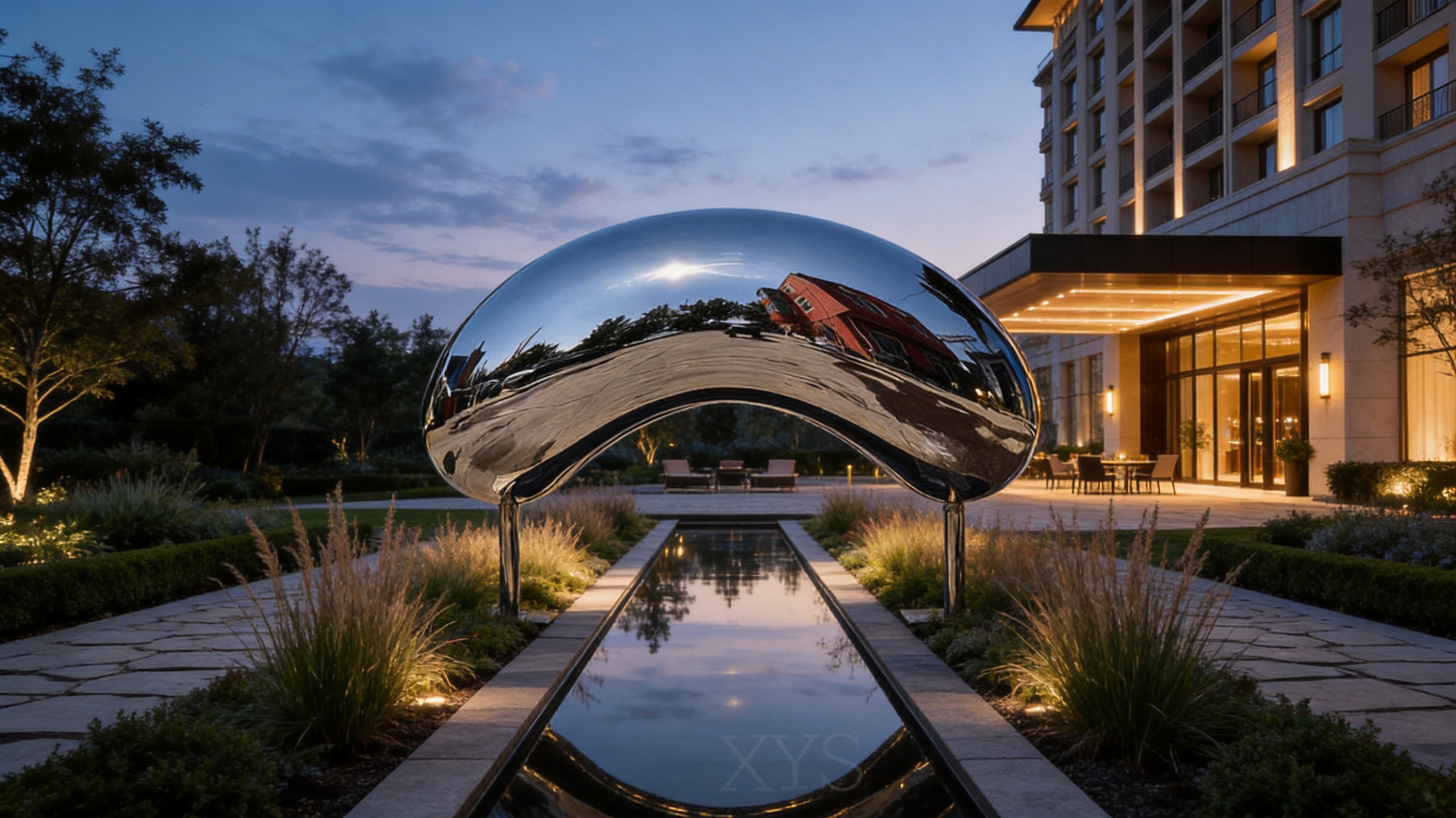
The Arched Bridge Mirror-Polished Stainless Steel Sculpture is a distinctive outdoor artwork designed for locations where sculpture must do more than occupy space. Its sweeping arch, coordinated support columns, and fixed matching base create a complete architectural composition that can serve as a visual gateway, a landmark, or a symbolic connection between separate areas. Rather than presenting a conventional freestanding figure or abstract mass, this sculpture uses the familiar structure of a bridge to introduce movement, passage, balance, and reflection into the landscape.
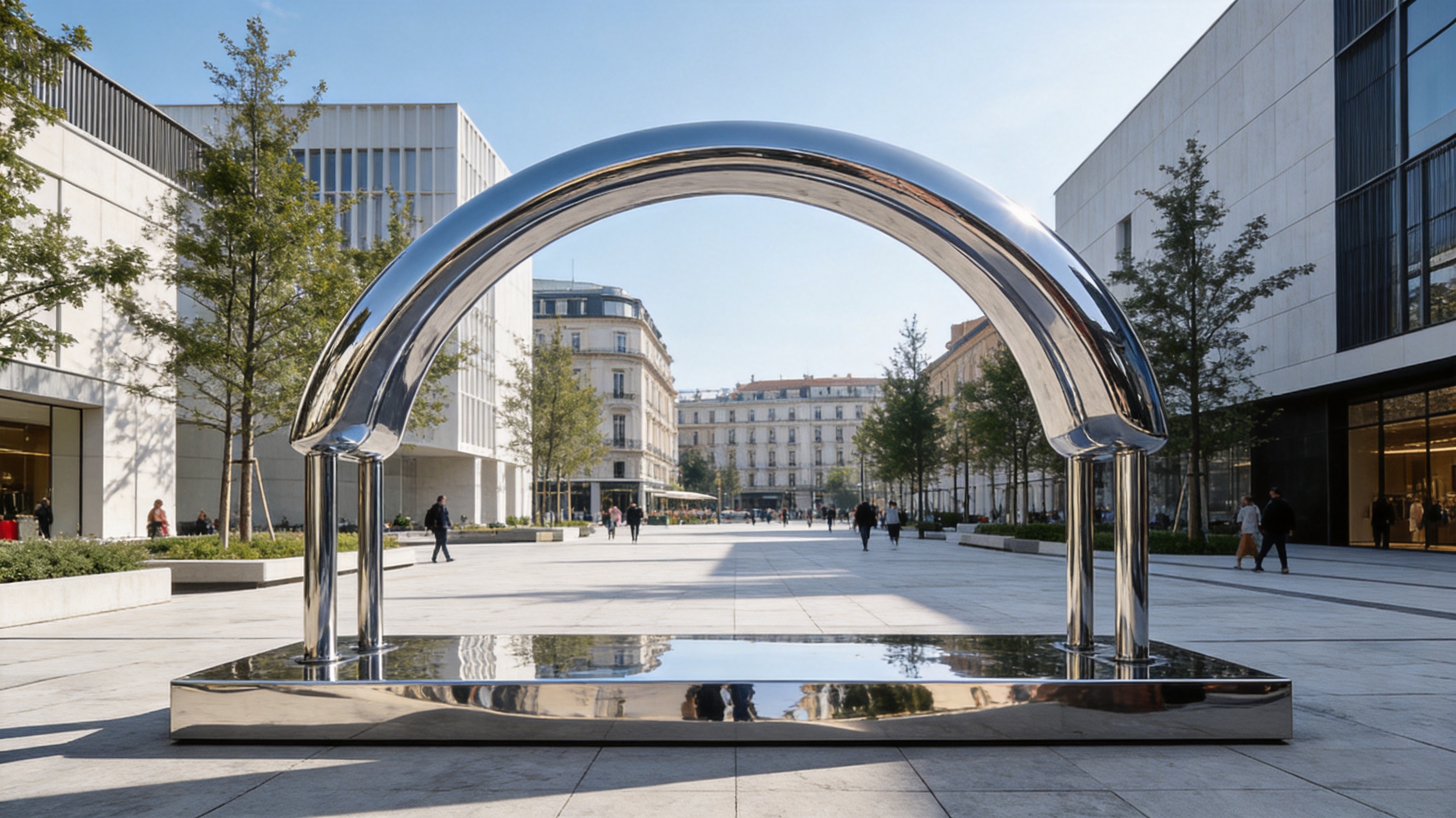
Manufactured from 304 or 316 stainless steel and finished with an 8K mirror polish, the sculpture combines structural clarity with a highly reflective surface. The curved underside and outer face continuously reflect nearby buildings, trees, paving, water, sky, and visitors. As daylight changes, the sculpture also changes visually, creating a dynamic relationship with its surroundings without requiring electrical components, moving parts, or illumination systems.
Available in sizes from 1 to 4 meters and offered at an indicative price range of $1,580 to $4,680, the sculpture can be adapted for intimate gardens, hospitality entrances, European-style plazas, villa estates, tourism streets, and transitional public spaces. Its proportions can be customized to suit the dimensions of a site, allowing buyers to retain the essential bridge silhouette while selecting a scale appropriate to the landscape.
Produced by Jiangsu Xinyesheng Sculpture Co., Ltd., the sculpture reflects a manufacturing approach centered on carefully formed stainless steel, integrated visual composition, precision curvature, coordinated support elements, and high-grade surface finishing. These characteristics give it several advantages over ordinary outdoor ornaments, painted steel arches, and separately assembled decorative structures.
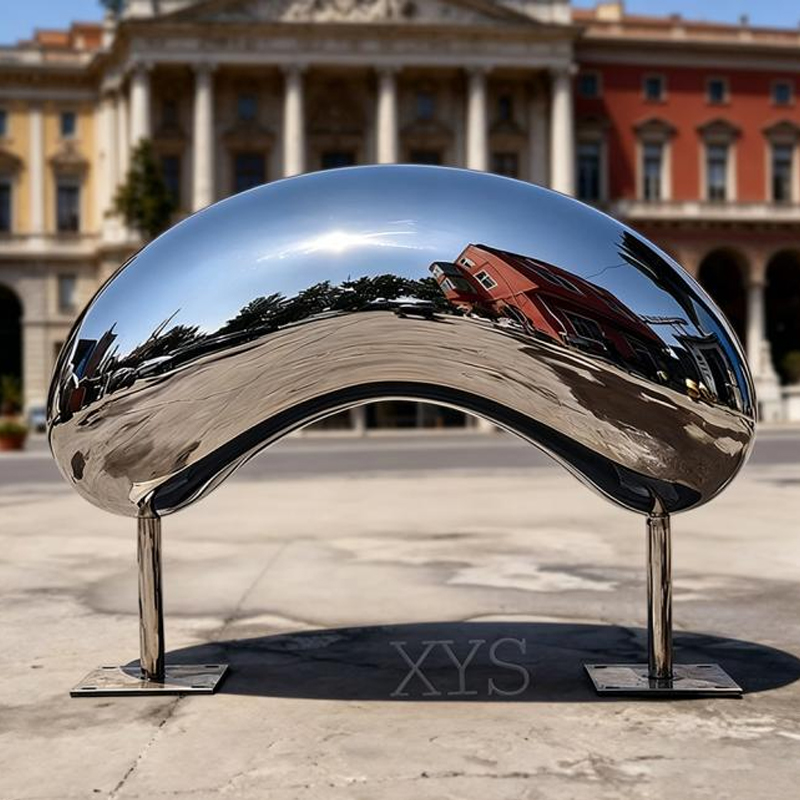
Arched Bridge Mirror-Polished Stainless Steel Sculpture
Bridge imagery is understood across many cultures as a symbol of connection, progress, transition, and successful passage. A bridge links two points that were previously separated. In a landscape, this symbolism can be literal, architectural, and emotional at the same time. The Arched Bridge Mirror-Polished Stainless Steel Sculpture can mark an entrance, define a route, frame a view, or express the idea of moving from one experience to another.
The arch itself contributes a sense of balance and continuity. Unlike a rigid horizontal beam, an arch creates a flowing line that rises gradually and returns toward the ground. This movement gives the sculpture a lighter visual character while maintaining a clear structural presence. The eye follows the curvature naturally, making the form easy to understand from a distance and rewarding to examine at close range.
In a hotel entrance, the sculpture can communicate hospitality and arrival. In a villa estate or private garden, it can act as a refined focal point between planting zones. In a tourism street or pedestrian plaza, it can function as a recognizable landmark and photo location. When positioned above a shallow channel or dry streambed, it can become part of the physical route through the landscape, reinforcing the connection between artistic meaning and site design.
The design is also suitable for spaces that require a modern interpretation of classical architectural ideas. The bridge silhouette recalls established European landscape traditions without reproducing a historical structure. Its 8K stainless steel surface gives the form a contemporary identity, allowing it to complement modern paving, glass façades, minimalist gardens, luxury hotels, and carefully planned public spaces.
One of the sculpture’s principal advantages is that the arch, support columns, and fixed base are produced as a visually coordinated system from the same stainless steel material. This consistency avoids the mismatched appearance that can occur when an ornamental arch is attached to unrelated supports or placed on a base made from a visually incompatible material.
The design is forged as a single integrated bridge composition, with the major elements planned together rather than treated as unrelated decorative parts. The support columns are positioned to carry the visual and structural weight of the arch while preserving the uninterrupted line of the curve. This is important because the columns must be substantial enough to support the structure but restrained enough not to overpower the arch.
A coordinated base also improves the overall appearance. Many outdoor sculptures lose visual refinement at ground level because the mounting plate, foundation cover, or plinth appears separate from the artwork. In this design, the fixed base is produced from the same stainless steel family, helping the sculpture maintain continuity from its upper curve to its contact with the ground.
The integrated approach provides a stronger sense of completion than a simple metal arch installed without architectural support. It also gives landscape designers a clearer object to work with. Instead of adding a separate platform, support frame, or decorative surround, the designer receives a self-contained sculpture whose major visual relationships have already been established.
The arch is shaped to maintain a smooth and even curvature across its full span. This quality is essential to the sculpture’s identity. An uneven or interrupted curve would reduce the sense of flow and make the bridge appear mechanically assembled rather than intentionally formed.
A continuous curve also improves the way light moves across the polished surface. On a well-formed arch, reflections travel gradually along the metal rather than breaking into distracting irregularities. Architectural lines, trees, paving joints, and sky reflections can therefore appear to follow the sculpture’s shape, strengthening the visual impression of movement.
For buyers comparing this sculpture with lower-cost decorative arches, the difference is especially relevant. A basic arch may provide a general outline, but it may not offer the same attention to curvature, support placement, base coordination, and surface continuity. The value of this sculpture lies not only in the quantity of metal used, but also in the relationship between its geometry and its finish.
The sculpture is available in 304 or 316 stainless steel, two widely recognized stainless-steel grades used for durable architectural and outdoor applications. The selected grade can be matched to the environment, project requirements, and expected exposure conditions.
Stainless steel offers several advantages over ordinary carbon steel for outdoor sculpture. It does not require a painted color layer to create its primary appearance, and its metallic surface remains visually expressive even when the sculpture is viewed from different directions. Its resistance to weather exposure helps reduce the maintenance demands commonly associated with painted metalwork.
304 stainless steel is suitable for many outdoor landscapes, gardens, hotel entrances, plazas, and architectural settings. For environments with more aggressive atmospheric conditions, including areas influenced by coastal air or higher levels of moisture, 316 stainless steel may be considered because of its enhanced resistance characteristics. The appropriate selection should be determined according to the installation site and the project’s technical requirements.
The material choice also supports the sculpture’s long-term visual identity. Painted steel may fade, chip, blister, or require recoating after years of exposure. Weathering steel develops a deliberately oxidized surface, which can be attractive but may not suit a bright luxury environment. Aluminum can provide lightness, but it does not always deliver the same substantial architectural presence or mirror-reflective depth. Stainless steel provides a balance of durability, visual brightness, and structural character.
The 304/316 stainless steel construction is designed for continuous outdoor exposure. The arch, support columns, and base are all coordinated within the same weather-resistant material system, helping the sculpture maintain its structural stability and polished appearance through changing seasons.
Routine cleaning is still important. Dust, water spots, airborne pollution, plant residue, and fingerprints can reduce the clarity of a mirror finish even when the underlying steel remains sound. Regular cleaning with suitable non-abrasive methods allows the reflective surface to retain its intended brilliance.
Proper site preparation is equally important. A sculpture of this type should be installed on a stable foundation designed for its dimensions, location, and exposure to wind or visitor interaction. Where the sculpture is intended to span a water channel or dry streambed, the installer and project engineer should confirm the foundation, clearance, accessibility, and any relevant local safety requirements.
The 8K mirror polish is one of the most important elements separating this sculpture from ordinary stainless-steel structures. A standard brushed or satin finish offers a muted metallic appearance, while a mirror finish introduces reflections that make the sculpture visually responsive to its surroundings.
On the outer face of the arch, the polished surface can reflect the sky, façades, trees, garden planting, paving, and people moving nearby. The curved underside can capture darker or more fragmented reflections, creating a layered visual effect. The sculpture therefore does not appear identical throughout the day. Morning light, midday brightness, cloud cover, evening color, and artificial landscape lighting can all influence its appearance.
This reflective behavior allows the sculpture to occupy a space without visually closing it off. A solid painted object may impose a fixed color and shape on its environment. A mirror-polished sculpture still has a strong form, but it also visually borrows from the landscape around it. In carefully designed settings, this can help the artwork feel integrated rather than imposed.
The reflective surface is particularly effective near water. A shallow channel, reflecting pool, or wetland-inspired landscape can extend the appearance of the arch through duplicated highlights and broken reflections. Even in a dry landscape, the polished surface can provide contrast against stone, planting, gravel, and textured paving.
Hotels, resorts, commercial plazas, and tourism streets often require design elements that are immediately recognizable and suitable for photography. The mirror-polished arch creates a clear silhouette that can be identified from a distance, while its changing reflections provide detail for visitors standing close to it.
The sculpture can also support a sense of luxury without relying on excessive ornament. Its visual richness comes from the combination of proportion, curvature, material, and reflected light. This restrained approach makes it suitable for projects that seek a light-luxury aesthetic rather than a heavily decorated appearance.
Because the finish is neutral in color, it can complement many design palettes. It can sit beside white stone, dark granite, warm paving, green planting, glass walls, timber details, or concrete surfaces. The surrounding colors appear in the reflection, allowing the sculpture to change subtly with its context.
Every sculpture should be evaluated according to the project’s artistic goals, site conditions, budget, and maintenance expectations. The Arched Bridge Mirror-Polished Stainless Steel Sculpture is not intended to replace every possible material or design style. Its advantages are most apparent when a project requires architectural symbolism, outdoor durability, a contemporary appearance, and strong visual interaction with the surrounding landscape.
| Comparison factor | Arched Bridge Mirror-Polished Stainless Steel Sculpture | Painted carbon-steel arch | Stone or marble bridge ornament | Basic decorative metal arch |
|---|---|---|---|---|
| Primary visual character | Reflective, architectural, contemporary, and dynamic | Fixed color and painted appearance | Substantial, natural, and traditionally solid | Simple ornamental structure |
| Surface response | Reflects architecture, landscape, sky, and movement | Usually absorbs or uniformly displays color | Shows natural veining or matte texture | Usually limited visual variation |
| Outdoor material advantage | 304/316 stainless steel with strong weather resistance | Depends heavily on coating condition and maintenance | Durable but potentially heavy and site-dependent | Varies widely according to material and coating |
| Design integration | Arch, columns, and base are coordinated as one composition | May require separate supports or foundation treatments | Often requires substantial structural preparation | May appear visually disconnected from its base |
| Symbolic message | Connection, transition, arrival, and passage | Primarily decorative or structural | Traditional permanence and monumentality | General decorative framing |
| Customization potential | Size and curvature can be adapted to the site | Often customized mainly by dimensions and paint | Customization may require extensive carving or fabrication | Usually limited to standard proportions |
Compared with painted carbon steel, mirror-polished stainless steel reduces dependence on an exterior paint layer for its visual identity. Painted steel can be effective when a specific color is required, but the coating may eventually need inspection, repair, and renewal. Stainless steel offers a naturally metallic surface that remains central to the design.
Compared with marble or stone, stainless steel can provide a lighter visual impression while retaining a strong architectural presence. Stone is often associated with permanence and tradition, but it can require heavier foundations and may be less adaptable for a design based on a continuous reflective curve. The stainless-steel arch offers a more fluid and contemporary reading of the bridge concept.
Compared with an inexpensive decorative arch, this sculpture provides a more complete visual system. The carefully controlled curvature, coordinated columns, fixed matching base, and 8K finish create a level of refinement that is difficult to achieve with a generic frame or prefabricated garden ornament.
The manufacturing process begins with the design logic of the complete structure. The arch is not treated as an isolated strip of metal. Its span, rise, support columns, base, visual weight, and installation relationship must be considered together. This integrated planning helps maintain the intended balance between the upper curve and the supporting elements.
The production process uses 304 or 316 stainless steel according to the project specification. Material selection is an important early decision because it influences outdoor performance, fabrication requirements, surface finishing, and long-term maintenance expectations.
The selected stainless steel is prepared for forming and fabrication. At this stage, the production team must consider the final dimensions, curvature, connection areas, base arrangement, and the surface quality needed for mirror polishing. Since a mirror finish reveals irregularities more clearly than a matte surface, careful preparation is essential.
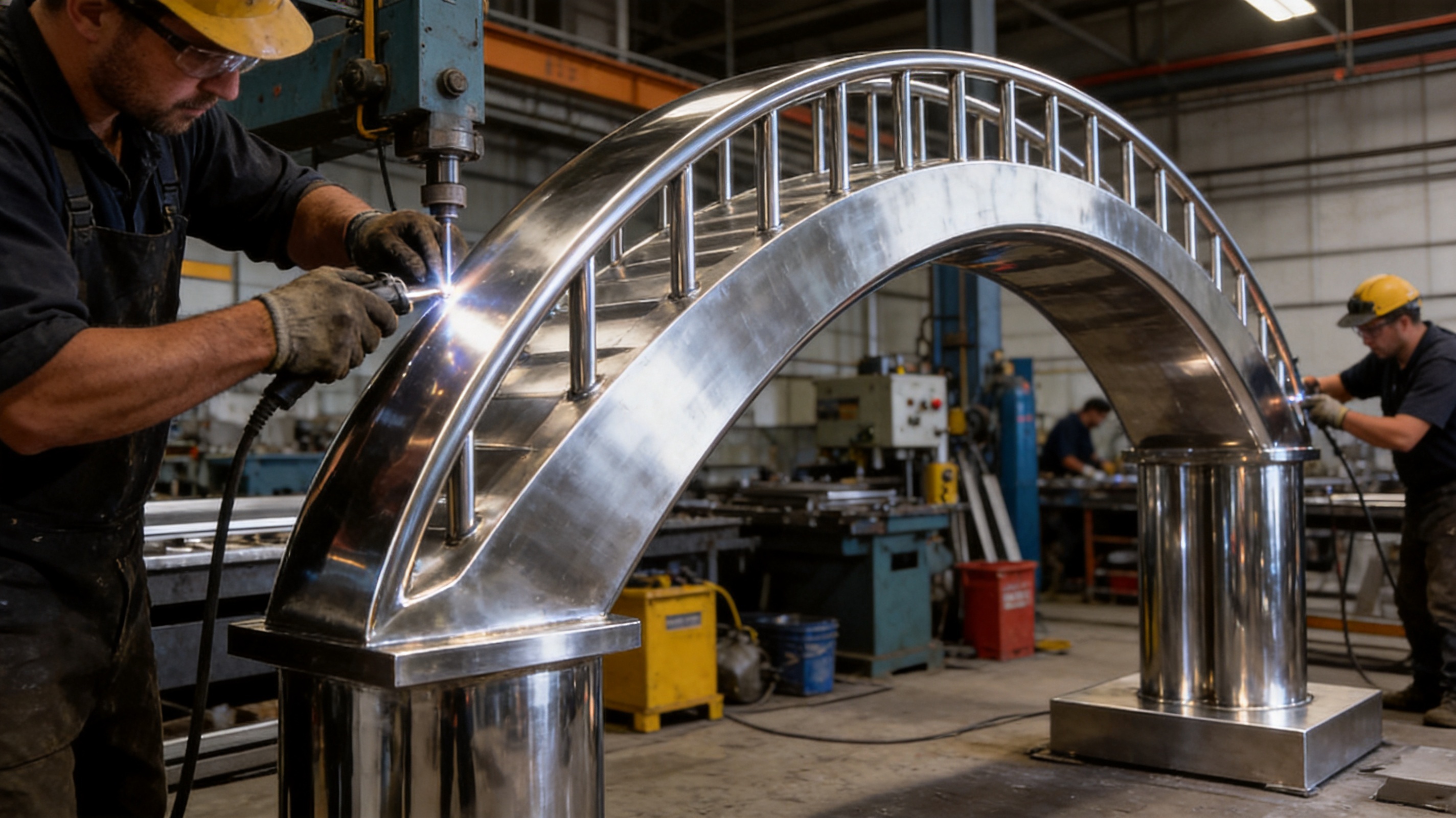
The arch is forged and shaped into a smooth, even curve across its full span. The objective is to achieve a controlled architectural line rather than a visibly segmented or irregular outline. The form must retain its visual continuity when seen from the front, side, underside, and oblique viewing angles.
Forming a large curved stainless-steel component requires attention to material behavior and dimensional control. The production team must manage the relationship between the intended shape and the material’s response during forming. This is particularly important when the final surface will receive a high-reflectivity polish, because changes in curvature can influence the way reflections appear.
The support columns are positioned in relation to the arch so that they provide a stable visual and structural transition. Their placement prevents the bridge from appearing top-heavy while preserving the openness beneath the span. The fixed base is then coordinated with the columns and arch to create a unified final composition.
After forming and structural preparation, the stainless-steel surfaces undergo progressive finishing to achieve the 8K mirror appearance. The surface must be prepared carefully before the final polishing stage. Scratches, uneven transitions, weld-related marks, and surface contamination can become highly visible once the metal is polished to a reflective level.
The goal of the polishing process is not simply to make the steel shiny. It is to create an even reflective field across the curved outer face, inner face, columns, and base. Consistency is important because a difference between highly polished and poorly polished areas would interrupt the visual unity of the design.
The final mirror polish enhances the sculpture’s ability to reflect its surroundings. It also emphasizes the accuracy of the curvature. When a building line or tree silhouette flows across the surface without sudden breaks, the viewer can recognize the care invested in both forming and finishing.
Quality inspection should address the sculpture as both an artwork and an outdoor structural object. Visual checks include the continuity of the arch, alignment of the columns, relationship between the base and upper structure, and consistency of the polished finish.
Dimensional checks are also relevant, especially when the sculpture is being produced for a specific entrance, path, channel, or plaza. The finished dimensions must correspond to the site plan and the intended installation method. Where customized proportions are requested, the relationship between width, height, support spacing, and base size should be reviewed before production is finalized.
These production strengths help distinguish a specialized sculpture manufacturer from a supplier offering only standard decorative metalwork. The value is found in the combination of material knowledge, controlled forming, integrated design, careful surface treatment, and the ability to adapt the basic concept to different site requirements.
The sculpture is available in sizes from 1 to 4 meters, providing options for different landscape scales. A 1-meter version may suit a smaller private garden, courtyard, interior-adjacent entrance, or compact landscape feature. Larger versions can create a stronger landmark presence at a hotel entrance, public plaza, villa estate, or pedestrian route.
Customization does not need to change the essential identity of the sculpture. The characteristic arched bridge silhouette can remain intact while the span, height, support spacing, and overall proportions are adjusted to fit a specific site. This is useful when the sculpture must align with an existing pathway, frame a view, cross a narrow landscape channel, or occupy a carefully measured entrance zone.
Project buyers should provide the manufacturer with site dimensions, preferred viewing directions, intended installation environment, material preference, access limitations, and any relevant foundation information. These details help the production team recommend a suitable scale and support arrangement.
Customization can also involve the relationship between the sculpture and its surrounding landscape. A design team may choose to emphasize the opening beneath the arch, place planting around the base, align the curve with a building entrance, or position the bridge over water. The sculpture’s neutral stainless-steel appearance makes it compatible with a broad range of landscape materials and planting styles.
In a European-style plaza, the sculpture can act as a contemporary landmark within a setting that may already contain stone paving, formal planting, fountains, benches, and architectural façades. Its bridge form introduces a clear symbolic narrative while its mirror finish adds a modern layer to the environment.
The arch can be positioned at the edge of the plaza to mark an entrance, along a pedestrian axis to frame movement, or near a seating area as a visual focal point. Its reflective surface may capture surrounding buildings and help connect the sculpture visually with the existing architectural character.
Hotel entrances benefit from objects that are recognizable, refined, and suitable for visitor photography. The sculpture can serve as a signature arrival element, especially when placed near a driveway, pedestrian forecourt, garden entrance, or shallow water feature.
The bridge symbolism is well suited to hospitality. It can suggest welcome, transition, and passage into a new experience. The mirror polish supports a premium appearance without requiring elaborate ornament, while the stainless-steel construction is suitable for a public outdoor setting subject to regular use and changing weather.
In a villa estate, the sculpture can define the transition between formal and informal garden areas. It may be installed near a gate, between lawn sections, beside a pool, above a dry streambed, or at the end of a long garden axis.
Its relatively clear silhouette allows it to remain visually strong without overwhelming the landscape. Planting can soften the base, while stone, gravel, or water can reinforce the bridge theme. In a private garden, the sculpture can also function as a quiet reflective object whose appearance changes with the seasons.
Tourism streets often require landmarks that help visitors orient themselves and remember a location. A polished stainless-steel arch can become a recognizable meeting point, gateway, or photographable feature. The bridge form provides a simple narrative that can be understood quickly, even by visitors unfamiliar with the project’s artistic background.
Where pedestrian access is intended beneath or across the sculpture, the final layout should be reviewed carefully by the project team. Clearances, foundation placement, traffic flow, public safety, and local regulations should all be addressed before installation.
The sculpture is designed with a fixed base produced from the same stainless-steel material, but the surrounding foundation remains an important part of the installation. The foundation should be selected according to the sculpture’s size, weight, wind exposure, soil conditions, and intended public access.
For installations over a shallow water channel or dry streambed, the supports should be coordinated with the channel’s width and the landscape’s drainage strategy. The sculpture can visually suggest a functional bridge, but the project team should establish whether visitors are intended to walk across it, walk beneath it, or simply view it as an artistic structure. Any direct visitor access should be evaluated for safety and engineering suitability.
The site should also provide sufficient space for transport, unloading, positioning, and final alignment. Larger versions may require specialized handling equipment or a coordinated installation schedule. These logistical issues should be considered during the design phase rather than after the sculpture has been completed.
Orientation is another important consideration. Since the sculpture reflects its surroundings, the viewing direction can influence which buildings, trees, water surfaces, or open skies appear on the polished metal. A landscape designer may choose to orient the arch toward a principal façade, a garden vista, a sunset direction, or a visitor approach route.
Routine maintenance helps preserve the clarity of the 8K mirror finish. Dust and general outdoor deposits should be removed with appropriate cleaning materials and soft equipment. Abrasive pads, harsh tools, and unsuitable chemicals can create fine scratches or reduce the clarity of the reflective surface.
Water spots should be addressed before mineral deposits accumulate. In areas with irrigation systems, sprinklers should be positioned so that they do not continuously spray the sculpture. Plant residue, bird deposits, and airborne pollution should also be removed in a timely manner.
Maintenance requirements are generally straightforward when compared with painted metal that requires periodic recoating. However, mirror-polished stainless steel is a premium surface and should be treated accordingly. Its durability protects the material, while regular care protects the quality of the reflection.
A maintenance schedule may be adjusted according to climate, pollution levels, proximity to the sea, visitor contact, and the presence of nearby trees or irrigation. A more frequent cleaning program may be appropriate for a hotel entrance or public plaza, while a private garden in a clean environment may require less frequent attention.
For landscape designers, the sculpture offers a strong central idea that can guide the arrangement of pathways, planting, water, paving, lighting, and sightlines. Its arch establishes a clear geometry, while its reflective finish allows the surrounding design to remain visible on the artwork itself.
For property developers, the sculpture can provide a recognizable feature that strengthens the identity of an entrance or public-facing space. Because it combines symbolic meaning with contemporary material quality, it can support projects positioned in the luxury, hospitality, tourism, and high-end residential markets.
For buyers comparing multiple sculpture suppliers, the product’s value should be assessed through more than its listed price. Relevant factors include the grade of stainless steel, the continuity of the curvature, the quality of the mirror polish, the coordination of the base and support columns, the ability to customize dimensions, the manufacturer’s communication during production, and the suitability of packaging and delivery arrangements.
The listed price range of $1,580 to $4,680 provides an initial reference for budgeting, while the final quotation may depend on size, stainless-steel grade, customized proportions, production details, packaging, shipping, and installation requirements. Buyers should request a project-specific quotation before placing an order.
The Arched Bridge Mirror-Polished Stainless Steel Sculpture stands out because it combines several qualities that are often found separately in competing products. It has a recognizable architectural form, a meaningful symbolic message, a high-reflectivity finish, weather-resistant stainless-steel construction, integrated support elements, and a size range suitable for both intimate and substantial settings.
Its strongest advantage is the relationship between form and finish. The arch provides the sculpture’s symbolic and architectural identity, while the mirror polish gives it a changing visual presence. Neither element is merely decorative. The curve controls the movement of reflected light, and the reflective surface makes the curve more visually active.
The use of matching stainless steel for the support columns and base also improves the sculpture’s overall coherence. A viewer can read the object as one deliberate composition rather than as an arch attached to a separate support system. This is particularly valuable in premium landscape projects where small inconsistencies can weaken the impression of quality.
Finally, the sculpture’s adaptability makes it practical for real projects. A buyer can select a size from 1 to 4 meters and discuss customized dimensions or proportions while retaining the central bridge concept. This combination of identity and flexibility is useful for designers who need a distinctive artwork that can still respond to site constraints.
The sculpture is manufactured from 304 or 316 stainless steel. The appropriate grade can be selected according to the installation environment and project requirements. The arch, support columns, and fixed base are designed as a coordinated stainless-steel composition.
An 8K mirror polish refers to a highly reflective stainless-steel surface. It allows the sculpture to reflect surrounding architecture, landscape, sky, water, and movement. The surface is more visually active than a brushed or matte finish and requires non-abrasive routine cleaning.
The listed size range is from 1 meter to 4 meters. Customized dimensions and proportions can also be discussed so that the sculpture fits a particular entrance, garden, plaza, water channel, or pedestrian space.
Yes. The 304/316 stainless-steel construction is intended for outdoor exposure and is suitable for locations such as plazas, hotel entrances, villa estates, gardens, and tourism streets. Site-specific foundation, drainage, wind, and installation requirements should be reviewed before installation.
The bridge form is suitable for placement over a shallow water channel or dry streambed. The project team should determine whether the sculpture is intended to be walked across, viewed from the side, or used as a visual bridge element. Any visitor access should be evaluated for structural and safety requirements.
Unlike painted steel, the sculpture’s primary appearance comes from its stainless-steel surface and mirror polish rather than an applied color coating. This provides a reflective, contemporary appearance and reduces dependence on paint maintenance, although regular cleaning is still recommended.
Neither grade is universally better for every project. 304 stainless steel is suitable for many outdoor settings, while 316 may be preferred for more aggressive environments, including some coastal or high-moisture locations. The correct selection depends on the site conditions and project specification.
The product is formed around a controlled, continuous arch with coordinated support columns and a matching fixed base. The manufacturing approach includes stainless-steel material selection, shaping and forging of the curved geometry, surface preparation, and progressive polishing to achieve the 8K mirror finish.
Routine cleaning with suitable non-abrasive materials is recommended. Dust, water spots, plant residue, and other deposits should be removed before they build up. Abrasive tools and unsuitable chemicals should be avoided because they may scratch or dull the polished surface.
The sculpture is well suited to European-style plazas, hotel and resort entrances, villa estates, private gardens, pedestrian tourism streets, transitional landscape spaces, water features, and dry streambeds. Its strongest applications are locations that benefit from a symbolic gateway or connection element.
Buyers should provide the desired size, preferred stainless-steel grade, installation location, site dimensions, intended viewing direction, whether visitors will pass beneath or across the sculpture, delivery destination, and any customization requirements. This information helps the manufacturer prepare a more accurate proposal.
The Arched Bridge Mirror-Polished Stainless Steel Sculpture offers a refined solution for outdoor spaces that require more than a conventional decorative object. Its continuous arch expresses connection and transition, while its support columns and matching base create a complete architectural composition. The 304/316 stainless-steel construction supports long-term outdoor use, and the 8K mirror polish gives the sculpture a changing relationship with its surroundings.
Its advantages over ordinary painted arches, generic metal ornaments, and heavier traditional bridge forms come from the combination of controlled curvature, integrated construction, reflective finishing, material durability, and customization potential. The sculpture can be adapted to a wide range of site scales, from intimate gardens to prominent public entrances, while preserving its essential identity.
Through a manufacturing process focused on material selection, formed geometry, coordinated structural elements, surface preparation, and high-quality polishing, Jiangsu Xinyesheng Sculpture Co., Ltd. provides a product suited to contemporary landscape and architectural projects. With appropriate site planning and routine maintenance, the sculpture can remain a durable landmark that reflects not only light and landscape, but also the idea of moving confidently from one place to another.
1. International Stainless Steel Forum. Stainless Steel in Architecture, Building, and Landscape Applications.
2. American Society for Testing and Materials. Standard Specifications and Practices Relating to Stainless Steel Products and Finishes.
3. International Organization for Standardization. Stainless Steel Grades, Corrosion Resistance, and Surface Treatment Principles.
4. Landscape Institute. Principles of Landscape Design, Spatial Transition, and Public Realm Planning.
5. Architectural Metalwork Industry Practice. Guidelines for Forming, Finishing, Cleaning, and Maintaining Exterior Stainless-Steel Surfaces.
6. Jiangsu Xinyesheng Sculpture Co., Ltd. Product specifications and manufacturing information for the Arched Bridge Mirror-Polished Stainless Steel Sculpture.



Daniel H.

Amanda R.

Robert B.

Jennifer S.

James W.

Barry G.

Michael T.

Emily K.

David L.

Sarah M.


Mikey XV

Jagxue

 English
 Español
 عربى
 Français
 italiano
 Deutsch