Public art is increasingly expected to do more than fill an empty space. In commercial developments, financial parks, shopping districts, sales centers, hospitality venues, and civic plazas, a successful sculpture must attract attention, communicate a memorable idea, withstand changing weather, and support the identity of its surroundings. The Key and Coin Fortune Tree Stainless Steel Sculpture responds to these requirements through a combination of symbolic clarity, skilled metal fabrication, durable materials, and a highly reflective contemporary finish.
Designed in the recognizable form of a tree, this sculpture replaces ordinary foliage with individually shaped keys and coins. The result is an immediately legible artistic statement about prosperity, opportunity, access, wealth, and accumulated good fortune. Rather than relying on an abstract interpretation that viewers may need to study, the sculpture uses familiar visual forms that can be recognized from a considerable distance. Its meaning is therefore accessible to visitors, customers, employees, and passersby of different ages and cultural backgrounds.
The sculpture combines a hand-forged stainless steel trunk with a branching canopy of individually cut, shaped, and polished symbolic leaves. The trunk is formed with organic curves and intentionally varied surface character, while the upper structure receives a bright mirror polish that reflects daylight, architectural lighting, and the movement of people around it. Available in sizes from 1.8 meters to 5.2 meters, the artwork can serve as a compact indoor accent or as a prominent outdoor landmark.
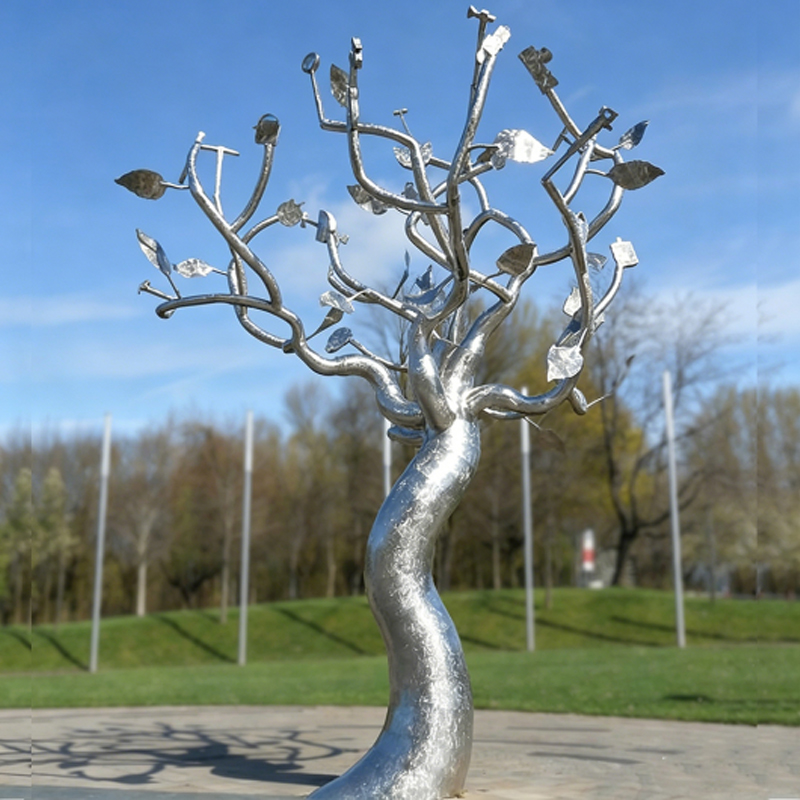
Key and Coin Fortune Tree Stainless Steel Sculpture
Content
Tree sculptures are commonly associated with life, growth, renewal, harmony, family, and connection to nature. The Key and Coin Fortune Tree preserves those positive associations while introducing a more specific financial theme. Its foliage consists of recognizable keys and coins, creating a direct visual connection with wealth, opportunity, commercial success, and the opening of new possibilities.
The key is a particularly effective symbolic element. It can represent access, solutions, authority, opportunity, and the opening of a new stage in life or business. In a commercial setting, keys may suggest access to a home, a new investment, a successful transaction, or a gateway to future achievement. Coins contribute a complementary meaning, expressing prosperity, value, financial accumulation, and material success. When the two forms are gathered into a tree canopy, they suggest that prosperity grows over time through opportunity, effort, and continuous development.
This combination makes the sculpture especially suitable for financial institutions, property developers, shopping centers, business parks, insurance companies, investment organizations, and sales centers. It can also be selected by hotels, restaurants, office complexes, and private developments that want an artwork with a welcoming and optimistic message.
Unlike a generic metal tree, this design does not depend entirely on a title or an accompanying plaque to explain its theme. Viewers can identify the key and coin shapes for themselves. That immediate recognition encourages conversation, photographs, social media sharing, and repeat engagement. In a busy public environment, such clarity can be a significant advantage because people often encounter outdoor art briefly while walking, shopping, driving, or entering a building.
Stainless steel provides a strong balance between structural performance, visual refinement, and long-term practicality. The material can be cut, bent, forged, welded, ground, and polished into complex sculptural forms. It also offers corrosion resistance that is valuable for public art installed outdoors or in semi-exposed environments.
The sculpture is produced using corrosion-resistant 304 or 316 stainless steel, depending on the project specification and environmental requirements. Grade 304 is widely used for architectural and decorative applications and performs well in many ordinary outdoor locations. Grade 316 offers additional resistance in more demanding environments, including areas affected by coastal air, higher humidity, or certain industrial conditions. Final material selection can therefore be matched to the installation site.
Stainless steel also allows the symbolic leaves to remain visually crisp. Keys and coins contain recognizable outlines, openings, edges, and surface planes. A material that is difficult to maintain or easily damaged could gradually reduce the clarity of those details. Stainless steel, properly fabricated and maintained, helps preserve the clean profile and polished appearance that make the design effective.
The bright mirror finish contributes another important advantage. It reflects the sky, surrounding buildings, greenery, paving, and artificial lighting, allowing the sculpture to change visually throughout the day. In the morning, it may reflect soft natural light. Under strong sunlight, the coin and key forms can appear bright and energetic. At night, architectural lighting can create points of reflection across the canopy and emphasize the branching arrangement.
Compared with painted steel, mirror-polished stainless steel does not depend on a surface color coating to create its primary visual effect. Paint can be attractive, but it may eventually fade, chip, or require recoating. A polished stainless steel surface instead uses the character of the metal itself. This can reduce the need for periodic color restoration and provides a refined appearance that suits both modern and European-influenced architectural environments.
The trunk is not intended to appear like a straight industrial pole. Its hand-forged construction allows the fabricators to develop irregular curves, subtle changes in thickness, and surface movement that resemble the dynamic growth of a living tree. This is an important artistic distinction because the trunk establishes the emotional character of the entire sculpture.
A mechanically bent tube can provide strength and consistency, but it may appear overly uniform when used as the central element of an organic sculpture. Hand-forging introduces controlled variation. The trunk can widen toward the base, divide into branches, and follow a more natural rhythm as it rises. The resulting structure feels less like a support frame and more like an intentional sculptural form.
Surface texture also contributes to the trunk’s character. Controlled forging marks, formed transitions, and carefully finished areas can create a tactile quality that contrasts with the highly reflective leaves. This contrast gives the sculpture visual depth. The trunk appears grounded, substantial, and connected to the idea of a living tree, while the key and coin foliage introduces a bright, contemporary, and symbolic layer.
The trunk is a sculptural feature in its own right rather than a hidden support for the canopy. This makes the work more rewarding from multiple viewpoints. Visitors approaching from the front may focus on the symbolic leaves, while viewers walking around the sculpture can appreciate the branching profile, forging details, and changing reflections on the polished surfaces.
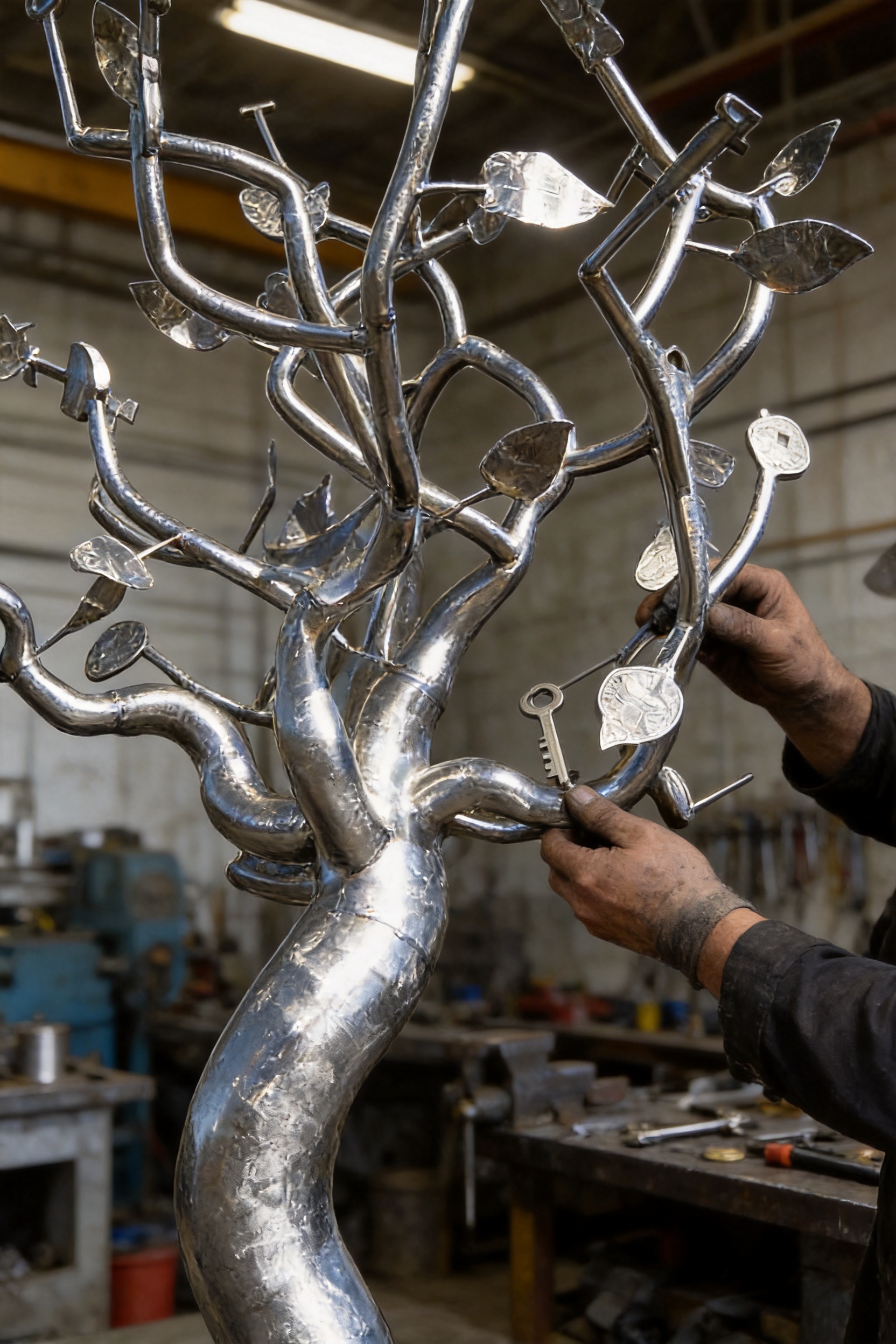
One of the strongest advantages of this design is the treatment of the foliage. The leaves are not represented by repetitive flat discs or identical machine-stamped components. Instead, key and coin shapes are cut and polished individually before being attached to the branching upper structure.
Individual fabrication allows each symbolic leaf to receive attention during shaping and finishing. Edges can be checked, surfaces can be polished, and the orientation of each piece can be adjusted to work with the overall canopy. This process is more labor-intensive than producing a simple repeated pattern, but it supports a more convincing final composition.
Subtle differences in the size and orientation of the key and coin leaves help prevent the canopy from appearing artificial or mechanically repetitive. Some elements may face toward the viewer, while others turn slightly sideways and catch light along their edges. This variation creates a naturalistic rhythm similar to the changing orientation of leaves on a real tree.
The varied arrangement also improves the sculpture’s performance under changing light. A completely uniform set of identical pieces would reflect light in the same direction and could appear visually flat. A more varied canopy produces a sequence of highlights and shadows, making the sculpture active and dimensional. From a distance, the foliage reads as a cohesive symbolic crown; from nearby, individual shapes reveal craftsmanship and detail.
Keys and coins can be arranged across the branching structure in a way that balances density and openness. The canopy should feel abundant without becoming visually congested. Open spaces between the symbolic leaves allow the background architecture and sky to remain visible, while clusters of polished elements provide the impression of accumulated prosperity.
The production of a large stainless steel sculpture requires more than cutting metal and assembling parts. It involves artistic development, structural planning, material preparation, forming, welding, surface treatment, inspection, and careful packing for delivery. The manufacturing process used for this sculpture is organized around preserving both the artistic concept and the practical demands of long-term installation.
Production begins with a review of the intended size, installation location, viewing distance, and visual emphasis. A sculpture for a small atrium may need a more compact canopy and refined proportions, while a landmark piece for a plaza must remain legible from farther away. The 1.8-meter to 5.2-meter size range allows the design to be adapted to different architectural settings.
Before fabrication, the trunk, branches, canopy density, base dimensions, and leaf distribution should be considered together. This prevents the upper foliage from becoming too heavy for the trunk or the symbolic elements from becoming too small to recognize. Proportion control is especially important in a fortune tree because the meaning depends on the visual relationship between the strong central trunk and the abundant canopy.
304 or 316 stainless steel is selected according to the project’s environmental and performance requirements. Sheets, tubes, bars, and formed components are prepared for their intended role. The trunk may use heavier structural sections, while the key and coin leaves can be fabricated from thinner sheet material shaped to retain sufficient stiffness and visual definition.
Material preparation includes measuring, marking, cutting, and organizing components before assembly. Accurate preparation helps maintain consistency across the sculpture while still allowing individually adjusted elements. It also supports efficient use of stainless steel and reduces unnecessary waste during the fabrication process.
The trunk is formed through a combination of controlled heating, forging, bending, and shaping methods appropriate to the selected stainless steel components. The objective is not to create random distortion. Instead, the fabricators guide the metal into a balanced organic structure with a stable base, convincing branch divisions, and a natural upward movement.
Forging gives the trunk a distinctive character that cannot be fully reproduced by a uniform industrial bend. The branching points can be developed with attention to flow, visual weight, and the way the canopy will be supported. The final form should appear energetic but not unstable, irregular but not chaotic, and expressive while remaining suitable for engineering and installation requirements.
The key and coin forms are cut from stainless steel using patterns or approved design drawings. Each component is checked for outline accuracy and then shaped as necessary. Coin forms may receive carefully controlled curvature or surface treatment, while key forms require attention to their shaft, bow, and tooth-like profile.
Individual shaping permits small variations that make the foliage more natural. However, variation is controlled rather than accidental. The collection of leaves must remain visually coherent, and the key and coin shapes must remain recognizable. This balance between repetition and variation is central to the sculpture’s success.
The branches and foliage are assembled after the major components have been prepared. Welding connects the structural elements and secures the symbolic leaves in their planned positions. Welded areas are treated carefully so that they support the structure without becoming distracting visual features.
Assembly requires attention to weight distribution. A large number of polished leaves can create a broad visual canopy, and their positions influence the balance of the entire sculpture. The fabrication team must consider how the branches carry the canopy, how the base transfers loads, and how the final artwork will be secured to its foundation.
After welding, visible areas are refined through grinding and surface preparation. The objective is to create clean transitions and remove unwanted sharp edges, irregular weld residues, and fabrication marks that would interfere with the intended appearance. The leaves are then polished to achieve their bright reflective finish.
Mirror polishing is a demanding finishing process because it reveals surface inconsistencies. Scratches, uneven grinding, and variations in reflectivity can become obvious under direct sunlight or artificial lighting. Careful preparation of the stainless steel is therefore essential. The company’s emphasis on individually cut and polished leaves supports a higher level of visual control than a basic untreated or uniformly painted metal finish.
Quality review should address both appearance and practical performance. Components are checked for secure attachment, balanced placement, clean edges, appropriate surface finish, and consistency with approved dimensions. The base and connection points are examined to ensure that the sculpture is ready for site installation.
Because the sculpture may be viewed from close range, inspection is not limited to its overall silhouette. Small details such as the clarity of key openings, the roundness of coin forms, and the quality of reflective surfaces contribute to the visitor experience. A professional production process recognizes that the perceived quality of a large sculpture is often influenced by many small details.
| Evaluation Area | Key and Coin Fortune Tree | Conventional Generic Metal Tree | Basic Painted Metal Ornament |
|---|---|---|---|
| Symbolic clarity | Keys and coins communicate prosperity and opportunity directly | Usually relies on a broader growth or nature theme | Meaning may depend primarily on color or shape |
| Surface effect | Mirror-polished stainless steel creates changing reflections | May use a standard brushed or untreated finish | Often depends on a painted coating |
| Foliage treatment | Individually shaped and varied symbolic leaves | Frequently uses repeated or simplified leaves | May use mass-produced decorative parts |
| Trunk character | Hand-forged curves and organic surface qualities | Can appear mechanically bent or structurally uniform | May emphasize ornament rather than sculptural form |
| Commercial suitability | Strong fit for financial, retail, property, and sales environments | Suitable for general landscape decoration | Depends heavily on the selected design and coating |
| Size flexibility | Available from 1.8 meters to 5.2 meters | May be limited to standard catalog sizes | Often produced in fixed decorative dimensions |
| Outdoor material performance | 304 or 316 corrosion-resistant stainless steel | Material quality varies by manufacturer | Paint and substrate require attention to weathering |
| Visitor engagement | Recognizable forms encourage photographs and discussion | May create a quieter, less specific impression | Engagement depends on novelty and visual color |
The table illustrates why the sculpture can compete effectively in the market for decorative public art. Its advantage is not based on a single feature. Instead, it combines a memorable concept, a durable material, skilled forming, individually finished components, and a wide range of potential applications.
A generic tree sculpture may be attractive, but it may not express a specific commercial message. A conventional abstract sculpture may be sophisticated, but it may not be immediately understood by every visitor. A painted ornament may provide strong color, but the coating can become the primary maintenance concern. The Key and Coin Fortune Tree occupies a useful position between symbolic accessibility and high-end metal craftsmanship.
Financial districts and business parks often need public art that reflects confidence, growth, ambition, and prosperity. The fortune tree provides a visual landmark that can be positioned near an entrance, central plaza, visitor reception area, or landscaped pedestrian route. Its reflective surfaces can reinforce the modern character of glass, stone, and steel architecture.
The symbolism is particularly appropriate for investment organizations, financial service providers, wealth management centers, and corporate campuses. It can serve as a statement piece without relying on prominent branding. The keys and coins communicate the theme while leaving the surrounding organization free to interpret the work in relation to its own mission.
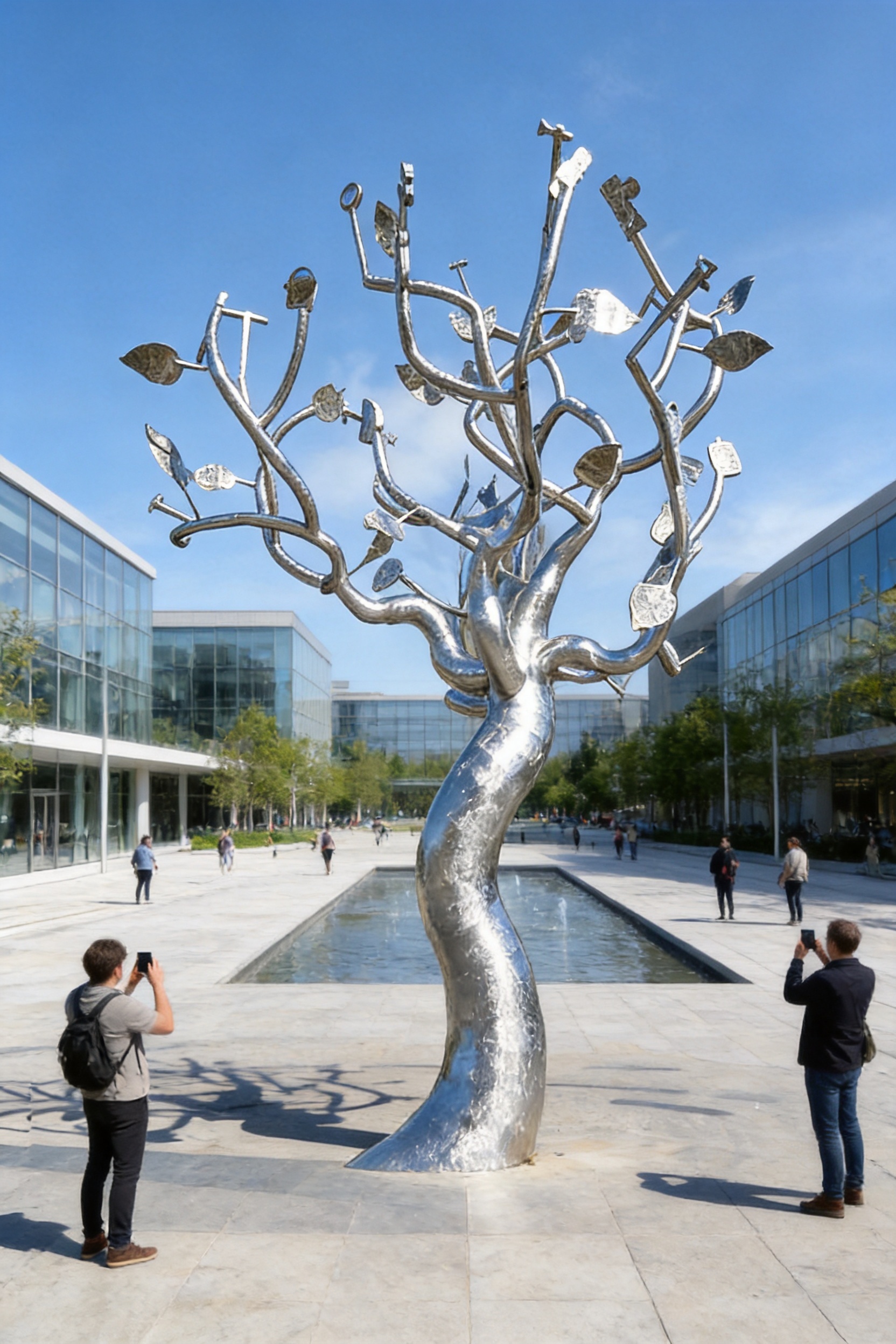
Shopping environments benefit from sculptures that invite visitors to pause and take photographs. A fortune-themed tree can become a recognizable meeting point and a visual feature associated with positive experiences. The combination of a tree silhouette and bright metallic foliage is easy to identify in photographs, maps, promotional materials, and visitor-generated social media content.
In a shopping street, the sculpture may be placed near a public seating area, an entrance plaza, a seasonal event zone, or a landscaped intersection. Its open canopy can preserve sightlines and allow the surrounding retail environment to remain visible. The polished surface can also respond to storefront lighting and changing displays, creating a connection between the artwork and its commercial surroundings.
Property sales centers often use symbols of opportunity, stability, family prosperity, and future achievement. A key-and-coin tree can support these themes in a direct but visually elegant manner. The key may suggest access to a new home or investment, while the tree indicates long-term growth and rooted value.
For a residential development, the sculpture may be placed in a reception garden or model-home entrance. For a commercial property, it can occupy an atrium or sales hall where potential buyers and investors encounter it during presentations. Its presence can strengthen the atmosphere of optimism and make the sales environment more memorable.
Hospitality properties frequently seek public art that creates a strong arrival experience. A fortune tree can be installed in a lobby, entrance courtyard, driveway approach, banquet space, or resort garden. When paired with carefully designed lighting, the reflective leaves can create an elegant focal point during evening events.
The concept can also be adapted to cultural or regional contexts. In some settings, coins and keys may be interpreted as symbols of welcome, opportunity, successful travel, or the opening of new experiences. The design’s broad positive associations allow it to function beyond strictly financial environments.
Although the sculpture is particularly suitable for commercial projects, it can also be used in large private gardens, villa entrances, corporate residences, and carefully planned landscape developments. Its 1.8-meter size can provide a more intimate presence, while larger versions can act as a prominent landmark in an expansive garden.
In a private setting, the sculpture may be positioned beside a reflecting pool, at the end of a pathway, near a landscaped terrace, or in a courtyard framed by stone and planting. The contrast between living vegetation and symbolic metal foliage can create a layered interpretation of nature, prosperity, and human creativity.
The available height range of 1.8 to 5.2 meters allows the sculpture to be matched with different spatial conditions. Size selection should consider the dimensions of the surrounding architecture, the expected viewing distance, pedestrian circulation, lighting, and the desired role of the artwork.
| Approximate Height | Recommended Setting | Primary Visual Role |
|---|---|---|
| 1.8 to 2.4 meters | Indoor atriums, reception areas, boutique landscapes, private courtyards | Accessible decorative focal point |
| 2.5 to 3.5 meters | Shopping centers, sales centers, hotel entrances, medium-sized plazas | Distinctive landmark visible across a pedestrian area |
| 3.6 to 4.5 meters | Business parks, large courtyards, public gardens, commercial plazas | Strong architectural and landscape feature |
| 4.6 to 5.2 meters | Financial district plazas, large public spaces, major development entrances | Prominent landmark and destination feature |
The height alone does not determine visual impact. Canopy width, branch spread, base design, viewing angle, and lighting all contribute to the final impression. A professional project review should therefore examine the sculpture in relation to the complete site rather than selecting a size in isolation.
Successful installation begins with a suitable foundation. The sculpture must be securely anchored to a stable base designed for its size, weight, center of gravity, and local environmental conditions. Outdoor installations may require consideration of wind exposure, drainage, soil conditions, pedestrian safety, and local construction requirements.
The foundation and anchor system should be coordinated with the sculpture manufacturer and the project’s architect, landscape designer, engineer, or contractor. Connection points should be concealed or integrated in a way that preserves the visual character of the base. The final installation should appear intentional from all normal viewing directions.
Access for delivery and assembly should also be reviewed in advance. A large sculpture may be fabricated in sections for transportation and then assembled on site. This can be useful for projects with restricted access, narrow entrances, or limited lifting capacity. The assembly plan should protect the mirror-polished surfaces from scratching during handling.
Indoor installations may have different requirements from outdoor installations. In an atrium, the design team may focus more on floor loading, ceiling clearance, pedestrian circulation, cleaning access, and the relationship between the polished surface and interior lighting. Outdoor projects require greater attention to foundation engineering, weather exposure, drainage, and maintenance access.
Lighting can significantly enhance the sculpture’s reflective qualities. Daylight already produces a changing appearance, but carefully positioned evening illumination can make the artwork visible after dark and strengthen its role as a landmark.
Uplighting from the base can emphasize the forged trunk and project highlights upward through the branching structure. Narrow-beam fixtures can pick out selected keys and coins without flattening the entire canopy. Softer ambient lighting can preserve the reflective character while avoiding excessive glare for nearby pedestrians or drivers.
Lighting design should be coordinated with the surrounding environment. Highly reflective stainless steel can produce strong highlights when illuminated directly, so fixture angles and brightness should be tested on site. The best result usually combines several levels of illumination rather than relying on one intense light source.
During the day, placement can also be planned to take advantage of natural reflections. Positioning the sculpture near water, glass architecture, pale paving, or greenery can create varied background effects. A dark landscaped backdrop may make the bright foliage more visible, while a lighter background can emphasize the silhouette and shadow pattern.
Stainless steel is durable, but no outdoor material should be considered completely maintenance-free. Regular care helps preserve the mirror finish and keeps the symbolic leaf shapes easy to recognize. Maintenance requirements will vary according to the installation environment.
Routine cleaning can remove dust, fingerprints, airborne pollutants, water spots, bird residue, and other surface deposits. Soft cloths, clean water, and products appropriate for stainless steel are generally preferable to abrasive materials. Harsh cleaners containing unsuitable chemicals should be avoided because they may mark or discolor the surface.
Coastal locations, industrial areas, and regions with heavy traffic may require more frequent cleaning. Salt deposits and atmospheric contaminants can affect the appearance of polished surfaces if they are allowed to remain for long periods. A planned maintenance schedule is therefore useful for preserving the sculpture’s reflective quality.
Inspections should also include the welded connections, base, anchor points, and any assembled joints. The purpose is not only cosmetic. Early identification of loose components, unexpected movement, drainage problems, or damage from external impact can help prevent more significant repairs later.
The use of 304 or 316 stainless steel provides a strong material foundation, but performance still depends on correct fabrication, installation, environmental suitability, and maintenance. For projects in demanding conditions, selecting 316 stainless steel and establishing a regular cleaning program may be particularly beneficial.
The standard concept can be adjusted to suit the visual language and practical requirements of a specific project. Customization may include overall height, canopy width, trunk proportions, branch density, leaf distribution, surface finish, base treatment, and installation configuration.
A client may prefer a denser canopy to create a more abundant impression of prosperity, or a lighter arrangement to preserve transparency within an atrium. The balance between keys and coins can also be adjusted according to the intended message. More key forms may emphasize opportunity and access, while more coin forms may create a stronger focus on wealth and financial abundance.
Finishing choices can be discussed as part of the design process. A bright mirror polish creates maximum reflection and visual energy. Selective brushed areas may introduce contrast on the trunk or selected components. A combined finish can help distinguish the organic structural elements from the symbolic foliage while maintaining a cohesive stainless steel identity.
Custom dimensions are especially important when the sculpture must align with a building entrance, central axis, water feature, signage zone, or existing landscape composition. The company’s experience with metal sculpture production allows the work to be developed as a project-specific object rather than treated as a fixed ornament with limited adaptability.
Jiangsu Xinyesheng Sculpture Co., Ltd. operates as a China-based sculpture manufacturer and supplier of custom metal statues and decorative artworks. Its production capabilities cover stainless steel sculpture as well as other sculpture categories, including bronze, marble, fiberglass, and weathering steel works. This broader material experience can be valuable for clients comparing different finishes and construction methods for a single landscape or architectural project.
The company’s strength in this product is its combination of concept-specific fabrication and metalworking skill. The fortune tree is not simply a standard tree model with decorative attachments. The design requires a coordinated understanding of organic trunk formation, symbolic component production, reflective finishing, structural assembly, and outdoor application.
Hand-forging the trunk demonstrates a willingness to preserve artistic irregularity while maintaining a controlled production process. Individually cutting and polishing the key and coin leaves demonstrates attention to detail at the component level. The use of 304 and 316 stainless steel provides material flexibility for different environments, while the available size range supports projects from compact indoor settings to large public plazas.
Custom production also enables communication between the client and the manufacturer regarding dimensions, finish, application, and delivery requirements. For large-scale public art, this direct manufacturing relationship can be more useful than selecting an anonymous mass-produced decoration that offers little flexibility after purchase.
The company can support buyers seeking a custom design metal statue, a European-style decorative sculpture, or a contemporary stainless steel landmark with a defined symbolic purpose. Its ability to work across several sculpture materials also provides a foundation for coordinated artwork programs in which stainless steel pieces are combined with bronze, marble, fiberglass, or weathering steel elements.
For commercial buyers, manufacturing strength should be evaluated through more than catalog variety. Important factors include the ability to interpret a concept accurately, control proportions, maintain surface quality, fabricate components securely, prepare work for transportation, and adapt production to the installation environment. These are the areas in which the fortune tree’s production characteristics are particularly relevant.
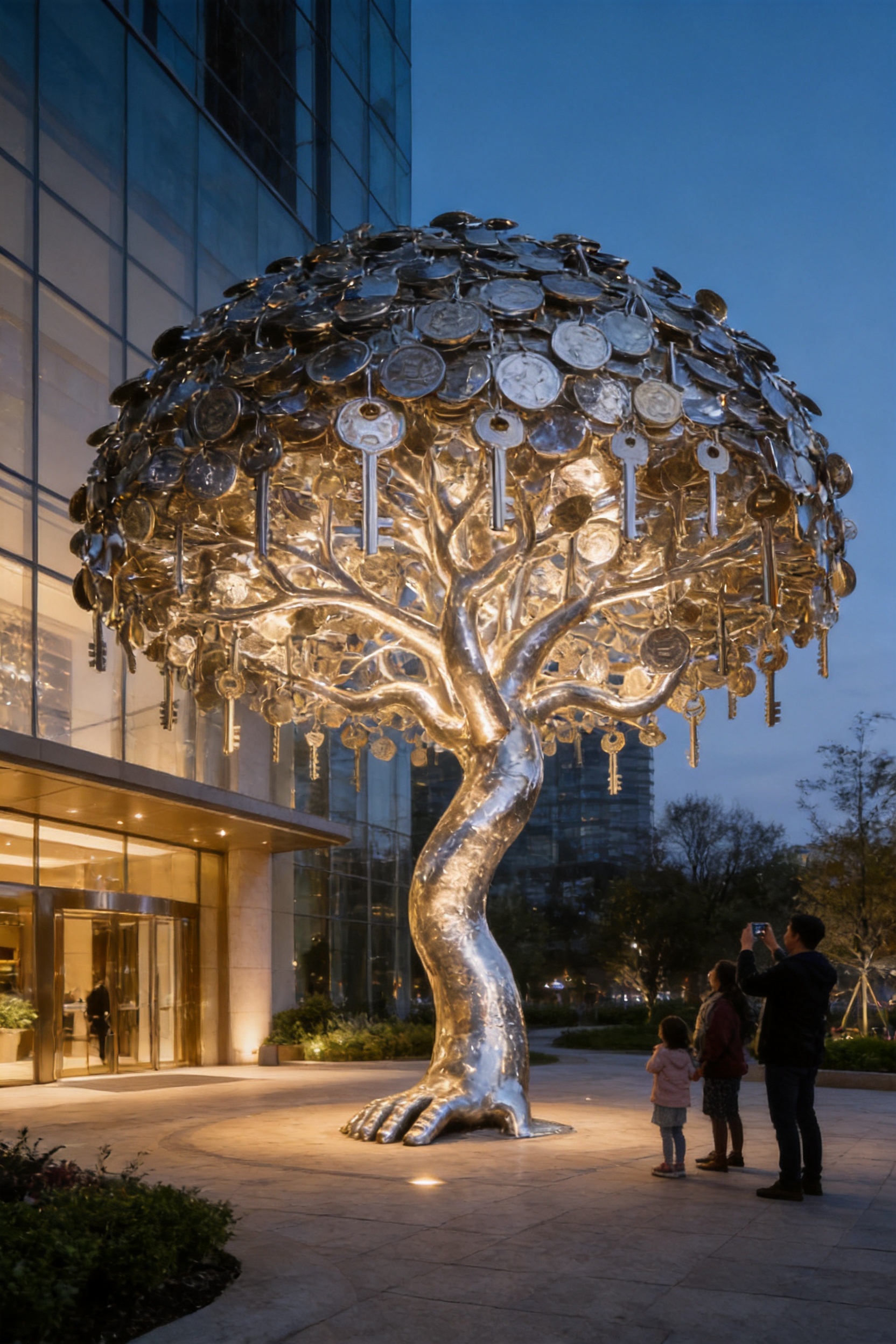
A public sculpture can contribute value in several ways. It can establish a visual identity, improve the atmosphere of a site, create a destination for visitors, support marketing photography, and help people remember a location. The Key and Coin Fortune Tree is designed to perform across these functions.
Its prosperity theme is useful for organizations that want public art connected with financial confidence or commercial activity. Its tree form gives the sculpture a welcoming and organic character, preventing the financial message from becoming excessively rigid or corporate. The polished steel surface adds a premium appearance that can complement high-quality architecture and landscape design.
The sculpture can also act as a social object. Visitors may photograph themselves beside the canopy, point out the unusual key and coin leaves, or use the sculpture as a meeting location. In a shopping or hospitality setting, this kind of informal engagement can make the surrounding site feel more distinctive and memorable.
For developers, a landmark sculpture may help create a recognizable visual signature for a new project. When positioned correctly, it can be seen in promotional imagery, entrance views, visitor photographs, and landscape panoramas. The work does not need to be covered with commercial text to contribute to identity; its form and symbolism can carry the message in a more refined way.
Bronze provides warmth and historical associations, marble offers solidity and classical elegance, fiberglass permits lightweight large-scale forms, and weathering steel creates a deep rust-colored appearance. Each material has a valid role in public art. Stainless steel is distinctive because it combines a modern reflective character with substantial weather resistance and precise fabrication potential.
For a sculpture centered on keys and coins, reflection is especially appropriate. The bright surface gives the symbolic foliage an energetic quality and allows the forms to interact with the environment. A dark or matte material would communicate the concept differently, perhaps with greater visual weight but less sparkle and movement.
Stainless steel is also effective when a project requires a contemporary appearance that can sit beside glass façades, metal cladding, polished stone, and modern landscape materials. Its clean surfaces can appear luxurious without depending on bright paint or decorative color.
The choice between 304 and 316 stainless steel should be made with attention to location and budget. A qualified project team can evaluate humidity, salt exposure, pollution, cleaning practices, and expected service conditions. The manufacturer can then coordinate the material selection with the design and fabrication plan.
The sculpture symbolizes prosperity, financial success, opportunity, access, accumulated value, and positive growth. The tree form suggests development and abundance, while the keys and coins create a more direct connection with wealth and new opportunities.
It is well suited to commercial plazas, financial parks, business districts, shopping streets, sales-center atriums, hotel entrances, resort landscapes, public gardens, and corporate campuses. Smaller versions can also be used in interior reception spaces and private courtyards.
The listed size range is approximately 1.8 meters to 5.2 meters in height. The most suitable size depends on the available space, viewing distance, architectural scale, and whether the sculpture is intended as an accent or a major landmark.
The trunk and symbolic foliage are fabricated from corrosion-resistant 304 or 316 stainless steel. The appropriate grade can be selected according to the project environment, particularly where coastal air, high humidity, or industrial exposure may be present.
No. The components are individually cut and polished, and subtle variations in size and orientation may be introduced. This helps the canopy avoid a repetitive stamped appearance and creates a more natural distribution of symbolic foliage.
The trunk is hand-forged and shaped to create organic curves, branching movement, and distinctive surface character. This approach gives the trunk a more sculptural appearance than a simple straight or mechanically bent support.
Yes. Stainless steel is highly durable, but periodic cleaning and inspection are recommended. Removing dust, salt, pollutants, fingerprints, and water deposits helps preserve the mirror-polished surface. Anchor points and structural connections should also be reviewed as part of routine site maintenance.
Customization may be discussed for dimensions, canopy density, branch arrangement, key-to-coin balance, surface treatment, base configuration, and installation requirements. Project-specific adjustments are particularly useful when the sculpture must fit a defined architectural or landscape composition.
Both grades can be suitable. Grade 304 is commonly used in many outdoor and architectural applications, while grade 316 offers greater resistance in more demanding environments, including coastal or high-humidity locations. The final decision should consider the site conditions and project specifications.
The provided price range is approximately 1,760 to 5,180 United States dollars. The final quotation may depend on the selected size, material grade, customization, finishing requirements, packing, transportation, and installation conditions.
Yes. The smaller sizes are suitable for atriums, reception areas, sales centers, hotel interiors, and other spacious indoor environments. Indoor planning should consider floor loading, ceiling height, pedestrian circulation, lighting, and access for cleaning.
The unusual key-and-coin foliage is easy to recognize and visually different from ordinary tree sculptures. Its reflective surfaces change with the surrounding light, and its open branching structure creates attractive photographic angles. These qualities can encourage visitor interaction and social sharing.
The Key and Coin Fortune Tree Stainless Steel Sculpture offers a clear and memorable interpretation of prosperity through a carefully developed tree form. Its hand-forged trunk provides organic movement and structural character, while its individually shaped key and coin leaves create a direct symbolic message. Mirror-polished stainless steel adds brightness, depth, and changing reflections, helping the sculpture remain visually engaging in daylight and under architectural lighting.
Its advantages over more conventional decorative sculptures come from the combination of concept and execution. The design is easier to understand than a generic abstract tree, more distinctive than a repeated metal ornament, and more adaptable than a fixed painted decoration. The use of 304 or 316 stainless steel supports long-term outdoor application, while individual component finishing helps maintain clarity and quality at close viewing distances.
For financial parks, shopping streets, commercial plazas, property sales centers, hotels, business campuses, and public landscapes, the sculpture can function as both artwork and landmark. It can reinforce a theme of opportunity, create a recognizable visitor destination, and contribute to the identity of a development without depending on excessive signage.
Supported by hand forging, precision cutting, individual polishing, controlled assembly, and custom size options, the sculpture demonstrates the value of specialized metal sculpture manufacturing. Its available height range of 1.8 to 5.2 meters and listed price range of 1,760 to 5,180 United States dollars provide a practical starting point for projects of different scales. With appropriate foundation planning, lighting, and maintenance, the Key and Coin Fortune Tree can provide a durable and highly recognizable expression of growth, access, and good fortune.
1. International Stainless Steel Forum. General Principles of Stainless Steel Selection for Architectural and Outdoor Applications.
2. ASTM International. Standard Practices Relating to Stainless Steel Fabrication, Surface Finishing, and Corrosion Evaluation.
3. American Welding Society. Guidance on Welding, Inspection, and Finishing of Stainless Steel Fabrications.
4. Architectural Metalwork Design Principles. Surface Reflection, Material Character, and Public Art Integration.
5. Landscape Institute. Considerations for Public Art Placement in Commercial and Civic Landscapes.
6. International Council on Monuments and Sites. General Principles for the Planning and Maintenance of Public Art Installations.
7. Materials and Methods in Contemporary Metal Sculpture. Forming, Forging, Welding, Polishing, and Structural Assembly.



Daniel H.

Amanda R.

Robert B.

Jennifer S.

James W.

Barry G.

Michael T.

Emily K.

David L.

Sarah M.


Mikey XV

Jagxue

 English
 Español
 عربى
عربى Français
 italiano
 Deutsch