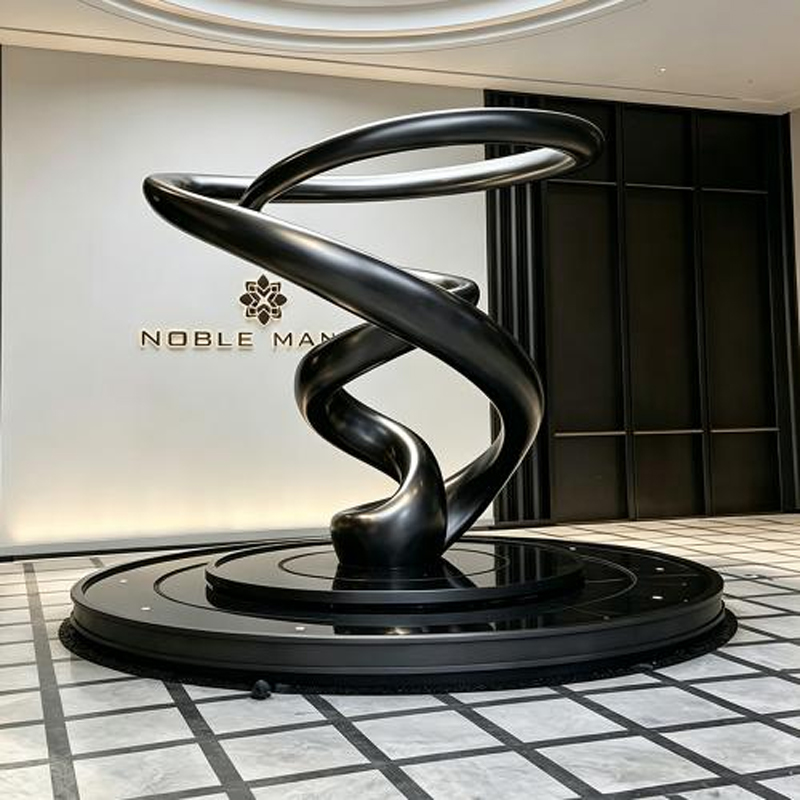
A powerful interior sculpture does more than occupy an empty floor area. It establishes a visual center, guides movement through a room, reinforces the character of an architectural setting, and gives visitors an object they can remember. The Mobius Spiral Abstract Stainless Steel Sculpture is designed for precisely this role. Its continuously twisting form, deep black lacquer finish, and multilayer concentric black stone base combine contemporary geometry with a restrained sense of luxury.
Unlike many stainless steel sculptures that depend on bright mirror polishing, dramatic reflections, or outdoor monumentality, this indoor interpretation uses a glossy matte-black lacquer coating to create a quieter and more sophisticated presence. The result is a sculpture capable of standing confidently in a hotel lobby, luxury boutique, sales-office reception area, corporate entrance, or upscale private interior without overwhelming the lighting, materials, or atmosphere of the space.
The sculpture is constructed from a single continuously twisted heavy-gauge tube made from corrosion-resistant 304 or 316 stainless steel. This approach gives the work a visually uninterrupted profile. There are no obvious breaks between separate flat plates, and the rounded tube maintains a sense of continuity as it rises, curves, and loops through the air. The form suggests a Mobius-like cycle: a flowing loop without a conventional beginning or end, interpreted through a smooth architectural spiral.
Available heights range from 1.3 to 4.2 meters, while the tube diameter can be customized to support different proportions and installation requirements. This range allows the sculpture to function as a compact statement piece in a reception area or as a dramatic vertical centerpiece in a multi-story lobby. Its adaptable dimensions, specialized tube-bending process, and carefully layered finish make it particularly suitable for designers seeking a custom decorative sculpture rather than a standard mass-produced object.
Mobius Spiral Abstract Stainless Steel Sculpture (Indoor)
Content
The Mobius concept is traditionally associated with continuity, infinity, harmony, and unending movement. In architectural and decorative sculpture, these associations can be expressed in many ways, including flat ribbons, interlocking bands, folded sheets, and abstract loops. This sculpture takes a different approach by using a heavy-gauge circular tube as the primary visual and structural element.
The tubular construction creates a rounded silhouette that changes subtly as the viewer moves around it. From one angle, the sculpture may appear like an upright spiral. From another, it may resemble a flowing ring or an abstract flame. When viewed from the side, the twisting tube emphasizes depth and movement. This changing appearance encourages visitors to walk around the work instead of experiencing it from only one fixed viewpoint.
The continuous curve also creates a strong contrast with the straight lines commonly found in modern interiors. Marble floors, glass walls, rectangular reception desks, metal partitions, and linear ceiling systems all benefit from the introduction of a smooth organic form. The sculpture softens the geometry of the surrounding architecture while retaining a highly controlled and contemporary appearance.
Although the design is abstract, it is not visually arbitrary. Its proportions are based on the relationship between the overall height, the radius of the looping curve, the thickness of the tube, and the visual weight of the base. These elements must work together so that the sculpture appears stable, balanced, and intentional. A tube that is too thin may lose its architectural authority, while one that is too thick may make the curve appear heavy. Custom tube-diameter options allow the proportions to be adjusted for the intended environment.
One of the most important advantages of the design is its uninterrupted appearance. Sculptures assembled from multiple flat plates can create strong graphic effects, but their seams, joins, or abrupt changes in direction may be noticeable from certain angles. By contrast, a continuously twisted tube produces a more unified line. The eye follows the curve naturally from the lower section through the central twist and toward the upper loop.
This continuity is especially effective in interiors where viewers may approach the sculpture from different directions. In a hotel lobby, for example, guests may see the work while entering through a front door, approaching a reception desk, waiting beside a seating area, or ascending a staircase. The sculpture offers a different composition from each viewpoint while preserving the same overall visual identity.
The material selection is central to the sculpture’s performance and appearance. The primary form is produced from heavy-gauge stainless steel, with 304 or 316 grades available depending on the project specification and environmental requirements. Both grades are widely recognized for their corrosion resistance, strength, and suitability for architectural and decorative applications.
Using heavy-gauge tube stock provides more than structural strength. It also gives the sculpture a substantial visual presence. The form does not look like a thin decorative wire or a lightweight temporary installation. Instead, the rounded tube suggests permanence and solidity while remaining visually fluid because of its continuous curve.
Stainless steel is also advantageous for interior installations because it is stable, durable, and relatively easy to maintain under normal indoor conditions. When protected by the selected lacquer system and used in a suitable interior environment, the material can retain its intended appearance for many years with routine care.
Grade 304 stainless steel is a widely used option for indoor architectural sculpture. It offers a strong balance of corrosion resistance, workability, durability, and cost efficiency. For most hotel lobbies, office entrances, reception spaces, galleries, and retail interiors, 304 stainless steel can provide an appropriate material foundation.
Grade 316 stainless steel contains additional alloying elements that can improve resistance in more demanding environments. It may be selected when the installation is near coastal air, exposed to higher humidity, or located in a setting where enhanced corrosion resistance is a priority. Although the sculpture is designed for indoor use, project conditions can vary, and material selection should be considered alongside humidity, ventilation, cleaning practices, and local environmental factors.
The availability of both 304 and 316 stainless steel gives designers and purchasers greater flexibility. They can select the material grade according to the installation environment, budget, and performance expectations rather than being limited to a single standard specification.
Creating a smooth, continuously twisting curve from thick tube stock is significantly more demanding than producing a flat laser-cut plate or a simple straight-frame sculpture. The tube must be shaped while preserving a consistent wall profile and a perfectly round or acceptably controlled cross-section. If the process is not carefully managed, the tube can flatten, buckle, wrinkle, or develop inconsistent curvature.
The production process therefore requires specialized bending equipment and experienced technical control. The tube is shaped gradually to achieve the intended spiral geometry. During this operation, attention must be given to bending radius, rotation, feed rate, alignment, and the relationship between different sections of the overall form. The objective is not merely to force the tube into a general loop, but to create a controlled continuous curve that reads as smooth from multiple viewing angles.
Maintaining a consistent wall thickness is also important. Uneven deformation can affect both the appearance and the structural behavior of the sculpture. A uniform tube profile supports a cleaner reflection of the surrounding light, a more consistent surface after coating, and a more predictable relationship between the tube and the supporting base.
The twisting stage demands additional precision because the sculpture’s visual effect depends on the gradual transition of the tube through space. A sudden change in angle can make the sculpture look mechanical or fragmented. A properly controlled twist produces an uninterrupted visual flow, allowing the work to suggest a single movement frozen in time.
Before the lacquer system is applied, the formed tube must be inspected for geometry, surface condition, and connection accuracy. The sculpture’s overall dimensions are checked against the approved design, including height, loop width, base connection, tube diameter, and alignment. These checks help ensure that the completed work will stand correctly and interact with the surrounding space as intended.
Surface preparation is equally important. Stainless steel surfaces must be cleaned and prepared so that the coating can bond consistently. Any irregularities that might become more visible under a glossy black finish require attention before painting. Because a dark, reflective coating can emphasize small imperfections, preparation quality directly affects the final impression.
This preparation stage is one of the areas in which a specialist sculpture manufacturer can offer an advantage over general metal fabrication. A workshop experienced in decorative sculpture understands that the finished piece will be viewed as an artistic object from close range. The standards for continuity, visual balance, and surface quality can therefore be higher than those applied to ordinary industrial components.
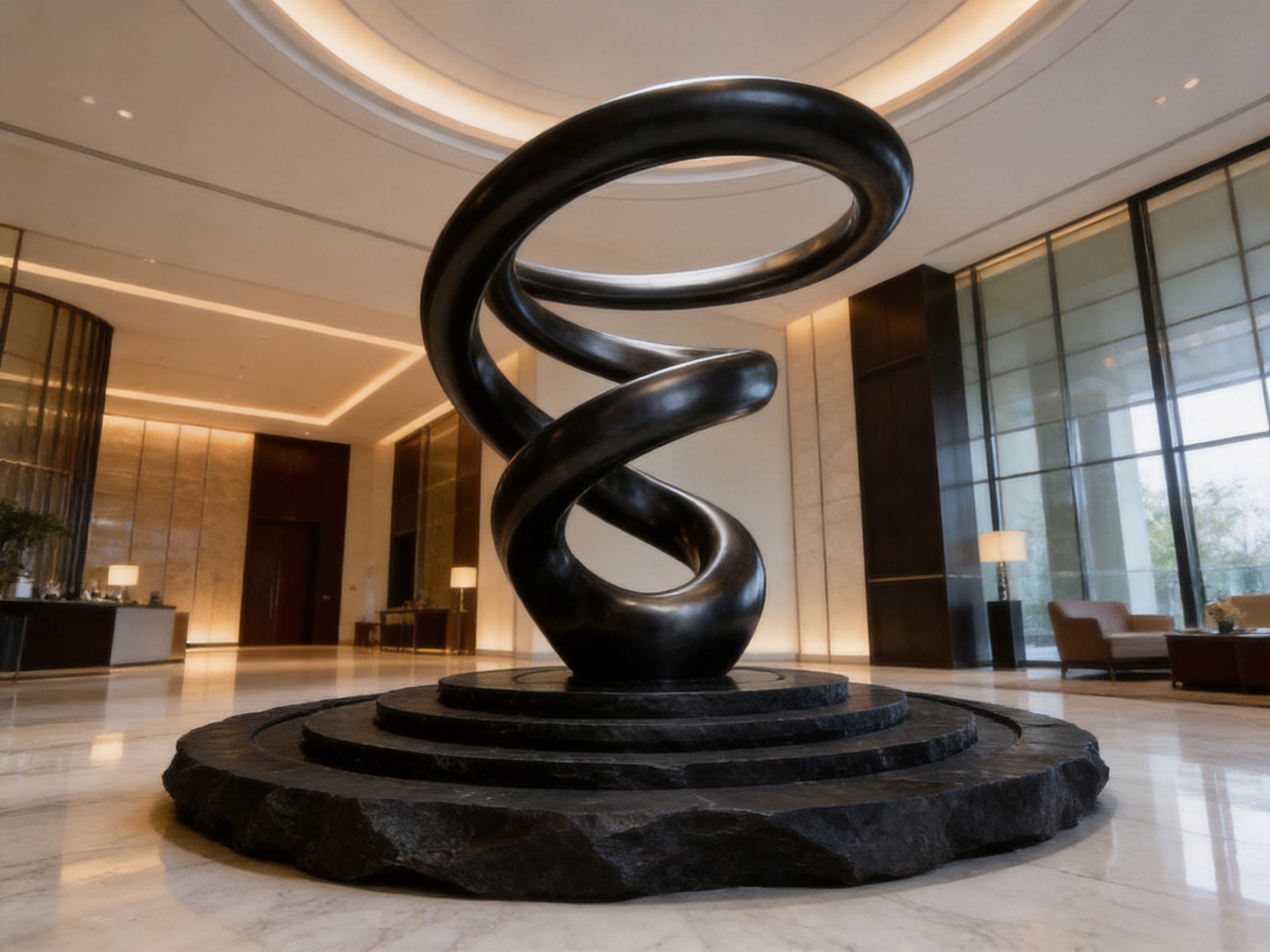
The finish distinguishes this sculpture from many stainless steel works intended for exterior plazas, gardens, and public landscapes. Instead of relying on the bright silver appearance of polished stainless steel, the sculpture receives a glossy matte-black lacquer coating. The black treatment creates a powerful visual identity while allowing the curved form to remain the primary focus.
The term glossy matte-black describes a controlled surface that combines deep black color with a refined sheen. It is not a raw, chalky matte surface, nor is it necessarily the highly reflective appearance of a mirror-polished automobile finish. The objective is a rich, glass-like depth that responds to interior lighting without generating excessive glare.
Multiple lacquer layers are applied, with polishing between coats to develop a smooth and even appearance. This layered process helps create visual depth in the black color. Rather than looking like a thin layer of paint placed over metal, the finished sculpture has a more substantial and luxurious surface character.
Bright mirror-polished stainless steel can be highly effective in outdoor environments, where sunlight and open space emphasize its reflective energy. In a carefully designed interior, however, strong reflections may compete with architectural lighting, polished stone, display cases, artwork, or branded visual elements. A black lacquer finish offers a more restrained alternative.
The pure black surface absorbs and controls much of the surrounding visual noise while still revealing the curved geometry through highlights. As a result, the sculpture can appear bold without becoming visually aggressive. It complements warm timber, neutral stone, white marble, smoked glass, bronze details, dark wood, and brushed metal finishes.
Black also provides a strong contrast against light-colored interiors. Against white or cream marble, the sculpture reads as a precise graphic gesture. Against dark stone, it becomes more subtle and atmospheric, with the highlights defining the form. In a hotel lobby with carefully positioned spotlights, the surface can shift between solid black and soft reflected gray as visitors move through the space.
The black finish changes the symbolic tone of the Mobius design as well. The looping form still suggests continuity and harmony, but the color gives it a quieter visual register. Instead of emphasizing motion and spectacle, it communicates confidence, restraint, permanence, and contemporary luxury.
The supporting base is designed as an important part of the overall composition rather than a purely functional platform. Its multilayer concentric structure echoes the circular logic of the Mobius form. The rings or layered profiles create a visual transition between the solid floor and the rising tubular sculpture.
Produced in matching black tones, the base supports a unified color relationship between the metal form and the stone foundation. This helps the sculpture appear integrated rather than assembled from unrelated materials. The dark stone provides visual weight at the bottom, while the twisting tube introduces vertical movement above it.
The concentric arrangement can also emphasize the sculpture’s symbolic associations. The circular layers suggest expansion, repetition, and continuity. They visually anchor the central form while reinforcing the concept of an unending cycle.
The base can be produced from more than one natural stone source in matching or closely coordinated black tones. This gives installers and project managers flexibility when sourcing locally available material. The ability to consider different stone sources may help control transportation costs, lead times, and logistical complexity, particularly because a substantial stone base can be heavy and expensive to ship over long distances.
Local sourcing should always be coordinated with the approved color, texture, thickness, load requirements, and fabrication standards. Natural stone varies in veining, density, and surface character, so sample approval is recommended before final production. When carefully selected, a locally sourced material can preserve the intended design language while adapting the project to regional availability.
The base also requires appropriate coordination with the installation floor. Depending on the selected dimensions and total weight, the project may need a level, structurally suitable surface and an installation method that prevents movement. The manufacturer and installation team should review these requirements before delivery.
Interior buyers often compare stainless steel sculptures with bronze, marble, fiberglass, painted mild steel, and standard polished metal designs. Each material has its own value, but this Mobius sculpture offers a particular combination of durability, customization, visual continuity, and contemporary elegance.
| Feature | Mobius Spiral Stainless Steel Sculpture | Common Alternative | Practical Advantage |
|---|---|---|---|
| Primary form | Continuously twisted heavy-gauge tube | Flat plate, welded frame, or segmented form | Creates a smoother uninterrupted visual line |
| Material options | 304 or 316 stainless steel | Painted mild steel or a single fixed alloy | Allows material selection according to environment and project priorities |
| Surface finish | Multi-layer glossy matte-black lacquer | Bright mirror polish or basic single-layer paint | Provides a restrained, luxurious indoor appearance |
| Scale | Approximately 1.3 to 4.2 meters in height | Often available in limited standard sizes | Supports different ceiling heights and spatial conditions |
| Tube diameter | Customizable | Usually fixed by catalog design | Improves proportional control and visual balance |
| Base | Multilayer concentric black natural stone | Simple plinth or separate metal plate | Creates a more integrated architectural composition |
| Maintenance | Routine indoor dusting under normal conditions | May require frequent refinishing or specialized care | Supports straightforward long-term upkeep |
Mirror-polished stainless steel is highly reflective and can deliver a striking contemporary effect. However, its high reflectivity may produce glare, visible fingerprints, and strong reflections of nearby furniture, people, and lighting fixtures. In a controlled interior with many reflective surfaces, this can make the composition feel excessively busy.
The black lacquer version offers a more curated visual response. Its highlights remain visible, but they are controlled by the depth and tone of the coating. This makes the sculpture easier to coordinate with sophisticated interiors where the designer wants a focal point that is memorable but not disruptive.
Painted mild steel can be cost-effective, but it generally requires more attention to corrosion protection, especially at joints, edges, and areas where the coating may be damaged. Stainless steel offers a more corrosion-resistant material foundation, while the lacquer system supplies the desired color and finish.
For indoor projects, this combination can provide a useful balance between appearance and durability. It also gives buyers the flexibility to select either 304 or 316 stainless steel when project conditions justify a higher corrosion-resistance specification.
Flat-plate sculptures can create bold silhouettes, but they often read as graphic compositions viewed from a preferred direction. The rounded tube used in this design offers a more three-dimensional experience. Its form changes as viewers walk around it, and the absence of broad flat faces reduces the risk that the sculpture will feel like a large sign or panel.
The tube also produces a softer relationship with light. Instead of reflecting light from a single broad plane, its curved surface creates gradual transitions between highlight and shadow. This is particularly effective under architectural spotlights and indirect lobby lighting.
Fiberglass and composite materials can support complex shapes and lower shipping weights. They may be useful where a lightweight installation is essential. However, stainless steel provides a more substantial tactile and architectural presence. The heavy-gauge tube communicates permanence and quality, which can be important in premium commercial interiors.
The selected material also gives the client a clear connection to contemporary metal craftsmanship. The sculpture is not merely molded into a shape; it is formed through a demanding process that preserves the identity of the metal tube while transforming it into a continuous abstract structure.
The sculpture’s size range and restrained finish make it suitable for a broad range of interior applications. Its ideal location is a space with enough clearance for viewers to appreciate the full curve and enough visual simplicity for the form to remain legible.
Hotel lobbies often need a memorable centerpiece that communicates the property’s design quality from the moment guests arrive. A 3- or 4-meter version can establish a vertical focal point beneath a high ceiling, near a reception desk, beside a staircase, or within a central arrival zone.
The black sculpture pairs naturally with marble flooring, stone reception counters, warm lighting, and dark timber. It can also work with metallic accents such as brass, bronze, or brushed stainless steel. Because the form is abstract, it does not impose a specific cultural or figurative narrative on the hotel. Instead, it allows the architecture, lighting, and hospitality brand to determine the surrounding interpretation.
Sales-office reception areas benefit from decorative objects that create confidence and professionalism without distracting from conversations. The sculpture’s smooth geometry and controlled black finish can support a modern corporate image. A smaller 1.3- to 2.2-meter version may be appropriate behind a reception desk or near a visitor seating area, while a taller version can occupy a double-height entrance.
The Mobius concept may also suggest long-term partnership, continuity, and forward movement, associations that are suitable for property developers, investment offices, technology companies, and design-led professional firms.
Corporate interiors increasingly use art and sculpture to make reception areas feel less institutional. The continuous loop introduces an artistic element while maintaining the precision expected in a professional environment. Its all-black palette is easy to coordinate with neutral architectural materials and does not depend on a particular corporate color scheme.
For office projects, designers should consider the path of circulation around the sculpture. The work should be visible from the entrance and key waiting areas while remaining outside the main route of travel. Low-level lighting can emphasize the base, while focused overhead illumination can reveal the twist and upper loop.
In a luxury boutique, the sculpture can act as a sculptural display anchor. The black finish supports high-end fashion, jewelry, furniture, automotive, and lifestyle environments. Its form is distinctive enough to create an atmosphere of exclusivity, yet restrained enough to keep attention on merchandise and interior presentation.
Placed near a window, the sculpture can acquire subtle changes in appearance throughout the day. In a more controlled showroom, directional lighting can be used to create a sequence of highlights along the tube. The concentric stone base can also define a small zone within a larger sales floor without requiring a wall or bulky partition.
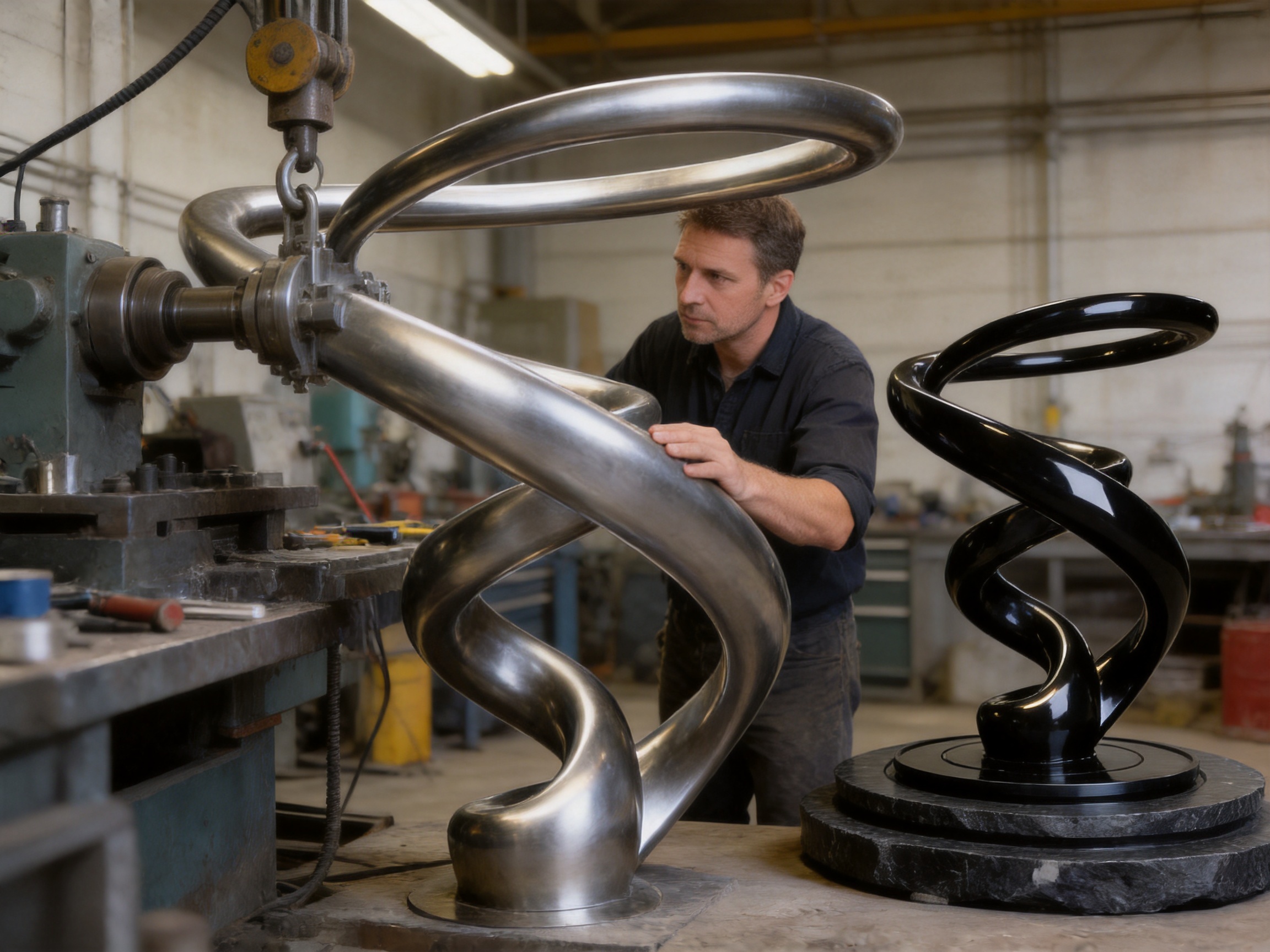
Customization is one of the strongest reasons to commission this sculpture for a specific project. A decorative object that is too small may disappear within a large lobby, while one that is too large may obstruct sightlines or compete with architectural features. The available height range allows the design to be adjusted to the ceiling height and visual scale of the room.
Height options from 1.3 to 4.2 meters cover a broad range of interior applications. Lower versions can be used in boutique entrances, reception corners, private clubs, and executive offices. Medium-height versions can serve as focal points in standard-height lobbies. Taller versions are suitable for atriums, hotel entrances, gallery-like spaces, and other areas where vertical impact is required.
Tube diameter customization provides another level of control. A larger diameter can make the sculpture appear more monumental and better suited to a broad open floor. A smaller diameter can produce a lighter, more delicate line for a narrower room or a setting where the sculpture must remain visually understated.
Before confirming the final dimensions, the designer should evaluate the sculpture from the principal viewpoints in the room. The work should be visible from the entrance, reception desk, main corridor, or other intended approach. Its upper loop should be checked against ceiling services, lighting fixtures, sprinkler systems, signage, and ventilation equipment.
The base diameter and clearance around the sculpture should also be considered. Although the form is compact compared with a large figurative group, the curve extends in several directions and requires sufficient space to be appreciated safely. A clear perimeter can help viewers experience the work from multiple angles while reducing the risk of accidental contact.
Digital drawings, scaled elevations, physical samples, or architectural mock-ups may be useful during the planning stage. The manufacturer can use the approved dimensions to coordinate the tube diameter, overall curve, base proportions, and installation interface.
Jiangsu Xinyesheng Sculpture Co., Ltd. specializes in custom decorative sculpture production and provides a manufacturing approach suited to projects that require more than a standard catalog object. The supplied production description emphasizes specialized bending equipment, heavy-gauge stainless steel tube forming, multi-layer coating, polishing between lacquer coats, and the fabrication of a layered natural stone base.
These capabilities are important because the sculpture combines several demanding processes. The tube must first be formed into a precise continuous curve. It must then be prepared for a dark coating whose reflective qualities make surface defects more noticeable. Finally, the metal sculpture must be coordinated with a heavy, multilayer stone base that matches the intended visual language.
A manufacturer capable of managing these stages as part of one coordinated production process can help reduce inconsistencies between the metal form, coating, and base. The result is more likely to appear as a unified work rather than a metal element placed on a generic support.
One practical strength is the ability to address the metal sculpture and stone base together. The base is not an afterthought. Its dimensions affect the visual balance, total weight, packaging requirements, shipping method, and final installation. Coordinating these components during the design stage helps ensure that the tube terminates correctly within the concentric stone layers.
Matching black tones across stainless steel lacquer and natural stone requires attention because the materials respond to light differently. The lacquer may show controlled highlights, while the stone may reveal subtle texture, veining, or a honed surface. The goal is not necessarily to make the materials identical, but to make them harmonize as part of one composition.
Custom sculpture projects usually require communication between the purchaser, interior designer, architect, manufacturer, freight coordinator, and installation team. Important information includes the desired height, tube diameter, site conditions, entrance dimensions, elevator capacity, floor strength, packaging restrictions, and final placement.
Clear approval of drawings and finish samples can reduce misunderstandings. The client should confirm whether the required finish is the deep glossy matte-black appearance described for the indoor model and whether the selected stone base should match a particular interior sample. The choice between 304 and 316 stainless steel should also be confirmed before fabrication begins.
For international projects, shipping and customs planning should begin early. A sculpture with a heavy stone base may require reinforced crating, specialized handling, and careful scheduling. If local stone sourcing is preferred, this possibility should be discussed in advance so that the base specification remains consistent with the design and structural requirements.
Installation planning is essential for a sculpture that may reach 4.2 meters in height. The finished piece should be delivered with clear handling instructions and a plan for positioning the metal form and stone base. Depending on the size and weight, mechanical lifting equipment may be required.
The floor should be level and capable of supporting the combined load. Designers should also consider access routes from the loading point to the final location. Door widths, corridor turns, ceiling heights, elevators, ramps, and temporary protection for finished flooring can all affect the installation process.
The sculpture should be positioned where it is visually prominent but does not interfere with emergency exits, fire-safety equipment, accessibility routes, or normal visitor circulation. In a public lobby, the installation team may need to coordinate with building management to schedule lifting and assembly during low-traffic hours.
Lighting has a major influence on the appearance of a black lacquered sculpture. A single harsh light placed directly in front of the work may flatten the form or produce an overly bright reflection. Multiple carefully controlled light sources can better reveal the twist, rounded tube, and relationship between the sculpture and its base.
Soft directional lighting from above or from the side can create a continuous highlight along one part of the tube. Low-level illumination can separate the black stone base from a dark floor and emphasize the concentric layers. Indirect lighting may be suitable where the design objective is a quieter, more atmospheric effect.
The final lighting should be evaluated at different times of day if the sculpture is near windows. Natural daylight may create a different balance of highlights and shadows than evening architectural lighting. The dark finish is intentionally responsive to its surroundings, so lighting should be treated as part of the artwork’s presentation rather than as an afterthought.
Under normal indoor conditions, maintaining the sculpture is straightforward. Routine dusting with a soft, clean cloth can remove surface particles and preserve the deep appearance of the lacquer. The cloth should be free from grit, metal fragments, or abrasive residue that could scratch the coating.
If additional cleaning is needed, a mild cleaning solution suitable for coated metal may be applied with a soft cloth, followed by gentle drying. Strong solvents, abrasive powders, rough sponges, and aggressive polishing compounds should be avoided unless specifically approved for the finish. Unapproved products can reduce gloss, alter the color, or leave visible marks.
Visitors should be discouraged from touching the sculpture unnecessarily, particularly in high-traffic commercial locations. Fingerprints may be more noticeable on a deep black glossy surface even though they can generally be removed with appropriate cleaning. A small amount of preventive education for cleaning staff and security personnel can help preserve the intended appearance.
The stone base should be cleaned according to the characteristics of the selected stone and its surface treatment. Dust and loose particles can usually be removed with a soft cloth or a suitable stone-safe cleaning method. Acidic cleaners should be avoided unless the stone supplier specifically confirms that they are safe.
Spills should be addressed promptly, especially if the stone has a porous or honed finish. The maintenance team should retain the stone specification and any recommended care instructions supplied during production. Consistent maintenance of both the metal and stone components will help preserve the sculpture as a unified interior feature.
The sculpture offers value beyond its initial visual impact. For designers, it provides a flexible form that can be scaled, specified, and coordinated with a wide variety of interiors. For developers and hospitality operators, it creates a memorable arrival experience without requiring a figurative theme or a complex narrative. For private collectors, it offers a contemporary abstract work with a strong material identity and a refined monochrome palette.
Its design is also adaptable to different aesthetic directions. In a minimalist interior, it can function as a solitary focal point. In a more richly decorated space, it can act as a dark sculptural counterpoint to marble, wood, textile, and warm metal details. Because the form is abstract, it does not become tied to a short-lived decorative trend as easily as highly literal or novelty-driven objects may.
The continuously flowing Mobius-inspired shape can communicate a sense of movement while remaining stable and composed. This balance makes it appropriate for spaces that want to appear progressive but not chaotic, luxurious but not excessive, and artistic without losing architectural discipline.
The listed size range is approximately 1.3 to 4.2 meters in height, with a price range of approximately $1,780 to $5,320. Final pricing may depend on the selected height, tube diameter, stainless steel grade, stone type, coating requirements, packaging, shipping destination, and installation arrangements.
When requesting a quotation, purchasers should provide the intended installation location, preferred dimensions, indoor environmental conditions, base requirements, and target delivery schedule. If the sculpture will be placed near a coastal region, humid indoor pool area, or other demanding environment, the material and finish specification should be reviewed carefully.
Clients should also confirm whether the project requires documentation such as dimension drawings, material information, finish samples, packing details, or installation guidance. These documents can assist architects, contractors, building managers, and procurement teams in integrating the sculpture into a larger construction or interior design program.
The most successful result comes from treating the sculpture as part of the architecture from the beginning. Early coordination allows the final height, lighting, floor condition, circulation clearance, and base proportions to be considered together.
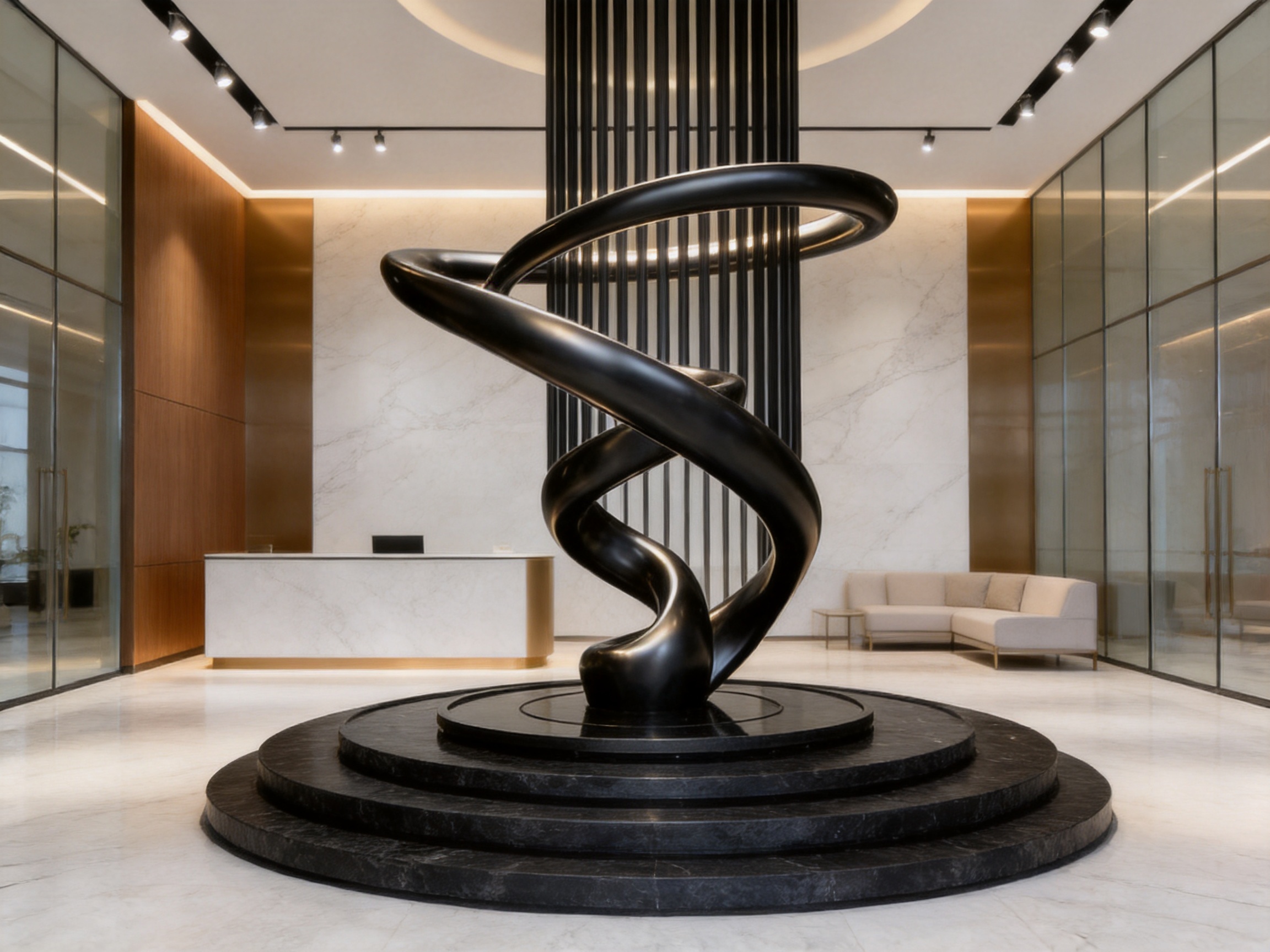
The primary sculpture form is made from heavy-gauge 304 or 316 stainless steel tube. The selected grade can be considered according to the indoor environment, project budget, and desired corrosion-resistance specification.
This particular model is designed for indoor use. It features a glossy matte-black lacquer coating intended to create a refined interior appearance rather than the bright mirror-polished finish commonly associated with many outdoor stainless steel sculptures.
The sculpture is formed from a single continuously twisted tube rather than a collection of disconnected flat plates. Its rounded profile and continuous curve create a smooth visual transition and allow the appearance to change as viewers move around it.
Yes. The available height range is approximately 1.3 to 4.2 meters. The appropriate size depends on the ceiling height, viewing distance, circulation pattern, and visual scale of the intended interior.
Yes. The tube diameter can be customized so that the sculpture’s visual weight and proportions suit the project. A larger diameter can create a stronger monumental effect, while a smaller diameter can produce a lighter and more understated appearance.
The base provides structural support and visual anchoring. Its concentric layered design echoes the circular movement of the Mobius-inspired form, while its black tone coordinates with the lacquered stainless steel.
The base can be produced from more than one natural stone source in matching or closely coordinated black tones. Local sourcing may help manage shipping costs for the heavy base component, but the proposed material should be reviewed for color, texture, thickness, strength, and compatibility with the approved design.
The glossy matte-black finish is created through multiple layers of lacquer, with polishing between coats. This process is intended to develop a smooth, deep, glass-like black appearance with controlled reflectivity.
Under normal indoor conditions, maintenance is generally simple. Regular dusting with a soft, clean cloth is usually sufficient. When necessary, a mild coating-safe cleaning method can be used, while abrasive materials and unapproved solvents should be avoided.
It is particularly suitable for hotel lobbies, sales-office reception areas, upscale office entrances, luxury boutiques, showrooms, galleries, executive spaces, and other refined indoor settings.
Mirror-polished stainless steel creates strong reflections and a brighter, more dramatic effect. This black lacquered version offers a quieter and more controlled appearance that may coordinate more easily with carefully designed interior lighting and other premium materials.
The project team should review floor capacity, levelness, delivery access, elevator dimensions, ceiling height, circulation clearance, lighting, emergency routes, and the handling requirements associated with the stone base and overall sculpture weight.
A quotation request should include the desired height, tube diameter, stainless steel grade, finish preference, stone-base requirements, delivery location, installation conditions, and target schedule. Architectural drawings or photographs of the proposed site can also help with planning.
The Mobius Spiral Abstract Stainless Steel Sculpture offers a highly controlled interpretation of continuous form for contemporary indoor architecture. Its strength lies in the relationship between material, process, finish, and proportion. Heavy-gauge 304 or 316 stainless steel provides a durable foundation, while specialized bending equipment allows the tube to retain a smooth and consistent profile through the twist.
The multi-layer glossy matte-black lacquer finish gives the sculpture an atmosphere of quiet luxury. It avoids the excessive glare that can accompany bright mirror polishing while still responding beautifully to carefully positioned interior lighting. The multilayer concentric black stone base completes the composition by providing weight, rhythm, and a strong architectural connection to marble and other premium surfaces.
With customizable height from approximately 1.3 to 4.2 meters and adjustable tube diameter, the sculpture can be tailored to spaces ranging from compact reception zones to large hotel atriums. Its continuous Mobius-inspired curve communicates harmony, movement, and unending cycles, while its monochrome treatment keeps the overall expression refined and contemporary.
For clients seeking a custom European-style decorative sculpture with a distinctive manufacturing process, this design provides an alternative to conventional flat-plate abstracts, highly reflective stainless steel works, and standard catalog pieces. Its combination of sculptural continuity, corrosion-resistant metal, specialist forming, layered lacquer craftsmanship, and coordinated natural stone makes it a compelling centerpiece for premium indoor environments.
1. General technical literature on 304 and 316 austenitic stainless steel for architectural and decorative applications.
2. Reference materials concerning tube bending, rotary forming, wall-thickness control, and preservation of circular cross-sections in metal fabrication.
3. Professional guidance on lacquer coating preparation, multilayer finishing, intercoat polishing, and maintenance of coated metal surfaces.
4. Architectural interior design references concerning sculpture placement, circulation clearance, focal-point composition, and lobby lighting.
5. Natural stone fabrication and care guidance for black stone bases, honed surfaces, polished surfaces, and concentric architectural assemblies.
6. Product specification materials for the Mobius Spiral Abstract Stainless Steel Sculpture, including available dimensions, finish characteristics, material options, and indicative pricing.



Daniel H.

Amanda R.

Robert B.

Jennifer S.

James W.

Barry G.

Michael T.

Emily K.

David L.

Sarah M.


Mikey XV

Jagxue

 English
 Español
 عربى
عربى Français
 italiano
 Deutsch