Public art has the power to transform an ordinary street, plaza, garden, waterfront, or commercial district into a memorable destination. Among the many forms available to architects, developers, municipalities, landscape designers, and private collectors, the fiberglass blue whale sculpture offers an especially compelling combination of visual impact, practical performance, customization, and installation flexibility. Its large scale attracts attention immediately, while its fluid silhouette communicates movement, freedom, nature, and imagination.
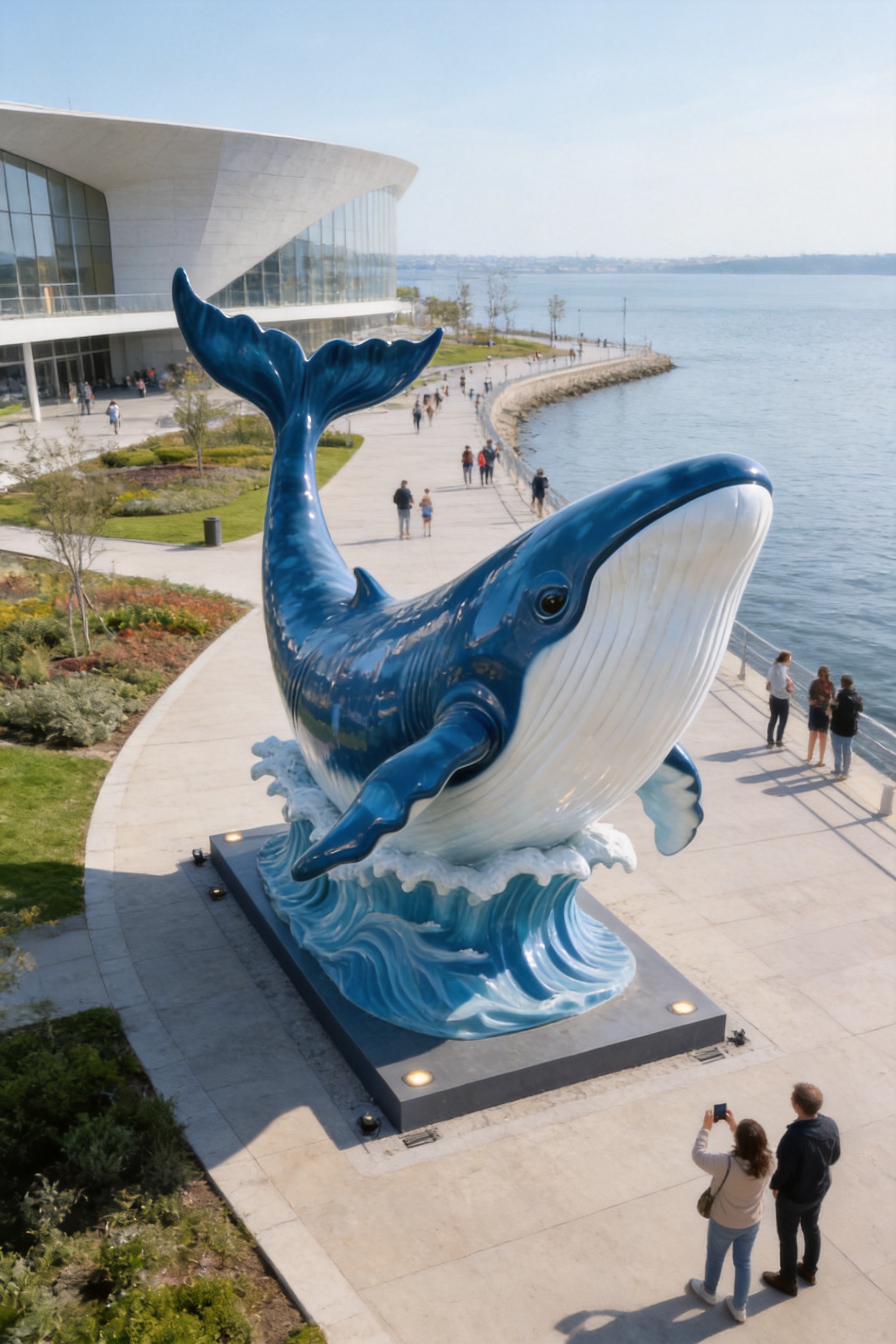
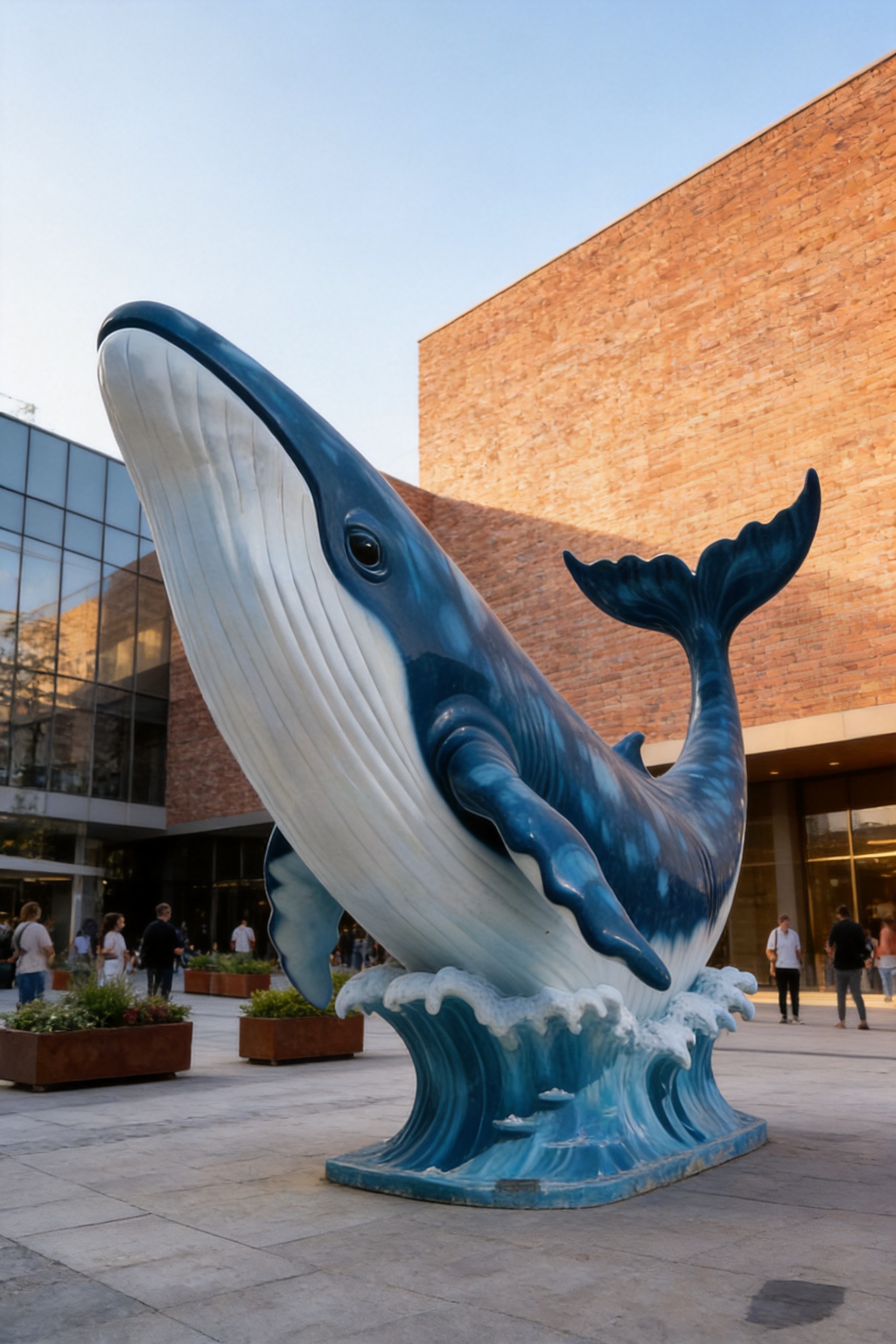
This sculpture presents a blue whale leaping through the streets and alleys as if it were breaking through an urban ocean. The concept creates a striking contrast between the organic form of the animal and the hard surfaces of buildings, roads, paving, and architectural structures. The result is more than a decorative object. It can become a visual landmark, a photo opportunity, a thematic centerpiece, or an artistic focal point that changes the identity of an entire space.
The supplied product information identifies this piece as a fiberglass blue whale sculpture designed for public art and large-scale display. It is available in approximate lengths of 3.6 to 5 meters and heights of 1.5 to 3 meters, with a listed price range of US$2,343.47 to US$3,834.76. These dimensions make the sculpture substantial enough to command attention while remaining significantly easier to transport and install than many comparable stone or solid-metal sculptures.
Manufactured by Jiangsu Xinyesheng Sculpture Co., Ltd., the sculpture reflects the practical advantages of fiberglass as a modern sculptural material. Fiberglass can reproduce the smooth curves of a whale’s body, the uplift of its tail, the flow of its fins, and the dynamic character of a wave-shaped base. At the same time, it avoids much of the excessive weight associated with stone, cast bronze, or thick steel construction.
For buyers seeking a custom animal sculpture that combines artistic expression with outdoor performance, this product is a strong candidate. Its visual scale, lightweight structure, weather resistance, corrosion resistance, easy maintenance, and broad customization potential make it suitable for projects where design freedom and practical installation must work together.
Content
The blue whale is one of the largest animals on Earth, yet it is also associated with grace, mystery, migration, and the vastness of the natural world. Translating this animal into a sculpture creates an opportunity to bring marine symbolism into places that may be far from the sea. In an urban setting, a whale sculpture can suggest the hidden relationship between cities, rivers, oceans, trade routes, climate, and ecological responsibility.
The leaping pose adds a sense of energy. A stationary whale resting on a base would communicate mass and calmness, while a whale emerging dynamically from a wave suggests transformation and movement. The composition can make a narrow alley feel more theatrical, give a public square a strong vertical accent, or introduce an unexpected narrative into a commercial development.
The contrast between the whale and the surrounding architecture is part of the sculpture’s appeal. Older buildings, weathered walls, paved lanes, and industrial surfaces can provide a textured background against which the smooth animal form becomes especially prominent. The sculpture does not need to imitate its environment. Instead, it can deliberately interrupt the visual rhythm of the city and create a moment of surprise.
This type of installation is also well suited to cultural, educational, and environmental themes. It may be used near aquariums, marine education centers, science museums, coastal resorts, public parks, shopping centers, family entertainment destinations, hotels, waterfront developments, or ecological exhibitions. In each setting, the whale can support a different message while retaining its recognizable and emotionally engaging character.
Large animal sculptures require a material that can reproduce complicated organic geometry without making the finished piece unnecessarily difficult to handle. Fiberglass is particularly effective because it can be formed into smooth, flowing, and sculpturally expressive surfaces while maintaining a relatively low structural weight.
A whale’s body contains long continuous curves rather than rigid geometric planes. The back, belly, fins, tail, and transition into the wave base must appear unified. Fiberglass allows these elements to be developed as a cohesive form, helping the finished sculpture maintain the visual softness associated with a living marine animal.
The material also supports the creation of a wide range of surface effects. Depending on the design brief, the surface may be finished with deep ocean blue, blue-green gradients, pale highlights, darker dorsal tones, stylized wave patterns, subtle texture, or a more imaginative decorative treatment. This versatility gives designers greater freedom than they might have with naturally colored stone.
Fiberglass is commonly selected for large public art because it offers a useful balance between strength and weight. The sculpture can be made large enough to function as a landmark without requiring the same lifting equipment, foundation scale, or transportation arrangements that a solid stone or heavy-metal counterpart may demand.
The product description emphasizes the lightweight and high-strength characteristics of fiberglass. These qualities are especially valuable for a sculpture measuring several meters in length. A large installation must be moved from the workshop to the project site, unloaded, positioned, and secured. Lower weight can simplify these steps and may reduce the logistical burden placed on the buyer.
Lightweight construction does not mean that installation can be treated casually. The sculpture still requires a suitable support system, secure anchoring, and professional assessment of local wind and site conditions. However, compared with a solid stone block or a massive metal casting, the reduced weight can make the project more adaptable and economical.
Fiberglass is well suited to custom forms with extended curves, undercuts, layered wave elements, and expressive poses. For a blue whale sculpture, this means the body can be shaped with a convincing sense of momentum rather than being reduced to a simplified silhouette. The wave base can also be designed to look energetic, rising, curling, or splashing beneath the animal.
The freedom of shape is a major advantage when the sculpture must fit a particular architectural environment. A client may request a longer body for a broad plaza, a higher leap for a vertical entrance, a lower profile for a pedestrian corridor, or a more compact composition for an indoor atrium. Fiberglass allows the form to be adjusted according to the physical and visual requirements of the site.
The product information highlights weather resistance and corrosion resistance. These properties are essential for outdoor sculpture. Public installations are exposed to sunlight, rain, humidity, temperature variation, dust, airborne pollutants, and, in some locations, salt-laden coastal air. A suitable exterior finish and correctly prepared fiberglass structure can provide dependable protection in these environments.
Fiberglass does not rust in the same way as exposed ordinary steel, and it does not absorb water like many porous natural materials. Its resistance to corrosion is particularly useful for waterfront or humid sites where metal sculptures may require more frequent inspection and protective treatment. The final performance still depends on fabrication quality, surface coatings, drainage, anchoring, and maintenance procedures.
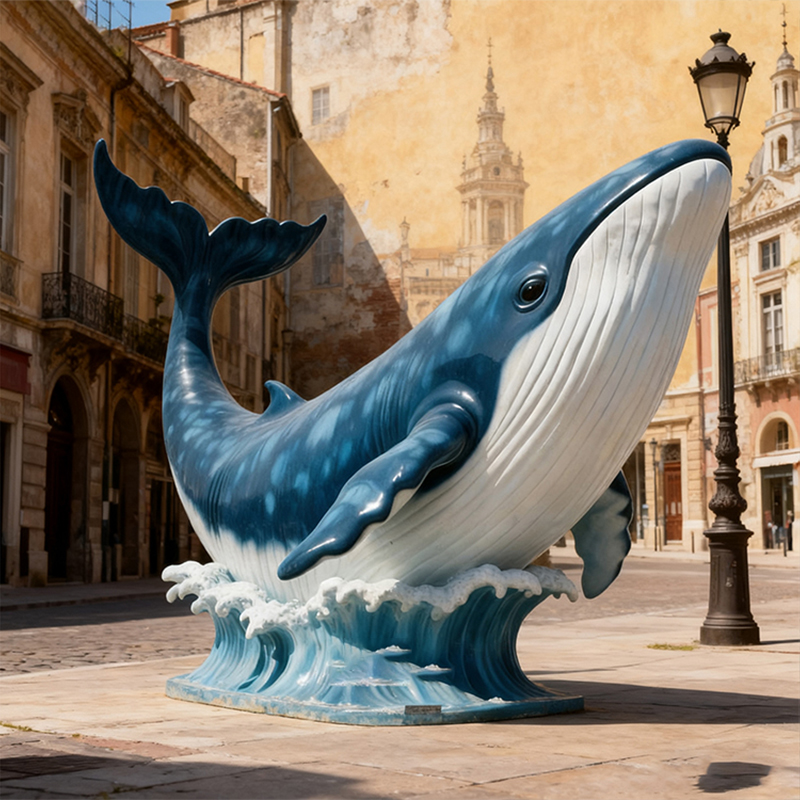
Fiberglass Blue Whale Sculpture
The listed size range for the fiberglass blue whale sculpture is approximately 3.6 to 5 meters in length and 1.5 to 3 meters in height. This range allows the product to serve multiple project types. The smaller end may be appropriate for a landscaped entrance, restaurant courtyard, school, private garden, or interior public space. The larger end can create a prominent landmark in a plaza, park, resort, shopping district, or waterfront development.
| Item | Product Information | Project Consideration |
|---|---|---|
| Product type | Fiberglass blue whale sculpture | Suitable for decorative, commercial, cultural, educational, and public art applications |
| Material | Fiberglass | Lightweight, high-strength, shape-flexible, weather-resistant, and corrosion-resistant |
| Length | Approximately 3.6 to 5 meters | Choose according to viewing distance, site width, transport access, and visual hierarchy |
| Height | Approximately 1.5 to 3 meters | Higher versions create stronger landmark value; lower versions may suit intimate spaces |
| Visual composition | Leaping whale with wave base | Creates movement and a strong relationship between animal form and supporting structure |
| Listed price | Approximately US$2,343.47 to US$3,834.76 | Final quotation may depend on size, finish, customization, packaging, shipping, and installation requirements |
| Maintenance profile | Relatively easy to maintain | Routine cleaning and periodic inspection help preserve appearance and structural performance |
Size selection should be based on more than the available ground area. The viewing distance is equally important. A sculpture placed at the end of a long approach may need greater length or height to remain visually legible. A sculpture installed beside a pedestrian path may benefit from a more moderate scale that allows visitors to appreciate the details of the fins, eyes, tail, and surface finish.
Proportion is also important. A whale with an extended horizontal body may require a broader visual field than a vertically oriented sculpture. The wave base can increase the overall height and create a stronger sense of lift, but it also needs sufficient room around it so that the composition does not appear crowded.
Stone has a long history in sculpture and remains valued for its natural character, permanence, and visual weight. However, stone can present challenges when used for a very large animal form. A solid stone whale may be extremely heavy, difficult to transport, and expensive to install. Large pieces can require specialized lifting equipment, reinforced foundations, and carefully planned access routes.
Fiberglass offers greater freedom when the design involves a dynamic pose. A whale leaping from a wave contains projecting fins, an elevated body, and potentially complex transitions between the animal and the base. Producing these features in stone may increase the risk of breakage or require the sculpture to be divided into several heavy sections.
Fiberglass is also more adaptable in terms of color. Stone provides its own natural palette, while fiberglass can be finished in a controlled blue tone or a multicolor marine scheme. This makes it easier to coordinate the sculpture with branding-neutral architectural palettes, landscape planting, lighting design, or an environmental exhibition concept.
For buyers who need a large sculpture on a limited schedule or at a controlled budget, the lower transportation and handling burden of fiberglass can be a decisive benefit. Stone may remain the preferred material for certain monumental or heritage projects, but fiberglass is often more practical for a modern public installation requiring movement, color, and manageable weight.
Bronze and stainless steel are respected materials for outdoor sculpture, and each has important strengths. Bronze provides a traditional artistic appearance and can develop a distinctive patina. Stainless steel offers a clean reflective surface and strong contemporary character. Weathering steel creates a dramatic rust-colored appearance that integrates well with industrial landscapes.
Nevertheless, metal construction may involve higher material costs, greater weight, welding requirements, surface finishing, and more complex fabrication for large organic forms. A metal whale can be visually impressive, but a fully solid or heavily framed version may impose significant demands on foundations, cranes, transport vehicles, and installation crews.
Fiberglass can reproduce a similar sense of scale with less mass. It can also be painted to achieve a vivid blue whale appearance rather than relying on the natural or chemically developed color of the metal. This is especially useful where the client wants an expressive, approachable, family-friendly, or educational visual identity.
In coastal environments, corrosion management is another consideration. Stainless steel is highly resistant when the correct grade and fabrication methods are selected, but it may still require attention to welds, fasteners, surface contamination, and maintenance. Ordinary steel requires protective coatings, while weathering steel requires appropriate exposure conditions and drainage. Fiberglass avoids metallic rusting, although its coatings and structural connections still need responsible care.
Within the fiberglass sculpture category, the blue whale has a distinct advantage: its scale is naturally associated with grandeur. Even a stylized whale can appear monumental because the animal itself is known for its extraordinary size. This allows the sculpture to create a landmark effect without requiring excessive height or a complicated architectural tower.
The long body also offers strong horizontal movement. It can guide the eye across a plaza, direct visitors toward an entrance, or visually connect separate areas of a landscape. The wave base introduces a second movement direction, usually upward, creating a balanced composition of horizontal travel and vertical lift.
Many animal sculptures communicate a single action, such as standing, sitting, or walking. The leaping whale communicates an entire scene. It implies water, motion, emergence, and interaction with the surrounding space. That narrative quality can make the installation more memorable and more likely to be photographed and shared by visitors.
The whale also has broad cross-cultural appeal. Children recognize the animal through books, documentaries, aquariums, and educational media, while adults may respond to its symbolism of nature, scale, and conservation. This broad appeal can help a public space attract different age groups without relying on a highly specialized cultural reference.
The quality of a fiberglass sculpture depends on more than the visible surface. A successful manufacturing process must coordinate design, proportion, mold preparation, structural reinforcement, surface finishing, inspection, packaging, and installation planning. For a sculpture of this scale, each stage influences the final appearance and long-term performance.
The process begins with the intended visual concept. The manufacturer and buyer should confirm the desired whale pose, overall dimensions, wave shape, viewing angles, color scheme, surface character, and installation location. A sculpture that will be viewed primarily from the front may be designed differently from one placed in the center of a plaza and seen from all directions.
Design confirmation should also consider the relationship between the body and the wave base. The base must support the artistic narrative while providing a stable and practical transition. If the whale appears to be leaping, the supporting structure must visually communicate motion without creating an unstable or fragile appearance.
For custom orders, drawings, digital references, dimensional sketches, or approved visual samples can help reduce misunderstandings. Important details may include the position of the eyes, mouth, fins, tail flukes, water spray, color transitions, and any lettering or surrounding decorative elements.
After the design is approved, the sculptural form is prepared for molding. The mold-making stage is critical because it determines the quality of the reproduced curves and the consistency of the surface. A well-prepared mold helps preserve the whale’s anatomy and ensures that the wave base flows naturally into the main composition.
Organic sculpture requires careful attention to transitions. Abrupt changes in curvature can make a whale appear mechanical rather than alive. The back should flow smoothly into the tail, the fins should emerge naturally from the body, and the wave should support the animal without looking disconnected. Skilled form development can give the final sculpture a more convincing sense of movement.
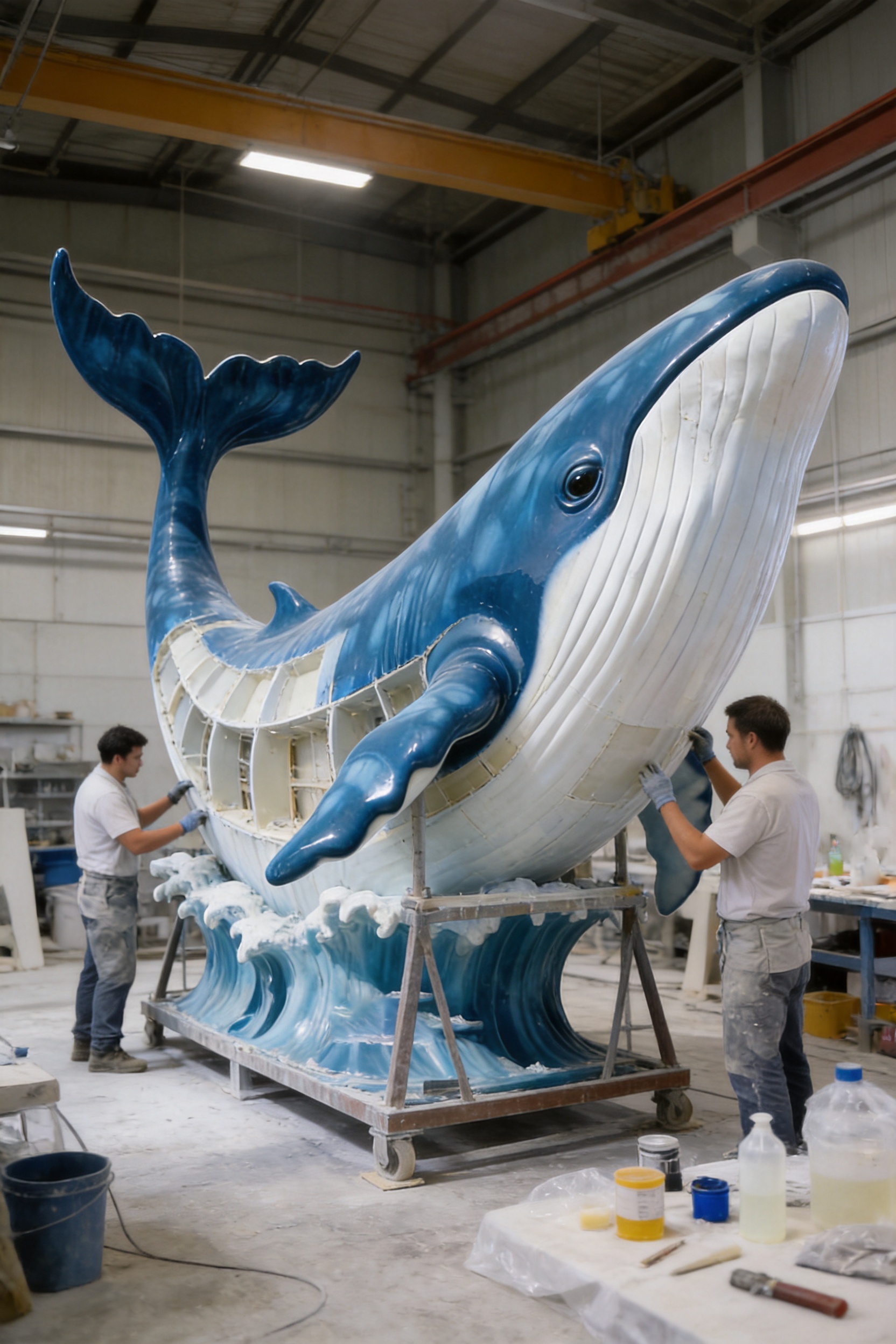
Fiberglass production typically combines resin with reinforcing fibers to create a shell that is strong relative to its weight. The number and arrangement of layers can be adjusted according to the size, shape, projected loads, and intended use of the sculpture.
Large public sculptures may require internal reinforcement in addition to the fiberglass shell. Structural supports, internal frames, mounting plates, or connection points can be incorporated into the design. These components help transfer loads to the foundation and provide secure attachment during installation.
The manufacturer’s strength lies in coordinating artistic shape with practical structure. A whale sculpture cannot be judged only by its exterior appearance. It must also be designed to withstand handling during transport, installation forces, environmental exposure, and ordinary public-space conditions. Internal support should be integrated without compromising the smooth external form.
Once the fiberglass body is formed, the surface is prepared for finishing. Seams, small imperfections, and transitions are refined so that the finished body appears continuous and polished. This stage is especially important on a blue whale because broad smooth surfaces can reveal irregularities under direct sunlight.
The final finish may use a deep blue base, lighter blue highlights, darker upper surfaces, or a stylized gradient. The wave can be finished in complementary tones, including white, pale blue, turquoise, or a more dramatic deep-water palette. The precise treatment should be selected according to the surrounding architecture and the desired emotional effect.
A protective exterior coating can improve resistance to ultraviolet exposure, moisture, and everyday dirt. The finishing system should be appropriate for the intended environment and applied consistently over the entire surface. Details such as the eyes, mouth, fins, tail, and wave crests should be carefully checked because small inaccuracies may become visible when the sculpture is viewed at close range.
Quality control should review both artistic and practical requirements. Dimensional checks can confirm that the finished sculpture matches the approved size. Surface inspections can identify bubbles, pinholes, uneven coating, visible seams, or color inconsistencies. Structural checks can examine the base, internal support, attachment points, and any lifting or transport provisions.
For a custom project, the buyer may request photographs or approval documentation before shipment. This can be especially useful when the sculpture is being produced for a public project with an established design schedule. Clear communication between the manufacturer and client helps ensure that the final piece meets the original intent.
Jiangsu Xinyesheng Sculpture Co., Ltd. is identified in the supplied material as the manufacturer and supplier of the product. Its listed business focus includes sculpture production across multiple material categories, including bronze, stainless steel, marble, fiberglass, and weathering steel. This breadth is valuable because it indicates familiarity with different sculptural materials and the distinct requirements associated with each one.
A supplier working across several material categories can provide useful comparative guidance. For example, a client may initially consider bronze or stainless steel but discover that fiberglass is more suitable for a large, colorful, lightweight animal sculpture. Conversely, a project may require several sculptures in different materials, and a manufacturer with a broad product range may be able to coordinate the artistic language across the complete installation.
The company’s fiberglass capability is particularly relevant to this blue whale design. The product description highlights easy shaping, easy maintenance, rich texture, weather resistance, corrosion resistance, and a lightweight yet high-strength structure. These features indicate a production approach focused not only on appearance but also on practical public-space performance.
Another strength is the suitability of fiberglass for custom work. The dimensions are presented as a range rather than a single fixed size, suggesting that the sculpture can be adapted to different project requirements. Customization may involve scale, color, surface treatment, pose adjustments, base configuration, and site-specific proportions, subject to design confirmation and quotation.
Because the manufacturer is located in Jiangsu, China, the supplier can serve buyers seeking custom sculpture production from an established manufacturing region. International buyers should still confirm shipping terms, packaging, installation responsibilities, payment arrangements, production schedules, and documentation before placing an order.
Even a lightweight sculpture requires careful installation planning. Before production begins, the buyer should evaluate the available access route, ground conditions, foundation requirements, drainage, public circulation, lighting, and viewing angles. A site survey can prevent costly changes after the sculpture has been completed.
The foundation should be designed according to the sculpture’s size, internal structure, local soil conditions, wind exposure, and applicable construction standards. The exact anchoring system must be confirmed with the manufacturer and, where necessary, a local engineer. Fiberglass reduces the total weight but does not eliminate wind loads or the need for a secure connection to the ground.
For a sculpture installed in a busy public area, pedestrian safety should be considered from the beginning. Sharp edges, low projections, climbing opportunities, slippery surfaces, and insufficient clearance should be avoided. The wave base should remain visually dynamic while maintaining a safe relationship with visitors.
Lighting can substantially enhance the whale’s visual impact. Concealed ground lights may emphasize the belly and wave, while directional lighting can create highlights along the back and fins. Blue lighting should be used carefully so that it complements rather than overwhelms the sculpture’s painted surface. Nighttime illumination should also avoid glare for pedestrians and drivers.
Drainage is important where the wave base contains recessed or layered forms. Water should not remain trapped in concealed areas. Proper drainage helps reduce staining, biological growth, and long-term deterioration of coatings or connection points.
One of the product’s stated advantages is easy maintenance. Routine care generally begins with visual inspection and gentle cleaning. Dust, pollution, bird residue, leaves, and other surface contaminants should be removed before they accumulate. A soft cloth, clean water, and a mild, non-abrasive cleaning solution are generally preferable to harsh chemicals or aggressive tools.
Periodic inspections should examine the surface finish, seams, joints, anchor points, base, and surrounding foundation. Small coating damage should be addressed promptly, especially in locations exposed to intense sunlight, heavy rainfall, freezing conditions, or salt air. Early repair can help prevent a minor surface issue from developing into a more extensive maintenance problem.
The frequency of maintenance depends on the installation environment. An indoor sculpture may require only occasional dusting and surface cleaning. A sheltered courtyard may require seasonal inspection, while a coastal public space may benefit from more frequent washing and examination of the mounting system.
Owners should keep records of the original color specifications, coating information, installation details, and repair materials. This information can make future maintenance more consistent. If the sculpture is relocated, the new site should be evaluated before dismantling or transporting the piece.
Municipalities can use the fiberglass blue whale as a landmark for a new public space, cultural district, waterfront improvement, or urban regeneration project. Its recognizable shape can help create a local identity and encourage visitors to explore an otherwise overlooked area.
The sculpture can also support environmental education. A plaque, interpretive display, or nearby educational program may explain marine ecosystems, ocean conservation, migration, or the relationship between inland communities and the sea. The whale’s accessible form makes it suitable for family-oriented public programming.
Shopping centers, mixed-use developments, hotels, restaurants, and entertainment complexes often need memorable visual features that encourage visitors to stop, take photographs, and share their experiences. A large blue whale can perform this role effectively because it is visually distinctive and immediately understandable.
The installation may be placed near an entrance, central courtyard, children’s area, themed corridor, or outdoor event zone. Its color and movement can add energy to a space dominated by concrete, glass, and steel.
Aquariums, museums, schools, universities, and science centers may use the sculpture to create a strong connection between architecture and educational content. The whale can serve as a three-dimensional teaching object, an exterior welcome feature, or a visual symbol for a marine science program.
Because fiberglass is relatively easy to customize, the sculpture may be produced with simplified anatomical features for younger audiences or with more detailed proportions for a scientific setting. The desired balance between artistic stylization and realism should be agreed during the design stage.
Resorts and parks can use the sculpture to reinforce a coastal, aquatic, ecological, or family-friendly atmosphere. Positioned near landscaping, water features, boardwalks, or open lawns, the whale may appear naturally connected to its surroundings while remaining clearly recognizable as an artistic installation.
In a waterfront environment, the sculpture’s weather resistance and corrosion resistance are important practical advantages. The site should still be evaluated for salt exposure, wind intensity, ultraviolet radiation, and public access so that the finish and anchoring system are correctly selected.
Although the listed product has a defined concept, buyers may want the sculpture to respond to a specific project identity. Customization can begin with dimensions. A long, low version can emphasize horizontal movement, while a taller version can create a more powerful vertical landmark. The relationship between body length and wave height should remain visually balanced.
Color is another major customization area. A realistic blue whale may use darker blue on the upper body and lighter tones below. A contemporary public art project may prefer a gradient, geometric pattern, metallic blue, or a colorful interpretation designed for a younger audience. The wave base can match the whale or use contrasting colors to emphasize separation between animal and water.
The level of realism can also be adjusted. A realistic whale may include anatomical details, textured skin, carefully shaped fins, and natural facial proportions. A stylized whale may use simplified curves and bold colors that are easier to read from a distance. Neither approach is automatically superior; the correct choice depends on the site, audience, budget, and artistic purpose.
Additional elements may include water-splash forms, integrated platforms, decorative rocks, marine plants, educational plaques, or coordinated smaller sculptures. Any additions should be considered in relation to the main form so that the blue whale remains the dominant visual element.
International customers should begin by providing the intended installation location, approximate dimensions, preferred finish, quantity, and required delivery schedule. Photos or drawings of the site can help the manufacturer understand the context and recommend a suitable scale.
The listed price range of US$2,343.47 to US$3,834.76 should be treated as a starting reference rather than a complete delivered project cost. The final quotation may depend on the selected size, level of detail, surface treatment, custom color, internal reinforcement, packaging, export preparation, shipping method, insurance, taxes, unloading, foundation work, and installation.
Buyers should request confirmation of the following points before production: final dimensions, material specification, finish type, color approval method, internal structure, anchoring arrangement, packaging method, production period, inspection procedure, delivery terms, and warranty or repair policy. Written confirmation helps protect both sides and provides a clear reference for project management.
Large fiberglass sculptures should be packaged to protect projecting parts such as fins, tail flukes, wave crests, and other delicate forms. The shipping plan should account for the sculpture’s actual crated dimensions rather than only its finished dimensions. Access at the destination should also be checked in advance.
When the project is part of a public construction program, coordination with architects, landscape contractors, structural engineers, lighting designers, and local authorities may be necessary. The manufacturer can provide product-related information, while local professionals should confirm compliance with regional building, safety, and installation requirements.
The strongest competitive advantage of this product is the balance it creates between scale and manageability. Buyers can obtain a large, expressive animal sculpture without accepting the full weight and installation complexity of a comparable stone or heavy-metal piece. This can be particularly important when a project has restricted access, limited foundation capacity, or a controlled art budget.
The second advantage is visual adaptability. The whale can be finished in a vivid blue palette, customized for a specific theme, and integrated into modern or historic environments. It can appear playful in a family destination, educational in a museum setting, dramatic in a plaza, or symbolic in an ecological project.
The third advantage is the combination of emotional recognition and sculptural movement. The whale is familiar to a broad audience, while the leaping pose creates a strong sense of action. This makes the sculpture more than a static object and increases its potential to become a destination feature.
The fourth advantage is the material’s outdoor practicality. Weather resistance, corrosion resistance, relatively easy maintenance, and rich surface possibilities support long-term use when the sculpture is properly fabricated, installed, and cared for.
Finally, the manufacturer’s experience with multiple sculpture materials and its ability to supply custom-sized fiberglass work can be valuable for buyers comparing several production options. A supplier capable of discussing bronze, stainless steel, marble, fiberglass, and weathering steel can help clients select a solution based on artistic intent, location, budget, weight, maintenance, and schedule rather than on appearance alone.
The sculpture is made from fiberglass. The material is described as lightweight, high-strength, weather-resistant, corrosion-resistant, easy to shape, easy to maintain, and capable of carrying rich surface texture and color.
The listed size range is approximately 3.6 to 5 meters in length and 1.5 to 3 meters in height. The exact dimensions should be confirmed according to the buyer’s site, viewing distance, transportation requirements, and customization needs.
The supplied product information lists a price range of approximately US$2,343.47 to US$3,834.76. The final price may vary according to size, finish, design complexity, packaging, shipping, installation, and other project requirements.
Fiberglass is well suited to painted and coated finishes, so color customization can generally be discussed during the design process. Buyers should confirm the available color system, sample approval procedure, protective coating, and expected appearance under indoor and outdoor lighting.
Yes. The product is described as weather-resistant and corrosion-resistant and is intended to withstand outdoor conditions. Site-specific factors such as coastal salt, strong ultraviolet exposure, freezing temperatures, wind, drainage, and public access should still be evaluated before installation.
Fiberglass is generally much lighter than a solid stone sculpture and can be lighter than many heavy-metal constructions of comparable visual size. This can simplify transport and handling, although professional anchoring and foundation planning remain essential.
The product concept specifically presents the whale as suitable for streets and alleys. However, the selected size must match the available clearance, turning radius, overhead obstructions, pedestrian flow, emergency access, and delivery route.
A secure foundation or prepared mounting surface is normally required for a large outdoor sculpture. The appropriate foundation and anchoring system depend on the sculpture’s dimensions, internal structure, site conditions, wind exposure, and local engineering requirements.
Routine cleaning can usually be performed with clean water, a soft cloth or sponge, and a mild non-abrasive solution. Harsh solvents, abrasive pads, and high-pressure cleaning should not be used unless specifically approved for the finish.
The fiberglass manufacturing process supports both realistic and stylized approaches. Buyers should communicate their preferred anatomy, surface detail, facial expression, color treatment, wave design, and viewing distance before the final design is approved.
Buyers should confirm the final dimensions, material and finish, color, structural support, anchoring details, packaging, production schedule, shipping terms, inspection process, installation responsibilities, maintenance recommendations, and final quotation.
The supplied product information identifies Jiangsu Xinyesheng Sculpture Co., Ltd. as the manufacturer and supplier. The company’s listed contact details include telephone numbers and an email address for project inquiries and quotation requests.
The fiberglass blue whale sculpture is a strong solution for buyers seeking a memorable, large-scale public artwork with practical installation advantages. Its leaping form introduces movement and narrative, while its blue finish creates an immediate connection with the marine world. The wave base strengthens the composition and helps the sculpture appear as a complete scene rather than an isolated animal figure.
Compared with stone, fiberglass can reduce weight and increase flexibility. Compared with many metal alternatives, it can provide a more colorful, approachable, and cost-conscious solution for large animal forms. Its resistance to weather and corrosion supports outdoor applications, while its easy-to-shape surface allows manufacturers to respond to different sizes, finishes, and site conditions.
The product’s approximate dimensions of 3.6 to 5 meters in length and 1.5 to 3 meters in height offer flexibility for public squares, streets, alleys, parks, resorts, commercial developments, educational institutions, and cultural venues. The listed price range of US$2,343.47 to US$3,834.76 provides a useful starting point for budgeting, with the final quotation determined by project specifications.
Jiangsu Xinyesheng Sculpture Co., Ltd. brings the stated advantages of fiberglass together with experience across several sculpture materials. Its ability to support custom dimensions and finishes makes the blue whale suitable for projects that require a distinctive artistic centerpiece rather than a generic decorative product. With careful design approval, structural planning, professional installation, and routine maintenance, this sculpture can become a durable landmark that adds character, movement, and emotional value to the built environment.
1. Product specification sheet for the Fiberglass Blue Whale Sculpture, including listed dimensions, price range, material characteristics, and product description.
2. Manufacturer-supplied information for Jiangsu Xinyesheng Sculpture Co., Ltd., including product categories, contact details, and sculpture production scope.
3. General principles of fiberglass-reinforced polymer fabrication for architectural and public-art applications.
4. General outdoor sculpture conservation practices concerning cleaning, protective coatings, corrosion resistance, drainage, and periodic inspection.
5. General planning considerations for the transportation, anchoring, foundation preparation, and public-space installation of large-scale sculptures.



Daniel H.

Amanda R.

Robert B.

Jennifer S.

James W.

Barry G.

Michael T.

Emily K.

David L.

Sarah M.


Mikey XV

Jagxue

 English
 Español
 عربى
عربى Français
 italiano
 Deutsch