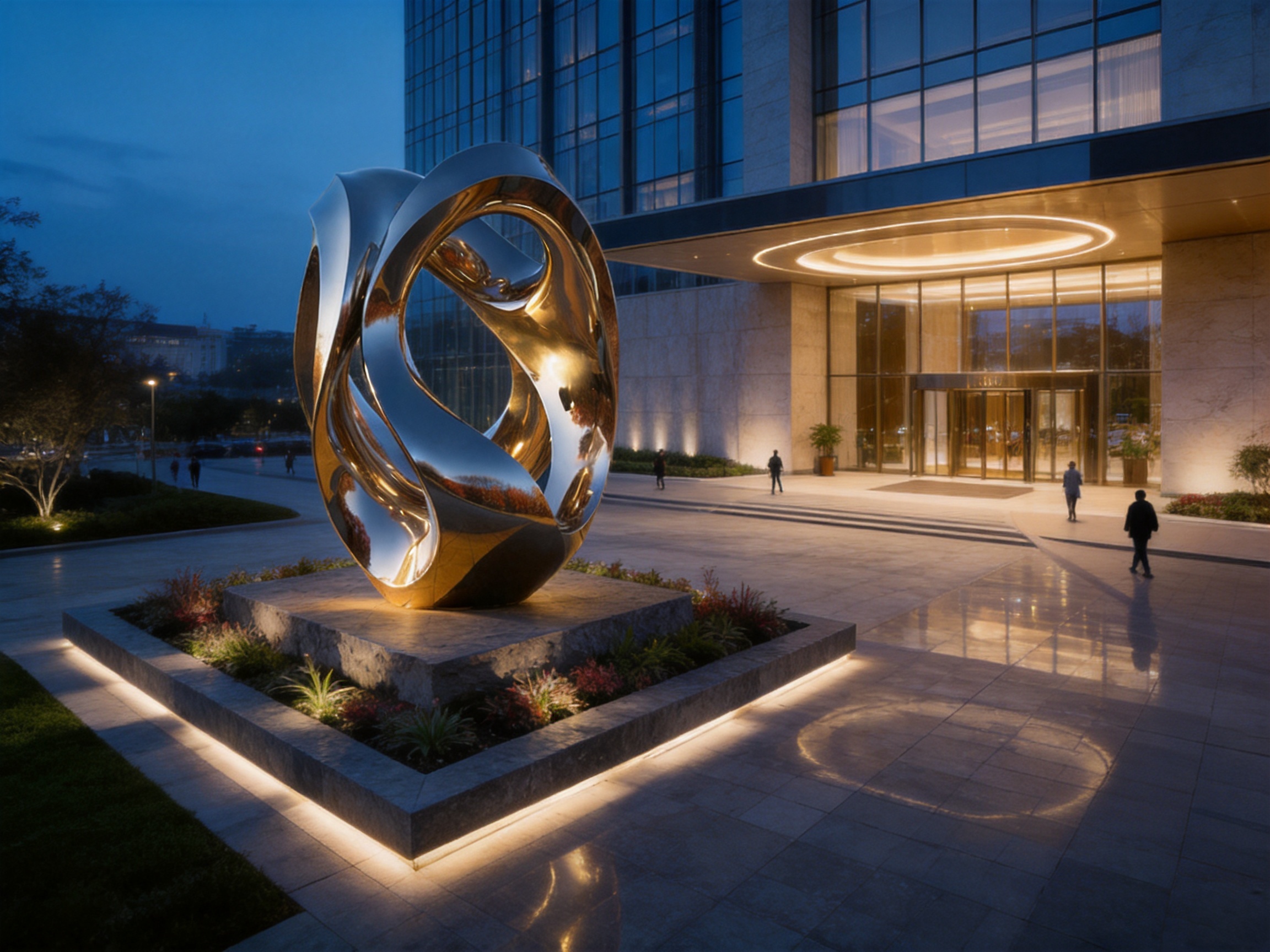
Public art has the power to define a place. A well-designed sculpture can become the visual signature of a city square, the focal point of a hotel entrance, the centerpiece of a corporate campus, or the most photographed feature in a landscaped cultural district. The Gold & Silver Twisted Metal Sculpture is created for precisely this role. Combining flowing intertwined geometry, polished stainless steel, and contrasting metallic color, it offers a dramatic architectural presence while retaining the durability required for long-term outdoor installation.
With an approximate height of 200 to 300 centimeters, this sculpture occupies an ideal scale for public landscapes. It is large enough to command attention from a distance, yet sufficiently adaptable for plazas, galleries, gardens, commercial developments, and premium interior environments. Its twisting form establishes movement even when the sculpture is stationary, allowing viewers to experience changing contours, reflections, and visual relationships as they walk around it.
The design brings together two distinct visual identities: a warm gold tone and a cool silver tone. Their interaction creates a layered composition that is elegant, contemporary, and immediately recognizable. The gold surface introduces richness and warmth, while the silver surface reflects the surroundings with a cleaner and more neutral character. Together, the two finishes create a refined contrast that can support both classical architectural settings and modern urban environments.
Content
The central concept of the sculpture is the interweaving of two or more sweeping metallic forms. These forms appear to twist around one another, producing a sense of continuous motion and controlled tension. The curves can suggest natural growth, flowing ribbons, architectural arches, or abstract human interaction. Because the composition does not depend on a single frontal view, it remains visually engaging from multiple directions.
This multi-angle quality is particularly important in public art. A sculpture placed in a square or entrance plaza is rarely viewed from only one fixed position. Visitors may approach it from a road, a pedestrian path, a building lobby, a garden, or a parking area. The twisted configuration responds to these different sightlines by revealing changing overlaps, openings, highlights, and shadows.
During daylight, the polished metal interacts with the sky, nearby structures, paving, trees, and moving people. The reflected environment becomes part of the sculpture’s appearance. In the morning, the surface may capture cool light and long shadows. At noon, it may appear brighter and more graphic. In the evening, architectural lighting can emphasize the curves and transform the artwork into a glowing urban feature.
This ability to change with its surroundings gives the sculpture a strong destination-making quality. It is not simply an object placed in a landscape; it becomes a visual participant in the landscape. The surrounding architecture is reflected across its surfaces, while the sculpture introduces a new form that changes how the space is perceived.
The main material is 316 stainless steel. This grade is widely valued for its strong corrosion resistance and suitability for demanding architectural and outdoor applications. Its composition offers improved resistance to many corrosive conditions compared with more basic stainless steel grades, making it an appropriate choice for public artworks exposed to rain, humidity, urban pollutants, and changing weather.
Material selection is one of the most important differences between a temporary decorative object and a durable public sculpture. A large installation must withstand more than its own weight. It may be exposed to wind, moisture, temperature changes, dust, cleaning procedures, ultraviolet radiation, and accidental contact. The use of 316 stainless steel gives the sculpture a reliable structural and surface foundation for long-term service when the work is correctly engineered, fabricated, installed, and maintained.
Stainless steel also offers an excellent balance between strength and visual refinement. Unlike materials that require thick solid construction to achieve stability, stainless steel can be fabricated into carefully shaped components that support a bold silhouette without making the design appear excessively heavy. This is especially valuable for a twisting sculpture, where visual lightness and flowing movement are essential to the artistic concept.
The material is also compatible with a variety of finishing processes. Its surface can be polished to produce a mirror-like reflection, treated for different levels of gloss, or combined with special metallic coloring. This allows the final piece to balance structural performance and artistic intention rather than treating the surface as an afterthought.
The sculpture’s gold and silver appearance is produced through a special metallic coloring coating applied to the stainless-steel surface. This treatment allows the artwork to achieve a richer and more deliberate color composition than ordinary uncoated steel. The result is a refined metallic palette that can be coordinated with building façades, landscape materials, lighting schemes, and surrounding architectural finishes.
Gold-colored metal is often associated with prestige, celebration, warmth, and cultural value. Silver-colored metal suggests precision, modernity, clarity, and technological sophistication. By combining the two, the design avoids the limitations of a single-tone sculpture. The contrast helps the intertwined forms remain visually legible, even when viewed from a distance or against complex surroundings.
A color treatment also gives designers more control over the intended atmosphere. The sculpture can be positioned as a premium entrance feature for a luxury development, a cultural symbol in a civic plaza, or a contemporary artwork in a gallery courtyard. The color combination is sufficiently expressive to attract attention, while its metallic character remains compatible with professional architectural environments.
Long-term color stability is a major consideration for outdoor art. According to the supplied product specifications, the special coating is intended to resist weathering and maintain a stable appearance during extended outdoor use. As with any exterior finish, the final performance depends on correct surface preparation, fabrication quality, installation conditions, local climate, and routine maintenance. Nevertheless, the combination of stainless steel and a purpose-selected metallic coating provides a strong foundation for enduring visual quality.
The mirror-polished surface is one of the sculpture’s most important artistic and functional features. Polishing removes irregularities and creates a smooth, reflective finish capable of capturing light and surrounding images. Instead of presenting a flat, unchanging color, the surface produces a constantly shifting visual experience.
Reflection gives the sculpture a sense of depth. A curved gold or silver surface may stretch a nearby building into an abstract line, compress the sky into a bright highlight, or fragment trees and pedestrians into moving shapes. These effects make the artwork appear different throughout the day. The observer does not see only the metal; the observer also sees the environment transformed by the metal.
Polished stainless steel is particularly effective on flowing forms because highlights travel along the curves. On a straight panel, light may appear uniform. On a twisted surface, light gathers, narrows, widens, and disappears as the viewer changes position. This interaction emphasizes the sculpture’s dynamic character and makes the geometry easier to appreciate.
The smooth surface also supports practical maintenance. Dust, light surface contamination, and ordinary marks can generally be removed more easily from a well-finished metal surface than from a porous or heavily textured material. Routine cleaning with suitable non-abrasive methods helps preserve the clarity of the reflection and the brightness of the metallic colors.
Care is still required. Abrasive pads, aggressive chemicals, and unsuitable cleaning equipment may damage polished surfaces or affect the coating. A maintenance program should be selected according to the installation environment, with particular attention to coastal air, industrial pollution, road salt, irrigation water, and nearby construction activity.
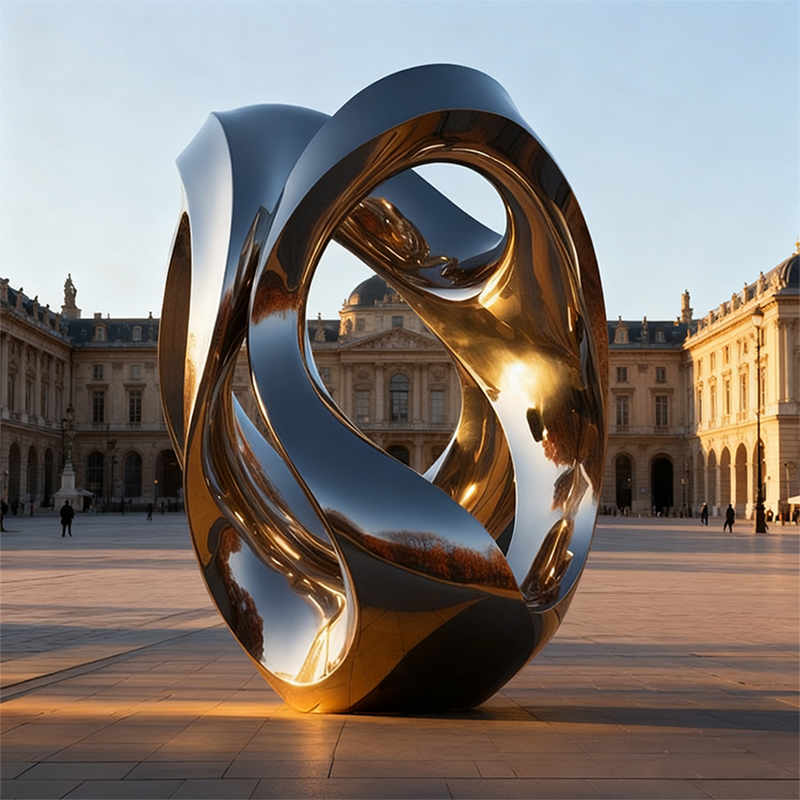
Gold & Silver Twisted Metal Sculpture
The form of this sculpture is visually active without being chaotic. Its curves create movement, but the overall composition remains controlled and balanced. This combination is important in architectural settings, where an artwork must attract attention without overwhelming the surrounding design.
Openings within the intertwined structure create moments of transparency. Viewers can see portions of the background through the sculpture, allowing the work to frame architecture, vegetation, sky, or pedestrian activity. These openings also reduce the sense of visual mass, making the sculpture appear lighter and more graceful than a solid block of equivalent height.
The twisted configuration can communicate several ideas without prescribing a single interpretation. Some viewers may see cooperation or connection. Others may recognize waves, ribbons, flames, vines, or abstract architectural movement. This interpretive openness is an advantage for public art because it allows different communities and visitors to form their own relationship with the work.
The artwork is also suitable for photographic engagement. Its reflective surface, recognizable silhouette, and changing color contrast create strong images from both close and distant viewpoints. This can support the identity of a destination and encourage visitors to share photographs of the site. In commercial and tourism-oriented developments, such visual memorability can contribute to a location’s public appeal.
At the same time, the design has sufficient sophistication for art galleries and curated collections. It does not rely solely on scale or bright color. Its formal qualities include line, volume, negative space, surface, reflection, rhythm, and balance. These characteristics allow the sculpture to be discussed and appreciated in an artistic context as well as an architectural one.
Compared with conventional painted steel sculptures, the Gold & Silver Twisted Metal Sculpture offers a more durable and visually integrated surface concept. Painted steel can provide extensive color choices, but paint may chip, fade, or require periodic renewal when exposed to weather and physical contact. The stainless-steel foundation and metallic coating of this sculpture are intended to provide a more stable premium finish for outdoor use.
Compared with ordinary stainless-steel sculptures finished in a single silver tone, this design offers greater visual differentiation. Single-tone sculptures can be elegant, but they may blend into modern architecture or become less distinctive in reflective environments. The gold-and-silver contrast produces a recognizable identity while retaining the clean character of metal.
Compared with stone sculptures, the metal construction provides a different relationship between strength, weight, and form. Marble and other stones offer natural variation and substantial visual mass, but complex interwoven curves can be more difficult to produce in stone. Stainless steel allows a more fluid and continuous silhouette, with open spaces that create visual lightness and dynamic movement.
Compared with fiberglass sculptures, stainless steel provides a more substantial architectural presence and a stronger association with permanence. Fiberglass can be useful for lightweight forms and complex color effects, yet stainless steel is often preferred when the client wants a high-end metallic appearance, strong reflective behavior, and a durable material suitable for a landmark installation.
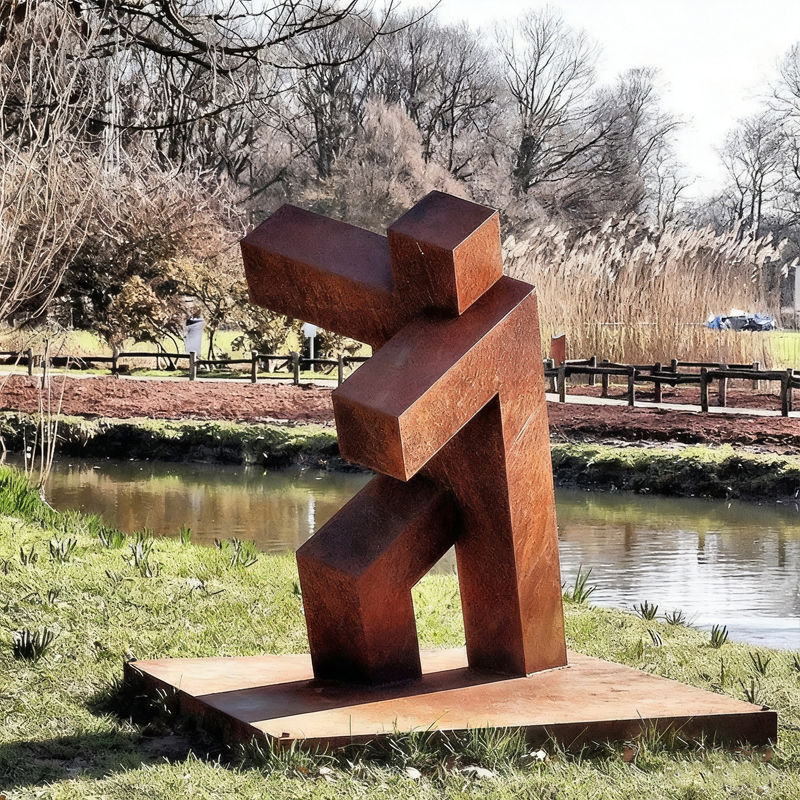
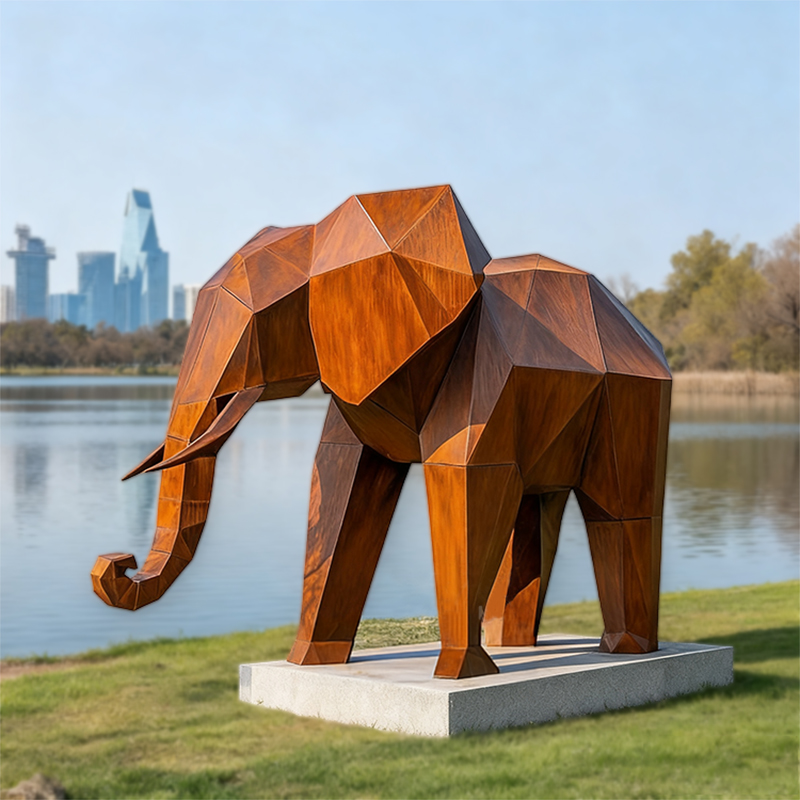
Compared with weathering steel, stainless steel provides a different aesthetic and maintenance profile. Weathering steel is admired for its rust-colored patina and industrial character. The gold-and-silver sculpture instead offers polished reflections, a cleaner contemporary appearance, and a color scheme that can coordinate with luxury architecture, illuminated plazas, and formal landscapes.
| Characteristic | Gold and Silver Twisted Stainless Steel | Painted Steel | Stone or Marble | Fiberglass |
|---|---|---|---|---|
| Visual identity | Contrasting gold and silver metallic surfaces with dynamic reflections | Strong color options but generally less reflective | Natural texture and substantial mass | Flexible color and lightweight appearance |
| Form potential | Well suited to flowing, interwoven, and open curved structures | Suitable for many forms, depending on fabrication and coating | More limited for thin, complex, continuous curves | Highly flexible for complex molded forms |
| Outdoor character | Architectural, polished, contemporary, and landmark-oriented | Decorative or industrial depending on finish | Classical, monumental, and natural | Decorative and lightweight |
| Reflective performance | High, especially with mirror polishing | Usually low to moderate | Generally low unless specially treated | Usually low or dependent on surface coating |
| Customization | Size, finish, and surface treatment can be customized | Color and shape can be customized | Shape and stone selection can be customized | Shape, color, and surface can be customized |
| Maintenance considerations | Routine cleaning and suitable care for polished and coated surfaces | Inspection and possible repainting over time | Cleaning, sealing, and protection from staining may be required | Protection from impact, ultraviolet exposure, and coating wear |
The supplied product information indicates that the sculpture supports customization of size and surface finish. This is important because public artwork must be proportioned to its setting. A 200-centimeter sculpture may be appropriate for a landscaped hotel entrance or a private courtyard, while a larger version may be preferred for a broad civic plaza or a high-rise development.
Scale affects more than visibility. It also influences the relationship between the sculpture and nearby buildings, trees, paving, lighting, seating, and pedestrian circulation. A professional design review can help determine whether the sculpture should act as a foreground feature, a central monument, a gateway element, or a distant visual anchor.
Surface finish customization can also help coordinate the artwork with the project’s design language. Clients may request adjustments to the relative visual prominence of gold and silver, the degree of polishing, or other surface effects appropriate to the project. The final treatment should be evaluated in relation to local light conditions, viewing distance, nighttime illumination, and surrounding materials.
Customization does not mean compromising the original concept. The essential identity of the sculpture remains its interwoven geometry and contrasting metallic surfaces. Adjustments to height, proportions, finish, and installation details can adapt the work to a specific space while preserving its artistic character.
The production of a twisted stainless-steel sculpture requires coordination between artistic modeling, structural planning, metal fabrication, surface finishing, coating, quality inspection, and installation preparation. Each stage influences the final result. A visually attractive design can lose its impact if curves are inconsistent, seams are poorly managed, reflections are uneven, or the finish is not properly protected.
The process begins with a review of the intended form, dimensions, viewing angles, and installation environment. A three-dimensional model helps define the sculpture’s overall proportions, center of gravity, clearances, openings, and relationship between the intertwined elements. It also supports communication between the client, designer, fabricator, structural consultant, and installation team.
Three-dimensional planning is especially valuable for complex curves. It enables the production team to study how the gold and silver components overlap, where connection points are located, and how the form will appear from different viewpoints. It can also help identify potential challenges before material is cut or formed.
After the design is confirmed, 316 stainless-steel components are prepared and shaped according to the approved geometry. Depending on the form and engineering requirements, fabrication may involve cutting, rolling, bending, forming, assembly, and welding. The objective is to create a continuous visual flow while maintaining sufficient internal strength and dimensional stability.
Curved sculpture fabrication requires careful control of alignment. Small deviations may become noticeable when reflected highlights travel along the surface. The fabrication team must therefore pay attention to the consistency of curves, the symmetry or intentional asymmetry of the design, the positioning of joints, and the transition between individual sections.
Welding is used to connect stainless-steel sections and create the required sculptural volume. On a polished artwork, weld areas must be managed carefully because uneven seams can interrupt reflections and reduce the sense of continuity. Finishing work may include grinding, blending, smoothing, and progressive polishing to produce a visually integrated surface.
Quality welding also contributes to structural reliability. The connection strategy must consider the sculpture’s size, internal support, transportation requirements, and installation conditions. The visible surface and the concealed internal structure must work together so that the artwork is both expressive and stable.
Before coloring and final treatment, the stainless-steel surface is prepared to remove fabrication marks and create the required finish. Mirror polishing is a progressive process in which the surface is refined through increasingly fine stages. Consistency is essential because the sculpture’s visual effect depends on smooth, continuous reflections.
On a twisted form, polishing requires attention to changing angles and difficult-to-reach areas. A uniform finish helps maintain the impression that the metal flows naturally through the composition. The transition between polished sections should be controlled so that the final surface appears deliberate rather than mechanically assembled.
Once the surface has been properly prepared, the gold and silver metallic coloring treatment can be applied according to the approved finish specification. The purpose of this stage is not merely to add color. It is to establish a stable, coherent surface that supports the sculpture’s contrast and protects the visual quality of the underlying metal.
Color consistency is particularly important when the sculpture is built from multiple components. The production team must consider how each section will relate to the others under natural and artificial light. Final inspection should review tone, gloss, continuity, surface cleanliness, and areas around joints or transitions.
Before shipment, the completed sculpture should be reviewed for dimensional accuracy, surface quality, color consistency, structural details, and packaging protection. Large curved components require careful packing because polished surfaces can be damaged by friction, impact, moisture, or unsuitable wrapping materials during transportation.
Installation planning should address the foundation, anchoring system, lifting points, assembly sequence, access equipment, and site safety. Where the sculpture is divided into transportable sections, the connection points should be planned to preserve the intended visual continuity after assembly.
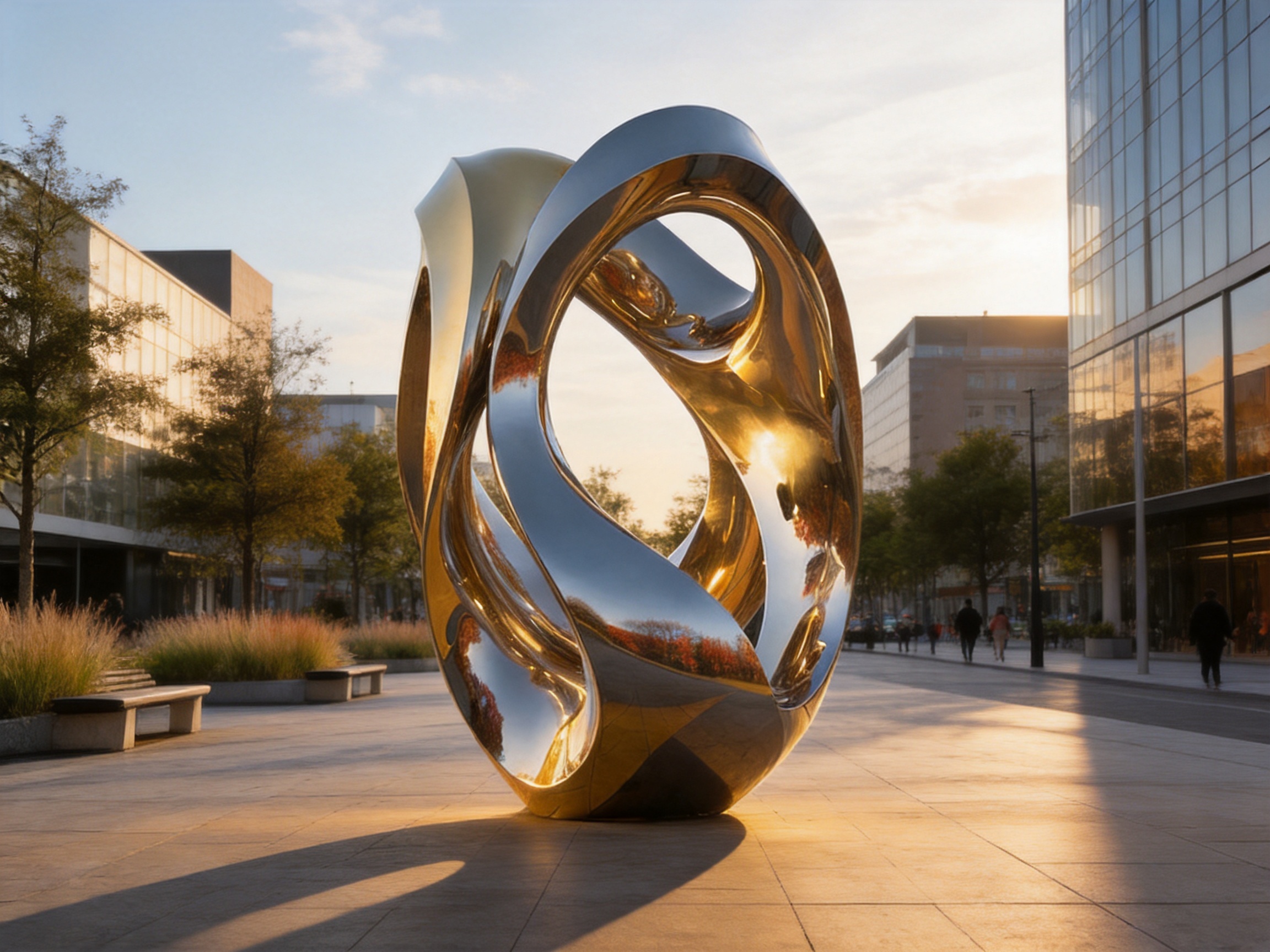
Jiangsu Xinyesheng Sculpture Co., Ltd. is identified in the supplied information as the manufacturer and supplier of this sculpture. The company’s stated product range includes bronze sculptures, stainless steel sculptures, marble sculptures, fiberglass sculptures, and weathering steel sculptures. This range indicates experience across several major categories of architectural and landscape art, allowing the supplier to evaluate material selection according to the client’s desired appearance, site conditions, scale, and budget.
A manufacturer working across multiple sculpture materials can offer a broader design perspective than a supplier limited to one production method. Stainless steel may be the best choice for a reflective landmark, while bronze may be more suitable for a classical figurative work, marble for a monumental natural texture, fiberglass for a lightweight decorative installation, or weathering steel for an industrial landscape. This cross-material experience can help clients make more informed decisions during project development.
The company also supports custom design and custom sizing. This is a meaningful strength for developers, architects, landscape designers, art consultants, hotels, municipalities, and cultural organizations that need a sculpture adapted to a specific site. Custom production allows the artwork to respond to project dimensions rather than forcing the project to accommodate a standard decorative object.
The supplier’s focus on public and decorative sculpture also aligns with the requirements of commercial and civic environments. Such projects require attention to appearance, durability, delivery, installation, and long-term presentation. A product is successful only when these elements are considered together.
The combination of 316 stainless steel, special metallic coloring, mirror polishing, and custom fabrication gives the supplier a strong basis for producing premium contemporary metal artworks. For clients comparing suppliers, the most relevant evaluation criteria should include material traceability, fabrication quality, finish consistency, structural coordination, packaging, customization capability, communication, and after-sales support.
In a city square, the sculpture can function as a central landmark that helps organize pedestrian movement and strengthen local identity. Its height and open form allow it to remain visible without creating a solid barrier. Placed near seating, paving patterns, water features, or public buildings, it can contribute to a coherent civic composition.
The gold-and-silver appearance is suitable for formal public settings because it is expressive but not dependent on a temporary trend. The reflective surface can also connect the artwork visually with glass façades, metal building details, and contemporary urban infrastructure.
At a hotel entrance, resort plaza, or luxury residential development, the sculpture can communicate quality and exclusivity before visitors enter the building. Its metallic finish can coordinate with lighting, stone paving, water, landscaping, and reception architecture. The distinctive shape may also become part of the property’s visual branding without requiring a literal logo or sign.
In these environments, the sculpture is often viewed both during the day and at night. Carefully positioned lighting can emphasize the separation between gold and silver sections, create shadows on adjacent surfaces, and highlight the inner openings of the twisted form.
Corporate and commercial spaces often need artwork that appears modern, confident, and memorable. The sculpture’s abstract form can fit technology parks, financial centers, shopping districts, office campuses, and mixed-use developments. Because it does not depict a narrow subject, it can remain appropriate even if the property’s tenants or functions change over time.
Its reflective qualities can also make the installation feel connected to the activity of the site. People, vehicles, landscaping, and architecture are reflected in the metal, allowing the sculpture to change as the environment changes.
In an art gallery courtyard, museum entrance, or cultural institution, the sculpture can be presented as an example of contemporary abstract metalwork. Its value lies in the relationship between material, form, color, light, and space. A gallery may choose to place it outdoors as a permanent architectural work or use it as a transitional feature between indoor exhibitions and the surrounding landscape.
The sculpture can also serve as a focal point in a private garden, estate entrance, or landscaped courtyard. Against greenery, the metallic colors become especially prominent. Against stone or concrete, the polished surface introduces movement and contrast. The final placement should allow sufficient viewing distance so that the intertwined geometry can be appreciated as a complete composition.
Successful installation begins with a site assessment. The client and project team should review ground conditions, drainage, prevailing wind, pedestrian access, nearby trees, irrigation systems, lighting, and maintenance routes. The sculpture should be positioned where its visual impact is strong but where it does not obstruct required circulation or emergency access.
Foundation design must be coordinated with the sculpture’s dimensions and local environmental conditions. The anchoring system should be selected according to the structural requirements of the final design and the characteristics of the installation surface. For large outdoor works, professional engineering review is recommended.
Transportation planning is equally important. A tall or complex sculpture may need to be divided into sections for loading, shipping, and site assembly. The division should be designed early so that joints are discreet and the completed artwork maintains visual continuity.
Lighting can significantly enhance the sculpture. Narrow-beam fixtures may emphasize the outer curves, while softer illumination can reveal the reflective interaction between the gold and silver surfaces. Lighting should be tested at night from the principal viewing areas to avoid glare and ensure that the work remains comfortable to approach.
Drainage and cleaning access should not be overlooked. Water accumulation, irrigation spray, or runoff containing dirt and salts can affect the appearance of any outdoor artwork. A good installation plan makes routine inspection and cleaning practical rather than treating maintenance as an emergency response.
The sculpture is designed with outdoor durability in mind, but regular maintenance remains important for preserving its appearance. A simple maintenance schedule may include visual inspections, gentle cleaning, review of the finish, and inspection of accessible structural or anchoring areas.
Cleaning frequency should reflect the environment. A sculpture in a clean inland landscape may require less frequent cleaning than one near a coast, industrial facility, busy roadway, or construction site. Salt, pollutants, dust, bird deposits, and hard-water residue should be removed using methods appropriate for polished and coated stainless steel.
Non-abrasive tools and compatible cleaning solutions should be used. Harsh acids, strong alkalis, metal scrapers, rough pads, and unapproved solvents may affect the polished surface or metallic coating. When in doubt, the owner should request a care recommendation based on the actual finish specification.
Any change in color, unusual staining, visible damage, or movement at a connection should be documented and assessed promptly. Early attention can prevent a minor maintenance issue from becoming a more expensive restoration problem.
A landmark sculpture can provide value beyond its purchase price. In a public or commercial environment, it can help define a recognizable location, create a memorable arrival experience, and support photography and social engagement. Visitors are more likely to remember a space that contains a distinctive visual feature with a clear identity.
The Gold & Silver Twisted Metal Sculpture is especially suitable for this role because its silhouette is recognizable while its surface remains responsive to changing conditions. The work can appear formal and architectural in one context, lively and reflective in another, and dramatic under nighttime lighting.
For developers, the sculpture may contribute to the perceived quality of a project. For municipalities, it can strengthen the identity of a civic space. For hotels and resorts, it can create a signature arrival point. For corporate clients, it can express innovation, connection, and forward-looking design without relying on literal imagery.
The listed price range is approximately USD 7,953.35 to USD 15,452.23, with the final price depending on factors such as size, surface finish, customization, fabrication complexity, packaging, shipping, and installation requirements. Clients should request a project-specific quotation before making a purchasing decision.
When comparing this sculpture with similar products, buyers should look beyond photographs and initial price. The grade of stainless steel, internal construction, surface preparation, coating method, welding quality, finish consistency, and installation support all influence the long-term result.
A low-cost sculpture may use a less suitable material, a thinner construction, a basic surface treatment, or limited quality control. These differences may not be obvious at first delivery, but they can become visible through uneven reflections, coating deterioration, corrosion, deformation, or difficult maintenance.
Buyers should also ask whether the supplier can provide drawings, finish samples, dimensional confirmation, packaging details, and installation recommendations. A professional quotation should clearly distinguish the sculpture itself from optional services such as foundation work, transport, customs handling, lifting, and on-site assembly.
The supplier’s ability to customize the design is another important advantage. A standard sculpture may appear attractive in a catalog but fail to suit the proportions of the actual site. A custom version can be adjusted to produce a stronger relationship between the artwork and its surroundings.
| Project Requirement | Recommended Consideration |
|---|---|
| Need for a strong landmark | Use the sculpture as a central visual anchor with clear approach views |
| Modern architectural surroundings | Emphasize mirror polishing and silver reflection to connect with glass and metal façades |
| Luxury or hospitality setting | Highlight the gold finish through landscape and nighttime lighting |
| Large public plaza | Review scale, foundation, wind exposure, pedestrian circulation, and viewing distance |
| Limited installation area | Request customized dimensions and confirm delivery access before production |
| Coastal or polluted environment | Confirm the finish specification and establish a more frequent cleaning schedule |
| Nighttime visibility requirement | Coordinate sculpture placement with architectural lighting and glare control |
The sculpture is made primarily from 316 stainless steel. This material is selected for its strength, corrosion resistance, and suitability for demanding architectural and outdoor applications.
The contrasting appearance is created through a special metallic coloring coating applied to the stainless-steel surface. The gold and silver tones are arranged to emphasize the intertwined structure and create a distinctive visual identity.
Yes. It is designed as a public landscape artwork for applications such as city squares, commercial developments, gardens, entrances, and outdoor cultural spaces. Correct foundation design, installation, cleaning, and environmental maintenance are important for long-term performance.
The supplied product information gives an approximate height of 200 to 300 centimeters. Customized dimensions are available, subject to design review, fabrication requirements, transportation conditions, and installation planning.
Yes. The product supports customization of surface finish. Buyers should discuss the desired gloss, color balance, reflective effect, and environmental requirements with the manufacturer before production begins.
The mirror-polished surface reflects surrounding buildings, natural light, sky, landscaping, and movement. As the viewer changes position, the highlights and reflections change, creating a dynamic visual experience.
It combines 316 stainless steel with a metallic coloring treatment and mirror polishing, creating a refined reflective appearance. Painted steel can offer many colors, but it generally does not produce the same depth of reflection or premium metallic character.
Stainless steel allows the creation of thinner, more fluid, and more open intertwined forms. Marble and stone provide natural texture and monumental weight, while this sculpture emphasizes movement, reflection, contrast, and visual lightness.
Yes. Although it is designed for public landscape applications, it can also be considered for large interior spaces such as galleries, atriums, hotel lobbies, and corporate reception areas, provided that the dimensions and reflective finish suit the interior environment.
Clients should prepare the intended location, approximate dimensions, viewing distances, preferred surface finish, delivery destination, installation conditions, and lighting concept. Drawings or site photographs can help the manufacturer recommend an appropriate configuration.
Maintenance generally includes routine visual inspection and gentle cleaning with suitable non-abrasive materials. The frequency depends on the local climate and pollution level. Coastal, industrial, and high-traffic environments may require more frequent care.
The supplied price range is approximately USD 7,953.35 to USD 15,452.23. The actual quotation may vary according to size, customization, finish, packaging, shipping, installation, and project-specific requirements.
Its landmark scale, distinctive silhouette, reflective finish, and photographic qualities make it suitable for spaces intended to attract attention and encourage visitor interaction. Its success as a tourist feature will also depend on location, accessibility, lighting, landscape design, and broader place-making strategy.
The Gold & Silver Twisted Metal Sculpture is a sophisticated public artwork that combines expressive form with practical material performance. Its interwoven curves create movement and symbolic openness, while the contrast between gold and silver gives the work an immediately recognizable identity. The mirror-polished surface adds depth by reflecting the surrounding environment, allowing the sculpture to change with light, weather, architecture, and human activity.
Its use of 316 stainless steel, special metallic coloring, and customizable dimensions gives it important advantages over many conventional outdoor sculptures. It offers the visual richness of a premium metallic artwork, the adaptability of custom fabrication, and the durability expected from a carefully produced architectural installation.
Jiangsu Xinyesheng Sculpture Co., Ltd. brings experience across stainless steel, bronze, marble, fiberglass, and weathering steel sculpture categories. This broader manufacturing background supports material selection, custom design, surface development, and project coordination for a range of public and private environments.
For city squares, hotels, cultural institutions, corporate campuses, commercial centers, landscaped entrances, and high-end residential developments, the sculpture can act as more than decoration. It can become a landmark, a meeting point, a photographic symbol, and a visual connection between architecture and landscape. With appropriate engineering, installation, lighting, and maintenance, it is positioned as a durable contemporary artwork capable of making a lasting impression.
Architectural Institute of America. Principles of Site-Specific Public Art and Environmental Integration.
American Society for Testing and Materials. General Guidance on Stainless Steel Materials and Corrosion-Resistant Architectural Applications.
International Stainless Steel Forum. Stainless Steel in Outdoor Architecture and Public Design.
International Council of Museums. Recommendations for the Care and Maintenance of Contemporary Metal Artworks.
Landscape Institute. Public Realm Design, Landmark Features, and Visitor Experience.
Metal Finishing Association. Surface Preparation, Polishing, and Protective Treatments for Decorative Metalwork.
Product information supplied for the Gold & Silver Twisted Metal Sculpture, including material, finish, dimensions, pricing, customization, and application details.



Daniel H.

Amanda R.

Robert B.

Jennifer S.

James W.

Barry G.

Michael T.

Emily K.

David L.

Sarah M.


Mikey XV

Jagxue

 English
 Español
 عربى
عربى Français
 italiano
 Deutsch