Lucky Deer Mirror Spotted Deer Sculpture
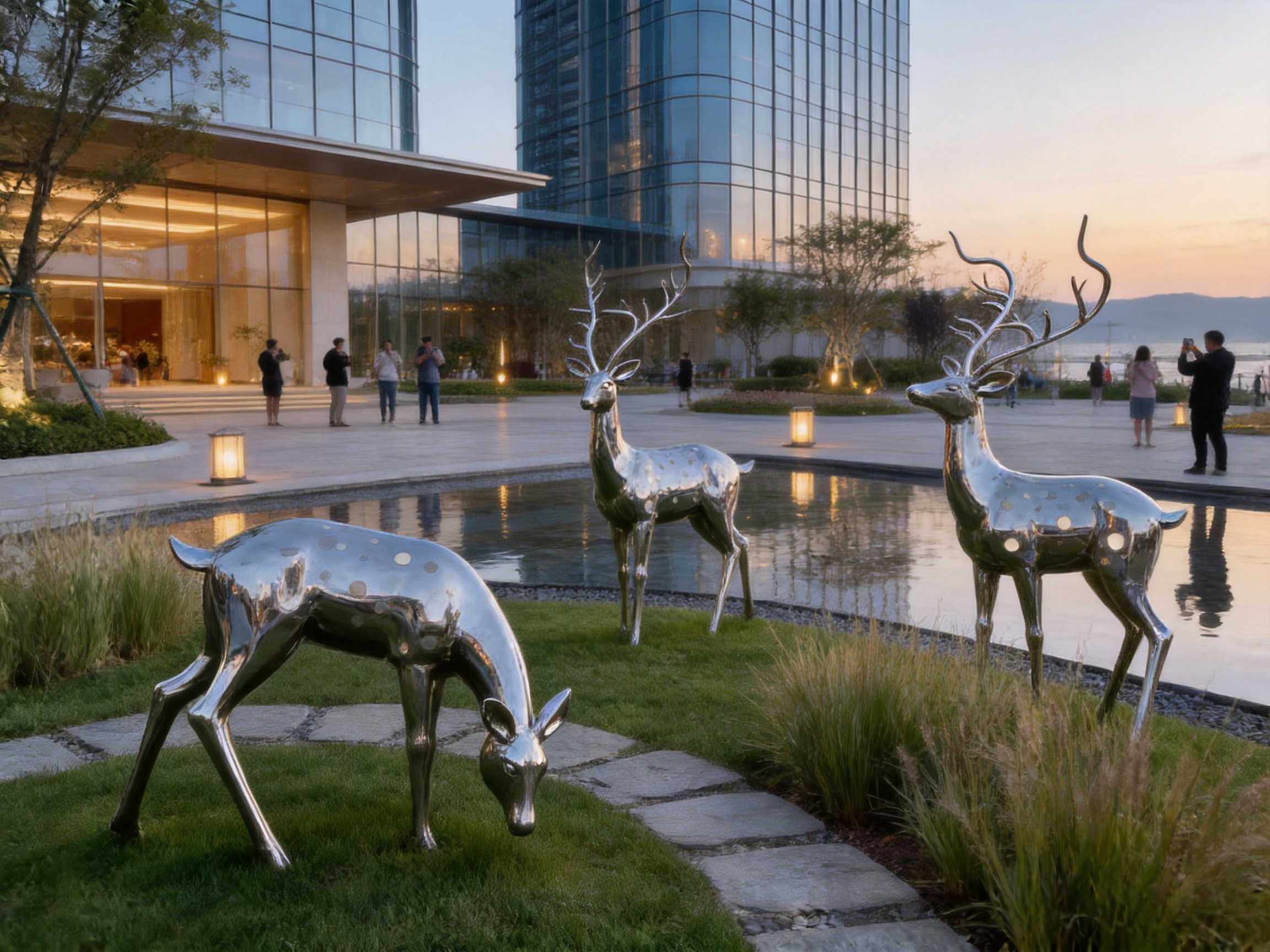
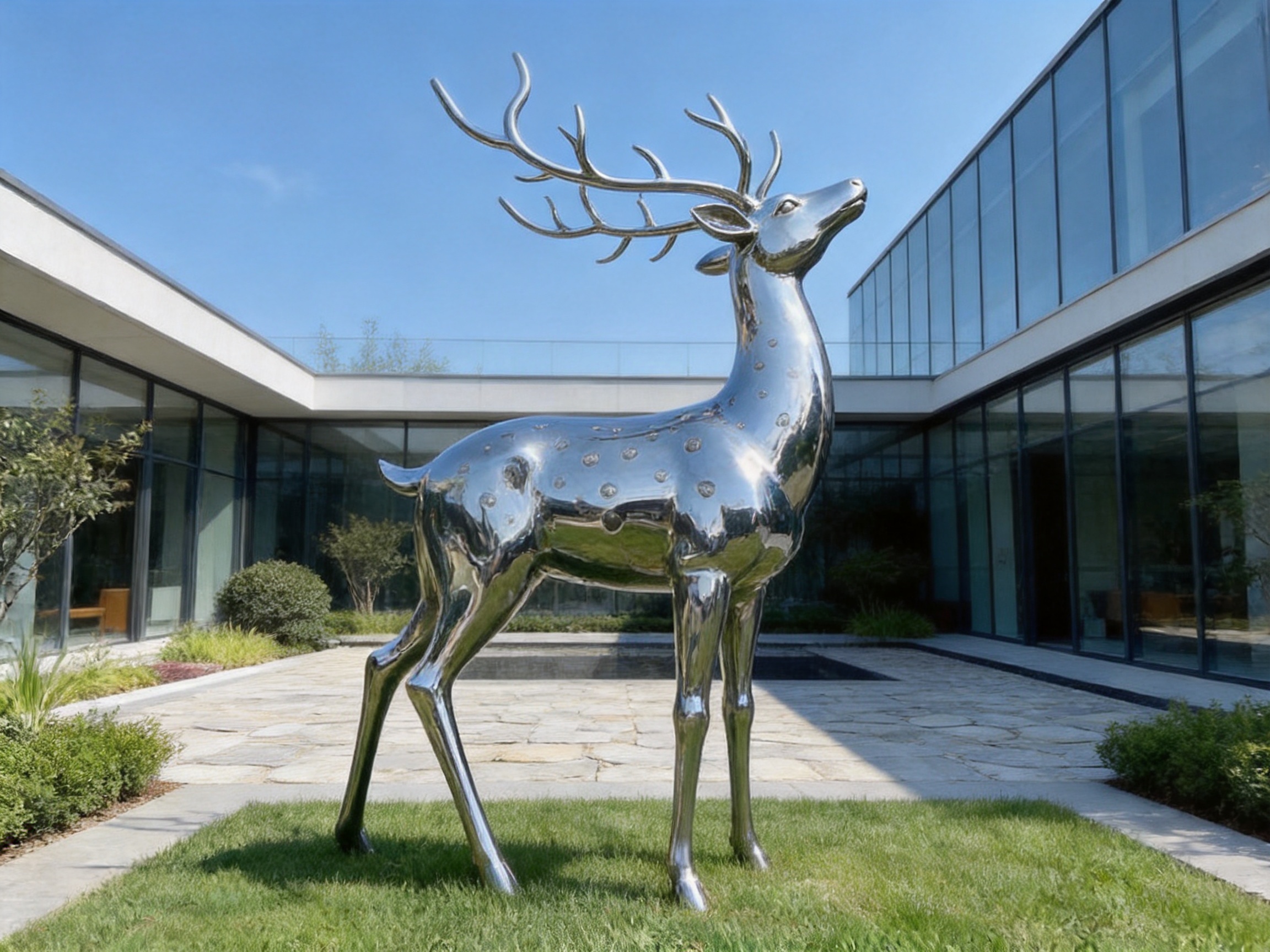
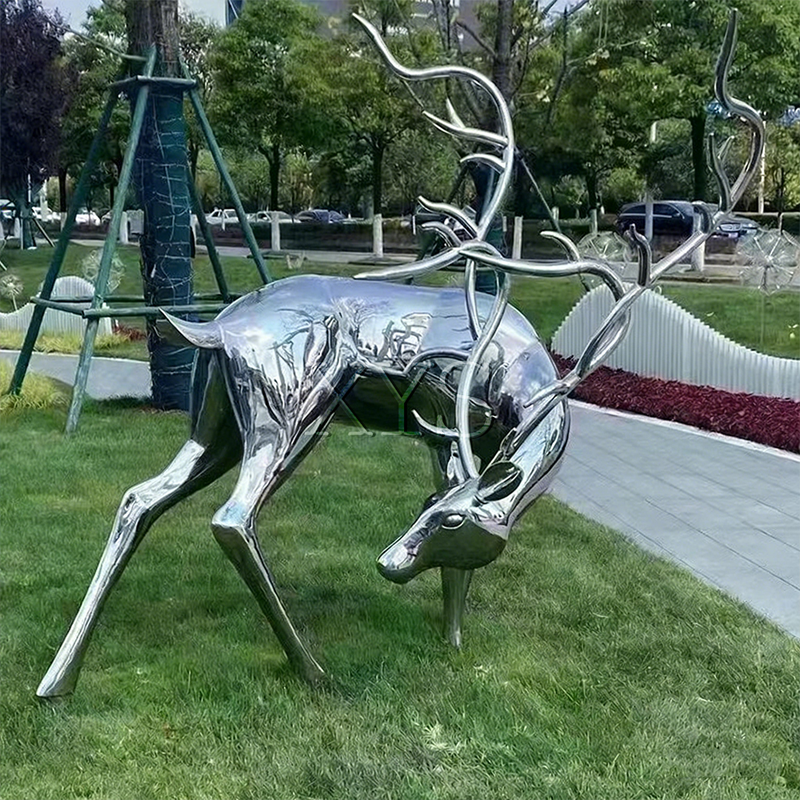
The Lucky Deer Mirror Spotted Deer Sculpture is a refined outdoor artwork designed to combine natural symbolism, contemporary metal craftsmanship, and long-term landscape performance. Made from mirror-finished 304 stainless steel, this sculpture presents a vivid spotted deer with an elegant body profile, carefully shaped legs, and graceful antler lines. Its polished surface reflects surrounding light, vegetation, architecture, and movement, allowing the sculpture to change visually throughout the day.
With an available height of approximately 1.5 to 2.5 meters and a price range of $2,196.05 to $3,367.27, the sculpture is suitable for a wide range of public, commercial, residential, and institutional environments. It can be displayed as a single focal point or arranged in groups to create a more dynamic composition. Typical applications include garden landscapes, sales centers, municipal parks, commercial plazas, hotel entrances, resort grounds, themed developments, and architectural courtyards.
More than a decorative animal figure, this sculpture is a symbolic landscape element. The deer is widely associated with fortune, vitality, grace, prosperity, and good luck. Its calm posture and distinctive antlers can introduce a welcoming emotional character into spaces that might otherwise feel overly formal or architectural. At the same time, its stainless steel construction gives it a modern presence capable of complementing glass buildings, stone paving, green planting, water features, and contemporary public art programs.
Content
The design of the Lucky Deer Mirror Spotted Deer Sculpture is based on the recognizable silhouette of a spotted deer. The form is intended to appear vivid and lifelike while retaining the visual clarity required for large-scale outdoor display. The body is shaped to communicate natural movement and alertness, while the antlers extend in graceful lines that create a strong vertical and directional rhythm.
This balance between realism and stylization is important in public sculpture. An excessively realistic animal may appear like a taxidermy display, while an overly abstract form may lose its symbolic identity. The spotted deer design occupies a productive middle ground. Its proportions, contours, and antler structure allow viewers to identify the animal immediately, yet the reflective metal surface transforms the familiar subject into a contemporary artistic object.
The mirror finish adds another layer to the design. Instead of presenting a fixed color or opaque surface, the sculpture visually absorbs and reflects its surroundings. On a sunny day, it may reflect blue sky and bright highlights. In a garden, it can mirror green foliage and seasonal colors. Near a building, it may pick up the tones and geometry of the surrounding architecture. This changing appearance makes the sculpture feel integrated with its site rather than simply placed on it.
The surface also improves visibility from different viewing angles. A matte or painted sculpture may look substantially the same regardless of where it is viewed. A polished stainless steel sculpture produces changing highlights and reflections as pedestrians move around it. This interactive quality encourages people to observe the work from multiple perspectives and can make it especially effective in entrance zones, plazas, walkways, and gathering areas.
| Specification | Product Detail |
|---|---|
| Product name | Lucky Deer Mirror Spotted Deer Sculpture |
| Category | Stainless Steel Animal Sculptures |
| Primary material | 304 stainless steel |
| Surface treatment | Mirror finish |
| Subject | Spotted deer with graceful antler lines |
| Recommended application | Gardens, sales centers, municipal parks, commercial plazas, resorts, and architectural landscapes |
| Available height | Approximately 1.5 to 2.5 meters |
| Price range | $2,196.05 to $3,367.27 |
| Display method | Single installation or grouped arrangement |
| Customization | Available according to project requirements |
| Outdoor performance | Corrosion-resistant and weatherproof for appropriate outdoor use |
The available height range allows purchasers to select a scale suited to the size and importance of the installation site. A 1.5-meter version can work effectively in a garden, courtyard, or landscaped entrance where visitors view the sculpture at close range. A 2.5-meter version can provide stronger visibility in an open plaza, public park, commercial development, or large property entrance.
Because the sculpture is customizable, the listed dimensions should be understood as a practical range rather than a fixed limitation. Project requirements may influence the final height, proportions, surface appearance, base arrangement, and number of deer included in a composition. Before production, buyers should confirm the desired dimensions, installation conditions, delivery requirements, and site-specific engineering considerations.
Material selection is one of the most important decisions in outdoor sculpture. A public artwork must withstand rain, sunlight, temperature changes, dust, humidity, and repeated cleaning while retaining its visual quality. The use of 304 stainless steel gives the Lucky Deer sculpture a strong foundation for these conditions.
304 stainless steel is widely used in architectural, commercial, decorative, and industrial applications. It contains chromium, which helps the material form a passive protective layer on its surface. This layer contributes to its resistance to ordinary atmospheric corrosion and supports long-term use in many outdoor environments. The material is not completely immune to every form of corrosion, but it provides a dependable combination of strength, workability, appearance, and resistance for many landscape installations.
Compared with ordinary carbon steel, stainless steel does not require the same dependence on paint or surface coatings to maintain a clean appearance. Painted carbon steel can provide good performance when properly prepared and maintained, but scratches, impact damage, ultraviolet exposure, and coating deterioration may eventually create areas that need repair. Mirror-finished stainless steel offers a different maintenance model: the visual surface is produced through metal finishing rather than relying solely on an applied color layer.
Compared with iron or mild steel, 304 stainless steel can reduce concerns about visible rust in ordinary outdoor settings. Compared with many painted sculptures, it provides a more reflective and architectural appearance. Compared with some lower-grade stainless steels, 304 offers a widely recognized balance of corrosion resistance and fabrication suitability. These advantages make it particularly appropriate for landscape projects that require both decorative impact and practical durability.
The material is also compatible with a wide range of design styles. It can appear luxurious in a hotel entrance, playful in a family-oriented commercial plaza, elegant in a private garden, or civic-minded in a municipal park. The same material can therefore support different branding and architectural environments without losing its own identity.
The mirror finish is a defining characteristic of this deer sculpture. A highly polished surface creates a clean, bright appearance and emphasizes the sculptural contours of the animal. Curved sections of the body can produce soft, flowing reflections, while the antlers can create thin, bright lines against darker vegetation or building surfaces.
Reflection also gives the work a sense of movement. The sculpture itself remains stationary, but the reflected sky, people, vehicles, trees, and light conditions are constantly changing. This visual activity can prevent the work from feeling static and can encourage repeat engagement from visitors. A person who sees the deer in the morning may notice a substantially different appearance in the afternoon or under evening lighting.
In commercial landscapes, this quality can help create memorable photo opportunities. Visitors may photograph the mirrored body, position themselves near the reflective surface, or use the deer as a recognizable meeting point. In a sales center, a polished animal sculpture can contribute to an atmosphere of quality and prosperity. In a public park, it can provide a visually distinctive landmark that helps people orient themselves within the site.
However, mirror stainless steel should be considered as a reflective material rather than a perfectly uniform visual field. Minor variations in reflection can occur because of the curvature of the sculpture, the fabrication process, the viewing angle, and surrounding light. These variations are part of the artistic character of a handmade metal sculpture. Proper handling, transportation, and installation remain important for protecting the polished surface from unnecessary scratching.
Animal sculpture often succeeds because it communicates at an intuitive level. Viewers do not need specialist knowledge to recognize a deer or understand its association with the natural world. The deer’s alert posture, slender legs, branching antlers, and spotted body pattern can evoke woodland environments, seasonal change, peaceful movement, and harmony with nature.
The Lucky Deer design adds a symbolic dimension by associating the deer with fortune and good luck. This makes the sculpture especially suitable for entrances and places where a positive first impression is important. A deer positioned near a commercial property, hotel, resort, business campus, or residential development can suggest welcome, prosperity, and favorable beginnings.
The symbolism may also be adapted to different cultural and project contexts. Some buyers may emphasize the deer as a sign of good fortune. Others may focus on its connection with ecological awareness, wildlife appreciation, or a calm relationship between architecture and landscape. Because the form is recognizable and broadly positive, it can serve multiple communication purposes without requiring written explanation.
When several deer are arranged together, the installation can communicate movement, family, community, or migration. A group can be placed in a loose formation across a lawn, aligned along a pedestrian route, or positioned at different angles around a water feature. This flexibility enables landscape designers to create a composition that responds to the geometry and circulation pattern of a specific site.
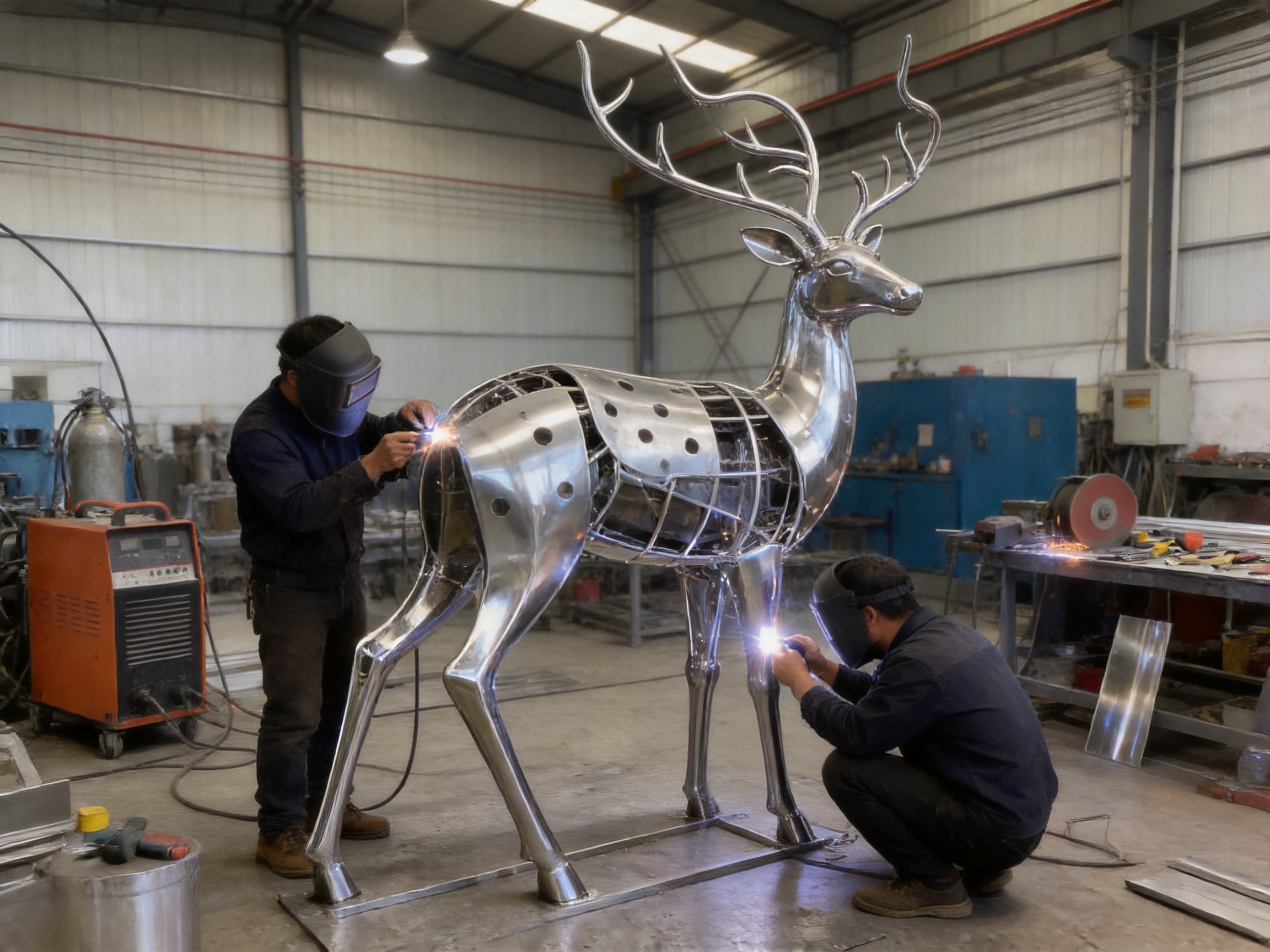
The production of a large mirror-finished stainless steel animal sculpture requires more than simply cutting and assembling metal sheets. The finished work must combine a convincing three-dimensional form, stable construction, smooth transitions, carefully controlled welds, and a consistent reflective surface. The manufacturing process therefore depends on design interpretation, forming skill, fabrication accuracy, finishing expertise, and quality inspection.
The production process begins with design planning. A deer sculpture must be considered from multiple viewpoints because it may be seen from the front, side, rear, and elevated perspectives. The design team must determine the animal’s overall proportions, body volume, leg placement, neck angle, head position, and antler structure. For a customized project, the form may also be adjusted to suit a specified height, viewing distance, installation location, or group arrangement.
After the form has been approved, the sculpture can be translated into workable sections and fabrication components. Large animal forms are commonly developed through a combination of templates, shaped metal sections, internal supports, and carefully aligned surface pieces. The exact construction method depends on the final scale, geometry, and engineering requirements. The goal is to ensure that the external skin follows the intended contours while the internal structure provides adequate stability.
Forming 304 stainless steel requires controlled metalworking. Curved body surfaces, slender legs, neck sections, ears, facial elements, and antlers each present different fabrication challenges. Broad surfaces must be shaped without creating distracting distortion, while narrow elements require precision to maintain their visual delicacy and structural reliability. Skilled forming helps preserve the natural appearance of the deer and prevents the finished piece from appearing overly angular or mechanically assembled.
Welding is another critical stage. Joints must be strong enough for transportation, handling, installation, and outdoor exposure. At the same time, visible welds should be refined so that they do not interrupt the mirror finish or the continuity of the animal’s contours. Welding stainless steel requires attention to heat control, joint preparation, alignment, and post-weld finishing. Excessive heat or poor handling can affect the appearance of the metal and create additional finishing work.
After fabrication, the surface is progressively refined. Grinding and polishing remove irregularities, blend transitions, and prepare the metal for the mirror finish. This stage requires patience because the reflective surface can reveal small scratches, uneven areas, or inconsistent polishing patterns. The closer the viewing distance, the more important these details become. A sculpture designed for a pedestrian plaza demands particularly careful finishing because visitors may see it from only a short distance.
Final inspection should consider both artistic and practical criteria. The sculpture should be checked for overall proportion, stability, surface continuity, antler alignment, leg placement, sharp edges, weld quality, and finish consistency. Packaging and transport protection are also important. A polished stainless steel artwork can be damaged by contact with abrasive materials, careless stacking, or inadequate protection during loading and unloading. Proper packaging procedures support the quality achieved during fabrication.
Customization is one of the principal strengths of a project-based sculpture supplier. Standard dimensions can provide a useful starting point, but public art and landscape installations often require adjustments. The scale of a deer sculpture should relate to the surrounding buildings, pathways, planting, signage, lighting, and expected viewing distance.
For a compact garden, a smaller sculpture may create a sense of discovery without overpowering the vegetation. For a large commercial plaza, a taller sculpture or a group of deer may be necessary to establish a clear visual anchor. At a sales center, the artwork may be positioned along the approach route so that it becomes visible before visitors enter the building. In a municipal park, the installation may be integrated into a broader public art plan with multiple viewpoints and pedestrian circulation paths.
Customization can include height, quantity, grouping, orientation, and spatial arrangement. A buyer may request several deer with different head positions or staggered placements to create the impression of movement. Another project may require a symmetrical composition at an entrance. A resort may prefer a more natural arrangement in which the deer appear to emerge from planting or face toward a water feature.
Surface expectations can also be discussed during customization. The mirror finish is the defining treatment for this model, but project teams may need to clarify the desired level of reflectivity, visual uniformity, and relationship to other materials used on the site. The appearance of the sculpture should be considered alongside paving, stone, glass, timber, concrete, and landscape lighting.
Site conditions should be communicated before manufacturing begins. Information about wind exposure, ground conditions, access limitations, installation equipment, coastal proximity, maintenance expectations, and local regulations can help determine the appropriate support and installation approach. Custom design is most successful when artistic requirements and site engineering are considered together rather than treated as separate stages.
The Lucky Deer Mirror Spotted Deer Sculpture offers several advantages when compared with common alternatives in the outdoor sculpture market.
Painted carbon steel provides extensive color options and can be cost-effective, but its appearance depends heavily on the condition of the coating. Over time, paint may fade, chip, peel, or require repair. The mirror stainless steel approach offers a more contemporary surface with strong resistance to ordinary atmospheric conditions and without the same dependence on a colored paint layer.
The stainless steel surface also creates a more dynamic relationship with its surroundings. Instead of presenting one fixed color, it reflects natural and architectural elements. This can give the installation greater visual depth and make it more suitable for premium commercial or civic environments.
Stone and concrete sculptures can convey permanence and weight, but they may appear visually heavy in modern landscapes. They can also be vulnerable to staining, cracking, surface weathering, or biological growth depending on their composition and site conditions. A polished stainless steel deer presents a lighter and more contemporary alternative.
The reflective surface can make the sculpture feel less bulky even when it has a substantial physical volume. This is useful in spaces where designers want a strong landmark without blocking sightlines or making the landscape feel crowded.
Fiberglass can support complex shapes and relatively light structures, but its long-term outdoor performance depends on the resin system, gel coat, pigments, and quality of surface protection. Scratches and coating damage may affect the appearance and require specialized repair. Stainless steel offers a robust metal surface and a distinctive reflective effect that fiberglass cannot naturally reproduce.
For projects seeking a high-end architectural finish, mirror stainless steel can communicate greater material permanence and sophistication. It is especially appropriate where the sculpture is positioned near glass façades, polished stone, metal cladding, or other premium construction materials.
Bronze has a long artistic tradition and develops a distinctive patina, but it creates a warmer, heavier, and more classical impression. The mirror deer is better suited to contemporary, minimalist, luxury, and technology-oriented environments. Its bright surface can reinforce the visual language of modern architecture while still preserving the organic character of the animal.
Mass-produced figures often have limited sizes, fixed poses, and standardized finishes. They may be appropriate for small decorative uses, but they do not always provide the individuality required for a landmark installation. Customizable stainless steel fabrication allows the buyer to request a more suitable scale, composition, and site relationship.
The distinction is particularly important for commercial properties and public spaces. A landmark sculpture should feel intentional and connected to the identity of its location. A carefully planned deer installation can provide a stronger sense of place than a generic ornament selected from a limited catalog.
The sculpture is described as corrosion-resistant and weatherproof for outdoor use. These characteristics make it suitable for gardens, parks, plazas, and other exposed environments. Nevertheless, every outdoor artwork benefits from appropriate site planning and routine care. Weatherproof does not mean maintenance-free under every condition.
Periodic cleaning helps preserve the clarity of the mirror finish. Dust, pollen, bird residue, mineral deposits, and airborne pollution can reduce reflectivity if they remain on the surface for extended periods. Cleaning methods should be gentle and compatible with stainless steel. Soft cloths, clean water, and suitable non-abrasive cleaning products are generally preferable to harsh scouring materials.
Installations in coastal or highly polluted environments may require more frequent cleaning. Salt deposits and aggressive airborne contaminants can increase the risk of surface staining or corrosion, particularly in areas where deposits are allowed to dry repeatedly. Site-specific maintenance planning is therefore advisable for waterfront developments, industrial districts, and locations exposed to de-icing salts.
Landscape maintenance teams should also avoid striking the sculpture with mowing equipment, trimmers, ladders, or metal tools. Temporary protective measures may be useful during nearby construction, paving work, planting operations, or building cleaning. Preventing impact and abrasion is easier and more economical than repairing a polished surface after damage has occurred.
Anchoring and drainage should also be reviewed during installation. The base must be appropriately connected to the supporting foundation, and water should not be allowed to collect in vulnerable areas. A qualified installation team should confirm the foundation design, lifting method, anchor arrangement, and local safety requirements before the sculpture is placed in service.
In a garden, the deer can function as a focal point at the end of a pathway, beside a lawn, near ornamental planting, or within a quiet courtyard. Its reflective surface contrasts with leaves, bark, soil, and stone, creating a clear visual distinction between the artwork and the natural environment. A single deer often works well where the goal is elegance and visual calm.
Sales centers depend on strong first impressions. A polished deer sculpture positioned near the entrance can communicate quality, confidence, and prosperity. The symbolic association with good luck can also support marketing narratives related to a favorable future, a successful investment, or a welcoming new community.
For residential or mixed-use developments, a group of deer can become a recognizable identity feature. Visitors may use the installation as a meeting point, while residents may associate it with the character of the development. The sculpture can remain relevant after the initial sales period and become part of the long-term landscape identity.
In a municipal park, the sculpture can add cultural and visual interest without requiring a complex narrative. Its animal subject is accessible to children and adults, and its reflective finish can support educational discussions about light, material, art, and the relationship between built and natural environments.
Park planners may choose to install several deer along a promenade, at the edge of a meadow, or around a public gathering space. The arrangement can encourage visitors to explore different parts of the site and view the sculpture from changing angles.
Commercial plazas often require memorable features that improve visitor experience and strengthen visual identity. The deer’s bright surface can attract attention from a distance, while the recognizable animal form creates a friendly and approachable landmark. It may be especially effective near entrances, outdoor dining zones, event spaces, and landscaped seating areas.
Hospitality environments frequently use sculpture to establish atmosphere and create photo-friendly locations. A mirror deer can suggest elegance, nature, and celebration without being tied to one narrow decorative style. Its reflective form can respond well to water features, garden lighting, stone terraces, and glass architecture.
The ability to arrange the deer in groups expands the artistic possibilities of the product. A group installation should be planned as a composition rather than as several unrelated objects. The spacing, orientation, height variation, and relationship to pathways all influence how visitors perceive movement and scale.
One approach is to place the deer in a loose diagonal formation. This can guide the eye across a lawn or plaza and create a sense of forward motion. Another approach is to use varied orientations, with one deer facing toward the main approach, another turned slightly toward the landscape, and a third positioned as if looking into the distance.
Designers should avoid placing every deer at exactly the same angle unless symmetry is specifically desired. Minor variations can make the group feel more natural. At the same time, excessive irregularity may weaken the visual unity of the installation. A clear compositional concept helps balance spontaneity with order.
Scale can also be varied within a group if the project allows it. Different heights may suggest depth or a family structure, although the final arrangement should remain consistent with the intended artistic design. Lighting can further emphasize the group at night, especially when carefully controlled illumination highlights the antlers and polished contours without creating uncomfortable glare for pedestrians or drivers.
Jiangsu Xinyesheng Sculpture Co., Ltd. supplies custom metal statues and sculptures, including stainless steel animal sculptures and European-style decorative works. The product information indicates capabilities in mirror-finished 304 stainless steel fabrication, outdoor-oriented production, customizable sizing, and project applications ranging from private landscapes to municipal and commercial sites.
One important strength is the ability to work across multiple sculpture materials and categories. The supplier’s product range includes bronze sculptures, stainless steel sculptures, marble sculptures, fiberglass sculptures, and weathering steel sculptures. This broader experience can be useful when a project involves more than one material or requires comparison between different aesthetic and performance options.
Another strength is project flexibility. Buyers can select from the stated 1.5-to-2.5-meter height range or discuss a customized solution. The possibility of arranging multiple deer allows the supplier to support both individual installations and larger landscape compositions. Customization is especially valuable for developers, landscape contractors, architects, municipal buyers, and art consultants working with site-specific dimensions.
The manufacturing value of the product lies in the combination of material and finish. 304 stainless steel provides a reliable fabrication base, while mirror polishing creates the distinctive visual effect. Producing a successful result requires coordination between sculptural modeling, metal forming, welding, grinding, polishing, inspection, packing, and delivery planning.
For international buyers, communication before production is essential. A professional project discussion should establish dimensions, quantity, finish expectations, installation location, delivery schedule, packaging, and payment terms. Buyers may also request production drawings, finish samples, photographs of completed work, and installation guidance where appropriate.
When evaluating an outdoor stainless steel sculpture, buyers should look beyond the initial price. The purchase decision should consider material grade, finish quality, structural design, customization capability, packaging, transportation, installation, and expected maintenance.
The listed price range of $2,196.05 to $3,367.27 provides a starting point for the specified size range, but the final price may be affected by custom dimensions, number of pieces, design complexity, special packaging, shipping destination, installation requirements, and project-specific engineering. A detailed quotation should identify what is included and what may be charged separately.
Buyers should confirm whether the quoted price covers only the sculpture or also includes a base, internal support, anchor components, shipping crate, delivery, and installation assistance. These details can significantly affect the total project budget.
It is also advisable to discuss surface protection during transport. Mirror-finished stainless steel should be protected from friction and impact. Packaging should be sufficiently robust for the expected handling conditions, especially when the sculpture will be shipped internationally or transferred between multiple logistics providers.
For large projects, buyers may benefit from approving drawings or visual renderings before fabrication. A drawing can confirm overall proportions, antler shape, base dimensions, viewing orientation, and relationship between multiple sculptures. This step reduces the risk of misunderstandings and gives the manufacturer a clear production reference.
A sculpture’s success depends partly on how well it is integrated into its surroundings. The deer should have enough visual space to be appreciated from different angles. Crowding it with signs, dense shrubs, parked vehicles, or unrelated ornaments may reduce its impact.
The approach route should be considered carefully. If the sculpture is intended as a landmark, it should be visible from the main pedestrian or vehicular approach. If the goal is discovery and intimacy, it may be placed deeper within the garden or along a winding path. The correct placement depends on the role assigned to the artwork.
Background conditions are also important. Dark foliage, textured stone, or shaded architectural surfaces may emphasize the brightness of polished stainless steel. Extremely bright backgrounds can create visual competition or excessive glare. Landscape designers should review the sculpture at different times of day and consider how sunlight changes across the site.
Lighting should be planned with restraint. Low-angle lighting can reveal the body contours and antler lines, while diffuse lighting can provide a softer evening appearance. The lighting designer should avoid positioning fixtures where direct reflections may inconvenience pedestrians or drivers. Lighting equipment should also be located so that routine maintenance does not expose the sculpture to accidental impact.
Foundation and anchoring details should be determined by qualified professionals according to the sculpture’s final dimensions, weight, center of gravity, wind exposure, and local building requirements. The supplier can provide relevant product information for coordination, but site-specific structural responsibility should be assigned to the appropriate engineer or installation contractor.
Durable materials can contribute to the long-term value of public art because they reduce the likelihood of frequent replacement. A stainless steel sculpture designed, fabricated, installed, and maintained properly can remain a visible landscape feature for many years. Its continued presence can support place identity and reduce the waste associated with replacing lower-quality decorative objects.
Stainless steel is also a recyclable material. At the end of its service life, the metal can enter established recycling streams, although practical recycling depends on local facilities and project conditions. The long usable life of the sculpture is the more immediate sustainability benefit because it allows the artistic and financial investment to continue serving the site.
Customization can further support responsible purchasing. Rather than selecting an unsuitable standard figure that may later be removed or replaced, buyers can commission a sculpture with dimensions and proportions appropriate to the site from the beginning. Proper planning helps prevent material waste, installation changes, and unnecessary transportation.
A basic maintenance program should include visual inspections at regular intervals. The inspection can look for surface contamination, accidental impact, unusual staining, loose components, damage near the base, and changes in surrounding drainage. Any issue should be addressed before it becomes more difficult or expensive to correct.
Cleaning frequency will depend on the environment. A sheltered courtyard may require only occasional cleaning, while a coastal promenade or heavily trafficked urban plaza may need more frequent attention. Cleaning should be carried out using methods that do not introduce scratches or leave aggressive chemical residues.
When the sculpture is installed near irrigation systems, sprinklers should be adjusted to avoid repeatedly spraying mineral-rich water directly onto the polished surface. Water deposits can reduce reflectivity and may be difficult to remove if allowed to accumulate. Similarly, fertilizer, soil, and mulch should be kept away from areas where they could contact the sculpture or its base.
If repairs or refinishing become necessary, the work should be assigned to personnel experienced with stainless steel mirror surfaces. Uncontrolled grinding or polishing can create visible patches that differ from the surrounding finish. Professional assessment is recommended before any significant surface intervention.
The sculpture is made from 304 stainless steel and finished with a mirror polish. This material provides a contemporary appearance, good fabrication suitability, and resistance to ordinary outdoor exposure when properly installed and maintained.
Yes. The sculpture is designed for outdoor applications and is described as corrosion-resistant and weatherproof. It is suitable for gardens, parks, sales centers, commercial plazas, and other landscape environments. Site-specific conditions, especially coastal exposure and industrial pollution, should be reviewed in advance.
The stated size range is approximately 1.5 to 2.5 meters in height. Customized dimensions may be discussed for projects that require a different scale or a coordinated group of sculptures.
Yes. Customization is available. Buyers can discuss dimensions, quantity, arrangement, orientation, and project-specific requirements with the supplier before production begins.
Yes. The sculptures can be arranged in groups. A group installation can create a stronger landmark, suggest movement, or support a larger landscape composition. Spacing and orientation should be planned according to the site’s circulation and viewing angles.
The listed price range is $2,196.05 to $3,367.27 for the stated size range. The final price may vary according to size, customization, quantity, packaging, delivery, installation, and other project conditions.
A mirror finish reflects surrounding light and scenery, creating a changing visual appearance. Painted metal provides a more uniform color. Mirror stainless steel can offer a more contemporary and architectural effect, while also avoiding dependence on a colored coating for its primary appearance.
Routine cleaning and inspection are recommended. Dust, pollen, pollution, water deposits, and bird residue can reduce the clarity of the polished surface. Maintenance frequency depends on the local environment and the sculpture’s exposure.
Recommended applications include garden landscapes, sales centers, municipal parks, commercial plazas, hotels, resorts, residential developments, business campuses, courtyards, and public art projects.
Buyers should confirm the final height, quantity, surface expectations, installation location, foundation and anchoring requirements, packaging, delivery terms, production schedule, and whether installation assistance is included. Drawings or renderings can be useful for customized projects.
The deer is widely recognizable and carries positive associations with nature, grace, vitality, fortune, and good luck. Its form is approachable for a broad audience, while the antlers and reflective body provide strong visual features for contemporary landscape design.
The sculpture combines customizable sizing, 304 stainless steel construction, mirror finishing, outdoor suitability, and a recognizable symbolic subject. These qualities allow it to function as a site-specific landmark rather than merely a standard ornament.
The Lucky Deer Mirror Spotted Deer Sculpture brings together symbolic meaning, contemporary design, and durable stainless steel fabrication. Its lifelike spotted deer form creates an immediate connection with nature, while the graceful antlers provide an elegant vertical accent. The mirror finish adds changing reflections that connect the sculpture with the surrounding landscape, architecture, weather, and movement of visitors.
Made from 304 stainless steel, the sculpture offers a practical material solution for many outdoor environments. Its corrosion-resistant and weatherproof characteristics support use in gardens, sales centers, municipal parks, commercial plazas, and hospitality landscapes. The available height range of 1.5 to 2.5 meters provides flexibility for different site scales, while customization and grouped arrangements make the product adaptable to larger design concepts.
Compared with painted steel, fiberglass, concrete, bronze, and mass-produced decorative figures, this sculpture offers a distinctive combination of reflective appearance, contemporary character, outdoor suitability, and project flexibility. Its value is not limited to the metal itself. The quality of the final result depends on the full manufacturing process, including design development, stainless steel forming, welding, surface refinement, mirror polishing, inspection, packaging, and installation coordination.
For landscape architects, property developers, municipal planners, hospitality operators, commercial project managers, and private collectors, the sculpture provides a strong option for creating a memorable outdoor focal point. Whether installed alone in a quiet garden or arranged as a group across a public plaza, it can enhance the spatial tone of its setting and communicate a message of grace, vitality, and good fortune.
1. ASTM International. Standard Specifications and General Information for Stainless Steel Products.
2. International Stainless Steel Forum. General Principles of Stainless Steel Corrosion Resistance and Maintenance.
3. Nickel Institute. Practical Guidance for the Selection and Maintenance of Stainless Steel in Outdoor Environments.
4. American Welding Society. Recommended Practices for Stainless Steel Fabrication and Welding Quality.
5. International Council on Monuments and Sites. General Principles for the Conservation and Maintenance of Outdoor Artworks.
6. Landscape Institute. Guidance on Integrating Public Art with Landscape and Urban Design.
7. Product specifications supplied for the Lucky Deer Mirror Spotted Deer Sculpture, including material, dimensions, price range, applications, and customization information.



Daniel H.

Amanda R.

Robert B.

Jennifer S.

James W.

Barry G.

Michael T.

Emily K.

David L.

Sarah M.


Mikey XV

Jagxue

 English
 Español
 عربى
 Français
 italiano
 Deutsch