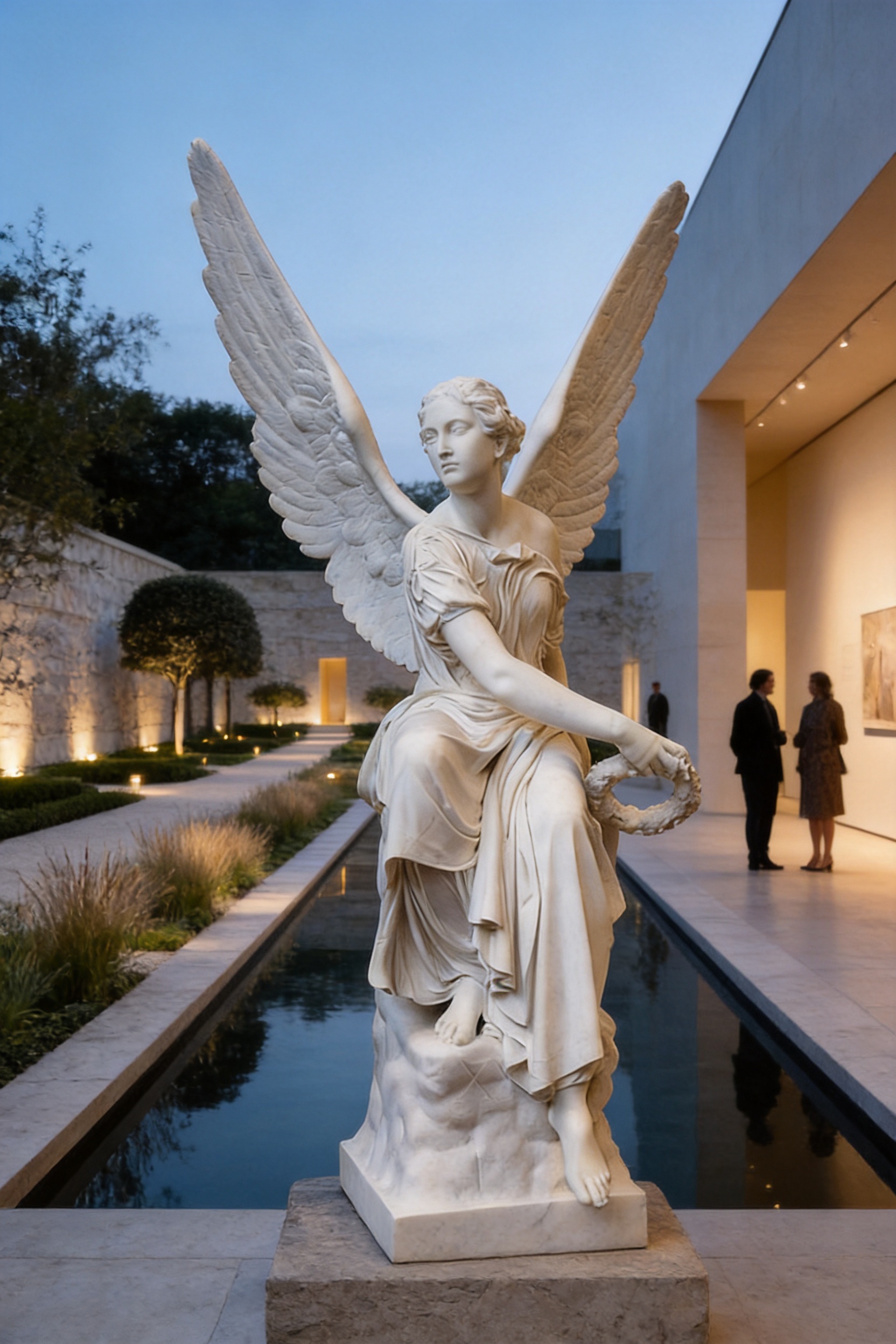
The White Marble Winged Victory Goddess Sculpture is a monumental work of classical art designed to bring elegance, symbolism, and permanence to architectural and landscape environments. Hand-carved from natural pure white stone, the sculpture presents a graceful goddess with wings fully extended, flowing drapery, and a poised posture that communicates movement, triumph, and beauty. Its height options of approximately 1.8 to 2.2 meters make it substantial enough for a prominent outdoor installation while remaining adaptable to courtyards, gardens, hotel entrances, galleries, and refined interior spaces.
More than a decorative object, this sculpture serves as an architectural focal point. The winged figure immediately establishes a sense of arrival, ceremony, and cultural depth. Its symbolism is especially suitable for locations associated with achievement, hospitality, prestige, celebration, and aspiration. The image of a victorious goddess can welcome visitors to a luxury property, strengthen the identity of a cultural institution, or provide a meaningful centerpiece for a private garden.
The sculpture is produced by Jiangsu Xinyesheng Sculpture Co., Ltd., a China-based sculpture manufacturer specializing in bronze sculptures, stainless steel sculptures, marble sculptures, fiberglass sculptures, and weathering steel sculptures. This broader material capability is valuable for clients seeking coordinated sculpture programs, custom artwork, or multiple materials for a single architectural project. While this particular piece is a marble human sculpture, its development benefits from a manufacturing environment familiar with both traditional sculptural forms and contemporary project requirements.
Content
The visual strength of the Winged Victory Goddess Sculpture begins with its material. Pure white marble has been associated with monumental art, sacred architecture, public memorials, and elite interiors for centuries. Its light color reflects both natural and architectural lighting, allowing the figure to remain visually clear from a distance while also revealing subtle hand-finished details up close.
Unlike painted or heavily coated decorative materials, white marble offers an authentic stone surface with natural depth. Slight variations in grain, tone, and crystalline structure give every finished sculpture a character that cannot be completely duplicated by industrial molds or printed surfaces. These natural distinctions are not imperfections; they are part of the identity of genuine stone art.
The sculpture’s pure white appearance also creates strong compatibility with a wide range of surroundings. It can contrast dramatically with dark paving, green hedges, deep-toned walls, or reflective pools. In a bright contemporary lobby, it can provide a soft classical counterpoint to glass, steel, and polished stone. In a traditional garden, it can appear fully integrated with columns, fountains, terraces, and formal planting arrangements.
Marble is particularly effective for human figures because it captures the relationship between light and anatomy. The material can express the curve of a shoulder, the fall of fabric, the shape of a wing, and the balanced movement of a standing body without relying on bright colors or artificial surface effects. This restraint gives the sculpture an enduring quality that can remain relevant as surrounding décor changes.
The winged goddess is a powerful classical archetype. Wings traditionally represent elevation, freedom, divine protection, aspiration, and movement beyond ordinary limitations. Victory, meanwhile, is associated with achievement, resilience, honor, and the successful completion of a difficult journey. Combined in a single figure, these themes make the sculpture suitable for environments that wish to communicate confidence and excellence.
The figure’s posture is elegant rather than aggressive. This distinction is important. The sculpture does not communicate victory through physical force alone; it expresses triumph through balance, dignity, and composure. The fully spread wings create a broad silhouette, while the controlled posture maintains visual harmony. As a result, the work can function in formal settings without appearing overly theatrical.
For a private residence, the goddess may symbolize personal accomplishment or the beginning of a new chapter. For a hotel or resort, she can represent hospitality, elevated service, and an exceptional guest experience. For an office or commercial development, the work may reinforce themes of progress and leadership. In a museum, gallery, or cultural venue, it can participate in a wider conversation about classical artistic traditions and the continuing relevance of mythological imagery.
The symbolism is also adaptable across cultures. Although the form is inspired by European classical traditions, its ideas of beauty, success, protection, and aspiration have broad international appeal. This makes the sculpture appropriate for global hospitality brands, luxury property developments, diplomatic environments, and residences designed around a refined international aesthetic.
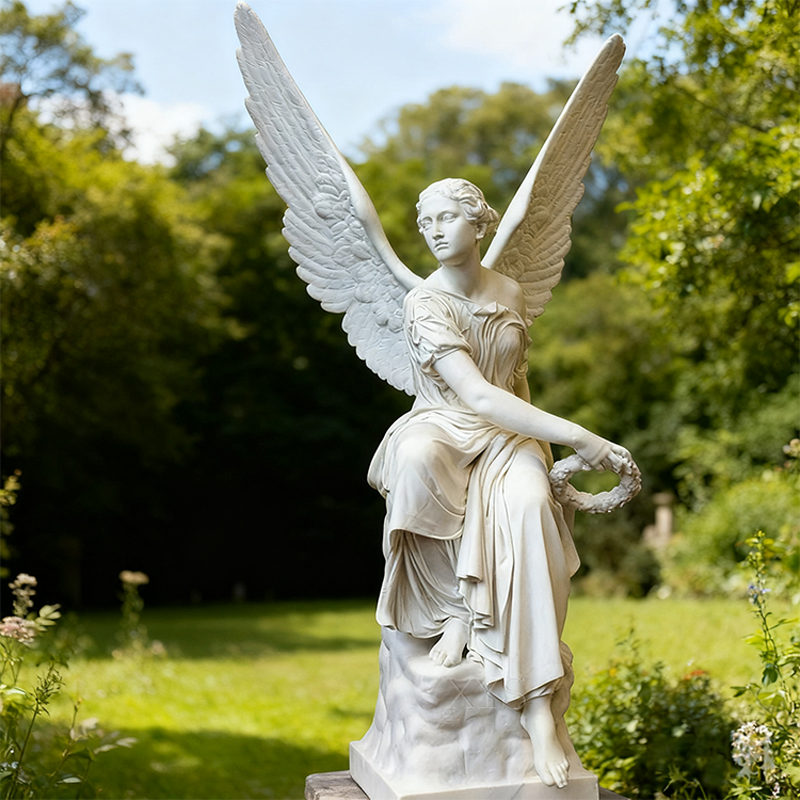
White Marble Winged Victory Goddess Sculpture
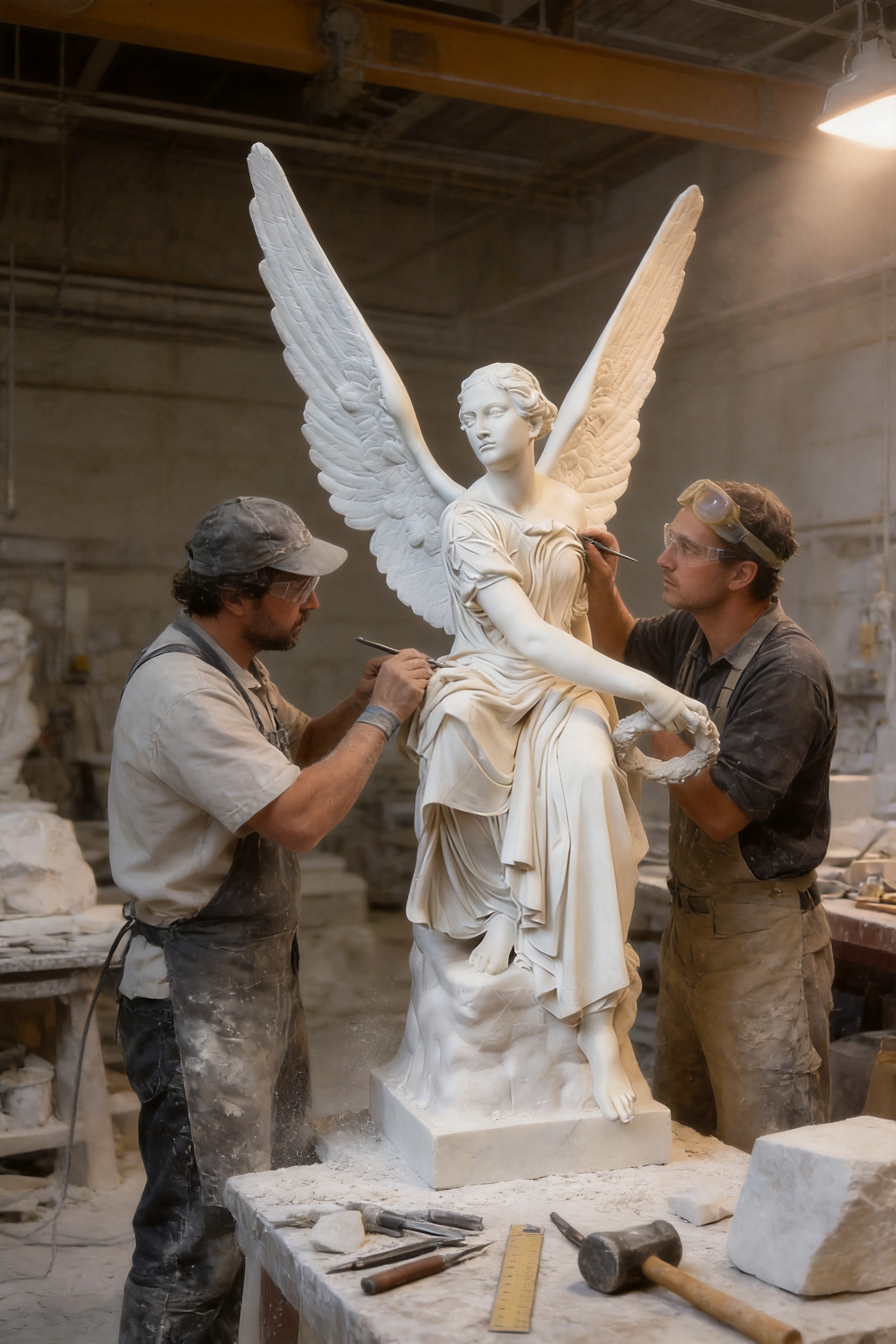
The product description identifies the sculpture as hand-carved from natural pure white stone. Hand carving is one of the most significant advantages of a stone sculpture when compared with mass-produced replicas. It allows the maker to respond to the individual structure of the marble, adjust transitions between surfaces, and refine the visual rhythm of the figure throughout the process.
A molded or mechanically reproduced sculpture can provide consistency, but it may not offer the same tactile variation or sense of human judgment. In a hand-carved work, the sculptor considers how each plane receives light, how the fabric appears to move around the body, and how the silhouette reads from different viewing distances. These decisions contribute to an artwork that feels composed rather than merely manufactured.
The drapery is a particularly important feature of this design. Lifelike drapery requires controlled changes in depth, tension, and direction. Folds should appear connected to the body and influenced by movement, rather than arranged as repetitive grooves. When carefully carved, the fabric creates a layered visual effect: deep folds produce shadows, raised ridges catch highlights, and softer transitions suggest thin or tensioned areas of cloth.
The wings require a similarly balanced approach. Individual feathers must be articulated clearly enough to read at close range, while the overall wing should retain a unified and graceful shape when viewed from across a courtyard or entrance plaza. The spread wings also influence the sculpture’s center of gravity and visual width, so the composition must be considered as an entire three-dimensional form rather than a front-facing image.
Hand finishing is especially valuable at the final stage. After larger areas have been shaped, the sculptor can refine facial expression, hair, fingers, feather transitions, fabric edges, and other areas that determine the personality of the work. This final attention helps prevent the sculpture from appearing flat, mechanical, or excessively standardized.
Every sculptural material has a distinct visual and technical character. Bronze is valued for its warm metallic surface and ability to support complex casting processes. Stainless steel is favored for a modern, reflective appearance and strong compatibility with contemporary architecture. Fiberglass can be lightweight and economical for certain large-scale applications. Weathering steel offers a dramatic oxidized surface that changes over time.
White marble provides a different combination of qualities. It offers natural authenticity, a soft yet monumental visual presence, and a direct connection with the history of classical sculpture. For a Winged Victory Goddess, these characteristics are especially appropriate because the form depends on the viewer’s appreciation of anatomy, drapery, wings, and light rather than on color or reflective effects.
Compared with painted fiberglass, natural white marble generally provides a more substantial tactile experience and does not depend on a surface coating to create its primary appearance. Compared with a metal sculpture, marble gives the figure a quieter and more sculptural presence. It absorbs and reflects light in a nuanced way rather than producing the hard industrial effect associated with polished metal.
Compared with a simple molded reproduction, a hand-carved marble sculpture can offer greater individuality. The natural stone structure and manual finishing process ensure that the final piece is not merely a repeated decorative unit. It is a physical artwork shaped from a specific block of material.
The best material depends on the project’s design language, environment, budget, installation requirements, and maintenance plan. For clients seeking a classical, luxurious, and enduring focal point, white marble is a particularly strong choice. It can communicate importance without relying on bright color, complex technology, or fashionable surface treatments that may become dated.
The listed sculpture is available in total heights ranging from approximately 1.8 to 2.2 meters. Two reference prices are provided: the 1.8-meter version is listed at $19,800, while the 2.2-meter version is listed at $33,000. Final quotations may depend on the selected dimensions, stone characteristics, carving complexity, finishing requirements, packaging, shipping, installation conditions, and any additional customization.
| Item | Reference Detail | Project Consideration |
|---|---|---|
| Artwork | White Marble Winged Victory Goddess Sculpture | Classical human figure with spread wings and flowing drapery |
| Material | Natural pure white stone | Natural variation may occur in tone and grain |
| Construction | Hand-carved | Supports individualized detail and artisanal finishing |
| Height option one | Approximately 1.8 meters | Suitable for gardens, courtyards, galleries, and interior focal spaces |
| Height option two | Approximately 2.2 meters | Suitable for prominent entrances, plazas, and larger landscapes |
| Reference price | $19,800 at 1.8 meters | Price subject to project confirmation |
| Reference price | $33,000 at 2.2 meters | Price subject to project confirmation |
| Customization | Full-size customization available | Scale, proportions, base, and project details can be discussed |
| Recommended applications | Villas, gardens, hotels, galleries, and public-facing spaces | Final suitability depends on site, access, and installation planning |
The difference between the two reference sizes is not merely a matter of height. Increasing the scale can alter the visual impact, stone volume, structural considerations, transport requirements, and installation approach. A 2.2-meter figure may be more effective in a large entrance court or open garden, while a 1.8-meter version may be better proportioned for a private courtyard, hotel lobby, or gallery interior.
Clients should evaluate the sculpture in relation to the surrounding architecture. The height of nearby doors, columns, retaining walls, hedges, steps, and seating areas can influence the ideal scale. The viewing distance is equally important. A sculpture positioned at the end of a long axis may need greater height or a more substantial base to remain visually dominant, while one placed beside a walkway may be better kept at a scale that encourages close observation.
Full-size customization is a significant benefit for professional buyers. A sculpture intended for a private garden may need different proportions from one commissioned for a hotel entrance or civic plaza. Customization can help align the work with the dimensions, circulation patterns, sightlines, and architectural language of the site.
Potential areas for discussion include total height, figure proportions, wing span, base design, pedestal height, surface finish, and placement orientation. The client may also need to consider whether the sculpture should face a primary entrance, align with a central axis, frame a water feature, or interact with an existing architectural element.
A custom base can substantially influence the final presentation. A low plinth creates a more intimate relationship between viewer and figure. A taller pedestal increases monumentality and can improve visibility over planting or low walls. A broad architectural base may connect the sculpture with a terrace or platform, while a simpler stone support can preserve the impression that the figure is the sole focus.
Customization should not compromise the artistic balance of the original design. The spread of the wings, the center of gravity, the direction of the drapery, and the relationship between the body and the base must remain coherent. An experienced sculpture manufacturer can help clients identify which changes enhance the site and which changes might weaken the figure’s visual integrity.
For large developments, customization may also support a coordinated collection. The manufacturer’s broader material range allows a client to consider marble figures together with bronze, stainless steel, fiberglass, or weathering steel works. A hotel, resort, or landscape design company could use white marble for classical focal points and select metal sculptures for contemporary transition areas, while maintaining a unified commissioning process.
The production of a large marble figure requires a sequence of artistic, technical, and logistical decisions. Although each commission may differ, a professional process commonly begins with design clarification. The manufacturer and client establish the desired height, application, style, installation environment, budget framework, and delivery requirements before the carving begins.
The first stage is to review the design as a three-dimensional composition. The maker examines the proportions of the goddess, the spread of the wings, the arrangement of the drapery, and the relationship between the figure and its intended base. At this point, practical matters such as shipping dimensions, handling access, and installation conditions should also be considered.
For a custom project, drawings, reference images, dimensional diagrams, or a smaller model may be used to confirm the design direction. Clear approval at this stage reduces the risk of misunderstandings later in production. It also gives the client an opportunity to discuss whether the final surface should be more finely polished, softly honed, or finished with a texture that emphasizes the hand-carved character.
Natural stone selection is central to the quality of the finished sculpture. The block must provide enough volume for the intended dimensions and allow the figure, wings, drapery, and base to be developed safely. The maker must consider the stone’s color, grain direction, visible inclusions, structural soundness, and suitability for detailed carving.
White marble is not a completely uniform industrial material. Its natural appearance can vary from block to block. A responsible selection process seeks a stone whose overall character supports the design. For a classical goddess, a bright and relatively consistent white surface may be preferred, although subtle veining can also contribute visual interest when carefully incorporated into the composition.
Once the block has been selected, rough shaping removes excess material and establishes the general silhouette. This phase requires accuracy because the wings and extended forms may create complex areas around the central body. Too much removal at an early stage can limit later corrections, while insufficient shaping can make the process inefficient.
Modern workshop equipment may support the initial reduction of large stone volumes, improving efficiency and helping establish major planes. However, machinery does not replace the artistic judgment required to develop the figure. The transition from rough mass to recognizable form depends on the sculptor’s understanding of anatomy, balance, drapery, and classical composition.
Detailed carving develops the face, hair, hands, wings, fabric, and other defining elements. Tools of different sizes and profiles allow the sculptor to move from broad planes to narrow grooves and delicate transitions. The goal is not simply to add lines to the surface but to create a convincing relationship between light, shadow, volume, and movement.
The face must remain calm and dignified, supporting the symbolic character of the goddess. The hands and arms should appear anatomically balanced. The wings need clear feather structure without becoming visually heavy. The drapery must suggest natural movement while preserving the underlying form of the body.
After the main carving is completed, the surface is refined through progressive finishing. Selected areas may be polished to create a brighter reflection, while other areas may remain softly honed to preserve texture and emphasize the carved process. The final finish should support the intended viewing distance and lighting conditions.
Surface refinement is also the stage at which small inconsistencies can be corrected and transitions can be made more natural. On white marble, these adjustments are highly visible because the material provides little color distraction. The quality of the finished work therefore depends on patient attention to subtle changes in plane and texture.
Before shipment, the sculpture should be checked for dimensional accuracy, visual completeness, surface condition, and compatibility with the agreed specifications. Large marble works require careful packing because wings, fingers, drapery edges, and other projecting details may be vulnerable during handling.
Packaging planning should be treated as part of the manufacturing process rather than an afterthought. A suitable crate, internal supports, protective materials, and clear handling instructions help reduce transport risk. For international projects, the client and manufacturer should also coordinate documentation, delivery access, unloading equipment, and installation responsibilities.
The company’s product range includes bronze, stainless steel, marble, fiberglass, and weathering steel sculptures. This breadth indicates an ability to work across traditional and contemporary categories rather than focusing on a single production method. For clients, a diversified product capability can simplify communication when a project includes different artistic styles or materials.
A supplier familiar with multiple materials can also help compare options according to the site. For example, a client may initially request a metal sculpture but later determine that white marble is more appropriate for a classical garden. Alternatively, a development may use marble human figures in one zone, stainless steel works in a contemporary lobby, and weathering steel pieces in a landscape installation. Working with one manufacturer can make the process of coordinating these elements more manageable.
The company’s listed capability for full-size customization is another important strength. Custom sculpture requires more than changing a standard product’s dimensions. It involves interpreting a project brief, maintaining visual proportion, preparing production information, selecting suitable stone, and coordinating finishing and delivery. A supplier that accepts custom requirements is better positioned to support architects, landscape designers, hospitality groups, property developers, art consultants, and private collectors.
The location in Jiangyin, Jiangsu Province, places the company within a major Chinese manufacturing region with access to industrial infrastructure, skilled labor, fabrication resources, and domestic logistics networks. These conditions can support the organization of large-scale production and international export preparation. As with any commissioned artwork, clients should confirm the exact process, quality-control procedures, packaging arrangements, and delivery terms for their individual project.
The manufacturer’s combination of hand-carved artistic work and broader material production can provide a useful balance between craftsmanship and project practicality. The classical appearance of the sculpture depends on artisanal skill, while a commercial project also requires accurate communication, schedule management, packaging, and reliable coordination. Both sides are essential for a successful result.
The White Marble Winged Victory Goddess Sculpture has several qualities that distinguish it from generic decorative figures. First, it uses natural stone rather than relying exclusively on resin, cement, or synthetic surface treatments. This gives the work a substantial material presence and a more authentic relationship to the long tradition of marble sculpture.
Second, it is described as hand-carved. Hand carving gives the sculpture a degree of individuality and allows the surface to be refined according to the character of the selected stone. Mass-produced products often prioritize speed and repeatability, whereas a hand-carved piece emphasizes detail, interpretation, and material expression.
Third, the design combines a recognizable classical subject with a strong architectural silhouette. The spread wings help the figure read clearly as a landmark from a distance. The drapery and facial expression reward closer inspection. This dual performance is valuable in public-facing environments where the work must function both as a distant visual anchor and as an object of detailed appreciation.
Fourth, the product offers a meaningful scale range. A client does not have to select a single fixed size that may be too small for an entrance or too large for a private setting. The two listed reference sizes provide a starting point, while full-size customization allows the sculpture to be adjusted for a particular site.
Finally, the work carries symbolic meaning that can support a property’s identity. A purely abstract decoration may be visually attractive but difficult to connect with a brand narrative or architectural concept. The goddess figure provides an immediate story involving victory, beauty, protection, and aspiration. This can strengthen the emotional impact of an entrance, garden, or ceremonial space.
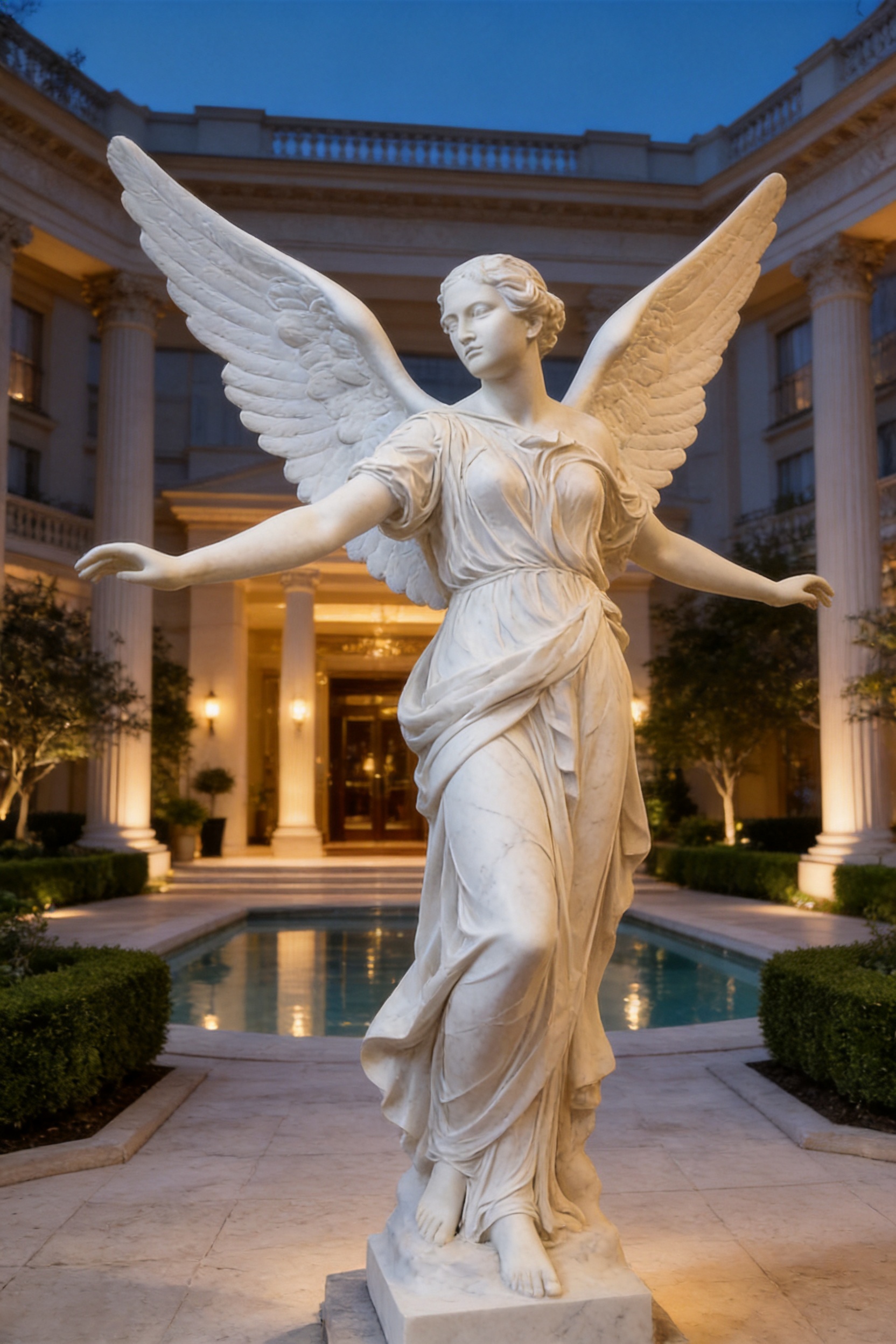
In a villa courtyard, the sculpture can serve as the central feature of a formal composition. It may be placed at the end of a pathway, beside a reflecting pool, within a circular planting bed, or against a restrained architectural wall. White marble works particularly well with clipped greenery, pale stone paving, water, and warm landscape lighting.
Private owners should consider how the sculpture will be viewed throughout the day. Morning and afternoon light can reveal different aspects of the carving, while evening illumination can emphasize the wings and drapery. A carefully selected background is important because fine white details may be less visible against a very bright wall or pale sky.
Formal gardens, hotel landscapes, botanical settings, and estate grounds can use the sculpture as a destination within a larger circulation plan. Its symbolic character can mark an axis, terminate a vista, or distinguish a transition between planting zones.
When installed outdoors, the sculpture should be placed on a stable foundation with appropriate drainage and access for maintenance. The surrounding landscape should not hide the lower body or overwhelm the wings. Planting can frame the sculpture, but sufficient clearance should remain around delicate projecting elements and the main viewing angles.
A hotel lobby requires artwork that can be understood quickly by arriving guests while also rewarding repeated viewing. The goddess’s formal posture and bright marble surface make her suitable for a reception hall, grand staircase, atrium, or entrance vestibule. The piece can communicate luxury without requiring an elaborate explanatory display.
Interior placement also allows greater control over moisture, temperature, pollution, and physical contact. Nevertheless, large marble sculptures require professional handling during installation. Floor loading, doorway width, elevator capacity, turning radii, and final positioning should be reviewed before delivery.
In a gallery or cultural venue, the sculpture can be presented as an example of classical subject matter interpreted through contemporary craftsmanship. A controlled environment allows curators to emphasize the relationship between natural stone, hand tools, historical references, and present-day production.
Lighting should be designed carefully. Narrow or sharply angled lighting can create dramatic shadows within the wings and fabric folds, while broad diffuse illumination can present the sculpture as a calm, unified form. The best arrangement depends on whether the exhibition emphasizes detailed craftsmanship, silhouette, historical symbolism, or architectural integration.
Organizations associated with achievement, education, finance, hospitality, sport, or cultural exchange may find the victory theme relevant to their identity. The sculpture can occupy a headquarters entrance, executive garden, ceremonial hall, or award-related environment. Its message is elevated but not tied to a short-term advertising campaign, allowing it to remain appropriate over many years.
The product description states that the stone is hard and weather-resistant for long-term outdoor display. This makes the sculpture suitable for carefully planned exterior applications. However, weather resistance does not mean that the sculpture is unaffected by every environment. Local climate, pollution, freeze-thaw cycles, salt exposure, drainage, biological growth, and maintenance practices can all influence long-term appearance.
A suitable foundation is essential. The base should be level, stable, and designed to support the sculpture’s weight. Large figures with spread wings may require additional engineering review because their silhouette can be affected by wind exposure. The final anchoring approach should be determined according to the sculpture’s dimensions, center of gravity, site conditions, and local safety requirements.
Routine care generally begins with visual inspection. Dust, soil, leaves, bird residue, and organic growth should be removed using methods appropriate for natural marble. Abrasive cleaning products, harsh acids, aggressive pressure washing, and unapproved sealers may damage the stone or alter its appearance. A conservator or qualified stone-care professional should be consulted when significant staining or surface deterioration occurs.
In cold climates, drainage is particularly important. Water entering small openings and freezing repeatedly can create stress. In coastal or polluted environments, deposits may accumulate more quickly and should be addressed through an appropriate maintenance schedule. Clients should request material-care guidance suited to the actual installation location.
Indoor placement generally reduces environmental exposure but introduces different considerations. The floor must support the sculpture’s weight, and the work should be protected from accidental impact, moving equipment, and uncontrolled visitor contact. A discreet barrier or carefully planned circulation path may be appropriate in busy public areas.
Installation should be planned before the sculpture leaves the workshop. The client, architect, contractor, logistics provider, and manufacturer should clarify the route from delivery vehicle to final position. Measurements should include gates, doors, corridors, stairs, elevators, ramps, and overhead clearances.
For a 1.8- or 2.2-meter marble sculpture, specialized lifting equipment may be necessary. The lifting points and handling method should be approved in advance to avoid placing stress on wings, arms, fingers, or other vulnerable elements. The crate should not be opened in a location where the sculpture cannot be safely moved onward.
The visual orientation is also part of installation quality. The goddess may have a preferred front view, but the sculpture should be evaluated from multiple approach paths. In a garden or lobby, visitors may encounter the work from the side or rear before reaching the principal viewing position. The spread wings should be oriented to support the strongest sightlines and the architectural axis.
Professional installation can protect both the artwork and the property. It can also ensure that the base is correctly aligned, the sculpture is stable, and the final presentation matches the approved design. Clients should confirm whether installation is included in the quotation or arranged separately.
Buyers should begin by defining the purpose of the artwork. Is it intended as a private decorative centerpiece, a public landmark, a hotel arrival statement, or a gallery object? The answer will influence the ideal size, surface finish, base design, lighting, and installation method.
The next step is to review the site. Consider the surrounding colors, materials, scale, viewing distance, pedestrian movement, sunlight, shade, drainage, and maintenance access. White marble is highly adaptable, but it should be positioned where its light surface and detailed carving can be appreciated.
Clients should request confirmation of the selected material, final dimensions, customization details, finish, packaging, estimated production schedule, shipping method, and payment terms. For a natural stone piece, it is also useful to discuss the expected range of color and grain variation. These details help establish realistic expectations while respecting the individuality of the material.
Project buyers should also confirm how revisions are handled. A clearly documented approval process can reduce confusion regarding the final form. For custom work, dimensional drawings or visual approvals may be especially important before detailed carving begins.
Finally, the client should establish responsibility for foundation work, unloading, installation, local permits, and long-term maintenance. These practical decisions are as important as the artistic selection itself. A beautifully carved sculpture will perform best when its environment has been prepared with equal care.
Decorative trends can change quickly, but classical human sculpture has a long history of remaining relevant. The Winged Victory Goddess Sculpture does not depend on a temporary color palette or a seasonal motif. Its value comes from proportion, craftsmanship, natural material, symbolic meaning, and the ability to enrich a space over time.
For a property owner, the sculpture can become part of the site’s identity. Guests may associate the figure with the entrance, the garden, or the building itself. For designers, it can provide a clear focal point around which paving, planting, lighting, and circulation are organized. For collectors, it offers the satisfaction of owning a substantial hand-carved work connected to the traditions of European-style sculpture.
The use of white marble also supports long-term stylistic flexibility. If the surrounding furniture, planting, lighting, or architectural finishes are updated, the sculpture can continue to work within the new setting. Its neutral color and classical form allow it to coexist with both traditional and contemporary design decisions.
The manufacturer’s ability to offer customization further increases the work’s project value. Instead of forcing the site to accommodate a standard object, the client can discuss dimensions and presentation details that improve the relationship between sculpture and architecture. This is especially important for high-value developments where every major visual element must appear intentional.
The sculpture is hand-carved from natural pure white stone identified in the product information as white marble. Because marble is a natural material, slight variations in tone, grain, and crystalline pattern may occur from one piece to another.
The listed total height range is approximately 1.8 to 2.2 meters. Reference pricing is provided for a 1.8-meter version and a 2.2-meter version. Custom dimensions may be discussed for specific architectural or landscape requirements.
The reference price is $19,800 for a height of approximately 1.8 meters and $33,000 for a height of approximately 2.2 meters. The final quotation should be confirmed according to customization, stone selection, finishing, packaging, shipping, installation, and other project conditions.
Yes. The product information states that full-size customization is available. Clients can discuss dimensions and other project-specific details with the manufacturer. Customization should be reviewed carefully to preserve the balance of the figure, the wings, the drapery, and the support structure.
The stone is described as hard and weather-resistant for long-term outdoor display. It can be considered for villas, gardens, courtyards, and other exterior settings when installed on a suitable foundation and maintained appropriately. Local climate and site conditions should be reviewed before final placement.
White marble has a strong historical connection with classical human sculpture. Its bright surface reveals the contours of the body, folds of the drapery, and structure of the wings. It also provides a calm, refined appearance that works well in both formal gardens and prestigious interiors.
Hand carving allows the sculptor to respond to the specific stone block and refine details through direct artistic judgment. Mass-produced pieces may offer speed and repeatability, but hand-carved marble generally provides more individuality, tactile depth, and connection to traditional sculptural craftsmanship.
Recommended applications include villa courtyards, gardens, hotel lobbies, art galleries, entrance areas, cultural venues, and other spaces requiring a classical focal point. The final location should provide sufficient space, structural support, safe access, suitable lighting, and an appropriate viewing distance.
Buyers should confirm the final size, stone characteristics, design details, surface finish, base, price, production schedule, packaging, shipping terms, installation responsibilities, and maintenance recommendations. For custom commissions, a documented design approval process is also advisable.
The company’s listed product categories include bronze sculptures, stainless steel sculptures, marble sculptures, fiberglass sculptures, and weathering steel sculptures. This range may be useful for clients planning multiple artworks in different materials or styles.
Regular visual inspection and gentle cleaning are recommended. Harsh chemicals, abrasive tools, and aggressive cleaning methods should be avoided unless approved by a qualified stone-care professional. Outdoor sculptures should also be checked for drainage, biological growth, staining, and any changes around the foundation.
The White Marble Winged Victory Goddess Sculpture brings together classical symbolism, natural material, hand-carved craftsmanship, and substantial architectural presence. Its elegant posture, spread wings, lifelike drapery, and pure white marble surface make it a compelling choice for clients seeking more than a standard decorative object.
Its advantages over mass-produced competitors include the authenticity of natural stone, the individuality of hand carving, the visual power of a large classical figure, the adaptability of multiple size options, and the symbolic strength of the victory theme. The stated weather resistance supports outdoor applications, while the refined appearance makes the sculpture equally appropriate for sophisticated interiors.
Jiangsu Xinyesheng Sculpture Co., Ltd. supports this product through a broader manufacturing capability that includes several sculpture materials and full-size customization. This combination can benefit architects, landscape designers, hotels, developers, galleries, collectors, and private owners who require both artistic quality and practical project coordination.
When properly selected, installed, and maintained, the sculpture can become a lasting landmark within its environment. It can welcome visitors, define a garden axis, enrich a lobby, strengthen a property’s identity, or express the enduring ideas of beauty, achievement, and aspiration.
1. Product specification and description for the White Marble Winged Victory Goddess Sculpture, supplied project materials.
2. Company product-category information for marble, bronze, stainless steel, fiberglass, and weathering steel sculptures, supplied project materials.
3. Gombrich, E. H. The Story of Art. General discussions of classical artistic traditions and the development of European sculpture.
4. Boardman, John. Greek Sculpture: The Classical Period. Historical background on classical figure design, proportion, movement, and drapery.
5. The Conservation of Outdoor Marble Sculpture. General professional principles concerning stone selection, installation, environmental exposure, and maintenance.
6. Architectural stonework and sculpture conservation guidance concerning natural marble care, handling, foundation planning, and surface protection.



Daniel H.

Amanda R.

Robert B.

Jennifer S.

James W.

Barry G.

Michael T.

Emily K.

David L.

Sarah M.


Mikey XV

Jagxue

 English
 Español
 عربى
 Français
 italiano
 Deutsch