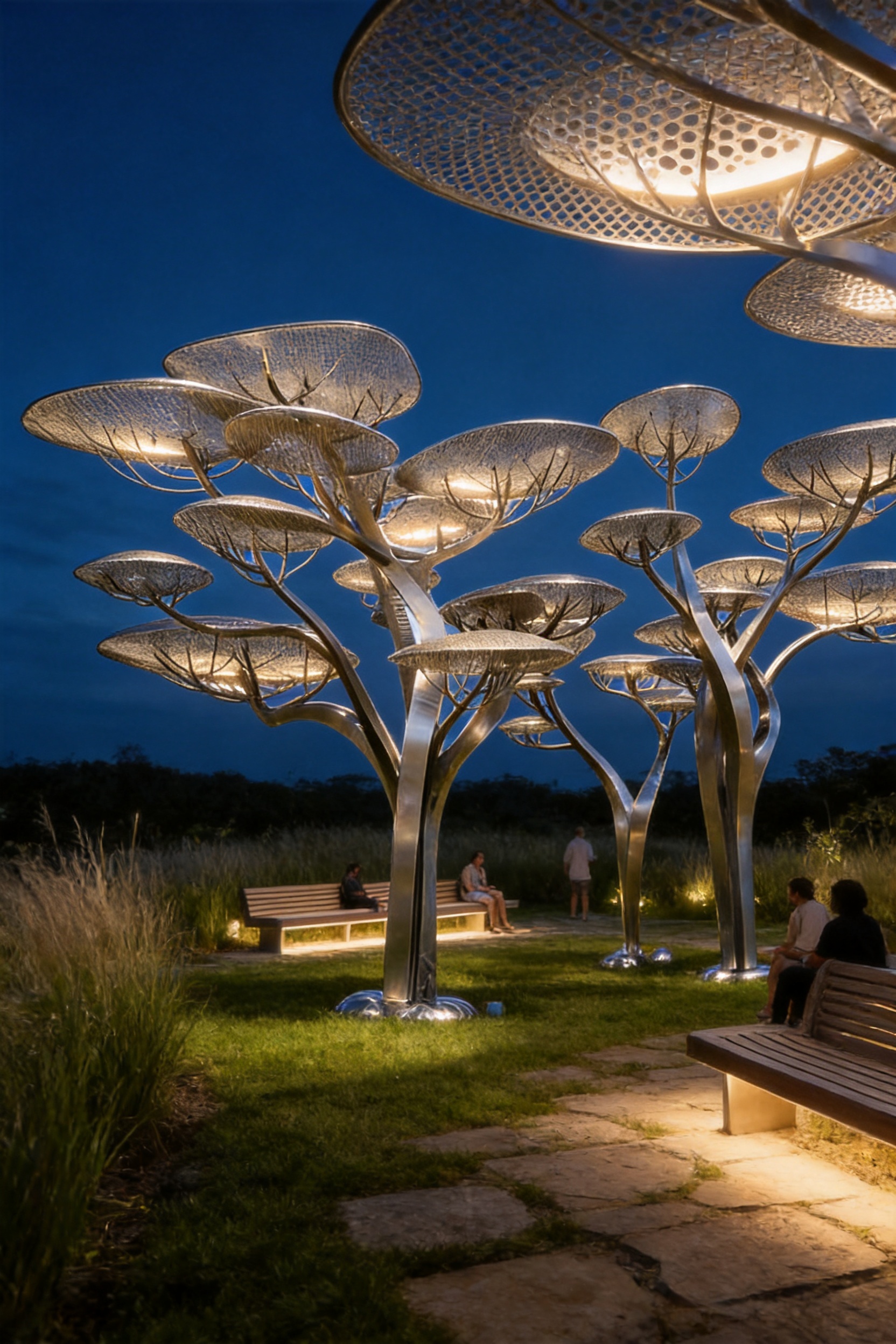
Outdoor sculpture is increasingly expected to do more than occupy an attractive position in a plaza, park, resort, or tourism destination. The strongest contemporary installations combine artistic identity, architectural usefulness, material durability, and memorable visitor experience. The Multi-Tree Cluster Metal Umbrella Pergola Sculpture responds to these expectations by bringing together the visual language of trees, the practical function of a pergola, and the long service life of outdoor stainless steel construction.
Rather than presenting a single decorative object, this installation groups several umbrella-shaped tree structures into one coordinated sculptural environment. Each individual unit has a sculptural trunk, a layered hollow-cut canopy, and a fine-mesh surface that filters sunlight. When multiple units are arranged together, they create a unified grove-like composition capable of sheltering a much larger area than a single tree-form sculpture. The result is a landmark that can organize public space while also providing shade, gathering areas, and a distinctive visual identity.
The sculpture is manufactured from 304 or 316 stainless steel, with brushed and polished surfaces available for the trunks and canopy elements. Its customizable unit count and height range of approximately 4 to 11 meters make it adaptable to different site conditions, development scales, and architectural settings. The installation may also accommodate discreet lighting beneath selected canopy layers, allowing the cluster to remain active and recognizable after sunset.
For clients comparing this design with conventional pergolas, individual metal trees, fabric shade structures, or standard outdoor sculptures, its primary advantage is integration. It combines a large-scale artistic statement with genuine functional shelter, long-term weather resistance, flexible customization, and a strong capacity to transform an otherwise ordinary open area into a destination.
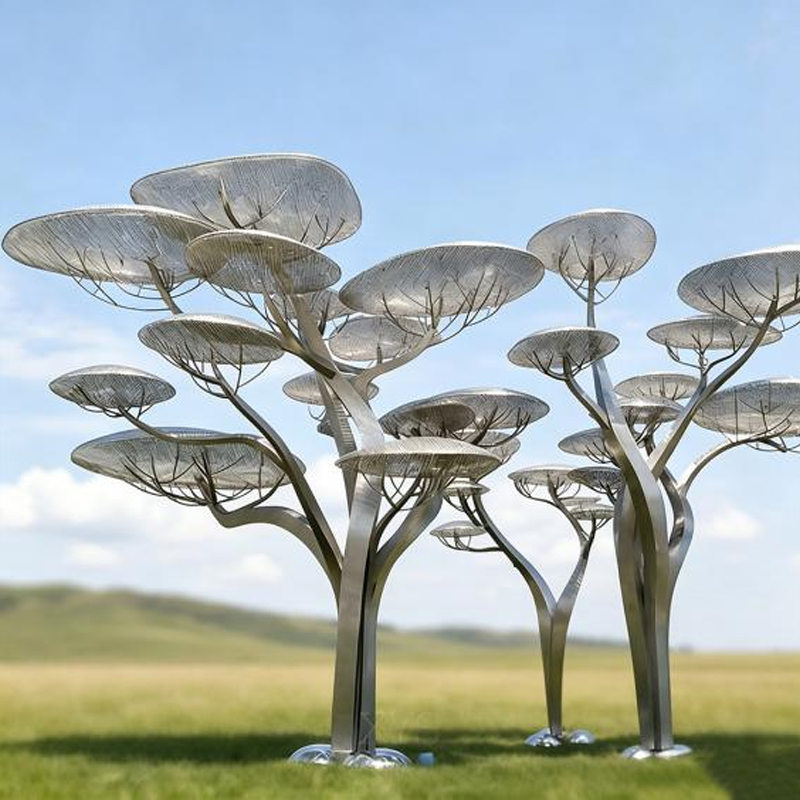
Multi-Tree Cluster Metal Umbrella Pergola Sculpture
Content
The central concept is based on the natural image of a small stand of trees. Each unit resembles a stylized tree whose canopy expands outward in layered umbrella forms. Instead of copying a natural tree literally, the sculpture translates the idea of branching growth, overlapping foliage, filtered light, and shared shelter into a contemporary metal structure.
A single umbrella-shaped tree can be visually effective, but a grouped composition creates a more substantial sense of place. Multiple trunks establish rhythm across the ground plane, while variations in height and canopy level prevent the installation from appearing repetitive. The viewer perceives individual sculptural units and a unified grove at the same time.
This balance is important in large-scale public art. If every unit is identical and aligned in a rigid row, the installation may appear mechanical or overly predictable. If the spacing and heights are carefully coordinated, the cluster gains a more natural silhouette. Taller units can form a visual background, medium-height structures can define the central gathering area, and lower units can help connect the sculpture to pedestrian level.
The umbrella profile also has a clear architectural advantage. Its broad canopy creates a recognizable overhead boundary without requiring solid roofing. The perforated, hollow-cut, and fine-mesh surfaces allow light and air to pass through, producing shade that feels open rather than enclosed. This makes the design suitable for spaces where clients want shelter without creating a heavy pavilion or blocking important views.
The installation should be understood as an environment rather than a collection of separate products. Its success depends on how the trunks, canopies, circulation paths, seating areas, landscaping, lighting, and surrounding buildings relate to one another. The manufacturer can produce the sculptural units, while the project team determines the final site arrangement and supporting infrastructure.
For example, a resort may place the cluster near a pedestrian promenade, swimming area, outdoor dining zone, or event lawn. A city park may use it to define a rest area along a walking route. An industrial-park plaza may use it as a central gathering point between office buildings. A grassland tourism site may position it as a recognizable landmark visible from a distance.
In each case, the repeated tree forms help visitors understand the space. The installation can create a destination, a meeting point, a shaded pause, or a backdrop for photography and events. Its usefulness is therefore both visual and organizational.
The Multi-Tree Cluster Metal Umbrella Pergola Sculpture is available in configurations based on the number of tree units, their heights, their spacing, canopy proportions, and the overall footprint required by the client. Individual unit heights generally range from 4 to 11 meters. This broad range supports projects from medium-sized landscape interventions to major civic and commercial developments.
The final configuration can be developed around the available site rather than forcing the site to conform to a fixed product size. A narrow linear arrangement may support a walkway or promenade. A broad circular or organic arrangement may form a central plaza. A staggered configuration may create a sequence of shaded rooms. Several clusters can also be distributed across a large development to create a repeated landscape identity.
| Product Element | Typical Option | Project Benefit |
|---|---|---|
| Primary material | 304 or 316 stainless steel | Durability and resistance suitable for demanding outdoor environments |
| Unit height | Approximately 4 to 11 meters | Adaptation to different scales, sightlines, and surrounding buildings |
| Configuration | Multiple tree-shaped pergola units | Expanded shade coverage and a unified grove-like composition |
| Canopy surface | Layered, hollow-cut, fine-mesh construction | Filtered daylight, moving shadows, air circulation, and visual depth |
| Surface treatment | Brushed-polished stainless steel | Contemporary appearance with controlled reflections |
| Lighting provision | Discreet lighting beneath selected canopy layers | Nighttime visibility and a softly glowing landmark effect |
| Pricing range | Approximately 2,860 to 7,430 US dollars | Initial budgeting reference before final customization and logistics |
The listed price range should be treated as an initial product reference. The final quotation may depend on the number of units, dimensions, steel grade, canopy complexity, finish, lighting provisions, packing, shipping, foundation requirements, and installation conditions. A detailed project discussion is therefore recommended before fabrication begins.
304 stainless steel is widely used for outdoor architectural and sculptural applications because it offers a strong balance between corrosion resistance, formability, appearance, and cost. It is suitable for many inland urban parks, commercial plazas, landscaped developments, and resort environments where exposure to aggressive salts is limited.
316 stainless steel contains additional molybdenum and is generally selected for more demanding environments. It may be particularly appropriate for coastal locations, waterfront developments, humid climates, or sites where salt exposure is a significant concern. The choice between 304 and 316 should be made according to the local atmosphere, maintenance strategy, budget, and expected service conditions.
Offering both grades gives the client greater control over performance and investment. Instead of applying the same material specification to every project, the design can be matched to the actual environmental requirements. This is one of the advantages of working with a manufacturer experienced in custom metal sculpture rather than purchasing a standardized garden ornament.
Many outdoor shade installations compete for the same project budgets. Traditional fabric canopies, timber pergolas, concrete pavilions, individual sculptures, and prefabricated metal shelters all offer useful qualities. The Multi-Tree Cluster Metal Umbrella Pergola Sculpture distinguishes itself by combining functions that are often separated among several different products.
A conventional pergola is generally designed as a practical shade structure with posts, beams, rafters, and a roof. It may perform its function effectively, but it does not always create a strong artistic identity. The umbrella tree cluster turns the supporting structure itself into a public artwork. The trunks become sculptural vertical elements, and the canopies become a recognizable overhead composition.
This distinction is valuable for resorts, municipal projects, commercial districts, and tourism destinations that need more than basic weather protection. A memorable landmark can strengthen a visitor’s impression of a site and provide a recognizable image for promotional materials, event photography, and social media sharing.
A single tree-shaped sculpture can provide a focal point, but its shade area is limited. A multi-tree cluster expands the covered footprint while preserving the artistic character of the original concept. By adjusting tree count and spacing, the project team can create a shaded zone appropriate for seating, pedestrian rest, outdoor dining, informal performances, or gathering.
This makes the product more efficient for large sites. Instead of installing many unrelated decorative objects and separate shade devices, the client can use one coordinated sculptural language throughout the designated area.
Fabric awnings and lightweight tensile structures can be attractive, but they may require more frequent replacement or seasonal maintenance depending on the fabric, climate, wind conditions, and cleaning program. Stainless steel canopies do not rely on textile membranes for their primary identity. Their rigid metal construction offers a more permanent architectural presence.
The open mesh and hollow-cut surfaces also reduce the visual heaviness associated with solid roofs. At the same time, the stainless steel framework is designed for long-term outdoor use, subject to proper engineering, foundation design, fabrication quality, installation, and maintenance.
A solid roof produces a clear shadow, but it can also make a space feel enclosed and may reduce visual connection with the sky. The layered mesh canopy produces a softer and more dynamic experience. Sunlight passes through the openings and creates dappled patterns on the ground. As the sun moves or wind changes the surrounding environment, the shadows shift naturally.
This changing light is one of the sculpture’s most distinctive qualities. It creates a different visual experience in the morning, at midday, in late afternoon, and after artificial lighting is activated at night. The product therefore remains engaging even when visitors pass through the same area repeatedly.
Some modular outdoor products are limited to one standard height, one canopy size, or one prescribed layout. The multi-tree cluster is intended to be configured for the project. Variations in height, spacing, trunk alignment, canopy overlap, and unit count help the finished installation respond to the site instead of appearing like a generic catalog assembly.
Customization also allows the client to coordinate the sculpture with nearby architecture. For example, taller units may complement a high-rise entrance or large resort lobby, while lower units may be more appropriate for a neighborhood park or intimate courtyard.
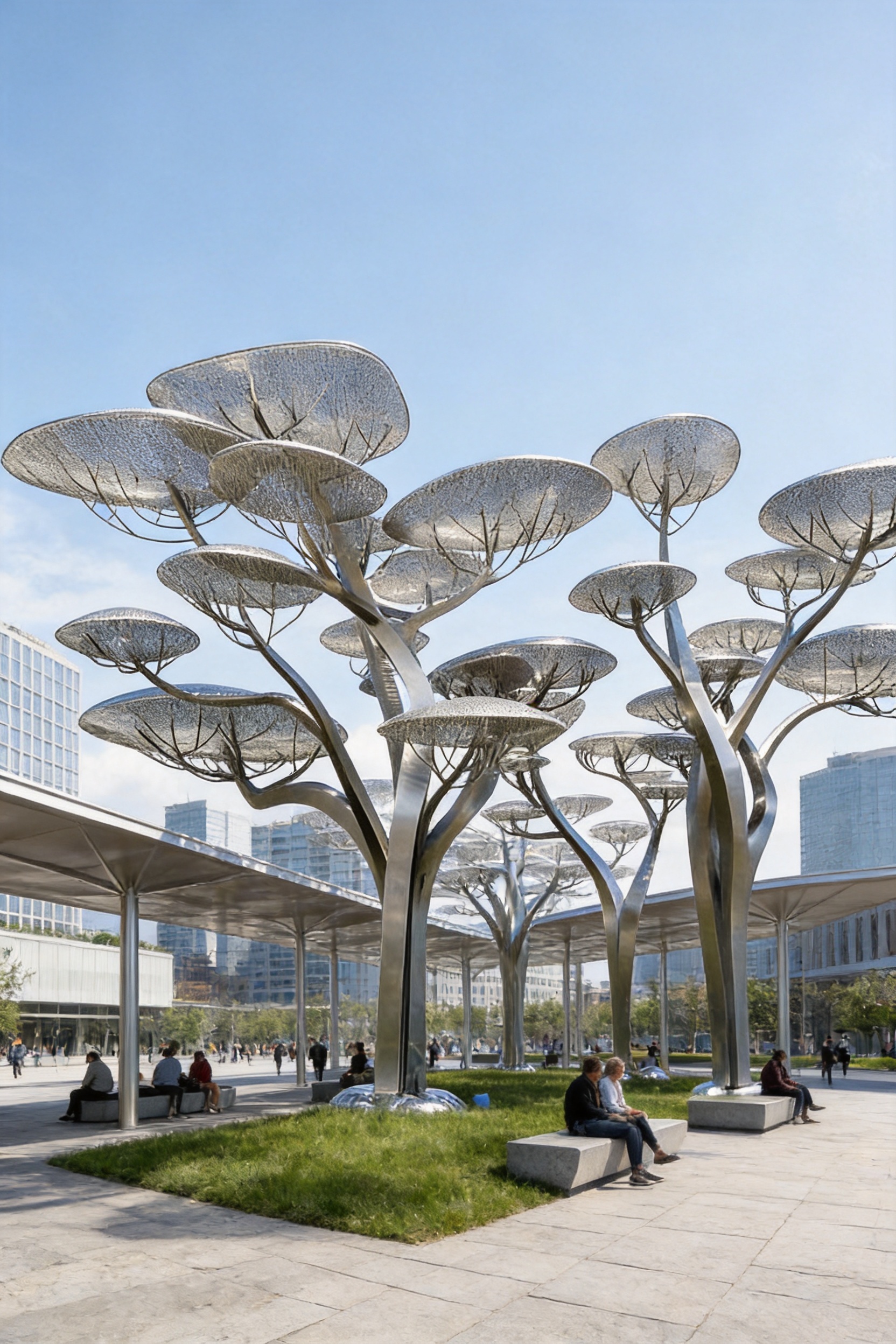
Material selection is fundamental to the performance of a large outdoor sculpture. Because the installation may remain exposed to sunlight, rain, humidity, dust, wind, temperature changes, and pollution for many years, the material must support both structural reliability and visual stability.
Stainless steel is well suited to this role because it combines a refined appearance with a strong resistance to corrosion. Its surface can be brushed to reduce excessive glare and create a consistent architectural texture. Polished details may then be used to highlight selected parts of the trunk or canopy and create controlled reflections as the viewer moves around the sculpture.
The brushed-polished treatment also supports the product’s modern character. It contrasts effectively with green grass, stone paving, water, wood, concrete, and dark landscape planting. In daylight, the metal responds to the sky and surrounding colors. In the evening, integrated illumination can make the surfaces appear gently luminous.
Outdoor durability involves more than choosing a corrosion-resistant alloy. Water management, weld quality, surface finishing, connection design, drainage, foundation detailing, and installation workmanship all influence the service life of the finished sculpture.
Layered canopies should be designed so that water does not become trapped in inaccessible areas. Hollow sections, joints, and enclosed components require appropriate fabrication and drainage considerations. The use of suitable stainless steel fasteners and compatible connection materials is also important to reduce the risk of galvanic corrosion when the sculpture interfaces with other metals.
For coastal and high-humidity environments, 316 stainless steel may offer a stronger material specification. However, even high-grade stainless steel benefits from periodic cleaning, especially where airborne salt, industrial residue, dust, or organic deposits accumulate on horizontal or sheltered surfaces.
The installation is intended to maintain consistent maintenance requirements across the individual units in the cluster. A coordinated group is easier to manage than a mixture of unrelated materials and finishes. Routine care may include visual inspections, removal of dirt and leaves, checking drainage points, examining fasteners and joints, and cleaning the stainless steel surfaces with suitable non-abrasive methods.
Lighting components, if included, should be accessible for inspection and replacement. The electrical design should be coordinated with local regulations and the project’s broader landscape-lighting system. The manufacturer and project engineer should also establish a maintenance schedule that reflects the local climate and the intensity of public use.
The quality of a complex sculpture depends on the relationship between artistic design, engineering judgment, metal fabrication, finishing, quality control, packing, and installation support. A multi-tree cluster is more demanding than a small decorative object because repeated units must remain consistent while still producing a naturalistic overall composition.
Production begins with a clear understanding of the site, required height, canopy coverage, number of units, viewing angles, pedestrian routes, lighting intentions, and environmental conditions. The design team can then develop the cluster as a coordinated system rather than producing isolated units without regard to their final arrangement.
Technical planning should address the dimensions of each trunk, the connection between trunk and canopy, canopy layer geometry, mesh or hollow-cut patterns, support points, transportation limits, assembly requirements, and foundation interfaces. A well-developed technical plan reduces fabrication uncertainty and helps ensure that the finished group has the intended silhouette.
For large projects, digital drawings and three-dimensional modeling are especially useful. They help verify clearances, compare different height arrangements, evaluate shade coverage, and coordinate lighting positions. They also allow the client to review the composition before material is cut.
The fine-mesh and hollow-cut canopy surfaces require controlled cutting and forming. Depending on the selected pattern and thickness, production may involve precision cutting methods suitable for stainless steel sheet, plate, or mesh components. Accurate cutting helps maintain consistent openings and reduces irregularities that could distract from the layered design.
Forming is equally important. Each canopy layer must achieve the intended curvature and overlap, while the trunk elements must maintain a stable relationship with the canopy load. Controlled forming supports visual consistency among repeated units and helps avoid unwanted distortion during assembly.
Because the sculpture is custom-made, the manufacturing process can accommodate adjustments in canopy size, density, edge profile, and layering. The pattern may be visually open and delicate, or it may be made denser where stronger shading or a more substantial appearance is required.
Stainless steel welding requires appropriate preparation, heat control, and finishing. Excessive heat can cause distortion or discoloration, while inconsistent welds may affect both appearance and long-term performance. Skilled fabrication is therefore essential for a product whose surfaces are visible from multiple angles and often viewed at close range.
The trunk and canopy connection deserves particular attention. It must combine visual continuity with adequate support. The connection should be strong enough for the intended loads while remaining visually integrated into the tree-like form. Where the sculpture is divided into transportable sections, the assembly joints should be planned to facilitate installation without compromising the finished appearance.
For a cluster, repeatability is also critical. Individual units do not have to be identical in every dimension, but their shared design language must remain clear. The manufacturer must control key dimensions, connection details, surface treatment, and canopy pattern so the units appear to belong to one family.
After fabrication, stainless steel surfaces may be brushed, polished, or treated with a combination of finishes. Brushing creates a directional texture that moderates reflections and can make minor surface marks less visually prominent. Polishing creates brighter highlights and can be used selectively to emphasize the trunk or canopy edges.
Quality control should include dimensional checks, inspection of welds and joints, verification of canopy layers, review of surface consistency, and confirmation that components correspond to the approved drawings. For a large installation, trial assembly or partial pre-assembly can help identify alignment issues before the sculpture is shipped to the project site.
The company’s strength in custom sculpture production lies in coordinating these stages. Jiangsu Xinyesheng Sculpture Co., Ltd. is presented as a China-based manufacturer and supplier of custom metal statues and European-style sculpture products. Its role in this project is not limited to supplying raw metal forms; it involves translating a design concept into a fabricated outdoor installation with specified dimensions, material options, finishes, and configuration requirements.
The arrangement of multiple units is one of the most important aspects of the product. A cluster that is too uniform may seem artificial, while a cluster that is too irregular may lack visual order. The goal is controlled variation.
Using several heights creates a layered skyline. The tallest trees can establish the dominant profile, medium-height units can fill the middle field, and shorter units can create a gradual transition toward the surrounding landscape. Height variation also helps each unit remain visible from different approach directions.
However, variation should be coordinated with structural and functional needs. If all the tallest units are concentrated in one location, the cluster may appear unbalanced. If canopies overlap too closely, the shade pattern may become excessively dense and maintenance access may be limited. A professional layout should balance visual effect, circulation, shelter, and service access.
Spacing determines whether the installation reads as one grove or as a row of separate objects. A closer arrangement encourages canopy overlap and creates a more immersive sheltered zone. Wider spacing gives each unit greater independence and may be appropriate for circulation corridors, large lawns, or sites where views through the sculpture are important.
The ground-level arrangement should also consider seating, wheelchair access, emergency routes, drainage, landscaping, and the movement of service vehicles during installation. The manufacturer can provide recommendations based on the chosen number of units, but the final layout should be coordinated with the site architect, landscape designer, and structural engineer.
Overlapping canopy layers can visually unite the group and create a continuous pattern of shade. The overlap should be sufficient to establish cohesion but not so extensive that the individual umbrella forms disappear. Slight changes in angle, elevation, and orientation can produce a more naturalistic canopy profile.
The layered surfaces also create depth. From a distance, the cluster appears as a strong silhouette. At medium range, the viewer sees the repetition of umbrella forms. Up close, the fine mesh and hollow-cut patterns reveal detail, texture, and changing transparency.
The sculpture is not merely a visual metaphor for trees. Each individual canopy provides genuine shade, and the grouped arrangement can shelter a substantially larger area. The open canopy design allows filtered daylight and natural airflow, which can be more comfortable than a completely enclosed structure in warm climates.
Shade performance depends on geographic location, sun angle, canopy dimensions, layer density, installation orientation, and the position of the user beneath the sculpture. These factors should be considered during site planning. In some locations, denser canopy layers may be desirable. In others, a more open surface may support a brighter and more transparent environment.
Potential uses include shaded seating, outdoor café tables, waiting zones, pedestrian rest areas, festival gathering spaces, resort lounges, educational interpretation points, and informal performance areas. The sculpture can also be paired with benches, low walls, planters, paving patterns, or water features to form a complete public-space composition.
The shade is dynamic rather than static. As sunlight passes through the mesh, patterns move across the ground. This creates an experiential quality that conventional solid shelters do not normally provide. Children may notice the changing shadows, photographers may use the patterned light, and visitors may experience the installation differently throughout the day.
Many public and commercial sites remain active after dark. A sculpture that disappears at sunset may lose much of its potential as a landmark. The Multi-Tree Cluster can incorporate discreet lighting beneath selected canopy layers, allowing the umbrella forms to become softly visible at night without overwhelming the surrounding environment.
Lighting may be used to emphasize the layered construction, illuminate gathering areas, or create a subtle glow beneath the canopies. The system should be coordinated with the design from the beginning so that conduits, access points, fixtures, and maintenance requirements do not interfere with the sculpture’s appearance.
Different lighting strategies can create different moods. A warm, low-intensity glow may suit a resort or eco-leisure destination. A neutral white light may support a civic plaza or contemporary business district. Carefully controlled color lighting may be appropriate for festivals or special events, although permanent installations generally benefit from a restrained palette that preserves the material character of the stainless steel.
Glare control is important. Fixtures should be positioned to illuminate the metal surfaces and ground plane without shining directly into the eyes of pedestrians or nearby residences. Photocells, timers, dimming controls, and energy-efficient light sources can help balance operational cost with nighttime visibility.
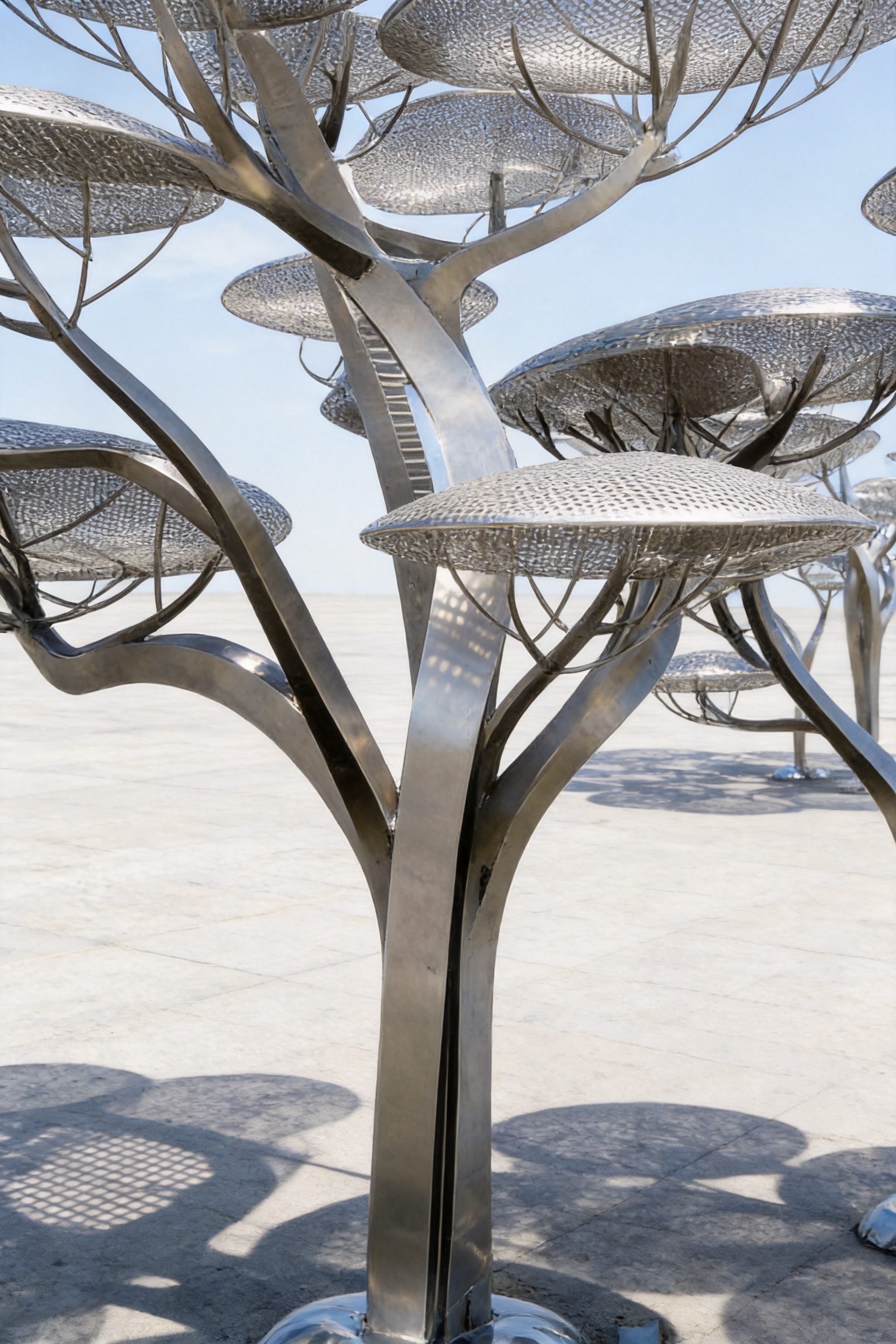
Grassland tourism destinations often require landmark structures that are visible across an open landscape. The clustered tree forms can provide a recognizable destination while also introducing shade into an environment where natural overhead shelter may be limited.
The open canopy respects the expansive character of the site. Rather than constructing a visually heavy building, the project can use a group of sculptural trees to create a gathering point, photo location, viewing stop, or rest area. The reflective stainless steel can respond to the sky and surrounding grassland, creating different visual effects as weather conditions change.
In an urban park, the sculpture can organize an underused lawn or connect separate activity zones. Its shade function supports seating and social interaction, while its artistic character gives the park a distinctive identity.
The cluster may be located near a walking route, playground, event lawn, or café. Careful placement can preserve sightlines and avoid conflicts with existing trees, underground services, drainage, and emergency access. The varied heights can also provide a transition between low planting and taller urban buildings.
Industrial and technology parks often contain broad paved spaces that need stronger human-scale features. A multi-tree sculpture can soften the hardness of concrete and steel surroundings while providing a shaded place for employees and visitors to rest.
The stainless steel material is especially compatible with contemporary industrial architecture. The canopy pattern can echo themes of technology, engineering, precision, and innovation, while the tree form introduces a more organic and welcoming quality.
Resorts benefit from installations that combine comfort, identity, and photographic appeal. The cluster can be placed beside a pool, outdoor dining terrace, garden route, arrival court, or open-air event area.
When paired with discreet nighttime lighting, it can become a signature feature that remains active during evening dining, entertainment, and pedestrian movement. The stainless steel construction also supports a premium appearance that complements contemporary resort design.
Shopping districts, mixed-use developments, and waterfront promenades can use the installation to create a shaded social node. Its recognizable form can assist with wayfinding and help distinguish one zone from another.
Because the configuration can be adjusted to the available footprint, the sculpture may be designed for a compact courtyard or a much larger public forecourt. A series of clusters could also create a continuous design language across a large development.
A successful installation requires coordination beyond the fabrication workshop. Before production, the client should provide accurate site information, including available dimensions, ground conditions, access routes, local climate, expected wind exposure, surrounding structures, underground services, and intended use.
The foundation design should be developed by a qualified local engineer based on the final structural drawings, site soil conditions, applicable building codes, and local wind and seismic requirements. The sculpture manufacturer can provide connection information and loading data where available, but local professionals remain responsible for adapting the foundation and installation design to the site.
Transportation should also be considered at an early stage. Large canopies and trunks may need to be divided into sections that fit shipping containers, road transport limits, lifting equipment, and site access conditions. Planned modularity can simplify assembly while retaining the appearance of a continuous sculptural form.
Installation may involve cranes, temporary supports, bolted connections, welded field joints, electrical coordination, and final surface cleaning. A clear installation sequence helps protect the stainless steel finish and reduces the risk of damage during construction.
For international projects, the client should also confirm packaging standards, export documentation, customs requirements, local labor availability, unloading equipment, and responsibility for on-site assembly. Early communication between the manufacturer, buyer, architect, engineer, and installer reduces delays and avoids misunderstandings regarding scope.
Large custom sculpture projects involve more variables than ordinary decorative products. A manufacturer must understand the relationship between artistic form and fabrication limitations, between surface appearance and structural support, and between shipping requirements and final assembly.
Jiangsu Xinyesheng Sculpture Co., Ltd. presents capabilities in custom design metal statues, European-style sculpture, and outdoor sculptural products. For a project such as the Multi-Tree Cluster Metal Umbrella Pergola Sculpture, the manufacturer’s value lies in coordinating design interpretation, stainless steel selection, canopy fabrication, trunk production, surface treatment, unit repetition, packaging, and project communication.
A capable supplier should be able to discuss the following topics with the buyer:
• The required number of tree units and their intended arrangement.
• The preferred stainless steel grade based on climate and location.
• The desired height variation and canopy coverage.
• The visual relationship between brushed and polished surfaces.
• The density and pattern of the mesh or hollow-cut canopy.
• Lighting provisions and access for future maintenance.
• Foundation interfaces and installation responsibilities.
• Packing, shipping, unloading, and assembly requirements.
• Quality-control procedures before dispatch.
• Maintenance expectations after completion.
These discussions help transform a general product idea into a buildable project. They also enable the client to compare suppliers based on technical understanding rather than price alone.
Although every construction project has an environmental impact, long service life can improve the overall value of a durable outdoor installation. Stainless steel components that remain in use for many years may reduce the need for frequent replacement, repainting, or disposal compared with shorter-lived shade products.
The open canopy also uses a material-efficient visual strategy. Fine mesh and hollow-cut layers create a substantial appearance without requiring a completely solid roof. This allows the sculpture to provide shade and visual presence while preserving airflow and filtered daylight.
Long-term value should be evaluated across the full life cycle of the project. Initial purchase price is important, but so are maintenance, cleaning, replacement of components, energy use for lighting, repair access, and expected service life. A well-designed stainless steel installation can become a permanent part of the site’s identity rather than a temporary decorative feature.
The sculpture may also support social sustainability by making public spaces more comfortable and usable. Shaded areas encourage people to stay longer, interact, rest, and participate in outdoor activities. In tourism and commercial settings, a memorable place can increase visitor engagement and strengthen the perceived quality of the development.
Before ordering, buyers should prepare a project brief that defines the intended use, site conditions, approximate footprint, number of units, height range, preferred material, finish, lighting requirements, delivery location, and target completion date.
It is helpful to request drawings or visual proposals showing the cluster from several viewpoints. A front elevation alone may not reveal how the canopies overlap from the side or how the installation appears when approached along a pedestrian path. Three-dimensional views, layout plans, and dimensional schedules can support a more confident decision.
The buyer should also ask for clarification regarding what is included in the quotation. Important items may include fabrication, surface treatment, packing, export preparation, shipping, lighting fixtures, electrical components, foundation bolts, installation supervision, and after-sales support. Differences in scope can make two apparently similar prices difficult to compare.
Material certification, finish samples, weld quality, structural information, and maintenance recommendations may also be requested where appropriate. For a large public installation, the project team should maintain an organized record of approved drawings and revisions.
It is a large-scale outdoor installation composed of multiple umbrella-shaped tree pergola units arranged as a coordinated grove. Each unit has a stainless steel trunk and layered, fine-mesh or hollow-cut canopy. Together, the units create a sculptural landmark that also provides shade.
Yes. The cluster can be planned around the required site footprint, shade coverage, circulation pattern, and visual effect. The number of units, their spacing, and their height variation can be discussed during the design stage.
Individual units are offered in a general height range of approximately 4 to 11 meters. The final dimensions depend on the selected configuration, structural requirements, transportation conditions, and project design.
304 stainless steel is suitable for many inland outdoor environments and offers a practical balance of durability and cost. 316 stainless steel may be preferable for coastal, waterfront, high-humidity, or salt-exposed locations. The final selection should consider local conditions and professional project advice.
Yes. Each canopy provides genuine filtered shade, and grouping multiple units increases the sheltered ground area. The exact shade intensity depends on canopy dimensions, mesh density, sun angle, orientation, and the arrangement of the cluster.
The layered mesh and hollow-cut canopy are designed as open surfaces rather than solid roofs. They allow air to pass through while filtering daylight. This can create a more open and comfortable environment than a fully enclosed shelter.
Discreet lighting can be integrated beneath selected canopy layers. Lighting should be planned before fabrication so that fixtures, wiring routes, access points, and maintenance requirements are coordinated with the sculpture.
It can be adapted for coastal environments, with 316 stainless steel often considered for locations exposed to salt and humidity. Regular cleaning and appropriate detailing remain important even when a more corrosion-resistant grade is selected.
It is both. The installation is designed as a sculptural landmark, but its canopies also provide functional outdoor shelter. This combination is one of its main advantages over products that serve only an artistic or purely architectural role.
Support and foundation details should be developed according to the final dimensions, local soil conditions, wind loads, applicable regulations, and engineering requirements. The manufacturer can coordinate connection information, while a qualified local engineer should approve the site-specific foundation solution.
Routine maintenance may include cleaning stainless steel surfaces, removing dust and organic deposits, checking joints and fasteners, inspecting drainage, and servicing lighting components. The maintenance frequency depends on the local climate and site conditions.
The provided reference range is approximately 2,860 to 7,430 US dollars. The final price depends on the number of units, dimensions, steel grade, canopy design, finish, lighting, packaging, delivery, and installation requirements.
The Multi-Tree Cluster Metal Umbrella Pergola Sculpture offers a compelling solution for projects seeking a combination of public art, outdoor shade, material durability, and destination identity. Its multi-unit composition creates a stronger visual presence than a single sculpture, while its genuine canopy function gives the installation practical value throughout the day.
Its layered stainless steel canopies produce filtered daylight and changing shadows, creating an experience that evolves with time and weather. Height variation and customized spacing allow the cluster to feel like a naturalistic grove rather than a rigid row of repeated structures. The availability of 304 and 316 stainless steel supports adaptation to different environmental conditions, while brushed and polished finishes provide a contemporary architectural appearance.
Compared with standard pergolas, temporary fabric shelters, or isolated decorative trees, the installation offers a more integrated design solution. It can define a plaza, create a resort landmark, organize a city park, support a tourism destination, or bring human scale to an industrial development.
The manufacturer’s role is central to realizing this potential. Careful design development, precision cutting, forming, stainless steel welding, layered canopy assembly, surface finishing, quality control, packing, and project coordination all contribute to the final result. When these processes are combined with site-specific engineering and thoughtful landscape planning, the sculpture can become a durable and memorable part of the built environment.
For clients searching for a large-scale outdoor installation that is artistic, functional, customizable, and suitable for long-term public use, the Multi-Tree Cluster Metal Umbrella Pergola Sculpture presents a distinctive alternative to conventional shade structures and ordinary outdoor statues.
1. International Stainless Steel Forum. General guidance on stainless steel grades, corrosion resistance, and architectural applications.
2. American Society for Testing and Materials. Standards and technical guidance related to stainless steel products and outdoor material performance.
3. International Building Code Council. General principles for structural design, public occupancy, and site safety considerations.
4. Landscape Institute. Principles of landscape design, public-space planning, pedestrian movement, and outdoor comfort.
5. Project information supplied for the Multi-Tree Cluster Metal Umbrella Pergola Sculpture, including product dimensions, materials, applications, customization options, and indicative pricing.
6. Manufacturer-provided product and company information concerning custom metal statues, stainless steel sculpture fabrication, outdoor decorative installations, and project coordination.




Daniel H.

Amanda R.

Robert B.

Jennifer S.

James W.

Barry G.

Michael T.

Emily K.

David L.

Sarah M.


Mikey XV

Jagxue

 English
 Español
 عربى
 Français
 italiano
 Deutsch