In contemporary architecture and landscape design, sculpture is no longer viewed as a secondary decorative feature. A well-designed sculpture can define the character of an entrance, establish a memorable visual identity, guide the movement of visitors, and transform an ordinary outdoor area into a destination. The Mirror-Polished Stainless Steel Water-Drop Sculpture is designed for precisely this purpose. Its elongated teardrop form, reflective 304 stainless steel body, and highly refined 8K mirror finish combine to create a landmark-quality artwork for hotels, sales offices, villas, public plazas, courtyards, and other prestigious environments.
The sculpture presents a simple visual idea—a falling drop of water—but expresses it through a durable architectural material and a demanding finishing process. The result is a piece that appears fluid, lightweight, and constantly in motion, even though it is formed from solid metal. Its curved surface captures the sky, nearby architecture, landscape planting, artificial lighting, and the movement of people around it. As environmental conditions change, the appearance of the sculpture changes as well.
Unlike painted metal statues that depend on a fixed color or applied coating, this sculpture uses polished stainless steel as both its structure and its visual finish. The mirror-like surface creates depth without requiring complicated ornamentation. It can appear silver, blue, green, gold, or charcoal depending on the surrounding environment and time of day. This adaptability gives the sculpture a strong advantage in projects where the artwork must remain visually relevant as the architecture, lighting, or landscaping evolves.
Manufactured by Jiangsu Xinyesheng Sculpture Co., Ltd., the sculpture is available in total lengths from 1.6 meters to 4 meters, with listed prices ranging from $1,521 to $8,412. The size range allows designers to select a more compact version for indoor presentation or a larger version for outdoor plazas and landscape compositions. Because the form can be customized, the product can be adapted to the scale, circulation pattern, and visual requirements of a particular project.
Content
Water has long been associated with movement, renewal, calmness, luxury, and natural balance. A water-drop sculpture translates these qualities into a permanent architectural object. The falling-drop silhouette is immediately recognizable, yet it is sufficiently abstract to suit modern commercial and residential spaces. It does not depend on a literal human figure, animal, or historical theme, which makes it easier to integrate with a wide range of architectural styles.
The elongated profile gives the sculpture a strong vertical or diagonal visual rhythm. Its tapered upper section suggests the moment when a drop separates from a larger body of water, while the rounded lower section gives the form visual weight and stability. This contrast between a narrow point and a fuller body makes the sculpture easy to read from a distance. Visitors can identify the basic concept quickly, while closer observation reveals the quality of the metal forming, welded construction, and polishing.
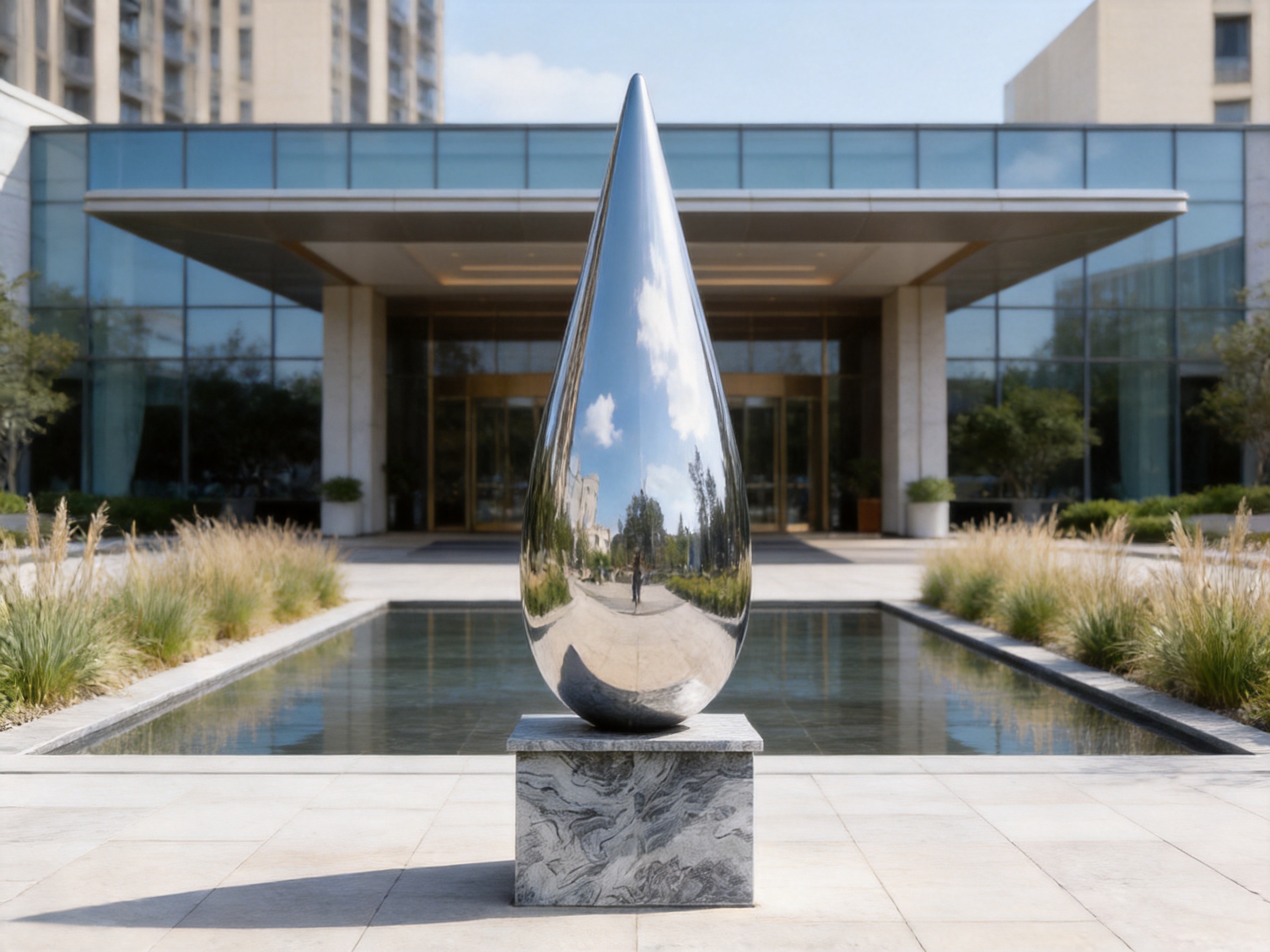
Although the form is static, the design communicates movement. The curved surface breaks up reflections into long flowing bands, causing surrounding images to stretch and move across the sculpture as viewers walk past. Clouds can appear to travel along the metal surface. Trees and planting can be reflected as vertical green patterns. Architectural lines can become curved or elongated. At night, nearby lighting may produce bright highlights that appear to travel across the body as the viewing angle changes.
This optical activity is one of the product’s principal strengths. Many conventional sculptures present a fixed appearance from a limited number of viewpoints. The water-drop sculpture offers a more dynamic experience because its finish responds to the entire environment. The artwork can therefore provide visual interest without mechanical movement, electrical systems, water pumps, or ongoing operational costs.
Material selection is central to the long-term performance and visual character of outdoor sculpture. The use of 304 stainless steel provides a practical balance between strength, formability, corrosion resistance, and surface quality. It is a widely used stainless steel grade for architectural, decorative, and general industrial applications. These properties make it suitable for sculpture projects that require both a refined appearance and dependable everyday performance.
For a sculptural form with smooth curves and a continuous reflective surface, the material must be workable enough to undergo controlled forming while remaining strong enough to retain its shape. Stainless steel offers this combination. It can be shaped into an elongated drop profile, joined through welding, and subsequently processed to create a unified visual surface.
Corrosion resistance is particularly valuable in outdoor settings. The sculpture may be installed near planted areas, paved plazas, hotel entrances, or water features where it is exposed to humidity, rainfall, dust, and changing temperatures. Compared with untreated carbon steel, stainless steel does not rely on paint to provide its primary surface protection. This reduces concerns associated with peeling or flaking decorative coatings and helps preserve a clean architectural appearance.
It is important to note that stainless steel is not maintenance-free in every environment. Airborne contaminants, hard-water deposits, fingerprints, construction dust, and coastal salt can still affect its appearance if allowed to accumulate. However, the material is generally easier to maintain than painted or untreated metal, and routine cleaning can help preserve the mirror finish. In normal conditions, regular wiping with suitable cleaning materials is typically sufficient for appearance control.
Painted steel can provide attractive color options, but its appearance depends on the continuing integrity of the coating system. Scratches, impact damage, ultraviolet exposure, and weathering may require touch-up work or repainting. Over time, a painted sculpture can lose color consistency, particularly when individual sections are repaired at different times.
The mirror-polished stainless steel water-drop sculpture takes a different approach. Its visual identity comes from the reflectivity of the metal itself rather than from a surface color applied over the structure. Minor changes in lighting and surroundings create variation without requiring repainting. This can be especially advantageous for public-facing projects where the sculpture is expected to maintain a premium appearance for many years.
The polished surface also creates a more luxurious impression than many standard painted finishes. For hotel lobbies, commercial entrances, upscale residential developments, and sales galleries, a mirror finish can support the perception of quality and exclusivity. It functions not only as decoration but also as a visual statement about the standard of the property.
Stone and concrete sculptures can provide permanence and mass, but they are often visually heavier and less reflective. Their appearance is strongly determined by the material’s natural color, texture, and lighting. The stainless steel water-drop sculpture offers a lighter, more contemporary expression. Its reflective body can make a space feel more open because it visually incorporates the surrounding environment.
The product can also achieve a tall and slender silhouette without the same visual heaviness associated with a solid stone form. This is useful when designers want a strong landmark feature without blocking sight lines or overwhelming nearby planting and architecture. The sculpture can stand as a focal point while still allowing the background landscape to remain visible.
Fiberglass and other composite materials can be useful when a lightweight structure, complex color, or low initial cost is the main priority. However, their surface appearance may depend on paint, gel coat, or metallic-effect treatments. These finishes can age differently from solid polished metal and may require periodic restoration to maintain a premium appearance.
By contrast, the water-drop sculpture uses stainless steel as the visible architectural surface. The material provides a genuine metallic reflection rather than a printed or painted imitation. This is particularly important for close-up installations, where visitors can see the relationship between the sculpture’s form and its reflective surface.
The selection of 304 stainless steel reflects a practical approach to decorative sculpture manufacturing. This grade is widely recognized for its useful combination of mechanical strength, workability, and resistance to everyday corrosion. It is suitable for many indoor and outdoor applications, provided that the environmental conditions and maintenance requirements are properly considered.
For this product, the value of 304 stainless steel is not based on one property alone. Its formability supports the creation of the elongated drop shape. Its structural qualities help the finished body maintain its profile. Its corrosion resistance supports installation in common landscape and architectural environments. Its surface can also be progressively polished to a highly reflective level.
The material is therefore aligned with the product’s entire manufacturing concept. A less workable metal might make the curved profile more difficult to produce. A material with weaker surface performance might require an additional coating. A material that could not receive a consistent polish would not deliver the same optical effect. The use of 304 stainless steel supports the design from fabrication through installation and maintenance.
For highly aggressive environments, such as locations with significant salt exposure or specialized industrial pollutants, designers should review the site conditions and maintenance plan with the manufacturer before ordering. Material selection, surface care, drainage, installation details, and cleaning frequency should all be considered together. This site-specific approach helps ensure that the sculpture performs appropriately in its intended location.
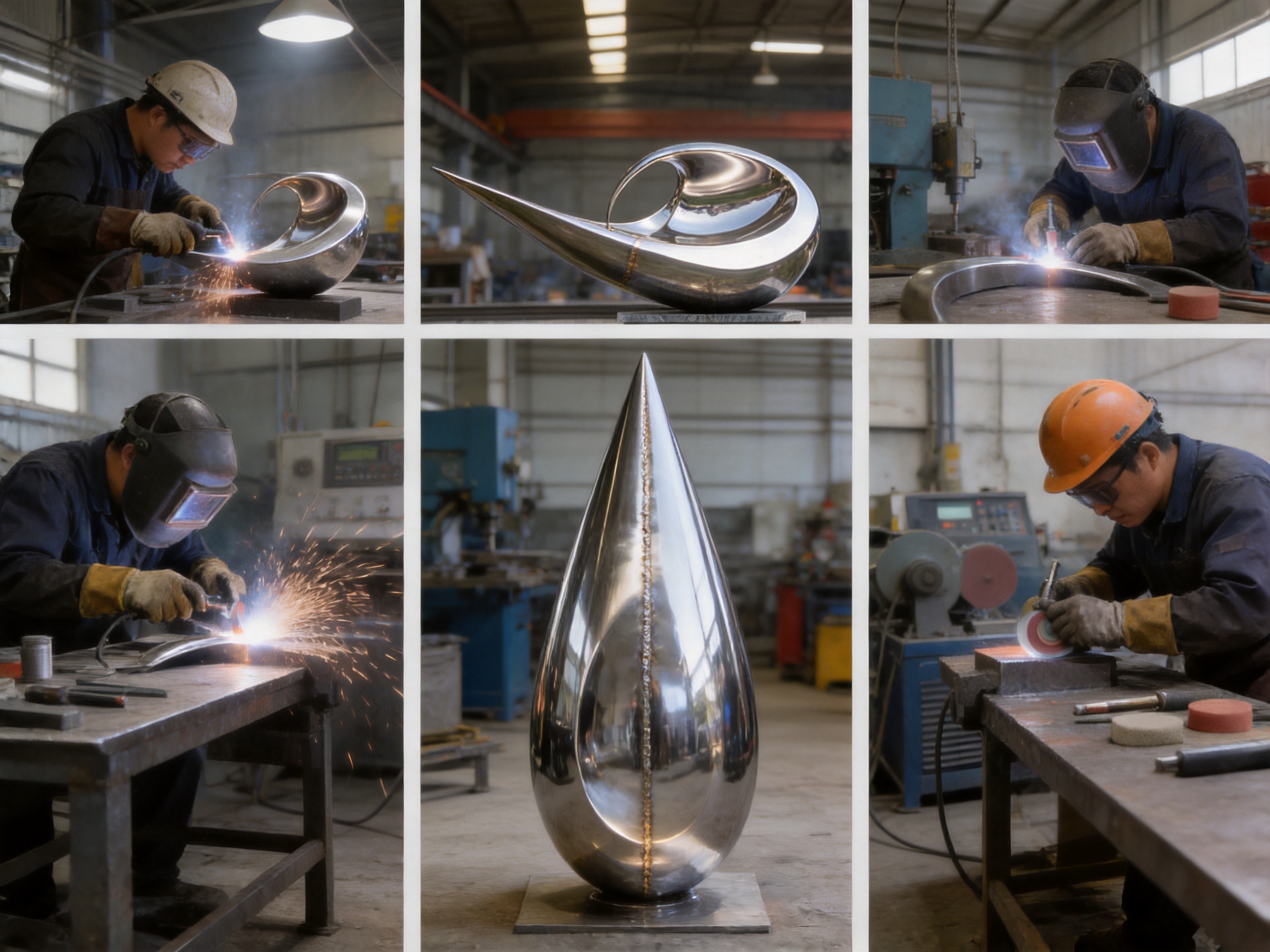
The visual simplicity of the finished sculpture should not be confused with manufacturing simplicity. A smooth, elongated water-drop form requires accurate shaping, controlled joining, and extensive surface preparation. The quality of the final reflection depends on the consistency of every stage that precedes polishing.
Manufacturing begins with the development of the sculpture’s overall proportions. The product is offered in a size range from 1.6 meters to 4 meters in total length, allowing it to serve different architectural roles. A shorter model may work as an interior lobby accent, while a four-meter version can function as a prominent outdoor centerpiece.
Scaling a sculpture is not merely a matter of enlarging every dimension. The visual balance of the profile, the structural requirements, the support arrangement, and the installation conditions must all be reviewed. A larger sculpture may need greater attention to internal reinforcement, wind exposure, transportation, lifting, and anchoring. Custom production allows these factors to be coordinated with the project’s design intent.
The ability to customize size also gives architects and landscape designers greater control over proportion. A sculpture that is too small may disappear within a large plaza. A sculpture that is too large may compete with the building or restrict circulation. Selecting the appropriate scale helps the water-drop form become a deliberate part of the overall composition rather than an isolated object.
After the design proportions are established, stainless steel components are formed into the smooth, elongated profile. Metal forming must be performed with care because excessive force, uneven pressure, or poor alignment can create distortions that become visible after polishing.
The objective is to establish a continuous and graceful surface. The transition from the narrow upper section to the fuller lower section must appear intentional and fluid. The forming process must also preserve the dimensional accuracy needed for the sculpture to stand correctly and meet its support or installation requirements.
For a mirror-polished product, forming quality is especially important. A painted surface can conceal some minor irregularities, while a mirror finish tends to reveal them by reflecting light and surrounding objects. This makes early-stage fabrication discipline a critical part of the final visual result.
The shaped stainless steel sections are joined through welding. Welding provides the structural connection required to transform individual formed components into a unified sculpture body. However, visible welds can interrupt the smooth reflection if they are not carefully treated.
For this reason, seam treatment is an important part of the manufacturing process. The surface is prepared so that weld areas are blended into the surrounding metal. The aim is to remove visible discontinuities and create the impression of a continuous flowing shell. This work requires patience because the polished finish will emphasize any remaining line, depression, heat mark, or uneven transition.
Good welding practice also contributes to the sculpture’s durability. Properly joined and treated seams help the body retain its integrity during handling, transportation, installation, and long-term service. The process must balance structural strength with the aesthetic demand for a nearly uninterrupted surface.
The defining production stage is the 8K mirror-polishing process. This level of finish is labor-intensive and typically involves multiple abrasive stages, with each stage using progressively finer materials to reduce surface marks and refine the reflection. A final buffing pass helps achieve the glass-like brightness associated with the finished product.
Polishing is not simply the application of a shiny coating. It is a controlled refinement of the stainless steel surface. Coarser abrasives first remove forming marks, welding traces, and irregularities. Finer abrasives then reduce the remaining scratches and create a more uniform surface. Final buffing enhances reflectivity and gives the sculpture its jewel-like appearance.
The process must be applied consistently across curved areas, tapered sections, joints, and transitions. Curved surfaces can reflect light differently from flat surfaces, so the operator must work carefully to avoid uneven brightness or visible polishing patterns. A high-quality mirror finish requires both suitable equipment and experienced handling.
This extensive finishing process creates a clear advantage over sculptures that use a basic brushed finish, ordinary buffing, or metallic paint. The 8K surface produces sharper reflections and a more luxurious appearance. It allows the water-drop silhouette to interact fully with its surroundings, which is essential to the product’s visual concept.
Before delivery, a sculpture with a reflective finish should be examined from multiple angles and under different lighting conditions. This helps identify visible seams, inconsistent polishing, handling marks, or areas that require additional finishing. Because the sculpture is intended for prominent architectural settings, surface quality has a direct influence on the perceived quality of the entire project.
Packaging and handling are also important. A mirror-polished surface should be protected from scratches, impact, dust, and contamination during transportation and installation. The project team should plan lifting, temporary storage, and final positioning carefully so that the finished surface is not damaged before the sculpture is placed in service.
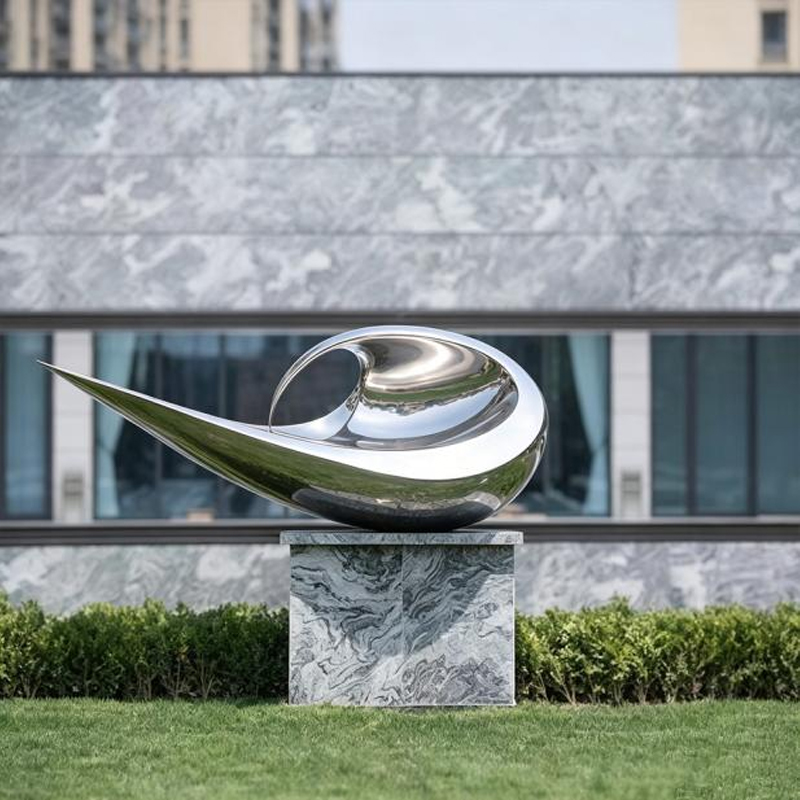
Mirror-Polished Stainless Steel Water-Drop Sculpture
The following table summarizes the principal product information provided for the Mirror-Polished Stainless Steel Water-Drop Sculpture.
| Item | Specification |
|---|---|
| Product type | Decorative stainless steel sculpture |
| Design | Elongated falling water-drop or teardrop form |
| Primary material | 304 stainless steel |
| Surface finish | 8K mirror polish |
| Manufacturing methods | Metal forming, welding, seam treatment, progressive abrasive polishing, and final buffing |
| Available total length | Approximately 1.6 meters to 4 meters |
| Listed price range | Approximately $1,521 to $8,412 |
| Recommended applications | Hotels, sales offices, villas, public plazas, courtyards, lobbies, and landscape entrances |
| Customization | Size customization and project-based production |
| Routine care | Regular wiping and cleaning with suitable non-abrasive materials |
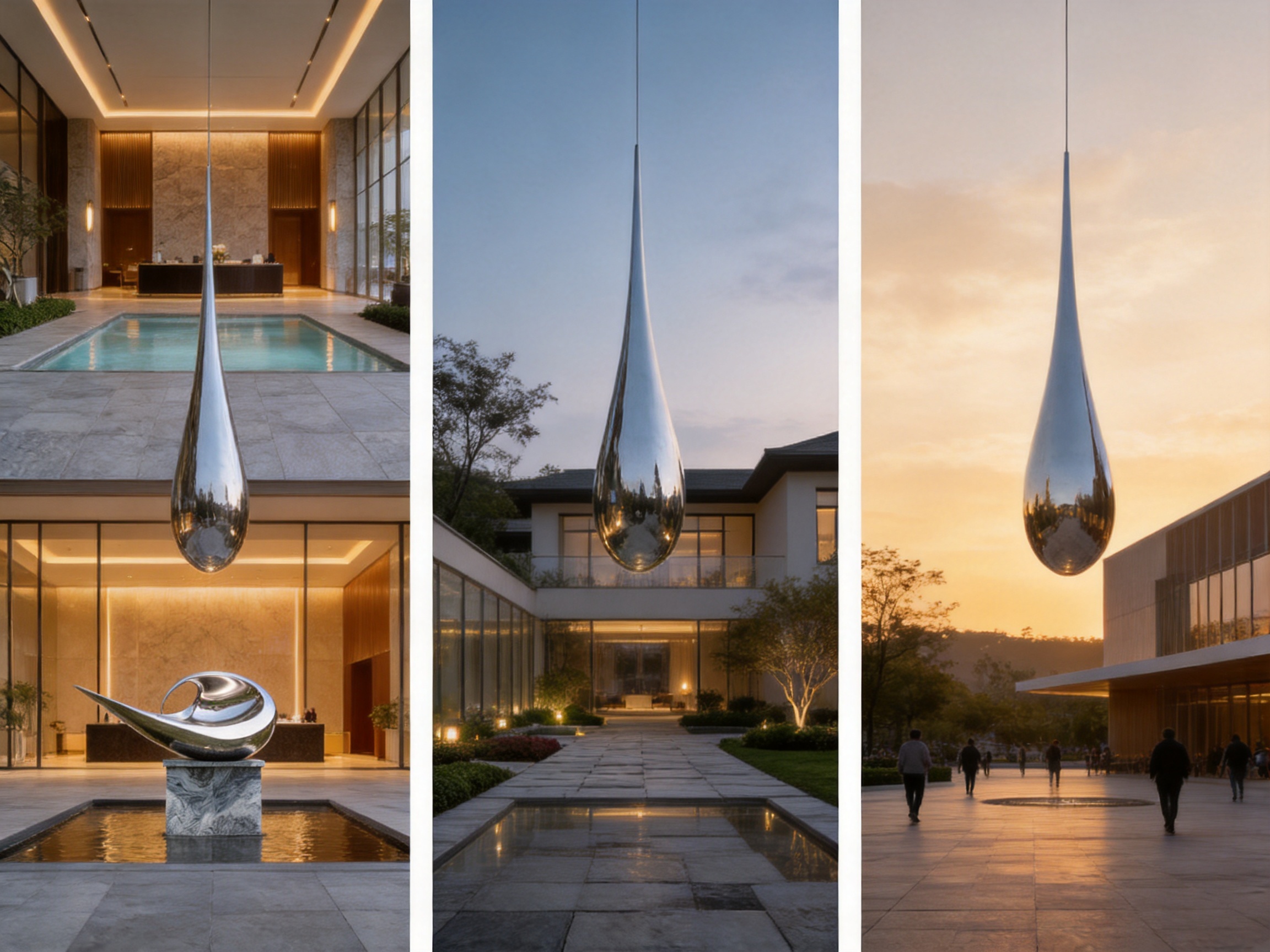
For an interior lobby, the sculpture should be selected according to ceiling height, floor area, visitor circulation, and the scale of surrounding furniture or architectural features. A compact version can be placed near a reception desk, elevator lobby, staircase, or feature wall. Its reflective surface can add brightness to the interior without requiring a large footprint.
In a double-height lobby, a taller version may be used to connect the floor plane with the upper architectural volume. The vertical profile can reinforce the height of the room and create a visual pause between large walls, glazing, or columns. Designers should allow sufficient viewing distance so that visitors can appreciate the overall drop shape rather than seeing only a portion of the surface.
Outdoor installations generally require a more substantial scale so that the sculpture remains visible against planting, paving, façades, and open sky. A larger water-drop sculpture can anchor a central courtyard, mark an entrance, or serve as a focal point at the end of a pedestrian axis.
For outdoor use, the installation plan should consider wind exposure, drainage, foundation conditions, access for lifting equipment, and the relationship between the sculpture and surrounding circulation. The manufacturer and project team should confirm the support and anchoring requirements for the selected size and location.
Hotels and resorts depend heavily on first impressions. A polished stainless steel water-drop sculpture can create an immediate sense of refinement at a main entrance, driveway, porte cochère, or garden approach. Its reflective surface can echo glass façades, water features, polished stone, and contemporary lighting systems.
The sculpture is also suitable for resort landscapes where the design theme includes water, relaxation, or natural movement. It can be positioned beside a pool, near a fountain, or within a planted courtyard. Even when it is not directly connected to a functioning water feature, the drop form can reinforce the atmosphere of freshness and calm associated with water.
At night, carefully positioned landscape lighting can reveal the curves and create controlled highlights. Because stainless steel reflects its surroundings, lighting designers should test fixture positions to avoid excessive glare and to achieve a comfortable viewing experience for guests.
In sales offices and property developments, sculpture often serves as part of the project’s visual identity. A custom-sized water-drop sculpture can be placed in a reception hall, model display area, entrance plaza, or central landscape court. Its contemporary appearance can support the marketing message of modernity, quality, and investment value.
The reflective surface also photographs well when the surrounding environment is carefully designed. It can capture landscaping, architectural lighting, and branded interiors, creating a memorable background for visitor photographs and promotional materials. The sculpture can therefore contribute to both physical experience and visual communication.
For villas and luxury residences, a smaller customized version can provide a strong focal point without creating a crowded appearance. It may be installed beside an entrance, within a courtyard, at the end of a garden path, or near a private pool. The design’s abstract character allows it to complement both minimalist architecture and more decorative European-inspired environments.
In a residential setting, the changing reflection can make the sculpture feel integrated with the garden. During the day, it may reflect foliage and sky. In the evening, it may reflect warm architectural lighting. This ability to change with the surroundings helps the artwork remain visually engaging over time.
Public plazas require artwork that can be understood from different distances and viewpoints. The water-drop profile has a clear silhouette that can be recognized across an open space, while its reflective surface encourages closer inspection. It can be used near pedestrian routes, gathering areas, commercial districts, or cultural developments.
For public projects, safety and accessibility planning are essential. The placement should maintain clear routes, avoid sharp or hazardous projections, and provide a stable support system. The reflective finish should also be considered in relation to direct sunlight and nearby traffic to minimize unwanted glare.
The sculpture’s value is not limited to its physical form. Its reflective finish makes it an active participant in the surrounding composition. Rather than presenting a single color, it receives and returns the visual information of the site.
In a green landscape, the metal may reflect trees, ornamental grasses, and planting beds. Against a stone façade, it may pick up warm beige or gray tones. Near blue glazing or water, it can create a visual connection between architecture and landscape. In a public plaza, the reflections of pedestrians can make the sculpture seem animated and socially connected to the space.
This quality is especially useful in projects where the design team wants a sculpture that changes throughout the day. Morning light may create soft highlights, midday light may produce bright contrast, and evening illumination may turn the surface into a dark reflective volume with selective points of brightness. The piece can therefore provide a changing visual experience without mechanical movement or digital technology.
The sculpture also has a useful relationship with photography. Its curved surface creates distinctive reflections that can become recognizable in project images. When installed in a well-designed setting, it can help establish a visual signature for the property, particularly in hospitality, retail, and real estate environments.
One of the product’s practical advantages is its relatively straightforward maintenance routine. Unlike painted metal, the sculpture does not normally require repainting simply to preserve its basic visual finish. Unlike porous stone, it does not depend on sealing to maintain a polished appearance. Routine cleaning is generally the principal requirement.
Dust and airborne particles should be removed before they accumulate. A soft, clean cloth and a suitable stainless steel cleaning solution can be used according to the product manufacturer’s instructions. Abrasive pads, rough brushes, harsh chemicals, and contaminated cloths should be avoided because they may create fine scratches or leave residues on the mirror surface.
Fingerprints can be especially visible on a mirror finish. In indoor settings, they may be removed through regular wiping. In outdoor environments, rainwater and irrigation spray may leave mineral marks. If the sculpture is positioned near a sprinkler system, designers should consider the direction and quality of irrigation water. Preventing repeated hard-water deposits is easier than removing them after they have built up.
Coastal and industrial locations may require more frequent cleaning because airborne salt or pollutants can settle on the surface. The maintenance schedule should be based on local conditions rather than on a universal timetable. A simple inspection program can help identify deposits, stains, or accidental damage before they become more difficult to address.
The surface should also be protected during nearby construction, renovation, landscaping, or paving work. Cement dust, grinding particles, welding sparks, and metal fragments can damage a polished surface. Temporary protective covering and careful site coordination are recommended whenever construction continues around an installed sculpture.
A successful sculpture project depends on more than the quality of the artwork itself. Installation conditions influence stability, appearance, safety, and long-term performance. The base or support structure should be appropriate for the sculpture’s dimensions, weight, center of gravity, and site conditions.
Before ordering, the project team should confirm the proposed location, access route, lifting method, foundation arrangement, and final orientation. Outdoor installations may need to account for wind loads, rainwater drainage, ground settlement, and the possibility of contact with maintenance equipment. Indoor installations should consider floor loading, delivery access, door dimensions, ceiling clearance, and protection of nearby finishes.
The final orientation can also affect the visual result. A sculpture may be positioned to reflect a building entrance, a line of trees, a water feature, or a specific view corridor. Since the surface is reflective, even a small change in orientation can alter the composition. Designers should review the sculpture from the main approach routes and from the locations where visitors are likely to stop.
Lighting should be tested after the sculpture is positioned. A mirror-polished surface can produce powerful highlights, so the goal is usually to emphasize the form rather than flood the entire surface with uncontrolled brightness. Concealed, indirect, or carefully angled fixtures may provide a more elegant result than direct frontal lighting.
Jiangsu Xinyesheng Sculpture Co., Ltd. offers a product range that includes bronze sculptures, stainless steel sculptures, marble sculptures, fiberglass sculptures, and weathering steel sculptures. This breadth suggests an ability to work across several sculptural materials and visual styles. For buyers, a broad material portfolio can be useful when a project contains multiple artwork types or when the design concept changes during development.
The company’s stainless steel production approach is particularly relevant to this water-drop sculpture. The product requires more than basic cutting and assembly. Its value depends on the coordinated execution of forming, welding, seam treatment, and high-level surface polishing. The manufacturer’s stated process addresses each of these stages, from creating the curved silhouette to achieving the final reflective surface.
Another important strength is custom sizing. The available length range of 1.6 meters to 4 meters allows the sculpture to be adapted to different project scales. Custom production is important for professional architectural work because the ideal artwork dimensions are often determined by a specific façade, entrance, landscape axis, or interior volume rather than by a standard retail space.
The product also reflects an understanding of different application environments. It is presented as suitable for sales offices, hotels, villas, public plazas, lobbies, courtyards, and other modern landscape settings. These applications require a combination of visual impact, material durability, manageable maintenance, and production flexibility.
From a procurement perspective, the listed price range of $1,521 to $8,412 provides a starting point for budget planning. Final pricing may vary according to size, structural requirements, customization, packaging, transportation, installation needs, and project quantity. Buyers should request a project-specific quotation and confirm the complete scope of supply before placing an order.
Because the company works with several sculpture categories, it may be able to support broader decorative art programs. A landscape project could combine a polished stainless steel centerpiece with weathering steel accents, bronze figures, or marble elements. Such combinations can create contrast between reflective, warm, textured, and natural surfaces.
For a project requiring a unified visual language across different locations, coordination with one sculpture manufacturer may also simplify communication. Design references, dimensions, production schedules, packaging standards, and quality expectations can be discussed through a more consistent process. This is particularly valuable for hospitality groups, property developers, and landscape contractors handling multiple artworks.
The sculpture creates a strong sense of motion through form and reflection rather than through moving parts. This reduces the complexity associated with kinetic sculptures, fountains, interactive lighting, or digital installations. There are no pumps, motors, control systems, or water treatment requirements inherent in the sculpture itself.
This mechanical simplicity can support long-term reliability. The sculpture’s visual effect depends on the physical shape, material, and finish, all of which remain passive once installation is complete. Maintenance can therefore focus on cleaning and routine inspection rather than on specialized mechanical servicing.
The 8K mirror polish provides a level of reflectivity that is difficult to reproduce with paint or composite coatings. The result is a more authentic and refined metallic appearance. The sculpture can function as a luxury feature in high-end architectural environments where surface quality is closely associated with project value.
The combination of a neutral metallic material and a universally recognizable natural form allows the sculpture to move between different contexts. It can support a minimalist interior, a luxury hotel entrance, a private garden, or a contemporary civic plaza. Its visual identity is distinctive without being tied to one architectural style.
The size range enables buyers to choose between a more compact accent piece and a larger landmark installation. Pricing scales across a wide range, giving project owners an opportunity to select an appropriate version without abandoning the design concept entirely. This flexibility can be useful when the same design language must be applied across several properties or locations.
Stainless steel’s resistance to everyday corrosion and the absence of a conventional painted coating can reduce long-term maintenance demands. Regular cleaning is still necessary, but the sculpture does not generally require repainting to restore ordinary appearance. For commercial properties, this can reduce disruption and help preserve a consistent presentation.
When evaluating the sculpture for a project, buyers should begin by defining the intended visual role. Is the piece meant to be a discreet lobby accent, a central courtyard focal point, a gateway marker, or a landmark visible from a distance? The answer will influence the preferred size, orientation, lighting, base design, and viewing distance.
The next step is to assess environmental exposure. Indoor installations usually provide the most controlled conditions, while outdoor sites vary widely in humidity, pollution, salt, dust, irrigation, and sunlight. Sharing site photographs, dimensions, climate information, and installation plans with the manufacturer can help determine the most appropriate specification.
Buyers should also clarify the details of customization. Important questions may include the final height and width, stainless steel thickness, internal reinforcement, base or mounting method, surface treatment, packaging, delivery schedule, installation guidance, and inspection procedures. These details are particularly important for a large sculpture that must be transported and installed safely.
A physical finish sample or representative polished sample may be helpful when the sculpture is part of a high-value architectural project. Mirror polish can appear different under warm indoor light, cool daylight, direct sun, and landscape lighting. Reviewing the finish in relation to the project’s other materials can support better design decisions.
For larger outdoor pieces, the structural and civil engineering teams should coordinate with the sculpture manufacturer. Foundation design, anchor placement, wind exposure, and access for installation should be resolved before fabrication is completed. Early coordination can reduce the risk of costly modifications at the construction stage.
The polished stainless steel surface can be paired with many common architectural materials. Against dark stone, it creates a high-contrast focal point. Against light marble, it produces a more delicate and integrated composition. Next to wood, planting, or textured concrete, the reflective metal provides a contemporary counterpoint to natural or tactile surfaces.
Water features can strengthen the conceptual connection between the sculpture and its subject. A shallow reflecting pool may double the image of the drop and emphasize the theme of fluidity. However, a water feature is not necessary. The sculpture is complete as a standalone object and can be installed on paving, a landscaped platform, or a finished architectural base.
Weathering steel can provide a particularly strong contrast when used nearby. The warm rust-colored surface of weathering steel emphasizes the cool brightness of stainless steel. Bronze can introduce a darker, more traditional tone, while marble can add weight and natural veining. Because the manufacturer offers multiple sculpture materials, designers may explore coordinated combinations within one project.
When assessing a mirror-polished sculpture, the buyer should look beyond general brightness. Important quality factors include the continuity of reflection, the treatment of welded seams, the consistency of curvature, the absence of visible dents, the uniformity of polishing, and the protection of the surface during delivery.
A good mirror finish should support the intended form rather than distract from it. If a seam remains visually dominant, the eye may focus on the construction instead of the water-drop silhouette. If the curvature is uneven, reflections may appear broken in ways that do not seem intentional. If the surface contains scratches or contaminated polishing marks, the sculpture may not achieve the premium appearance expected in a high-end setting.
The manufacturing process described for this product—forming, welding, seam removal, progressively finer abrasive work, and final buffing—is suited to these quality requirements. Each stage contributes to the next. Careful forming reduces the amount of correction required. Controlled welding supports structural integrity. Seam treatment prepares the surface. Progressive polishing refines the reflection. Final buffing establishes the visual brilliance.
The sculpture is made from 304 stainless steel. This grade is widely used because it combines strength, workability, and resistance to everyday corrosion. It is suitable for many indoor and outdoor architectural applications when the site conditions and maintenance plan are properly considered.
An 8K mirror polish refers to a highly reflective surface finish. It is produced through multiple stages of abrasive refinement followed by final buffing. The process is intended to remove visible surface marks and create a glass-like reflection rather than a basic brushed or semi-polished appearance.
Yes. The product is available in total lengths from approximately 1.6 meters to 4 meters, and the design can be customized in size for different applications. The final dimensions should be discussed with the manufacturer in relation to the intended location, structural requirements, transportation, and budget.
It is designed for both indoor and outdoor landscape settings. Its 304 stainless steel construction offers resistance to everyday corrosion, making it suitable for many exterior environments. Coastal, industrial, or highly polluted locations may require additional site review and more frequent cleaning.
The sculpture does not depend on a conventional painted finish, so routine repainting is generally not required to preserve its mirror appearance. Regular cleaning is still important, and the surface should be protected from abrasive materials, construction contamination, hard-water deposits, and accidental impact.
Routine cleaning can generally be performed with a soft, clean cloth and a suitable stainless steel cleaning product. Abrasive pads, rough brushes, harsh chemicals, and dirty cloths should be avoided because they may scratch or contaminate the polished surface. Cleaning frequency should reflect the local environment.
Potential applications include hotel entrances, resort landscapes, sales offices, lobbies, villas, private courtyards, public plazas, commercial developments, and modern landscape projects. The sculpture can be used as a standalone focal point or integrated with paving, planting, lighting, architecture, or a reflecting pool.
No. The sculpture is a static artwork. Its sense of movement comes from the elongated drop form and the changing reflections across its polished surface. It does not require pumps, motors, water circulation, or electronic controls.
The listed price range is approximately $1,521 to $8,412. Actual pricing may vary according to size, customization, structural requirements, quantity, packaging, shipping, installation, and other project-specific factors. A final quotation should be requested for the chosen specification.
Buyers should review the foundation or base, anchoring, wind exposure, delivery access, lifting requirements, drainage, final orientation, lighting, and protection during construction. Larger outdoor installations should be coordinated with the project’s architectural, landscape, civil, and structural teams.
Its main advantage is that the visual effect comes from the polished stainless steel itself rather than from a painted coating. This creates more authentic reflections and reduces dependence on repainting. Painted metal may offer more fixed color choices, while mirror-polished stainless steel offers a changing appearance that responds to its surroundings.
Yes. Stainless steel can be combined with bronze, marble, fiberglass, or weathering steel artwork to create contrast in color, texture, reflectivity, and visual weight. Such combinations can support a broader landscape or architectural art program.
The Mirror-Polished Stainless Steel Water-Drop Sculpture is a carefully developed architectural artwork that combines a clear natural concept with demanding metal craftsmanship. Its falling-drop silhouette communicates movement, while the 304 stainless steel body provides a durable and adaptable foundation. The 8K mirror polish transforms the sculpture into a dynamic reflective surface that continually responds to sky, landscape, architecture, light, and human activity.
Its advantages over many conventional sculptures are found in the combination of form, material, finish, customization, and maintenance practicality. It offers stronger visual interaction than a fixed-color statue, a lighter contemporary expression than many solid stone forms, and a more authentic metallic appearance than painted composite artwork. At the same time, it avoids the mechanical complexity of kinetic or water-powered installations.
The manufacturing process is central to the product’s value. Controlled forming establishes the graceful profile. Welding creates the unified body. Careful seam treatment reduces visible construction lines. Multiple progressively finer polishing stages and final buffing produce the high-end mirror finish. Together, these processes allow the sculpture to function as both a durable object and a refined visual centerpiece.
With available lengths from 1.6 meters to 4 meters and a listed price range of $1,521 to $8,412, the product can be adapted to different scales, spaces, and budgets. Whether installed in a hotel lobby, villa courtyard, sales office, public plaza, or landscaped entrance, it offers a distinctive way to introduce fluidity, reflection, and contemporary luxury into the built environment.
For buyers seeking a custom stainless steel sculpture with a strong silhouette, premium surface treatment, and broad application potential, this water-drop design provides a versatile solution. Proper site planning, installation coordination, and routine cleaning will help preserve its reflective character and ensure that it continues to serve as a memorable focal point for years to come.
1. Product specification materials for the Mirror-Polished Stainless Steel Water-Drop Sculpture, including material, dimensions, finish, applications, and listed pricing.
2. General technical literature on 304 stainless steel, including its common architectural uses, workability, strength, and corrosion-resistance characteristics.
3. General metal fabrication references covering forming, stainless steel welding, seam treatment, surface preparation, abrasive finishing, and buffing.
4. General architectural maintenance guidance for polished stainless steel in indoor, outdoor, commercial, and landscape environments.
5. General design references concerning sculpture placement, architectural focal points, landscape composition, lighting, viewing distance, and public-space integration.



Daniel H.

Amanda R.

Robert B.

Jennifer S.

James W.

Barry G.

Michael T.

Emily K.

David L.

Sarah M.


Mikey XV

Jagxue

 English
 Español
 عربى
 Français
 italiano
 Deutsch