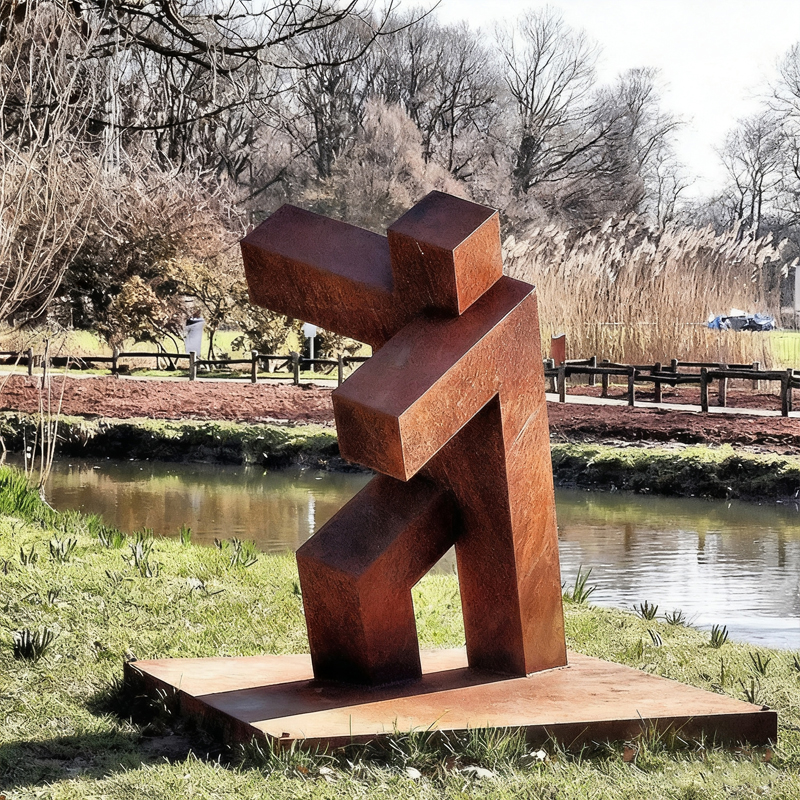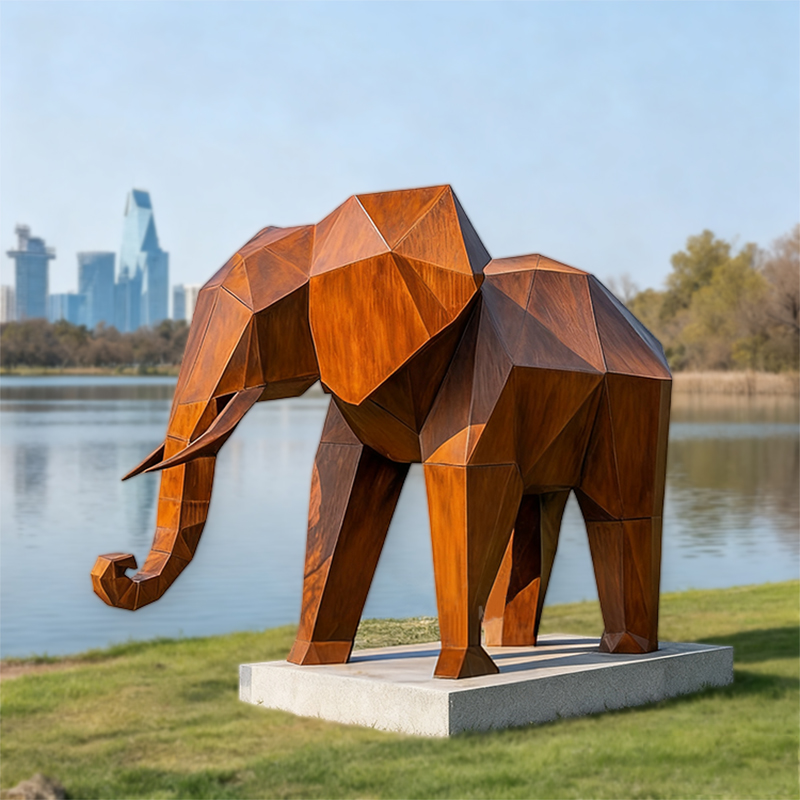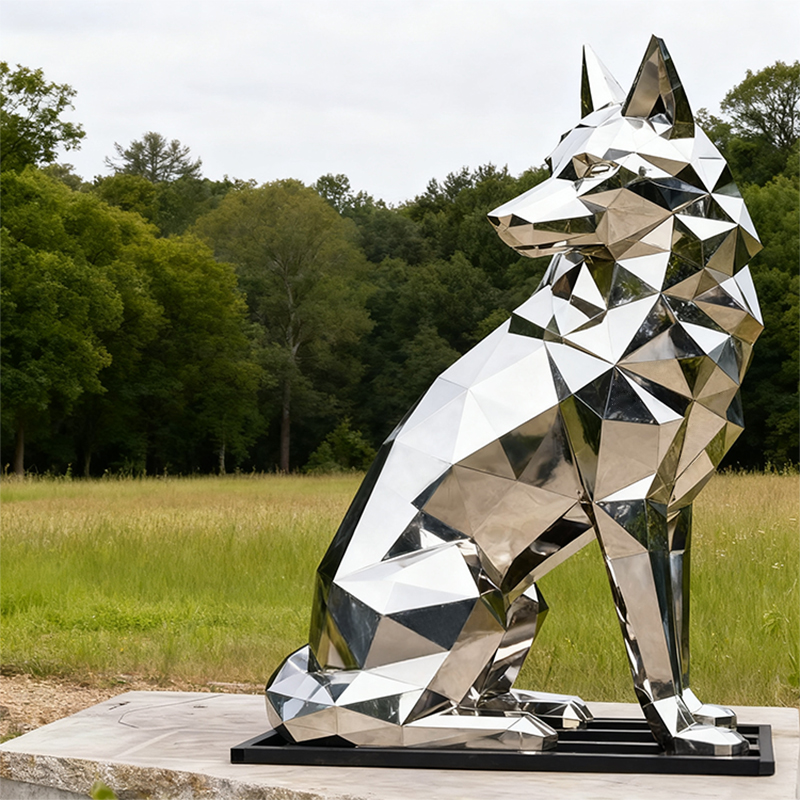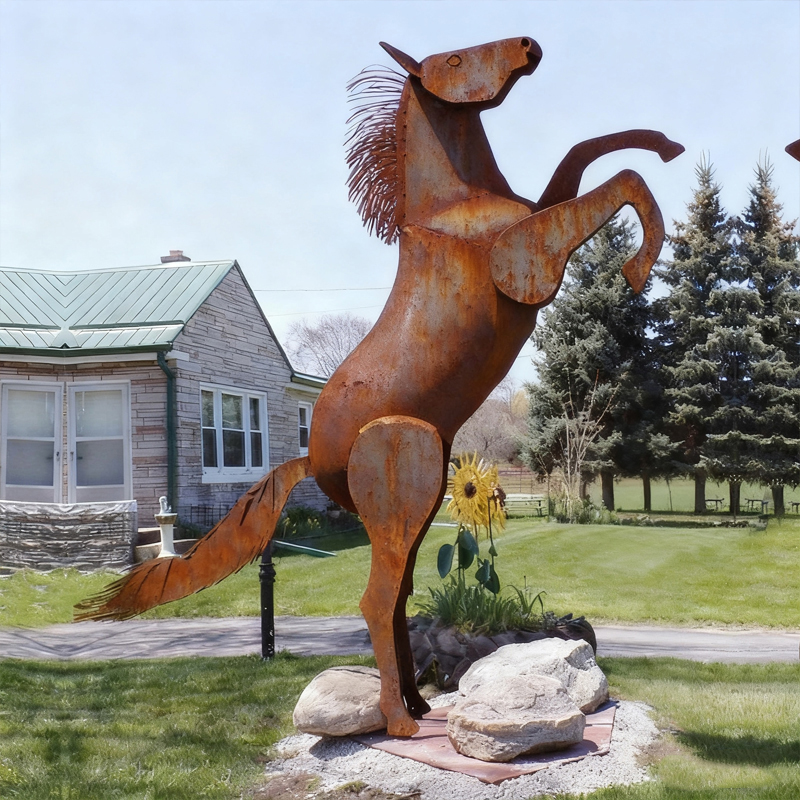
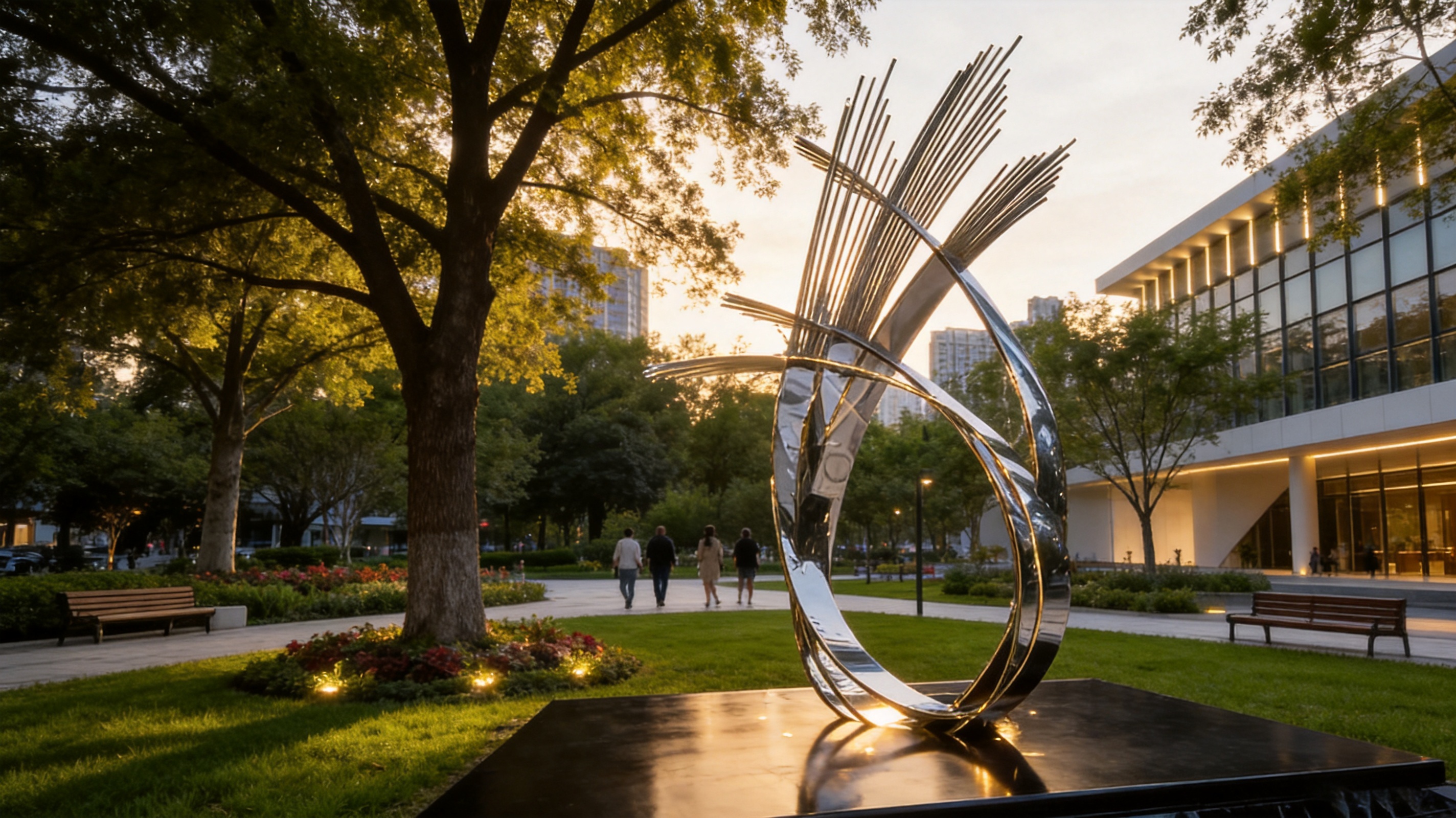
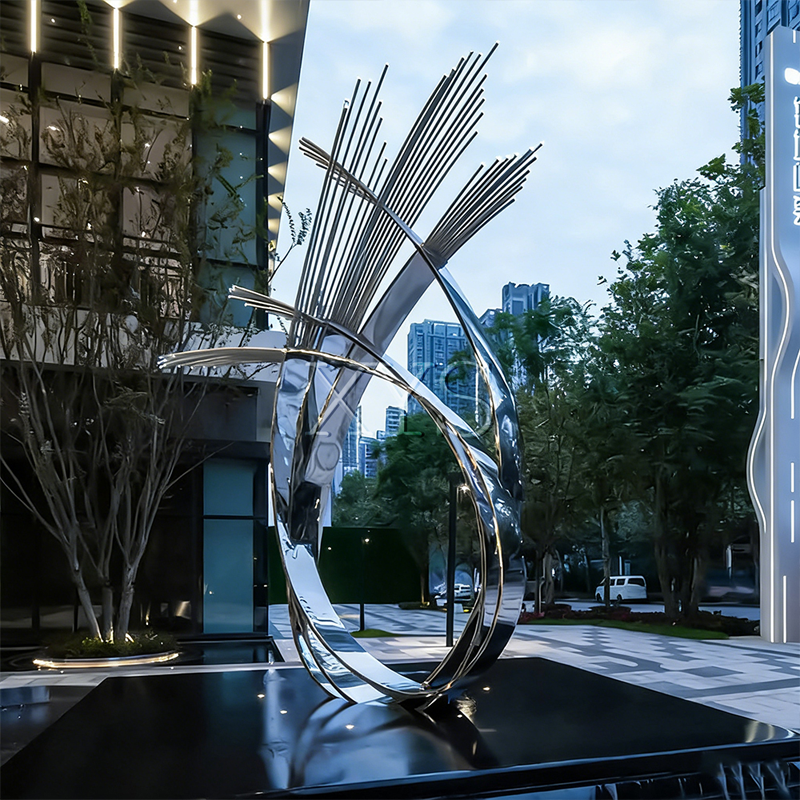
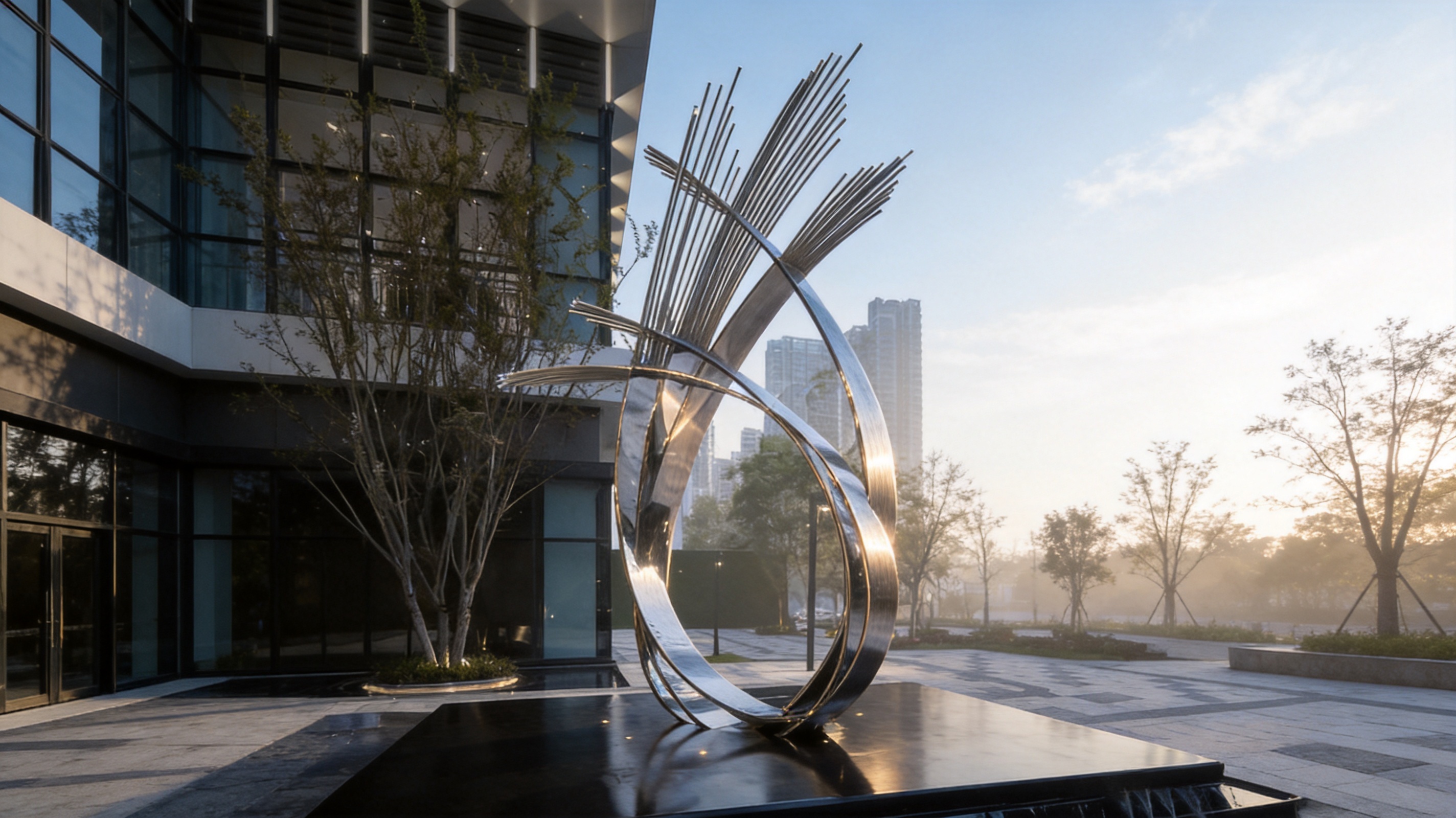
The Phoenix Tail at Dawn Openwork Feather Sculpture is a contemporary stainless steel artwork designed to give outdoor spaces a distinctive visual identity. Rising from approximately three to five meters in height, the sculpture translates the flowing movement of a phoenix tail into a light, linear, openwork structure. Its form is expressive without becoming visually heavy, making it suitable for commercial plazas, residential entrances, municipal green spaces, hospitality developments, cultural landscapes, and other public-facing environments.
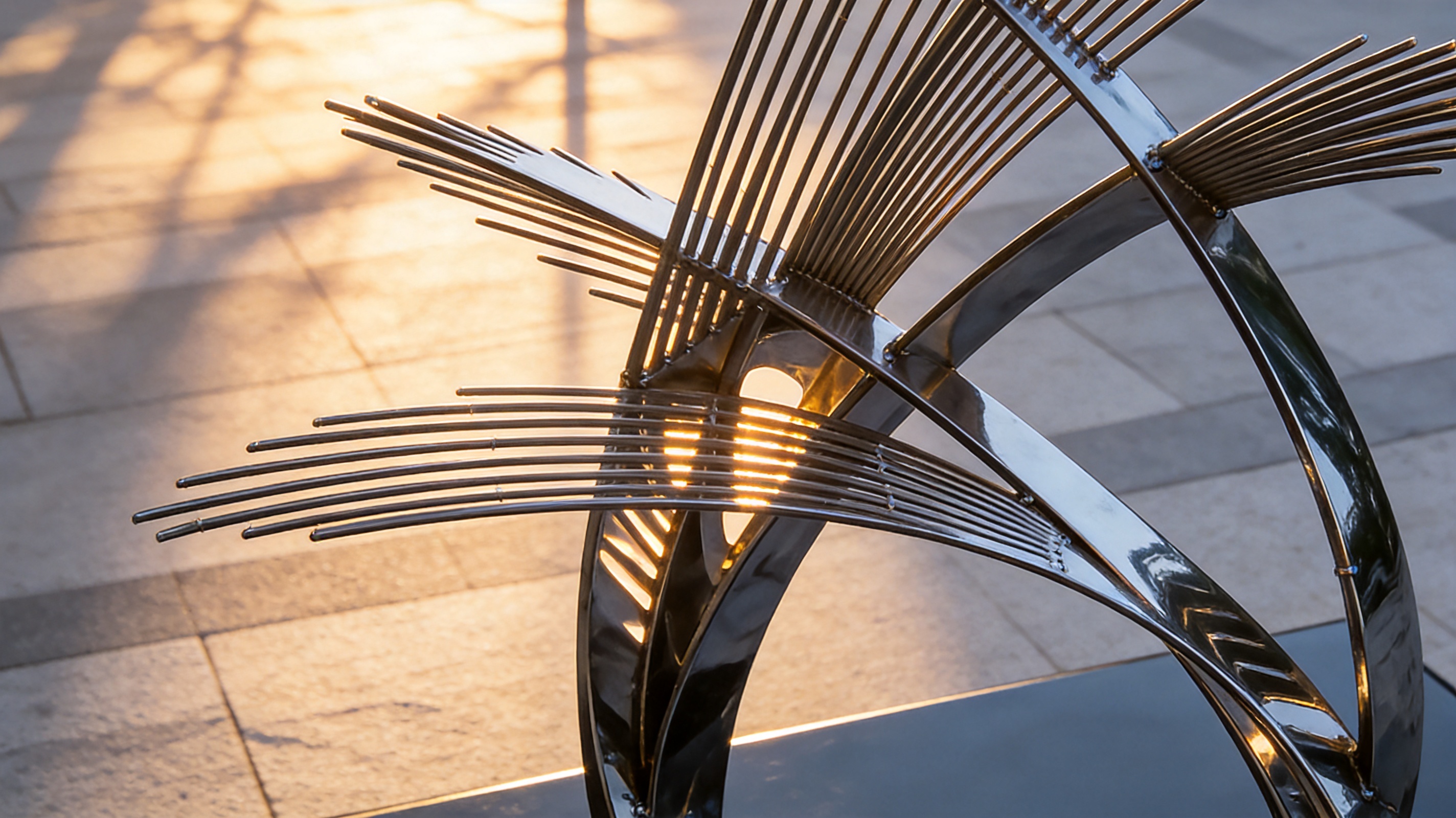
Manufactured from 304 stainless steel and shaped through a forged construction process, the sculpture combines symbolic meaning, architectural presence, and outdoor durability. Its feather-like lines create a layered silhouette that changes as viewers move around it. During daylight, the openings allow the surrounding landscape to remain visible through the sculpture. At dawn, sunset, or under carefully positioned landscape lighting, the overlapping lines can produce changing shadows and highlights, giving the artwork a dynamic presence throughout the day.
Unlike a conventional solid metal statue, this openwork phoenix tail is designed around rhythm, negative space, and controlled visual lightness. The result is an artwork that can serve as a landmark while maintaining a refined relationship with its surroundings. It does not simply occupy a site; it helps organize the way people see, approach, and remember that site.
Content
The Phoenix Tail at Dawn Openwork Feather Sculpture belongs to the category of stainless steel animal sculptures. Although the subject is a phoenix, the design does not rely on a literal bird figure with fully modeled wings, body, and head. Instead, it focuses on one of the phoenix’s most recognizable visual elements: the sweeping, layered tail.
This design approach gives the sculpture a modern artistic character. The tail is constructed as a linear openwork assembly, creating a flowing arrangement of feather-like components. These elements can appear to fan outward, rise upward, or curve through space depending on the selected design configuration and installation orientation. The open structure gives the sculpture a sense of motion, as though the tail is being lifted by air or illuminated by the first light of morning.
The listed product height is approximately 3–5 meters. This range allows the sculpture to be adapted to different site conditions. A smaller configuration may be appropriate for a landscaped residential entrance or a boutique commercial development, while a larger configuration can function as a major visual marker in a civic plaza, hotel forecourt, shopping center, or urban green space.
The listed price range is $1,756.37–$4,098.19. Final pricing may vary according to height, design complexity, material quantity, surface treatment, structural requirements, installation conditions, packaging, and shipping arrangements. Because the product is customizable, buyers should confirm the final specification and quotation before placing an order.
| Product Attribute | Details |
|---|---|
| Product name | Phoenix Tail at Dawn Openwork Feather Sculpture |
| Primary material | 304 stainless steel |
| Manufacturing description | Forged stainless steel with linear openwork assembly |
| Product category | Stainless steel animal sculptures |
| Approximate height | 3–5 meters |
| Listed price range | $1,756.37–$4,098.19 |
| Recommended settings | Commercial plazas, residential entrances, municipal green spaces, hospitality sites, and landscaped public areas |
| Customization | Available according to project requirements |
| Outdoor characteristics | Corrosion-resistant and weatherproof for suitable outdoor applications |
Phoenix Tail at Dawn Openwork Feather Sculpture
The phoenix is one of the most enduring symbols in world culture. It is commonly associated with renewal, transformation, resilience, hope, and the beginning of a new cycle. These meanings make phoenix-inspired sculpture especially suitable for spaces intended to communicate progress, ambition, vitality, or long-term development.
The Phoenix Tail at Dawn Openwork Feather Sculpture emphasizes the transition from darkness to light. The phrase “at dawn” suggests a moment of emergence, while the open feather structure expresses movement and release. Instead of presenting a static decorative object, the sculpture evokes a continuing action: the rise of the phoenix, the opening of its tail, or the beginning of a new day.
This symbolic flexibility allows different users to interpret the sculpture according to their own setting. A business district may view the phoenix as an image of innovation and growth. A residential development may connect it with a welcoming new beginning. A municipal landscape may use it to represent renewal, cultural confidence, or a forward-looking public identity. A hotel, resort, or cultural venue may use it as a memorable focal point for visitors.
The design also benefits from the fact that it does not depict the entire bird in a highly literal way. A full figurative animal sculpture can sometimes appear overly specific or traditional. By concentrating on the tail and feather movement, this artwork remains recognizable while retaining an abstract, architectural quality. It can therefore work in both contemporary and more symbolically oriented environments.
One of the most important characteristics of this sculpture is its openwork construction. Rather than using a solid mass of metal, the design creates a framework of lines, gaps, overlaps, and layered feather forms. This approach has several aesthetic and practical advantages over conventional solid sculptures.
First, negative space reduces visual heaviness. A large solid object can dominate a landscape in a blunt or static way. The openwork phoenix tail maintains a strong vertical presence while allowing the sky, trees, buildings, and circulation routes behind it to remain part of the visual composition. The sculpture becomes integrated with its environment rather than simply placed in front of it.
Second, openwork creates changing viewpoints. From one angle, the feathers may overlap and form a dense, dramatic silhouette. From another angle, the gaps may widen and reveal more of the surrounding landscape. People walking past the sculpture can experience a sequence of changing images rather than seeing exactly the same composition from every position.
Third, the openings can interact effectively with sunlight and artificial lighting. At different times of day, the metal lines can cast shadows onto nearby paving, planting beds, or walls. At night, carefully planned lighting can emphasize the layered structure without requiring the entire sculpture to be flooded with intense illumination. This can support energy-conscious landscape design and create a more refined nighttime atmosphere.
Openwork design also makes the sculpture visually suitable for sites where openness and accessibility are important. In a plaza, it can provide a landmark without blocking pedestrian sightlines. At a residential entrance, it can create identity without forming an oppressive barrier. In a green space, it can remain visually connected to trees, lawns, and seasonal planting.
The sculpture is made from 304 stainless steel, a widely used stainless steel grade known for its corrosion resistance, strength, clean appearance, and versatility in fabrication. These characteristics make it a practical material for decorative and architectural objects that must remain outdoors and exposed to changing weather conditions.
Outdoor sculpture is subject to many environmental influences, including rain, humidity, temperature changes, airborne pollutants, dust, and ultraviolet exposure. A material that is not suited to these conditions may develop rust, staining, surface degradation, or structural weakness. The corrosion-resistant properties of 304 stainless steel provide a stronger basis for long-term outdoor use than ordinary carbon steel without appropriate protection.
The product description identifies the sculpture as corrosion-resistant and weatherproof. These characteristics are particularly valuable for installations in commercial and municipal settings, where regular repainting or frequent surface restoration can increase maintenance costs and disrupt public use. Stainless steel also has a clean, contemporary appearance that can complement glass, concrete, stone, wood, water features, and modern landscape planting.
Material selection is only one part of long-term performance. The actual durability of an installed sculpture also depends on fabrication quality, weld or connection integrity, drainage, anchoring, site exposure, surface finishing, transportation, and installation. For this reason, project buyers should provide accurate site information and request a construction and installation plan appropriate to the intended location.
For coastal, industrial, high-salinity, or chemically aggressive environments, additional technical review is advisable. Depending on the project, the buyer may need to confirm the most suitable surface finish, cleaning routine, fasteners, foundation design, and maintenance schedule. The use of 304 stainless steel offers a strong starting point, while site-specific engineering completes the performance strategy.
The product information identifies the sculpture as forged 304 stainless steel. Forging is especially relevant to a design based on flowing feather lines because it can support the creation of shaped metal elements with a strong, crafted character. In a sculpture such as this, the manufacturing process is not separate from the visual result. The way the material is formed influences the thickness, curvature, transitions, rhythm, and overall sense of motion.
A well-controlled production process begins with design development. The intended height, viewing distance, installation location, wind exposure, lighting plan, and relationship to nearby structures should be considered before final fabrication drawings are prepared. For a 3–5-meter sculpture, the visible form and the hidden support system must work together. The artwork needs to appear light and open while remaining stable and suitable for its intended environment.
Digital modeling can be used to coordinate the feather arrangement, establish proportions, check sightlines, and identify potential intersections between components. A model can also help the manufacturer prepare fabrication drawings, estimate material quantities, divide the sculpture into transportable sections, and plan assembly on site. These steps are particularly useful for custom projects in which the sculpture must fit a specific plaza, entrance axis, planting scheme, or architectural elevation.
Material preparation and forming follow the design stage. The stainless steel is cut and shaped into the principal components of the openwork assembly. Forged elements can be developed to create controlled curves and transitions that support the phoenix-tail silhouette. The process must balance artistic detail with practical consistency, especially when multiple feather-like components need to form a coherent rhythm.
Assembly is another important manufacturing stage. The sculpture’s appearance depends on the relationship between individual lines and layers. If the spacing is inconsistent, the feather rhythm may appear irregular in an unintended way. If the overlaps are too dense, the structure may lose its open and light character. If the components are too widely separated, the phoenix-tail impression may become weak. Careful assembly helps preserve the intended balance between density and openness.
Welding, grinding, finishing, and inspection are also critical. Visible joints should be handled in a manner consistent with the selected finish and the aesthetic goals of the project. Edges should be reviewed for safety and visual continuity. Surfaces should be checked for contamination, discoloration, or unwanted marks introduced during production and handling. For a public sculpture, these details contribute to both appearance and user confidence.
The manufacturing strength of a sculpture supplier is therefore not limited to having suitable raw material. It includes the ability to translate a concept into a stable structure, maintain consistency across repeated elements, prepare the piece for shipping, and coordinate the final installation requirements. The Phoenix Tail at Dawn design is well suited to this integrated approach because its openwork form requires close coordination between artistic design and practical fabrication.
The Phoenix Tail at Dawn Openwork Feather Sculpture offers several advantages when compared with conventional solid metal statues, generic decorative objects, or mass-produced outdoor ornaments.
A 3–5-meter sculpture must be large enough to be visible from a distance, yet it should not make a site feel crowded. The openwork structure addresses this challenge by providing height and movement without the visual density of a solid block. Its lines define a landmark while the surrounding sky and landscape remain visible through the form.
Many outdoor decorative products use repeated geometric patterns or familiar figurative forms. The phoenix tail offers a more memorable visual identity. It combines an internationally recognizable symbol with a contemporary, abstract treatment. This makes it suitable for developments that want a landmark with emotional meaning and a modern appearance.
Solid sculptures often depend on their surface color and silhouette. The openwork phoenix tail adds another layer of experience through shadow, transparency, reflection, and overlapping lines. Natural light can produce different visual effects throughout the day, while landscape lighting can highlight the structure after dark.
The clean stainless steel material and linear design can complement modern architecture, but the phoenix symbolism also allows the sculpture to work in cultural, hospitality, civic, and landscaped settings. It can be used near glass façades, stone paving, planted walkways, water features, and concrete structures without requiring a fully traditional environment.
The product is identified as customizable. This is a significant advantage for landscape architects, developers, contractors, and project owners who need a sculpture to suit a specific site. Customization may address height, width, feather density, curvature, surface treatment, mounting arrangement, lighting coordination, or color and finish requirements, subject to technical review.
Compared with untreated ordinary steel, 304 stainless steel offers a corrosion-resistant material solution for many outdoor applications. This can reduce the need for repeated painting and help preserve the sculpture’s contemporary appearance. Proper maintenance remains important, but the material is well aligned with long-term exterior use.
A tall sculpture can help visitors identify an entrance, central plaza, drop-off zone, or gathering area. The sweeping upward form of the phoenix tail can guide attention toward an important point in the landscape. Because the design is open, it can function as a visual marker without entirely obstructing movement or sightlines.
Commercial plazas often require public art that is visible, photographable, durable, and easy to connect with a broader branding or placemaking strategy. The Phoenix Tail at Dawn Openwork Feather Sculpture can serve as a central landmark, a gateway feature, or an attraction near a main pedestrian route.
Placed in a central open area, the sculpture can create a destination within the plaza. Visitors may use it as a meeting point, while the surrounding seating, planting, paving, and retail frontage provide a complete public environment. Its vertical presence can also help break up large expanses of hardscape and introduce a more expressive element into an otherwise functional space.
At a commercial entrance, the sculpture can communicate arrival and transition. The phoenix symbolism may suggest energy, renewal, and forward movement, qualities that are often appropriate for shopping centers, office developments, mixed-use projects, and new commercial districts.
Lighting design should be considered at an early stage. Low-angle lighting can reveal the feather layers, while concealed or carefully positioned fixtures may emphasize the silhouette without creating glare for pedestrians or nearby drivers. The openwork structure gives the lighting designer opportunities to create depth with relatively controlled illumination.
Residential developments increasingly use public art to establish character and differentiate an entrance from neighboring properties. A sculpture at the gateway or main arrival court can create a sense of welcome and permanence. The phoenix theme can also be interpreted as a symbol of a new home, a new community, or the beginning of a new stage of life.
For residential applications, scale and proportion should be carefully coordinated with the height of adjacent buildings, the width of the entrance road, and the expected viewing distance. A 3-meter configuration may provide a balanced presence in a landscaped entrance, while a larger configuration may be suitable for a broad driveway, tower complex, or master-planned community.
The openwork design can be especially effective in residential landscapes because it allows planting and architectural details to remain visible. The sculpture may be surrounded by ornamental grasses, low shrubs, flowering plants, stone, or water, creating a layered setting rather than a single isolated object.
Municipal green spaces require artwork that can withstand public exposure while contributing positively to the identity of the area. A phoenix-inspired sculpture can be used in a park entrance, civic lawn, urban renewal project, cultural corridor, or landscaped public square.
In a public park, the sculpture can function as an educational and cultural focal point. Its symbolic theme provides an opportunity for interpretation, while its open structure remains visually accessible to visitors of different ages. It can be viewed from paths, lawns, seating areas, and nearby roads, making it suitable for landscapes with multiple approach directions.
Municipal buyers may also value the product’s customization potential. The size, orientation, finish, and installation details can be coordinated with a broader public-art plan or urban design scheme. In some cases, the sculpture may be paired with signage, paving patterns, planting, or lighting to create a complete civic installation.
Because public spaces experience frequent use, safety and maintenance planning are important. The selected design should avoid hazardous protrusions at pedestrian level, provide suitable clearances, and use a secure foundation and anchoring system. Final engineering and installation details should be confirmed for the specific site.
Customization is one of the strongest commercial advantages of this product. A standard sculpture can provide a starting point, but project owners often need an artwork that responds to a particular site, architectural language, budget, viewing distance, or cultural objective.
The stated height range of 3–5 meters provides flexibility for different environments. The width and spread of the tail can be adjusted in relation to the available footprint. A narrow vertical configuration may suit a gateway, while a broader composition may work better in a plaza or open lawn.
The number, spacing, and overlap of the linear elements influence the visual weight of the sculpture. A more open configuration creates a delicate, airy impression. A denser arrangement can produce a stronger silhouette and greater visual impact from a distance. The appropriate balance depends on the viewing distance, background, and desired artistic effect.
Stainless steel can be finished in different ways to create varied reflections and levels of visual softness. A polished surface may create a brighter, more reflective appearance, while a brushed or satin surface can provide a quieter architectural quality. The final finish should be selected with regard to sunlight, nearby buildings, maintenance expectations, and lighting design.
Custom projects should consider how the sculpture will be transported, assembled, lifted, anchored, and maintained. A modular approach may be useful for larger configurations or sites with restricted access. The foundation must be appropriate to the sculpture’s dimensions, weight, wind conditions, and soil characteristics. The manufacturer and local engineering team should coordinate these requirements before production is finalized.
Because the sculpture is based on layered openwork, it can be planned together with landscape lighting. The buyer may wish to specify viewing conditions for daytime, evening, and special events. Lighting should be designed to reveal the sculpture’s form rather than flatten it with excessive brightness.
A high-quality outdoor sculpture depends on a sequence of controlled decisions rather than a single production step. Design confirmation, material verification, forming accuracy, assembly alignment, surface treatment, packing, and installation preparation all influence the final result.
For the Phoenix Tail at Dawn sculpture, visual inspection should confirm that the feather-like elements maintain a coherent rhythm and that the open spaces remain consistent with the approved design. Structural inspection should verify that connections and support points are suitable for the intended configuration. Surface inspection should review the stainless steel for scratches, stains, uneven finishing, or contamination.
Packaging is also important. Openwork components can be vulnerable to bending or surface damage if they are not supported properly during transportation. Suitable protective materials, bracing, labeling, and loading procedures can help preserve the sculpture’s condition before installation.
When a project involves multiple sections, clear assembly documentation can reduce installation time and minimize errors. The supplier should coordinate section numbering, connection points, lifting locations, and orientation marks. Buyers should also confirm whether installation services, foundation work, cranes, and local site preparation are included in the quotation or arranged separately.
Although 304 stainless steel is corrosion-resistant and suitable for many outdoor environments, routine care is still recommended. Dust, pollution, fingerprints, irrigation residue, bird deposits, and airborne salts can accumulate on the surface over time. Regular inspection and gentle cleaning help preserve the intended appearance.
Cleaning methods should be compatible with stainless steel. Abrasive tools, harsh chemicals, and cleaners containing contaminants that may damage or stain the surface should be avoided. A site-specific maintenance team can establish a cleaning schedule based on local weather, pollution levels, proximity to the sea, and public use.
Inspections should also review the foundation, anchoring points, connections, drainage areas, and nearby vegetation. Fasteners and concealed structural elements should be checked at suitable intervals, particularly after severe weather events. If the sculpture includes lighting, cables, fixtures, or control equipment, those systems should be inspected according to the lighting manufacturer’s recommendations.
Maintenance requirements are generally easier to manage when they are considered during design. Avoiding water traps, allowing access to critical points, selecting a suitable surface finish, and coordinating the sculpture with irrigation systems can all support better long-term performance.
A project-specific sculpture requires more than an attractive image. It requires a manufacturer capable of converting an artistic idea into a buildable, transportable, and installable product. The company identified in the supplied product information, Jiangsu Xinyesheng Sculpture Co., Ltd., presents this sculpture as a customizable stainless steel artwork for commercial, residential, and municipal applications.
The stated manufacturing strengths associated with this product include the use of 304 stainless steel, forged construction, linear openwork assembly, weather-resistant outdoor suitability, and customization. Together, these features indicate a production approach that combines material selection, metal forming, structural assembly, and project adaptation.
For buyers, the value of a manufacturing partner lies in the ability to discuss practical requirements early. These may include site dimensions, target height, viewing angles, structural conditions, transportation access, finish preferences, lighting coordination, installation sequence, and expected maintenance. A manufacturer that can address these matters can help reduce the risk of a mismatch between the design concept and the physical site.
Supplier communication is particularly important for international projects. Buyers should confirm drawings, dimensions, material specifications, surface finish, packaging, shipping terms, installation responsibilities, and warranty or after-sales arrangements in writing. Product photographs and general descriptions are useful for initial selection, but project approval should be based on confirmed technical documentation.
Before ordering the Phoenix Tail at Dawn Openwork Feather Sculpture, the buyer should prepare a concise project brief. This brief can include the intended location, available footprint, preferred height, background conditions, distance from major viewing points, expected installation date, and whether lighting is required.
The buyer should then request a customized proposal that clearly identifies the sculpture dimensions, material grade, surface finish, component arrangement, support system, packaging method, estimated production schedule, and price. If the project is subject to local building or public-space regulations, the relevant engineering and safety requirements should be shared with the supplier at the beginning of the process.
It is also useful to determine whether the listed price includes only the sculpture or also includes design development, packing, export documentation, shipping, foundation components, installation, and lighting. The available information gives a product price range, but a final quotation depends on the confirmed configuration and delivery conditions.
For large or prominent installations, approval samples or finish samples may be helpful. A small sample can allow the buyer and design team to evaluate reflectivity, brushing, color tone, and the relationship between the metal surface and nearby materials. This step is particularly valuable when the sculpture will be placed beside glass, water, pale stone, or strong architectural lighting.
The sculpture should be positioned where people can experience both its overall silhouette and its layered details. A location that is too close to a wall may reduce the transparency of the openwork structure, while a location surrounded by excessive visual clutter may weaken its landmark quality.
A contrasting background can improve legibility. Against a dark planting mass, the stainless steel lines may appear bright and defined. Against open sky, the silhouette may become more delicate and sculptural. The selected background should support the intended mood and remain attractive across different seasons.
The approach path also matters. A curved pedestrian route can reveal the changing overlaps of the feather elements. A straight axial approach may emphasize the rising composition and create a strong arrival moment. In a plaza, seating can be arranged at different distances so visitors experience both the complete outline and the details of the openwork assembly.
Landscape planting should complement rather than conceal the sculpture. Low planting can frame the base, while taller plants may be placed farther away to preserve the silhouette. If water is used nearby, reflections can add depth, but drainage and splash control should be considered to protect the surrounding paving and support areas.
The Phoenix Tail at Dawn Openwork Feather Sculpture is a distinctive option for buyers seeking a contemporary outdoor landmark with symbolic depth, material durability, and architectural lightness. Its 304 stainless steel forged construction provides a suitable foundation for outdoor use, while the linear openwork assembly gives the sculpture its defining character.
Its advantages over conventional solid statues include a lighter visual presence, stronger interaction with daylight and lighting, more dynamic viewpoints, compatibility with varied architectural settings, and the ability to create a recognizable site identity without blocking the surrounding landscape. The phoenix theme adds a message of renewal and forward movement, while the abstract tail-focused design keeps the artwork modern and adaptable.
With an approximate height of 3–5 meters and a listed price range of $1,756.37–$4,098.19, the sculpture can be considered for commercial plazas, residential entrances, municipal green spaces, hospitality properties, and other public-facing developments. Its customization potential allows project owners to refine the scale, openness, finish, installation approach, and lighting coordination according to the site.
The success of a final installation will depend on more than the visible design. Careful modeling, forging, assembly, surface finishing, quality control, packaging, engineering coordination, and maintenance planning are all important. By treating the sculpture as both an artwork and a site-specific manufactured structure, buyers can achieve a durable and memorable result that continues to contribute to the landscape for many years.
The sculpture is made from 304 stainless steel. The supplied product information describes it as forged stainless steel with a linear openwork assembly.
The phoenix commonly represents renewal, transformation, resilience, hope, and a new beginning. This design focuses on the phoenix tail and uses flowing feather-like lines to suggest movement and emergence at dawn.
The listed height range is approximately 3–5 meters. The final dimensions can be confirmed according to the project site and customization requirements.
Yes. The product is identified as customizable. Buyers can discuss dimensions, feather density, composition, finish, installation requirements, and other project-specific details with the manufacturer.
Yes. The product is described as corrosion-resistant and weatherproof, and it is intended for applications such as commercial plazas, residential entrances, and municipal green spaces. Site conditions should still be reviewed to confirm the most suitable specification and maintenance plan.
Potential locations include commercial plazas, residential gateways, municipal parks, landscaped public areas, hotel entrances, office developments, cultural venues, mixed-use projects, and other outdoor spaces requiring a contemporary landmark.
The stated price range is $1,756.37–$4,098.19. The final price may change according to size, customization, material quantity, finish, packaging, shipping, installation, and other project conditions.
The openwork design uses lines and gaps instead of a solid mass. This makes the sculpture appear lighter, allows the surrounding landscape to remain visible, creates changing viewpoints, and enables sunlight and artificial lighting to interact with the feather structure.
Yes. Although 304 stainless steel is corrosion-resistant, periodic cleaning and inspection are recommended. Dust, pollution, salts, irrigation residue, and other deposits should be removed using methods suitable for stainless steel.
Buyers should confirm the final dimensions, material specification, surface finish, design drawings, structural and foundation requirements, packaging, shipping, installation responsibilities, lighting coordination, production schedule, and the exact contents of the quotation.
Yes. Its layered openwork form can respond effectively to landscape lighting. Lighting should be planned carefully to reveal the feather lines, avoid glare, and coordinate with the surrounding architecture and public circulation areas.
1. Product specification supplied for the Phoenix Tail at Dawn Openwork Feather Sculpture, including material, size, application, customization, and price information.
2. General technical literature on 304 stainless steel, corrosion resistance, outdoor metal fabrication, and architectural applications.
3. General design literature on public art, landscape sculpture, openwork structures, negative space, and site-responsive installation.
4. General guidance on stainless steel cleaning, inspection, surface care, and maintenance in exterior environments.
5. General professional practice in sculpture fabrication, metal forming, structural coordination, transportation, and outdoor installation planning.



Daniel H.

Amanda R.

Robert B.

Jennifer S.

James W.

Barry G.

Michael T.

Emily K.

David L.

Sarah M.


Mikey XV

Jagxue

 English
 Español
 عربى
 Français
 italiano
 Deutsch