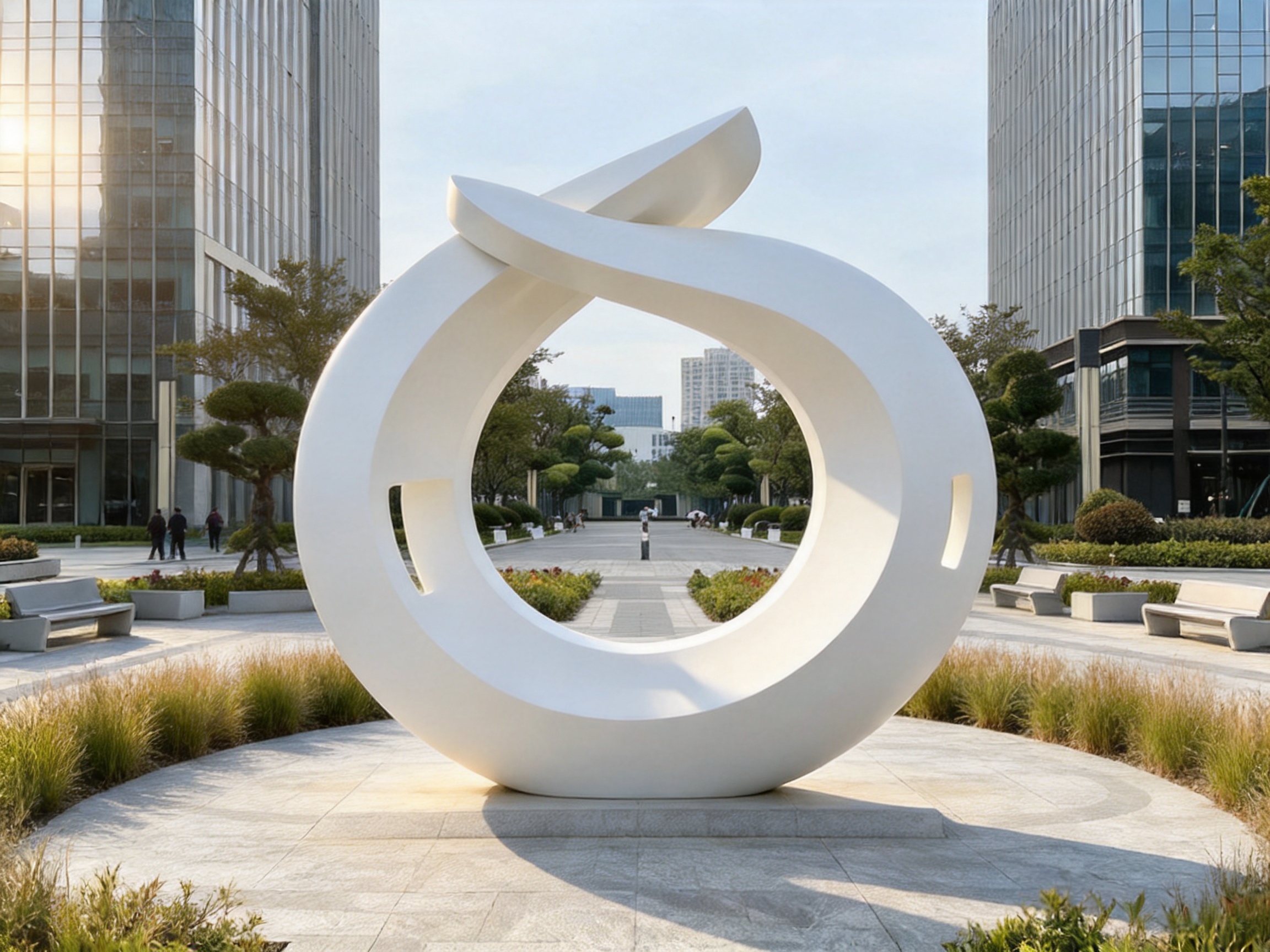
Contemporary public art increasingly depends on a careful balance between visual identity, engineering performance, and long-term maintenance. A sculpture placed in a shopping-mall plaza, community atrium, art district, hotel forecourt, or upscale club must do more than occupy space. It should establish a memorable focal point, complement the architecture around it, withstand changing weather conditions, and remain visually relevant as design trends evolve. The White Double-Opening Mobius Ring Stainless Steel Sculpture responds to these requirements through a carefully controlled combination of open geometry, corrosion-resistant stainless steel, matte white fluorocarbon finishing, and customizable dimensions.
Unlike a conventional closed circular ring, this sculpture is formed from two layered, heavy-gauge curved rings that remain deliberately open at two points along their circumferences. The openings create a distinctive asymmetric outline and introduce negative space into the composition. Rather than presenting a complete, uninterrupted loop, the design suggests movement, transformation, and continuity through an incomplete but visually connected structure. The result is an architectural sculpture that appears dynamic from multiple viewpoints while maintaining a restrained and highly organized overall form.
The sculpture is manufactured using 304 or 316 stainless steel, materials widely valued for their strength, corrosion resistance, and suitability for demanding indoor and outdoor applications. Both ring layers are finished in matte white fluorocarbon coating. This treatment produces a consistent, low-reflective surface across the complete structure, giving the sculpture a crisp appearance that differs from the mirror-polished surfaces often associated with stainless steel art. The finish emphasizes silhouette, shadow, proportion, and spatial relationships instead of relying primarily on reflected light.
Available in sizes from approximately 1.2 to 5 meters, the sculpture can be adapted to compact interior installations as well as larger public-facing landscape projects. Its size and paint color may be adjusted according to project requirements, allowing architects, landscape designers, developers, hospitality groups, and public-art planners to integrate the form into a broader visual program.
Content
The Mobius ring is associated with continuity, cyclic movement, and the relationship between a single surface and multiple perspectives. In this sculpture, the basic idea is interpreted through two layered curved rings rather than a simple closed band. The ring layers are intentionally interrupted at two points, creating openings that prevent the form from becoming a conventional circular loop. These interruptions are not accidental gaps. They are essential design elements that establish the sculpture’s distinctive character.
The open sections produce an asymmetric silhouette that changes as viewers move around the sculpture. From one angle, the structure may appear close to a pair of interwoven circular gestures. From another, the openings become more prominent, revealing the layered construction and emphasizing the passage of air and light through the form. This changing visual experience is particularly valuable in public spaces where people encounter the sculpture from different directions rather than from a single controlled viewing point.
A fully closed ring generally communicates stability, completion, and repetition. The double-opening configuration introduces a more active visual language. The eye follows the curves, pauses at the open sections, and then continues along the adjacent arc. This produces a sense of movement without requiring mechanical rotation or complicated ornamentation. The sculpture can therefore appear energetic while remaining appropriate for minimalist architectural settings.
The two layers also add depth. A single curved ring may read as a relatively simple outline, but the layered arrangement creates overlapping edges, interior shadows, and controlled visual tension. The layers can be positioned to achieve a balanced composition while preserving enough separation to keep the design legible. This balance between mass and openness helps the sculpture occupy a substantial physical presence without appearing visually heavy.
The openings in each ring perform several important aesthetic and practical functions. Visually, they create negative space that is as important as the stainless-steel surfaces. The viewer does not see only a solid object; instead, the sculpture frames portions of the surrounding building, sky, landscape, paving, and lighting. This creates a changing relationship between the artwork and its site.
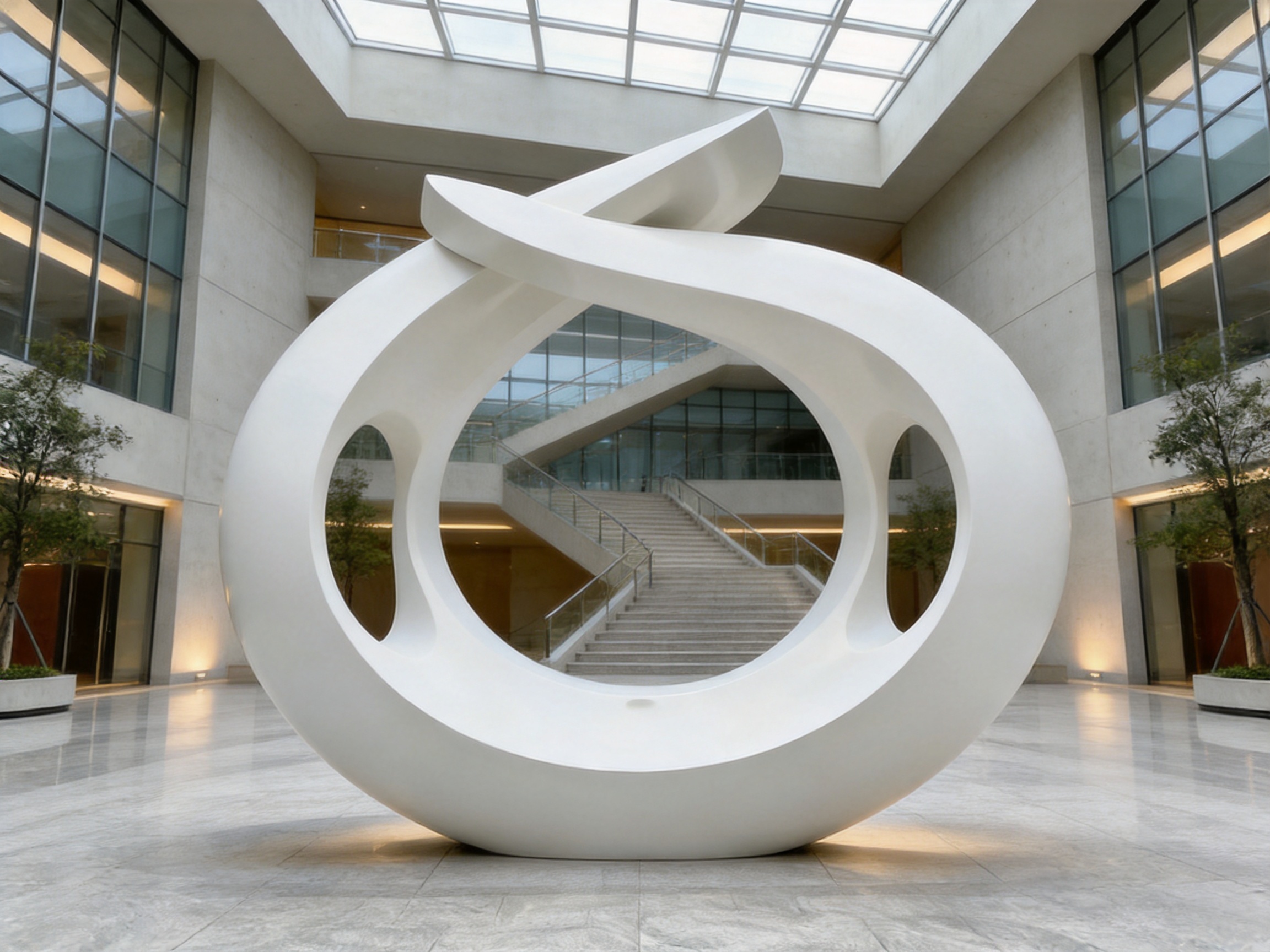
In a landscaped plaza, the openings may frame trees, planting beds, fountains, or distant architectural façades. In an atrium, they may reveal overhead skylights or multiple levels of circulation. In an art district, the gaps may create sightlines toward neighboring installations. The sculpture therefore interacts with its surroundings rather than functioning as an isolated object.
The open geometry also helps prevent the form from becoming excessively dense at larger dimensions. When a sculpture reaches several meters in height or width, a solid or heavily enclosed composition can create a stronger visual and structural load. The double-opening design retains a bold outline while allowing considerable air and light to pass through the ring layers.
From an engineering perspective, open areas may allow wind to move through the structure more easily than it would through a fully closed plate-like form. This can reduce the amount of uninterrupted surface exposed to wind pressure. Actual foundation and anchoring requirements must always be determined through project-specific structural calculations, local building codes, site conditions, and professional engineering review, but the open arrangement provides a useful starting point for installations subject to wind-loading considerations.
The balance of openness and material strength is one of the sculpture’s most important competitive advantages. It creates a visually substantial landmark without relying on excessive solid mass. This can support more efficient planning for plazas, atriums, and other sites where visual impact, circulation, and structural requirements must be considered together.
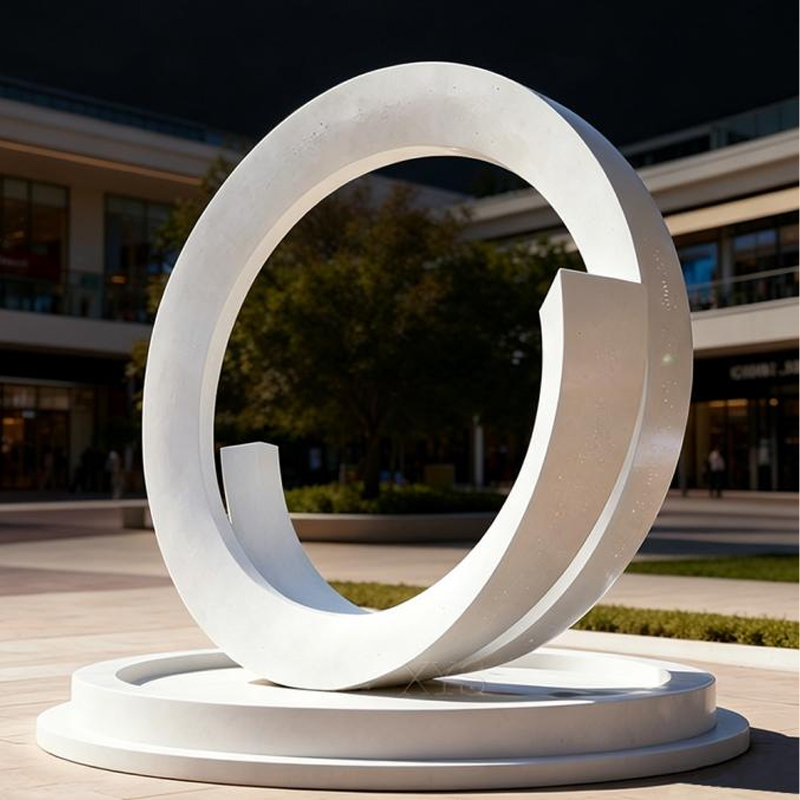
White Double-Opening Mobius Ring Stainless Steel Sculpture
Many stainless-steel sculptures emphasize mirror polishing, bright reflections, or highly decorative surface effects. Those treatments can be effective in certain settings, but they may also create strong glare, visually compete with surrounding architecture, or become less predictable under changing daylight conditions. The White Double-Opening Mobius Ring takes a different approach by using a matte white fluorocarbon coating.
The matte surface reduces direct reflection and gives the sculpture a soft, consistent appearance. Instead of producing a constantly changing mirror image, the coating allows the shape itself to remain the primary focus. Curves, openings, overlaps, and shadows become more legible because the viewer is not distracted by intense highlights or reflections of nearby buildings and pedestrians.
White also gives the sculpture a clean and highly adaptable visual identity. It can complement concrete, stone, glass, metal cladding, dark paving, green landscaping, and warm architectural lighting. In a luxury retail environment, the finish can support a refined, light-toned design language. In an art district, it can act as a neutral sculptural statement. In a community atrium, it can introduce a sense of openness and brightness without overwhelming the interior environment.
The fluorocarbon coating is applied evenly across the curved surfaces to create a consistent finish throughout the double-layer structure. Consistency is especially important for a geometric sculpture because uneven color, visible coating variation, or inconsistent gloss can weaken the clarity of the design. A controlled coating process helps preserve the intended relationship between the two layers and ensures that the openings remain visually prominent.
The coating is designed to resist yellowing, chipping, and fading under continuous ultraviolet exposure. This is a key consideration for outdoor display. A sculpture that begins with a pure white appearance but quickly discolors or loses its finish may require costly maintenance and may no longer support the original design concept. A durable exterior coating helps preserve the sculpture’s visual quality over an extended service period, subject to correct installation, local climate conditions, and an appropriate maintenance program.
White is not simply a color choice for this sculpture; it is a way of controlling how the artwork occupies space. A dark metal finish tends to emphasize mass and visual weight. A highly polished finish emphasizes reflection. A bright colored coating creates a stronger contrast and may become a dominant element within the site. Matte white occupies a different position. It is visible and distinctive, yet it remains compatible with many architectural palettes.
Under daylight, the white surface can appear bright and crisp. Under soft overcast conditions, the curves may take on a quieter sculptural quality. At night, carefully positioned lighting can emphasize the inner and outer edges, creating layered shadows and a luminous architectural silhouette. Because the surface is matte rather than mirror-polished, lighting designers have greater control over the visual result and are less likely to encounter harsh reflected glare.
The finish can also support a broader design strategy in which the sculpture serves as a visual transition between contrasting materials. It may bridge a dark stone plaza and a pale building façade, connect landscaping to a glass entrance, or soften the transition between polished commercial architecture and a more organic outdoor environment.
The sculpture is produced from 304 or 316 stainless steel, depending on the project specification and environmental requirements. Both grades are widely recognized for their durability and corrosion resistance, making them appropriate for architectural sculpture applications where the material must retain strength and appearance over time.
304 stainless steel is commonly used in architectural, decorative, and general outdoor applications. It offers a strong combination of corrosion resistance, fabrication suitability, and cost efficiency. For many inland urban, commercial, residential, and interior environments, it provides an effective foundation for a large-scale sculptural structure.
316 stainless steel contains molybdenum, which improves resistance to certain corrosive conditions, particularly those involving chlorides and marine exposure. It may therefore be considered for coastal locations, waterfront developments, areas exposed to salt spray, or sites where environmental conditions are more demanding. The final grade selection should be based on a site assessment that considers humidity, airborne salts, industrial pollutants, cleaning chemicals, and expected maintenance practices.
Using stainless steel rather than ordinary carbon steel provides several advantages for this product category. Stainless steel offers a durable structural base, supports clean curved fabrication, and reduces the risk of rust-related surface deterioration when correctly processed and maintained. It also works effectively beneath a painted finish, allowing the project to combine the performance benefits of stainless construction with the visual character of a matte white exterior.
The heavy-gauge construction contributes to the sculpture’s sense of solidity. Although the design contains open sections and flowing curves, it is not intended to look fragile or temporary. The substantial ring layers create a landmark presence suitable for public environments where the artwork must remain visually confident beside large buildings, broad plazas, and active pedestrian areas.
Material thickness, internal reinforcement, connection details, base design, and anchoring must be finalized according to the selected dimensions and installation conditions. A professional manufacturer should coordinate these technical factors with the buyer or project engineer before production. This is especially important for sculptures installed outdoors, in high-wind regions, or in areas with public access.
Jiangsu Xinyesheng Sculpture Co., Ltd. manufactures custom metal sculpture products for architectural, commercial, landscape, and public-art applications. The company’s production capability is particularly relevant to this double-opening ring sculpture because the design requires accuracy in curved fabrication, layer alignment, surface preparation, coating consistency, and final assembly.
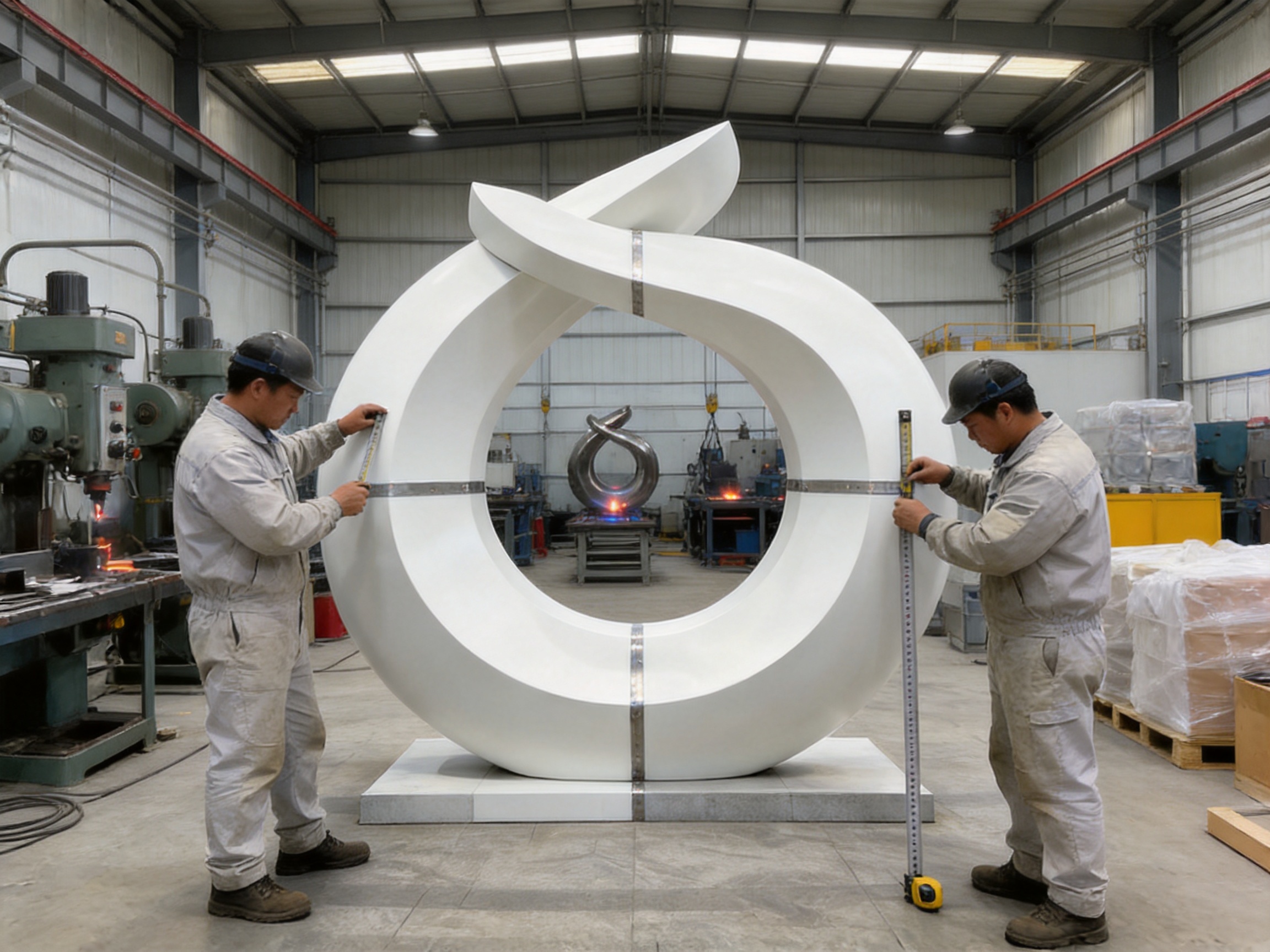
Manufacturing a large curved sculpture is more complex than producing a flat decorative panel. The ring layers must follow the intended radius and overall profile while maintaining a consistent relationship between the two forms. The open sections must be positioned accurately so that the asymmetry appears deliberate rather than irregular. Small deviations in curvature, angle, or spacing can become more visible as the sculpture increases in size.
A controlled production process begins with design confirmation. Dimensions, overall proportions, opening positions, ring-layer spacing, material grade, coating color, installation orientation, and foundation requirements should be reviewed before fabrication. For custom projects, drawings or digital models can help confirm the visual result and reduce ambiguity during production.
The next stage involves material preparation. Stainless-steel sheets, sections, or formed components are selected according to the approved design and structural requirements. Material identification and preparation are important because the finished sculpture must combine aesthetic precision with adequate load-bearing performance. Edges, joints, and transition areas require particular attention, especially where curved elements meet the base or connect with hidden reinforcement.
Curved fabrication is then carried out to create the ring profiles. Depending on the final design, this may involve bending, forming, cutting, welding, grinding, and fitting processes. The objective is to achieve smooth, continuous curves without visible distortion. Because the sculpture’s identity depends on its ring geometry, the fabrication team must check both individual components and the assembled relationship between the two layers.
Welding and joint treatment are also critical. Visible welds that are poorly blended can interrupt the clean architectural quality of the form. Appropriate welding procedures, controlled heat input, careful alignment, and thorough finishing help produce a more unified appearance. After welding, the surface may require grinding and refinement to reduce visual transitions and prepare it for coating.
Surface preparation determines how well the fluorocarbon finish bonds to the stainless-steel substrate. Cleaning, degreasing, abrasion, and other preparation steps remove contaminants and help create a suitable surface for coating. The exact process depends on the coating system and the manufacturer’s technical specifications. Consistent preparation across all curved surfaces is essential to achieving an even matte white result.
Before final delivery, the sculpture can be inspected for dimensional accuracy, surface quality, coating uniformity, weld treatment, hardware compatibility, and packaging protection. For large installations, the manufacturer may also coordinate sectional production or shipping arrangements to accommodate transport limitations. This production flexibility is valuable for projects in which the sculpture must travel internationally or be delivered to a site with restricted access.
| Production Element | Purpose | Value to the Project |
|---|---|---|
| Design confirmation | Establishes dimensions, openings, material, finish, and installation requirements | Reduces production ambiguity and supports accurate customization |
| Curved forming | Creates the double-ring profiles and intended asymmetric geometry | Preserves the sculpture’s distinctive silhouette |
| Layer alignment | Maintains the correct spacing and relationship between ring layers | Improves visual balance and depth from multiple viewpoints |
| Welding and blending | Connects components and refines transitions | Supports structural integrity and a cleaner architectural appearance |
| Surface preparation | Removes contaminants and prepares stainless steel for coating | Helps achieve consistent coating adhesion and appearance |
| Fluorocarbon coating | Provides the matte white exterior finish | Improves color consistency and outdoor visual durability |
| Final inspection | Checks dimensions, finish, components, and packing | Helps ensure readiness for shipment and installation |
The most immediate advantage of this sculpture over a conventional closed ring is its more distinctive silhouette. Closed circular forms are familiar and can appear visually predictable when used repeatedly in public landscapes. The double-opening design introduces interruption, tension, and directional movement, allowing the sculpture to establish a more individual identity.
The second advantage is the use of negative space. The openings prevent the sculpture from becoming a solid visual barrier and allow the surrounding site to remain part of the composition. This can be especially useful in locations where planners want an artwork to attract attention without blocking views, circulation paths, entrances, or landscape features.
The third advantage is reduced reliance on reflectivity. A mirror-polished ring can create dramatic effects, but it may also reflect vehicles, signage, neighboring structures, and direct sunlight in ways that compete with the sculpture’s shape. The matte white finish presents a more controlled appearance and can be easier to integrate into a carefully designed architectural environment.
The fourth advantage is adaptability. The sculpture is available in a broad size range from approximately 1.2 to 5 meters, and the color can be adjusted beyond pure white when required. This allows the same fundamental design language to serve different project types. A smaller version may work as an interior lobby feature, while a larger model may anchor an outdoor plaza or entrance court.
The fifth advantage is material choice. The use of 304 or 316 stainless steel provides a durable foundation for the sculpture, while the fluorocarbon coating adds an additional layer of visual and environmental protection. Buyers can select the grade according to the site rather than relying on a single material specification for every project.
Compared with sculptures built primarily from ordinary painted steel, stainless-steel construction can provide stronger resistance to corrosion-related deterioration when properly fabricated and maintained. Compared with sculptures made from fragile composite materials, the heavy-gauge metal structure can provide a more substantial public-art presence. Compared with ornate decorative forms, the restrained geometry may remain relevant for longer as architectural preferences change.
Shopping-mall plazas often require a landmark that is recognizable, photogenic, and compatible with high pedestrian activity. The sculpture can be placed near an entrance, central gathering area, outdoor seating zone, or landscaped court. Its white surface can align with a light-toned commercial façade, while its open form maintains visual permeability across the plaza.
Because the sculpture is legible from several directions, it can support wayfinding and place identity. Visitors may use it as a meeting point or visual reference. At night, integrated landscape or architectural lighting can reinforce its profile without requiring the surface to become highly reflective.
In a community atrium, the sculpture can introduce a strong central form without creating the visual heaviness of a solid monument. The openings help preserve sightlines across the interior, while the matte white surface reflects soft ambient light without producing intense glare.
The layered rings can also echo architectural themes such as circulation, connection, continuity, and shared public space. Positioned in a large lobby or multi-level atrium, the sculpture can be viewed from balconies, stairways, and adjacent corridors, allowing its changing silhouette to become part of the daily experience of the building.
Art districts often benefit from outdoor works that are visually memorable but not tied too closely to a temporary trend. The sculpture’s minimalist geometry gives it a contemporary identity while leaving room for interpretation. Viewers may read the open rings as symbols of connection, renewal, movement, balance, or incomplete cycles.
The neutral white finish also allows the sculpture to coexist with murals, colorful installations, historic architecture, and changing exhibitions. It can function as a quiet counterpoint to more expressive works without losing its own presence.
Hotels, resorts, private clubs, and premium residential developments frequently use sculpture to strengthen the identity of arrival areas and outdoor lounges. The double-opening ring can create an elegant visual marker near a porte-cochère, garden, pool terrace, or reception entrance.
Its clean silhouette is compatible with refined landscaping and contemporary lighting. A custom color may be selected if the project requires a warmer metallic tone, deep neutral, or branded architectural palette, while the original white version remains particularly effective for light, minimalist schemes.
Corporate campuses, research centers, galleries, and institutional buildings may use the sculpture to express innovation, collaboration, continuity, or forward movement. The open geometry can support these themes without relying on literal figurative imagery.
Placed at a building entrance or internal courtyard, the sculpture can create a lasting visual signature. Its material and finish communicate precision, while its asymmetry suggests creativity and transformation. This combination can be appropriate for organizations seeking a public artwork that feels modern but not excessively decorative.
The available size range of approximately 1.2 to 5 meters allows the sculpture to be adapted to different spatial conditions. Selecting the correct scale requires more than measuring the available footprint. The surrounding building height, pedestrian distance, viewing angles, landscape density, and expected lighting conditions should all be considered.
A 1.2-meter version may function as a compact decorative sculpture in a lobby, private courtyard, garden, or reception area. At this scale, viewers can inspect the layered ring geometry more closely and appreciate the surface finish and fabrication details.
Medium-sized versions can serve as focal points in courtyards, entrance plazas, hotel gardens, and commercial interiors. They may be large enough to establish presence while remaining appropriate for spaces where people circulate closely around the artwork.
At the upper end of the range, a sculpture approaching 5 meters can become a major landmark. It may be used in a broad plaza, campus entrance, large atrium, or public landscape. Larger installations require careful review of transport access, lifting procedures, foundation construction, wind loads, pedestrian safety, lighting, and maintenance access.
Proportion is equally important. The relationship between the two ring layers, the size of the openings, the thickness of the material, and the overall height determines whether the sculpture feels light, balanced, monumental, or dynamic. Custom engineering and design review can help ensure that the selected version is appropriate for the site rather than simply being scaled mechanically.
The installation area should provide enough clearance for the sculpture to be viewed from multiple directions. Designers should avoid placing it directly against a visually chaotic background if the intention is to emphasize the clarity of the white silhouette. At the same time, a controlled contrast with dark paving, green foliage, textured stone, or shadowed architecture can make the form more visually prominent.
Although the sculpture is visually open, it still requires a properly designed support and anchoring system. The base, anchor bolts, concealed reinforcement, and foundation must be matched to the sculpture’s size, weight, center of gravity, local wind conditions, soil characteristics, and applicable construction codes.
For outdoor installations, a site engineer should review wind exposure, drainage, frost conditions, seismic requirements where applicable, and public access. The sculpture should be installed on a stable, level foundation capable of transferring loads safely into the ground. The exact foundation solution may vary from a reinforced concrete pad to a more specialized structural base depending on the project.
The open ring sections can allow wind to pass through more readily than a solid closed plate, potentially reducing wind pressure on the structure. However, openness does not eliminate the need for structural analysis. Large curved surfaces can still experience complex forces, particularly when the sculpture is installed in an exposed plaza, coastal site, or elevated location.
Installation planning should also consider delivery routes. A large sculpture may need to be shipped in assembled or partially assembled sections depending on road restrictions, door dimensions, crane access, and site logistics. The manufacturer and installation team should establish lifting points, connection procedures, protective packing requirements, and on-site assembly instructions before dispatch.
Once installed, the sculpture should be inspected to confirm alignment, finish condition, anchor security, drainage around the base, and safe clearance from pedestrian circulation. Any protective film or temporary packaging should be removed carefully to avoid damaging the coating.
The matte white fluorocarbon coating is designed to support long-term outdoor use, but routine maintenance remains important. Dust, airborne pollutants, bird deposits, pollen, salt, and other contaminants can accumulate on any exterior sculpture. Regular cleaning helps preserve the brightness and consistency of the finish.
Cleaning procedures should follow the coating supplier’s recommendations. In general, gentle methods using clean water, soft cloths, or non-abrasive tools are preferable. Harsh solvents, abrasive pads, aggressive pressure washing, and unapproved chemicals may damage the coating or alter its matte texture.
Coastal installations may require more frequent rinsing because salt deposits can accumulate on exposed surfaces. Industrial or urban sites may also need periodic cleaning to remove airborne pollutants. A maintenance schedule should be based on local climate, pollution levels, rainfall, nearby vegetation, and the visibility standards expected by the property owner.
Annual or periodic inspections should review the coating, weld areas, base connections, drainage, anchor components, and any joints or access panels. Early identification of scratches, impact damage, or unusual corrosion can allow for localized repair before the problem becomes more extensive.
Maintenance planning is one of the areas in which a professionally manufactured stainless-steel sculpture can offer an advantage over less durable alternatives. When the substrate, surface preparation, coating, and installation are properly coordinated, the owner can maintain the sculpture through a structured care program rather than relying on frequent major refinishing.
The essential character of the sculpture is established by its double-opening, layered ring geometry, but several aspects may be customized. Size is the most obvious option. The sculpture can be produced within the approximate range of 1.2 to 5 meters, subject to engineering review and project specifications.
Color can also be adjusted. Pure matte white is the defining finish of the supplied version, but other coating colors may be considered when the project requires coordination with a corporate identity, architectural palette, landscape concept, or public-art program. Any alternative color should be reviewed for gloss level, ultraviolet performance, surface appearance, and compatibility with the intended location.
Material grade may be selected according to environmental exposure. 304 stainless steel may be suitable for many inland and sheltered environments, while 316 stainless steel may be preferable for coastal or chloride-sensitive conditions. The choice should be made with input from the project architect, engineer, or material consultant when the site presents unusual risks.
Lighting can be integrated into the site design even when it is not built into the sculpture itself. Ground-mounted uplights, concealed linear lighting, or carefully positioned architectural fixtures can emphasize the openings and layered curves. Because the surface is matte, the lighting concept can focus on revealing form and shadow rather than producing reflections.
Mounting details may also be adapted to the site. A sculpture installed on a plaza may require a robust concealed base and reinforced foundation, while an interior atrium installation may use a different support arrangement. All structural and installation changes should be confirmed before production to ensure that the final product remains safe and visually balanced.
For developers, a distinctive sculpture can strengthen the identity of a project and create a recognizable visual feature for marketing, visitor orientation, and social-media photography. The white double-opening ring offers a strong silhouette without requiring a highly complex figurative subject. Its abstract quality allows it to remain relevant across different tenant groups and future changes in property use.
For architects and landscape designers, the sculpture provides a flexible geometric element that can be positioned within a broader composition of paving, planting, lighting, water, and architecture. Its open form offers opportunities for framed views and layered site design. Its neutral finish gives designers considerable freedom when coordinating surrounding materials.
For property owners, the combination of stainless steel and fluorocarbon coating can support a practical balance between appearance and durability. The sculpture is designed for long-term display and can be maintained through regular cleaning and inspection. Its resistance to yellowing, chipping, and fading under ultraviolet exposure helps protect the original design intent.
For public-art planners, the sculpture can function as a symbolic and accessible work. The ring form is easy to recognize, while the open sections encourage viewers to think about continuity, connection, transformation, and the relationship between solid material and empty space. Its abstract nature permits different interpretations without requiring extensive explanatory signage.
Successful custom sculpture production depends on clear communication between the buyer, design team, manufacturer, structural consultant, and installation contractor. Before placing an order, the project team should confirm the target dimensions, material grade, finish, color, installation location, foundation condition, expected delivery date, and site access limitations.
Reference drawings, site photographs, elevation information, and dimensional constraints can help the manufacturer prepare an appropriate proposal. If the sculpture will be placed in a high-wind, coastal, seismic, or publicly accessible location, those conditions should be disclosed at the beginning of the project.
The quoted product range is approximately $1,610 to $4,830, depending on size, material, finish, customization, packaging, shipping, and project-specific requirements. The final quotation should be confirmed after the technical details have been reviewed. International projects should also account for freight, customs, unloading, installation equipment, local taxes, and foundation work.
Jiangsu Xinyesheng Sculpture Co., Ltd. can be contacted for product consultation, customization, technical coordination, and commercial discussion. The company’s available contact information includes telephone numbers and email communication for project inquiries. Buyers should request current technical documents, finish information, packing details, production lead time, and installation guidance before final approval.
The sculpture uses two layered curved rings that are deliberately open at two points along each circumference. These openings create an asymmetric silhouette, increase negative space, and produce a more dynamic visual effect than a fully closed circular ring.
Yes. It is manufactured from 304 or 316 stainless steel, with the final grade selected according to the project environment and requirements. 316 stainless steel may be especially suitable for coastal or chloride-exposed locations.
The supplied version uses a matte white fluorocarbon coating. The finish is designed to create a consistent, low-reflective surface and to resist yellowing, chipping, and fading under continuous ultraviolet exposure when properly applied and maintained.
Yes. Although matte white is the primary finish, the paint color can be adjusted for a project’s architectural palette or design concept. The selected color, gloss level, and coating specification should be confirmed before production.
The sculpture is offered in approximate sizes from 1.2 to 5 meters. The appropriate size depends on the installation location, viewing distance, surrounding architecture, structural conditions, and transportation requirements.
Yes. The stainless-steel construction and exterior fluorocarbon coating are intended to support outdoor display. Outdoor projects still require suitable foundation design, anchoring, drainage, structural review, and regular maintenance.
The open sections allow air to pass through the structure more easily than a fully closed plate-like form may permit. This can help reduce uninterrupted wind exposure, but a qualified engineer must determine the actual wind loads, foundation, and anchoring requirements for each site.
Yes. It can be installed in atriums, lobbies, galleries, clubs, hotels, community buildings, and other interior spaces. Indoor installations may use different support, lifting, and finishing requirements depending on the building conditions.
Cleaning should generally use gentle methods recommended for the coating system, such as clean water and soft, non-abrasive materials. Abrasive pads, harsh solvents, and unapproved chemicals should be avoided. The exact maintenance procedure should be confirmed with the manufacturer or coating supplier.
Depending on its final size and the delivery conditions, the sculpture may be manufactured or shipped in sections. The production and logistics plan should be agreed upon in advance, especially when site access, road transport, elevators, or lifting equipment are limited.
Useful information includes the desired height or overall dimensions, installation location, indoor or outdoor use, preferred stainless-steel grade, finish color, site climate, foundation status, delivery destination, and any special access or installation limitations.
The listed price range is approximately $1,610 to $4,830. The final price may vary according to size, material grade, finish, customization, packaging, shipping, installation requirements, and other project-specific factors.
The White Double-Opening Mobius Ring Stainless Steel Sculpture combines a recognizable circular language with a more individual and contemporary interpretation. Its two layered rings, deliberate openings, and asymmetric profile create a form that changes with viewpoint while maintaining visual clarity. The sculpture is neither a conventional closed ring nor an overly ornate decorative object. It occupies a middle ground in which geometry, negative space, and material performance work together.
Its 304 or 316 stainless-steel construction provides a durable foundation for indoor and outdoor applications. The matte white fluorocarbon finish gives the sculpture a controlled architectural appearance, reduces visual glare, and supports a clean integration with modern buildings, landscaped plazas, commercial developments, cultural spaces, and hospitality environments. The coating’s resistance to yellowing, chipping, and fading under ultraviolet exposure further supports long-term visual performance when combined with correct installation and maintenance.
The sculpture also benefits from a manufacturing approach centered on curved fabrication, layer alignment, joint treatment, surface preparation, coating consistency, inspection, and project coordination. These processes are particularly important because the quality of a minimalist sculpture depends on precision. When there are few decorative elements to distract the eye, the accuracy of every curve, opening, transition, and surface becomes more apparent.
With sizes from approximately 1.2 to 5 meters, adjustable color options, and the choice of 304 or 316 stainless steel, the sculpture can be tailored to a wide range of architectural and landscape requirements. Its open structure can contribute to visual permeability and may offer practical benefits in sites where wind exposure must be carefully considered. Above all, it provides developers, designers, and property owners with a distinctive landmark capable of communicating continuity, movement, balance, and modernity.
1. Architectural Institute resources on the selection and use of stainless steel in exterior architectural applications.
2. International standards and technical guidance concerning austenitic stainless-steel grades, including 304 and 316 stainless steel.
3. Technical literature on fluoropolymer and fluorocarbon coatings for architectural metal surfaces.
4. General engineering guidance on wind-load assessment, foundation design, and anchoring for outdoor public art.
5. Publications on contemporary sculpture, negative space, geometric abstraction, and site-specific architectural art.
6. Manufacturer-supplied product information for the White Double-Opening Mobius Ring Stainless Steel Sculpture.
7. Professional guidance on the cleaning, inspection, and maintenance of coated stainless-steel architectural structures.



Daniel H.

Amanda R.

Robert B.

Jennifer S.

James W.

Barry G.

Michael T.

Emily K.

David L.

Sarah M.


Mikey XV

Jagxue

 English
 Español
 عربى
 Français
 italiano
 Deutsch