Content
The Mirror-Polished Water-Drop Flame Stainless Steel Sculpture is a contemporary metal artwork designed around a compelling visual paradox. Its flowing profile combines the downward movement of a falling droplet with the upward energy of a flame. Although water and fire traditionally represent opposing forces, the sculpture unites them in one continuous stainless steel form, creating an artwork that can suggest calmness, vitality, transformation, and movement at the same time.
Made from corrosion-resistant 304 or 316 stainless steel and finished with a full 8K mirror polish, the sculpture is designed to function as both a decorative object and an architectural focal point. Its surface reflects the surrounding environment, daylight, landscape planting, architectural lines, and artificial illumination. As viewers move around it, the appearance changes continuously. One angle may emphasize a tapering water droplet, while another may reveal the uplifted gesture of a flame.
This changing visual character gives the work advantages over many conventional outdoor statues. A traditional solid-form sculpture may offer a fixed silhouette, while this fluid stainless steel design interacts with its surroundings. It does not merely occupy a site; it visually absorbs and reinterprets the site. In a reflecting pool, it can appear to emerge from water. In a hotel forecourt, it can become a polished emblem of sophistication. In an office development, it can communicate progress, energy, and refined modernity.
Produced by Jiangsu Xinyesheng Sculpture Co., Ltd., the sculpture reflects the capabilities of a specialized Chinese sculpture manufacturer experienced in custom metal artwork, stainless steel fabrication, finishing, and project-oriented production. The company supplies sculptures for architectural, commercial, residential, hospitality, and landscape applications, with the ability to provide multiple sizes and support tailored design requirements.
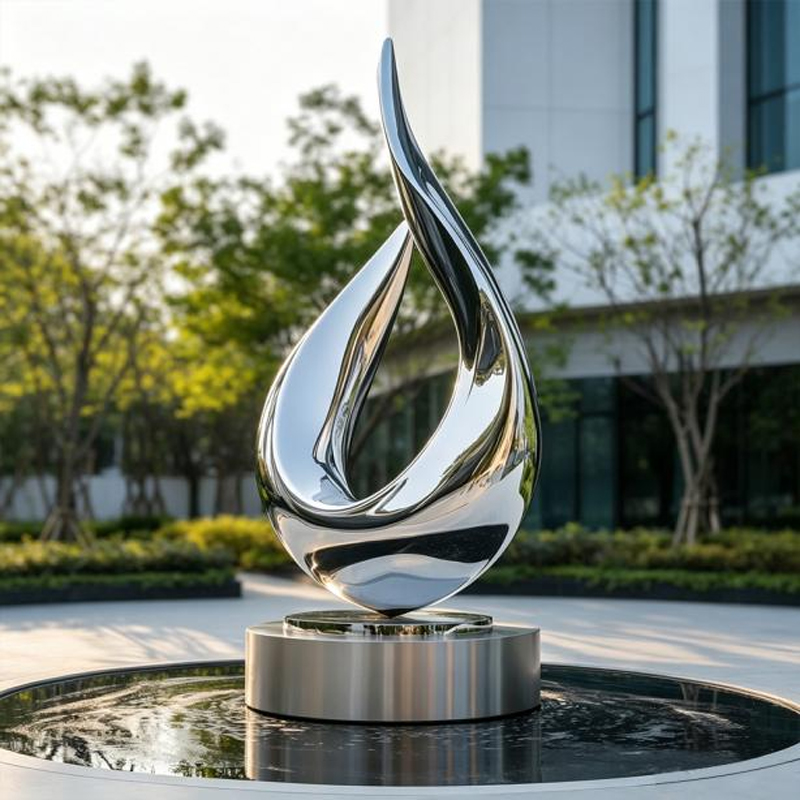
Mirror-Polished Water-Drop Flame Stainless Steel Sculpture
The Mirror-Polished Water-Drop Flame Stainless Steel Sculpture is available in heights ranging from 1.0 meters to 4.2 meters. This size range allows the design to serve different spatial roles. A smaller version can complement an interior-adjacent entrance, reception area, private courtyard, or compact landscape composition. Larger versions can function as major landmarks in hotel forecourts, commercial developments, public gardens, office campuses, sales centers, and large private estates.
The sculpture is offered in 304 or 316 stainless steel. Both grades provide strong resistance to corrosion and are widely used in architectural and decorative applications. Grade 304 is suitable for many inland, urban, indoor, and general outdoor environments. Grade 316 offers enhanced resistance in more demanding conditions, including coastal areas, humid climates, and locations where salt exposure or airborne contaminants may be a concern.
The exterior is finished with an 8K mirror polish. This finish produces a bright, highly reflective surface that can make the artwork appear lighter, cleaner, and more dynamic than a painted or matte sculpture. Instead of presenting a single fixed color, the sculpture reflects blue skies, green planting, stone paving, surrounding architecture, warm evening lighting, and seasonal changes. The result is a surface that remains visually active throughout the day.
The primary product specifications are summarized below.
| Item | Specification | Application Value |
|---|---|---|
| Product type | Decorative stainless steel sculpture | Suitable for architectural, commercial, hospitality, residential, and landscape projects |
| Concept | Falling water droplet combined with an upward flame | Provides symbolic depth and a recognizable contemporary silhouette |
| Material options | 304 or 316 stainless steel | Allows material selection according to climate, location, and budget |
| Surface finish | Full 8K mirror polish | Creates strong reflection, brightness, and visual interaction with the surroundings |
| Available height | 1.0 to 4.2 meters | Accommodates compact courtyards and large-scale outdoor installations |
| Indicative price range | USD 1,590 to USD 4,560 | Supports different project budgets and size requirements |
| Maintenance | Routine wiping and periodic cleaning | Helps preserve the polished appearance over long-term use |
| Environmental suitability | Indoor-adjacent and outdoor use | Appropriate for gardens, forecourts, water features, and reflecting pools |
One of the sculpture’s strongest advantages is its ability to communicate an idea without relying on complex figurative details. The profile is simple enough to be understood from a distance, yet sufficiently fluid and ambiguous to reward closer observation. The lower or tapering movement evokes a droplet falling under gravity. The upper curve suggests a flame reaching upward, with a sense of flickering motion and continuous energy.
This dual image gives the sculpture greater conceptual range than a purely decorative abstract object. Water can symbolize flexibility, renewal, clarity, patience, and persistence. Fire can symbolize energy, ambition, transformation, light, and life. By joining these two visual languages, the sculpture can support different interpretations depending on the setting and the client’s intended message.
In a corporate environment, the water element may suggest adaptability and steady progress, while the flame element may represent innovation and ambition. In a hotel or resort, the work can express luxury, vitality, and a connection with natural forces. In a private courtyard, it can serve as a contemplative object whose appearance changes with sunlight and weather. In a water landscape, it can reinforce the relationship between sculpture, reflection, movement, and stillness.
The design is also suitable for projects that require modern elegance rather than excessive ornamentation. Its visual language is contemporary and restrained. It does not depend on elaborate classical decoration, bright paint, or numerous secondary details. The form itself supplies the drama, while the mirror surface provides richness and depth.
Compared with generic geometric sculptures, the water-drop flame design has a clearer narrative foundation. Compared with realistic figurative sculpture, it is more adaptable to modern architecture and minimalist landscaping. Compared with ordinary polished columns or spheres, it offers a more distinctive silhouette and a stronger emotional association.
The manufacturing process begins with the selection of stainless steel appropriate to the project. The choice between 304 and 316 stainless steel can be made according to the installation environment, desired service life, exposure conditions, and overall budget. Material selection is not only a technical decision; it also influences the long-term appearance and maintenance requirements of the finished sculpture.
Stainless steel is particularly valuable for outdoor sculpture because it combines strength, formability, corrosion resistance, and a clean architectural appearance. Unlike many painted metals, it does not rely on a colored coating to create its visual identity. Its character comes from the material itself and from the precision of the surface finishing process.
For demanding coastal or highly humid locations, 316 stainless steel can provide an additional level of protection. For many urban, inland, garden, and general architectural installations, 304 stainless steel offers an effective balance between performance and cost. Jiangsu Xinyesheng Sculpture Co., Ltd. can assist buyers in selecting the appropriate grade according to the intended site conditions.
The sculpture’s apparently simple shape requires careful fabrication. A water droplet and a flame do not follow the same visual direction. One is associated with descent, gravity, and tapering weight; the other is associated with ascent, flicker, and expansion. If the proportions are not controlled carefully, the result may look like an undefined abstract form rather than a convincing combination of both images.
To address this challenge, the forming process focuses on maintaining a continuous fluid curve. The silhouette must narrow and expand at carefully considered points so that the form retains both downward and upward visual movement. The transition between the two gestures must appear intentional rather than mechanically joined.
In custom sculpture production, proportion control is especially important when the same design is produced at different scales. A form that looks balanced at 1.0 meter may appear too thin, too heavy, or visually weak at 4.2 meters if it is enlarged without adjustment. A capable manufacturer must therefore consider visual mass, surface tension, curve continuity, structural requirements, and viewing distance when producing different sizes.
The fabrication team’s experience with large decorative metal forms helps ensure that the final piece retains the essential design character across the available size range. The objective is not merely to make a larger or smaller copy, but to preserve the recognizable relationship between the droplet and flame elements at each scale.
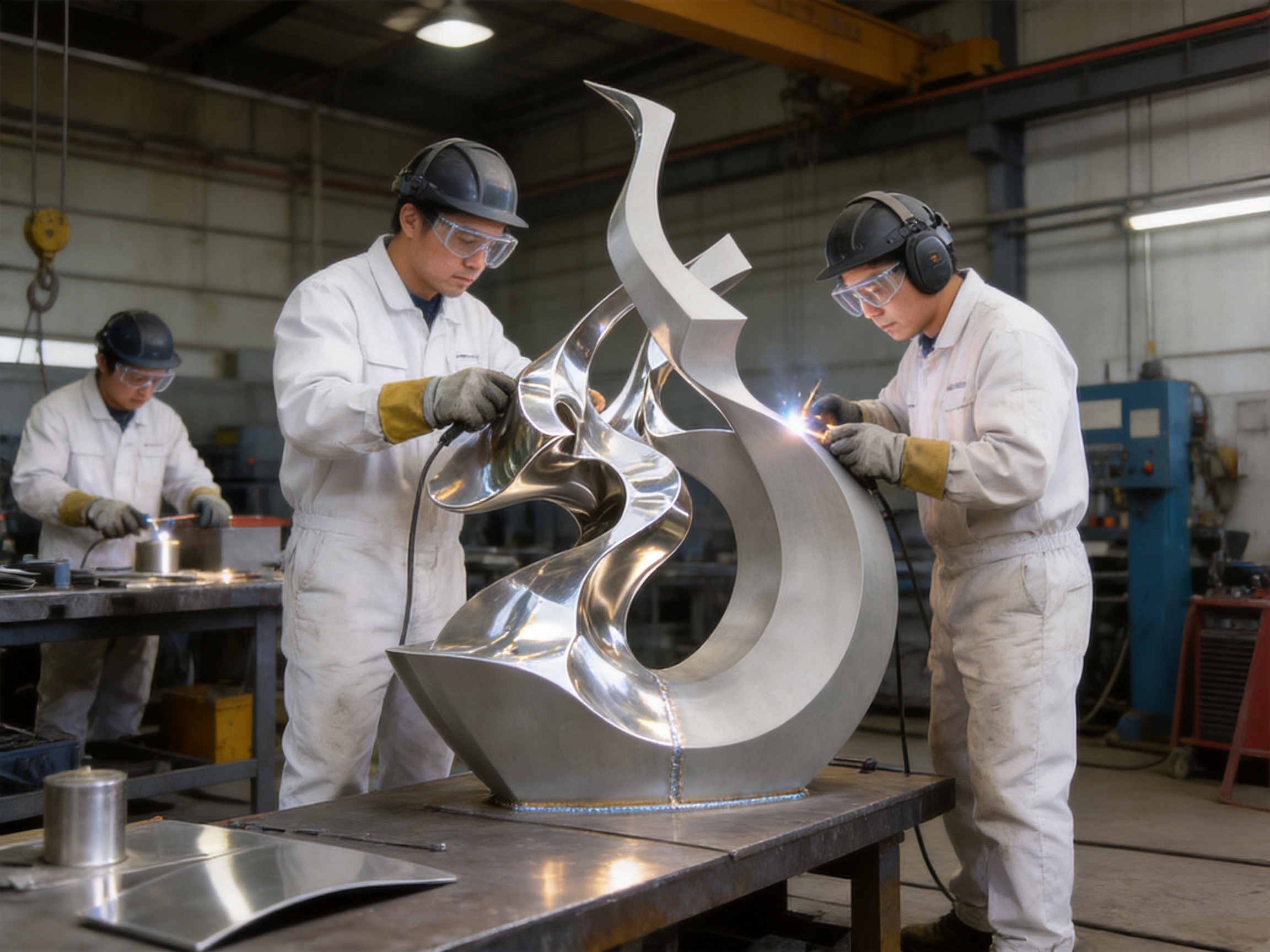
Stainless steel sculpture frequently requires multiple formed sections to be joined into a unified body. Welding and joining must be carefully managed because visible seams can interrupt the illusion of continuous movement. On a mirror-polished surface, even small inconsistencies may become noticeable when light reflects across the metal.
For this reason, the joining process must be followed by careful grinding, blending, and surface preparation. The goal is to reduce visible transitions and create a smooth visual flow across the sculpture. This is particularly important around the narrow tapering areas, where the eye naturally follows the curve and any discontinuity can affect the perceived quality of the form.
Compared with low-cost decorative metal products that may rely on visible seams, uneven edges, or inconsistent polishing, a professionally fabricated stainless steel sculpture offers a more refined appearance. It is intended to be viewed from multiple directions, not only from one selected front elevation. The quality of the joining and blending process therefore contributes directly to the sculpture’s value.
The 8K mirror finish is one of the product’s most important competitive advantages. Achieving a bright and consistent mirror surface requires more than applying a surface coating. It involves progressive preparation, smoothing, polishing, inspection, and correction.
The surface must first be prepared so that irregularities, scratches, welding marks, and small imperfections are minimized. Successive abrasive stages can then be used to refine the surface before final polishing brings out the high reflectivity associated with an 8K finish. The process demands patience and consistency because the curved body contains changing angles and different reflection paths.
A high-quality mirror polish enhances the sculpture in several ways. It increases visibility from a distance, gives the object a premium architectural presence, and allows the surrounding environment to become part of the artwork. It also makes the sculpture visually responsive to weather and time. Morning light, afternoon sun, cloudy skies, landscape greenery, and nighttime illumination can all create different appearances.
Compared with powder-coated or painted sculptures, the mirror-polished surface can provide a more luxurious and timeless look. Painted metal may offer a strong fixed color, but it generally remains visually static. The polished stainless steel surface changes according to its surroundings, making it particularly effective in modern commercial settings where the artwork should remain engaging throughout the day.
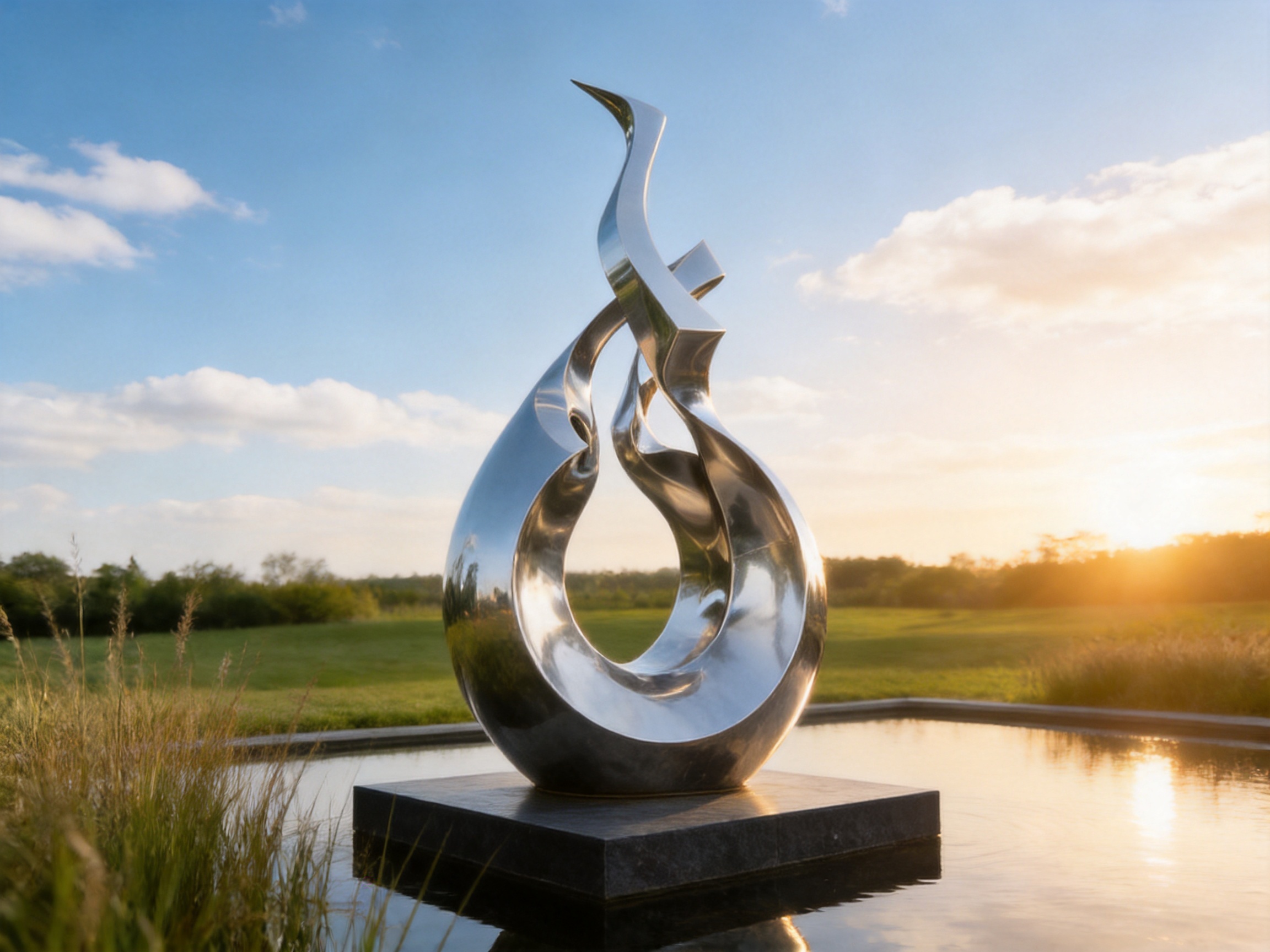
Many contemporary outdoor sculptures use basic geometric forms such as rings, spheres, cones, cubes, or intersecting panels. These shapes can be attractive, but they may lack a clear symbolic narrative. The Water-Drop Flame Sculpture is also modern and abstract, yet it has a stronger conceptual foundation. Its silhouette links two universally familiar natural elements, allowing viewers to form an immediate visual association.
This recognition can be valuable in commercial and public spaces. A sculpture that can be discussed, named, and remembered may contribute more effectively to a project’s identity than an object whose meaning is difficult to explain. The combined water-and-flame concept gives architects, designers, property developers, and marketing teams a story that can be integrated into presentations and site narratives.
The mirror-polished surface differentiates the sculpture from products with fixed finishes. Its appearance is never entirely isolated from its location. It reflects surrounding architecture, paving, planting, water, sky, and lighting. As a result, the same sculpture can look different when installed at a hotel, a corporate campus, a luxury residence, or a garden.
This environmental responsiveness makes the product more adaptable than a sculpture designed around one permanent color. It can complement cool gray stone, warm beige architecture, green landscapes, blue water features, and contemporary glass buildings. The sculpture does not compete with every surrounding color; instead, it often borrows and reorganizes those colors through reflection.
During daylight, the 8K finish captures natural light and moving reflections. At night, carefully positioned landscape lighting can emphasize the curves and create a dramatic luminous effect. Linear lights, concealed uplighting, pool illumination, or soft architectural lighting can all be used to reveal the form without overwhelming its reflective surface.
This day-to-night versatility offers an advantage over artworks that are visible mainly under one lighting condition. For hospitality, commercial, and sales environments, the sculpture can support daytime branding as well as evening atmosphere. It may appear crisp and architectural in the morning, bright and energetic in the afternoon, and elegant or theatrical after sunset.
The 1.0-to-4.2-meter size range gives buyers more freedom than a single fixed-size product. Smaller pieces can be placed in entry courts, indoor-outdoor transition zones, landscaped terraces, or private gardens. Larger versions can establish a stronger presence in open spaces and serve as a visual marker for a building or development.
Because the design remains visually legible at different heights, it can be used in projects with different spatial proportions. A buyer does not need to select a completely different design simply because the available site is larger or smaller. Instead, the size can be coordinated with the surrounding architecture, pedestrian distance, viewing angle, and installation base.
The sculpture is not only designed to attract attention at the time of installation. Its material and finish are selected for long-term use. Stainless steel is weather-resistant, and the absence of a conventional painted coating reduces concerns about peeling or color fading associated with some painted metal products.
Routine wiping and periodic cleaning can help maintain the reflective appearance. In dusty or polluted environments, more frequent cleaning may be appropriate. In coastal areas, regular removal of salt deposits is especially important, even when 316 stainless steel is selected. Proper maintenance is straightforward and can be incorporated into the normal care schedule for surrounding landscape and architectural surfaces.
The sculpture is well suited to office-building water features where a modern landmark is needed near an entrance, plaza, or reception approach. Positioned in a reflecting pool, it can appear to rise directly from the water. The downward droplet gesture reinforces the relationship with the pool, while the flame-like upper curve communicates energy and aspiration.
For corporate environments, the artwork can serve as more than decoration. It can support an identity based on innovation, balance, sustainability, adaptability, or forward movement. The clean stainless steel surface also works well with glass façades, stone paving, exposed concrete, and contemporary landscape design.
Sales offices often require a strong visual feature that helps create an immediate impression of quality. A mirror-polished sculpture positioned at the entrance or in a central courtyard can provide a recognizable focal point for visitors and prospective buyers.
The water-and-flame concept can also be adapted to the narrative of a property development. Water may suggest a refined landscape and a relaxed lifestyle, while fire may suggest ambition, modernity, and distinctive design. In a premium sales environment, the artwork can help establish an atmosphere of exclusivity without relying on excessive ornamentation.
Hotels and resorts benefit from sculptural elements that are visible in photographs, memorable after a visit, and compatible with day and night presentation. The polished surface can reflect entrance lighting, landscaped planting, fountains, and the movement of arriving guests and vehicles.
At a hotel forecourt, the sculpture can be used as a signature visual element near the driveway or main entrance. At a resort, it can be placed beside a reflecting pool, garden path, terrace, or lobby approach. The form’s natural references make it suitable for wellness-oriented properties, while its reflective finish supports a luxury positioning.
In a private courtyard, the sculpture can provide a concentrated focal point without making the landscape feel crowded. Its simple silhouette is especially effective against a clean stone platform, dark paving, clipped planting, or a quiet water surface.
The work is best supported by a relatively uncluttered setting. Busy planting arrangements, complicated paving patterns, or numerous competing ornaments may reduce the clarity of the water-and-flame profile. A restrained landscape allows the reflective surface to capture its surroundings while keeping the central form visually dominant.
The sculpture can also be considered for cultural campuses, commercial plazas, municipal gardens, mixed-use developments, and other semi-public areas. The symbolic combination of water and flame can encourage interpretation and conversation, while the durable stainless steel construction supports repeated viewing in an outdoor environment.
For such projects, important considerations include pedestrian safety, foundation design, lighting, drainage, installation access, and the relationship between the sculpture and nearby circulation routes. These requirements should be addressed during the planning stage rather than after production has begun.
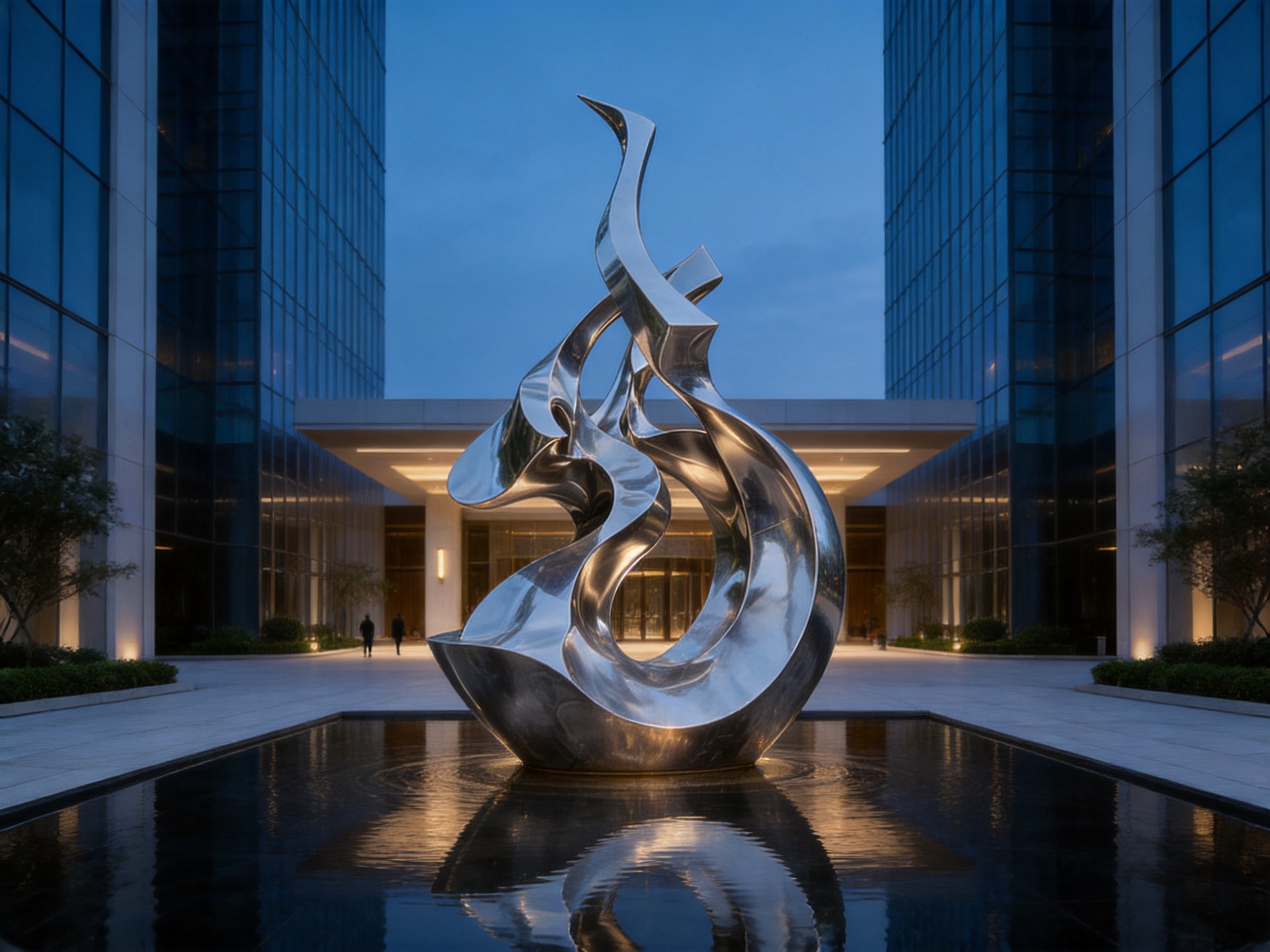
The correct size depends on more than the total area of a site. Designers should consider the typical viewing distance, the height of surrounding buildings, the width of the supporting platform, the presence of water, and whether people will encounter the sculpture while walking or driving past.
A 1.0-meter version may be appropriate for a close-range courtyard or entrance setting where viewers can appreciate the polished surface and detailed curve. A larger version from approximately 2.0 to 4.2 meters may be more effective in open plazas, hotel forecourts, large gardens, and commercial landscapes where the sculpture must remain legible from a greater distance.
The proportions of the base should also be considered. An overly small platform may make a tall sculpture appear unstable, while an excessively large platform may reduce the sense of lightness. A clean, carefully proportioned base helps the sculpture appear intentional and integrated with the wider landscape.
A still or gently moving reflecting pool can reinforce the product’s water symbolism. The reflective surface of the pool can extend the visual effect of the polished steel, creating a layered composition in which the sculpture and its reflection appear to form one vertical gesture.
When installed near water, the support structure must be planned carefully. The foundation, anchoring method, drainage, access for maintenance, and separation between water systems and structural components should be coordinated by qualified project professionals. The artwork itself can be weather-resistant, but the complete installation must also be engineered appropriately for the location.
Lighting should reveal the sculpture rather than create uncontrolled glare. Soft uplighting can emphasize the rising flame-like curve, while a secondary light source can bring out the descending droplet profile. The exact arrangement depends on the surface environment and the desired nighttime mood.
Because mirror-polished stainless steel reflects light strongly, designers should test fixture positions before final installation. Direct high-intensity beams may create harsh highlights, whereas diffused or carefully angled lighting can produce a more refined result. Warm lighting may create a welcoming luxury atmosphere, while neutral or cool lighting may emphasize the sculpture’s clean modern character.
Stone, concrete, water, timber, glass, and controlled planting can all work effectively with the sculpture. A neutral background helps maintain silhouette clarity. Dark stone can increase contrast, pale stone can create a bright minimalist composition, and water can reinforce the droplet concept.
Dense or highly colorful planting should be used with care. Greenery can create attractive reflections, but an overly busy background may make it harder to read the form. The best surrounding design often combines one or two supporting textures with enough open space for the sculpture to remain visually independent.
Jiangsu Xinyesheng Sculpture Co., Ltd. is presented as a China-based sculpture manufacturer and supplier specializing in custom design metal statues and contemporary architectural sculpture. Its product range includes stainless steel sculptures as well as other sculpture categories, including bronze, marble, fiberglass, and weathering steel works.
For buyers, the value of working with a specialized manufacturer lies in the ability to coordinate design intent, material selection, fabrication, polishing, sizing, and delivery through one production partner. A general metal workshop may be able to cut and weld steel, but a sculpture manufacturer must also understand proportion, visual balance, surface continuity, viewing angles, and the expectations of architectural presentation.
The company’s stated product offering and manufacturing orientation support several practical advantages:
First, the manufacturer can produce decorative metal sculpture in multiple sizes. This is useful for buyers who need to coordinate the artwork with a specific site rather than purchase a standard retail object.
Second, the company can work with 304 and 316 stainless steel, giving clients a choice based on climate and project requirements.
Third, the manufacturer’s emphasis on mirror-polished stainless steel indicates familiarity with the demanding finishing stages required for reflective architectural surfaces.
Fourth, the company can support custom design metal statue projects, which may allow modifications to dimensions, base details, surface treatment, installation arrangements, or related design requirements subject to technical review.
Fifth, direct manufacturing can help buyers communicate more efficiently about specifications, production details, packaging, and project quantities. This can be particularly important for contractors, landscape designers, hotel groups, property developers, and importers managing several pieces or multiple projects.
As with any commissioned sculpture, buyers should confirm final drawings, material certificates, installation details, production schedules, inspection procedures, packing methods, and shipping responsibilities before placing an order. Clear documentation helps ensure that the final work matches both the artistic concept and the site’s technical requirements.
A high-quality sculpture requires quality control at several stages rather than only at the end of production. The first stage is design review. The manufacturer and buyer should confirm the dimensions, overall silhouette, thickness considerations, opening or closing details, base arrangements, and intended viewing directions.
The second stage is material confirmation. The selected stainless steel grade should be documented according to the project specification. If the installation is near the coast, in a high-humidity region, or in an area with frequent airborne contaminants, the material selection should reflect those conditions.
The third stage is forming and structural review. The curve should be checked for consistency, symmetry where required, and visual proportion. For larger sculptures, internal supports and anchoring points may require particular attention. A sculpture can be visually elegant while still requiring a carefully engineered internal structure to withstand handling, wind exposure, and installation forces.
The fourth stage is welding and seam treatment. Joins should be positioned and finished so that they do not distract from the continuous form. Grinding and blending should be inspected before final polishing.
The fifth stage is polishing. The mirror finish should be reviewed under suitable lighting because some surface imperfections may be less visible in a workshop than they are outdoors. A final inspection should consider scratches, dull areas, uneven reflections, discoloration, edge quality, and the overall consistency of the finish.
The sixth stage is packing and dispatch. A polished stainless steel sculpture must be protected from abrasion, impact, moisture accumulation, and contact with unsuitable materials during transportation. Protective wrapping, cushioning, reinforced crates, and clear handling instructions can reduce the risk of damage before the sculpture reaches the installation site.
Stainless steel is selected partly because it offers relatively straightforward maintenance, but a mirror-polished surface still benefits from proper care. Dust, fingerprints, water marks, pollution deposits, and organic residue can reduce reflectivity if they are allowed to remain for long periods.
Routine cleaning may involve clean water, a soft cloth, and a mild, non-abrasive cleaning solution suitable for stainless steel. The surface should be wiped carefully rather than scrubbed with rough pads. After cleaning, drying the surface can help reduce water spotting, especially in regions with hard water.
Chloride-containing cleaners, harsh abrasives, steel wool, and unknown chemical products should be avoided unless their suitability has been confirmed. Contact with carbon steel particles or contaminated tools may cause surface staining. Maintenance staff should use clean equipment dedicated to stainless steel care.
In coastal environments, salt deposits should be removed regularly. Even corrosion-resistant stainless steel performs best when contaminants are not allowed to accumulate. If the sculpture is installed near a fountain or irrigation system, spray patterns should be reviewed so that mineral-rich water does not repeatedly dry on the polished surface.
Periodic professional inspection may be appropriate for larger outdoor pieces. The inspection can review anchor points, base connections, drainage, surface condition, and any signs of impact or environmental stress. Good maintenance protects both the appearance and the long-term investment value of the artwork.
Before ordering, buyers should provide the manufacturer with basic project information. Useful details include the intended installation location, approximate viewing distance, indoor or outdoor conditions, proximity to the sea, preferred height, foundation situation, desired stainless steel grade, lighting plans, water-feature requirements, and delivery destination.
Buyers should also clarify whether the sculpture will be installed directly on a platform, placed in a pool, mounted on a concealed base, or coordinated with a separate architectural structure. These decisions can affect the lower section of the sculpture and the anchoring system.
For custom orders, the design approval process should include drawings or digital renderings showing front, side, and perspective views. If the sculpture is to be produced in a nonstandard size, the buyer should review how the proportions will be adjusted to preserve the visual relationship between the droplet and flame gestures.
Color and surface expectations should be stated clearly. An 8K mirror polish is highly reflective and will display the colors of its surroundings. Buyers seeking a fixed color should consider whether a different stainless steel finish or coating is more suitable. For this particular design, however, the mirror surface is central to the product’s visual identity and should be evaluated in the actual installation context.
Because prices vary according to size, material grade, fabrication complexity, finish requirements, packaging, and shipping arrangements, the stated range of USD 1,590 to USD 4,560 should be treated as an indicative product range rather than a universal quotation. A final commercial offer should be confirmed against the selected specifications.
The sculpture combines the visual language of a falling water droplet and an upward-reaching flame. Water can suggest flexibility, renewal, clarity, and persistence, while fire can suggest energy, transformation, ambition, and life. The work intentionally allows both interpretations to exist within one continuous form.
The sculpture is available in 304 or 316 stainless steel. Grade 304 is suitable for many general indoor and outdoor applications, while grade 316 can be preferable for coastal, humid, or salt-exposed locations. The final selection should be based on the actual site environment.
An 8K mirror polish is a highly reflective stainless steel surface finish created through progressive surface preparation and polishing. It reflects light and surrounding scenery, making the sculpture appear visually different from different viewpoints and under different lighting conditions.
The available product range includes several sizes, and custom design metal sculpture production may be possible subject to technical review. Buyers should discuss height, proportions, material grade, base arrangements, installation requirements, and other modifications with the manufacturer before production.
It is suitable for office-building water features, upscale sales offices, hotel forecourts, private courtyards, gardens, commercial plazas, landscaped entrances, reflecting pools, and other contemporary architectural environments. The strongest results are usually achieved in clean, uncluttered surroundings.
Yes. The sculpture is designed for outdoor use and is made from corrosion-resistant stainless steel. Site-specific factors such as coastal exposure, foundation design, wind conditions, drainage, and installation quality should still be reviewed by qualified professionals.
Routine wiping with clean water and a soft cloth can remove dust and fingerprints. Mild stainless steel cleaning products may be used when appropriate. Abrasive materials, steel wool, harsh chemicals, and contaminated tools should be avoided. Coastal installations may require more frequent cleaning to remove salt deposits.
No. A reflecting pool or water feature can reinforce the water-drop concept, but the sculpture can also be installed on a stone platform, landscaped base, architectural terrace, or courtyard surface. Its dual silhouette remains effective without actual water.
Soft and carefully angled lighting is generally recommended. Uplighting can emphasize the upward flame-like curve, while additional controlled illumination can reveal the descending droplet profile. Since the mirror surface reflects light strongly, fixture positions should be tested before final installation.
Its advantages include a recognizable dual concept, a fluid and continuous silhouette, a full mirror-polished finish, several available sizes, outdoor suitability, and the ability to interact with surrounding architecture and landscape. It offers both decorative impact and symbolic meaning rather than functioning only as a generic geometric object.
Buyers should confirm the final height, stainless steel grade, surface finish, base and anchoring details, installation method, packaging, delivery terms, production schedule, inspection requirements, and maintenance expectations. For major projects, approved drawings and technical documentation should be completed before fabrication begins.
The Mirror-Polished Water-Drop Flame Stainless Steel Sculpture is a distinctive contemporary artwork that combines natural symbolism, advanced metal fabrication, and architectural versatility. Its central concept is immediately accessible: the downward movement of water meets the upward energy of fire. Yet the form remains open enough to support different interpretations and to adapt to a wide variety of commercial, hospitality, residential, and landscape settings.
Its 304 or 316 stainless steel construction provides a durable foundation for outdoor use, while the full 8K mirror polish gives the sculpture a premium and continually changing appearance. Reflections of sky, water, planting, stone, glass, and light allow the artwork to participate in its surroundings rather than remain visually isolated.
Compared with ordinary decorative metal products, the sculpture offers a stronger combination of narrative clarity, visual interaction, scale flexibility, and long-term practicality. Compared with painted or matte sculptures, its reflective finish can create greater brightness and environmental integration. Compared with generic abstract forms, its water-and-flame silhouette gives it a memorable identity that can support architectural storytelling and project branding.
Jiangsu Xinyesheng Sculpture Co., Ltd. provides the manufacturing foundation for this product through stainless steel fabrication, fluid-form development, welding and blending, mirror polishing, size variation, and custom project support. For buyers seeking a contemporary landmark with a refined surface, meaningful symbolism, and dependable outdoor performance, this sculpture represents a strong choice for creating a visually memorable setting.
1. International Organization for Standardization. Stainless Steel Material Designations and General Corrosion-Resistance Principles.
2. American Society for Testing and Materials. Standard Practices for Stainless Steel Products and Architectural Metal Applications.
3. International Molybdenum Association. Stainless Steel Selection for Coastal and High-Chloride Environments.
4. Society of Architectural Historians. Studies in Contemporary Public Art, Landscape Integration, and Architectural Sculpture.
5. Architectural Metalwork Industry Guidance. Surface Preparation, Welding, Blending, and Polishing of Decorative Stainless Steel.
6. Landscape Design Practice. Principles of Reflecting Pools, Outdoor Lighting, Sculpture Placement, and Visual Composition.
7. Manufacturer Product Information. Mirror-Polished Water-Drop Flame Stainless Steel Sculpture, material and specification brief.



Daniel H.

Amanda R.

Robert B.

Jennifer S.

James W.

Barry G.

Michael T.

Emily K.

David L.

Sarah M.


Mikey XV

Jagxue

 English
 Español
 عربى
 Français
 italiano
 Deutsch