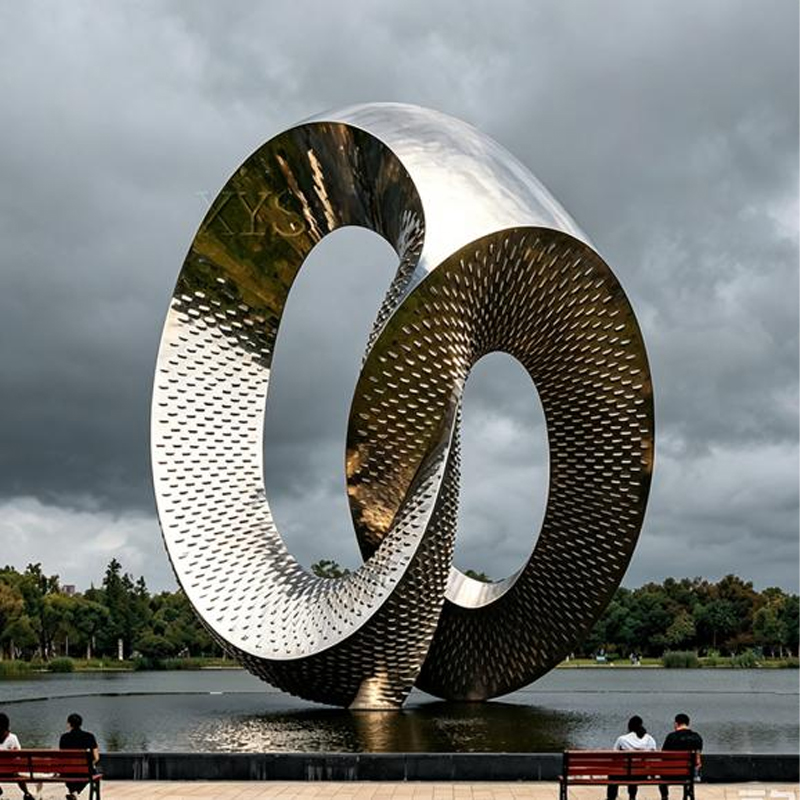
Public art placed on water must accomplish more than visual attraction. It must remain compelling from multiple viewpoints, interact naturally with reflections and changing daylight, tolerate long-term exposure to moisture, and provide an identity strong enough to define a park, plaza, resort, campus, or civic landscape. The Dotted-Texture Double-Ring Mobius Stainless Steel Water-Feature Sculpture is designed around these combined requirements. Its interwoven double-ring geometry, raised dot texture, mirror-polished stainless steel, and water-oriented installation form a unified artistic and engineering concept rather than a collection of unrelated decorative features.
Fabricated from 304 or 316 stainless steel, the sculpture presents a continuous double-ring Mobius form with a surface covered by an even pattern of raised dots. The entire structure is then brought to an 8K mirror polish. This manufacturing sequence creates a particularly demanding finish because the polishing process must address not only broad, smooth metal areas but also the many individual raised details distributed across the form. Each dot must achieve a consistent brightness and transition smoothly into the surrounding surface.
The result is a sculpture with two simultaneous visual identities. From a distance, the double-ring structure reads as a clear, balanced, and monumental form. At closer range, the dotted texture introduces a fine field of highlights, shadows, and reflections. When installed directly on still or moving water, the sculpture adds a third layer of visual activity: its reflected image changes with wind, current, daylight, and artificial illumination.
Available in sizes from 2.2 to 8 meters, the sculpture can be adapted for moderate residential lakes, hospitality developments, institutional campuses, urban parks, riverside tourism plazas, and large public water features. It is especially appropriate for projects seeking a recognizable landmark with a more distinctive surface character than a conventional smooth stainless steel sculpture.
Dotted-Texture Double-Ring Mobius Stainless Steel Water-Feature Sculpture
Content
The Mobius concept is based on continuity. A Mobius form has no obvious beginning or end, and its visual logic naturally suggests circulation, connection, transformation, and perpetual movement. In this sculpture, the concept is expanded into a double-ring composition. The two interwoven rings appear to pass through and around one another, producing a balanced structure that can be appreciated from all sides.
Unlike a flat emblem or front-facing statue, the double-ring form is intended to operate as a three-dimensional landmark. Visitors walking around the water feature encounter changing overlaps, openings, and reflections. From one angle, the rings may appear tightly intertwined. From another, the negative space between them becomes more prominent. This shifting visual reading allows the sculpture to remain interesting even in settings where people view it repeatedly over many years.
The open central spaces are also important from a landscape-design perspective. They allow the surrounding sky, trees, buildings, and water surface to remain visible through the sculpture. Instead of blocking the environment with a solid mass, the form frames the landscape and incorporates it into the artwork. This quality makes the sculpture suitable for spaces that require a strong focal element without completely interrupting sight lines.
The double-ring arrangement contributes to visual symmetry while retaining enough complexity to avoid appearing static. Symmetry gives a public artwork an immediate sense of order and stability. The Mobius interweaving introduces tension and movement within that order. The combination can communicate harmony, partnership, cyclical development, innovation, or continuity, depending on the narrative of the installation site.
For universities, the form may symbolize research, collaboration, and the continuous exchange of knowledge. In a city park, it can suggest connection between people and place. At a riverside destination, the flowing interwoven lines can relate to movement, circulation, and the changing path of water. In a private development, the sculpture can function as a refined architectural centerpiece with an abstract and contemporary appearance.
Many polished stainless steel sculptures rely primarily on a smooth surface. Smooth mirror stainless steel is highly reflective and can produce strong highlights, but its appearance may become visually uniform, especially when viewed from a distance or under flat lighting. The raised dot texture of this sculpture introduces a more complex surface response without abandoning the brilliance of mirror-polished metal.
The dots are distributed across the interwoven double-ring structure in an even pattern. This consistency is essential. A random or irregular texture could weaken the clarity of the Mobius form, while an overly dense pattern could obscure the geometry. The selected approach allows the underlying ring structure to remain legible while adding a second visual layer across the metal surface.
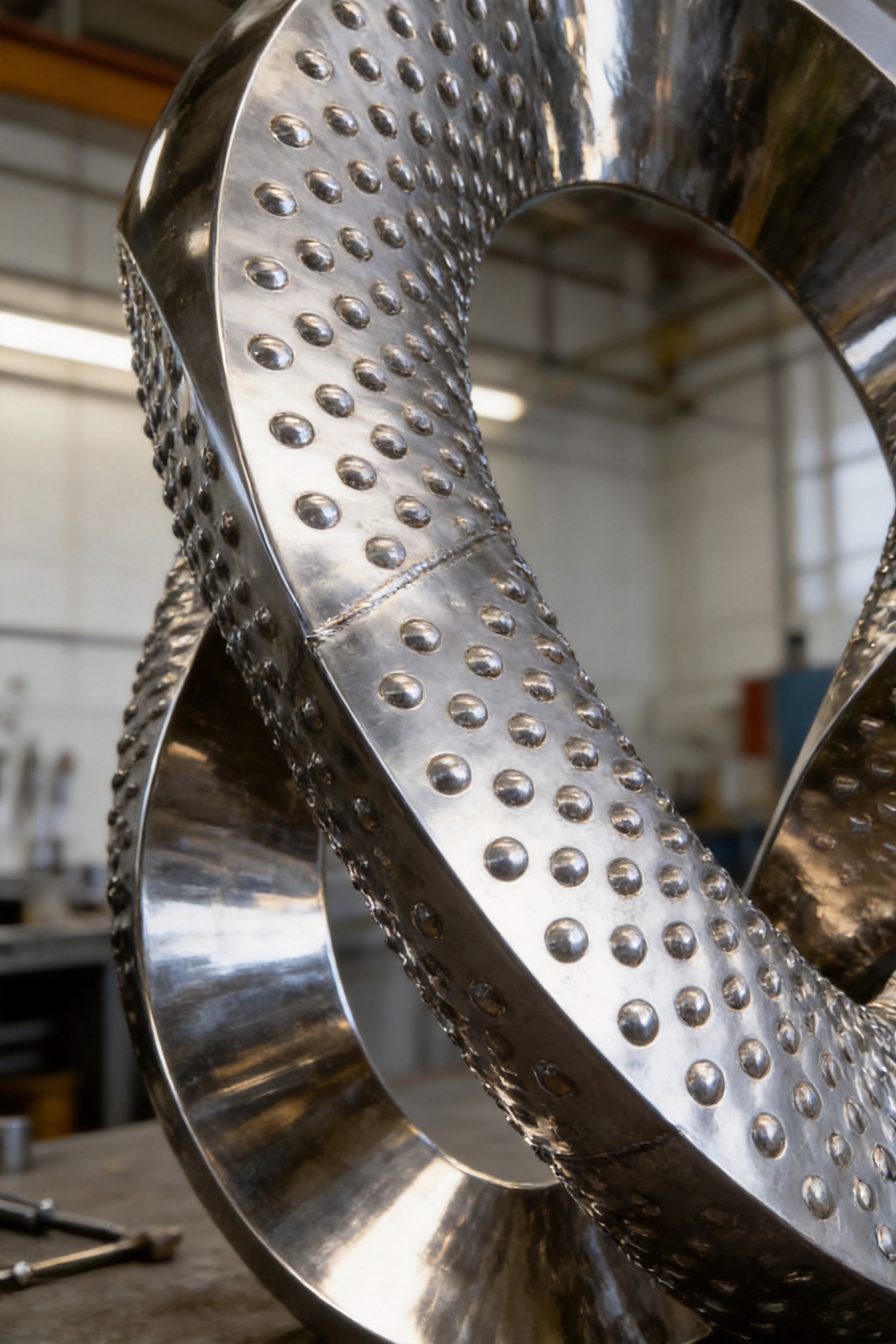
Each raised dot creates a small transition between light and shadow. Under direct sunlight, the dots can produce countless minute highlights. Under overcast conditions, they provide subtle tonal variation that prevents the surface from appearing flat. At sunset, warm natural light can collect across the polished texture. At night, fitted warm-white LED strips can emphasize the raised pattern and reveal the dimensional quality of the surface after dark.
The texture also improves close-range engagement. Visitors approaching a smooth metal sculpture may first notice its overall silhouette and reflected surroundings. With this piece, closer inspection reveals a tactile visual field composed of repeated details. Even when visitors do not physically touch the sculpture, the dots create an impression of surface depth and craftsmanship.
This is a meaningful distinction from many conventional polished sculptures. The piece does not depend only on scale or silhouette to make an impression. Its identity comes from the relationship between large-scale geometry and small-scale surface treatment. That relationship gives designers more freedom to place the work in environments where people may observe it from both a distance and a close pedestrian viewpoint.
Achieving a mirror finish on a smooth sheet or tube requires careful preparation, progressive abrasion, and controlled polishing. Applying the same level of brightness to a dotted surface is substantially more labor-intensive. The polishing tools and processes must reach the raised dots, the surrounding flat areas, and the transition zones between them without creating inconsistent reflections.
The raised dots increase the total surface area of the sculpture. They also create many small edges and curved transitions that can reveal differences in finishing quality. If some dots are polished more strongly than others, the pattern may appear uneven. If the surrounding metal is brighter than the dots, the intended integrated texture can be lost. If the dots are overworked, their definition may be softened. The finishing process therefore requires careful control of pressure, movement, abrasives, inspection, and sequencing.
The manufacturing approach begins with the formation of the double-ring structure. Stainless steel components are prepared and shaped to achieve the intended curvature, proportion, and interwoven relationship. The components are then welded into the three-dimensional form. Welded areas must be treated as part of the final visual surface, not merely as hidden structural joints. They require grinding, blending, and preparation before the mirror-polishing stages can begin.
Surface preparation is particularly important for a large outdoor sculpture. Any deep marks, uneven weld transitions, contamination, or dimensional inconsistencies may become highly visible once the metal reaches a reflective finish. A controlled preparation process helps preserve the clarity of the rings and supports the consistent appearance of the dot pattern.
After preparation, the polishing process proceeds through increasingly fine stages. The objective is not simply to make the steel shiny. It is to develop a uniform reflective quality across the entire visible surface while preserving the raised dot geometry. The final 8K mirror polish gives the metal a high-brightness appearance capable of reflecting sky, water, surrounding vegetation, architecture, and artificial lighting.
This detailed surface work is one of the product’s most important competitive advantages. A sculpture may have an attractive shape, but inconsistent finishing can reduce its perceived value. Here, the manufacturing challenge of polishing the textured surface is treated as a central part of the design. The dots are not added as a rough decorative afterthought; they are integrated into the complete surface-finish strategy.
The sculpture is available in 304 or 316 stainless steel. Both grades are widely used for architectural, decorative, and industrial applications because of their corrosion resistance, strength, and clean appearance. The appropriate selection depends on the installation environment, water chemistry, exposure conditions, maintenance plan, and project budget.
Grade 304 stainless steel is suitable for many outdoor settings and can provide a durable and attractive finish when properly fabricated, cleaned, and maintained. It is often appropriate for freshwater environments and general landscape applications where the atmosphere is not heavily contaminated by salt or aggressive chemicals.
Grade 316 stainless steel offers enhanced resistance in more demanding environments because of its molybdenum content. It may be preferred for sites exposed to coastal air, salt spray, higher chloride levels, or more challenging water conditions. A project team can select the material grade according to the local environmental assessment rather than applying a single solution to every installation.
Material choice should be considered together with fabrication quality. Stainless steel performance depends not only on the nominal grade but also on clean handling, appropriate welding practices, effective removal of surface contamination, and the prevention of conditions that can encourage staining or corrosion. The production process for this sculpture is therefore important because the final appearance and long-term performance are influenced by every stage from forming through polishing.
The mirror-polished surface also supports the sculpture’s relationship with water. Rather than absorbing the visual character of the site, the metal reflects it. Blue sky, clouds, trees, nearby buildings, and moving water become temporary components of the sculpture’s appearance. As the environment changes, the piece changes with it while retaining its stable double-ring identity.
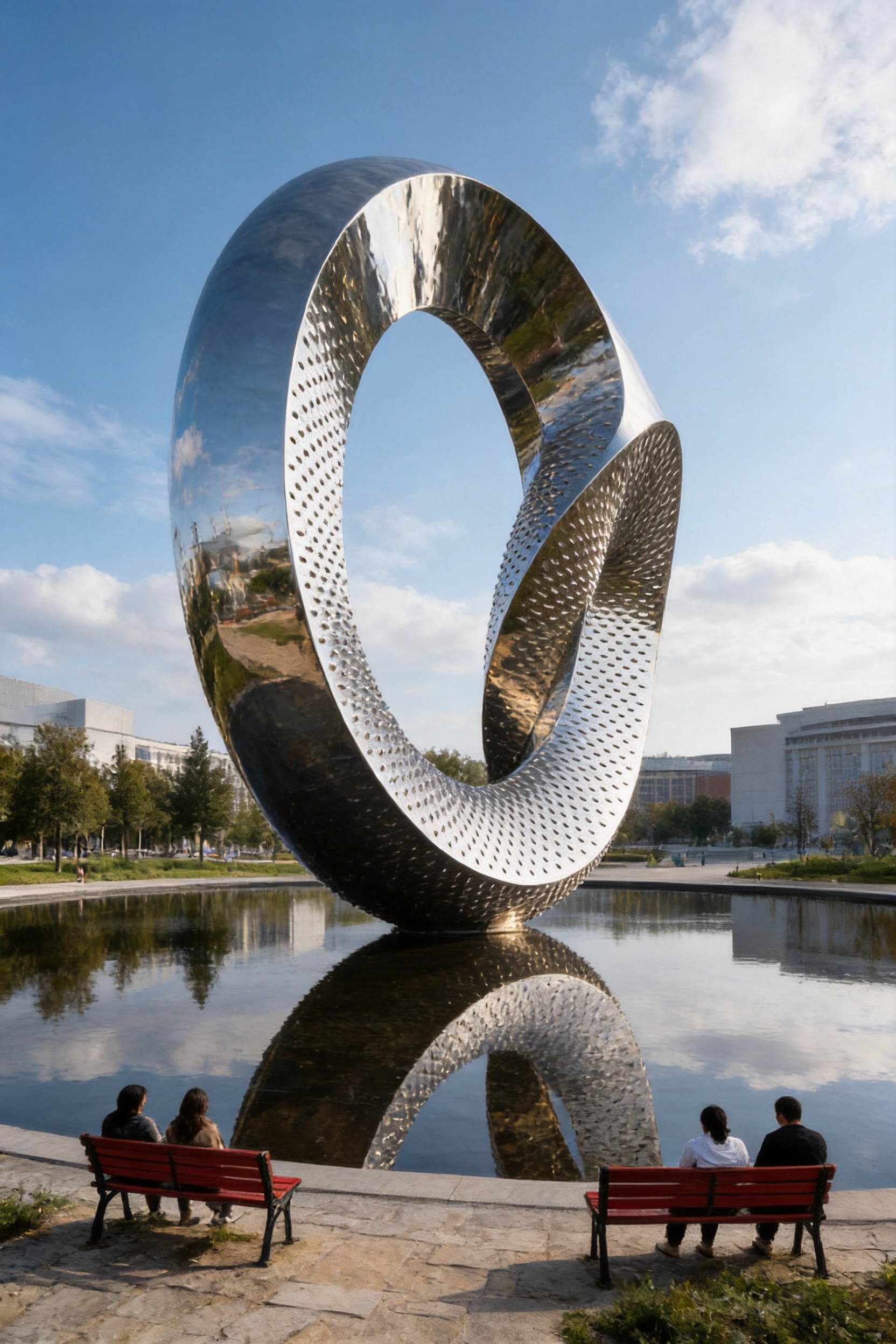
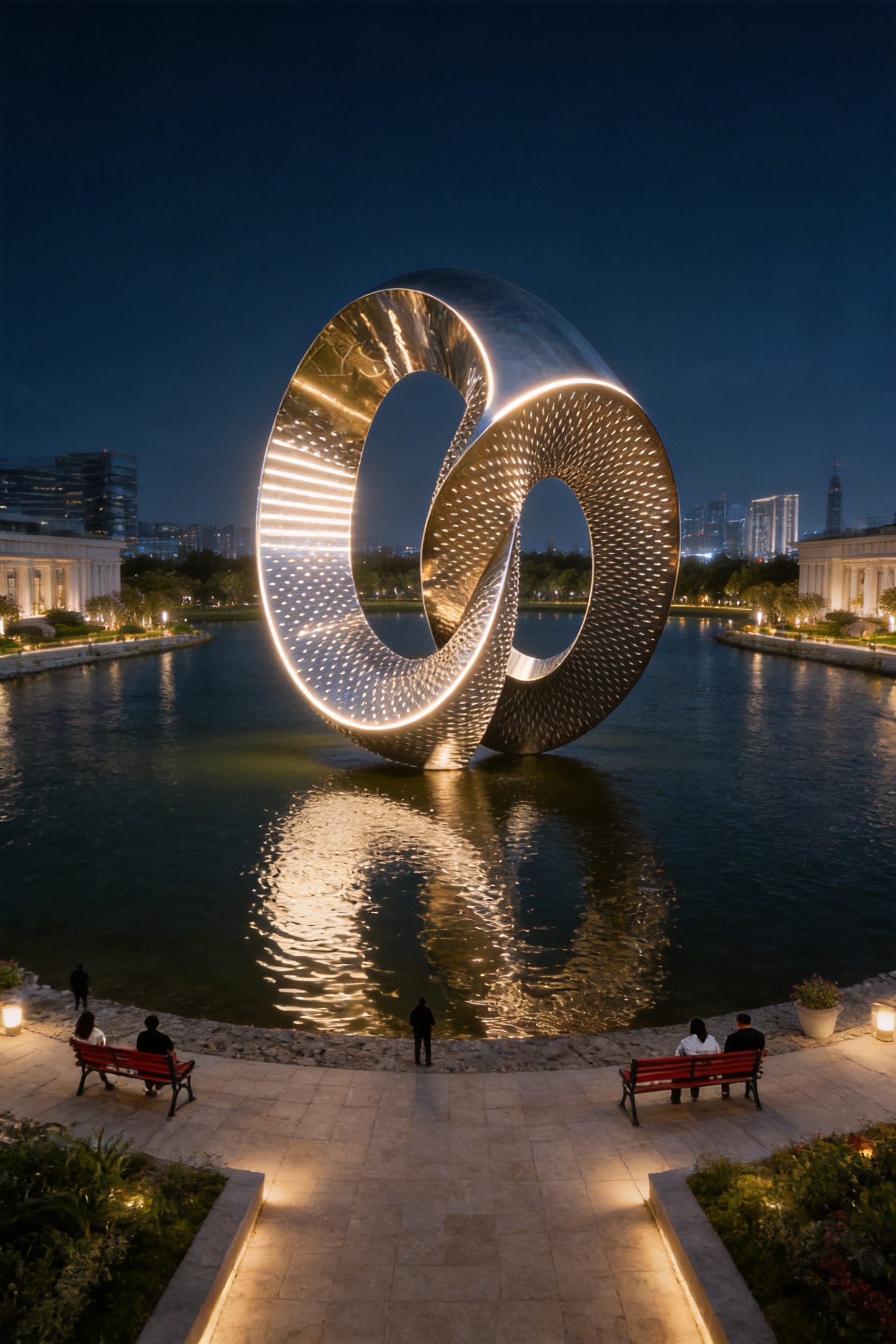
The sculpture is intended for direct installation on water, including lakes, pools, and purpose-built public water features. Its geometry is especially effective in this context because the double-ring form can be read both above and below the waterline. On a still surface, the reflection creates a visual extension of the sculpture and reinforces the impression of continuity.
A smooth lake or pool may produce a relatively clear reflection in calm conditions. The dotted surface then appears twice: once on the physical sculpture and again in the reflected image. This repetition strengthens the pattern without requiring additional decorative elements. The reflected rings can appear to meet the original form at the waterline, creating the impression of a complete circular or continuous structure.
Wind and current introduce a different effect. As the surface moves, the reflected form becomes fragmented and dynamic. The raised dots create small shimmering variations that shift across the water. The sculpture remains physically stable, but its reflected identity appears to move. This contrast between structural permanence and visual motion is one of the strongest reasons to position the work on water.
The water setting also provides natural separation from surrounding pedestrian circulation. In a lake or pool, the sculpture can be viewed from promenades, bridges, terraces, shorelines, and nearby buildings. A single installation may therefore serve multiple audiences and offer different compositions from every approach. The open ring structure helps maintain visual connection between observers on different sides of the water.
For landscape architects, the waterline offers an additional compositional tool. The base can be designed to meet a submerged support, platform, or engineered foundation while the visible portion maintains a clean transition. The reduced dot density near the base supports this transition by visually grounding the more heavily textured upper sections.
The raised dot texture is applied at a slightly reduced density near the lower section where the sculpture meets the water or mounting surface. This decision provides both visual and practical benefits. The upper areas retain the strongest textured identity, while the base becomes calmer and more visually stable.
A fully dense pattern from the highest point to the foundation could make the lower section appear visually heavy. By reducing the density near the base, the design creates a gradual transition between the active surface above and the supporting environment below. The sculpture appears to settle naturally into the water rather than ending abruptly at the waterline.
This transition is also valuable when the sculpture is installed on a platform or architectural plinth. A simpler lower zone can relate more easily to concrete, stone, stainless steel mounting hardware, or a concealed support assembly. The upper textured form remains the artistic focus while the base communicates stability and installation precision.
From a distance, the density variation may be subtle. At closer range, however, it demonstrates that the surface treatment has been intentionally considered across the entire object. It is an example of how the product combines artistic design decisions with practical installation requirements.
The sculpture’s production requires coordination among design interpretation, stainless steel forming, welding, surface preparation, texture application, mirror polishing, inspection, packing, and installation planning. Because the final form combines complex geometry with a demanding finish, quality depends on the relationship between these processes rather than on any single operation.
The interwoven double-ring geometry must be accurately established before the surface receives its final treatment. Small dimensional discrepancies can become more noticeable when the sculpture is reflected in water or viewed against a symmetrical background. Proper forming and assembly help maintain the intended balance between the two rings and preserve the clear negative spaces within the design.
Welding is another crucial stage. The structural joints must provide adequate strength while allowing the finished form to appear continuous. After welding, the seams are prepared so that they do not interrupt the reflection pattern. This requires controlled grinding and blending, followed by surface refinement before the final polishing sequence.
The texture application must also remain even across curved and interwoven surfaces. A dot pattern that looks consistent on a flat panel may behave differently when transferred to a curved ring. The production team must account for changing angles, compound curves, overlaps, and the visual relationship between adjacent surfaces.
Polishing then brings together the work of the earlier stages. The final surface must reflect light consistently while maintaining the clarity of the dots and the overall shape. Inspection should consider the sculpture from different distances and angles, because an area that appears acceptable under workshop lighting may show differences under strong daylight or nighttime illumination.
This integrated production approach gives the sculpture an advantage over lower-complexity decorative products. The value is not based solely on raw material or overall size. It is also found in the controlled execution of a demanding surface and the ability to coordinate structural fabrication with high-level finishing.
Smooth mirror-polished stainless steel remains a popular material for outdoor sculpture because it is bright, contemporary, and highly reflective. However, a smooth surface can sometimes produce a simpler visual experience. Its appearance depends heavily on silhouette, lighting, and the reflected environment.
The dotted-texture design preserves the benefits of a mirror finish while adding a repeatable surface rhythm. The result can be more visually distinctive in a competitive public-art environment where several polished metal works may otherwise appear similar. The texture gives the sculpture a recognizable signature that remains visible even when the surrounding reflections change.
The dotted pattern also reduces the risk of the surface appearing visually empty at close range. Visitors can discover details within the larger form, and lighting designers can use those details to create additional effects. Warm-white LED strips placed within the structure can illuminate the textured metal and produce a refined nighttime appearance without requiring bright, multicolored lighting.
This does not mean that the sculpture replaces the advantages of a smooth surface. Instead, it combines smooth reflective areas and raised details in a way that expands the range of visual effects. The broad polished surfaces preserve the clarity of the ring geometry, while the dots create depth, sparkle, and tactile character.
Painted or powder-coated metal can offer strong color choices, but coatings may eventually require repair, refinishing, or replacement as a result of ultraviolet exposure, impact, abrasion, or weathering. A mirror-polished stainless steel sculpture presents its visual identity through the material itself rather than through an applied color layer.
This material-led approach can be advantageous for projects seeking a neutral and adaptable landmark. Stainless steel can reflect seasonal changes and surrounding architecture, allowing the sculpture to fit into different landscape palettes over time. It does not depend on a single fixed color that might conflict with future renovations or changes in adjacent planting.
The reflective finish also contributes to a more premium architectural appearance. In upscale residential developments, hotels, civic plazas, and institutional landscapes, the combination of polished stainless steel and carefully controlled texture can communicate precision and permanence.
Maintenance requirements still need to be considered. Stainless steel should be cleaned appropriately, and project owners should avoid allowing contaminants, hard-water deposits, or unsuitable chemicals to accumulate on the surface. However, the absence of a painted color layer eliminates concerns associated specifically with peeling or color fading of conventional coatings.
The sculpture is offered in sizes from 2.2 to 8 meters. This range allows the same artistic concept to be used in different spatial conditions. A 2.2-meter version may suit a private lake, hotel courtyard pool, residential estate, or smaller campus garden. Larger versions can serve as prominent landmarks in civic parks, tourism plazas, broad lakes, and major public water features.
Scale should be selected according to viewing distance, water-body dimensions, surrounding architecture, pedestrian circulation, and the desired relationship between the sculpture and the horizon. A sculpture placed in a compact pool may need to remain visually intimate so that the reflection is not lost. A piece located in a wide lake may require greater height and width to retain presence from distant promenades.
The product’s open structure supports scale adjustment because the form remains visually light even when enlarged. A solid mass of the same height might appear oppressive, whereas the interwoven rings preserve air, sky, and landscape views. This makes the sculpture capable of becoming monumental without overwhelming its setting.
The stated price range of approximately $2,450 to $6,820 provides an initial reference for the available size range. Final project pricing may depend on material grade, dimensions, structural requirements, surface specifications, lighting integration, packaging, shipping, foundation design, and installation conditions. Project teams should confirm technical and commercial details before placing an order.
| Project Consideration | Product Relevance | Design Benefit |
|---|---|---|
| Water feature size | Available in approximately 2.2 to 8 meters | Supports both intimate and landmark-scale installations |
| Material environment | 304 or 316 stainless steel options | Allows selection according to freshwater, coastal, or more demanding exposure conditions |
| Surface appearance | Raised dot texture with 8K mirror polishing | Combines high reflectivity with a distinctive close-range visual pattern |
| Nighttime presentation | Warm-white LED strips can be fitted within the structure | Extends the sculpture’s visual impact after sunset |
| Viewing conditions | Open double-ring Mobius form | Provides changing views from multiple sides and preserves sight lines through the sculpture |
| Base transition | Reduced dot density near the lower section | Creates a calmer visual connection with water, platforms, or foundations |
In a central city park, a landmark sculpture must compete with buildings, trees, pathways, signage, lighting, and constant pedestrian movement. The double-ring Mobius form provides a strong silhouette that can be recognized from a distance, while its reflective surface captures the changing urban environment.
Placed on a pool or lake, the sculpture can become a central orientation point. Visitors may use it as a meeting location, and the reflection can help establish a memorable identity for the park. The textured finish distinguishes it from ordinary polished monuments and provides visual interest for people who approach the water’s edge.
Riverside destinations often benefit from artwork that relates visually to flowing water and movement. The continuous double-ring form can support themes of circulation, connection, and renewal. Reflections disturbed by river wind or nearby water movement create an active background for the sculpture.
At night, warm-white illumination can make the sculpture visible from promenades, bridges, and nearby commercial areas. The lighting should be designed carefully so that it highlights the form without producing excessive glare for pedestrians, boat operators, or neighboring properties.
University campuses frequently seek art that can represent knowledge, exchange, and long-term development. The Mobius concept offers a flexible symbolic language without prescribing a single interpretation. The interwoven rings can suggest collaboration between disciplines, continuity between generations, or the constant evolution of ideas.
A campus lake provides the ideal setting for reflection and public gathering. Students and visitors can encounter the work from multiple routes, and the changing surface appearance can support photography, ceremonies, and campus identity programs.
In high-end residential communities, hotels, resorts, and private estates, the sculpture can serve as a centerpiece that reinforces the quality of the surrounding landscape. Stainless steel is compatible with contemporary architecture, glass façades, stone paving, controlled planting, and architectural water features.
The product’s surface detail is especially appropriate for projects that want a refined but memorable centerpiece. It can be elegant in daylight, dramatic at sunset, and discreetly illuminated at night. Its abstract form also avoids the cultural or thematic limitations that may accompany figurative statuary.
Warm-white LED strips can be fitted within the structure to illuminate the sculpture after dark. The lighting concept should follow the geometry of the rings rather than compete with it. Concealed or carefully integrated fixtures can create a continuous glow that emphasizes the interwoven form and reveals the dotted surface.
The raised dots respond well to grazing or indirect light because small projections can produce individual highlights and shadows. When the light source is positioned appropriately, the pattern becomes visible without requiring excessive brightness. This creates a sophisticated nighttime effect that can be appreciated from nearby paths and reflected on the water.
Lighting design must also address electrical safety, waterproofing, access for maintenance, cable routing, and compatibility with the water-feature system. The sculpture itself may be fabricated from corrosion-resistant stainless steel, but the complete installation includes fixtures, connectors, drivers, supports, and control equipment that require equal attention.
Warm-white light is a practical choice for many public landscapes because it complements the natural color of polished stainless steel and generally integrates well with stone, planting, and architectural lighting. Depending on the project, dimming and scheduling can be used to reduce energy consumption and maintain an appropriate nighttime atmosphere.
A successful water-feature installation begins before the sculpture arrives at the site. The project team should coordinate the sculpture dimensions with the water depth, foundation or support platform, access routes, lifting equipment, electrical systems, drainage, and maintenance procedures.
The foundation must be designed to manage the sculpture’s weight, wind loads, water movement, and any dynamic forces associated with the site. If the artwork is installed on a lake or large pool, the support system should be engineered for the conditions of the water body rather than treated as a simple decorative base.
Waterline positioning is especially important. The lower section should appear intentionally integrated with the water while remaining accessible for inspection when required. The reduced dot density near the base can help create a visually clean transition, but the engineering support must still be concealed or coordinated with the landscape design.
Transportation planning is also relevant for larger sizes. Packaging must protect the mirror-polished surface from scratches, impact, contamination, and movement during transit. Lifting points and handling procedures should be agreed upon in advance so that equipment does not damage the surface or place stress on the interwoven rings.
On-site work may include final assembly, positioning, anchoring, lighting connection, cleaning, and inspection. A clear installation plan helps preserve the intended finish and reduces delays during commissioning. For large public projects, coordination among the sculpture manufacturer, landscape architect, civil engineer, electrical contractor, water-feature contractor, and general contractor is recommended.
Mirror-polished stainless steel is selected for its durability and reflective appearance, but regular care is still important, particularly in public water environments. Dust, mineral deposits, fingerprints, airborne pollutants, bird residue, and water-treatment chemicals can reduce surface clarity if they remain on the metal for extended periods.
Maintenance should use cleaning methods and products compatible with the selected stainless steel grade and finish. Abrasive materials that could create scratches should be avoided. Cleaning frequency should be established according to the site, local climate, water chemistry, nearby traffic, and the level of visual perfection required by the owner.
The dotted surface may require more careful inspection than a completely smooth sculpture because deposits can collect around raised details. This is also why the quality of the initial polish and the discipline of the maintenance program are important. Proper care preserves the contrast between the bright dots, surrounding polished areas, and reflected environment.
LED systems should be inspected according to the lighting supplier’s recommendations. Access arrangements should be included in the original design so that drivers, connectors, and other serviceable components can be reached without unnecessary disruption to the water feature or surrounding landscape.
When maintenance is planned from the beginning, the sculpture can retain its visual strength for many years. Its abstract design does not rely on temporary trends, and the reflective surface allows it to evolve visually with the surrounding landscape.
The standard product concept provides a clear starting point, but large landscape projects may require customization. Potential project discussions can include overall size, material grade, dot density, base treatment, lighting arrangement, support conditions, finish requirements, packaging, and delivery coordination.
The texture density near the base is already reduced to create a controlled transition. Depending on the project, the visual emphasis may be adjusted within practical manufacturing limits. Designers may also coordinate the sculpture’s proportions with a specific pool shape, viewing axis, architectural façade, or landscape circulation route.
Customization should preserve the core qualities that define the product: the interwoven double-ring Mobius structure, the raised surface pattern, the high-level mirror finish, and the ability to generate strong reflections on water. Changes that support the site should enhance these qualities rather than obscure them.
Early communication is valuable because modifications can affect structural calculations, material quantities, polishing time, packing dimensions, lighting integration, and installation requirements. A well-developed project brief should identify the site environment, desired height, water conditions, viewing distances, nighttime objectives, and applicable safety standards.
The product distinguishes itself through the combination of four major elements: a recognizable double-ring Mobius form, an even raised dot texture, an 8K mirror-polished stainless steel finish, and direct compatibility with water-feature installation.
Many sculptures may offer one or two of these qualities, but the combination creates a more complete visual and technical proposition. The Mobius structure provides symbolic and geometric identity. The dots provide surface character. The mirror polish provides brightness and environmental reflection. The water installation creates movement and a second visual image.
The piece also offers greater versatility than a single-view artwork. Its open structure is visible from many sides, and its reflection changes with weather and water movement. This is valuable in public spaces where people approach from different directions and where the sculpture must function throughout the day.
The manufacturing process adds further value. Producing a polished dotted surface requires additional labor and attention compared with a smooth sculpture. The final appearance therefore communicates a level of craft that can support premium positioning in architectural and landscape projects.
Material flexibility between 304 and 316 stainless steel allows the product to be matched to different environmental conditions. The range from 2.2 to 8 meters gives designers options for both modest and monumental settings. Optional warm-white LED integration extends the artwork’s use beyond daylight hours.
For buyers comparing suppliers, the most important evaluation should include not only the concept image or quoted price but also the supplier’s ability to manage complex shaping, welding quality, surface preparation, high-level polishing, texture consistency, packing, and project communication. The strength of this product lies in the coordination of those capabilities around one integrated sculpture.
The sculpture is based on an interwoven double-ring Mobius form. Its continuous geometry suggests connection, harmony, circulation, and perpetual movement. The open structure allows it to be viewed from multiple sides and enables the surrounding landscape to remain visible through the rings.
The sculpture is fabricated from 304 or 316 stainless steel. The suitable grade depends on the environmental conditions, water chemistry, coastal exposure, maintenance plan, and project requirements.
The entire surface includes an even pattern of raised dots before receiving an 8K mirror polish. Every raised dot and surrounding area must be polished consistently, making the process more labor-intensive than finishing a smooth surface. The result provides both high reflectivity and a distinctive textured appearance.
Yes. It is designed specifically for water-feature installation and can be placed on lakes, pools, and engineered water landscapes. The foundation, support system, water depth, access, and installation conditions should be planned by qualified project professionals.
Wind and current distort the reflected image, creating a changing pattern of light and shadow. The physical sculpture remains stable, while its reflection appears to shimmer and move. This gives the installation a dynamic quality that changes with weather and water conditions.
The lower density creates a calmer transition where the sculpture meets the water or mounting surface. It visually grounds the more heavily textured upper sections and helps the structure relate to a platform, foundation, or waterline.
The available size range is approximately 2.2 to 8 meters. The appropriate size depends on the water feature, viewing distance, surrounding architecture, pedestrian circulation, and desired landmark scale.
Warm-white LED strips can be fitted within the structure. Lighting should be coordinated with waterproofing, electrical safety, access, controls, and maintenance requirements. Properly positioned lighting can reveal the raised dot pattern and make the sculpture effective after dark.
Suitable locations include central city parks, riverside tourism plazas, university lakes, upscale residential communities, hotels, resorts, private estates, civic landscapes, and other public or private water features seeking a contemporary landmark.
The surface should be cleaned according to a planned maintenance schedule using methods and products appropriate for polished stainless steel. Abrasive tools and unsuitable chemicals should be avoided. The dotted areas should be inspected carefully for mineral deposits, airborne contaminants, or other residue.
Buyers should confirm the required size, material grade, water and atmospheric conditions, foundation design, lighting requirements, finish expectations, shipping arrangements, installation responsibilities, maintenance access, delivery schedule, and final commercial terms.
The Dotted-Texture Double-Ring Mobius Stainless Steel Water-Feature Sculpture is a carefully integrated work of architectural metal art. Its strength comes from the interaction of form, texture, material, finish, and setting. The interwoven rings provide a memorable silhouette and a flexible symbolic language. The raised dot texture adds depth and individuality. The 8K mirror polish reflects the surrounding landscape while preserving the visual richness of the surface. Water introduces a constantly changing second image through reflection.
Its production demands more than ordinary metal fabrication. Accurate forming, controlled welding, thorough surface preparation, texture consistency, and labor-intensive polishing are all necessary to achieve the intended result. The availability of 304 and 316 stainless steel supports adaptation to different environments, while the 2.2-to-8-meter size range allows the concept to serve both intimate and monumental sites.
For designers and developers seeking a distinctive water landmark, the sculpture offers a strong alternative to smooth, painted, or single-view outdoor artworks. It can provide identity during the day, atmosphere at night, and changing visual interest throughout the seasons. With appropriate engineering, installation, lighting, and maintenance planning, it can become a durable focal point for civic, institutional, commercial, hospitality, residential, and tourism landscapes.
Architectural Metalwork Principles: Stainless Steel Forming, Welding, and Surface Finishing.
International Stainless Steel Standards: Material Selection for Outdoor and Water-Exposed Applications.
Landscape Architecture and Water Features: Reflection, Circulation, Scale, and Public-Space Design.
Public Art Installation Planning: Foundations, Transportation, Lighting, and Long-Term Maintenance.
Stainless Steel Surface Care: Cleaning Practices for Architectural and Decorative Finishes.
Outdoor Lighting Design: Warm-White LED Integration for Sculptural and Water-Feature Environments.



Daniel H.

Amanda R.

Robert B.

Jennifer S.

James W.

Barry G.

Michael T.

Emily K.

David L.

Sarah M.


Mikey XV

Jagxue

 English
 Español
 عربى
 Français
 italiano
 Deutsch