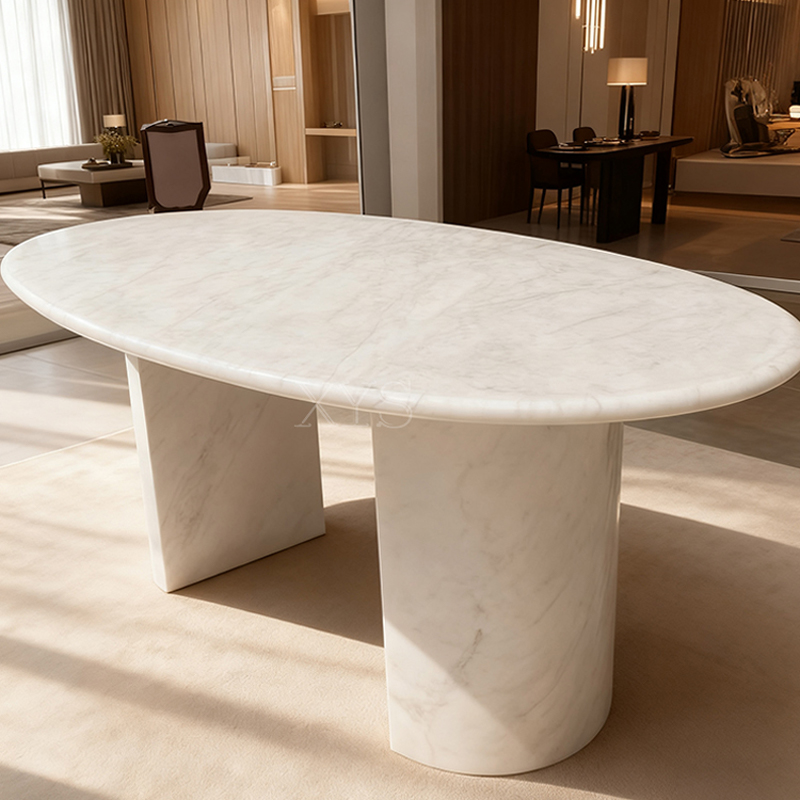
A dining table is more than a practical surface for meals. It is often the visual and social center of a home, hospitality venue, executive dining room, or luxury residential project. The right table must perform reliably every day while also contributing to the character of the surrounding interior. The Natural Marble Oval Dining Table brings these two expectations together through the use of high-quality natural stone, a graceful oval silhouette, and a stable dual-support base designed as a unified structure.
With its combination of natural texture, refined proportions, practical durability, and adaptable styling, this marble table is suitable for modern, light-luxury, and many other interior environments. It is available in two principal size options: 180 × 90 × 75 centimeters and 200 × 100 × 75 centimeters. These proportions provide comfortable room for everyday family dining, formal entertaining, restaurant applications, and carefully planned hospitality interiors.
Manufactured by Jiangsu Xinyesheng Sculpture Co., Ltd., the table reflects a product approach rooted in stone craftsmanship, sculptural design, and practical functionality. Instead of treating a dining table as a simple slab placed on a separate frame, the design gives equal attention to the tabletop, support structure, proportions, surface finish, and relationship between the furniture and the room.
Natural Marble Oval Dining Table
Content
The Natural Marble Oval Dining Table is created from natural marble selected for its visual depth and tactile quality. Unlike artificial surfaces that may repeat a highly uniform pattern, natural marble offers an individual appearance. Veining, color movement, mineral variation, and subtle tonal changes make each finished table distinct. These characteristics allow the table to function as both furniture and a natural sculptural element.
The oval tabletop creates a softer visual profile than a conventional rectangular dining table. Its continuous curved edges reduce visual rigidity and help the table sit comfortably in open-plan spaces. The rounded ends also improve circulation around the table, which can be especially useful in dining rooms where chairs, walkways, sideboards, and other furnishings must coexist within a limited footprint.
The design is supported by a dual-support base in one-piece form. This structural approach gives the table a strong and visually balanced foundation. The base is intended to provide dependable support while avoiding the overly complicated appearance associated with tables that use numerous legs, crossbars, or exposed mechanical components. The result is a clean silhouette that allows the marble top to remain the primary visual focus.
The table is designed to be scratch-resistant, wear-resistant, and easy to clean in the context of normal dining use. Its natural stone construction gives it a substantial and permanent presence, while the polished or carefully finished surface supports practical maintenance. As with all natural stone products, appropriate care remains important, but the material is well suited to daily use when properly maintained.
| Product Feature | Specification or Benefit |
|---|---|
| Product type | Natural marble oval dining table |
| Primary material | High-quality natural marble |
| Base design | Dual-support, one-piece structural design |
| Available size one | Length 180 cm × width 90 cm × height 75 cm |
| Available size two | Length 200 cm × width 100 cm × height 75 cm |
| Recommended environments | Modern homes, light-luxury interiors, hospitality spaces, dining rooms, and selected commercial projects |
| Functional qualities | Stable, wear-resistant, scratch-resistant, and easy to clean with suitable care |
| Price for 180 cm option | 8,250 United States dollars |
| Price for 200 cm option | 10,725 United States dollars |
Rectangular dining tables remain popular because they use space efficiently and provide a familiar seating arrangement. However, their straight edges can introduce a formal or rigid quality into an interior. The oval shape offers an alternative that retains a generous central surface while creating a more relaxed visual rhythm.
The curved ends make the table easier to approach from different directions. In a family setting, this can encourage a more open seating arrangement. In a hospitality or restaurant setting, the oval outline can help guests and staff move around the table with fewer abrupt corners. In an open-plan residence, the curved profile can also soften the transition between the dining zone, kitchen, living area, and circulation paths.
An oval table can create a stronger sense of visual unity than a rectangular table because the eye travels continuously around its perimeter. There are no sharp corners interrupting the outline. This quality is particularly effective when the table is positioned beneath a rounded pendant, near curved architectural features, or alongside furniture with organic contours.
Marble has long been valued for its depth, luminosity, and connection with architectural craftsmanship. The stone surface may show subtle variations that change under daylight, warm artificial lighting, and different viewing angles. Rather than appearing flat or printed, natural marble often has a layered visual character that gives the table greater presence.
For modern interiors, this natural complexity can prevent a space from feeling too uniform. A room with clean walls, linear cabinetry, and restrained decoration can benefit from the movement of marble veining. In a light-luxury interior, the stone contributes refinement without requiring excessive ornamentation. In a more traditional setting, the material connects the table with established architectural traditions associated with stone, sculpture, and fine furniture.
Every natural marble table has its own visual identity. This individuality is a significant distinction from mass-produced tables that use printed surfaces or repeated decorative patterns. Buyers who value authentic materials can enjoy a product whose appearance reflects the geological origin of the stone and the craftsmanship applied during fabrication.
The dual-support base is one of the most important features of the design. Many dining tables rely on four individual legs. While this arrangement is familiar, it can appear visually fragmented and may create awkward contact points for diners. A central or paired support system can offer more legroom and a more coherent sculptural profile.
The one-piece base design provides a sense of structural continuity. It is intended to support the substantial weight of the marble top while maintaining visual balance. The support does not merely disappear beneath the tabletop; it contributes to the identity of the product. From different angles, the base can be read as a deliberate architectural form rather than an accessory added after the fact.
This approach is particularly valuable in premium furniture, where customers expect the underside of a product to receive as much design attention as the visible top. The relationship between the base and the tabletop affects perceived stability, proportions, and overall quality. A carefully integrated base ensures that the table feels complete from every direction.
Wooden tables offer warmth and familiarity, but they may not provide the same mineral depth or formal presence as natural marble. Wood grain is generally directional, while marble veining can move across the surface in a more fluid and visually dramatic way. For interiors that require a focal point, marble can provide a stronger sense of permanence and luxury.
Wood can also be more sensitive to moisture, heat, staining, and changes in humidity, depending on the species and finish. Natural marble is not maintenance-free, and it should still be protected from harsh chemicals, prolonged exposure to staining substances, and direct contact with very hot cookware. Nevertheless, a properly finished marble tabletop offers a durable and easy-to-wipe surface for ordinary dining activities.
The marble table also has a different visual lifespan. Trends in wood color and finish can change quickly, while stone remains associated with enduring architectural materials. This makes the product a strong choice for buyers who want a statement piece that can remain relevant as surrounding furniture and decorative details evolve.
Glass tables can create a light and visually open appearance, but transparent surfaces often reveal fingerprints, dust, smudges, and the structural components beneath them. They may also feel less substantial in large dining rooms. A marble tabletop provides a stronger visual anchor and a more tactile experience.
The opaque stone surface conceals minor visual clutter beneath the tabletop and gives the dining zone a defined center. It can also coordinate more naturally with stone flooring, marble wall panels, metal sculpture, or architectural surfaces. For projects seeking an impression of solidity and permanence, marble generally communicates more weight and material richness than glass.
Engineered stone and decorative laminates can offer consistency, broad color selection, and predictable patterns. These advantages are useful in some projects. However, buyers who prioritize authentic material character may prefer natural marble because no two slabs are exactly alike.
Natural variation creates a more individual product. The visual pattern is not simply applied to the surface; it is part of the stone itself. This distinction can be appreciated in close view and under changing light. For a high-value dining table intended to serve as a centerpiece, the authenticity of natural stone can justify the investment.
Four-leg tables are widely available and often easy to manufacture, but the leg arrangement can restrict seating positions. Guests may need to avoid placing their legs near corner supports, and the visual structure can appear ordinary when viewed from a distance. The dual-support base creates a more intentional design language and may improve seating flexibility around the perimeter.
The one-piece support concept also allows the table to be read as a unified sculptural object. This is an important distinction for buyers who want functional furniture with an artistic quality. The table can complement sculpture collections, gallery-like interiors, designer residences, and hospitality settings where furniture contributes to the overall visual story.
The performance and appearance of a marble table begin with the selection of the raw slab. High-quality natural stone must be reviewed for color, pattern, structural condition, thickness, and suitability for the intended shape. Because the tabletop has an oval outline, the slab must provide enough usable area for the complete form while preserving an attractive arrangement of veining.
Stone selection is not simply a matter of choosing the most dramatic pattern. The slab must also be appropriate for fabrication. Excessive fissures, unstable areas, or irregular structural weaknesses can create difficulties during cutting and finishing. A professional manufacturer evaluates both the aesthetic and practical qualities of the material before production begins.
For an oval table, layout planning is especially important. The position of the tabletop within the slab can affect the final composition of the veins. A thoughtful layout may align a central movement with the length of the table or distribute visual variation evenly from one end to the other. This process helps prevent a finished product from appearing visually unbalanced.
Natural stone variation should be regarded as a feature rather than a defect. Slight differences in tone, vein density, and mineral markings are part of the identity of real marble. Customers seeking a natural stone table should expect the delivered piece to reflect the character of the selected slab rather than an entirely uniform industrial surface.
A reliable manufacturing process begins with a clear understanding of the product dimensions, intended use, structural requirements, and aesthetic goals. The 180-centimeter and 200-centimeter versions require accurate technical planning to maintain the correct relationship between length, width, height, tabletop thickness, and base position.
The oval profile must be defined precisely. Even a small inconsistency in curvature can affect the visual quality of the table, particularly when viewed from above or when multiple chairs are arranged around it. Technical drawings, templates, or digital layout tools may be used to establish the shape before cutting begins. This planning stage helps reduce material waste and supports consistency between repeat orders.
The base also requires careful coordination with the tabletop. Its width, depth, centerline, and contact points must be considered together with the weight of the marble. A well-planned support system distributes loads effectively and minimizes unnecessary stress on the stone. The result should be a table that feels stable during everyday use and visually proportionate from all sides.
Once the slab has been approved and the layout determined, the marble is cut to the planned oval profile. Professional stone fabrication requires precision because the material is heavy, valuable, and not easily corrected once removed. Accurate cutting protects the intended dimensions and helps preserve the visual composition of the slab.
The edge is then shaped and refined. The treatment may be simple and understated so that the natural stone remains the focus. Edge work must be even around the full perimeter, with attention given to smooth transitions at the curved ends. A consistent edge improves comfort for users and contributes to the perception of quality.
Modern fabrication methods can support precision, while experienced craftspeople remain essential for inspection, adjustment, and finishing. Machinery may establish the basic form, but human judgment is needed to assess the stone’s individual characteristics, identify subtle imperfections, and determine whether the result meets the expected standard.
The tabletop surface is refined through a sequence of grinding, smoothing, and polishing or other specified finishing operations. Each stage affects the final appearance and tactile quality. Excessively aggressive treatment may reduce the visual depth of the stone, while insufficient refinement may leave the surface uneven or dull.
A carefully finished marble surface should feel smooth and consistent under the hand. Reflected light should reveal the natural movement of the stone without exposing avoidable fabrication marks. The edge and top must also transition naturally, ensuring that the table looks like a unified object rather than a raw slab fitted onto a frame.
Finishing is also important for daily maintenance. A smooth, properly treated surface is easier to wipe after meals and less likely to retain ordinary dust or food particles. Natural marble still benefits from prompt cleaning and suitable protective practices, but the manufacturing finish provides the foundation for practical use.
The dual-support base must combine visual clarity with structural reliability. Its one-piece design requires accurate forming, assembly, or carving according to the chosen construction method. The base must sit evenly on the floor and connect securely with the tabletop without creating unnecessary pressure points.
During production, attention is given to alignment, contact surfaces, balance, and the relationship between the base and the oval top. The objective is not simply to produce a support that carries weight. The base must also reinforce the table’s aesthetic language. Its dimensions should appear neither too light for the marble nor so heavy that the table becomes visually oppressive.
Inspection of the base includes checking for levelness, surface quality, edge consistency, and connection accuracy. These details are particularly important because a premium table is viewed from standing, seated, and walking positions. Any misalignment may be more noticeable when light travels across the surface or when the table is placed in a spacious room.
Final assembly brings together the tabletop and base. Before packaging, the completed product can be checked for dimensional accuracy, stability, surface consistency, edge smoothness, and overall appearance. The table should be evaluated as a complete object rather than as separate components.
Quality inspection is especially important for natural stone furniture because marble is heavy and sensitive to improper handling. A responsible manufacturing workflow considers lifting, transport, packaging, and installation requirements. Protective materials should be used to reduce the risk of edge damage, surface abrasion, or movement during delivery.
Jiangsu Xinyesheng Sculpture Co., Ltd. combines sculpture-oriented manufacturing experience with functional product development. This combination is valuable because the table requires both artistic judgment and practical engineering. A purely decorative approach may overlook stability and usability, while a purely utilitarian approach may fail to deliver the visual refinement expected from natural stone furniture.
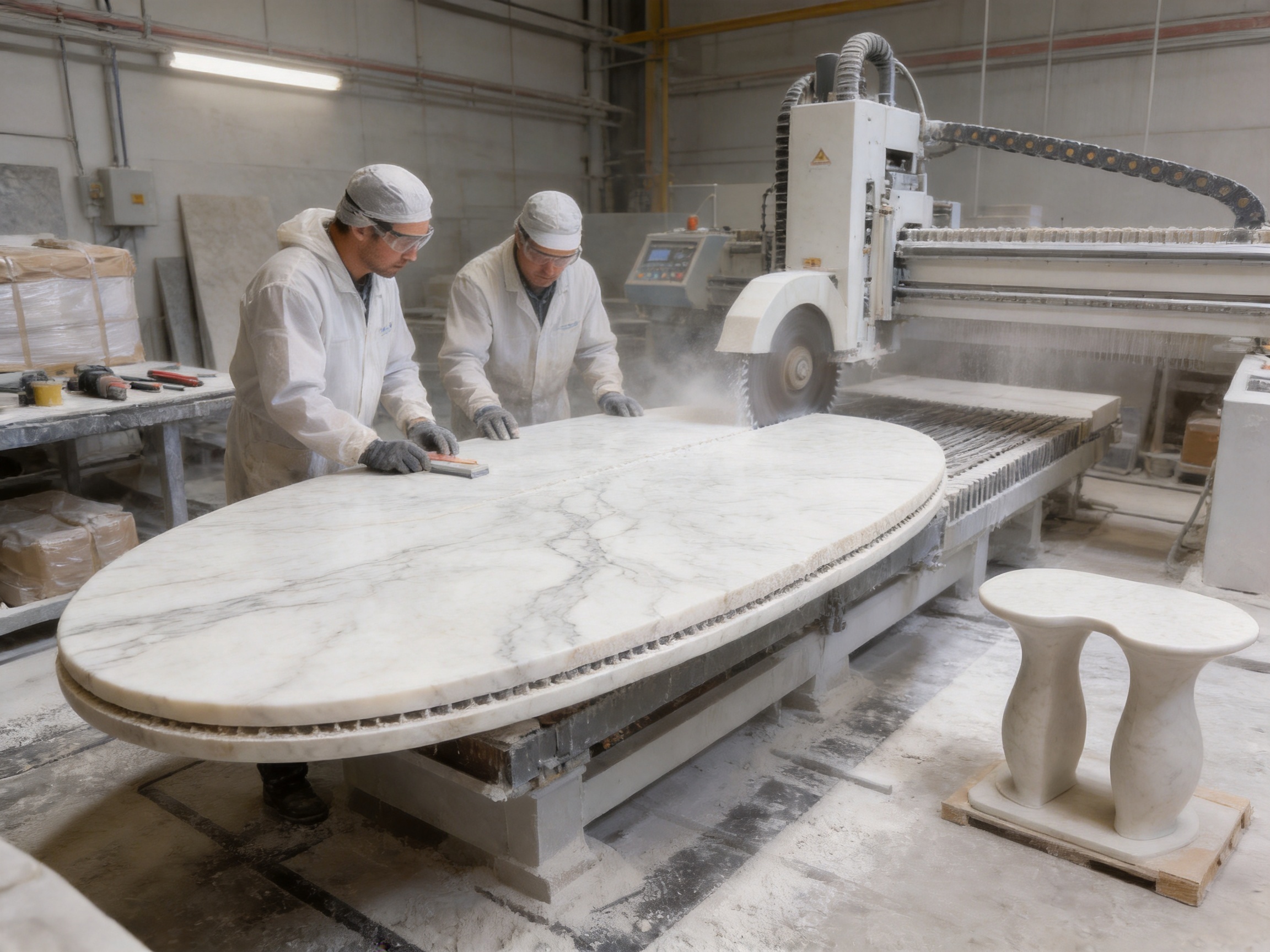
A dining table with a sculptural base demands a broader skill set than a standard flat-pack furniture product. The manufacturer must understand volume, balance, proportion, surface transitions, and the way a form is experienced from multiple viewpoints. Sculpture-oriented production encourages attention to these details.
The company’s product range includes bronze sculptures, stainless steel sculptures, marble sculptures, fiberglass sculptures, and weathering steel sculptures. This broad material background indicates an understanding of how different substances behave visually and physically. Although the Natural Marble Oval Dining Table is a functional product, it benefits from the same attention to form and finish associated with sculptural work.
Experience with marble sculpture can be particularly relevant to the tabletop and base. Marble must be handled with respect for its density, natural variation, and fracture behavior. The manufacturer’s familiarity with stone-based artistic products can support more careful material selection, shaping, finishing, and inspection.
Experience with metal and fiberglass products can also contribute to broader manufacturing coordination. A company accustomed to producing large decorative objects must consider scale, packaging, surface protection, installation, and the relationship between a product and its environment. These considerations are relevant to a substantial dining table intended for residential or commercial interiors.
The 180-centimeter option offers a balanced solution for many family dining rooms and medium-sized hospitality interiors. Its 90-centimeter width provides enough space for table settings, serving dishes, centerpieces, and comfortable personal dining areas without requiring an excessively large room.
Depending on chair width and the desired degree of comfort, this size may accommodate a number of diners along the long sides and additional seating at the curved ends. The oval outline allows the end positions to feel less compressed than they might at the sharp corners of a rectangular table. Final seating capacity should be determined according to local space conditions, chair dimensions, and circulation requirements.
The larger 200-centimeter option provides greater presence and additional surface area. It is suitable for larger dining rooms, generous residential interiors, executive dining spaces, boutique hospitality venues, and projects where the table is intended to serve as a major architectural feature.
The additional length and width create more room for formal place settings and shared dishes. They also increase the visual scale of the table, making it better suited to rooms with high ceilings, expansive flooring, large windows, or substantial surrounding furniture. Because the table is made from natural marble, adequate access planning is essential before delivery and installation.
The listed height of 75 centimeters corresponds to a conventional dining height and works with most standard dining chairs. However, the room must provide sufficient clearance around the tabletop. Space is needed not only for chairs but also for people to sit, stand, and move behind occupied seating.
Before ordering, customers should measure doorways, corridors, elevators, stairways, and the final dining area. The route from unloading point to installation location should be reviewed carefully. A marble table is a substantial product, and appropriate handling equipment or professional installation may be advisable, particularly for the larger size.
| Planning Element | Recommended Consideration |
|---|---|
| Table height | 75 cm, suitable for conventional dining chairs |
| Room proportion | Choose the 180 cm or 200 cm version according to room scale and circulation needs |
| Chair placement | Check chair width, armrests, and the position of the dual-support base |
| Walking clearance | Provide enough room to pull out chairs and move around the dining area |
| Delivery route | Measure doors, corridors, stairs, elevators, and turns before shipment |
| Floor condition | Confirm that the finished floor is level and capable of supporting the table safely |
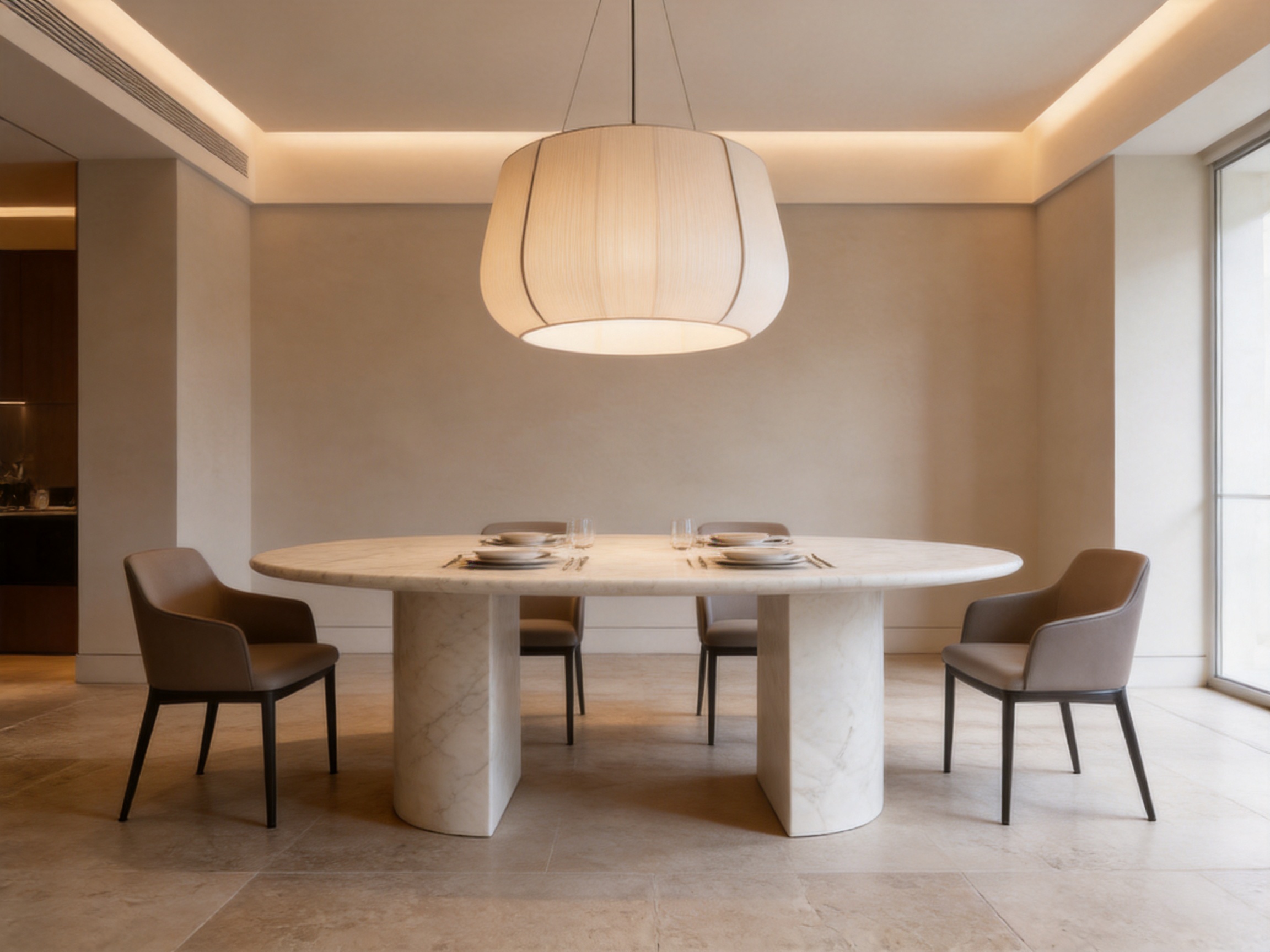
| Lighting | Use pendant or architectural lighting to reveal the marble surface without glare |
In a modern home, the Natural Marble Oval Dining Table can serve as a central element within a restrained palette of stone, wood, glass, fabric, and metal. Its organic surface movement adds visual interest without requiring elaborate decoration. Minimal dining chairs can allow the tabletop and base to remain the focus.
The table pairs well with neutral walls, contemporary cabinetry, architectural lighting, and flooring in wood or stone. It can also soften a highly linear interior by introducing curved edges and natural variation. A simple arrangement of ceramic tableware, clear glassware, or low floral decoration can complement the marble without concealing its character.
Light-luxury design emphasizes quality, proportion, texture, and quiet refinement rather than excessive ornament. The natural marble surface supports this approach. It introduces a sense of richness while the oval shape and uncluttered base prevent the product from appearing overly formal.
In this setting, the table can be combined with upholstered chairs, brushed metal lighting, softly colored wall finishes, and carefully selected decorative objects. The overall effect can be luxurious without becoming visually crowded. The table’s material authenticity provides much of the room’s character.
Restaurants, private dining rooms, boutique hotels, and members’ clubs often require furniture that communicates quality at first sight. A substantial marble table can help establish a memorable identity and create a strong focal point for guests.
The oval form is particularly useful in hospitality environments because it encourages visual connection among diners. It also gives staff a smoother path around the table than a design with pronounced corners. Commercial users should establish a suitable maintenance schedule and confirm that the selected finish meets the practical demands of the intended environment.
In a showroom or interior design presentation, the table can demonstrate how sculptural furniture contributes to a complete spatial concept. It may be paired with marble accessories, metal artwork, modern seating, or large-scale lighting. Because natural stone varies from slab to slab, the finished piece can help communicate an atmosphere of exclusivity and customization.
Natural marble is durable, but it is still a porous stone that deserves appropriate care. Daily cleaning should generally be carried out with a soft cloth and a mild, stone-suitable cleaning solution. Abrasive powders, harsh acids, and aggressive chemical products should be avoided because they may dull the finish or affect the surface.
Spills should be wiped promptly, especially when they involve strongly colored liquids, acidic foods, oils, or substances that may leave marks. Coasters, placemats, and serving trays can help protect the tabletop during meals and entertaining. Hot cookware should not be placed directly on the surface without suitable protection.
Heavy objects should be lifted rather than dragged across the table. Although the surface is described as scratch-resistant and wear-resistant for ordinary use, sharp grit beneath an object can still create abrasion. Felt pads and clean contact surfaces can help protect the stone and surrounding floor.
Periodic professional assessment may be useful in high-use commercial environments. Depending on the stone and finish, a suitable sealer or maintenance treatment may be recommended. Customers should follow the manufacturer’s care instructions and confirm that any cleaning or sealing product is appropriate for the specific marble.
Good care does not eliminate the natural aging of stone. Instead, it preserves the surface while allowing the table to develop the subtle character associated with genuine marble. With responsible use, the product can remain a long-term furnishing rather than a short-lived decorative purchase.
The listed price for the 180 × 90 × 75 centimeter version is 8,250 United States dollars. The 200 × 100 × 75 centimeter version is priced at 10,725 United States dollars. The difference reflects the larger dimensions, greater material requirement, increased handling considerations, and expanded visual scale of the larger table.
When comparing prices with competing products, buyers should consider more than the tabletop dimensions. Natural stone grade, slab selection, edge treatment, base construction, finishing quality, packaging, shipping, installation, and after-sales support all influence the total value of a premium table.
A lower-priced table may use a thin surface, engineered material, printed pattern, separate low-cost supports, or a simplified finishing process. Such alternatives may be appropriate for certain budgets, but they do not provide the same combination of natural material authenticity, sculptural presence, and substantial construction.
The Natural Marble Oval Dining Table is best understood as a long-term interior investment. It is designed to occupy a central position in a room and to contribute to the room’s identity for many years. For homeowners, designers, developers, and hospitality operators seeking a distinctive centerpiece, this long-term perspective is important.
The two standard sizes provide a practical starting point for many interiors. For projects with specific architectural requirements, customers may also wish to discuss stone appearance, edge treatment, surface finish, base proportions, and installation conditions with the manufacturer before confirming an order.
Natural marble customization requires realistic expectations. A requested color or vein direction may not be available in exactly the same form because each slab is unique. The manufacturer may need to propose suitable alternatives based on current material availability. Clear communication about acceptable variation helps align the final result with the customer’s expectations.
For design professionals, project coordination should include drawings, room dimensions, access information, delivery timing, and the relationship between the table and other built-in elements. If the table is being specified for a hotel, restaurant, or large residence, early coordination can reduce installation risks and ensure that the base, chairs, lighting, and floor finish work together.
The company’s experience in sculpture production is useful for custom project communication because sculptural objects frequently require coordination between visual concepts and technical execution. A successful result depends on translating an aesthetic intention into material, structure, scale, and finish.
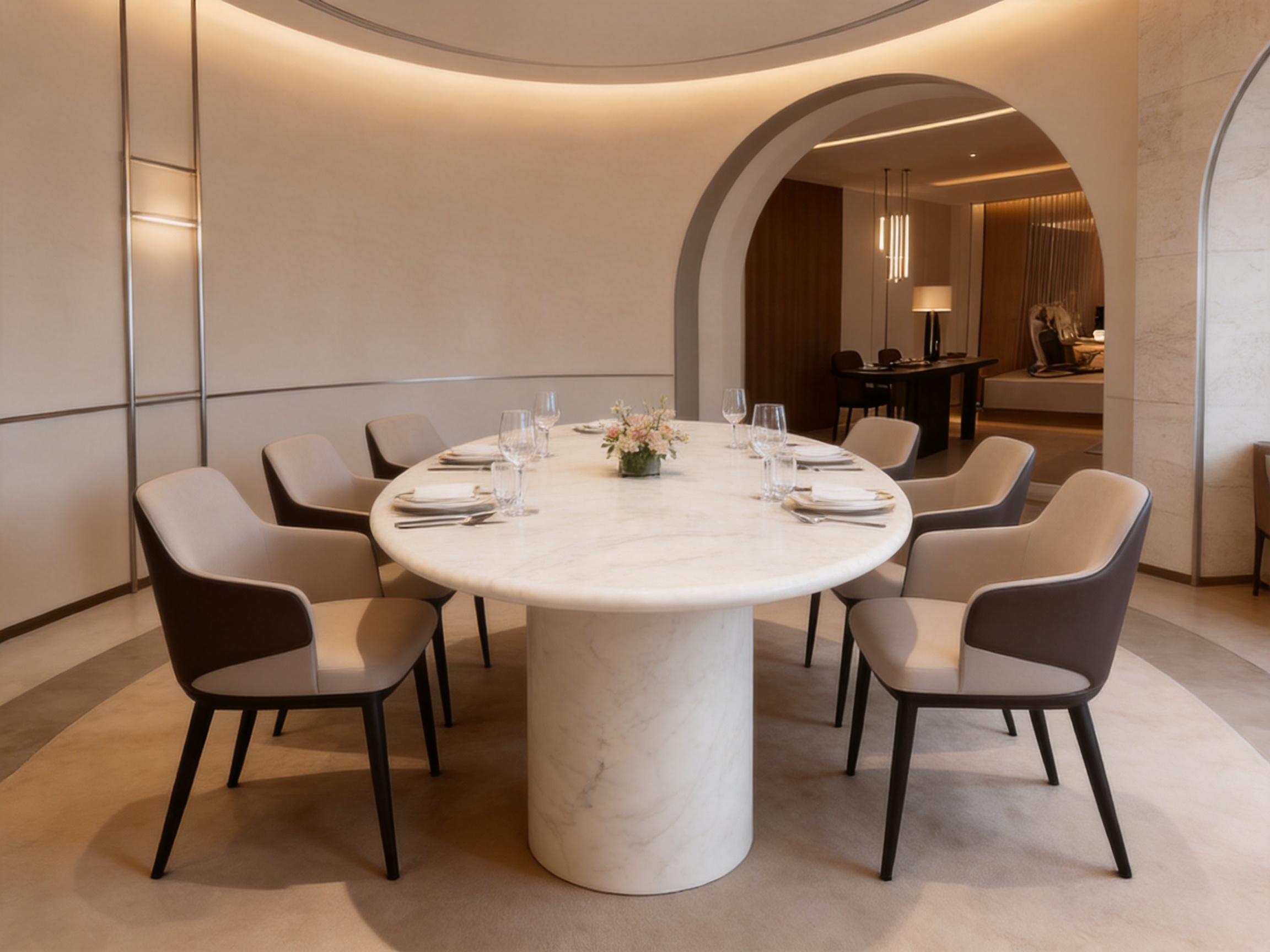
The tabletop is made from high-quality natural marble. Natural variations in color, veining, and mineral pattern are expected and contribute to the individuality of each table.
The listed options are 180 × 90 × 75 centimeters and 200 × 100 × 75 centimeters. The first number indicates length, the second indicates width, and the third indicates height.
The 180 × 90 × 75 centimeter version is priced at 8,250 United States dollars. The 200 × 100 × 75 centimeter version is priced at 10,725 United States dollars.
Yes. The product is designed to meet daily family dining needs while also providing a refined visual presence. Normal use should be supported by suitable care, prompt cleaning, and protection from harsh chemicals, excessive heat, and abrasive materials.
The oval shape softens the visual appearance of the table, reduces sharp corners, supports smoother circulation, and allows a more flexible seating arrangement. It can also complement curved lighting, architectural details, and organic decorative forms.
The dual-support base provides a stable foundation while creating a clean, sculptural appearance. Its one-piece design helps the table read as a unified object and may provide more comfortable seating than a conventional arrangement of four separate corner legs.
Natural marble is practical to maintain when cleaned with suitable products and treated responsibly. Wipe spills promptly, avoid abrasive or acidic cleaners, use protection beneath hot or rough objects, and follow the manufacturer’s recommendations for sealing and long-term care.
No. Because marble is a natural material, each slab has individual veining, tonal variation, and mineral characteristics. The finished table will reflect the selected material and may differ from representative images.
It can be considered for hospitality and commercial interiors, provided that the project accounts for traffic, cleaning frequency, delivery access, floor capacity, installation, and an appropriate maintenance program.
Customers should confirm the preferred size, room dimensions, chair arrangement, floor condition, doorway and corridor measurements, delivery route, installation requirements, care expectations, and the accepted degree of natural stone variation.
A sculpture manufacturer brings experience in proportion, three-dimensional form, material behavior, surface finishing, and presentation from multiple viewpoints. These capabilities are valuable for a dining table whose base and overall silhouette are intended to have a sculptural quality.
The Natural Marble Oval Dining Table combines the authenticity of natural stone with the usefulness of carefully considered dining furniture. Its oval profile provides a softer and more approachable alternative to rigid rectangular designs. Its dual-support one-piece base contributes stability, legroom, and sculptural character. Its natural marble surface adds depth, individuality, and a sense of permanence to the interior.
Compared with ordinary wooden, glass, engineered-stone, or four-leg tables, the product offers a distinctive balance of material richness, visual presence, practical function, and design flexibility. The available 180-centimeter and 200-centimeter sizes make it adaptable to a range of residential and commercial spaces, while the 75-centimeter height corresponds to conventional dining use.
The manufacturing value lies not only in the marble itself but also in the process used to select, shape, finish, support, inspect, and prepare the complete table. Jiangsu Xinyesheng Sculpture Co., Ltd. brings sculpture-oriented experience to a functional product, helping connect artistic form with everyday practicality. For customers seeking a durable centerpiece that can elevate the tone of a dining room, this table provides a compelling combination of natural beauty, structural clarity, and long-term interior value.
1. Ching, Francis D. K. Interior Design Illustrated. Wiley.
2. Ashby, Michael F. Materials Selection in Mechanical Design. Butterworth-Heinemann.
3. International Organization for Standardization. Natural Stone Terminology and General Principles for Stone Products.
4. Marble Institute of America. Dimension Stone Design Manual.
5. Piotrowski, Christine M. Professional Practice for Interior Design. Wiley.
6. Jiangsu Xinyesheng Sculpture Co., Ltd. Product information for the Natural Marble Oval Dining Table.



Daniel H.

Amanda R.

Robert B.

Jennifer S.

James W.

Barry G.

Michael T.

Emily K.

David L.

Sarah M.


Mikey XV

Jagxue

 English
 Español
 عربى
 Français
 italiano
 Deutsch