Outdoor sculpture has evolved from being a purely decorative addition to becoming an important part of architectural identity, landscape planning, and commercial presentation. A well-designed sculpture can establish the atmosphere of a site, guide movement through a garden, strengthen the visual character of a hotel or villa, and give visitors a memorable focal point. The Mirror-Polished Twisted Ribbon Stainless Steel Sculpture is designed for precisely this role. Its continuous ribbon form, reflective stainless steel surface, adaptable dimensions, and durable construction combine to create a sculpture that is both visually expressive and practical for long-term outdoor use.
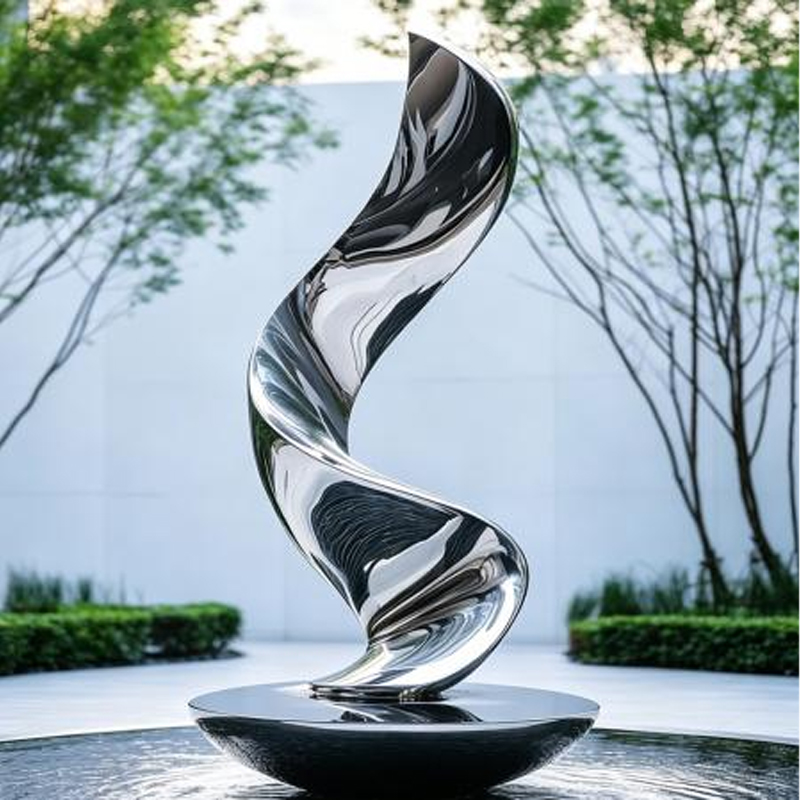
Unlike conventional statues that depend on a single recognizable subject or fixed silhouette, this twisted ribbon sculpture is based on movement. A flat metal band is transformed through bending and torsion into a flowing three-dimensional form that seems to rise, turn, and unfold in space. The result is an object that changes with every viewing angle. From one direction, it may appear slender and architectural; from another, its surface opens into a broad reflective plane; from a third, the sculpture seems to narrow into a bright, energetic line.
This changing appearance makes the sculpture especially effective in public and semi-public environments. Visitors do not simply look at it once and move on. They experience it while walking around it, viewing it from inside a landscape, seeing it reflected in water, or observing the way natural light travels across its polished surface. The sculpture therefore contributes not only a physical object but also an evolving visual experience.
Manufactured from 304 or 316 stainless steel and finished with an 8K mirror polish, the sculpture is engineered to combine aesthetic refinement with resistance to outdoor conditions. It is available in approximate sizes from 1.0 meter to 4.5 meters, enabling use in intimate garden settings as well as larger commercial and hospitality landscapes. Its current indicated price range is approximately $1,620 to $4,690, depending on size, material selection, fabrication requirements, and customization.
Mirror-Polished Twisted Ribbon Stainless Steel Sculpture
Content
The defining characteristic of the design is its twisted ribbon structure. Rather than using a series of disconnected plates, angular components, or stacked geometric forms, the sculpture presents one visually continuous band that curves through space. This continuity gives the piece a sense of movement and makes it appear as though a solid ribbon has been lifted, stretched, and rotated by an invisible force.
The form suggests upward energy without depending on literal symbols. It may evoke a rising current, a turning wave, a flame, a spiral of wind, or a stream of light. Because the design remains abstract, it can be interpreted in different ways by different viewers. This is a significant advantage over highly figurative outdoor sculptures, which may be tied to a particular theme, cultural reference, or decorative style.
In landscape design, abstract forms are often easier to integrate with different architectural environments. The sculpture can complement contemporary villas, minimalist courtyards, luxury hotels, commercial plazas, sales centers, public gardens, and water features without competing with a specific architectural subject. Its flowing outline also softens hard building lines and introduces a sense of organic movement into spaces dominated by concrete, glass, stone, and straight pathways.
The ribbon silhouette can be positioned vertically, diagonally, or as part of a broader sculptural composition, depending on the selected size and site plan. A smaller version may be used near an entrance, walkway, planted bed, or reception area. A larger version can become a dominant landmark near a reflecting pool, driveway, commercial plaza, or hotel courtyard.
Its proportions can also be considered in relation to pedestrian scale. At approximately one meter, the sculpture functions as an intimate accent that rewards close viewing. At four meters or more, it becomes an architectural feature visible from a significant distance. This range allows designers to select a scale that matches the importance, openness, and viewing distance of a particular site.
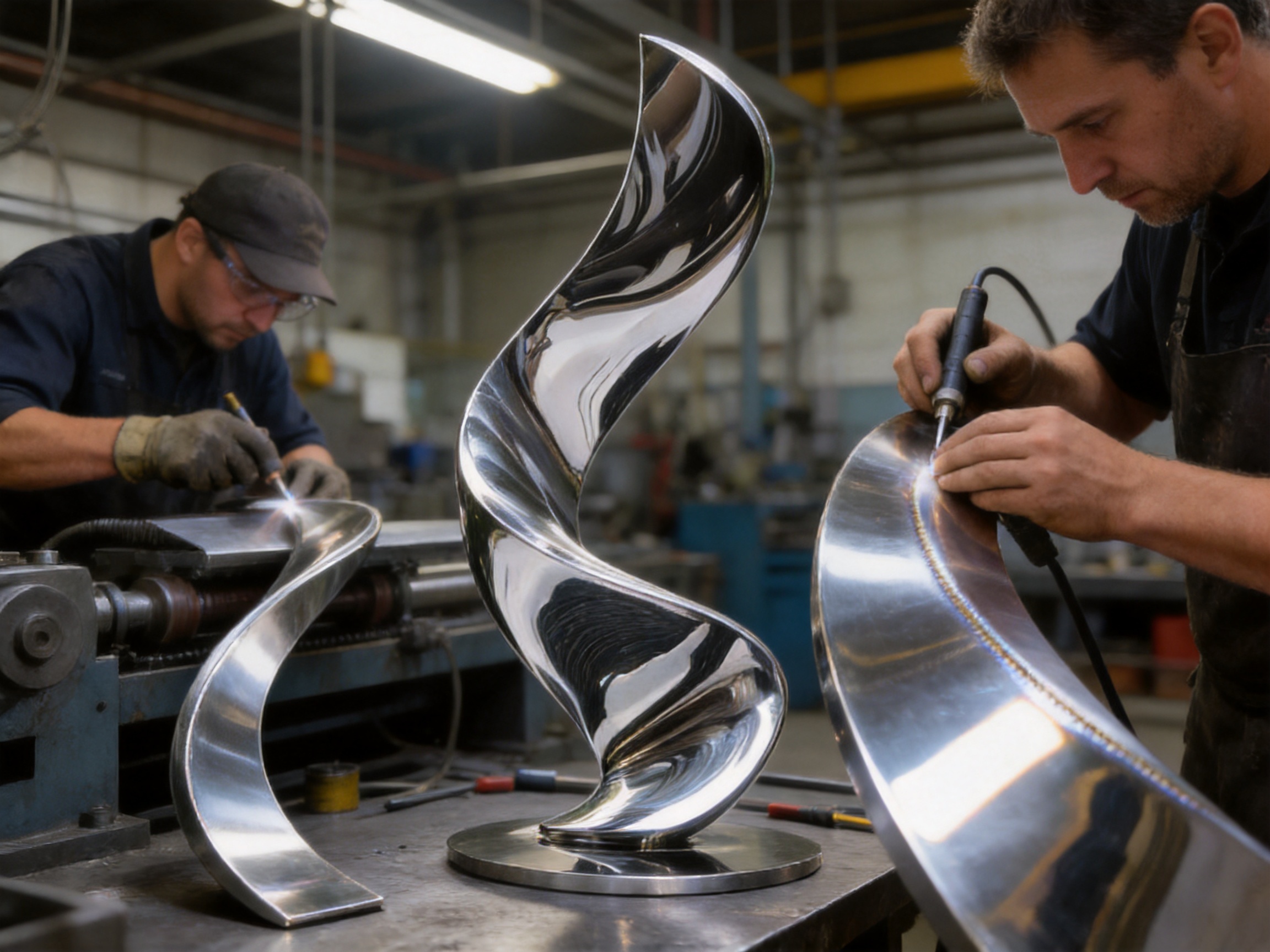
Producing a smooth twisted ribbon from stainless steel requires considerably more than cutting and assembling flat metal. The visual simplicity of the finished sculpture conceals a demanding fabrication process. A flat band must be shaped gradually through controlled bending and torsion so that its curvature remains smooth from one end to the other.
The initial material is selected from stainless steel suitable for the intended environment and structural requirements. The sculpture can be fabricated in 304 or 316 stainless steel. Both grades are widely used for durable architectural and decorative applications, while 316 stainless steel offers additional corrosion resistance in more demanding conditions, including locations exposed to moisture, salts, or coastal air.
After material preparation, the metal band is marked and formed according to the desired three-dimensional profile. Bending establishes the primary arc, while torsion rotates the ribbon around its longitudinal direction. These operations must be coordinated carefully. Excessive pressure in one area can produce a visible kink, a sudden change in curvature, or a local stress mark that would remain noticeable after polishing.
The fabrication team must therefore work progressively rather than forcing the entire form into shape in a single operation. Controlled adjustment helps distribute the stress along the length of the band. It also allows the craftspeople to preserve the intended relationship between the ribbon’s edges, central axis, and reflective surfaces.
One of the most important manufacturing strengths is the ability to achieve continuity across the complete form. A poorly made twisted ribbon may show abrupt transitions, flattened sections, asymmetrical rotation, or irregular edge lines. Such defects are particularly visible on a mirror-polished surface because the reflected environment becomes distorted wherever the metal geometry changes unexpectedly.
For this reason, shaping and surface finishing are closely connected. The form must first be refined until its curves are visually consistent. Only then can the surface be prepared for the final high-gloss treatment. The manufacturing process combines metalworking skill, three-dimensional judgment, careful inspection, and finishing discipline.
The 8K mirror polish is central to the identity of this sculpture. Stainless steel can be finished in many ways, including brushed, satin, matte, bead-blasted, or colored surfaces. A mirror polish is different because it turns the sculpture into a dynamic reflector. The metal does not simply display its own color and texture; it receives and redirects the colors, shapes, and brightness of the surrounding environment.
On a twisted surface, this reflective quality is especially effective. The changing orientation of the ribbon causes highlights to travel continuously across its body. A bright sky may appear as a narrow silver-white streak on one section, while trees, buildings, paving, or water may be reflected in elongated and gently distorted shapes elsewhere. As the viewer moves, these reflections change immediately.
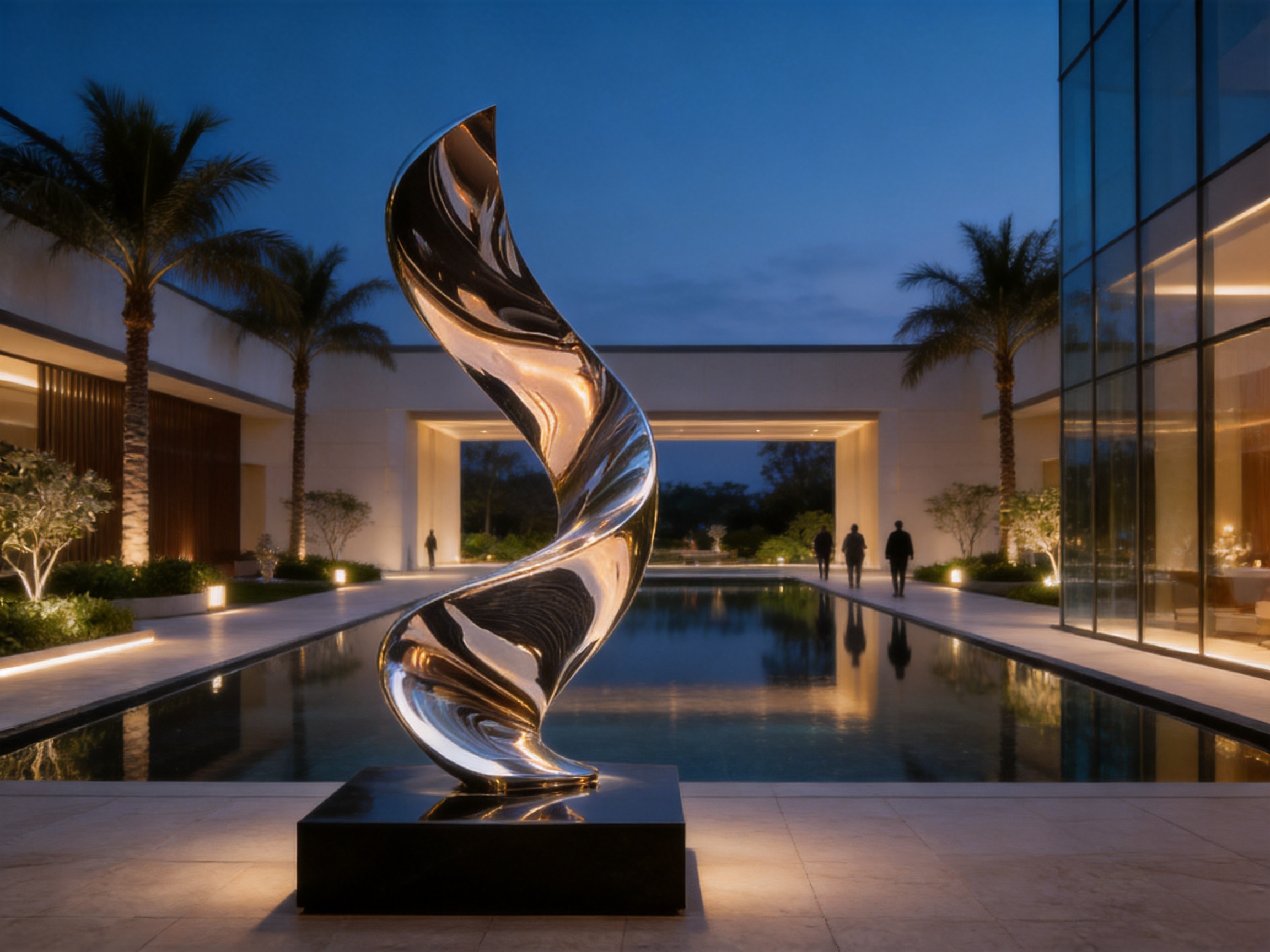
This means that the sculpture can look different in the morning, at midday, in the late afternoon, and after sunset under landscape lighting. It may appear crisp and brilliant under direct sunlight, soft and atmospheric under overcast skies, or dramatically illuminated by carefully placed spotlights after dark.
Compared with painted metal sculptures, a mirror-polished stainless steel piece offers a more fluid visual relationship with its surroundings. Painted surfaces provide a stable color, whereas polished steel participates in the environment. The sculpture can visually borrow tones from nearby vegetation, stone, water, glass, and sky, helping it integrate with the site while still maintaining a strong presence.
The mirror finish also gives the piece a refined appearance that is well suited to light-luxury environments. Hotel entrances, premium residential developments, sales galleries, private villas, and high-end commercial landscapes often require materials that communicate precision and permanence. The brilliant surface of polished stainless steel supports this design language more directly than ordinary painted or unfinished metal.
However, a high-gloss finish also demands careful preparation. Surface scratches, grinding lines, uneven polishing, and welding discoloration can become more obvious on a reflective surface. The ability to deliver a consistent mirror finish therefore indicates attention to multiple stages of production rather than only the final polishing step.
Material selection has a direct influence on the service life, maintenance requirements, and appearance of outdoor sculpture. Stainless steel is particularly valuable because it combines structural strength, corrosion resistance, visual neutrality, and compatibility with modern architecture.
Grade 304 stainless steel is a widely used material for architectural and decorative applications. It provides good resistance to ordinary outdoor exposure and is suitable for many inland environments. Its clean metallic appearance supports both contemporary and transitional landscape designs.
Grade 316 stainless steel is an alternative for more demanding conditions. Its composition provides enhanced resistance to corrosion associated with chlorides and marine environments. For sculptures installed near coastlines, saltwater features, humid locations, or areas where airborne pollutants are a concern, 316 stainless steel may be a preferred specification.
The availability of both grades gives buyers and designers more flexibility. Instead of applying one material specification to every project, the selection can be matched to the site environment, expected exposure, budget, and long-term maintenance plan.
Compared with ordinary carbon steel, stainless steel provides a major advantage in corrosion resistance. Carbon steel generally requires protective coatings and periodic renewal to prevent rust, particularly outdoors. Although weathering steel can develop a deliberately oxidized appearance, it creates a very different visual character and may release runoff stains during the weathering process. Stainless steel avoids the need for a rust-colored patina and maintains a bright, clean appearance when properly cared for.
Compared with fiberglass, stainless steel offers a stronger sense of material authenticity and permanence. Fiberglass can be lightweight and highly adaptable, but its surface may be more vulnerable to fading, impact damage, or coating deterioration depending on the resin and finish. Mirror-polished stainless steel presents a harder, more substantial surface suited to landmark installations.
Compared with stone or marble, stainless steel allows a more fluid and complex form with a lower visual mass. Marble sculptures can communicate luxury and solidity, but their weight, brittleness, and dependence on block carving may limit certain shapes. The twisted ribbon design uses metal’s ability to form thin, sweeping planes, producing an airy silhouette that would be difficult to achieve in stone.
The sculpture’s first major advantage over many conventional products is its dynamic appearance. A static block, sphere, or figurative statue usually maintains a relatively consistent visual identity from different directions. The twisted ribbon, by contrast, is designed to reveal different profiles as the viewer moves. This makes it valuable in spaces where people approach from several directions or spend time walking through the landscape.
Its second advantage is adaptability. The approximate size range of 1.0 to 4.5 meters enables the same design concept to serve several project types. Buyers do not need to select between a small decorative object and an unrelated monumental form. They can choose a scale that fits their site while retaining the recognizable ribbon language.
Third, the reflective surface increases visual impact without requiring excessive physical volume. A relatively slender sculpture can attract attention because it catches sunlight, reflects movement, and contrasts with matte landscape materials. This can be particularly useful in compact spaces where a heavy or oversized sculpture would obstruct circulation or overwhelm the surrounding architecture.
Fourth, stainless steel offers a durable solution for long-term outdoor installation. The sculpture is intended to withstand sun, rain, and changing temperatures while maintaining structural integrity and a polished appearance with only occasional cleaning. As with any outdoor metal product, the exact maintenance schedule depends on local environmental conditions, but the base material is well suited to permanent landscape use.
Fifth, the design carries symbolic flexibility. The upward and outward movement of the ribbon can be associated with progress, momentum, rising fortune, vitality, and energy. This makes the sculpture suitable for commercial sites that wish to express growth, for hospitality spaces that seek a welcoming landmark, or for private properties that want a contemporary symbol of movement and aspiration.
Finally, the sculpture provides strong photographic and branding value without relying on overt advertising. Reflective, sculptural landmarks are often photographed by visitors and can become recognizable features of a development or venue. When placed thoughtfully, the sculpture can contribute to the identity of a property through form, material, and atmosphere.
| Material | Typical Visual Character | Outdoor Considerations | Suitability for the Twisted Ribbon Concept |
|---|---|---|---|
| 304 Stainless Steel | Bright, clean, modern, reflective | Good general outdoor corrosion resistance; routine cleaning recommended | Highly suitable for inland villas, courtyards, hotels, and commercial landscapes |
| 316 Stainless Steel | Bright, clean, modern, reflective | Enhanced resistance for humid, coastal, or chloride-exposed locations | Highly suitable for demanding environments and premium long-term installations |
| Bronze | Warm, traditional, sculptural, patinated | Patina changes over time; may require specialized cleaning or coating care | Suitable for classical or figurative forms, but less aligned with a high-tech mirror effect |
| Marble | Solid, luxurious, natural, monumental | Heavy and potentially vulnerable to staining, cracking, and weathering | Less practical for thin, continuously twisted ribbon forms |
| Fiberglass | Lightweight and adaptable; finish depends on coating | Coatings may require renewal; impact and ultraviolet exposure should be considered | Can reproduce flowing shapes but may not provide the same metallic permanence |
| Weathering Steel | Rust-colored, industrial, earthy | Requires appropriate drainage and controlled weathering; runoff may stain nearby surfaces | Strong for industrial landscapes but visually different from a bright reflective ribbon |
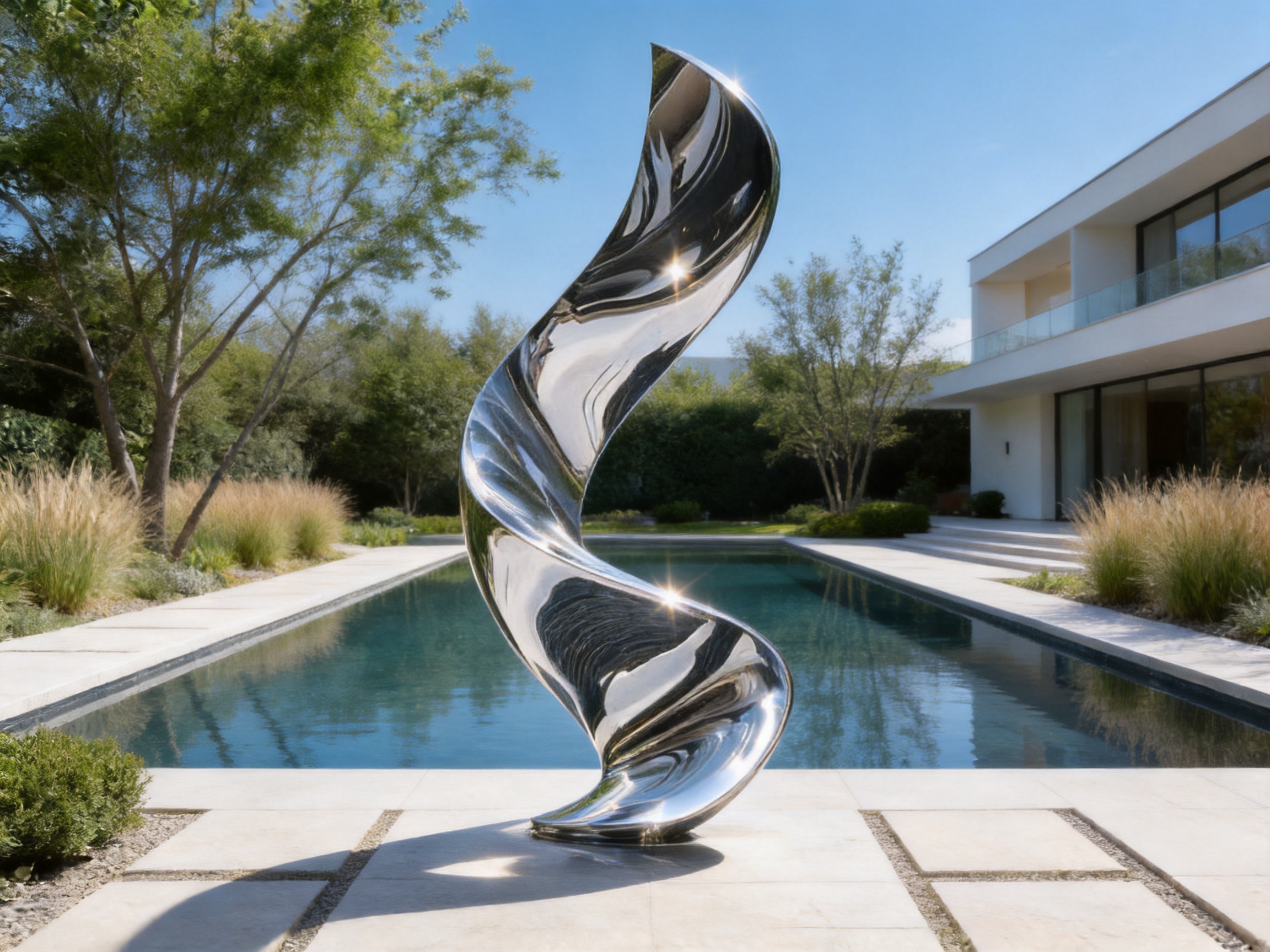
In a villa landscape, the sculpture can serve as a focal point near a driveway, entrance court, swimming pool, garden path, or outdoor entertaining area. Its polished surface reflects the surrounding planting and architecture, allowing it to connect the built environment with the landscape.
A smaller sculpture can be positioned beside a pathway where visitors encounter it at close range. In this situation, the changing curvature becomes the main experience. The viewer can observe the relationship between the ribbon’s edges, the smoothness of the bend, and the shifting reflections in the steel.
A medium-sized installation may be placed beside a pool or planted lawn. The open space around the sculpture allows its silhouette to remain visible, while the water provides an additional reflective layer. When the sculpture is positioned so that its form appears in the surface of the pool, the visual impression can become more expansive and atmospheric.
For larger villas or estates, a taller version may mark an entrance or terminate a long axis. The upward movement of the design can reinforce the perspective of a driveway or formal garden. Because the sculpture is visually light despite its height, it can create a landmark without producing the same visual heaviness as a solid stone monument.
Water is one of the most effective surroundings for mirror-polished stainless steel. Both materials respond to light, but they do so differently. Water produces soft, moving reflections, while polished steel produces sharper, more controlled highlights. Placing them together creates visual dialogue between liquid movement and metallic movement.
The sculpture can be positioned at the edge of a reflecting pool, beside a fountain, near a resort water feature, or within a landscaped area containing still water. Its ribbon shape may be oriented so that the strongest curves are reflected in the pool. Even when the water surface is disturbed by wind or circulation, the fragmented reflection can add a sense of motion.
Careful placement is important. The sculpture should have sufficient clearance from maintenance equipment, pedestrian routes, and splash zones that may introduce deposits to the surface. A professional installer can also consider the position of the sun, the direction of primary viewing, and the relationship between the sculpture and surrounding lighting.
In a hotel or resort environment, a sculpture near water can become a memorable arrival or leisure-space feature. During daylight, it can reflect the sky and landscape. At night, concealed or carefully directed lighting can emphasize its curves without creating excessive glare for guests.
Hotels, resorts, clubs, and restaurants often use sculpture to establish a sense of arrival and differentiation. A recognizable sculptural form can help guests orient themselves within a large property while also reinforcing the venue’s design theme.
The twisted ribbon form is particularly suitable for hospitality settings because it feels elegant without being overly formal. It does not impose a historical style or a specific cultural subject. Instead, it communicates energy, movement, and refinement through its shape and material.
In a hotel courtyard, the sculpture may be viewed from guest-room balconies, reception areas, restaurants, pathways, or outdoor seating. Its changing reflections allow it to remain visually active from multiple elevations. A taller version can also be seen above low planting and walls, helping it function as a visual marker throughout the property.
For restaurants and event venues, the sculpture can serve as a background for photography. Its reflective surface and flowing silhouette provide a distinctive setting for guest images, opening ceremonies, promotional materials, and social media content. This type of indirect visibility can create lasting recognition for a property.
Sales centers and development show areas must communicate quality quickly. Visitors often form an impression of a project before they have seen the interior, and the landscape is part of that first impression. A polished stainless steel sculpture can signal attention to detail, contemporary design, and investment in the overall environment.
Placed near a main entrance, model display, water feature, or reception zone, the sculpture can help create a clear visual hierarchy. Its shape directs the eye upward and along the curve, while the reflective finish adds brightness to the surrounding space. This is useful in commercial developments that want to present an atmosphere of progress, prosperity, and modern living.
The abstract design also avoids limiting the project to a narrow decorative theme. It can work with residential, office, retail, hospitality, or mixed-use developments. The same general form can be specified in different sizes according to the scale of the development and the distance from which it needs to be seen.
The company’s manufacturing strength is represented by its ability to combine custom metal forming with refined surface finishing. A sculpture of this type is not a standard flat panel product. Its quality depends on the relationship between structural shaping, visual symmetry, weld treatment, edge preparation, and polishing.
During forming, the ribbon must retain the intended overall gesture. The curvature should feel deliberate rather than accidental, and the rotation should progress naturally along the length. Skilled operators can identify areas where the metal is beginning to flatten, buckle, or develop inconsistent tension, allowing corrections before the surface treatment is completed.
Welding and joining, where required by the design, must be handled with particular care. Weld areas can introduce discoloration, unevenness, or local distortion. They must be blended and prepared so that the final surface reads as a continuous polished form rather than a collection of visibly joined parts.
Edge treatment is equally important. The ribbon’s edges contribute strongly to its silhouette, especially when viewed against the sky or a dark landscape background. Smooth, consistent edges improve both safety and appearance. Sharp or irregular edges can interrupt the visual flow and create unnecessary installation concerns.
Surface preparation generally progresses through multiple stages of grinding, smoothing, and polishing. Each stage reduces the visibility of marks left by the previous operation. The goal is not merely to make the steel shiny but to produce an even reflective response across the complete sculpture.
Inspection should consider the sculpture from multiple angles and under different lighting conditions. A surface may appear acceptable under diffuse workshop lighting but reveal irregularities under direct sunlight. Reviewing the piece from a distance and at close range helps confirm that the proportions, curvature, and finish meet the intended standard.
The company’s experience in decorative metal sculpture supports the production of custom forms for different environments. This is important for buyers who need adjustments to size, material grade, installation orientation, or site-specific requirements rather than an off-the-shelf decorative object.
Customization is one of the most practical strengths of this sculpture. The listed size range provides a starting point, but the final specification can be coordinated with the project’s spatial conditions. Important considerations include total height, width, viewing distance, foundation location, transportation access, and the relationship with nearby architecture.
A designer may choose a lower version for a narrow garden or a taller version for an open plaza. The width and gesture of the ribbon can be considered in relation to wind exposure and the desired visual density. In a large landscape, the sculpture may need enough scale to remain legible behind trees, planting, or architectural elements.
Material grade can also be selected according to the environment. Grade 304 may be appropriate for many inland projects, while grade 316 can provide additional reassurance for coastal or high-humidity locations. Buyers should discuss local conditions with the manufacturer before confirming the final material specification.
The installation plan should be prepared at the same time as the sculpture order. A large sculpture is not only an artistic object; it is also a structural installation. The foundation, anchoring method, access route, lifting equipment, and local safety requirements must be assessed by qualified professionals. The manufacturer can provide product information and coordinate relevant dimensions, while site-specific engineering should be confirmed according to local regulations.
The surrounding environment has a major influence on how a mirror-polished sculpture is perceived. An open background, such as sky, water, pale stone, or dark planting, can help the silhouette remain clear. If the sculpture is placed directly against a visually crowded background, its reflections may become difficult to read.
Designers should consider the primary approach routes. The sculpture is most effective when visitors can experience more than one viewpoint. A location beside a path, in the center of an open courtyard, or near a circulation loop may provide better engagement than a position hidden against a wall.
Lighting deserves special attention. During the day, the sun provides changing highlights, but direct glare should be considered in relation to pedestrian sightlines and nearby windows. At night, low-angle lighting or concealed uplighting can reveal the sculpture’s contours. The goal is to emphasize the three-dimensional form rather than illuminate the surface so intensely that it becomes visually flat.
Drainage and cleaning access should also be incorporated into the landscape plan. Water that remains on the surface or accumulates around the foundation can increase deposits and maintenance demands. Good drainage, appropriate paving falls, and reasonable access for cleaning help preserve the appearance of the installation.
One of the practical advantages of stainless steel is its relatively low maintenance requirement. The sculpture is designed to withstand outdoor exposure to sunlight, rain, and temperature variation. Occasional cleaning can help remove dust, fingerprints, water marks, airborne pollutants, and other deposits that may reduce the brilliance of the mirror finish.
Routine care should use clean water and suitable non-abrasive materials. Soft cloths or specialized stainless steel cleaning products can be used according to the supplier’s recommendations. Abrasive pads, harsh scouring compounds, and tools that may scratch the surface should be avoided.
In coastal or polluted urban environments, cleaning may need to occur more frequently than in a clean inland garden. Salt deposits and industrial particles should not be allowed to remain on the surface for extended periods. Regular inspection can identify areas that need attention before deposits become difficult to remove.
Cleaning should follow the direction of the existing surface treatment where applicable, and the entire visible area should be checked for streaks. Because a mirror finish reflects its surroundings, even small residues may be noticeable under strong sunlight.
The foundation and anchoring components should also be inspected periodically. Maintenance is not limited to the visible metal surface. Confirming that the base remains stable, drainage remains clear, and surrounding paving has not shifted contributes to the long-term safety of the sculpture.
Value in outdoor sculpture should be considered beyond the initial purchase price. A successful installation contributes to the identity of a site, creates visual interest over time, and avoids frequent replacement or refinishing. The Mirror-Polished Twisted Ribbon Stainless Steel Sculpture addresses these needs through a combination of distinctive design, durable material, flexible scale, and low-maintenance performance.
The stated price range of approximately $1,620 to $4,690 creates several entry points for different project budgets. Smaller pieces can provide a refined accent without requiring the investment associated with a monumental installation. Larger pieces can act as signature landmarks for developments, hospitality properties, and public-facing landscapes.
Because the sculpture changes appearance as people move around it, its visual content is not exhausted after a single glance. This gives the object a lasting role in the landscape. Seasonal changes, shifting daylight, nearby planting growth, and changing weather conditions can all alter the reflections seen on the surface.
The sculpture also provides a useful balance between individuality and compatibility. It is distinctive enough to serve as a landmark but neutral enough to work with many architectural styles. This balance can be more valuable than a highly themed product that becomes difficult to integrate when the surrounding design changes.
The sculpture is made from 304 or 316 stainless steel. The appropriate grade can be selected according to the project environment, exposure conditions, budget, and desired long-term performance.
An 8K mirror polish refers to a highly refined reflective surface. It allows the steel to catch and redirect light, reflect surrounding architecture and landscape, and create changing highlights across the twisted form.
Yes. The stainless steel construction is intended for outdoor use and is resistant to sun, rain, and temperature variation. Site conditions should still be reviewed, especially for coastal, high-humidity, industrial, or heavily polluted environments.
316 stainless steel is generally a stronger choice for coastal or chloride-exposed locations because it provides enhanced corrosion resistance. The final selection should be confirmed with the manufacturer and the project’s technical advisers.
The listed size range is approximately 1.0 meter to 4.5 meters. Custom sizing can be discussed according to the intended location, viewing distance, landscape scale, transportation conditions, and installation requirements.
Yes. Water features and reflecting pools are particularly suitable because they reinforce the sculpture’s visual relationship with light and reflection. The installation should include suitable drainage, safe clearance, and access for maintenance.
Bronze offers a warm, traditional character, while marble provides solidity and natural luxury. Mirror-polished stainless steel offers a brighter, more contemporary, and more visually dynamic effect. It is also well suited to thin, flowing forms that are difficult to carve from stone.
Cleaning frequency depends on the local climate and exposure. Inland locations may require only occasional cleaning, while coastal or polluted areas may benefit from more regular maintenance to remove salt, dust, and airborne deposits.
Like any high-gloss metal surface, mirror-polished stainless steel can be scratched by abrasive tools or harsh cleaning methods. Soft cleaning materials and suitable products should be used, and contact with construction debris should be avoided during installation.
The sculpture is well suited to villa gardens, hotel courtyards, resort landscapes, sales centers, commercial plazas, water features, entrance areas, and light-luxury developments. Its abstract form allows it to coordinate with contemporary, minimalist, and transitional architectural styles.
Yes. The continuous bending and torsion create a form that changes as the viewer moves. It is especially effective in open sites, paths, courtyards, and circulation areas where people can see it from several angles.
Installation planning should address the foundation, anchoring method, lifting equipment, access route, drainage, wind exposure, lighting, and local safety requirements. Qualified site and structural professionals should confirm the final installation details.
The indicated price range is approximately $1,620 to $4,690. The final price may vary according to size, stainless steel grade, customization, fabrication complexity, packaging, shipping, and installation-related requirements.
The Mirror-Polished Twisted Ribbon Stainless Steel Sculpture is a contemporary landscape feature built around the relationship between form, light, and movement. Its smooth ribbon structure gives it a distinctive identity, while its 8K mirror finish ensures that the appearance continues to change as viewers move around it and as the surrounding light shifts throughout the day.
Its use of 304 or 316 stainless steel provides a practical foundation for long-term outdoor installation. The material offers corrosion resistance, structural reliability, and a refined appearance that complements modern architecture. Compared with bronze, marble, fiberglass, and weathering steel, it provides a particularly strong combination of reflective brilliance, low visual mass, and contemporary adaptability.
The manufacturing process is equally important. Controlled bending and torsion operations transform the flat steel band into a continuous three-dimensional form, while careful surface preparation and polishing create the final mirror effect. Achieving consistent curvature, clean edges, smooth transitions, and an even reflective finish requires specialized metalworking skill and close attention to quality at every stage.
With sizes ranging from approximately one meter to four and a half meters, the sculpture can function as a small garden accent or a major architectural landmark. Its suitability for villas, reflecting pools, hotels, sales centers, and commercial landscapes makes it a flexible option for designers and property developers seeking a durable focal point with symbolic energy and strong visual presence.
For projects that require more than a static ornament, this twisted ribbon sculpture offers a lasting visual experience. It captures the sky, landscape, architecture, and movement of its surroundings, while its rising form suggests momentum, progress, and vitality. Properly specified, installed, and maintained, it can remain an elegant and memorable feature of a landscape for many years.
1. Stainless Steel Information Center. General principles of stainless steel grades, corrosion resistance, and architectural applications.
2. International Stainless Steel Forum. Guidance on stainless steel selection for outdoor and environmental exposure.
3. Architectural Metalwork Practice. Principles of forming, welding, surface preparation, and finishing stainless steel components.
4. Landscape Design and Site Planning Literature. Methods for integrating sculpture with paths, water features, planting, lighting, and architectural spaces.
5. General Fabrication Guidance for Decorative Metal Sculpture. Considerations for custom sizing, transportation, foundation planning, installation, and maintenance.



Daniel H.

Amanda R.

Robert B.

Jennifer S.

James W.

Barry G.

Michael T.

Emily K.

David L.

Sarah M.


Mikey XV

Jagxue

 English
 Español
 عربى
عربى Français
 italiano
 Deutsch